Status quo or plurality? : dominant party rule
and people’s preferences in Singapore
著者
Kawanaka Takeshi
権利
Copyrights 日本貿易振興機構(ジェトロ)アジア
経済研究所 / Institute of Developing
Economies, Japan External Trade Organization
(IDE-JETRO) http://www.ide.go.jp
journal or
publication title
IDE Discussion Paper
volume
724
year
2018-08
INSTITUTE OF DEVELOPING ECONOMIES
IDE Discussion Papers are preliminary materials circulated to stimulate discussions and critical comments
Keywords: Election, Political Party, Political Regime, Singapore JEL classification: D72
* Director-General, Area Studies Center, IDE ([email protected])
IDE DISCUSSION PAPER No. 724
Status Quo or Plurality?:
Dominant Party Rule and People’s
Preferences in Singapore
Takeshi KAWANAKA*
July 2018
Abstract
This paper aims to identify attributes of individuals that affect their political preferences regarding the dominant party rule in Singapore. In particular, the paper focuses on the effects of three socioeconomic attributes—education, income, and generation—on people’s preferences for political changes. By using the data from the Post-Election Surveys conducted in 2011 and 2015 by the Institute of Policy Studies Lee Kuan Yew School of Public Policy, National University of Singapore, this empirical examination show that, ceteris paribus, youth and higher levels of education enhance positive perceptions of political plurality. The results also indicate that income has significant effects, primarily that persons with lower incomes show strong support for the status quo, whereas persons with moderate income are more inclined to support political plurality.
This work was supported by JSPS KAKENHI Grant Numbers JP15K03307 and JP15H01931. The author is grateful to Gillian Koh and the Institute of Policy Studies for sharing the the Institute of Policy Studies (IPS) survey data sets, POPS (4): IPS Post-Election Survey 2011 and POPS (8): IPS Post-Election Survey 2015. The author also thanks Yasushi Hazama, Hirokazu Kikuchi, Momoe Makino, Gillian Koh, Eugene Tan, Kenneth Paul Tan, Kevin Tan, David Altman, Ryo Nakai, Shingo Hamanaka and participants of IDE Area Studies Seminar for their insightful advice and comments.
The Institute of Developing Economies (IDE) is a semigovernmental, nonpartisan, nonprofit research institute, founded in 1958. The Institute merged with the Japan External Trade Organization (JETRO) on July 1, 1998.
The Institute conducts basic and comprehensive studies on economic and related affairs in all developing countries and regions, including Asia, the Middle East, Africa, Latin America, Oceania, and Eastern Europe.
The views expressed in this publication are those of the author(s). Publication does not imply endorsement by the Institute of Developing Economies of any of the views expressed within.
INSTITUTE OF DEVELOPING ECONOMIES (IDE), JETRO 3-2-2, WAKABA,MIHAMA-KU,CHIBA-SHI
CHIBA 261-8545, JAPAN
©2018 by Institute of Developing Economies, JETRO
No part of this publication may be reproduced without the prior permission of the IDE-JETRO.
1
Introduction
What individual attributes affect attitudes towards a dominant party rule? Who supports the status quo under such a rule, and who prefers greater plurality in politics? If we identify particular attributes if individuals that are correlated with the preferences for plurality, we can better understand the conditions for sustaining the status quo, or for fostering political change.
Modernization theory claims that economic development is the key for changing people’s perceptions. Economic development enhances education and produces a middle class that holds the values of democratic society (Lipset 1959). On the other hand, a more recent school of thought, the so-called ‘new structuralists,’ regards income inequality as the main driver of political changes (Boix 2003, Acemoglu and Robinson 2006).1
Aside from education and income, changes in values caused by industrialization are another possible factor which affects individual political preferences. Such changes in values in a society can be observed as intergenerational differences (Inglehart and Welzel 2003).
These conventional arguments are about macro-level political changes. Put more simply, these theories claim that changes in the education, income and values of a nation affect the political regime of the country. In contrast, other studies address how individual preferences affect politics in a country. Such studies investigate the relationship between individual socioeconomic attributes and individual perceptions. Drawing implications from the macro-level studies, this paper deals with such micro-level political preferences. In particular, we examine whether individual socioeconomic attributes affect people’s preference under dominant party rule.
Yet, it is not easy to ascertain individual preferences in the less liberalized societies due to limited access to information. Many countries with dominant party rule are oppressive, where political freedom and civil rights are constrained. People are not free to reveal their perceptions, especially if they are against those in power. Furthermore, authoritarian rulers often do not allow opinion surveys about their rule.
The case of Singapore mitigates such problems. Singapore has been under the dominant rule of the People’s Action Party (PAP) since the first election after its independence in 1965. Major datasets in political science indicate that it has the characteristics of electoral authoritarianism.2 However, its rule is not sustained by
1 Iversen (2010) uses the term ”new structuralist” in reference to this theory of income inequality and political institutions.
2 As of 2016, Singapore has been considered as authoritarian state on the Polity IV Project scale (polity2 = -2) (Marshall 2017). It is classified in the category of partly free
2
violence or electoral fraud. Although the government has strong influence over the media, people can still express their views relatively freely. Also, surveys are not fully banned.3 This condition enables us to collect the information about people’s perception under a system of dominant party rule.
This paper aims to identify individual attributes that affect people’s political preferences about the dominant party rule in Singapore. For this purpose, we use data from the Post-Election Surveys conducted in 2011 and 2015 by the Institute of Policy Studies, Lee Kuan Yew School of Public Policy, National University of Singapore. The surveys were conducted in important years politically for Singapore. In 2011, the PAP gained its lowest share of the popular vote in the Parliamentary General Election in history. This result gave rise to debate about the possibility of political change in the near future. In contrast, in 2015, the PAP restored a level of support from the voters more in line with previous years.
It is beyond the scope of this paper to find out the causes of the changes in electoral results between the two elections. However, by dealing with these two elections, which resulted in fairly different outcomes, we expect to find consistent factors that help sustain the dominant party rule regardless short-term shifts in circumstances.
Following the arguments of the modernization theory, new structuralism, and value change theory, the effects of three attributes, namely, education, income and generation, will be examined in the paper.
In these examinations, by means of factor analysis, we estimate factor scores to measure people’s preference for political plurality. Then, we examine the effects of individual attributes on the scores. The results show that education has a significant effect on individual perceptions. As modernization theory predicts, higher levels of education bring about stronger preference for plurality. Income also matters. Persons with lower incomes show significant support to the status quo, whereas the middle income group supports political plurality, as modernization theory predicts. Intergenerational
in the Freedom in the World report (Puddington and Roylance 2017), but Freedom House does not consider Singapore as an electoral democracy in this dataset. The Variety of Democracy Dataset classifies Singapore as minimally democratic in terms of liberal democracy, but as electoral authoritarian in terms of electoral democracy (Coppedge, Gerring, Lindberg, Skaaning, Teorell, Altman, Bernhard, et al. 2017, Coppedge, Gerring, Lindberg, Skaaning, Teorell, Altman, Andersson, et al. 2017).
3 Poll surveys are not banned in Singapore, but there is a blackout period for electoral surveys during the election period. In addition, the results of exit polls are not allowed to be released on the polling day. See Sections 78C and 78D, The Parliamentary Election Act. However, in practice, few surveys are conducted.
3
differences, especially those between persons who were born before independence and those who were born after, result in differences in their political attitudes. The older generation prefers the status quo, but the younger generation supports greater plurality.
In the following sections, we provide a theory about individual perceptions about political plurality. Based on this, we propose three hypotheses. Then, we examine them through factor analysis and multiple regressions (OLS). Finally, we summarize the argument in the conclusion.
Modernization, New Stucturalist and Value Change Theories
Three traditional arguments in political science—modernization theory, new structuralism, and value change theory—hint at two primary socioeconomic factors that are associated with political liberalization, education, and income (or class). Values are treated as an intermediate variable between socioeconomic changes (industrialization) and political perceptions in the value change theory.
Initially, modernization theory asserts that economic development brings about democratization (Lipset 1959). In its argument, education and the middle class are crucial factors that are interrelated with each other and are both consequences of economic development. As this theory has had a strong impact, the effects of education and income have been empirically tested (Almond and Verba 1963, Barro 1999, Przeworski et al. 2000, Glaeser, Ponzetto, and Shleifer 2007).
As for education, the argument is straightforward. Higher education fosters a value to cherish democracy. On the other hand, the arguments about income are more complicated. Initially, macroeconomic growth, rather than individual economic status, were at the center of attention.
The emergence of the middle class in the process of modernization has also been paired with macro-level economic development. As the size of the middle class grows, the stratification structure changes. The middle class is expected to mitigate the conflict between the elite and non-elite, and bring about stable democracy. The middle class, with higher education, is also seen as holding the values of democratic rule.
In contrast, the new structuralists emphasize the income inequality of each country, rather than the level of GDP per capita, as the driver of political changes, and view the lower income class as the key player in democratization. Their argument is constructed on the game theoretic situation where different classes play strategic games over the redistribution of wealth. In its argument, democratic institutions are a tool to maintain or increase the redistribution of wealth. Democratic institutions provide non-elite veto power over policy decisions. Although they do not employ the same logic, Boix
4
(2003) and Acemoglu and Robinson (2006) assume that the lower income class prefers democratic institutions to reduce the exploitation by the rich and to enhance redistribution.
On the other hand, Inglehart and Welzel (2005), advocating the value change theory, connect income growth with changes in values. They claim that economic development reduces existential threats facing society, which eventually gives rise to emancipative values among the people. Their argument, then, leads to intergenerational differences in values, especially in the post-industrialization stage. Those who were born after industrialization are expected to hold emancipative values, as they are free from the existential threats from which the older generation suffered.
In short, modernization theory focuses on education and the middle class, while the new structuralists emphasize the redistribution of wealth, which the lower income class tries to maximize. Value change theory points out intergenerational differences.
Although these arguments about education and income are basically about the impacts of socioeconomic factors on macro-level political change, they assume that individual socioeconomic attributes affect individual political preferences. The argument about intergenerational differences also deal with the impact of individual demographic attributes. Therefore, it is reasonable to construct hypotheses about the impacts of individual education level, income, and generation on individual political preferences.
Welzel and Inglehart (2007) emphasize the effects of mass beliefs on political regimes at the aggregate level, claiming that a focus on individual beliefs causes “individualistic fallacy,” which prevents observers from detecting the true causality. It is plausible that mass beliefs should be given much attention when we discuss macro-level political changes. Nevertheless, we also obtain useful information and clues for political changes when we look at individual perceptions and behaviors.4
Education, Income, and Generation in the Context of Singaporean Politics
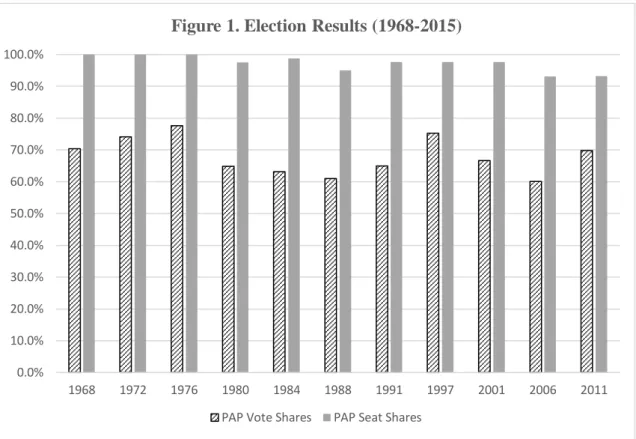
Studies on the political order in Singapore were stimulated when the share of the popular votes for the PAP declined to 60.1 percent in the 2011 Parliamentary General Election, which was the worst result for the PAP in its history. Although the PAP could still secure 93.1 percent of the elected seats in the Parliament, they received only 60.1 percent of popular votes. This is the lowest level of support received, even lower than
4 It is better to conduct multi-level analysis even to estimate the impacts of individual attributes on the individual perceptions as long as cross-national comparison is possible. But, since the scope of this paper is limited to the case of Singapore, the conclusion is applicable only in Singapore.
5
61.0 percent in the 1991 election.5 This result prompted arguments as to whether the 2011 election started a new political era in Singapore (Tan and Lee 2011b, Tan 2012).
There are several hypotheses to explain the decrease in support for the PAP, which are mostly based on specific issues like the opposition’s mutual collaboration and their leadership changes, the diffusion of the information through internet, the increase of foreign workers and the mismanagement of public services (Tan and Lee 2011a, Tan 2011a, Lam Peng Er 2011, Tan 2012). Besides these specific issues, more general issues like intergenerational differences and widening income inequality also attracted attention (Tan 2011a, Lam Peng Er 2011, Welsh 2011, 2016, Tan 2012).
Intergenerational differences are about the different behaviors between younger voters and older voters. Younger voters seemed to be more critical about the status quo.
5 Moreover, the PAP lost one group representation constituency (Aljunied), where three incumbent cabinet ministers were included as the PAP candidates. The PAP also lost one single member constituency (Hougang). Even in constituencies where the PAP won, the margins were very thin.
0.0% 10.0% 20.0% 30.0% 40.0% 50.0% 60.0% 70.0% 80.0% 90.0% 100.0% 1968 1972 1976 1980 1984 1988 1991 1997 2001 2006 2011
Figure 1. Election Results (1968-2015)
PAP Vote Shares PAP Seat Shares
For calculating vote shares, we exclude uncontested constituencies.
Source: The PAP vote shares and seat shares are calculated by the author based on the data from the Singapore Election Department.
6
These intergenerational differences, however, have been actually discussed mostly in connection with education levels, not as differences over political values as the value change theory stresses. Roughly speaking, most of the works by Singaporean scholars consider that the younger voters prefer more plurality due to the effects of their higher education level.
Empirically, and intuitively, education seems to enhance preferences for freedom, plurality and political participation. However, the logic about the causality is not clear. Apart from the Singaporean context, Glaeser, Ponzetto, and Shleifer (2007) asserts that education generally raises the benefits of political participation. Persons who receive higher education have better skills to interact with others and to persuade peers to join their activities and movements. However, this argument focuses on the relationship between education and political participation.6 The logic does not directly explain the correlation between education and inclination for plurality because the plurality issue is different from the participation issue. A possible explanation is that persons with higher education have the skill to collect and understand information. They have more exposure to the arguments and events related to democracy in other parts of the world. Access to such information may lead highly educated people to prefer the standard type of democracy with plural competition. Lam Peng Er (2011) and Tan (2012) use this logic for explaining the behavior of younger voters.
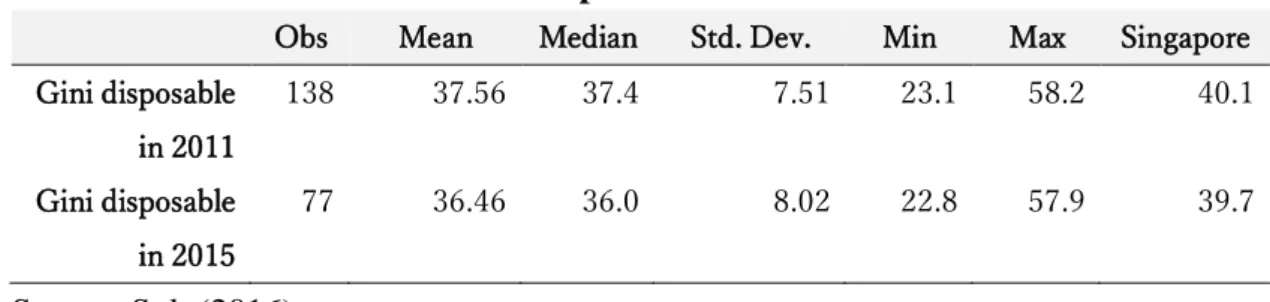
Widening income inequality is also pointed out as a source of dissatisfaction with the status quo (Tan 2011a, Lam Peng Er 2011). Figure 2 shows the changes in the Gini coefficient for households, before taxes and transfers, based on Singaporean government’s statistics. Inequality increased steadily through 2007, and remained at the same level until 2012. On the other hand, Table 1 shows the distribution the Gini coefficient using standardized inequality, after taxes and transfers, in the cross-national setting by using the Standardized World Income Inequality Dataset (SWIID). Singapore has slightly higher inequality level as compared with the mean and the median of the world, but not at a considerably high level.
Income inequality becomes a more pronounced problem when there is low social mobility (Ng 2011, 2013). With low social mobility, the lower income class is expected to be discontented with the status quo. If we follow the new structuralist theory, this situation pushes the lower income class to demands more plural politics under which their demands for redistribution and greater opportunity to climb the ladder of social hierarchy
6 In Singapore, voter turnout is very high because of compulsory voting and its geographic characteristics as a small island. The average turnout of the past twelve elections is 93.6 percent.
7
can be voiced.
However, the effects of income gaps are not straightforward. The PAP has been providing assistance to poor residents under government social welfare programs (Rodan 2016),7 which have redistribution effects, though these efforts may not substantially solve income inequality. As long as there are clientelistic payments to the lower income class, the PAP has a chance to earn support from them.
Before taxes and transfers, using per household member scale. Source: Ministry of Finance (2015).
7 For example, the government introduced the Workfare Income Supplement Scheme in 2007, which provides cash and Central Provident Fund (CPF) contributions to lower income households (Rahim 2015).
42.0% 43.0% 44.0% 45.0% 46.0% 47.0% 48.0% 49.0% 2000 2001 2002 2003 2004 2005 2006 2007 2008 2009 2010 2011 2012 2013 2014 2015
8
Table 1. Gini disposable in 2011 and 2015.
Obs Mean Median Std. Dev. Min Max Singapore Gini disposable in 2011 138 37.56 37.4 7.51 23.1 58.2 40.1 Gini disposable in 2015 77 36.46 36.0 8.02 22.8 57.9 39.7 Source: Solt (2016).
In contrast with the argument that discontent of the lower income class is a driver of political change, some scholars expect that higher income levels have positive effects on political liberalization. Welsh (2016) notes that the affluent class is independent of government support, which enables them to deviate from the status quo, unlike the lower income class which relies on government support. However, at the same time, Welsh (2016) also indicates the possibility of the opposite argument that the rich benefits from the policies of the incumbent government under the PAP’s dominance. The higher income class is the winner in Singapore under the PAP rule. It is hard to imagine that the winner has an incentive to deviate from the rule under which it acquired its status. If this logic holds, the higher income class will support the status quo.
Modernization theory suggests the middle class would prefer more plural politics. In Singapore, the middle class seems to prefer plural politics in order to maintain the accountability of the PAP government. The middle class is vulnerable to, and feels frustrated by, the high and rising cost of living and lower social mobility (Weiss 2014, Rodan 2016). As Tan and Lee (2011a) points out, the major frustrations of citizens towards the government concern the increased cost of housing, congestion in public transportation, and inflation, all of which disproportionately affect the living standards of the middle class. The PAP government bears responsibility for these socioeconomic problems because the society and economy are strongly managed by the government in Singapore. It is believed that political plurality is needed to keep a check on the government and the PAP and to pressure them to respond to the citizens’ needs.
As for the intergenerational differences, they are explained by the changes in political socialization that were brought about by the fast and drastic economic development of Singapore. Singapore was not secure militarily and economically when it acquired its independence in 1965 due to lack of natural resources, domestic conflicts between the English-educated and Chinse-educated populations, and external pressures from regional powers like Indonesia and Malaysia. By the 1970s, Singapore has achieved economic growth and political stability, which were seen as the achievements of the
9
dominant party rule of the PAP. On the other hand, those who were born after the period of Singapore’s rapid economic growth do not share the same memory. As value change theory claims, it is likely that the younger generation has acquired emancipative values as they are free from existential threats.
Based on the above theoretical arguments and observations on the case of Singapore, the following three hypotheses will be examined.
H1 Education: Persons who have attained a higher level of education prefer plurality,
while those who did not are less supportive of plurality.
H2 Class: (a) the modernization hypothesis: The middle class has a stronger preference
for plurality. (b) the new structuralist hypothesis: The lower income class prefers plurality so that they can influence redistribution policy.
H3 Generation: Older voters, who have memories of the development led by the PAP,
prefer the status quo, while younger voters prefer plural political competition.
Empirical Examinations
In order to examine the three hypotheses above, we use the datasets of the Post-Election Survey conducted in 2011 and 2015 by the Institute of Policy Studies (IPS), Lee Kuan Yew School of Public Policy, National University of Singapore.8 The IPS surveys were conducted just after the elections in these years,9 which captured respondents’ perceptions soon after they cast their votes. The surveys collected information through telephone polls of a random sample of 2,080 voters in 2011 and 2,015 voters in 201510. Institute of Policy Studies (2011, 2015) present the results of their cluster analyses on its survey, which are pioneering work in the field. Their results provide a clear picture about the major tendencies of voters’ behaviors, and support some of the above-mentioned hypotheses. However, the correlations between political preferences and socioeconomic attributes are estimated without controlling for the effects of other
8 This is the most comprehensive survey in Singapore regarding voter perceptions. Welsh (2011, 2016) also collected extensive information about the voter behaviors, which shows similar trends as the IPS surveys at the descriptive level.
9 The IPS surveys were conducted from May 8 to 20 in 2011 (the polling day was May 7), and from September 12 to 26 in 2015 (the polling day was September 11).
10 For additional detail on the IPS Surveys, please see
10
variables. This paper tries to estimate the effects of each independent variable holding other variables constant through multiple OLS regressions.
Our strategy is as follows. First, factor analysis is employed to estimate the factor scores for respondents’ preference for political plurality. Then, the scores are used as the dependent variable for estimating the effects of the independent variables selected based on the three hypotheses.
The advantage of factor analysis, especially principal-component factor analysis, is to produce a single scale that represents the core of a set of variables. Instead of dealing with different dependent variables that are correlated with each other in different models, researchers can concentrate on estimating the effects on one dependent variable produced by factor analysis.
For estimating factor scores, the answers to three related questions, which capture respondents’ perceptions about the status quo of the dominant party rule and preferences for plurality, are used. They are:
How important are the following issues in shaping your decision on who to vote/you would have voted if you had to? (1: not important at all, 2: not so important, 3: neutral, 4: important, 5: very important)
(1) Need for checks and balances in Parliament (Checks and Balance) (2) Need for different views in Parliament (Different Views)
Please give us your opinion on the following statements. As I read out each one, just tell me if you “Strongly Disagree,” “Disagree,” are “Neutral,” “Agree,” or “Strongly Agree” with the statement. (1: strongly disagree, 2: disagree, 3: neutral, 4: agree, 5: strongly agree)
(3) It is always important to have elected opposition party members in Parliament. (Elected Opposition)
The question about (3) Elected Opposition has different implications from those about (1) Checks and Balance and (2) Different Views in Singapore, because the Singaporean Parliament has some non-elected parliamentary members who do not enjoy full legislative rights, namely, the Non-Constituency Members of Parliament (NCMP) and the Nominated Members of Parliament (NMP). Some scholars point out that the introduction of these non-elected members provides advantages to the PAP because voters may be expected to be satisfied with merely the existence of different views in the parliament, even though their power is limited. In addition, opposition figures can be
11
coopted by being offered parliamentary membership (Mauzy 2002, Mauzy and Milne 2002, Mutalib 2002, Tan 2011b, Tan 2016). Therefore, individual perceptions about NCMP and NMP affect the answers to (3) Elected Opposition. The variables for (1)
Checks and Balance, (2) Different Views, and (3) Elected Opposition are by definition
related to political plurality as they ask about the necessity of the existence of political players who are independent of the dominant party.11
It is important to note that the IPS surveys avoided the word “democracy” in both questions and answer options. This provides a significant advantage. Perceptions about “democracy” havealways intertwined with other elements besides political plurality. For example, using the Asian Barometer dataset, Pietsch (2015) points out that the word “democracy” is more attached to economic development and governance in Southeast Asia.12 Instead, the questions on the IPS surveys deal with the issues of plurality directly, which avoids the influence of economic performance and governance issues. Furthermore, by asking specific and concrete questions, the IPS surveys mitigate the problem of political and social correctness, which often make respondents disguise their answers to conform with social norms and hide their true perceptions.
The results of the factor analysis are presented in Tables 2 and 3.
11 In addition, the IPS uses two more variables to classify respondents’ behaviors in their analysis (IPS 2011, 2015). The electoral system is perceived as key for sustaining PAP’s dominance (Mauzy 2002; Mauzy and Milne 2002; Tan 2013, 2016b). However, we do not include these two variables in our factor analysis due to two primary reasons. First, factor loadings for the two variables do not reach the standard (0.40 in absolute values) for including them in factor analysis. Second, it is not clear whether typical voters understand the effects of the electoral system on the Singaporean party system the way political scientists do.
12 Interestingly, more than 90 percent of Singaporean respondents perceive their country as democratic, while only half of Filipino respondents answer that their country is democratic.
12
Table 2. Factor Analysis for Preference for Plurality
Variable Factor Loadings Uniqueness Checks and Balance 0.68 0.53
Different Views 0.72 0.48 Elected Opposition 0.43 0.81 Eigenvalues 1.18
Proportion 1.31
(N=3,939, principal factors, unrotated)
Table 3. Scoring coefficients (method = regression)
Variable Factor 1 Checks and Balance 0.37 Different Views 0.44 Elected Opposition 0.17
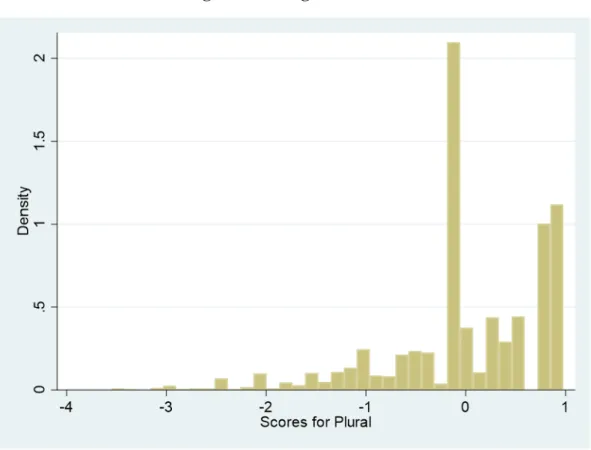
The eigenvalues of Factor 1 is over 1.00, which satisfies the condition for a potential candidate to be a measure of the preference for plurality.13 Additionally, all factor loadings for Factor 1 exceed 0.40.14 Hence, it is appropriate to use Factor 1 as the indicator for the preference for plurality. We named this factor Plural and estimated its factor scores. Descriptive statistics of Plural are as shown in Table 4. And Figure 3 shows the histogram.
Table 4. Descriptive Statistics of "Plural"
Variable N Mean Standard
Deviation Min Max Plural 3,939 0.00 0.80 -3.55 0.98
13 Eigenvalue is an indicator that shows how much of the variance of a variable is explained by a factor. If it is larger than 1.00, it is considered as a significant factor. 14 Factor loading shows how clusters of variables are related to a factor. A larger loading implies that it is a better indicator of the factor. Acock (2016) recommends that items with a loading value over 0.40 for a factor can be considered a good indicator of the factor.
13
Figure 3. Histogram of “Plural”
Using these factor scores with Plural as the dependent variable, we examine the four hypotheses by using multiple OLS regressions. The main specification is expressed as follows:
Plural=β0+β1(Education)+β2(Income)+β3(Income)2+β3(Post-independence) + β4 (controls) +u
The quadratic component of Income is added to test the non-linear effects of income. If the middle class has the strong preference of plurality, the effects of income is expected to be an inverted U-shaped curve, or at least an elastic curve.
The independent variables are as follows:
(1) Education:
Education levels are classified into five groups; 1 (Primary School or below), 2
(Secondary), 3 (Post-secondary), 4 (Polytechnic and Arts Institution Diploma), and 5 (University/Post-graduate/other professional qualification).
14
(2) Income:
Income clusters are produced based on the following monthly household income in $SGD: 1 ($0 to $1,999), 2 ($2,000 to 4,999), 3 ($5,000 to $6,900), and 4 ($7,000 or above).
(3) Post-independence:
Age groups are classified into nine ranges: 2 (21–24), 3 (25–29), 4 (30–34), 5 (35– 39), 6 (40–44), 7 (45–49), 8 (50–54), 9 (55–64), and 10 (65 years old or older). Based on the age groups, the generational variable Post-independence is generated to test the intergenerational differences. Those who are 21–44 years old in the 2011 survey or 21–49 years old in the 2015 survey are assigned a value of 1, otherwise 0. This variable indicates the new generation who went through political socialization after economic development.
As control variables, we use ethnicity, gender, naturalization, and year. Ethnicity is still regarded as the major cleavage in the society, as ethnic minorities seem to have dissatisfaction with the status quo as the result of their group identity.15 Gender is also included to control the effects of the gender gap. As for naturalization, persons who become naturalized citizens are expected to have positive impressions about the status quo because they acquired Singaporean citizenship by their own choice. We also control for year effects to avoid the influence of year specific events.
Ethnic Majority is a dummy variable, where a value of 1 is given if the person is
ethnic Chinese; otherwise, we give the value of 0, which means the respondent belongs to a different ethnicity, such as Malay or Indian. Male indicates the respondent’s gender, which is 1 if the person is male and 0 otherwise. For New Citizen, a naturalized person is given a value of 1, otherwise 0. A year dummy for 2011 is also included to control the influence of year specific events.
15 As a socioeconomic identity, ethnicity is considered important in Singapore (Welsh 2011, 2016). A majority of residents are ethnic Chinese, and this group comprises 74.1 percent of the residents as of 2010. The second largest group is ethnic Malays (13.4 percent), followed by ethnic Indians (9.2 percent) and others (3.3 percent) (Singapore Department of Statistics 2011). Mauzy and Milne (2002) claim that ethnic minorities feel left behind in terms of social status. Fetzer (2008) also points out the difference between ethnic groups. Nonetheless, he indicates that ethnic polarization between Chinse and Malays is getting lower in the recent years. Welsh (2011) also discusses the role of ethnic grouping.
15
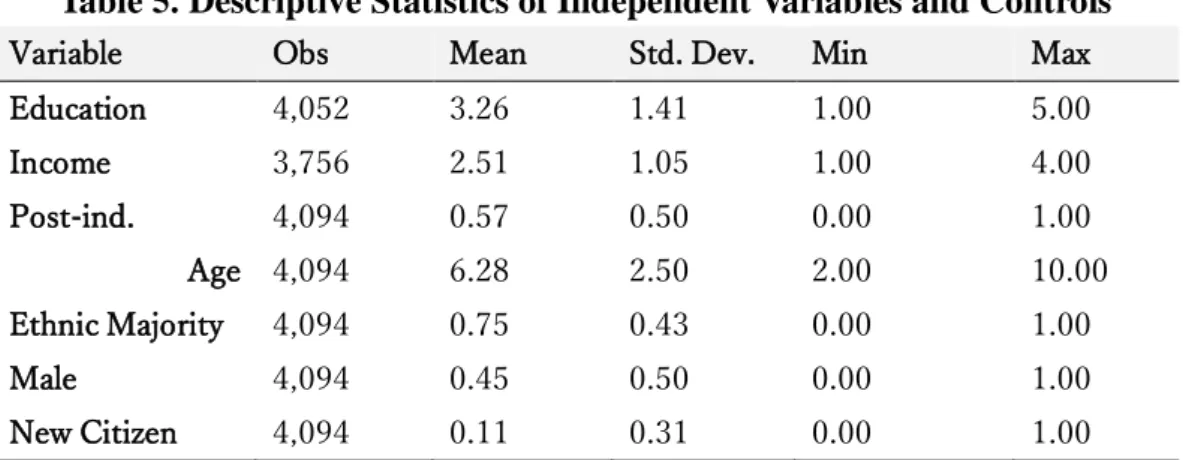
Table 5 shows descriptive statistics for the independent variables and controls, while Table 6 shows their correlations.
Table 5. Descriptive Statistics of Independent Variables and Controls
Variable Obs Mean Std. Dev. Min Max Education 4,052 3.26 1.41 1.00 5.00 Income 3,756 2.51 1.05 1.00 4.00 Post-ind. 4,094 0.57 0.50 0.00 1.00 Age 4,094 6.28 2.50 2.00 10.00 Ethnic Majority 4,094 0.75 0.43 0.00 1.00 Male 4,094 0.45 0.50 0.00 1.00 New Citizen 4,094 0.11 0.31 0.00 1.00
Table 6. Correlations of Independent Variables and Controls
Education Income Post-ind. Ethnic Majority Male New Citizen Education 1.00 Income 0.50 1.00 Post-ind. 0.41 0.19 1.00 Ethnic Majority 0.08 0.14 0.09 1.00 Male 0.08 0.08 0.02 0.02 1.00 New Citizen 0.08 0.02 0.10 -0.03 0.01 1.00 (N=3,743)
Education shows relatively higher correlations with Income and Post-independence. However, this correlation is not high enough to cause the problem of multicollinearity.
Results
16
Table 7. The Effects of Individual Attributes on Preference for Political Plurality
Standard errors are in parentheses. * p<0.05, ** p<0.01, *** p<0.001. Variables Education 0.06 *** 0.04 ** 0.04 ** 0.03 ** (0.01) (0.01) (0.01) (0.01) Income 0.08 *** 0.33 *** 0.27 *** 0.27 *** (0.01) (0.07) (0.07) (0.07) Income squared -0.05 *** -0.04 ** -0.04 ** (0.01) (0.01) (0.01) Lowe Income -0.24 *** -0.17 *** (0.04) (0.04) Age -0.03 *** -0.01 * (0.01) (0.01) Post-Independence 0.14 *** 0.08 ** 0.08 ** (0.03) (0.03) (0.03) Ethnic Majority -0.24 *** -0.25 *** -0.25 *** -0.24 *** -0.21 *** -0.22 *** -0.25 *** -0.24 *** -0.25 *** (0.03) (0.03) (0.03) (0.03) (0.03) (0.03) (0.03) (0.03) (0.03) Male 0.01 0.02 0.02 0.02 0.02 0.02 0.01 0.01 0.01 (0.03) (0.03) (0.03) (0.03) (0.03) (0.03) (0.03) (0.03) (0.03) New Citizen -0.15 *** -0.13 ** -0.13 ** -0.12 ** -0.10 * -0.11 ** -0.13 ** -0.13 ** -0.14 ** (0.04) (0.04) (0.04) (0.04) (0.04) (0.04) (0.04) (0.04) (0.04) Year 2011 0.09 ** 0.10 *** 0.10 *** 0.08 ** 0.07 ** 0.09 ** 0.08 ** 0.08 ** 0.09 ** (0.03) (0.03) (0.03) (0.03) (0.03) (0.03) (0.03) (0.03) (0.03) Constant -0.05 -0.06 -0.33 *** 0.18 *** 0.29 *** 0.04 -0.25 * 0.00 -0.38 *** (0.04) (0.05) (0.09) (0.03) (0.04) (0.04) (0.11) (0.05) (0.09) N 3,901 3,629 3,629 3,629 3,939 3,939 3,616 3,616 3,616 Adjusted R2 0.03 0.03 0.03 0.03 0.03 0.03 0.04 0.04 0.04 Model 8
Model 4 Model 7 Model 9
17
For Model 1 to Model 6, each independent variable is tested separately. The signs of the coefficients of all independent variables indicate the predicted directions of H1, H2(a) and H3. The coefficients are statistically significant at the 0.1 percent level.
Model 1 simply indicates that higher level of education bring about the preference for plurality.
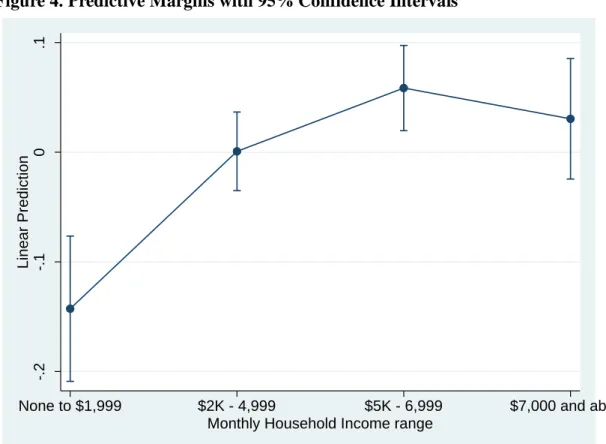
While Model 2 estimates the linear effects of income, Model 3 uses a quadratic term of income to estimate its nonlinear effects. Model 4 uses a binary variable for lower income class. Model 3 and Model 4 indicate that the middle class prefers plurality, while the lower income class supports the status quo.
Model 5 and Model 6 tested the effects of generations by using both Age and Post-independence. Model 5 indicates the linear effects of age, which indicates that the status quo is preferred as age increases. Model 6 implies that there are generational differences, with the younger generation born after independence seeming to prefer more plurality.
In Model 7, Model 8, and Model 9, all independent variables are included in the estimations. Model 9 is the main specification presented above. Model 7 uses Age instead of Post-independence, and Model 8 uses Lower Income instead of the quadratic term of income. Across all the models, there are no contradictions in the results observed. They are consistent with the predictions of H1, H2(a), and H3. The results for the examination of the three hypotheses are summarized as follows.
(1) H1 Education
The effects of Education are statistically significant in all models. For the main specification in Model 9, the results indicate that the effects are significant even after controlling other variables. The coefficients indicate that higher levels of education bring about stronger preferences for plurality. The results support H1.
(2) H2 Class
Income also has a significant effect on preferences for plurality. Moreover, as the
quadratic term shows significantly negative coefficients in Model 3, Model 7 and Model 9, the effects of income are shown to be an elastic curve. On the other hand, Model 4 and Model 8 imply that the lower income class supports the status quo. Figure 4 shows its predictive margins with 95 percent confidence intervals. Strong support for the status quo is observed among the lower income class, while the upper middle class has a significant inclination toward plurality. H2(a), the modernization hypothesis, is supported by this estimation, while the H2(b), the new structuralist hypothesis, is not.
18
Figure 4. Predictive Margins with 95% Confidence Intervals
(3) H3 Generation
The intergeneration difference has a significant effect in Model 5 to Model 9. In particular, the dichotomous variable Post-independence has a significant effect in the main model, Model 9, even after controlling other variables. As H3 indicates, the younger generation prefers more plurality, while the older generation supports the status quo.
The intergenerational differences are expected to be stronger in 2015 because the passing of Lee Kuan Yew and the 50th anniversary of Singapore’s independence reminded the older generation of the early days of independence and the succeeding period. However, by pooling the data of the 2011 and the 2015 surveys and controlling for the year effects, the estimations indicate the consistent existence of intergenerational differences. Furthermore, the estimations imply that the effects of intergenerational differences are independent of education and income. Model 8 and Model 9 indicate the statistically significant effects of age even after controlling for the effects of education and income. This implies that the intergenerational differences are caused by differences in the political socialization of each generation, rather than educational attainment.
Conclusion
Empirical studies on political liberalizations are mostly cross-national examinations using national-level data. Although aggregated data are important to check for differences between countries, individual behavior, which is the basis of regime changes, are not given much attention in these studies. On the other hand, studies that
-.2
-.1
0
.1
Linear Prediction
None to $1,999 $2K - 4,999 $5K - 6,999 $7,000 and above Monthly Household Income range
19
deal with micro-level data are often conducted in already liberalized countries because of data availability. Their implications are limited because these data provide information about the differences within a group of countries that share a similar political situation of liberalized competition.
By examining the data of Singapore, where dominant party rule has continued for several decades, we were able to obtain information about individual behavior under a political regime where political competition is controlled by the government. Through the examinations above, we identify at least three crucial factors that influence people’s attitudes towards the dominant party rule in Singapore. These factors are education, income/class, and intergenerational differences in values. The results confirm the effectiveness of modernization theory, and that of its modified version that emphasizes the differences in political culture between generations.
Nevertheless, it is still difficult to say which of the two elections, 2011 or 2015, shows the “normal” situation in Singapore. Also, we still do not have enough information to predict the future of Singaporean politics.16 More qualitative data on the perceptions and behaviors of citizens are necessary. Such data also provide us with deeper knowledge about the causal mechanisms that result in socioeconomic changes driving political changes.
16 There are two main predictions for the future of Singaporean politics. The first is “strong state democratization” (Slater 2012). Under this scenario, the PAP will give up its status of dominant party and will become merely a ruling party that controls a simple majority in the Parliament. The second possibility is the continuation of the PAP’s dominance. Voters punish the PAP if its performance does not maintain the expected standards, but they still generally prefer that the PAP remain in power. The opposition is expected to be used as a device to check the PAP’s performance and to provide the PAP with a fear of a transition in power following disappointing performance. (Lam Peng Er 2016).
20
References
Acemoglu, Daron, and James A. Robinson. 2006. Economic Origins of Dictatorship and Democracy. New York: Cambridge University Press.
Acock, Alan C. 2016. A Gentle Introduction to Stata. Fifth Edition ed. College Station, Texas: A Stata Press Publication.
Almond, Gabriel A., and Sidney Verba. 1963. The Civic Culture: Political Attitudes and Democracy in Five Nations. Princeton, N.J.: Princeton University Press.
Barro, Robert J. 1999. "Determinants of Democracy." Journal of Political Economy 107 (S6):S158-S183. doi: 10.1086/250107.
Boix, Carles. 2003. Democracy and Redistribution. New York: Cambridge University Press. Coppedge, Michael, John Gerring, Staffan I. Lindberg, Svend-Erik Skaaning, Jan Teorell, David
Altman, Frida Andersson, Michael Bernhard, M. Steven Fish, Adam Glynn, Allen Hicken, Carl Henrik Knutsen, Kyle L. Marquardt, Kelly McMann, Valeriya Mechkova, Pamela Paxton, Daniel Pemstein, Laura Saxer, Brigitte Seim, Rachel Sigman, and Jeffrey Staton. 2017. V-Dem Codebook v7.1. edited by Varieties of Democracy (V-Dem) Project. Coppedge, Michael, John Gerring, Staffan I. Lindberg, Svend-Erik Skaaning, Jan Teorell, David
Altman, Michael Bernhard, M. Steven Fish, Adam Glynn, Allen Hicken, Carl Henrik Knutsen, Joshua Krusell, Anna Lührmann, Kyle L. Marquardt, Kelly McMann, Valeriya Mechkova, Moa Olin, Pamela Paxton, Daniel Pemstein, Josefine Pernes, Constanza Sanhueza Petrarca, Johannes von Römer, Laura Saxer, Brigitte Seim, Rachel Sigman, Jeffrey Staton, Natalia Stepanova, and Steven Wilson. 2017. V-Dem [Country-year/Country-Date] Dataset v7.1. edited by Varieties of Democracy (V-Dem) Project. Fetzer, Joel S. 2008. "Election Strategy and Ethnic Politics in Singapore." Taiwan Journal of
Democracy, 4 (1):135-153.
Glaeser, Edward L., Giacomo A. M. Ponzetto, and Andrei Shleifer. 2007. "Why Does Democracy Need Education?" Journal of Economic Growth 12 (2):77-99. doi: 10.1007/s10887-007-9015-1.
Inglehart, Ronald, and Christian Welzel. 2003. "Political Culture and Democracy: Analyzing Cross-Level Linkages." Comparative Politics 36 (1):61-79. doi: 10.2307/4150160. Inglehart, Ronald, and Christian Welzel. 2005. Modernization, Cultural Change, and Democracy.
Vol.: pbk.
Institute of Policy Studies. 2011. IPS Post-Election Forum. Singapore: Institute of Policy Studies, Lee Kuan Yew School of Public Policy, National University of Singapore.
Institute of Policy Studies. 2015. Post-Election Conference 2015. Singapore: Institute of Policy Studies, Lee Kuan Yew School of Public Policy, National University of Singapore.
Iversen, Torben. 2010. "Democracy and Capitalism." In The Oxford Handbook of the Welfare State, edited by Francis G. Castles, Stephan Leibfried, Jane Lewis, Herbert Obinger and Christopher Pierson, 183-195. New York: Oxford University Press.
21
Politics of Singapore's 2011 General Election, edited by Kevin YL Tan and Terence Lee, 174-193. Singapore: Ethos Books.
Lam Peng Er. 2016. "New Normal or Anomaly." In Change in Voting: Singapore's 2015 General Election, edited by Terence Lee and Kevin YL Tan, 246-265. Singapore: Ethos Books. Lipset, Seymour Martin. 1959. "Some Social Requisites of Democracy: Economic Development
and Political Legitimacy." American Political Science Review 53 (1):69-105. doi: 10.2307/1951731.
Marshall, Monty G. 2017. Polity IV Project: Political Regime Characteristics and Transitions, 1800-2016. edited by Center for Systemic Peace.
Mauzy, Diane K. 2002. "Electoral Innovation and One-Party Dominance in Singapore." In How Asia Votes, edited by John Fuh-sheng Hsieh and David Newman, 234-254. New York: Chatham House.
Mauzy, Diane K., and R. S. Milne. 2002. Singapore Politics under the People's Action Party. Vol.: hbk, Politics in Asia series. London: Routledge.
Ministry of Finance. 2015. Income Growth, Inequality and Mobility Trends in Singapore. Singapore.
Mutalib, Hussin. 2002. "Constitutional-Electoral Reforms and Politics in Singapore." Legislative Studies Quarterly 27 (4):659-672.
Ng, Irene Y. H. 2011. "Singapore's Education System: Growing worry of social immobility." Straits Times, 16 February, Review.
Ng, Irene Y. H. 2013. "The Political Economy of Intergenerational Income Mobility in Singapore." International Journal of Social Welfare 22 (2):207-218. doi: 10.1111/j.1468-2397.2012.00887.x.
Pietsch, Juliet. 2015. "Authoritarian Durability: Public Opinion towards Democracy in Southeast Asia." Journal of Elections, Public Opinion and Parties 25 (1):31-46. doi: 10.1080/17457289.2014.933836.
Przeworski, Adam, Michael E. Alvarez, Jose Antonio Cheibub, and Fernando Limongi. 2000. Democracy and Development: Political Institutions and Well-Being in the World, 1950-1990. New York: Cambridge University Press.
Puddington, Arch, and Tyler Roylance. 2017. Freedom in the World 2017 Populists and Autocrats: The Dual Threat to Global Democracy. Freedom House.
Rahim, Lily Zubaidah. 2015. "Reclaiming Singapore's ‘Growth with Equity’ Social Compact." Japanese Journal of Political Science 16 (2):160-176. doi: 10.1017/S1468109915000043. Rodan, Garry. 2016. "Capitalism, Inequality and Ideology in Singapore: New Challenges for the
Ruling Party." Asian Studies Review 40 (2):211-230. doi: 10.1080/10357823.2016.1155536.
Singapore Department of Statistics. 2011. Census of Population 2010 Statistical Release 1 Demographic Characteristics, Education, Language and Religion. Singapore: Department of Statistics, Ministry of Trade and Industry, Republic of Singapore.
22
Slater, Dan. 2012. "Strong-State Democratization in Malaysia and Singapore." Journal of Democracy 23 (2):19-33. doi: 10.1353/jod.2012.0021.
Solt, Frederick. 2016. The Standardized World Income Inequality Database. In Social Science Quarterly 97.
Tan, Eugene KB. 2011a. "Election Issues." In Voting in Change: Politics of Singapore's 2011 General Election, edited by Kevin YL Tan and Terence Lee, 27-46. Singapore: Ethos Books.
Tan, Kenneth Paul. 2012. "Singapore in 2011: A "New Normal" in Politics?" Asian Survey 52 (1):220-226. doi: 10.1525/as.2012.52.1.220.
Tan, Kevin YL. 2011b. "Legal and Constitutional Issues." In Voting in Change: Politics of Singapore's 2011 General Election, edited by Kevin YL Tan and Terence Lee, 50-65. Singapore: Ethos Books.
Tan, Kevin YL, and Terence Lee. 2011a. "Political Shift: Singapore's 2011 General Election." In Voting in Change: Politics of Singapore's 2011 General Election, edited by Kevin YL Tan and Terence Lee, 10-25. Singapore: Ethos Books.
Tan, Kevin YL, and Terence Lee, eds. 2011b. Voting in Change: Politics of Singapore's 2011 General Election. Singapore: Ethos Books.
Tan, Netina. 2016. "Pre-Electoral Malpractice, Gerrymandering and its Effects on Singapore's 2015GE." In Change in Voting: Singapore's 2015 General Election, edited by Terence Lee and Kevin YL Tan, 169-190. Singapore: Ethos Books.
Weiss, Meredith L. 2014. "Of Inequality and Irritation: New Agendas and Activism in Malaysia and Singapore." Democratization 21 (5):867-887. doi: 10.1080/13510347.2014.910764. Welsh, Bridget. 2011. "Does Diffenrence Matter?: Particular and National Political Identities in
Singapore's 2011 General Election." In Voting in Change: Politics of Singapore's 2011 General Election, edited by Kevin YL Tan and Terence Lee, 92-114. Singapore: Ethos books.
Welsh, Bridget. 2016. "Political Identities, Engagement and Voting in Singapore's 2015 Election." In Change in Voting: Singapore's 2015 General Election, edited by Terence Lee and Kevin YL Tan, 190-219. Singapore: Ethos Books.
Welzel, Christian, and Ronald Inglehart. 2007. "Mass Beliefs and Democratic Institutions." In The Oxford Handbook of Comparative Politics, edited by Carles Boix and Susan C. Stokes, 297-316. New York: Oxford University Press.