Study on Transformation of Marine Origin
Bacterium Alteromonas 1055-1 Strain
著者
KAKIMOTO Daiichi, SHIRAHAMA Manabu, SAKATA
Taizo
journal or
publication title
鹿児島大学水産学部紀要=Memoirs of Faculty of
Fisheries Kagoshima University
volume
30
page range
325-330
別言語のタイトル
海洋細菌Alteromonas 1055-1株の形質転換に関する
研究
Vol.30 pp. 325-330 (1981)
Study on Transformation of Marine Origin Bacterium
Alteromonas 1055---1 Strain
Daiichi Kakimoto*, Manabu Shirahama and Taizo Sakata*
Abstract
It was found in this study that transformation occurred in a typical marine bacterium Alteromonas 1055-1 in a competence medium. The transformation was observed when the culture was kept in the competence medium made with Herbst's artificial sea water containing 0.005% yeast extract, 0.025% polypepton, and Tris buffer pH 7.5 equevalent to 0.05 Mol concentration and at 25 C. Typical minerals usually used for the growth of marine bacteria, namely NaCl, Mg++, and Ca++ contributed to the process of transformation.
One of the authors1) published the results of the study on the variations of the bacteria living in the marine environment in 1968. In the paper, he discussed that 1055-1 strain which was identified as Pseudomonas, but later recognized as Alteromonas
haloplanktis2\ showed the possibility of variant production by the mixed culture with
other halophilic bacteria. In this papaer, the authors confirmed a possibility of genetic transformation seemed to be proved by using 1055-1 strain. Since the
first observation of transformation was done in Pneumococcus3\ a lot of papers4)'5)'6)*7)
about the same kind of study using various bacteria living in terrestrial environment were published. But, there are no reports till these days as regards to whether transformation is possible in marine bacteria to carry out.
The purposes of this study are to make the possibility of transformation clear by
using marine bacteria and to establish the essential factors which presumably introduce the reaction. The transformation was ascertained in this study by means of application of the marker resistant to the antibiotic Leucomycin (LM).
Materials and Methods
Organisms: The derived strain from marine Alteromonas 1055-1 was used in this experiment. This strain was confirmed as marine type organism by Hidaka8).
Isolation of antibiotic resistant strain (Donor strain): In order to isolate a strain resistant
to many antibiotics, 1055-1 strain was placed on the ZoBell 2216E agar plates with
various antibiotic disks of Leucomycin, Streptomycin, Tetracycline, etc by the method of Adam's double layer. Among various antibiotics tested LM produced a clear inhibitive zone and a lot of large colonies of resistant strain as compared with their
antibiotics used. In this method, the authors were able to obtain a resistant strain * Laboratory of Microbiology, Faculty of Fisheries, Kagoshima University.
326 Mem. Fac. Fish., Kagoshima Univ. Vol. 30 (1981)
which showed resistance to 230 mg/L LM. To get more stable and stronger strain,
this resistant strain was irradiated with UV for 60 sec from the distance of 60 cm.
Eventually, some of the organisms treated this way showed a constant resistance
to 350 mg/L LM. The organism was used as Donor strain in transformation ex
periment.
Isolation of LM sensitive strain (Recipient strain): The sensitive strain was isolated from
the original strain by replica method which was carried out by replicating the colonies
on the ZoBell 2216E agar plate not containing LM. to another plate containing
10 mg/L LM. After incubation., the strain confirmed as sensitive to 10 mg/L LM was picked out. The sensitive strain selected was used as recipient strain.
Culture condition: For isolation and stock of Donor and Recipient strains ZoBell
2216E modified medium yeast extract 1.0 g, Polypepton 5.0 g, Herbst's SAW
1000 ml, and Agar 15 g, pH 7.5 was used.
Competence medium was composed of Herbst's ASW, 1000 ml, Polypepton, 0.25 g, Yeast extract, 0.05 g and 0.05 M Tris buffer (pH 7.5). Incubation was
carried out at 25°C for 24 hr except for special purposes.
Chemicals: Leucomycin (Tokyo Jozo Co. LTD), Sodium Laurylsulfate (Nakarai Chemicals LTD), EDTA (Kanto Chemical Co. Inc.), and Chroloform,
Isoamy-lalcohol and so on were all either chemically pure or highest grade.
recipient stock culture prcjxur&L 18hrs. ZoBell 22I6E modified medium 0.5ml/ 0.5ml competent medium (4.5ml)
r^i^i0-5" i
0.5ml 25°C/ 12hrs.\
|
V
V
competent medium (4.5ml)DNA control test recipient control
Transformation procedure
Kakimoto• Shirahama-Sakata : Transformation of Alteromonas 1055-1 327
Preparation of DNA: Marmur's method was applied for extracting DNA from the
Donor cells.
Confirmation of transformant: The confirmation of transformant was carried out as shown in Fig. 1. The recipient cells were incubated in 8 ml of ZoBell 2216E modified medium and incubated at 25°C for 24 hr. 0.5 ml of this culture suspension was transferred into 4.5 ml of competence medium. After incubation at 25°C for 14 hr (6.0-9.0X 10⁸ cells/ml), 0.5 ml cell suspension was transferred again into 3.5 ml of fresh competence medium (6.0-9.0 X 10⁷ cells/ml) with 1.0 ml DNA solution. After this treatment, the cell suspension was inoculated on the ZoBell 2216E agar plate containing 350 mg/L LM, and incubated for 24 hr and the colony appeared was observed. In order to confirm transformation, the recipient control and DNA control were prepared.
Results and Discussion
Factors affecting transformation, especially competence: At the beginning of this study, the authors used the Koser's citrate medium for competence induction, as it is well known that the medium is successiful for transformation of H. influenza. But no transformations were observable in such nutrient poor medium. The authors found new one in this experiment which is prepared with Herbst's ASW, yeast extract 0.005%, poplypepton 0.025% and Tris buffer (pH 7.5) of 0.05 Mol. The result is shown in Fig. 2.
Frequency of transformation (log)
-7 -6 -5 -4 -3 -2 ZoBell a 1/5 Z b
n
n
1/10Z c i 1/20 Z D i 1/30 Z e i 1/40 Z f iFig. 2. Effect of concentration of nutrients on competence induction.
Frequency of transformation (log)
7 - 6 - 5 -4 - 3 - 2 1 1 1 1 1 1 -™ | Y P I : NON
Fig. 3. Effect of organic compounds on competence induction.
Effect of organic compounds oncompetence induction: The effect on competence induction appeared higher in yeast extract than in polypepton as shown in Fig. 3.
328 Mem. Fac. Fish., Kagoshima Univ. Vol. 30 (1981)
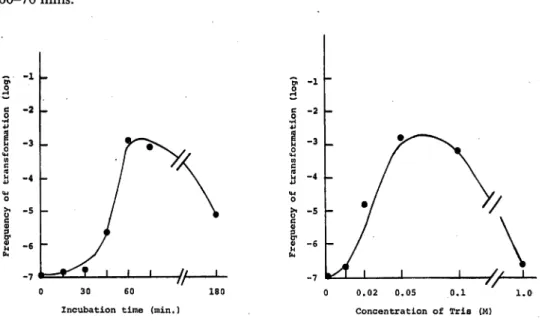
in the competence medium, each sample was incubated at 25°C with definite time intervals. As shown in Fig. 4, transformations did not appear at 0 and, 15 mins., but a small number of transformants was observed after 45 mins. That is, the trans-formants increased rapidly after 45 mins. incubation and reached maximum after
60-70 mins. -1 -2 -3
-/ X
- 5/
1
\
- 6/
-7 <i—t^T i1 '
//—•-30 60
Incubation time (min.)
180 0.02 0.05 0.1 Concentration of Tris (M)
Fig. 4. Time course on competence induction. Fig. 5. Effect of Tris cone, on competence induction.
Effect of Tris buffer solution oncompetence induction: Fig. 5 shows the effect of Tris buffer solution. The composition of competence medium was the same as previously described except the concentration of Tris buffer solution. The concentrations were from 0 to 1.0 Mol. No transformants were observed without Tris buffer, and a few transformants appeared in 1.0 Mol and 0.01 Mol in Tris buffer. The optimum concentration was ranged from 0.05 Mol to 0.2 Mol for transformation and also
Tris buffer was essential factor on the transformation. To make it clear whether
this result depends on only the ability to stabilize the pH, 0.05 Mol veronal buffer solution was used instead of Tris buffer. But very few transformants were observed in this case. This evidence showed that Tris buffer solution played an unknown role besides buffering effect in bringing about transformation.
Effect of temperature on competence induction: The temperatures used in the experiment
were from 16°C to 39°C at definite intervals. The competence medium was the same as previously used. Fig. 6 indicates that optimum temperature of competence
induction was 25°C and that no transformants were observed at 16°C, 34°C, 39°C.
The temperature required for competence induction coincided with optimum temper ature of this organism.
Effect on NaCl on competence induction: Competence medium in this experiment was the same as previously used except for NaCl concentrations. Fig. 7 shows the effect
_ - l -2 _ >» -5O - 3 -— -6 --7 Fig. 21 25 30 34 39 Temperature (°C)
6. Effect of temperature on competence ind uction. - l -- 2 --3 - # • ^ — v . -4 - J • -5 - / -6 - J _7 kr^T l_l I L * - 5 -Fig. 8. 0 20 40 60 Concentration of MgCl2(mM)
Effect of MgCl2 cone, on competence
induction.
0 1 2 3 4 5
Concentration of NaCl (%)
Fig. 7. Effect of NaCl cone, on competence induction.
0 5 10 15 20
Concentration of CaCl2(mM) Fig. 9. Effect of CaCl2 cone, on competence
induction.
of NaCl concentration on competence induction. Transformation was inhibited at 1% or less and 4% or more concentration of NaCl. The optimum concentration was found between 1.5% and 3%.
Effect of MgCl2 on competence induction: Fig. 8 shows the effect of MgCl2 concentrations
on competence induction. Competence medium was the same as previously used except that various concentrations of MgCl2 were added and CaCl2was omitted from Herbst's ASW. As shown in the figure, there was increase in competence induction with the increase of MgCl2 concentration until the concentration reached
330 Mem. Fac. Fish., Kagoshima Univ. Vol. 30 (1981)
40 mM. after which it decreased. Optimum concentration seemed to be in the ranges
from 20 mM to 40 mM.
Effect of CaCl2 on competence induction: Fig. 9 shows the effect of CaCl2 on transfor mation. The experimental method was the same as previously described in MgCl2 experiment. The frequency of transformant production increased linearly with
the increase of CaCl2 concentration, but decreased at 20 mM concentration.
Reference
1) D. Kakimoto and T. Hidaka: Proceedings of the U. S.-Japan Seminar on Marine Microbiology Ed. by H. Kadota and N. Taga, 1968.
2) M. Sakai: Communication 1976.
3) F.Griffith: J. Hyg., 27,113(1928).
4) H. E. Alexander, G. Leidy: Proc; Soc, Exptl., Biol., Med., 73, 485 (1950). 5) J. Spizizen: Proc, Natl., Acad., Sci., U. S., 44, 1072 (1958).
6) I. C. Felkner and O. Wyss: Biochem., Biophys., Res., Comm., 16, 94 (1964).
7) G. Leonard and M.J. Mahnesis: J. Bacteriol., 90, 558 (1965).
8) T. Hidaka and M. Sakai: Proceeding of the U. S.-Japan Seminar on Marine Microbiology, Ed. by H. Kadota and N. Taga, 111, (1968).