Seroepidemiological Survey of Anti-Human
T-cell Leukemia Virus-Type I Antibodies in
Western Samoa
著者
KUNIYOSHI Hideharu, KITANO Motoo, UCHIO
Yasuto, ENOSA Taulealeausumai Eti, ALOANIA
Leitua Faalii, ASAUA Vaasilifiti Faleniu,
TERASHI Shin-ichi
journal or
publication title
南太平洋研究=South Pacific Study
volume
18
number
2
page range
51-56
Seroepidemiological Survey of Anti-Human T-cell
Leukemia Virus-Type I Antibodies in Western Samoa
*Hideharu K
UNIYOSHI1), Motoo K
ITANO2), Yasuto U
CHIO3),
Taulealeausumai Eti E
NOSA4), Leitua Faalii A
LOAINA5),
Vaasilifiti Faleniu A
SAUA6)and Shin-ichi TERASHI7)†Abstract
A seroepidemiological survey of Anti-human T-cell Leukemia virus type I(HTLV-I) antibodies was conducted
on Western Samoa human sera in 1993∼1994. The result showed no positive cases in all 1953 samples.
Key words: Seroepidemiology, Adult T-cell leukemia lymphoma(ATL), Anti-human T-cell leukemia virus
type I(HTLV-I) antibodies, Western Samoa
Introduction
Adult T-cell leukemia lymphoma(ATL) is caused by infection of a retrovirus, human
T cell leukemia virus type-I (HTLV-I). It is observed in high incidence among persons
born in virus endemic areas, such as south-western Japan, the Caribbean basin, Central Africa, southern part of India, north-eastern part of Australia and Papua New Guinea. A neurological disease, HTLV-I associated myelopathy tropical spastic paraparesis (HAM
TSP) is also caused by the same virus. It is said that many diseases are associated with
HTLV-I infection.(HAB= HTLV-I associated bronchopneumonopathy, HAAP= HTLV-I
associated arthropathy, malignancies, etc.)
Many investigators have been making efforts to identify the ATL cases and HTLV-I carriers, and their results showed that there are many HTLV-I positive cluster countries in the world. Almost all the ATL patients and the carriers of HTLV-I are positive for anti-human T-cell leukemia virus-type I antibodies(anti-HTLV-I antibodies) in their sera. The
anti-HTLV-I antibody examination of the inhabitants in each country will help to detect and monitor the incidence of leukemia and the transmission of the virus.
*The Samoa Parliament passed the law to amend the Constitution changing the country’s name from Western
Samoa to Samoa in 1997. 1)Research fellow, First Department of Oral and Maxillofacial Surgery, Kagoshima
University Dental School, 8-35-1 Sakuragaoka, Kagoshima 890, Japan. 2)
Professor, Department of Oral Pathology, Kagoshima University Dental School, Kagoshima, Japan. 3)Professor, Division of Chemistry, School
of Allied Medical Sciences, Kagoshima University, Kagoshima, Japan. 4)Director General of Health Department
of Samoa. 5)Consultant Anesthesiologist and Head of Anesthesia, Samoa National Hospital. 6)
Consultant Pathologist and Director of National Health Laboratory Service of Samoa. 7)
Deceased, Professor, Kagoshima University Research Center for the South Pacific, Kagoshima, Japan.
Material, Method and Results
The human sera were collected as available samples from Western Samoa National Hospital Clinical Laboratories(Biochemical Laboratory and Microbiological Laboratory)
and Western Samoan Blood Transfusion Section, Apia, Western Samoa. The serological test was done by the Microtiter Technique using a gelatin particle agglutination test
(Serodia HTLV-I kit, FUJIREBIO INC., Tokyo, JAPAN). The HTLV-I positive range was
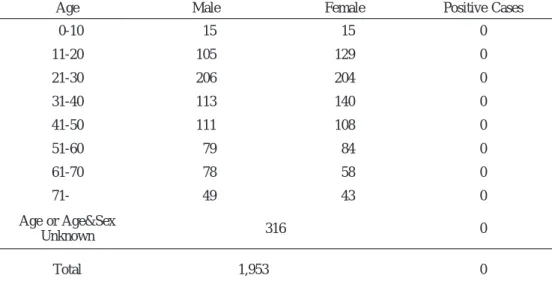
determined over 16 units of serum samples concentration by this qualititative test. A total of 1,953 samples were tested. The distribution of samples by age and sex are shown in Table 1. As for 316 out of the 1,953 cases, the age or the age and sex was unclear. The results of the present seroepidemiological study on Anti-HTLV-I antibody in Western Samoa showed no positive cases in all samples(Table 1).
Discussion
The adult T-cell leukemia lymphoma (ATL) is caused by an infection of a retrovirus,
HTLV-I(HINUMAet al., 1981). Anti-HTLV-I antibodies in human sera are detectable in
most ATL patients and are in a relatively high percentage in healthy individuals born in ATL-endemic areas(TAJIMAet al., 1984). Currently it is supposed that HTLV-I is
trans-mitted by three main routes; 1) sexual transmission (TAJIMA et al., 1982), 2) vertical
transmission (HINO et al., 1985), and 3) blood transfusion (OKOCHI et al., 1983). It is
suspected that there are 1.2 x 10⁵
carriers in Japan, and ATL-endemic areas are the south-western areas of Japan where healthy carriers were found at a rate between 6% and 37%
South Pacific Study Vol. 18, No. 2, 1998 52
Table 1. Distribution of Sample Material by Age and Sex with Incidence of Positive Cases for Anti-HTLV-I Antibodies
Age Male Female Positive Cases
0-10 15 15 0 11-20 105 129 0 21-30 206 204 0 31-40 113 140 0 41-50 111 108 0 51-60 79 84 0 61-70 78 58 0 71- 49 43 0 Age or Age&Sex Unknown 316 0 Total 1,953 0
(TAJIMA et al., 1979; HINO et al., 1982). The West Indies Caribbean basin, Columbia,
Brazil, southern India, Papua New Guinea, north-eastern Australia and central parts of Africa are also known as HTLV-I invaded areas(BLATINERet al., 1982; CATOVSKYet al., 1982; O’BRIEN et al., 1983; TAJIMA et al., 1992). In the United States the incidence is sporadic and most of the patients are black Americans.
A few seroepidemiological surveys have been made in Oceania. There was a reported 1.1% anti-HTLV-I antibodies positive cases in the Solomon Islands (HINUMAet al., 1983).
Another survey reported 0% in the Solomon Islands and Viti Levu (Fiji) of Melanesia (T
ERASHIet al., 1983). Yet another survey reported 0% in the Fiji (NICHOLSONet al., 1992).
But in Papua New Guinea at Port Moresby, Lae and Wewak of Melanesia showed a range of 6.9-30.2% positive cases (TERASHI et al., 1991; TERASHI et al., 1992). There was a
reported 0% in Truck State (TERASHI et al., 1986), 1.9% in Pohnpei (TERASHI et al., 1986), 6.8% in Yap State of the Federated States of Micronesia (TERASHI et al., 1987a).
In the Republic of Palau of Micronesia it was reported at 10.8% (TERASHIet al., 1987b).
Polynesia is not known as an area that has been invaded by HTLV-I. In some studies, no antibody was detected in sera from American Samoa, the Cook Islands, French Polynesia
(NICHOLSON et al., 1992) and Hawaii (TAJIMA et al., 1992). A study revealed 0.07%
positive cases in French Polynesia (CHUNGUE et al., 1993). USHIJIMA et al. (1990)
re-ported there were no positive cases in Tonga and Western Samoa. Our present exhaustive study also showed no positive cases in Western Samoa. The incidences of anti-HTLV-I antibodies in Micronesia and Melanesia and its absence in Polynesia including Western Samoa suggests certain patterns of socio-cultural interaction and early human migrations in the Pacific Basin. However, further research, is necessary to ascertain these relationships.
Acknowledgements
We thank Mr. Tipasa ME (Health Planning Unit, Western Samoa health Department), Ms. Letuu SLAVEN (Principal, Medical Laboratory Technologist, Samoa National Hospital), Mr. Suesue TALALELEI (Pathological Technologist, Samoa National Hospital), Mr. Palauni MAURIRATA(Pathological Technologist, Samoa National Hospital), Ms. T.S. MAUAULA(Research Laboratory of the Red Cross Blood Transfusion Section, Samoa) and Mr. Faapulou AUVAA(Supervisor Biochemistry Unit, Samoa National Hospital) for their help in this project.
This research work was supported by a Grant-in-Aid for Cancer Research(No.0604212)
References
BLATTNER, W.A., KALYANARAMAN, V.S., ROBERT-GUROFF, M., LISTER, A., GALTON, D.A.G., SARIN, P.S., CRAWFORD, M.H., CATOVSKY, D., GREAVES, M., GALLO, R.C. 1982. The human type-C retrovirus, HTLV, in Blacks from the Caribbean region, and relationship to adult T-cell leukemia lymphoma. Int. J. Cancer, 30: 257-264. CATOVSKY, D., GREAVES, M.F., ROSE, M., GALTON, D.A.G., GOOLDEN, A.W.G., MCCLUSKEY, D.R., WHITE, J.M., LAMPERT, I., BOURIKAS, G., IRELAND, R., BROWNELL, A.I., BRIDGES, J.M., BLATTNER, W.A., GALLO, R.C. 1982. Adult T-cell lymphoma-leukemia in Blacks from the West Indies. Lancet, March 20: 639-643. CHUNGUE, E., BOUTIN, J.P., LE-MARCHAND, L., PHILIPPON, G., LE-GUELLEC, A.,
CHANTEAU, S., CARTEL, J.L., GRAS, C., MARTIN, P.M., ROUX, J.F. 1993. Seroepidemiological survey of HTLV-I infection in French Polynesia, Cook Island and Fiji. Eur. J. Epidemiol. 9, 347-350.
HINO, S., YAMAGUCHI, K., KATAMINE, S., SUGIYAMA, H., AMAGASAKI, T., KINOSHITA, K., YOSHIDA, Y., DOI, H., TSUJI, Y., MIYAMOTO, T. 1985. Mother-to-child transmission of human T-cell leukemia virus type I. Jpn. J. Cancer Res., 76, 474-480. HINUMA, Y., NAGATA, K., HANAOKA, M., NAKAI, M., MATSUMOTO, T., KINOSHITA, K., S
HIRAKAWA, S., MIYOSHI, I. 1981. Adult T-cell leukemia: Antigen in a ATL cell line and detection of antibodies to the antigen in human sera. Proc. Natl. Acad. Sci. USA, 78, 6476-6486.
HINUMA, Y., KOMODA, H., CHOSA, T., KONDO, T., KOHAKURA, M., TAKENAKA, T., K IKUCHI, M., ICHIMARU, M., YUNOKI, K., SATO, I., MATSUO, R., TAKIUCHI, Y., UCHINO, H., HANAOKA, M. 1982. Antibodies to adult T-cell leukemia-virus associated antigen (ATLA) in sera from patients with ATL and controls in Japan: a nation-wide
sero-epidemiologic study. Int. J. Cancer, 29: 631-635.
HINUMA, Y., CHOSA, T., KOMODA, H., MORI, I., SUZUKI, M., TAJIMA, K., PAN, I-H., LEE, M. 1983. Sporadic retrovirus (ATLV)-seropositive individuals outside Japan. Lancet,
April 9: 824-825.
NICHOLSON, S.R., EFANDIS, T., DIMITRAKAKIS, M., KAROPOULOS, A., LEE, H., GUST, I.D. 1992. HTLV-I infection in selected populations in Australia and the Western Pacific region. Med. J. Aust., 156, 878-880.
O’BRIEN, C., LAMPERT, I.A., CATOVSKY, D. 1983. The Histopathology of adult T-cell lymphoma leukemia in blacks from the Caribbean. Histpathology, 7: 349-364.
OKOCHI, K., SATO, H., HINUMA, Y. 1983. A retrospective study on transmission of adult T-cell leukemia virus by blood transfusion: sero-conversion in recipients. Vox Sang., 46, 245-253.
TAJIMA, K., TOMINAGA, S., KURONISHI, T. 1979. Geographic features and epidemiological approach to endemic cell leukemia lymphoma in Japan. Clin.Oncol. 9: 495-504.
South Pacific Study Vol. 18, No. 2, 1998 54
TAJIMA, K., TOMINAGA, S., SUCHI, T., KAWAGOE, T., KOMODA, H., HINUMA, Y., ODA, T., FUJITA, K. 1982. Epidemiological analysis of the distribution of antibody to adult T-cell leukemia virus associated antigen: Possible horizontal transmisson of adult T-cell leukemia virus. Jpn. J. Cancer Res.(Gann) 73, 839-901.
TAJIMA, K., HINUMA, Y. 1984. Epidemiological features of adult T-cell leukemia virus. Advances in the Biosciences No.50, "Pathophysiological Respects of Cancer Epidemiology: Immunological, Virological, Endocrinologogical and Genetical Factors" eds. G. Mathe and P. Reizenstein, Pergamon Press, Oxford.
TAJIMA, K., HINUMA, Y. 1992. Epidemiology of HTLV-I II in the world. Gann Mono. No.39, "Advances in ATL and HTLV-I Reseach" eds. Y. HINUMA, K. TAKATSUKI, M. Y OSHIDA, Japan Scientific Society, Tokyo.
TERASHI, S., MATSUMOTO, T., KHAN, W., SINGH, K. 1983. Studies of Anti-adult T-cell leukemia associated antigens antibodies and some hematological findings on healthy adults in Viti Leve, Fiji. The Prompt Report 2nd Scient. Surv. South Pacific, (Ed. N
AKANO, K. et al.): 108-112. Kagoshima Univ. Res. Ctr South Pacific, Kagoshima.
TERASHI, S., MATSUMOTO, T., KIJIMA, S., HARRIS, I.A., BARBOSA, C., ATEN, G., KANSOU, N. 1986. Studies of Anti-Adult T-cell leukemia associated antigens antibodies and some hematological findings in inhabitants in Federated States of Micronesia. The Prompt Report 4th Scientific Survey South Pacific, (Ed. NAKANO, K. et al.): 57-64.
Kagoshima Univ. Res. Ctr South Pacific, Kagoshima.
TERASHI, S., FIGIR, M.B., GAJDUSEK, J.T., TALLEY, B., SUMOR, E., RACHI, A., MANGARFIR, G., DIBAY, L.G. 1987a. Studies of Anti-adult T-cell leukemia associated antigens antibodies in inhabitants in Yap, the Federated States of Micronesia. The Prompt Report 5th Scientific Survey South Pacific,(Ed. NAKANO, K. et al.): 66-70. Kagoshima
Univ. Res. Ctr South Pacific, Kagoshima.
TERASHI, S., KUMAGAI, M., POLLOI, A.H., BORJA, S., TECHECHOR, J., TERMEETY, F. 1987b. Studies of anti-adult T-cell leukemia associated antigens antibodies in inhabitants of the Republic of Palau. The Prompt Report 5th Scientific Survey South Pacific,(Ed.
NAKANO, K. et al.): 62-65. Kagoshima Univ. Res. Ctr South Pacific, Kagoshima. TERASHI, S., BABONA, D., TALONU, T. 1991. Seroepidemiological study of anti-adult T-cell
leukemia lymphoma associated antibodies in Papua New Guinea (1990). Kagoshima
Univ. Res. Ctr South Pacific,(Ed. HAYASHI, M.), Occasional Papers, No.21: 45-48. TERASHI, S., MALLETT, J.B., MAMBUIA, G., TALONU, T. 1992. Seroepidemiological study
of anti-adult T-cell leukemia lymphoma associated antibodies in Lae and Wewak of Papua new Guinea (1991). Kagoshima Univ. Res. Ctr South Pacific, (Ed. KARAKITA,
Y.), Occasional Papers, No.23: 47-52.
USHIJIMA, H., DAIRAKU, M., HONMA, H., SATO, K., SUGIYAMA, K., KITAMURA, T., INABA, N. 1990. Incidence of antibodies against human immunodeficiency virus, human T-cell lymphotropic virus type 1, hepatitis B virus, hemorrhagic fever with renal
syndrome virus and Chlamydia in Tonga and Western Samoa. Jpn. J. Med. Sci. Biol. 43: 101-109.
(Accepted 2 February 1998)
South Pacific Study Vol. 18, No. 2, 1998 56