
JAIST Repository: 証明スコアを用いた認証プロトコルの形式的検証の検討と新規事例調査 [課題研究報告書]
81
0
0
全文
(2) Master’s Research Project Report. An investigation of formal verification of authentication protocols with proof score and a new case study. Shuho FUJII. Supervisor Kazuhiro OGATA. Graduate School of Advanced Science and Technology Japan Advanced Institute of Science and Technology (Information Science). Month 3, Year 2021.
(3) Abstract With the rapid spread and development of the Internet, security protocols that guarantee safe and secure communication on the Internet are becoming more and more popular. Although these security protocols have been carefully designed by security experts, it was not uncommon for security attacks such as interception, tampering and impersonation to happen, leading to lots of serious damages. Ensuring the reliability of security protocols is thus absolutely important. Many approaches have been proposed against the unexpected flaws in these protocols. In formal method, some techniques for formally verifying the correctness of security protocols have been extensively studied. This research focuses on formal verification of the correctness of authentication protocols and We survey case studies conducted in the past as well as to conduct new case studies. Authentication is the process of verifying the identity of a person, an object, a computer, a program, etc. It is an indispensable technology for preventing unauthorized operations in network systems (also known as access control). Protocols are communication conventions that are necessary to communicate with each other. Thus, an authentication protocol is a communication convention to achieve authentication. Computers, printers, and programs are used and participated in by an unspecified number of entities, and only encoded information is exchanged. Therefore, there is a high possibility of eavesdropping, falsification, and impersonation of communication. There- fore, authentication protocols are intended to realize authentication for secure communication in such insecure communication channels. This research focuses on two case studies of authentication protocols are presented with the Identify-Friend-or-Foe-System protocol (IFF protocol or just IFF) and the Needham-Schroeder-Lowe Public-Key protocol (NSLPK protocol or just NSLPK). NSLPK can be regarded as an advanced authentication protocol of IFF. We study the specification of two protocols in CafeOBJ, which is a formal specification language, and understand the ”proof scores” to prove that they enjoy some desired properties. We present two more ways of verification that IFF enjoys some properties by using CafeInMaude Proof Assistant (CiMPA), and CafeInMaude Proof Generator (CiMPG). By achieving the objectives of this research, we will be able to acquire techniques to mitigate the number of authentication protocol failures, which can contribute to safer and more secure shopping on e-commerce sites and safer and more secure communication on the Internet..
(4) Keywords : CafeOBJ, CiMPG, CiMPA, proof score, algebraic specification language, authentication protocol. 2.
(5) Contents 1 Introduction 1.1 Overview . . . . . . . . . . . . . . . . . . . . . . . . . . . . . . 1.2 Aims . . . . . . . . . . . . . . . . . . . . . . . . . . . . . . . . 1.3 The structure of the subsequent chapters . . . . . . . . . . . .. 1 1 1 2. 2 Preliminaries 2.1 Authentication protocol . . . . . . . . . . . . . . . . . . 2.1.1 What is authentication . . . . . . . . . . . . . . . 2.1.2 What is Authentication protocol . . . . . . . . . . 2.1.3 Authentication implementation method . . . . . . 2.1.4 Threats in Communications . . . . . . . . . . . . 2.2 CafeOBJ . . . . . . . . . . . . . . . . . . . . . . . . . . . 2.2.1 What is CafeOBJ . . . . . . . . . . . . . . . . . . 2.2.2 What is Qlock . . . . . . . . . . . . . . . . . . . . 2.2.3 Understanding the problem and modeling it . . . 2.2.4 Creating a CafeOBJ specification and formulating properties to be verified . . . . . . . . . . . . . . 2.2.5 Verification by CafeOBJ system . . . . . . . . . . 2.3 CiMPG and CiMPA . . . . . . . . . . . . . . . . . . . . 2.3.1 What is CiMPG and CiMPA . . . . . . . . . . . 2.3.2 Proof of Qlock using CiMPG and CiMPA . . . .. . . . . . . . . .. 3 3 3 3 4 5 6 6 6 7. . . . . .. 9 13 17 17 17. . . . . . . . . . . . . . . . . . . the . . . . . . . . . .. 3 Formal Verification of IFF Authentication Protocol with Proof Scores 24 3.1 IFF authentication protocol . . . . . . . . . . . . . . . . . . . 24 3.2 Assumption of the existence of an intruder . . . . . . . . . . . 25 3.3 Basic behavior of the protocol . . . . . . . . . . . . . . . . . . 25 3.4 Creating a model of IFF . . . . . . . . . . . . . . . . . . . . . 25 3.5 Observation function and transition function . . . . . . . . . . 26 3.6 Create CafeOBJ specification for IFF . . . . . . . . . . . . . . 26 3.6.1 Creating a CafeOBJ specification for a data type . . . 26 1.
(6) 3.6.2. 3.7. 3.8. Creation of CafeOBJ specifications for observation transition system . . . . . . . . . . . . . . . . . . . . . . . Verification of IFF . . . . . . . . . . . . . . . . . . . . . . . . 3.7.1 Verification of intruder identification . . . . . . . . . . 3.7.2 Proof of inv1 . . . . . . . . . . . . . . . . . . . . . . . 3.7.3 Proof of inv2 . . . . . . . . . . . . . . . . . . . . . . . Summary of IFF . . . . . . . . . . . . . . . . . . . . . . . . .. 4 Formal Verification of NSLPK Authentication Protocol with Proof Scores 4.1 NSLPK authentication protocol . . . . . . . . . . . . . . . . . 4.2 Assumption of intruder’s presence . . . . . . . . . . . . . . . . 4.3 Basic protocol behavior . . . . . . . . . . . . . . . . . . . . . . 4.3.1 Confidentiality . . . . . . . . . . . . . . . . . . . . . . 4.4 Creating a model of NSLPK . . . . . . . . . . . . . . . . . . . 4.5 Observation function and transition function . . . . . . . . . . 4.6 Create CafeOBJ specification for NSLPK . . . . . . . . . . . . 4.6.1 Creating a CafeOBJ specification for a data type . . . 4.6.2 Creation of CafeOBJ specifications for observation transition system . . . . . . . . . . . . . . . . . . . . . . . 4.7 Verification of NSLPK . . . . . . . . . . . . . . . . . . . . . . 4.7.1 Verification of intruder identification . . . . . . . . . . 4.7.2 Proof scores of inv100 through inv260 . . . . . . . . . . 4.8 Summary of NSLPK . . . . . . . . . . . . . . . . . . . . . . .. 30 33 33 34 40 45. 46 46 47 47 47 47 48 49 49 55 59 59 62 62. 5 Formal Verification of IFF Authentication Protocol with CiMPA and CiMPG 63 5.1 Rewriting the specification of the IFF authentication protocol to use CiMPG and CiMPA . . . . . . . . . . . . . . . . . . . . 63 5.2 Execution results of the IFF authentication protocol using CiMPG and CiMPA . . . . . . . . . . . . . . . . . . . . . . . 66 5.3 Summary of IFF authentication protocol using CiMPG and CiMPA . . . . . . . . . . . . . . . . . . . . . . . . . . . . . . . 68 6 Lessons Learned 69 6.1 Security . . . . . . . . . . . . . . . . . . . . . . . . . . . . . . 69 6.2 Proof Scores and Proof Scripts . . . . . . . . . . . . . . . . . . 69 7 Conclusion 71 7.1 Summary of the report . . . . . . . . . . . . . . . . . . . . . . 71 7.2 Future prospects . . . . . . . . . . . . . . . . . . . . . . . . . 72.
(7) List of Figures 2.1 2.2 2.3. Example of a post office . . . . . . . . . . . . . . . . . . . . . Secure communication channel . . . . . . . . . . . . . . . . . . Behavior of each process . . . . . . . . . . . . . . . . . . . . .. 5 6 7. 5.1. Some of the execution results . . . . . . . . . . . . . . . . . . 67.
(8) Chapter 1 Introduction In Chapter 1, the background and purpose of this research project and the structure of the subsequent chapters are presented.. 1.1. Overview. With the rapid spread and development of the Internet, security protocols that guarantee safe and secure communication on the Internet are becoming more and more popular. Although these security protocols have been carefully designed by security experts, it was not uncommon for security attacks such as interception, tampering and impersonation to happen, leading to lots of serious damages. Ensuring the reliability of security protocols is thus absolutely important. Many approaches have been proposed against the unexpected flaws in these protocols. In formal method, some techniques for formally verifying the correctness of security protocols have been extensively studied.. 1.2. Aims. This research focuses on formal verification of the correctness of authentication protocols and We survey case studies conducted in the past as well as to conduct new case studies. This research focuses on two case studies of authentication protocols are presented with the Identify-Friend-or-FoeSystem protocol (IFF protocol or just IFF) and the Needham-SchroederLowe Public-Key protocol (NSLPK protocol or just NSLPK). NSLPK can be regarded as an advanced authentication protocol of IFF. We study the specification of two protocols in CafeOBJ, which is a formal specification language, and understand the ”proof scores” to prove that they enjoy some 1.
(9) desired properties. We present two more ways of verification that IFF enjoys some properties by using CafeInMaude Proof Assistant (CiMPA), and CafeInMaude Proof Generator (CiMPG). By achieving the objectives of this research, we will be able to acquire techniques to mitigate the number of authentication protocol failures, which can contribute to safer and more secure shopping on e-commerce sites and safer and more secure communication on the Internet.. 1.3. The structure of the subsequent chapters. The remainder of this report is organized as follows: - Chapter 2 - Preliminaries gives some common notions and background knowledge which are requirements for the rest of the report. - Chapter 3 - Formal Verification of IFF Authentication Protocol with Proof Scores presents the formal verification that IFF protocol enjoys some desired properties by writing proof scores. - Chapter 4 - Formal Verification of NSLPK Authentication Protocol with Proof Scores presents the formal verification that NSLPK protocol enjoys some desired properties by writing proof scores. - Chapter 5 - Formal Verification of IFF Authentication Protocol with CiMPA and CiMPG presents two more ways of the formal verification with IFF protocol. - Chapter 6 - Lessons Learned describes what we learned through the research project. - Chapter 7 - Conclusion summarizes the report and gives some pieces of our future work.. 2.
(10) Chapter 2 Preliminaries This Chapter gives some common notions and background knowledge which are requirements for the rest of the report.. 2.1 2.1.1. Authentication protocol What is authentication. Authentication is the process of verifying the identity of a person, an object, a computer, a program, etc. It is an indispensable technology for preventing unauthorized operations in network systems (also known as access control). For example, in the authority management of a server in a network system, after authenticating the identifiers of the users registered in the server (who have accessed the server), a list called ACL is used to describe what authority the subject has, and operations other than those listed in the list are not allowed. In general, this kind of technology is used to manage computer resources. In general, this technology is used to achieve secure access control in network systems via the Internet.. 2.1.2. What is Authentication protocol. Protocols are communication conventions that are necessary to communicate with each other. Thus, an authentication protocol is a communication convention to achieve authentication. Computers, printers, and programs are used and participated in by an unspecified number of entities, and only encoded information is exchanged. Therefore, there is a high possibility of eavesdropping, falsification, and impersonation of communication. Therefore, authentication protocols are intended to realize authentication for secure communication in such insecure communication channels. 3.
(11) 2.1.3. Authentication implementation method. Authentication is the process of verifying the identity of a person, an object, a computer, a program, etc. Mutual authentication is when two parties authenticate each other. There are two main ways to achieve mutual authentication using computers. Method using shared information This is a method of verification in which secret information is shared between the verifier and the subject, and the verifier confirms whether or not the subject possesses the secret information. Examples include password authentication, shared key authentication, and biometric authentication. Method using public key It is a method of authentication using a public key and possession of the corresponding private key. Examples include challenge-response authentication and authentication using digital signatures. In both of these two methods, the information for authentication passes through an insecure communication channel at least once, because the authentication is ultimately done using a call from the subject to the verifier. Therefore, the following is necessary for the implementation of these methods. ・Confidential information should not flow through the communication channel in plain text. ・That the call for authentication is different every time. ・Easy to change secret information for authentication. ・Easy to manage confidential information for authentication. A report is an encrypted version of an identifier, key, nonce (random number, etc., a report generated for each session), etc. It is also necessary that the entity that is authenticating and the entity that is using the authentication must match. Take postal service as an example. In the postal service, when subject A sends a letter to subject B, the flow is as shown in Figure 2.1. Subject A takes the mail to the nearest post office (1), the mail is transferred between post offices (2), and subject B receives the mail from the nearest post office (3). In this case, authentication between post offices in (2) is only a secure communication in the transfer between post offices, and does not guarantee the safety of the user. Even if the authentication between post offices is done, if there is another person who pretends to be Subject B, the mail that should have been sent to Subject B may end up in the hands of another person. To ensure that the mail sent by Subject A passes through the secure communication channel and reaches Subject B, it is necessary to authenticate and encrypt the communication between Subject A and B. 4.
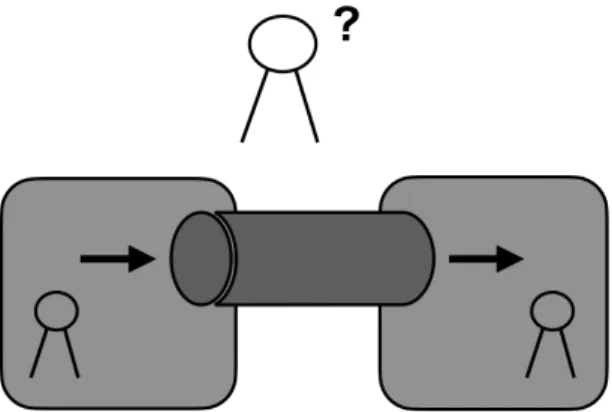
(12) Figure 2.1: Example of a post office. 2.1.4. Threats in Communications. The threats that may be posed on communication paths without authentication and encryption between communicating entities are as follows 1.Interception:Unauthorized entities (attackers) intercepting calls. 2.Falsification:An attacker takes a call, falsifies it, and sends it as if it were a legitimate call. 3.Hoax:Sending a report generated by an attacker to cause a malicious effect. 4.Masquerade:The attacker pretends to be a different entity. 5.Replay:An attacker uses the report, or a portion of it, to send it to an unauthorized effect. In order to achieve communication that eliminates these threats, it is necessary to satisfy confidentiality (the property that only an appropriately authorized entity can read the report in communication without an unintended third party being able to decipher it) and integrity (the property that the report in communication is genuine and has not been tampered with, or can be detected if it has been tampered with) between two mutually determined communication entities. In other words, it is enough to satisfy the following requirements In other words, it is enough to satisfy the following requirements. In other words, it is necessary to prepare a tunnel-like communication channel between two determined parties, as shown in Fig. 2.2, which is not subject to any observation by others, and to use that channel for all communication between the two parties, and the authentication protocol must ensure such a communication channel.. 5.
(13) Figure 2.2: Secure communication channel. 2.2 2.2.1. CafeOBJ What is CafeOBJ. CafeOBJ is a language for verification (formal specification) and validation of formal models, designed to support formal methods. CafeOBJ is a formal specification language classified as an algebraic specification language, and can be executed by interpreting the equations that make up the specification as rewrite rules[4][5][6]. The flow of verification is as follows. 1.Understanding the problem and modeling it 2.Creating a CafeOBJ specification and formulating the properties to be verified 3.Verification by CafeOBJ system Each of 1 3 will be explained using a mutual exclusion protocol called Qlock.. 2.2.2. What is Qlock. When there is a resource shared by multiple processes, it is sometimes required that the resource be exclusively specified in the sense that at any given time there is at most one process using the resource. Thus, a mutual exclusion protocol is a mechanism for exclusive use of a shared resource, and a mutual exclusion protocol realized by using an atomic queue is called a Qlock. An atomic queue is a queue in which elements can be added, deleted, etc. as indivisible operations.. 6.
(14) 2.2.3. Understanding the problem and modeling it. Each process in Qlock behaves as follows. Each process i is in the other region when it does not use the shared resource, and in the sensitive region when it does. When each process i wants to specify a shared resource, it adds the process identifier i to the end of the queue (put(queue,i)), waits until i comes to the top of the queue (top(queue) = i), and then enters the intervening region. When it finishes using the shared resource, it removes the top of the queue (get(queue)) and returns to the rest of the region. Each process i repeats this. rm, wt, and cs are labels. When a process is in the other region, we say it is in label rm. When it’s waiting to enter a sensitive area, say it’s on label wt. When it is in a close region, we say it is in label cs. Initially, we assume that all processes are in label rm and that queue is empty. One of the properties of Qlock to be satisfied is mutual exclusivity, that is, there is always at most one process in the intervening region, and this is the property to be verified.. Figure 2.3: Behavior of each process Modeling of states in observations The behavior of Qlock is modeled by specifying the change in observable values. The behavior of Qlock is modeled as an observation transition system SQlock , where the state transition system represents the state by a collection of observable values. Since the observables that characterize the state of Qlock are the value of queue and the position of each process, we prepare observation functions queue and pc that take the state of SQlock as arguments and return these values to represent their observables. That is, given the state s of SQlock and the process identifier i, queue(s) and pc(s,i) represent the value of queue and the position of process i in the snapshot of the execution of Qlock represented. 7.
(15) by the state s, respectively. The set of observation functions of SQlock is defined as follows OQlock OQlock {queue : Sys → Queue, pc : Sys Pid → Label} Sys, Queue, Pid, and Label represent the state, process identifier queue, process identifier, and label type, respectively. OQlock is described as follows in cafeOBJ. op pc : Sys Pid -> Label op queue : Sys -> Queue op stands for operator, which declares an operation that takes the state of the system as an argument; in the case of pc and queue, the return value is a data type, so we declare an observation function. Modeling of state transitions The behavior of Qlock is represented as state transitions, and Qlock has the following three execution units. (1)Execution of put(queue,i) (2)Execution of top(queue) = i (3)Execution of get(queue) These are represented by the transition functions want, try, and exit, respectively. Given a state s and a process identifier i in SQlock , want(s,i), try(s,i), and exit(s,i) represent the state after process i executes put(queue,i) in state s, the state after repeating top(queue) = i once, and the state after executing get(queue), respectively. and the state after executing get(queue). The set TQlock of transition functions in SQlock is represented as follows. TQlock {want : Sys Pid → Sys, try : Sys Pid → Sys, exit : Sys Pid → Sys} TQlock is written as follows in CafeOBJ. op want : Sys Pid -> Sys {constr} op try : Sys Pid -> Sys {constr} op exit : Sys Pid -> Sys {constr} {constr} indicates that want, try, and exit are Sys terms. Modeling the initial state In the initial state init of SQlock , queue(init) returns the empty queue, and for any process identifier i, pc(init,i) returns the label rm. The initial state can be modeled as a set of states LQlock that satisfy this condition as follows. LQlock {init ∥ queue(init) = empty ∧ pc(init, i) = rm} The initial state and the conditions it must satisfy are described in CafeOBJ as follows 8.
(16) op init : -> Sys {constr} eq pc(init,I) = rs . eq queue(init) = empty . The two equations declared in eq declare the conditions that init must satisfy. what I, rs, and empty are is defined elsewhere.. 2.2.4. Creating a CafeOBJ specification and formulating the properties to be verified. In describing the observation transition system SQlock in CafeOBJ, we first define the data types LABEL, PID, and QUEUE in CafeOBJ. the description unit of CafeOBJ is a module, and the CafeOBJ specification is expressed in modules. Embedded Modules: BOOL Some of the basic data types are provided as built-in modules. One of them is the module BOOL. It declares a visible sort Bool that returns a Boolean value, two arguments true and false that represent truth and falsity, and basic operations on Boolean values, and defines their meanings in equations. The module BOOL is automatically imported into the user-defined module, since it is the basis of logical computation for inference and verification. Specifications of Label : LABEL mod! LABEL { [Label] ops rs ws cs : -> Label {constr} eq (rs = ws) = false . eq (rs = cs) = false . eq (ws = cs) = false . } The three constants rm, ws, and cs, declared together in ops(operators), correspond to the labels rm, ws, and cs, respectively. process identifier : PID mod* PID { [ErrPid Pid < PidErr] op none : -> ErrPid var I : Pid var EI : ErrPid eq (I = EI) = false . }. 9.
(17) CafeOBJ can order inclusion relations between sorts, and can handle partial functions and error handling. pidErr is the upper sort for ErrPid and Pid. none is a constant for ErrPid, and is provided as different from the process identifier. Specifications ofQueueing : QUEUE mod! QUEUE(E :: TRIVerr) { [EQueue NeQueue < Queue] op empty : -> EQueue {constr} op : Elt.E Queue -> NeQueue {constr} op enq : Queue Elt.E -> NeQueue op deq : Queue -> Queue op top : EQueue -> ErrElt.E op top : NeQueue -> Elt.E op top : Queue -> EltErr.E op \in : Elt Queue -> Bool op del : Queue Elt.E -> Queue var Q : Queue vars X Y : Elt.E eq enq(empty,X) = X empty . eq enq(Y Q,X) = Y enq(Q,X) . eq deq(empty) = empty . eq deq(X Q) = Q . eq top(empty) = err.E . eq top(X Q) = X . eq X \in empty = false . eq X \textbackslash in (Y Q) = (if X = Y then true else X \in Q fi) . eq del(empty,Y) = empty . eq del(X Q,Y) = (if X = Y then Q else X del(Q,Y) fi) . eq X \in enq(Q,Y) = (if X = Y then true else X \in Q fi) . ceq X \in del(enq(Q,X),X) = false if not X \in Q . ceq X \in del(enq(Q,Y),X) = X \in del(Q,X) if not X = Y . ceq X \in del(Q,X) = false if not X \in Q . } E is a temporary argument of the parameterization module QUEUE, whose requirements are specified by the temporary argument module TRIVerr. The module TRIVerr is declared as follows: var Q: Queue declares that the identifier Q is to be used as a variable of the sort Queue with equality to be declared in this module. mod* TRIVerr { [ErrElt Elt < EltErr] op err : -> ErrElt 10.
(18) } The module TRIVerr specifies the existence of a set, indicated by the sort Elt, and one element that does not belong to that set, indicated by the constant none. The constant empty in module QUEUE indicates an empty queue, and the operation indicates that the non-empty queue construct {constr} is a construct attribute. Elt.E refers to the visible sort Elt of the temporary argument E. The operations enq, dep, top, and del represent the usual functions of a queue, and their definitions are given by the equations. Embodiment of the parameter module The real arguments used when embodying a parameterization module must meet the requirements specified in the temporary argument module TRIVerr. In other words, the model of the real argument must be the model of the temporary argument. The realization of the parameterization module is done by mapping the elements of real arguments to the elements of temporary arguments. The language element of CafePBJ that defines this mapping is the view. The view for embodying a provisional argument E, whose requirements are specified in the module TRIVerr, with the process identifier PID is as follows. view TRIVerr2PID from TRIVerr to PID sort Elt -> Pid, sort ErrElt -> ErrPid, sort EltErr -> PidErr, op err -> none, CafeOBJ Specification of Observation Transition System Now that we have created the CafeOBJ specifications for the required data types, we can use them to write the CafeOBJ specification for SQlock as follows mod* QLOCK { pr(LABEL + PID) pr(QUEUE(E <= TRIVerr2PID)) [Sys] op init : -> Sys {constr} op want : Sys Pid -> Sys {constr} op try : Sys Pid -> Sys {constr} op exit : Sys Pid -> Sys {constr} op pc : Sys Pid -> Label op queue : Sys -> Queue var S : Sys vars I J : Pid var Q : Queue 11.
(19) eq pc(init,I) = rs . eq queue(init) = empty . op c-want : Sys Pid -> Bool eq c-want(S,I) = (pc(S,I) = rs) . ceq pc(want(S,I),J) = (if I = J then ws else pc(S,J) fi) if c-want(S,I) . ceq queue(want(S,I)) = enq(queue(S),I) if c-want(S,I) . ceq want(S,I) = S if not c-want(S,I) . op c-try : Sys Pid -> Bool eq c-try(S,I) = (pc(S,I) = ws and top(queue(S)) = I) . ceq pc(try(S,I),J) = (if I = J then cs else pc(S,J) fi) if c-try(S,I) . eq queue(try(S,I)) = queue(S) . ceq try(S,I) = S if not c-try(S,I) . op c-exit : Sys Pid -> Bool eq c-exit(S,I) = (pc(S,I) = cs) . ceq pc(exit(S,I),J) = (if I = J then rs else pc(S,J) fi) if c-exit(S,I) . ceq queue(exit(S,I)) = deq(queue(S)) if c-exit(S,I) . ceq exit(S,I) = S if not c-exit(S,I) . op inv1 : Sys Pid Pid -> Bool op inv2 : Sys Pid -> Bool op inv3 : Sys Pid -> Bool op inv4 : Sys Pid -> Bool op inv5 : Sys Pid -> Bool op inv6 : Sys Pid -> Bool op inv7 : Sys Pid -> Bool eq inv1(S,I,J) = ((pc(S,I) = cs and pc(S,J) = cs) implies I = J) . eq inv2(S,I) = (pc(S,I) = cs implies top(queue(S)) = I) . eq inv3(S,I) = (pc(S,I) = rs implies (not I \in queue(S))) . eq inv4(S,I) = ((not I \in queue(S)) implies pc(S,I) = rs) . eq inv5(S,I) = (pc(S,I) = ws or pc(S,I) = cs implies I \in queue(S)) . eq inv6(S,I) = (I \in queue(S) implies pc(S,I) = ws or pc(S,I) = cs) . eq inv7(S,I) = (not I \in del(queue(S),I)) . } pr stands for protecting, which declares the module to be imported in protected mode. Module PLOCK explicitly imports LABEL, PID, and QUEUE (E <= TRIVerr2PID) and implicitly imports one module BOOL, where Sys is a hidden sort and represents the state space of SQlock . . The constant init represents an arbitrary initial state of SQlock . The operations pc and queue correspond to pc and queue, respectively, and are called observation functions. The operations try, want, and exit correspond to try, want, and exit, respectively, and are called transition functions. After these declarations, we. 12.
(20) define the initial state and the transition functions. inv1 inv7 formulate the properties that Qlock must have in order to satisfy mutual exclusivity.. 2.2.5. Verification by CafeOBJ system. In order to verify that Qlock satisfies mutual exclusivity, we modeled Qlock as an observation transition machine SQlock and created its CafeOBJ specification QLOCK. Finally, we formulate the proof methods and try to realize them in the CafeOBJ system[7][8][9]. The proof score for inv1 is expressed as follows. – I) Base case open QLOCK . – fresh constants ops i j : -> Pid . – ∥− red inv1(init,i,j) . close – II) Induction cases – 1) want(s,k) open QLOCK . – fresh constants op s : -> Sys . ops i j k : -> Pid . – IH eq [:nonexec] : inv1(s,I:Pid,J:Pid) = true . – assumptions eq pc(s,k) = rs . eq i = k . – ∥− red inv1(s,i,j) implies inv1(want(s,k),i,j) . close open QLOCK . – fresh constants op s : -> Sys . ops i j k : -> Pid . – IH eq [:nonexec] : inv1(s,I:Pid,J:Pid) = true . – assumptions eq pc(s,k) = rs . eq (i = k) = false . eq j = k . 13.
(21) – ∥− red inv1(s,i,j) implies inv1(want(s,k),i,j) . close open QLOCK . – fresh constants op s : -> Sys . ops i j k : -> Pid . – IH eq [:nonexec] : inv1(s,I:Pid,J:Pid) = true . – assumptions eq pc(s,k) = rs . eq (i = k) = false . eq (j = k) = false . – —red inv1(s,i,j) implies inv1(want(s,k),i,j) . close open QLOCK . – fresh constants op s : -> Sys . ops i j k : -> Pid . – IH eq [:nonexec] : inv1(s,I:Pid,J:Pid) = true . – assumptions eq (pc(s,k) = rs) = false . – ∥− red inv1(s,i,j) implies inv1(want(s,k),i,j) . close – 2) try(s,k) open QLOCK . – fresh constants op s : -> Sys . ops i j k : -> Pid . – IH eq [:nonexec] : inv1(s,I:Pid,J:Pid) = true . – assumptions eq pc(s,k) = ws . eq top(queue(s)) = k . eq i = k . eq j = k . – ∥− 14.
(22) red inv1(s,i,j) implies inv1(try(s,k),i,j) . close open QLOCK . – fresh constants op s : -> Sys . ops i j k : -> Pid . – IH eq [:nonexec] : inv1(s,I:Pid,J:Pid) = true . eq [:nonexec] : inv2(s,I:Pid) = true . – assumptions eq pc(s,k) = ws . eq top(queue(s)) = k . eq i = k . eq (j = k) = false . eq pc(s,j) = cs . – ∥− red inv2(s,j) implies inv1(s,i,j) implies inv1(try(s,k),i,j) . close open QLOCK . – fresh constants op s : -> Sys . ops i j k : -> Pid . – IH eq [:nonexec] : inv1(s,I:Pid,J:Pid) = true . eq [:nonexec] : inv2(s,I:Pid) = true . – assumptions eq pc(s,k) = ws . eq top(queue(s)) = k . eq i = k . eq (j = k) = false . eq (pc(s,j) = cs) = false . – ∥− red inv1(s,i,j) implies inv1(try(s,k),i,j) . close open QLOCK . – fresh constants op s : -> Sys . ops i j k : -> Pid . – IH eq [:nonexec] : inv1(s,I:Pid,J:Pid) = true . eq [:nonexec] : inv2(s,I:Pid) = true . 15.
(23) – assumptions eq pc(s,k) = ws . eq top(queue(s)) = k . eq (i = k) = false . eq j = k . eq pc(s,i) = cs . – ∥− red inv2(s,i) implies inv1(s,i,j) implies inv1(try(s,k),i,j) . close … The CafeOBJ command open makes the module given as its argument available; the CafeOBJ command red returns the value of the given term converted to the simplest possible term, using all the equations defined in the module as a left-to-right rewrite rule. The CafeOBJ command close is a command to discard and terminate the temporary module created in this way. through the end of the line is a comment. Proof scores can be broadly divided into an inductive basis and an inductive stage. The inductive stage is further divided corresponding to the transition functions want, try, and exit, each of which is divided into sufficient statements to be proved by running the proof clauses through the CafeOBJ system. Each proof clause in the inductive stage consists of the following four parts (1)Declaring a variable that represents an arbitrary value (2)Equation declarations for assumptions (3)Definition of post-event condition (4)Check that the logical formula to be proved is valid under the assumption (2). In addition, if it is necessary to divide the case within each transition function, the case is divided and further subdivided. If the return values of all reds are true after these subdivisions, the proof is successful, but this does not mean that all reds in inv1 are true. If we assume that inv2 is true, then the return value of red will be true in all cases, which means that the proof is successful. If we can prove all the cases from inv1 to inv7 as described above, the safeOBJ system has completed the verification that Qlock satisfies mutual exclusivity.. 16.
(24) 2.3 2.3.1. CiMPG and CiMPA What is CiMPG and CiMPA. The method of verification using proof scores in CafeOBJ may lead to incorrect proofs because of the addition of unnecessary equations or the wrong way of doing case spliting. CiMPA (CafeInMaude Proof Assistant) is a proof assistant for inductive properties of CafeOBJ specification. CiMPG (CafeInMaude Proof Generator) is a proof assistant that identifies proof scores and provides a minimal set of annotations to generate proof scripts for these proof scores[10][11][12][13]. The advantages of using these are twofold (1)If a proof script is successfully generated from a proof score using CiMPG, its properties shall be preserved. (2)If no proof scripts are generated, valuable feedback on the proofs underlying the proof scores can be obtained. Both proof scores and proof scripts can be written by hand by humans, but writing proof scripts is often more difficult than writing proof scores. Therefore, rather than writing the proof script by hand, it is better to use CiMPG to generate the proof script, and if the proof does not complete correctly, to modify the proof score.. 2.3.2. Proof of Qlock using CiMPG and CiMPA. Using QCiMPG and CiMPA, we will generate the proof script for Qlock as explained earlier, and perform the proof. In the proof, we first rewrite inv1 inv7, which formulate the properties that Qlock must have to satisfy mutual exclusivity, as follows. op inv1 : Sys Pid Pid -> Bool op inv2 : Sys Pid -> Bool eq inv1(S:Sys,I:Pid,J:Pid) = (((pc(S,I) = cs) and pc(S,J) = cs) implies I = J) . eq inv2(S:Sys,I:Pid) = (pc(S,I) = cs implies top(queue(S)) = I) . op inv2-0 : Sys Pid Pid Pid -> Bool eq inv2-0(S:Sys,I:Pid,J:Pid,K:Pid) = not((pc(S,K) = ws) and (top(queue(S)) = K) and (I = K) and (not (J = K)) and (pc(S,J) = cs)) . Since we have rewritten the properties that Qlock must have as described above, we also need to rewrite the proof score as follows. – I) Base case open QLOCK . :id(qlock) ops i j : -> Pid . 17.
(25) red inv1(init,i,j) . close – II) Induction cases – 1) want(s,k) open QLOCK . :id(qlock) op s : -> Sys . ops i j k : -> Pid . eq [:nonexec] : inv1(s,I:Pid,J:Pid) = true . eq pc(s,k) = rs . eq i = k . red inv1(s,i,j) implies inv1(want(s,k),i,j) . close open QLOCK . :id(qlock) op s : -> Sys . ops i j k : -> Pid . eq [:nonexec] : inv1(s,I:Pid,J:Pid) = true . eq pc(s,k) = rs . eq (i = k) = false . eq j = k . red inv1(s,i,j) implies inv1(want(s,k),i,j) . close open QLOCK . :id(qlock) op s : -> Sys . ops i j k : -> Pid . eq [:nonexec] : inv1(s,I:Pid,J:Pid) = true . eq pc(s,k) = rs . eq (i = k) = false . eq (j = k) = false . red inv1(s,i,j) implies inv1(want(s,k),i,j) . close open QLOCK . :id(qlock) op s : -> Sys . ops i j k : -¿ Pid . eq [:nonexec] : inv1(s,I:Pid,J:Pid) = true . eq (pc(s,k) = rs) = false . red inv1(s,i,j) implies inv1(want(s,k),i,j) . close 18.
(26) … – I) Base case open QLOCK . :id(qlock) – fresh constants op i : -> Pid . – —red inv2(init,i) . close – – II) Induction cases – 1) want(s,k) open QLOCK . :id(qlock) op s : -> Sys . ops i k : -> Pid . eq [:nonexec] : inv1(s,I:Pid,J:Pid) = true . eq [:nonexec] : inv2(s,I:Pid) = true . eq pc(s,k) = rs . eq i = k . red inv2(s,i) implies inv2(want(s,k),i) . close open QLOCK . :id(qlock) op s : -> Sys . ops i k : -> Pid . eq [:nonexec] : inv1(s,I:Pid,J:Pid) = true . eq [:nonexec] : inv2(s,I:Pid) = true . eq pc(s,k) = rs . eq (i = k) = false . eq queue(s) = empty . red inv2(s,i) implies inv2(want(s,k),i) . close open QLOCK . :id(qlock) op s : -> Sys . ops i k j : -> Pid . op q : -> Queue . eq [:nonexec] : inv1(s,I:Pid,J:Pid) = true . eq [:nonexec] : inv2(s,I:Pid) = true . eq pc(s,k) = rs .. 19.
(27) eq (i = k) = false . eq queue(s) = j — q . red inv2(s,i) implies inv2(want(s,k),i) . close open QLOCK . :id(qlock) op s : -> Sys . ops i k : -> Pid . eq [:nonexec] : inv1(s,I:Pid,J:Pid) = true . eq [:nonexec] : inv2(s,I:Pid) = true . eq (pc(s,k) = rs) = false . red inv2(s,i) implies inv2(want(s,k),i) . close … open QLOCK . :proof(qlock) close By rewriting it in this way, it becomes a statement that CiMPG can read, and by writing :proof(qlock) at the end, it generates a proof script. If you give CiMPG the above rewritten specification and proof score, it will return a proof script as shown below. open QLOCK . :goal{ eq [qlock :nonexec] : inv2(S:Sys,P:Pid) = true . eq [qlock1 :nonexec] : inv1(S:Sys,P:Pid,P0:Pid) = true . } :ind on (S:Sys) :apply(si) :apply(tc) :def csb1 = :ctf {eq pc(SSys,PPid) = cs .} :apply(csb1) :def csb2 = :ctf {eq P@Pid = PPid .} :apply(csb2) :imp [qlock1] by {P0:Pid <- P0@Pid ; P:Pid <- P@Pid ;} :apply (rd) :def csb3 = :ctf {eq P0@Pid = PPid .} :apply(csb3) :imp [qlock1] by {P0:Pid <- P0@Pid ; P:Pid <- P@Pid ;} :apply (rd) :imp [qlock1] by {P0:Pid <- P0@Pid ; P:Pid <- P@Pid ;} :apply (rd) 20.
(28) :imp [qlock1] by {P0:Pid <- P0@Pid ; P:Pid <- P@Pid :apply (rd) :def csb4 = :ctf {eq pc(SSys,PPid) = cs .} :apply(csb4) :def csb5 = :ctf {eq P@Pid = PPid .} :apply(csb5) :imp [qlock] by {P:Pid ¡- P@Pid ;} :apply (rd) :def csb6 = :ctf {eq pc(SSys,P@Pid) = cs .} :apply(csb6) :imp [qlock] by {P:Pid <- P@Pid ;} :imp [qlock1] by {P0:Pid <- PPid ; P:Pid <- P@Pid ;} :apply (rd) :imp [qlock] by {P:Pid <- P@Pid ;} :apply (rd) :imp [qlock] by {P:Pid <- P@Pid ;} :apply (rd) :apply(tc) :apply (rd) :apply (rd) :apply(tc) :def csb7 = :ctf {eq pc(SSys,PPid) = ws .} :apply(csb7) :def csb8 = :ctf {eq top(queue(SSys)) = PPid .} :apply(csb8) :def csb9 = :ctf {eq P@Pid = PPid .} :apply(csb9) :def csb10 = :ctf {eq P0@Pid = PPid .} :apply(csb10) :imp [qlock1] by {P0:Pid <- P0@Pid ; P:Pid <- P@Pid :apply (rd) :def csb11 = :ctf {eq pc(SSys,P0@Pid) = cs .} :apply(csb11) :imp [qlock1] by {P0:Pid <- P0@Pid ; P:Pid <- P@Pid :imp [qlock] by {P:Pid <- P0@Pid ;} :apply (rd) :imp [qlock1] by {P0:Pid <- P0@Pid ; P:Pid <- P@Pid :apply (rd) :def csb12 = :ctf {eq P0@Pid = PPid .} :apply(csb12) :def csb13 = :ctf {eq pc(SSys,P@Pid) = cs .} 21. ;}. ;}. ;}. ;}.
(29) :apply(csb13) :imp [qlock1] by {P0:Pid <- P0@Pid ; P:Pid <- P@Pid ;} :imp [qlock] by {P:Pid <- P@Pid ;} :apply (rd) :imp [qlock1] by {P0:Pid <- P0@Pid ; P:Pid <- P@Pid ;} :apply (rd) :imp [qlock1] by {P0:Pid <- P0@Pid ; P:Pid <- P@Pid ;} :apply (rd) :imp [qlock1] by {P0:Pid <- P0@Pid ; P:Pid <- P@Pid ;} :apply (rd) :imp [qlock1] by {P0:Pid <- P0@Pid ; P:Pid <- P@Pid ;} :apply (rd) :def csb14 = :ctf {eq pc(SSys,PPid) = ws .} :apply(csb14) :def csb15 = :ctf {eq top(queue(SSys)) = PPid .} :apply(csb15) :def csb16 = :ctf {eq P@Pid = PPid .} :apply(csb16) :imp [qlock] by {P:Pid <- P@Pid ;} :apply (rd) :imp [qlock] by {P:Pid <- P@Pid ;} :apply (rd) :imp [qlock] by {P:Pid <- P@Pid ;} :apply (rd) :imp [qlock] by {P:Pid <- P@Pid ;} :apply (rd) :apply(tc) :def csb17 = :ctf {eq pc(SSys,PPid) = rs .} :apply(csb17) :def csb18 = :ctf {eq P@Pid = PPid .} :apply(csb18) :imp [qlock1] by {P0:Pid <- P0@Pid ; P:Pid ¡- P@Pid ;} :apply (rd) :def csb19 = :ctf {eq P0@Pid = PPid .} :apply(csb19) :imp [qlock1] by {P0:Pid <- P0@Pid ; P:Pid <- P@Pid ;} :apply (rd) :imp [qlock1] by {P0:Pid <- P0@Pid ; P:Pid <- P@Pid ;} :apply (rd) :imp [qlock1] by {P0:Pid <- P0@Pid ; P:Pid <- P@Pid ;} :apply (rd) 22.
(30) :def csb20 = :ctf {eq pc(SSys,PPid) = rs .} :apply(csb20) :def csb21 = :ctf {eq P@Pid = PPid .} :apply(csb21) :imp [qlock] by {P:Pid <- P@Pid ;} :apply (rd) :def csb22 = :ctf [queue(SSys) .] :apply(csb22) :imp [qlock] by {P:Pid <- P@Pid ;} :apply (rd) :imp [qlock] by {P:Pid <- P@Pid ;} :apply (rd) :imp [qlock] by {P:Pid <- P@Pid ;} :apply (rd) close This is the proof script for Qlock generated by CiMPG, and when it is loaded into CiMPA, it returns ture for all terms, which means the proof is complete.. 23.
(31) Chapter 3 Formal Verification of IFF Authentication Protocol with Proof Scores This Chapter presents the formal verification that IFF protocol enjoys some desired properties by writing proof scores.. 3.1. IFF authentication protocol. Use the Identify-Friend-or-Foe System (IFF), which is simpler than NSLPK, to illustrate that. ・CafeOBJ ・Observation transition system ・Proof score ・Consideration of intruders when creating and verifying formal specifications of authentication protocols. An authentication protocol is a mechanism for entities to authenticate each other over a network[14]. IFF authentication protocol can be described as follows. Msg1 P → Q : R Msg2 Q → P : E K(R,Q) It is assumed that the members of the group share the private key and never leak it to a third party. R is a random number, and E K (R, Q) is a ciphertext in which the random number R and its own ID are encrypted with a private key.. 24.
(32) 3.2. Assumption of the existence of an intruder. Assume the existence of an intruder pretending to be a member. The intruder does not know the private key shared by the group, but can obtain all the messages flowing through the network such as random numbers and ciphertexts.. 3.3. Basic behavior of the protocol. f the subject P wants to authenticate the subject Q, which is a member of the group, P randomly generates a number R and send it to Q. Q which receives the random number R sends a ciphertext in which the received random number and its own ID are encrypted with the private key to P. The intruder cannot be visually identified, and all messages flowing through the network such as random numbers and ciphertexts can be acquired. Therefore, if the key used in the ciphertext received by P at this time is the private key shared by the members of the group, Q is a true member of the group and P can authenticate Q.. 3.4. Creating a model of IFF. Since IFF assumes the existence of an intruder, the model creation also assumes the existence of an intruder. Create the observation transition system Sif f as a model of IFF. Sif f consists of the set Oif f of observation functions, the set Lif f of the initial state, and the set Tif f of transition functions. Each is as follows. Oif f {nw : F ield → N etwork, ur : F ield → U Rands} Lif f {init | nw(init) = void ∧ ur(init) = empty} Tif f {sdcm : F ield Agent Agent Rand → F ield, sdrm : F ield Agent M sg → F ield, f kcm1 : F ield Agent Agent Rand → F ield, f krm1 : F ield Agent Agent Cipher → F ield, f krm2 : F ield Agent Agent Rand → F ield} Field, Network, URands, Agent, Rand, Msg and Cipher are state of IFF, type of network, type of random number multiset, type of subject, type of random number, type of message and type of ciphertext. The network is also modeled as a multiset of messages. Furthermore, due to the presence of intruders, messages once sent will remain on the net25.
(33) work.This is because a message once sent can be sent many times by an intruder. Void represents an empty multiset for networks, and empty represents an empty multiset for random numbers.. 3.5. Observation function and transition function. Given state F, the observation functions nw, ur return the random numbers available in that state (ur (F)) and the multiset of messages sent up to that state (nw (F)). The transition functions sdcm and sdrm correspond to the subject sending Msg1 and Msg2 according to the protocol, respectively. On the other hand, the transition functions fkcm1, fkrm1, and fkrm2 correspond to spoofing Msg1 and Msg2 using random numbers and ciphertexts collected by the intruder, respectively.. 3.6. Create CafeOBJ specification for IFF. We will create a CafeOBJ specification of Sif f f . Before that, create the CafeOBJ specifications for Network, URands, Agent, Rand, Msg, and Cipher. iff messages are ciphertext, so the network will be a set of multiple ciphertext.. 3.6.1. Creating a CafeOBJ specification for a data type. Specifications of agent : AGENT mod* AGENT { [Agent] op enemy : -> Agent eq (P:Agent = P) = true . } The constant enemy represents a generic intruder. Specifications of key : KEY mod! KEY { pr(AGENT) [Key] op k : Agent -> Key op p : Key -> Agent var P : Agent vars K1 K2 : Key 26.
(34) eq p(k(P)) = P . ceq (K1 = K2) = true if not(p(K1) = enemy) and not(p(K2) = enemy) . ceq (K1 = K2) = false if not(p(K1) = enemy) and p(K2) = enemy . } The operation k is a function that returns the key of a given subject based on that subject. Similarly, the operation p is a function that returns the subject holding the key based on the given key. Specifications of random number : RAND mod* RAND { [Rand] op = : Rand Rand -> Bool {comm} } The operation = is a predicate that determines whether the terms representing two random numbers are equal. Specifications of cipher text : CIPHER mod! CIPHER principal-sort Cipher { pr(AGENT + KEY + RAND) [Cipher] op enc : Key Rand Agent -> Cipher op k : Cipher -> Key op r : Cipher -> Rand op p : Cipher -> Agent var K : Key var R : Rand var P : Agent vars C1 C2 : Cipher eq k(enc(K,R,P)) = K . eq r(enc(K,R,P)) = R . eq p(enc(K,R,P)) = P . eq (C1 = C2) = (k(C1) = k(C2) and r(C1) = r(C2) and p(C1) = p(C2)) . } The operation enc is a component of the ciphertext. Given the key K, the random number R, and the subject P, it represents the ciphertext E K (R, P). The operations k, r, and p return the first, second, and third arguments of the operation enc, respectively. Specifications of message : MSG mod! MSG principal-sort Msg { pr(AGENT + RAND + CIPHER) [Msg] op cm : Agent Agent Agent Rand -> Msg 27.
(35) op rm : Agent Agent Agent Cipher -> Msg op cm? : Msg -> Bool op rm? : Msg -> Bool op crt : Msg -> Agent op src : Msg -> Agent op dst : Msg -> Agent op r : Msg -> Rand op c : Msg -> Cipher vars P1 P2 P3 : Agent var R : Rand var C : Cipher vars M1 M2 : Msg eq cm?(cm(P1,P2,P3,R)) = true . eq cm?(rm(P1,P2,P3,C)) = false . eq rm?(cm(P1,P2,P3,R)) = false . eq rm?(rm(P1,P2,P3,C)) = true . eq crt(cm(P1,P2,P3,R)) = P1 . eq crt(rm(P1,P2,P3,C)) = P1 . eq src(cm(P1,P2,P3,R)) = P2 . eq src(rm(P1,P2,P3,C)) = P2 . eq dst(cm(P1,P2,P3,R)) = P3 . eq dst(rm(P1,P2,P3,C)) = P3 . eq r(cm(P1,P2,P3,R)) = R . eq c(rm(P1,P2,P3,C)) = C . ceq (M1 = M2) = (cm?(M1) and crt(M1) = crt(M2) and src(M1) = src(M2) and dst(M1) = dst(M2) and r(M1) = r(M2)) if cm?(M2) . ceq (M1 = M2) = (rm?(M1) and crt(M1) = crt(M2) and src(M1) = src(M2) and dst(M1) = dst(M2) and c(M1) = c(M2)) if rm?(M2) . } The operation cm takes three subjects and a random number as arguments and returns a message. Each of the three entities represents the true author, sender, and recipient of the message, and this operation corresponds to Msg1. The operation rm takes three subjects and a ciphertext as arguments and returns a message. Similar to the operation cm, each of the three entities represents the true creator, sender, and recipient of the message, which corresponds to Msg2. Calculation cm?, rm? is a predicate that determines whether the given message is Msg1 or Msg2, and the operations crt, srt, and dst are predicates that determine the true creator, sender, and recipient from the given message, respectively.. 28.
(36) The operations r and s return a random number and a ciphertext from the given message, respectively. Specifications of general-purpose multiset for message : BAG mod! BAG (D :: TRIV) { [Elt.D < Bag] op void : -> Bag op , : Bag Bag -> Bag { assoc comm id: void } op \in : Elt.D Bag -> Bool var B : Bag vars E1 E2 : Elt.D eq E1 \in void = false . ceq E1 \in (E2,B) = true if E1 = E2 . ceq E1 \in (E2,B) = E1 \in B if not(E1 = E2) . } Specifications of general-purpose multiset for random number : SET mod! SET (D :: TRIV) { [Elt.D < Set] op empty : -> Set op : Set Set -> Set { assoc comm idem id: empty } op \in : Elt.D Set -> Bool var S : Set vars E1 E2 : Elt.D eq E1 \in empty = false . ceq E1 \in (E2 S) = true if E1 = E2 . ceq E1 \in (E2 S) = E1 \in S if not(E1 = E2) . } Specify formal argument D : COLLECTION mod* COLLECTION(D :: TRIV) { [Elt.D < Col] op \in : Elt.D Col -> Bool } Sort ELt.D is declared as a subsort of sort Bag and sort Col. This means that each element of a multiset can be regarded as a multiset having only that element. The constants void and empty represent an empty multiset, and the operations , and are constituents of a non-empty multiset. Also, the operations , and are declared to satisfy the commutative law (comm) and the associative law (assoc). The operation \in is a predicate that determines whether a given element is included in a given multiset. Specifications of general-purpose multiset for cipher : NETWORK 29.
(37) mod! NETWORK { pr(BAG(MSG)*{sort Bag -> Network}) pr(COLLECTION(RAND)*{sort Col -> ColRands}) pr(COLLECTION(CIPHER)*{sort Col -> ColCiphers}) op rands : Network -> ColRands op ciphers : Network -> ColCiphers var NW : Network var M : Msg var R : Rand var C : Cipher eq R \in rands(void) = false . ceq R \in rands(M,NW) = true if cm?(M) and R = r(M) . ceq R \in rands(M,NW) = true if rm?(M) and k(enemy) = k(c(M)) and R = r(c(M)) . ceq R \in rands(M,NW) = R ∈ rands(N W ) if not(cm?(M) and R = r(M)) and not(rm?(M) and k(enemy) = k(c(M)) and R = r(c(M))) . eq C \in ciphers(void) = false . ceq C \in ciphers(M,NW) = true if rm?(M) and C = c(M) . ceq C \in ciphers(M,NW) = C ∈ ciphers(N W )if not(rm?(M )and C = c(M)) . } Create a multiset of ciphertext from a general-purpose multiset. The sort name has been changed from BAG to NETWORK and from Col to ColRands and ColCiphers. The operations rands and ciphers return random numbers and ciphertexts in a given multiset, respectively.. 3.6.2. Creation of CafeOBJ specifications for observation transition system. Since the CafeOBJ specification of the data type used in the observation transition system Sif f has been created, the CafeOBJ specification of Sif f is created next. Specifications of observation transition system : IFF mod* IFF { pr(NETWORK) pr(SET(RAND)*{sort Set -> URands}) [Field] op init : -> Field {constr} 30.
(38) op nw : Field -> Network op ur : Field -> URands op sdcm : Field Agent Agent Rand -> Field {constr} op sdrm : Field Agent Msg -> Field {constr} op fkcm1 : Field Agent Agent Rand -> Field {constr} op fkrm1 : Field Agent Agent Cipher -> Field {constr} op fkrm2 : Field Agent Agent Rand -> Field {constr} var F : Field vars P1 P2 : Agent vars M1 M2 : Msg var R : Rand var C : Cipher … }. The constant init represents any initial state of Sif f . The operations nw and ur correspond to the observation functions of Sif f , and the remaining operations correspond to the transition functions. In the place of ..., the equations that defines the initial state and behavior of Sif f declared. They will be described below. Definition of initial state eq nw(init) = void . eq ur(init) = empty . These equations correspond to Lif f . Definition of transition function sdcm eq c-sdcm(F,P1,P2,R) = not(R \in ur(F)) . ceq nw(sdcm(F,P1,P2,R)) = cm(P1,P1,P2,R) , nw(F) if c-sdcm(F,P1,P2,R) . ceq ur(sdcm(F,P1,P2,R)) = R ur(F) if c-sdcm(F,P1,P2,R) . ceq sdcm(F,P1,P2,R) = F if not c-sdcm(F,P1,P2,R) . Each transition function has an effect condition, and the effect condition of this transition function is that R is not included in the multiset of random numbers. When there is a message cm(P1, P1, P2, R) generated by this transition function, the message is added to the network multiset nw(F) and the random number is added to the random number multiset ur(F). Definition of transition function sdrm eq c-sdrm(F,P1,M1) = (M1 \in nw(F) and cm?(M1) and P1 = dst(M1)) ceq nw(sdrm(F,P1,M1)) = rm(P1,P1,src(M1),enc(k(P1),r(M1),P1)) , nw(F) if c-sdrm(F,P1,M1) . eq ur(sdrm(F,P1,M1)) = ur(F) . ceq sdrm(F,P1,M1) = F if not c-sdrm(F,P1,M1) .. 31.
(39) The validity condition of this transition function is that M1 addressed to the subject P1 exists in the network. When there is a message rm(P1, P1, src(M1), enc(k (P1), r(M1), P1)) generated by this transition function, that message is put into the network multiset nw(F). In addition, a random number is added to the multiset ur(F) of random numbers. Definition of transition function fkcm1 eq c-fkcm1(F,P1,P2,R) = R \in rands(nw(F)) . ceq nw(fkcm1(F,P1,P2,R)) = cm(enemy,P1,P2,R) , nw(F) if c-fkcm1(F,P1,P2,R) . eq ur(fkcm1(F,P1,P2,R)) = ur(F) . ceq fkcm1(F,P1,P2,R) = F if not c-fkcm1(F,P1,P2,R) . The validity condition of this transition function is that R is included in the multiset of random numbers. This means that random numbers may have been collected by the intruder. When there is a message cm(enemy, P1, P2, R) generated by this transition function, the message is added to the network multiset nw(F) and the random number is added to the random number multiset ur(F). Definition of transition function fkrm1 eq c-fkrm1(F,P1,P2,C) = C \in ciphers(nw(F)) . ceq nw(fkrm1(F,P1,P2,C)) = rm(enemy,P1,P2,C) , nw(F) if c-fkrm1(F,P1,P2,C) . eq ur(fkrm1(F,P1,P2,C)) = ur(F) . ceq fkrm1(F,P1,P2,C) = F if not c-fkrm1(F,P1,P2,C) . The validity condition of this transition function is that C(ciphertext) is included in the multiset of the network. This means that the ciphertext may have been collected by an intruder. When there is a message rm(enemy, P1, P2, C) generated by this transition function, the message is added to the network multiset nw(F) and the random number is added to the random number multiset ur(F). Definition of transition function fkrm2 eq c-fkrm2(F,P1,P2,R) = R \in rands(nw(F)) . ceq nw(fkrm2(F,P1,P2,R)) = rm(enemy,P1,P2,enc(k(enemy),R,P1)) , nw (F) if c-fkrm2(F,P1,P2,R) . eq ur(fkrm2(F,P1,P2,R)) = ur(F) . ceq fkrm2(F,P1,P2,R) = F if not c-fkrm2(F,P1,P2,R) . The validity condition of this transition function is that R is included in the multiset of random numbers. When there is a message rm(enemy, P1, P2, enc(k(enemy), R, P1)) generated by this transition function, that message is added to the multiset nw(F) of the network. Add random numbers to the multiset ur(F) of random numbers.. 32.
(40) 3.7. Verification of IFF. IFF assumes the existence of an intruder that cannot be visually identified. We verify that the IFF authentication protocol modeled as described above can identify such intruders. The proof by CafeOBJ is performed below.. 3.7.1. Verification of intruder identification. First, declare the following modules. mod* INV { pr(IFF) ops p1 p2 p3 : -> Agent op k : -> Key op r : -> Rand op inv1 : Field Agent Agent Agent Key Rand -> Bool op inv2 : Field Key Rand -> Bool var F : Field vars P1 P2 P3 : Agent var K : Key var R : Rand eq inv1(F,P1,P2,P3,K,R) = ((not(K = k(enemy)) and rm(P1,P2,P3,enc(K ,R,P2))\in nw(F)) implies not(P2 = enemy)) . eq inv2(F,K,R) = (enc(K,R,enemy) ∈ ciphers(nw(F ))implies(K = k(ene my))). } The operation inv1 is the property of the IFF that we want to prove. rm(P1, P2, P3, enc(K, R, P2)) represents the cipher enc(K, R, P2) that appears to be transmitted from P2 to P3. P1 is the true sender. In other words, the property I want to prove is that if the message sent from P2 to P3 exists on the network and the key of that message is the private key of the group, P2 is a companion. The operation inv2 is a lemma used to prove this property, and ciphers (nw(F)) represent the ciphertext obtained by an intruder. In other words, the meaning of this lemma is that if the ciphertext that third argument of enc is enemy, the key used is the intruder’s key. A module that describes the logical formula to be proved at each induction stage is declared as follows. mod* ISTEP { pr(INV) ops f f’ : -> Field op istep1 : Agent Agent Agent Key Rand -> Bool 33.
(41) op istep2 : Key Rand -> Bool vars P1 P2 P3 : Agent var K : Key var R : Rand eq istep1(P1,P2,P3,K,R) = inv1(f,P1,P2,P3,K,R) implies inv1(f’,P1,P2,P3,K,R) . eq istep2(K,R) = inv2(f,K,R) implies inv2(f’,K,R) . } The constant f represents an arbitrary state, and the constant f’ represents the posterior state of the state f.. 3.7.2. Proof of inv1. Proof clause of induction basis open INV . red inv1(init,p1,p2,p3,k,r) . close CafeOBJ returns true for this proof clause. Since there were five transition functions this time, this proof clause is divided into five cases, and a proof clause is created for each case where the validity condition is satisfied and when it is not satisfied. Proof clause about cdcm When the validity condition is met open ISTEP . ops q1 q2 : -> Agent . op r1 : -> Rand . – eq c-sdcm(f,q1,q2,r1) = true . eq r1 \in ur(f) = false . – eq f’ = sdcm(f,q1,q2,r1) . red istep1(p1,p2,p3,k,r) . close When the validity condition is not met open ISTEP . ops q1 q2 : -> Agent . op r1 : -> Rand . eq c-sdcm(f,q1,q2,r1) = false . eq f’ = sdcm(f,q1,q2,r1) . red istep1(p1,p2,p3,k,r) . close. 34.
(42) We use the assumption that c-sdcm(f, q1, q2, r1) = true and the assumption that c-sdcm(f, q1, q2, r1) = false, respectively. CafeOBJ returns true for this proof clause. Proof clause about cdrm When the validity condition is met open ISTEP . op q1 : -> Agent . op m1 : -> Msg . op nw1 : -> Network . eq nw(f) = m1 , nw1 . eq cm?(m1) = true . eq q1 = dst(m1) . – eq (rm(p1,p2,p3,enc(k,r,p2)) = rm(dst(m1),dst(m1),src(m1),enc(k(dst(m1)) ,r(m1),dst(m1))))= false . eq f’ = sdrm(f,q1,m1) . red istep1(p1,p2,p3,k,r) . close open ISTEP . op q1 : -> Agent . op m1 : -> Msg . op nw1 : -> Network . eq nw(f) = m1 , nw1 . eq cm?(m1) = true . eq q1 = dst(m1) . – dst(m1))) . eq p1 = dst(m1) . eq p3 = src(m1) . eq k = k(dst(m1)) . eq r = r(m1) . eq p2 = dst(m1) . – eq dst(m1) = enemy . eq f’ = sdrm(f,q1,m1) . red istep1(p1,p2,p3,k,r) . close open ISTEP . op q1 : -> Agent . op m1 : -> Msg . op nw1 : -> Network . 35.
(43) eq nw(f) = m1 , nw1 . eq cm?(m1) = true . eq q1 = dst(m1) . – dst(m1))) . eq p1 = dst(m1) . eq p3 = src(m1) . eq k = k(dst(m1)) . eq r = r(m1) . eq p2 = dst(m1) . – eq (dst(m1) = enemy) = false . eq f’ = sdrm(f,q1,m1) . red istep1(p1,p2,p3,k,r) . close When the validity condition is not met open ISTEP . op q1 : -> Agent . op m1 : -> Msg . eq c-sdrm(f,q1,m1) = false . eq f’ = sdrm(f,q1,m1) . red istep1(p1,p2,p3,k,r) . close When the validity conditions are met, three additional cases are made. (1) c-sdrm(f, q1, m1) = true and (rm (p1, p2, p3, enc (k, r, p2)) = rm(dst (m1), dst(m1), src(m1), enc(k(ds t(m1)),r(m1)),dst(m1))))))) = false (2) c-sdrm(f, q1, m1) = true and rm(p1, p2, p3, enc (k, r, p2)) = rm(dst(m1), dst(m1), src(m1), enc(k(dst( m1)),r(m1), dst(m1))) and dst (m1) = enemy (3) c-sdrm(f, q1, m1) = true and rm(p1, p2, p3, enc(k, r, p2)) = rm(dst(m1), dst(m1), src(m1), enc(k(dst(m 1)),r(m1), dst(m1))) and Assuming (dst (m1) = enemy) = false If the validity condition is not satisfied, the assumption that c-sdrm(f, q1, m1) = false is used. CafeOBJ returns true for this proof clause. Proof clause about fkcm1 When the validity condition is met open ISTEP . ops q1 q2 : -> Agent . op r1 : -> Rand . 36.
(44) – eq c-fkcm1(f,q1,q2,r1) = true . eq r1 \in rands(nw(f)) = true . – eq f’ = fkcm1(f,q1,q2,r1) . red istep1(p1,p2,p3,k,r) . close When the validity condition is not met open ISTEP . ops q1 q2 : -> Agent . op r1 : -> Rand . eq c-fkcm1(f,q1,q2,r1) = false . eq f’ = fkcm1(f,q1,q2,r1) . red istep1(p1,p2,p3,k,r) . close We use the assumption that c-fkcm1(f, q1, q2, r1) = true and the assumption that c-fkcm1(f, q1, q2, r1) = false, respectively. CafeOBJ returns true for this proof clause. Proof clause about fkrm1 When the validity condition is met open ISTEP . ops q1 q2 : -> Agent . op c : -> Cipher . – eq c-fkrm1(f,q1,q2,c) = true . eq c \in ciphers(nw(f)) = true . – eq (rm(enemy,q1,q2,c) = rm(p1,p2,p3,enc(k,r,p2))) = false . eq f’ = fkrm1(f,q1,q2,c) . red istep1(p1,p2,p3,k,r) . close open ISTEP . ops q1 q2 : -> Agent . op c : -> Cipher . – eq c-fkrm1(f,q1,q2,c) = true . – eq c \in ciphers(nw(f)) = true . eq enc(k,r,p2) \in ciphers(nw(f)) = true . – – eq rm(enemy,q1,q2,c) = rm(p1,p2,p3,enc(k,r,p2)) . eq p1 = enemy . eq q1 = p2 . eq q2 = p3 . eq c = enc(k,r,p2) . 37.
(45) – eq k = k(enemy) . eq f’ = fkrm1(f,q1,q2,c) . red istep1(p1,p2,p3,k,r) . close open ISTEP . ops q1 q2 : -> Agent . op c : -> Cipher . – eq c-fkrm1(f,q1,q2,c) = true . – eq c \in ciphers(nw(f)) = true . eq enc(k,r,p2) \in ciphers(nw(f)) = true . – – eq rm(enemy,q1,q2,c) = rm(p1,p2,p3,enc(k,r,p2)) . eq p1 = enemy . eq q1 = p2 . eq q2 = p3 . eq c = enc(k,r,p2) . – eq (k = k(enemy)) = false . eq (p2 = enemy) = false . eq f’ = fkrm1(f,q1,q2,c) . red istep1(p1,p2,p3,k,r) . close open ISTEP . ops q1 q2 : -> Agent . op c : -> Cipher . – eq c-fkrm1(f,q1,q2,c) = true . – eq c \in ciphers(nw(f)) = true . – eq enc(k,r,p2) \in ciphers(nw(f)) = true . eq enc(k,r,enemy) \in ciphers(nw(f)) = true . – – eq rm(enemy,q1,q2,c) = rm(p1,p2,p3,enc(k,r,p2)) . eq p1 = enemy . eq q1 = p2 . eq q2 = p3 . eq c = enc(k,r,p2) . – eq (k = k(enemy)) = false . eq p2 = enemy . eq f’ = fkrm1(f,q1,q2,c) . red inv2(f,k,r) implies istep1(p1,p2,p3,k,r) . 38.
(46) close When the validity condition is not met open ISTEP . ops q1 q2 : -> Agent . op c : -> Cipher . eq c-fkrm1(f,q1,q2,c) = false . eq f’ = fkrm1(f,q1,q2,c) . red istep1(p1,p2,p3,k,r) . close When the validity conditions are met, four additional cases are made. (1) c-fkrm1(f, q1, q2, c) = true and (rm(enemy, q1, q2, c) = rm(p1, p2, p3, enc(k, r, p2)))) = false (2) c-fkrm1(f, q1, q2, c) = true and c \in ciphers(nw(f)) = true and rm(enemy, q1, q2, c) = rm(p1, p2, p3, enc(k, r, p2)) and k = k(enemy) (3) c-fkrm1(f, q1, q2, c) = true and c \in ciphers(nw (f)) = true and rm(enemy, q1, q2, c) = rm(p1, p2, p3, enc(k, r, p2)) and (k = k(enemy)) = false and (p2 = enemy) = false (4) c-fkrm1(f, q1, q2, c) = true and c \in ciphers (nw(f)) = true and enc(k, r, p2) \in ciphers(nw(f)) = true and rm(enemy, q1, q2, c) = rm(p1, p2, p3, enc(k, r, p2)) and (k = k(enemy)) = false and Assuming p2 = enemy Furthermore, as in v2(f, k, r) implies istep1(p1, p2, p3, k, r), this proof clause uses the prepared lemmas. If the validity condition is not met, the assumption c-fkrm1(f, q1, q2, c) = false is used. CafeOBJ returns true for this proof clause. Proof clause about fkrm2 When the validity condition is met open ISTEP . ops q1 q2 : -> Agent . op r1 : -> Rand . – eq c-fkrm2(f,q1,q2,r1) = true . eq r1 \in rands(nw(f)) = true . – eq (rm(p1,p2,p3,enc(k,r,p2)) = rm(enemy,q1,q2,enc(k(enemy),r1,q1))) = false . eq f’ = fkrm2(f,q1,q2,r1) . 39.
(47) red istep1(p1,p2,p3,k,r) . close open ISTEP . ops q1 q2 : -> Agent . op r1 : -> Rand . – eq c-fkrm2(f,q1,q2,r1) = true . eq r1 \in rands(nw(f)) = true . – – eq rm(p1,p2,p3,enc(k,r,p2)) = rm(enemy,q1,q2,enc(k(enemy),r1,q1)) . eq p1 = enemy . eq p2 = q1 . eq p3 = q2 . eq k = k(enemy) . eq r = r1 . – eq f’ = fkrm2(f,q1,q2,r1) . red istep1(p1,p2,p3,k,r) . close When the validity condition is not met open ISTEP . ops q1 q2 : -> Agent . op r1 : -> Rand . eq c-fkrm2(f,q1,q2,r1) = false . eq f’ = fkrm2(f,q1,q2,r1) . red istep1(p1,p2,p3,k,r) . close When the validity condition is met, two more cases are divided. (1) c-fkrm2(f, q1, q2, r1) = true and (rm(p1, p2, p3, enc(k, r, p2)) = rm(enemy, q1, q2, enc(k(enemy), r1, q1)))) = false (2) c-fkrm2(f, q1, q2, r1) = true and Assuming rm(p1, p2, p3, enc(k, r, p2)) = rm(enemy, q1, q2, enc(k(enemy), r1, q1)) If the validity condition is not met, the assumption c-fkrm2(f, q1, q2, r1) = false is used. CafeOBJ returns true for this proof clause. From the above, it was found that ture is returned in all the proof clauses of inv1.. 3.7.3. Proof of inv2. Proof clause of induction basis open INV . 40.
(48) red inv2(init,k,r) . close CafeOBJ returns true for this proof clause. As in inv1, this proof clause is divided into five cases, and a proof clause is created for each case where the validity condition is satisfied and when it is not satisfied. Proof clause about cdcm When the validity condition is met open ISTEP . ops q1 q2 : -> Agent . op r1 : -> Rand . – eq c-sdcm(f,q1,q2,r1) = true . eq r1 \in ur(f) = false . – eq f’ = sdcm(f,q1,q2,r1) . red istep2(k,r) . close When the validity condition is not met open ISTEP . ops q1 q2 : -> Agent . op r1 : -> Rand . eq c-sdcm(f,q1,q2,r1) = false . eq f’ = sdcm(f,q1,q2,r1) . red istep2(k,r) . close We use the assumption that c-sdcm(f, q1, q2, r1) = true and the assumption that c-sdcm(f, q1, q2, r1) = false, respectively. CafeOBJ returns true for this proof clause. Proof clause about cdrm When the validity condition is met open ISTEP . op q1 : -> Agent . op m1 : -> Msg . op nw1 : -> Network . – eq c-sdrm(f,q1,m1) = true . eq nw(f) = m1 , nw1 . eq cm?(m1) = true . eq q1 = dst(m1) . – eq (enc(k,r,enemy) = enc(k(dst(m1)),r(m1),dst(m1))) = false . eq f’ = sdrm(f,q1,m1) . red istep2(k,r) . 41.
(49) close open ISTEP . op q1 : -> Agent . op m1 : -> Msg . op nw1 : -> Network . – eq c-sdrm(f,q1,m1) = true . eq nw(f) = m1 , nw1 . eq cm?(m1) = true . eq q1 = dst(m1) . – – eq enc(k,r,enemy) = enc(k(dst(m1)),r(m1),dst(m1)) . eq k = k(dst(m1)) . eq r = r(m1) . eq dst(m1) = enemy . – eq f’ = sdrm(f,q1,m1) . red istep2(k,r) . close When the validity condition is not met open ISTEP . op q1 : -> Agent . op m1 : -> Msg . eq c-sdrm(f,q1,m1) = false . eq f’ = sdrm(f,q1,m1) . red istep2(k,r) . close When the validity condition is satisfied, two more cases are divided. (1) c-sdrm(f, q1, m1) = true and Assuming (enc (k, r, enemy) = enc(k(dst(m1)), r(m1), dst(m1))) = false (2) c-sdrm(f, q1, m1) = true and Assuming enc(k, r, enemy) = enc(k(dst(m1)), r(m1), dst(m1)) If the validity condition is not satisfied, the assumption that c-sdrm (f, q1, m1) = false is used. CafeOBJ returns true for this proof clause. Proof clause about fkcm1 When the validity condition is met open ISTEP . ops q1 q2 : -> Agent . op r1 : -> Rand . – eq c-fkcm1(f,q1,q2,r1) = true . eq r1 \in rands(nw(f)) = true . – 42.
(50) eq f’ = fkcm1(f,q1,q2,r1) . red istep2(k,r) . close When the validity condition is not met open ISTEP . ops q1 q2 : -> Agent . op r1 : -> Rand . eq c-fkcm1(f,q1,q2,r1) = false . eq f’ = fkcm1(f,q1,q2,r1) . red istep2(k,r) . close We use the assumption that c-fkcm1(f, q1, q2, r1) = true and the assumption that c-fkcm1(f, q1, q2, r1) = false, respectively. CafeOBJ returns true for this proof clause. Proof clause about fkrm1 When the validity condition is met open ISTEP . ops q1 q2 : -> Agent . op c : -> Cipher . – eq c-fkrm1(f,q1,q2,c) = true . eq c \in ciphers(nw(f)) = true . – eq (enc(k,r,enemy) = c) = false . eq f’ = fkrm1(f,q1,q2,c) . red istep2(k,r) . close open ISTEP . ops q1 q2 : -> Agent . op c : -> Cipher . – eq c-fkrm1(f,q1,q2,c) = true . eq c \in ciphers(nw(f)) = true . – eq enc(k,r,enemy) = c . eq f’ = fkrm1(f,q1,q2,c) . red istep2(k,r) . close When the validity condition is not met open ISTEP . ops q1 q2 : -> Agent . op c : -> Cipher . eq c-fkrm1(f,q1,q2,c) = false . 43.
(51) eq f’ = fkrm1(f,q1,q2,c) . red istep2(k,r) . close When the validity condition is satisfied, two more cases are divided. (1) c-fkrm1(f, q1, q2, c) = true and Assuming (enc (k, r, enemy) = c) = false (2) c-fkrm1(f, q1, q2, c) = true and Assuming enc(k, r, enemy) = c If the validity condition is not met, the assumption c-fkrm1(f, q1, q2, c) = false is used. CafeOBJ returns true for this proof clause. Proof clause about fkrm2 When the validity condition is met noindent open ISTEP . ops q1 q2 : -> Agent . op r1 : -> Rand . – eq c-fkrm2(f,q1,q2,r1) = true . eq r1 \in rands(nw(f)) = true . – eq (enc(k,r,enemy) = enc(k(enemy),r1,q1)) = false . eq f’ = fkrm2(f,q1,q2,r1) . red istep2(k,r) . close open ISTEP . ops q1 q2 : -> Agent . op r1 : -> Rand . – eq c-fkrm2(f,q1,q2,r1) = true . eq r1 \in rands(nw(f)) = true . – – eq enc(k,r,enemy) = enc(k(enemy),r1,q1) . eq k = k(enemy) . eq r = r1 . eq q1 = enemy . eq f’ = fkrm2(f,q1,q2,r1) . red istep2(k,r) . close When the validity condition is not met open ISTEP . ops q1 q2 : -> Agent . op r1 : -> Rand . eq c-fkrm2(f,q1,q2,r1) = false . eq f’ = fkrm2(f,q1,q2,r1) . 44.
(52) red istep2(k,r) . close When the validity condition is satisfied, two more cases are divided. (1) eq c-fkrm2(f, q1, q2, r1) = true and Assuming (enc(k, r, enemy) = enc(k(enemy), r1, q1)) = false (2) eq c-fkrm2(f, q1, q2, r1) = true and Assuming enc(k, r, enemy) = enc(k(enemy), r1, q1) If the validity condition is not met, the assumption c-fkrm2 (f, q1, q2, r1) = false is used. CafeOBJ returns true for this proof clause. From the above, it was found that ture is returned in all the proof clauses of inv2. Therefore, the lemma is proved, and it can be seen that the proof of inv1 using this lemma is also correct. From these two proofs, it was possible to verify that the IFF authentication protocol has the property of being able to identify an intruder. By using CafeOBJ in this way, it is possible to formal verify that the created protocol satisfies the desired properties.. 3.8. Summary of IFF. As a survey of formal verification of authentication protocols using the proof score method, we first performed formal verification of IFF, a simpler authentication protocol than NSLPK, to understand how to model the exchange of two messages, the necessity of assuming the existence of an intruder, and how to create a simple authentication protocol specification and proof score.. 45.
(53) Chapter 4 Formal Verification of NSLPK Authentication Protocol with Proof Scores This Chapter presents the formal verification that NSLPK protocol enjoys some desired properties by writing proof scores.. 4.1. NSLPK authentication protocol. The NSLPK authentication protocol is a new authentication protocol proposed by Lowe in 1995 by fixing a bug in the NSPK authentication protocol based on the public key method proposed by Needham and Schroeder in 1986. The NSLPK authentication protocol can be described as follows[1][2][3]. Msg1 p → q : ϵq (np , p) Msg2 q → p : ϵp (np , nq , q) Msg3 p → q : ϵq (np ) It is assumed that each entity is assigned a combination of private and public keys. The private key is known only to the entity to which it is assigned, and the public key is known to all the entities participating in the protocol. ϵp (m) is a message m encrypted with the public key of subject p. This ciphertext can be decrypted only by subject p who possesses the corresponding private key. np is the nonce generated by subject p. A nonce is a value that is used at most once. In this protocol, we further assume that the nonce is not analogous. As a nonce, we use a random number.. 46.
(54) 4.2. Assumption of intruder’s presence. As in the IFF, we assume the existence of intruders attacking the protocol. The entities that attack the protocol are collectively modeled as a generic intruder.. 4.3. Basic protocol behavior. When a subject p wants to mutually authenticate with another subject q, it generates a nonce np , encrypts the pair of np and the identifier p with q’s public key, and sends ϵq (np , p) to q. When q receives a message that seems to be of type Msg1, it first tries to decrypt it. When q receives a message that seems to be of type Msg1, it first tries to decrypt it, and if it is able to retrieve the nonce np and the subject’s identifier p through decryption, it generates a new nonce np and sends a message ϵp (np , nq , q) encrypted with the three sets of np , nq , and the identifier q using p’s public key to p. When p receives the message, it sends a message After sending ϵq (np , p) to q, when it receives a message that seems to be of the type Msg2, it first tries to decrypt it. If one of the nonces is equal to np and the identifier is q, then the communication partner of p can be verified to be q, and p is authenticated. After this, another message ϵq (np ) is sent to q, which encrypts another nonce nq with q’s public key, and after q sends ϵp (np , nq , q), it receives a message that seems to be of the type Msg3. When we receive a message that seems to be of Msg3 type, we first try to decrypt it. If the decryption yields a nonce, and it is equal to nq , then q can be sure that the communication partner of q is p, and q is mutually authenticated by p. In this case, p and q believe that the two nonces np and nq are secret information shared only by p and q.. 4.3.1. Confidentiality. Confidentiality is one of the properties that NSLPK must satisfy. This is the property that ”p and q believe that this is shared only by p and q and that the two nonces cannot be leaked to third parties other than p and q.. 4.4. Creating a model of NSLPK. Since NSLPK assumes the existence of intruders, we also assume the existence of intruders in creating the model of NSLPK, the observation transition system SN S LP K . 47.
(55) The observation transition system SN S LP K consists of an observation function ON S LP K , a set of initial states LN S LP K , and a set of transition functions TN S LP K . ON S LP K , LN S LP K , and TN S LP K are ON S LP K , LN S LP K , and TN S LP K are as follows. ON S LP K {nw : F ield → N etwork, ur : F ield → U Rands} LN S LP K {init | nw(init) = void∧ ur(init) = empty} TN S LP K {sdm1 : System P rincipal P rincipal Random → System, sdm2 : System P rincipal Random M essage → System, sdm3 : System P rincipal Random M essage M essage → System, f km11 : System P rincipal P rincipal P rincipal Cipher1 → System, f km12 : System P rincipal P rincipal P rincipal N once → System, f km21 : System P rincipal P rincipal P rincipal Cipher2 → System, f km22 : System P rincipal P rincipal P rincipal N once N once → System, f km31 : System P rincipal P rincipal P rincipal Cipher3 → System, f km32 : System P rincipal P rincipal P rincipal N once → System} where Field, Network, URands, Principal, Random, Message, Nonce, and Cipher1, 2, 3 are the state, network, multiset of random numbers, subject, random number, message, nonce, and ciphertext types of SN S LP K , respectively. Nons and ciphertext types. The network is also modeled as a multiset of messages. Furthermore, due to the presence of intruders, we assume that once a message is sent, it stays in the network. This is because once a message is sent, it may be sent many times by intruders. Also, void represents an empty multiset for the network, and empty represents an empty multiset for random numbers.. 4.5. Observation function and transition function. Given a state F, the observation function nw,ur returns the random numbers available in that state (ur(F)) and the multiset of messages sent up to that state (nw(F)). The transition functions sdm1, sdm2, and sdm3 correspond to the subject sending Msg1, Msg2, and Msg3, respectively, according to the protocol. In contrast, the transition functions fkm11, fkm12, fkm21, fkm22, fkm31, and fkm32 correspond to forging Msg1, Msg2, and Msg3 using random numbers and ciphertext collected by the intruder, respectively.. 48.
図



関連したドキュメント
The object of this paper is the uniqueness for a d -dimensional Fokker-Planck type equation with inhomogeneous (possibly degenerated) measurable not necessarily bounded
While conducting an experiment regarding fetal move- ments as a result of Pulsed Wave Doppler (PWD) ultrasound, [8] we encountered the severe artifacts in the acquired image2.
Wro ´nski’s construction replaced by phase semantic completion. ASubL3, Crakow 06/11/06
The theme of this paper is the typical values that this parameter takes on a random graph on n vertices and edge probability equal to p.. The main tool we use is an
「特定温室効果ガス年度排出量等(特定ガス・基準量)」 省エネ診断、ISO14001 審査、CDM CDM有効化審査などの業務を 有効化審査などの業務を
2012 年 3 月から 2016 年 5 月 まで.
地震による自動停止等 福島第一原発の原子炉においては、地震発生時点で、1 号機から 3 号機まで は稼働中であり、4 号機から
• Informal discussion meetings shall be held with Nippon Kaiji Kyokai (NK) to exchange information and opinions regarding classification, both domestic and international affairs
