Resting Energy Expenditure of the Unhealthy Elderly in the
Roken in Japan
Hidemasa Kuwabara , Noriko Yamaoka , Junko Oomaki and Mitsuo Suzuki
1 The Geriatric Health Services Facility Roken Ichiyokan ,Jobu Hospital for Respiratory Diseases,1012-5 Kozakashi-machi,Maebachi, Gunma 371-0122, Japan
2 The Department of Internal Medicine, National Hospital Organization Numata National Hospital, 1551-4 Kamihara-machi, Numata, Gunma 378-0051, Japan
Abstract
Background:To know actual conditions and a balance between food intake and energy expenditure of each of the elderly in the super-aged society is very important.
Aim:To determine the resting energy expenditure (REE) of the elderly residing in the Roken .
M ethods:For Study 1,REEs of 47 elderly people in the Roken were measured. For Study 2,REEs of 22 patients who were admitted to a general hospital were measured.
Results:In Study 1, REE of the elderly people in the Roken ranged from 523 to 1,628 kcal/day/body;the mean value was 909 ± 239 kcal/day/body(mean± SD) and 21.6± 4.5 kcal/kg/day. A discrepancy between REE and dietary energy intake was observed.
In Study 2, REE of patients in the hospital widely ranged from 589 to 2,549 kcal/day/body;the mean value was 1391± 459 kg/day/body(mean± SD).
Conclusions: The mean value of REE of the elderly in the Roken was 74% lower than that of the healthy individuals in previous reports. The observed discrepancy between REE and dietary energy intake suggested the need for improvement in the effective absorption of nutrients from the digestive system, which may be more important than food intake.
Introduction
Currently, there is a need to determine the energy expenditure (EE) of the elderly, particularly in those who are frail or disabled, and there is also a need to identify the optimal resting energy expenditure(REE) for the elderly in the Roken , which is a geriatric services facility in Japan .
The REE is clinically mesured to evaluate the EE better than the basal energy expenditure(BEE)because of the needs of strict measuring contitions for BEE.
The government of Japan has responded to vari-ous issues associated with the rapid growth of the aging population by developing various programs that have promoted health care, medical care, and welfare of the elderly, including the Roken. The Roken is a geriatric services facility in Japan that has been man-dated to serve as an intermediary facility for hospitals, homes, and nursing homes. The Roken provides new and unique services that include both medical and welfare services for the elderly. The mission of the Roken is to allow a person who requires long-term care to live a long and meaningful life. Its original purpose of improving the users level of functioning to permit a return home remains in place to date;how-ever, some users are disabled and could not go home.
In Japan,artificial routes of nutrition through the use of a nasogastric tube or percutaneous endoscopic gastrostomy tube are often provided for the elderly.
Article Information Key words: energy expenditure, energy intake, disabled, frail, geriatric assessment Publication history: Received: July 23, 2015 Revised: August 27, 2015 Accepted: September 3, 2015 Corresponding author: Hidemasa Kuwabara
Geriatric Health Services Facility Roken Ichiyokan ,Jobu Hospital for Respiratory Diseases, 1012-5 Kozakashi-machi, Maebashi, Gunma, 371-0122, Japan
Tel:+81-27-269-6667
E-mail:hidekuwabara@asahi-net.email.ne.jp
The absorptive effectiveness of alimentary therapy appears to widely vary;for example,some individuals gained weight with an intake of 800 kcal/day,whereas others achieved and maintained a constant weight with an intake of 1,600 kcal/day, regardless of having the same low level of daily activity and remaining in bed all day long (unpublished observation).
The ideal or adequate EE or its requirements of
individuals have been previously established.
How-ever,information on the relationship between EE and energy requirements, particularly the data related to the rapidly-growing aging population, remains been limited.
We therefore examined REE of elderly in the Roken who were unhealthy and were either frail or disabled. This study is designed as a kind of factual survey for the elderly in the Roken for the first time in the super-aged society in Japan.
M ethods
Study 1 involving 47 subjects from the Roken REEs were measured in 47 subjects who were receiving long-term care services and who were admit-ted to the Roken Ichiyokan (http://www.maroon.dti. ne.jp/sheep2/top.html). A Roken is a geriatric ser-vices facility in Japan that provides care and assistance to elderly persons who are either frail or disabled and who have low physical activity levels. The 47 subjects comprised 38 females and 9 males. Of these patients,1 was in the 60s,9 were in their 70s,21 were in their 80s, 15 were in their 90s, and 1 was 100 years old. The average age of the study population was 85.2± 7.6 (mean± SD) years (range:66-100 years).
REE was measured by indirect calorimetry(VMB-005N Vine Tokyo, Japan). The measuring
methodol-ogy is described in detail elsewhere. REE was
measured for 3 min in a stable general condition, recumbent, or semi-recumbent position at room
tem-peratures of 23-20℃, after at least 1 h postprandially and after>30 min of rest.
These measurements were conducted after receiv-ing informed consent from the patients themselves or from their guardians.
Study 2 involving an another group of population as a reference or control.
Another group comprised 22 patients, 8 females and 14 males, with ages ranging from 70 to 90 years. Each patient was troubled with some disease, and the patients were non-frail,frail,or disabled. The average age of this group, which was collected from the previ-ous medical records of patients treated between 1993 and 2001 at the general hospital, National Hospital Organization Numata National Hospital, was 77.5± 6.0 (mean± SD) years.
REEs were calculated by Fick s equation (table 1) from the gas analysis from the Swan-Ganz catheteriza-tion of the right hearts of subjects who were suspected of having either pulmonary hypertension or pulmo-nary thromboembolism and were thus admitted to the hospital after providing informed consent. All the patients of this group were unhealthy and comprised individuals who were non-frail, frail, or disabled.
The measureing condition were in a recumbent position after at least 1 h postprandially and after>30 min of rest but unclear in a relaxing state or nervous. We compared REEs of these patients with those from the Roken and used as a references of another popula-tion.
The statistical data are expressed as the mean±
Energy Expenditure in the Roken
Table 1 The equation formulae for the blood gas analysis derived from Fick s equation. Calorimetry was deter-mined by calculating the oxygen expenditure as 1 mL of oxygen = 5 calories.
VO (ml/min)= CO× (CaO −CvO )× 10
CaO (ml/dl)= (Hb × 1.34× SaO /100)+ (PaO × 0.0031) CvO (ml/dl)= (Hb × 1.34× SvO /100)+ (PaO × 0.0031)
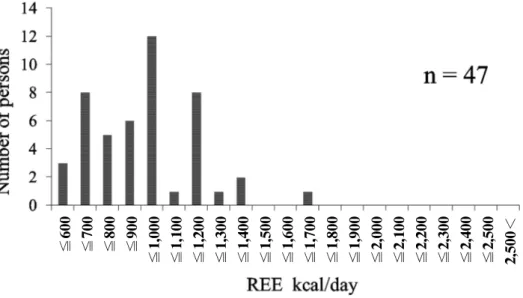
Figure 1 Frequency distribution of REEs of the elderly who resided in the Roken, which showed a normal Gaussian distribution and mean value of 909 ± 239 (mean ± SD) kcal/day/body. All the elderly were
≦60 0 ≦70 0 ≦80 0 ≦90 0 ≦1, 00 0 ≦1, 10 0 ≦1, 20 0 ≦1, 30 0 ≦1, 40 0 ≦1, 50 0 ≦1, 60 0 ≦1, 70 0 ≦1, 80 0 ≦1, 90 0 ≦2, 00 0 ≦2, 10 0 ≦2, 20 0 ≦2, 30 0 ≦2, 40 0 ≦2, 50 0 2, 50 0<
Microsoft Exel 2010.
Results
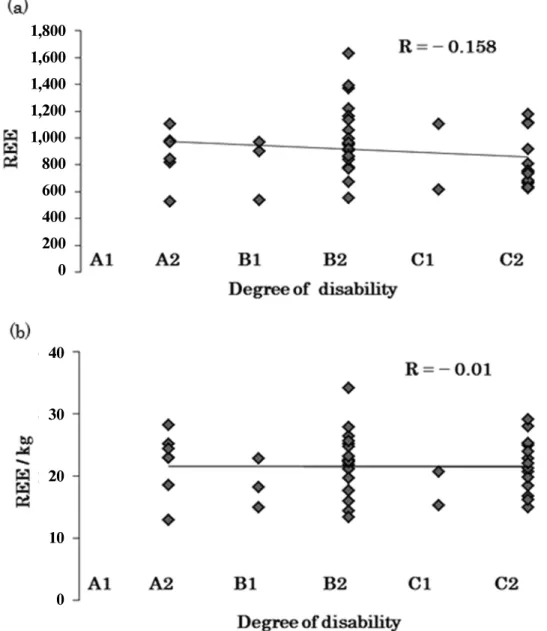
Study 1The REE/body of each of the 47 subjects ranged from 623 to 1,628 kcal/day/body;the mean value was 909 ± 239 (mean± SD) kcal/day/body and was 21.6± 4.5 kcal/kg/day (mean± SD) (Table 2). Fig-ure 1 shows the frequency distribution of the 47 sub-jects, which appeared to resemble a normal Gaussian distribution. The correlation coefficient between REE
and the degrees of disability was R=−0.158(Figure
2a) and that between REE/kg and the degrees of
were observed among the subjects.
However, as shown in Figure 3, a discrepancy between REE and dietary energy intake(F)was obser-ved. The F/REE ratio of 28 persons without body weight gain nor loss was 1.4± 0.4(mean± SD)(Table 2), which indicated that the absorption rate of nutri-ents widely varied among these individuals.
Study 2
The REE/body of each of the 22 patients of the reference group ranged from 589 to 2,549 kcal/day/ body;the mean value was 1391± 459 kcal/day/body (Table 3). The frequency distribution of these patients did not show a normal Gaussian distribution nor
Figure 2 (a) There was no significant correlation between REE and the degree of disability in the Roken. The degree of disability was defined as the gradual deterioration in the condition of daily life from A1 to C2. In A1, the elderly were unable to go outdoors without the aid of an attendant. In C2,the elderly were bedridden and unable to turn over alone. The evaluation methods of the degree of disability have been described in detail elsewhere.
(b) There was no correlation between the REE/kg levels and the degree of disability.
1,800 1,600 1,400 1,200 1,000 800 600 400 200 0 40 30 20 10 0
Figure 3 The discrepancy between REE and dietary energy intake;(○)indicates body weight gain,(×)represents body weight being constant,and (△) shows body weight loss. Subjects above the diagonal line showed a dietary energy intake/REE that was greater than 1.
One subject (a)had systemic edema,whereas another(b)was nervous. The two subjects depicted on the horizontal line were at an end-stage condition and could not eat. One subject (c) had a constant body weight that was maintained for 3 months,regardless of having a dietary intake of 1,600 kcal against REE of 800 kcal. Most subjects (×) were randomly distributed above the diagonal line.
Table 2 Resting energy expenditure(REE)measurements of the elderly in the Roken. REE of the elderly was measured in the Fowler or recumbent position at a resting state for 30 min and at least 1 h postprandially.
Case
No. Age Sex
Body height (cm) Body weight (kg) Degree of
disability (kcal/day)(a) REE (kcal/kg/day)REE/kg
Gain/loss of weight than 3months before (b) Actual food intake (kcal/day) (b)/(a) 1 82 ♀ 145.0 39.1 A2 1,103 28.2 1,300 1.2 2 77 ♀ 153.1 49.6 B1 902 18.2 1,400 1.6 3 80 ♀ 136.2 38.0 B2 860 22.6 1,200 1.4 4 91 ♀ 154.5 38.5 A2 969 25.2 1,440 1.5 5 70 ♂ 148.0 42.0 B2 1,058 25.2 1,665 1.6 6 89 ♀ 136.0 47.0 B2 995 21.2 1,300 1.3 7 81 ♀ 140.0 46.2 B2 1,221 26.4 1,400 1.1 8 73 ♀ 145.5 43.5 B2 918 21.1 1,200 1.3 9 92 ♀ 149.0 53.3 B2 1,369 25.7 1,200 0.9 10 88 ♀ 130.0 35.8 B1 534 14.9 1,200 2.2 11 94 ♀ 140.8 42.7 A2 979 22.9 1,100 1.1 12 85 ♀ 147.0 43.9 A2 815 18.6 1,400 1.7 13 87 ♀ 141.3 52.1 B2 1,137 21.8 1,200 1.1 14 66 ♀ 155.0 44.5 C2 747 16.8 840 1.1 15 82 ♀ 143.6 42.5 B1 968 22.8 1,200 1.2 16 82 ♀ 137.7 38.3 B2 553 14.4 1,200 2.2 17 90 ♀ 140.0 40.9 B2 949 23.2 1,444 1.5 18 86 ♀ 143.0 40.5 A2 523 12.9 1,400 2.7 19 93 ♀ 145.0 44.0 B2 779 17.7 1,344 1.7 20 74 ♀ 151.0 34.5 A2 842 24.4 1,200 1.4 21 97 ♀ 143.0 36.6 B2 906 24.8 1,444 1.6 22 78 ♀ 134.5 43.1 B2 964 22.4 1,200 1.2 23 94 ♀ 152.0 47.7 B2 1,628 34.1 1,600 1.0 24 82 ♀ 144.8 49.8 C2 917 18.4 800 0.9
Energy Expenditure in the Roken
1,800 1,600 1,400 1,200 1,000 800 600 400 200 0 0 200 400 600 800 1,400 1,600 1,800 1,200 1,000
27 81 ♂ 149.0 50.0 B2 1,392 27.8 1,400 1.0 28 79 ♂ 152.0 48.3 B2 772 16.0 1,200 1.6 29 94 ♀ 135.4 37.5 B2 840 22.4 1,200 1.4 30 90 ♀ 140.2 32.4 C2 672 20.7 800 1.2 31 89 ♀ 143.0 33.4 C2 660 19.8 450 0.7 32 83 ♂ 168.5 44.7 C2 1,115 24.9 1,200 1.1 33 81 ♀ 145.0 39.7 C2 1,111 28.0 1,400 1.3 34 100 ♀ 113.0 29.3 C2 623 21.3 800 1.3 35 81 ♂ 163.0 38.9 C2 629 16.2 1,400 2.2 36 85 ♂ 162.0 36.6 C2 808 22.1 1,600 2.0 37 78 ♂ 153.0 49.0 B2 1,137 23.2 1,300 1.1 38 96 ♀ 146.0 29.9 C2 755 25.3 800 1.1 39 90 ♀ 132.0 42.4 A2 971 22.9 1,200 1.2 40 76 ♂ 156.0 53.3 C1 1,103 20.7 1,644 1.5 41 78 ♀ 145.0 49.9 B2 670 13.4 1,000 1.5 42 82 ♀ 150.2 54.4 B2 960 17.6 1,000 1.0 43 93 ♂ 152.0 42.5 C2 637 15.0 0 0.0 44 84 ♀ 148.0 43.9 B2 863 19.7 1,200 1.4 45 90 ♀ 152.0 30.0 C2 684 22.8 0 0.0 46 83 ♀ 145.0 40.4 C2 1,177 29.1 435 0.4 47 93 ♀ 144.0 30.6 C2 733 24.0 1,080 1.5
Table 3 REE of the inpatients of the hospital who were 70 years old calculated by Fick s equation when examined by blood gas analysis using the Swan-Ganz right heart catheterization method.
Case
No. Sex Age Disease BSA(㎡) examinationDate of ml/㎡/minVO2 ml/body/minVO2 (kcal/day)REE
1 ♂ 70 COPD + PTE 1.48 12/2/1993 147 217 1,562 2 ♂ 71 COPD + PTE 1.27 11/5/1999 279 354 2,549 3 ♂ 71 CHF + PH 1.46 1/11/2000 123 180 1,296 4 ♀ 71 PTE 1.33 6/25/1999 104 138 996 5 ♀ 71 COPD + PH 1.52 4/9/1996 124 189 1,357 6 ♂ 72 COPD 1.38 11/5/1992 153 211 1,519 7 ♂ 73 CHF + PH 1.71 12/7/1999 174 298 2,146 8 ♀ 73 PTE? 1.36 3/3/1999 130 177 1,273 9 ♂ 75 PTE 1.71 12/20/1991 151 258 1,858 10 ♀ 75 COPD+PH 1.1 7/16/1997 120 132 950 11 ♀ 77 mild CHF 1.5 3/21/2000 165 248 1,782 12 ♂ 77 PH + ASD 1.23 12/15/2000 197 242 1,745 13 ♂ 79 PTE 1.21 12/14/1994 124 150 1,080 14 ♀ 79 COPD + PH 1.14 4/19/1996 135 154 1,108 15 ♂ 79 PH? 1.45 6/21/1999 76 110 794 16 ♂ 79 PH? 1.45 6/23/1999 111 161 1,159 17 ♂ 80 PTE? 1.42 4/14/1999 163 232 1,667 18 ♂ 83 CHF + PH 1.3 10/20/2000 125 163 1,171 19 ♂ 86 PH 1.5 9/14/1999 159 238 1,714 20 ♀ 86 PH 1.38 10/2/2001 123 170 1,222 21 ♂ 87 PTE 1.44 9/16/1998 103 148 1,068 22 ♀ 90 1.12 10/25/1996 73 82 589
VO2=flow of oxygen, PTE=pulmonary thromboembolism, CHF=chronic heart failure,PH=pulmonary hypertension.? denotes suspicion of disease.
resemble the distribution that was observed in Study 1 as shown in Figure 4.
Discussion
Hosoya et al previously reported on REEs of a total of 6,498 healthy individuals in Japan; these participants ranged in age from 1 to 104 years. The REE/kg levels for the male and female subjects remained steady after the age of 15 years and were estimated to be approximately 29 kcal/kg for the male and female subjects. In addition,based on sex and age stratifications, these REEs showed a normal Gaussian distribution. They also showed that the mean value of REEs of the individuals who were older than 70 years was 1,665± 437 kcal/day/body.
The present study demonstrated that the mean REE of the unhealthy elderly individuals in Study 1 was 909 ± 239 kcal/day/body,which was 55% that of a healthy elderly individual, and was 21.6± 4.5 kcal/ kg/day, which was 74% that of a healthy elderly individual,as described in the reports by Hosoya et al. The individual actual EE could be obtained by calculating REE multiplied by the activity level. However, with low activity levels, Study 1 showed no correlation between REE of the elderly and the activity level during daily life in the population in the Roken. The degrees of the activity level was described in detail
elsewhere. It means the value of REE would be near
to the value of actual EE in the Roken. This may be due to the low activity level of the elderly in the Roken population.
As shown in Figure 3,discrepancies between REE and dietary energy intake without weight gain, even when the daily activity levels were considered,indicat-ed that the absorptive factor of nutrition was more important than food intake.
comprising a combination of non-frail, frail, and disabled subjects,were widely varied and did not show a normal Gaussian distribution. Therefore, the statis-tic comparison between Study 1 and Study 2 was not done. The reason of different distribution between study 1 and study 2 would be due to different popula-tion. Population of study 2 had included non-frailed elderly persons, otherwise population of study 1 did not included non-frailed elderly persons.
The distribution pattern in Study 2 appeared to be a mixture of non-frail,frail,or disabled subjects;thus, there were two peaks that represented the unhealthy elderly described in Study 1 and non-frail healthy subjects which was similar to the findings described by Hosoya et al.
Based on the findings of the present study, we propose the following :
1. REE can be used as a surrogate marker for un-healthy elderly individuals who are frail or disabled. 2. Discrepancies between REE and dietary energy intake were observed and widely varied among the subjects. These findings suggested that although food intake through the alimentary therapy is impor-tant for the elderly, improving the effective absorp-tion of nutrients from the digestive system is impera-tive.
3. We do not believe that low energy intake is suffi-cient for the elderly people with low energy expendi-tures because it is a well-known fact that malnutri-tion results in a decline in physical power, immu-nity, and vitality. Therefore, optimal effective diet-ary energy intake for the elderly with low energy expenditure should be established.
4. It appears to be essential to avoid excessive nutri-tion intake in comparison with REE,particularly in the elderly who are toward the end of their lifespans. 5. The design of an alimentary therapeutic strategy
Figure 4 Frequency distribution of REE of the inpatients in the hospital who were 70 years old and unhealthy, combined with the non-frail, frail, or disabled individuals.
Energy Expenditure in the Roken
≦60 0 ≦70 0 ≦80 0 ≦90 0 ≦1, 00 0 ≦1, 10 0 ≦1, 20 0 ≦1, 30 0 ≦1, 40 0 ≦1, 50 0 ≦1, 60 0 ≦1, 70 0 ≦1, 80 0 ≦1, 90 0 ≦2, 00 0 ≦2, 10 0 ≦2, 20 0 ≦2, 30 0 ≦2, 40 0 ≦2, 50 0 2, 50 0<
Acknowledgements
The authors sincerely thank Yoshihiko Torii,who gave us the opportunity to measure REEs by using a portable indirect calorimeter (Metavine ).
Disclosure Statement
There was no conflict of interest that has affected the results of this study. The institutional ethics com-mittee approved this study.
References
1. Japan Association of Geriatric Health Services Facilities, editors. KAIGOHAKUSHO 2012 (White Paper 2012), Tokyo: KK Office TM, 2012; 202-205. (Available from: http://www.roken.or.jp/wp/english.Accessed April 4,2015). 2. Health and Welfare Services for the Elderly. In: White Paper (Annual Report on Health and Welfare 1998-1999), Tokyo:Ministry of Health, labour and welfare, 1999; vol ume2,II-7.(Available from:http://www.mhlw.go.jp/english/ wp/wp-hw/vol2/p2c7.html. Accessed April 4, 2015). 3. Tabata I, Ebine N,Kawashima Y,et al. Dietary reference
intakes for Japanese 2010: Energy. J Nutr Sci Vitaminol 2013;59:S26-35.
4. Weijs PJ, Vansant GA. Validity of equation for resting
obese women. Clin Nutr 2010;29:347-351.
5. Tamura T,Ichinoseki N,Yoshimura T,et al. Development and evaluation of a simple calorimeter for the measurement of resting metabolism. Clin Exp Pharmacol Physiol Suppl 2002;29:S2-6.
6. Amagai T, Mouri T, Ohkawa H, et al. Accuracy of flow and sensors of indirect calorimetry for neonates and infants: Using mass spectrometry and a pneumotachogram. Clin Exp Pharmacol Physiol Suppl 2002;29:S7-8.
7. Kato M,Tajika M,Miwa Y,et al. Validation of a portable indirect calorimeter (Metavine ) for measuring energy expenditure in an elderly population. Clin Exp Pharmacol Physiol Suppl 2002;29:S9-12.
8. Igawa S, Sakamaki M, Miyazaki M. Examination of the reliability of the portable calorimeter. Clin Exp Pharmacol Physiol Suppl 2002;29:S13-15.
9. Uza M,Tome K,Imai M,et al. A study of case finding of the latent bedridden elderly using criteria of activity of daily living. Minzoku Eisei,Japanese Journal Health and Human Ecology 1997;63(2):79-89. doi:http://dx.doi.org/10.3861/ jshhe.63.79
10. Sumii H, Ebara K. An investigation of the relationship between the kaigo index and the degree of independent living for the elderly and disabled. Bulletin of Hiroshima Prefectural College of Health and Welfare 1997;3(1):57-63 (in Japanese).
11. Hosoya N, Mitsuhashi F, Sugiyama M. Resting energy expenditure among Japanese. Clin Exp Pharmacol Physiol Suppl 2002;29:S16-18.