Abstract: Carbohydrates, inexpensive and rich in stereochemistry, are nature’s gifts to the synthetic organic chemists. We have been conducting research on the carbocyclization of carbohydrates for many years, i.e. the conversion of simple, readily available monosaccharides into hydroxylated cycloalkanes and cycloalkenes with pharmaceutical potential. Several key reactions are presented in this Article to illustrate such facile transformation namely [π4s+π2s] cycloaddition - intramolecular nitrone-alkene and nitrile oxide-alkene cycloadditions, intramolecular direct aldol reaction and intramolecular Horner–Wadsworth–Emmons olefination. These protocols provide facile entries to 6 and 7-membered hydroxylated carbocycles in enantiomerically pure forms which then could be further elaborated into target molecules. Examples including calystegines, tropane alkaloid, cyclohexanyl and cyclohexenyl gabosines, cycloheptanones, valiolamine, validoxylamine G, pseudo-acarviosin, and a SGLT2 inhibitor are presented.
Keywords: carbohydrates, natural products, organic synthesis, pericyclic reactions, hydroxylated carbocycles
This review article describes our research efforts on finding a short, facile, and efficient way of transforming carbohydrates into hydroxylated carbocycles over a period of about 30 years. There are excellent reviews on the topic published elsewhere.1
The story begins when I was a postdoctoral fellow at Oxford working with Professor George Fleet in 1983. We were trying to synthesize shikimic acid from D-mannose using an intramolecular aldol condensation or a Wittig-type alkenation as the key step. Installing a phosphono-acetate moiety at the C-5 of the benzyl furanoside intermediate 1 to form the Wittig–Horner–Emmons precursor met with difficulty (Scheme 1).2
Simple SN2 displacement reactions in carbohydrates are known to be sluggish/difficult due to the high
concentration of oxygen functions (electron rich). Thus the derived standard electrophiles, 5-tosylate 2 and 5-iodide 3 were found to be inert towards substitution. We then attempted to use the 5-triflate 4 as a reactive leaving group (this was new at that time). Gratifyingly, the alkylation proceeded smoothly to give the Horner– Wadsworth–Emmons (HWE) alkenation precursor in a good yield. Subsequent unmasking the aldehyde function in 5 by hydrogenolysis afforded lactol 6 that was treated with base to give the cyclohexene motif, the protected shikimic acid 7. Acid catalysed removal of the blocking groups in 7 furnished shikimic acid in an excellent overall yield.2
Carbocyclization of Carbohydrates to Hydroxylated Cycloalka(e)nes
Tony K. M. Shing
Department of Chemistry, Faculty of Science and Technology, Keio University Email: [email protected]
Up to date, this intramolecular HWE alkenation is still one of the most powerful strategies for the carbocyclization of sugar molecules. A notable example of using this strategy was demonstrated by Fang and co-workers3 to synthesize anti-viral agent Tamiflu® 12 and its more potent phosphonate analog 13 in a similar
manner (Scheme 2).
* Tamiflu® is a registered trademark of F. Hoffmann-La Roche, Ltd.
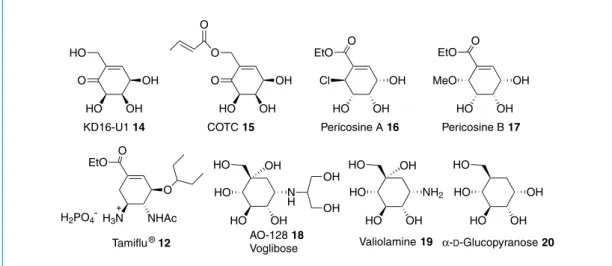
The reasons for researching on carbocyclization of carbohydrates are attributed to the fact that many biologically active molecules are hydroxylated cycloalkanes/alkenes. Carbohydrates are obvious starting materials that offer the most facile and economical way to approach these highly oxygenated carbocycles with defined stereochemistry.
Some hydroxlated cyclohexanes and cyclohexene are listed in Figure 1. They display a wide plethora of bioactivities including antibiotic, antitumor, antiviral, glycosidase inhibitory activities.
O O O OCH2Ph X O HO HO OH OH HO D-Mannose 1 X = OH 2 X = OTs 3 X = I 4 X = OSO2CF3 O O O OR (MeO)2P CO2tBu O 5 steps ~60% overall yield 5 R = CH2Ph 6 R = H (MeO)2P CO2tBu O Na+ -DMF, 15-crown- 5 CO2tBu O O HO CO2H HO OH HO aq. TFA Shikimic acid ~39%
overall yield NaH,
THF
7 Scheme 1. Synthesis of shikimic acid
D-Xylose O AcN O OCH2Ph (MeO)2P E O 8 E = CO2Et 9 E = PO(OEt)2 E AcN O HO E AcHN O H3N 10 E = CO2Et 11 E = PO(OEt)2 12 E = CO2Et (Tamiflu) 13 E = PO(OEt)2 H2PO4
Calystegines,4 displayed specific glycosidase inhibition, are a group of bicyclic heterocycles which are
in equilibrium with the open chain form, a hydroxylated gamma-amino cycloheptanone that are potentially accessible from carbohydrates (Figure 2).
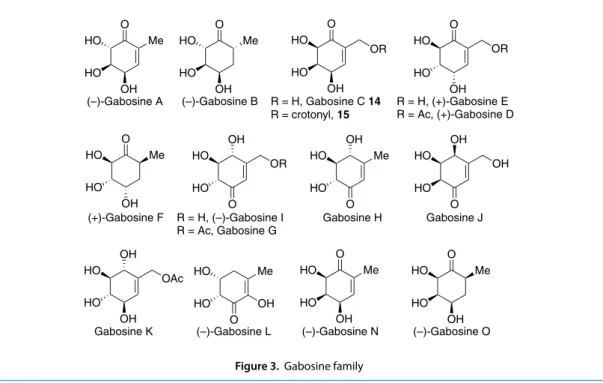
Gabosines are a group of hydroxylated cyclohexanones/cyclohexenones that display antibiotic, anticancer, and DNA binding properties (Figure 3).5 All these compounds should in theory be approachable from sugars,
but how could we effect the carbocyclization efficiently?
Calystegine B5 O NH2 HO HO Calystegine A6 NH HO HO OH O NH2 HO OH R = H Calystegine C1 N HO HO HO OH OH O NHR HO OH HO HO NH HO OH OH OH OH R R = CH3 N-methyl calystegine C1 N H OH HO HO OH HO OH OH HO O OH OH HO AO-128 18 Voglibose O O OH OH HO O EtO O NHAc H3N O H2PO4 -KD16-U1 14 COTC 15 Tamiflu® 12 NH2 OH HO HO OH HO Valiolamine 19 EtO Cl OH OH HO Pericosine A 16 O EtO MeO OH OH HO Pericosine B 17 O OH OH HO HO HO α-D-Glucopyranose 20
Figure 2. Structures of some calystegines
Towards that end, we have been investigating the following strategies for the carbocyclization of sugars: 1. Carbocyclization of Carbohydrates via an Intramolecular Nitrone-Alkene Cycloaddition (INAC) 2. Carbocyclization of Carbohydrates via an Intramolecular Nitrile Oxide-Alkene Cycloaddition (INOAC) 3. Carbocyclization of Carbohydrates via an Intramolecular Direct Aldol Addition of Sugar Diketone 4. Carbocyclization of Carbohydrates via an Intramolecular Horner–Wadsworth–Emmons (HWE)
Olefination
From 1984, I started my independent research career at the University of Manchester and began to investigate the construction of carbocycles using an INAC reaction as the key step.
O Me HO HO OH O Me HO HO OH O HO HO OH OR O HO HO OH OR O Me HO HO OH OH HO OH HO
(–)-Gabosine A (–)-Gabosine B R = H, Gabosine C 14
R = crotonyl, 15 R = H, (+)-Gabosine E R = Ac, (+)-Gabosine D
(+)-Gabosine F R = H, (–)-Gabosine I
R = Ac, Gabosine G Gabosine H Gabosine J
O Me HO HO OH O Me HO HO OH
Gabosine K (–)-Gabosine L (–)-Gabosine N (–)-Gabosine O
OR O OH HO HO Me O HO OH HO OH O OH HO HO Me OH O HO HO OAc
2,3-O-Isopropylidene D-ribose 23 underwent a chelation controlled Grignard vinylation to give triol 24 (Scheme 3). Glycol cleavage oxidation of the vicinal diol in 24 affoded lactol 25 which on heating with N-methyl hydroxylamine furnished a hydroxylated cyclopentane 27 smoothly. This is an extremely short approach towards 5-membered carbocycles and its application to the syntheses of carbocyclic nucleosides should have received more attention.6
On the other hand, chelation controlled vinylation of diacetone mannose 28 gave allyl alcohol 29 stereoselectively which was protected as benzyl ether 30 (Scheme 4). Regioselective mild acid hydrolysis of the terminal acetonide was feasible as the O-8 was the least hindered and therefore protonated first. The resultant diol 31 was oxidatively cleaved to afford aldehyde 32 which was reacted with N-methyl hydroxylamine to give nitrone 33. INAC occurred smoothly on heating to give cyclohexane 34 in good yield. In both cases, the new C–N bond is anti to the O-2 stereochemistry and the ring fusion is cis.6
We had more interests in this INAC reaction because we reasoned that it could be controlled to provide 7-membered carbocycles. When a sugar molecule was elaborated to have a terminal alkene, on reaction with N-alkyl hydroxylamine, there would be two possible modes of INAC cyclization, the exo or the endo mode (Scheme 5), which leads to either a fused or a bridged isoxazolidine, respectively.7 To be specific, a
hept-6-
1
Carbocyclization of Carbohydrates via an Intramolecular
Nitrone-Alkene Cycloaddition (INAC)
HO OHO O OBn OBn O MeN O O OBn BnO O -MeN O O OBn BnO + O OH O O O O O O O O OH OH O O O O OBn OBn aq. AcOH, 64% BnBr, NaH O O O OBn BnO 65% overall from 32 aq. MeOH 28 29 30 31 32 33 34 THF, 93% THF, 79% MeNHOH aq. EtOH MgBr NaIO4 O O O OH HO O O OH O O HO HO OH THF, 72% O O O HO NaIO4 aq. MeOH, 90% O MeN O O OH O -MeN+ NHMeOH aq.EtOH 94% 23 24 25 27 26 MgBrScheme 4. Synthesis of a functionalized cyclohexane 34 from mannose Scheme 3. Synthesis of a functionalized cyclopentane 27 from ribose
enose would provide either a fused bicyclo[4.3.0] system, i.e. a cyclohexane skeleton from an exo-mode or a bridged bicyclo[4.2.1] system, i.e. a cycloheptane skeleton from an endo-mode INAC cyclization. We were particularly intrigued by the potential formation of 7-membered carbocycles as there are few synthetic strategies towards cycloheptanes whereas the synthetic methods for the construction of 5- and 6-membered carbocycles are plentiful.
We realised that the formation of a cyclohexane skeleton via the exo-mode of cyclization of hept-6-enose is the usual regioselectivity outcome with conventional protecting groups like benzyl ether, silyl ether, acetonide, and esters etc. For examples, nitrone 35 and 36, both with a cis-diol acetonide protecting group gave cyclohexane rings in high yields (Scheme 6).8 The stereochemistry of 4-OH apparently had no effect on the
regioselectivity.
We reasoned that the mode of cyclization might be controlled by the blocking groups as they affect the orbital overlap between the nitrone and the alkene. Thus we investigated the effect of trans-diacetal blocking group on the regioselectivity of hept-6-enose. Epimeric nitrones 37 and 38 were readily prepared from
D-arabinose involving glycosidation with benzyl alcohol, diacetalisation, debenzylation, Grignard allylation, glycol cleavage oxidation and reaction with N-methyl hydroxylamine. Interestingly, nitrones 37 and 38 with a trans-diacetal blocking group (the diol moiety is trans) afforded endo-mode of cyclization products 41, 44, 45, i.e., cycloheptane rings, for the first time (Scheme 7). Another notable feature of this reaction is that a trans-fused
N+ -O N O R N+ -O R R N O R
fused bicyclo [X.3.0] bridged bicyclo [X.2.1]
exo mode of cyclization endo mode of cyclization
N+ -O N O R N+ -O R R ON R
fused bicyclo [4.3.0] bridged bicyclo [4.2.1]
R' R' R' R' R' R' R' R' ( )x ( )x ( )x ( )x N+ -O R
O RNHOH R-alkyl group
e.g. Bn, Me sugar aldehyde nitrone 92% O O O N OH Me O O OH O N Me 1 2 3 1 2 3 O O O N OH Bn O O OH O N Bn 94% 1 2 3 1 2 3 35 36
Scheme 5. INAC mode of cyclization
bicyclo[4.3.0] system, i.e. cyclohexane 40 and 43 were formed. The lower yield of cis-fused 42 and higher yield of trans-fused 43 is probably attributed to the 1,3 diaxial interaction between 4-OH and the 6-hydroxymethyl in 42, this steric interaction is absent in the cis-cycloadduct 39. The rigidity of the diacetal ring requires 2-O and 3-O in the trans-diequatorial dispositions, thus 4-OH and the 6-hydroxymethyl in 42 must be axial.8
We reasoned that cycloheptane ring might be more accommodating than 6-membered rings as far as ring strain is concerned. We therefore went on to study the effect of an acetonide with a trans-diol blocking group on the regioselectivity of nitrone cycloaddition of hept-6-enose (Scheme 8). Nitrones 46 and 47 with an acetonide of trans-2,3-diol provided endo-cycloadducts 48 and 49 as the major products for the first time.9
Hept-6-enose nitrones 50 and 51 with a 3,4-trans-acetonide were even more remarkable as only the endo-mode cycloheptanes were harvested in good yields (Scheme 9).10
O N O O Me OH O N O O Me OH O O N O Me OH + 13% 81% 1 2 3 1 2 3 1 2 3 O N O O Me OH O N O O Me OH O O N O Me OH + 31% 63% 1 2 3 1 2 3 1 2 3 46 47 48 49 O N O O Me OMe MeO OH O N O O Me OMe MeO OH O N O O Me OMe MeO OH O O N O Me OH OMe MeO 64% 18% 16% + + 1 2 3 1 2 3 1 2 3 1 2 3 O N O O Me OMe MeO OH O N O O Me OMe MeO OH O N O O Me OMe MeO OH O O N O Me OH OMe MeO 27% 35% 17% + + O O N O Me OH OMe MeO + 21% 1 2 3 1 2 3 1 2 3 1 2 3 1 2 3 6 4 37 38 39 40 41 42 43 44 45
Scheme 8. INAC of hept-6-enoses with a 2,3-trans-acetonide Scheme 7. INAC of hept-6-enoses with a trans-diacetal
We were wondering if the stereochemistry of the C-2/C-5 hydroxyl groups might affect the regioselectivity of the INAC reactions. We thus constructed a hept-6-enose nitrone 60 with only a 3,4-trans-acetonide from
L-tartaric acid using standard reactions (Scheme 10). Only a cycloheptane ring 61 was obtained, thereby confirming that the endo-mode of cyclization was controlled by the trans-acetonide ring.11
O O N O Me HO O O HO N Me O 2 3 4 1 1 2 3 4 O O N O Me HO 1 2 3 4 + 85% 8% O O N Bn O OBz BnO O O N O Bn OBz BnO + O O N O Bn OBz BnO 56% 29% 1 2 3 4 1 2 3 4 1 2 3 4 50 51
Scheme 9. INAC of hept-6-enoses with a 3,4-trans-acetonide
O O HO OH O O MeO OMe O O MeO OMe AcCl, MeOH
reflux Dean & Stark trap
88% from 52 conc. H3PO4, 3-pentanone L-Tartaric acid (52) 53 54 O O HO OH HO OH LiAlH4 THF, reflu x 55 O O HO OH I 2, PPh3, Im toluene, rt 77% THF, –78 °C to –30 °C73% 56 57 O O CuMgI • MgBr2 2 O O I I O O HO HO 58 5 mol% OsO4, NMO
aq. acetone 45%
BnNHOH MeCN, reflux 86% from 58 59
NaIO4, silica gel
CH2Cl2, rt O O H O N O O O Bn 61 N O HO OH Bn TFA, H2O CH2Cl2, rt 100% 62 H2N OH HO OH 63 H2, Pd/C t-BuOH/H2O (v/v=5:1) rt, 94% O O N O Bn 60 endo-mode INAC
(10 steps, 27% overall yield from L-tartaric acid) 3 4
99%
Since we have established that 7-membered cycloheptanes can be accessed via a trans-acetonide directed endo-selective INAC reactions of hept-6-enoses, we set out to synthesize calystegine analogs. In this way, D-xylose was transformed into cycloheptanes 63, 64, 65 with a 3,4-trans-acetonide (Scheme 11). Debenzoylation afforded the corresponding alcohols in which 66 and 68 were oxidized to the same ketone 69. Acidic deacetonation of 69 followed by global hydrogenolysis furnished (S)-3-hydroxy-calystegine B5 71.10
We found that tert-butanol was a good solvent for hydrogenolysis of a N-benzyl group as no side products from N-alkylation was possible.
68 N O BnO Bn O O OH K2CO3, MeOH/CH2Cl2 rt, 24 h, 91% 66 N O BnO Bn O O OH K2CO3, MeOH/CH2Cl2 rt, 8 h, 100% 67 N O BnO Bn O O OH 63 (14%) N O BnO Bn O O OBz 64 (7%) N O BnO Bn O O OBz 65 (14%) N O BnO Bn O O OBz + O OH HO OH OH D-Xylose 10 steps + K2CO3, MeOH/CH2Cl2 rt, 6 h, 100% 66 N O BnO Bn O O OH 68 N O BnO Bn O O OH 69 N O BnO Bn O O O IBX, DMSO/CH2Cl2 (v/v=1:1), rt, 100% IBX, DMSO/CH2Cl2 (v/v=1:1), rt, 100% 69 N O BnO Bn O O O TFA, H2O CH2Cl2, rt 70 N O BnO Bn HO OH O 10% Pd/C, H2 t-BuOH, rt, 92% NH HO OH OH O NH2 HO HO OH HO OH OH 71 (S)-3-Hydroxy-calystegine B5 NH HO OH OH OH Calystegine B5 O NH2 HO HO OH 4 1 2 3 5 6 7
On the other hand, D-ribose was converted into aldehyde 72 which underwent trans-acetonide directed endo-selective INAC reaction to give cycloheptane 73 in an excellent yield (Scheme 12). Acid hydrolysis of the acetonide ring produced the diol 74 which underwent steric controlled regio-selective oxidation of the less hindered alcohol to give ketone 75. Hydrogenolysis of the N–O bond afforded a B-type calystegine 76.10
Then we investigated this endo-selective INAC approach towards syntheses of tropane alkaloid 90 and analogs.
(A) Strategy towards tropane alkaloid 1: INAC of a Nitrone with a 2,3-cis-Isopropylidene as Blocking Group and an a,b-Unsaturated Ester as Dipolarophile
Since the alkene moiety in 77 is an electrophilic alkene whereas the alkenes used in our INAC cyclization mode studies were simple nucleophilic alkenes, we were hoping that the electrophilic alkene of the enoate group in 77 might cause an endo-selective INAC reaction attributable to HOMO–LUMO reasons (Scheme 13). This proposal was supported by a precedent12 that in the intermolecular nitrone-alkene cycloaddition of a,b-unsaturated
ester 82, and nitrone 81, the new C–O was installed on the b-carbon in cycloadducts 83 and in 84 (Scheme 14). If this were applied to our INAC case, the endo-mode cyclization would have taken place. We were excited with this precedent and therefore proceeded with the synthesis.
OHC O O OBn MeN O O O BnO MeNHOH D-Ribose 5 steps MeN O HO OH BnO 100% 97% 56% Ac2O DMSO TFA MeN O HO O BnO 75 HO O HO MeHN OH NMe HO HO HO HO 10% Pd/C, H2, t-BuOH/H2O (v/v=5:1), rt, 48h, 87%
76 B-type calystegine analog 72 73 74 exo-mode INAC endo-mode INAC 4 1 2 3 1 2 3 O O HO N Me O CO2Et 4 O NMe O O HO MeN O O CO2Et HO EtO2C N O O O Me H H CO2Et HO 1 2 3 4 ? ? 77 78 79 80 Scheme 12. Synthesis of a B-type calystegine analog
To our disappointment, the INAC of nitrone 85 produced only exo-mode cycloadducts 86 and 87, 6-membered carbocycles. Hence it appears that steric control is more important than electronic control for the regioselectivity (exo versus endo) of INAC reactions of hept-6-enoses (Scheme 15).11
(B) Strategy towards tropane alkaloid 2: INAC of a Nitrone with a 3,4-trans-Isopropylidene as Blocking Group and an a,b-Unsaturated Ester as Dipolarophile
Since we had shown that 3,4-trans-acetonide would direct an endo-selective mode of cyclization, we devised a synthetic route towards cocaine based on this key step as summarised in Scheme 16.
O O O OH EtO2C MeNHOH • HCl, py O O N O Me CO2Et HO (60%) exo-mode INAC H H O O N O Me HO CO2Et EtOH, reflux, 2 h (11%) + N O O O Me H H CO2Et HO 85 86 87 O O O N Me BnO O O BnO N O Me CO2Me 1 2 3 4 1 2 3 4 NMe CO2Me OBz Tropane alkaloid 90 O O O N CO2Me H H Me BnO 21 3 4 endo-mode INAC exo-mode INAC CO2Me 88 89 OHH H + CO2Me OHH H N O CO2Me Me N O Me OHH H N O CO2Me Me + xylene 140 °C α β α β αβ 81 82 83 84
Scheme 15. INAC of enoate with a cis-acetonide
Scheme 16. Steric controlled synthetic plan towards tropane alkalovid 90 Scheme 14. Intermolecular cycloaddition of nitrone 81 and enoate 82
Capitalising from our studies that 3,4-trans-acetonide would produce cycloheptane ring on INAC reactions of hept-6-enoses, we proceeded to prepare the nitrone 97 from ribose.13 The known allyl alcohol 91 was readily
obtained from D-ribose via a steric-controlled allylation (Scheme 17). Thermodynamic acetonation of 91 formed the 7,8-O-isopropylidene first as the primary 8-alcohol was the most reactive of all. Then an acetonide was formed between O-4,5 instead of O-5,6 because the substituents on the acetonide ring 92 were trans to each other. The diacetonide 92 was then transformed into diol 95 without incident. Glycol cleavage oxidation of 95 with silica supported NaIO4 furnished aldehyde 96 smoothly. This solid-phase NaIO4 reagent14 is highly
recommended as the operation is very simple and the aldehyde harvested is usually un-hydrated. INAC reaction of 97 did produce the desired cycloheptane derivative 98 as the major product.13
As the cycloheptane skeleton was installed correctly, cycloadduct 98 was converted into natural tropane alkaloid 90 and its analogs 100–104 as shown in Figure 4.13
O HO HO OH OH D-Ribose OH OH OH OH HO 64% from D-Ribose OH O O O O 91 92 anhydrous CuSO4 acetone In, allyl bromide
EtOH/H2O OBn O O O O 93 BnBr, NaH cat. nBu 4NI THF, 98% OBn O O O O CO2Me CO2Me Grubbs catalyst II CH2Cl2, 95% 94 80% AcOH rt, 73% OBn O O HO HO CO2Me 95
NaIO4, silica gel CH2Cl2, rt OBn O O H CO2Me O 96 99 + O N O O CO2Me BnO H H Me O O BnO NO Me CO2Me 97 INAC O O O N Me BnO 98 CO2Me (endo-cycloadduct) (exo-cycloadduct) toluene, reflux NHMeOH 75% 15 1
The use of chloramine-T in the conversion of ene-sugar oxime into a nitrile oxide and its subsequent INOAC reaction is known.15 This cycloaddition shown in Scheme 18 can only be exo-mode as the endo-mode
of cyclization would produce an impossible C=N bond at the bridge head position (Bredt’s rule).16
Common chemicals for the transformation of oxime into nitrile oxide include NaOCl, NaOCl/NEt3 and
N-chorosuccinimde/NEt3.16 Under the basic conditions, the free hydroxyl group in nitrile oxide 105 would
attack the nitrile carbon to give oximolactone 106 and failed to produce a carbocycle. The hydroxy groups of the sugar have to be protected in order to achieve satisfactory yields. Thus, providing a mildly acidic environment for the INOAC reactions is crucial in achieving a fruitful carbocyclization without the formation of oximolactone.
Carbocyclization of Carbohydrates via an Intramolecular
2
Nitrile Oxide-Alkene Cycloaddition (INOAC)
OBz CO2Me BnO NMe Cl 100(12 steps, 23% overall yield)
OBz CO2Me HO NMe OBz CO2Me MsO NMe 103
(14 steps, 16% overall yield)
101
(13 steps, 17% overall yield)
OBz CO2Me
Cl NMe
102
(14 steps, 15% overall yield)
OBz CO2Me
I NMe
104
(15 steps, 12% overall yield)
OBz CO2Me NMe Tropane alkaloid 90 (15 steps, 12% overall yield) Figure 4. Tropane alkaloid 90 and its analogs
N OH
O N
Chloramine-T N O *
Oxime Nitrile oxide Isoxazoline
exo only Nitrile oxide 105 O O O N HO Oximolactone 106 O O N O HO aq NaOCl or NCS, Et3N
Scheme 18. Intramolecular nitrile oxide-alkene cycloaddition (INOAC)
We found that adding flash chromatography silica gel to “buffer” the reaction medium dramatically increased the yield of the chloramine-T mediated INOAC reaction from 62 to 94% (Scheme 20).17
Towards the construction of 5-membered carbocycles, similar improvement in reaction yields were observed and examples are shown in Scheme 21. It is interesting to note that other acidic conditions attempted including the addition of acetic acid, benzoic acid, acetate buffer or phosphate buffer did not cause the INOAC to occur.
The silica gel mediated INOAC reactions were compatible with substrates containing unprotected hydroxyl groups, thus reducing masking/unmasking steps and rendering a synthesis shorter.17
We have applied this methodology to the construction of gabosine O and F.18 Mannose was transformed
readily into oxime 114 with a free hydroxyl group (Scheme 22). INOAC of 114 occurred smoothly to give a 6-membered carbocycle 115 which was hydrogenolysed, dehydrated, and then hydrogenated from the less hindered side to form ketone 118. Acidic hydrolysis of the acetonide in 118 yielded the target molecule gabosine O.18 O O OH N MeO OMe HO O O OH MeO OMe O N 107 108 (62%) Chloramine-T EtOH, rt EtOH, rt 108 (94%) Chloramine-T, silica gel
O O OH O N 110 (53%) + O O O HO 109 O O O N HO 106 (33%) 1) NH2OH 2) Chloramine-T, EtOH, rt 1) NH2OH
2) Chloramine-T, silica gel, EtOH, rt
N HO OH HO OH ON HO OH HO 112 (51%) 111 Chloramine-T EtOH, rt 110 (87%) 112 (87%) Chloramine-T, silica gel
EtOH, rt
106 (78%) 2) NaOCl (aq), CH2Cl2, 0 °C
1) NH2OH
Scheme 20. INOAC with and without silica gel
On the other hand, L-arabinose was transformed into oxime 119 with a free hydroxyl group. INOAC reaction of 120 furnished the 6-membered carbocycle in an excellent yield with the new C–C bond equatorially installed. Standard conversion afforded the target molecule gabosine F (Scheme 23).
O HO OH OH OH HO MgBr O O O O OH OH O O HON HO OH O N O O D-Mannose 1) acetone, H+, 92% 2) THF, 83% 1) H5IO6, Et2O, 79% 2) NH2OH, MeOH 100% Chloramine-T silica gel, EtOH 79%, α:β = 4.6:1 113 114 115 OH O O O 118 OH O HO OH Gabosine O 89% from 116
H2, Raney Ni, AcOH 97%, α:β = 6:1
OH O
O O
HO
Martin’s sulfurane H2, Raney Ni aq.TFA
116
OH O
O O
117
Scheme 22. Synthesis of gabosine O
O HO
OH OH OH
silica gel, EtOH, 94% N H O O OMe MeO HO HO Chloramine-T O O O N OH OMe MeO L-Arabinose
H2, Raney Ni, AcOH O O O OH MeO OMe OH 121 HO OH OH O Gabosine F 90% 119 120 1) AcCl 2) Et3N 3) H2, Raney Ni 6 steps
First of all, we started our investigation on D-glucose since voglibose 18 and valiolamine 19 are obvious synthetic targets. Glycosidation of D-glucose with allyl alcohol and then diacetalization produced 2,3- 124 and 3,4-diacetals 123 which were readily separable upon acetonation to the 4,6-acetonide 126.19 Palladium catalysed
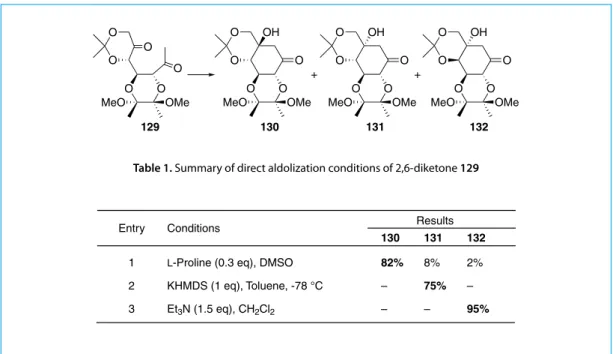
deallylation of glycoside 126 gave lactol 127 which underwent Grignard methyl addition followed by PDC oxidation afforded the 2,6-diketone 129. Intramolecular aldol addition reactions of 129 were carried out under various basic conditions and the best results are shown in Table 1.
The stereo-selective formation of a particular aldol product can be controlled by either L-proline, strong or weak amine base. It is noteworthy that all the direct aldol reactions are not reversible. The resistance towards a retro-aldol reaction is probably attributable to steric reasons.
3
Carbocyclization of Carbohydrates via an Intramolecular
Direct Aldol Addition of Sugar Diketone
O HO OH HO D-Glucose 122 123 124 O HO OAll HO O HO OAll HO O O MeO OMe 2,3-butadione CH(OMe)3 MeOH acetone O O OAll HO O OH OMe MeO HO HO OH OH + 125 (40%) 126 (43%) O O OAll O O O MeO OMe O O OAll HO O OH OMe MeO + OH MeO OMe 127 128 O O OH O O O MeO OMe MeMgBr THF OH O OH O O O MeO OMe 95% 92% 82% K2CO3, MeOH PDC, 3Å MS CH2Cl2 Pd(PPh3)4 126 O O OAll O O O MeO OMe 129 O O O O O O MeO OMe O O O O MeO OMe O OH Intramoleculardirect aldol reaction BF3 • OEt2
The preparation of mannose diketone 135 was executed in a similar manner (Scheme 25). Disappointingly, all strong and weak basic conditions failed to generate an aldol product with the exception of L-proline, which provided aldol 136 as the sole cyclohexanone in 60% yield.19
We have also investigated an intramolecular direct aldolization of 2,7-diketones, in search for a synthetic avenue towards hydroxylated cycloheptanones. The 2,7-diketones were prepared from D-ribose or D-mannose using standard reactions and the results are summarized in Scheme 26.20
129 O O O O O O MeO OMe 130 O O O O MeO OMe O OH 131 O O O O MeO OMe O OH 132 O O O O MeO OMe O OH + +
Entry Conditions Results
130 131 132
1 L-Proline (0.3 eq), DMSO 82% 8% 2%
2 KHMDS (1 eq), Toluene, -78 °C – 75% –
3 Et3N (1.5 eq), CH2Cl2 – – 95%
Table 1. Summary of direct aldolization conditions of 2,6-diketone 129
O HO HO OH OH HO O O OH O O O OH O OH O O O O O O O O O 1) 2-methoxypropene p-TsOH, DMF 2) Ac2O, pyridine O O OAc O O O K2CO3 MeOH MeMgBr THF 1) (COCl)2, DMSO 3Å MS, CH2Cl2 2) DIPEA D-Mannose 61% 93% 88% 75% O O O O O OH L-proline DMSO 60% 135 136 133 134
Application of the versatile intramolecular direct aldolization strategy to synthesis was demonstrated by the following examples.
3a. Synthesis of Valiolamine and Voglibose (AO128)
D-Glucose was transformed smoothly into aldol 131 as stated above. Oximation of the ketone moiety in 131 followed by hydrogenation/hydrogenolysis furnished amine 142. Acidic removal of the acetals in 142 provided vailolamine 19 which, reportedly, could be converted into the anti-diabetic agent voglibose (AO128) 18 (Scheme 27).19 O HO OH OH HO L-proline DMSO, 24 h 92% O O BnO O OH TBSO O O BnO O O TBSO D-Ribose O HO OH OH HO OH O O OBn BnO O OH TBSO O O OBn BnO O O TBSO 87% L-proline DMSO, 21d D-Mannose O HO OH OH HO O O OBn O TBSO O O O OBn TBSO O OH O O OBn O TBSO OH O O OBn TBSO O OH L-proline DMSO, 3d 91% + + D-Ribose 139 (55%) 140 (19%) 141 (17%) 137 138 O O O O MeO OMe O OH O HO OH HO HO OH 7 steps, 23.1% overall yield O O O O MeO OMe NH2 OH 1) NH2OH • HCl 2) Raney Ni, H2 EtOH, Et3N 85% HO HO HO OH NH2 OH TFA, H2O CH2Cl2 88% HO HO HO OH NH OH
Valiolamine 19 VogliboseAO-128 18
D-Glucose 131 142
OH OH
Scheme 26. Summary of direct aldolization of 2,7-diketones from ribose and mannose
3b. Synthesis of Pseudo-Acarviosin
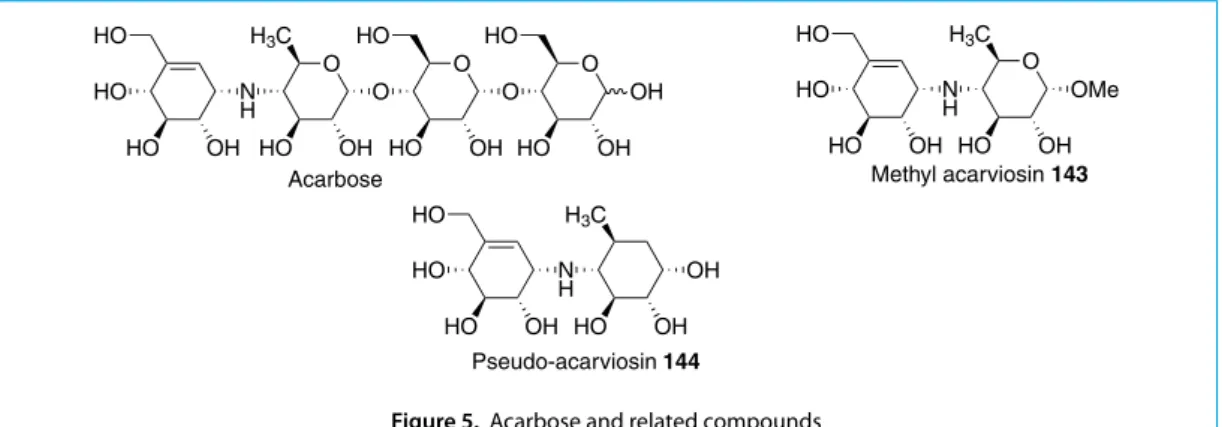
Methyl acarviosin 143 was obtained from the natural anti-diabetic agent, acarbose, by acidic methanolysis (Figure 5). As methyl acarviosin is a stronger a-amylase inhibitor, we wanted to replace the sugar moiety in 143 with a cyclohexane to render the compound more stability in acid conditions. In search for an improved anti-diabetic drug, we proceeded to synthesize pseudo-acarviosin 144 for biological screening.
Retrosythesis of pseudo-acarviosin 144 via a palladium catalysed allylic substitution would give two fragments, an allylic chloride 145 and a cyclohexanyl amine 146. Chloride 145 would be accessed from
D-glucose via a direct aldol strategy while the amine 146 should be approached from L-arabinose through an INAC reaction.21
The palladium-catalysed coupling plan is the result of a massive experimentation. We attempted a great many coupling reaction conditions between different partners, amine with mesylate, ketone, allylic epoxide, allyic cyclic sulphite, or allylic acetate.22 As most of the electrophiles are unstable under the conditions and
elimination is the major side-reaction, none of the coupling reactions gave the desired product except for using allylic chloride as the coupling partner shown in Scheme 29.23
N H OH HO HO HO O H3C HO OH O OH HO HO O O OH HO HO OH O HO N H O OMe OH OH HO H3C HO HO HO N H OH OH OH HO H3C HO HO
Acarbose Methyl acarviosin 143
Pseudo-acarviosin 144
Figure 5. Acarbose and related compounds
HO N H OH OH OH HO HO HO CH3CN, Et3N, rt + Pd(dba)2, TMPP 145 H2N O O OTBS OMe MeO 146 O O O O MeO OMe Cl O HO HO OH OH HO O OH OH HO HO O O OO P dba = TMPP = D-Glucose L-Arabinose 144
Since the coupling conditions were established, we started to construct the two coupling partners 145 and 146. D-Glucose was converted into aldol 130 as said earlier.19 Elimination of the alcohol in 130 followed by
reduction of the ketone group in 147 produced allylic alcohol 148 which was separated from its epimer via an acetylation and deacetylation protocol. The isolated 148 was then transformed into the allylic chloride 145 by standard reactions (Scheme 30).
On the other hand, the amine coupling partner 146 was assembled from L-arabinose via an INAC reaction of a protected hept-6-enose 151 as the key step (Scheme 31).21 The major exo-cycloadduct 154 with a
trans-ring fusion was formed with the correct stereochemistry. It is noteworthy that the trans-fused exo-cycloadduct could only be harvested with the nitrone containing a trans-diacetal blocking group. The cycloadduct 154 was transformed readily into the cyclohexyl amine 146 using standard reactions with a good overall yield.
OBn OBn O Cl OBn OBn OBn O OBn + N O NMe2 R1 N R2 H R1 R2 O Me2N Pd(dba)2, TMPP Et3N, CH3CN 13-98% yield O O O O MeO OMe O OH POCl3 pyridine 99% O O O O MeO OMe O O HO OH HO HO OH 7 steps, 25.3% overall yield L-proline, DMSO NaBH4, CeCl3 • 7H2O O O O O MeO OMe OH MeOH, –20 °C O O O O MeO OMe OAc Ac2O, DMAP Et3N, CH2Cl2 98% O O O O MeO OMe K2CO3, MeOH 99% O O O O MeO OMe O O O O MeO OMe Cl 1) MsCl, Et CH2Cl2 3N 2) 3ÅMS, nBu 4NCl 84% OH O O O O MeO OMe OH + 147 130 148 D-Glucose 149 150 145 OAc Scheme 29. Successful coupling reactions when allylic chloride was used
With the coupling partners in our hand, palladium catalysed allylic substitution of chloride 145 with amine 146 proceeded with retention of configuration to give the protected allylic amine 161 (Scheme 32). Hydrolysis gave the target molecule pseudo-acarviosin 144 which was shown to be a stronger sucrose and glucoamylase inhibitor than acarbose.21
O O O O MeO OMe Cl 145 H2N O O MeO OMe OTBS 146 O O O O MeO OMe H N O O MeO OMe OTBS 161 + Pd(dba)2, TMPP Et3N, CH3CN 84% HO HO HO OH N H HO OH OH TFA, H2O, CH2Cl2 90% 144 O O O MeO OMe HO NaHCO3, CH3CN rt, 100% BnNHOH • HCl OH N O Bn O O MeO OMe O N O O MeO OMe OH Bn O N O O MeO OMe OH Bn N O O O OH MeO OMe Bn N O O O OH MeO OMe Bn 153 (19%) 154 (43%) 155 (29%) 156 (7%) + + + 2-propanol 40 °C, 9d O OH HO OH OH L-Arabinose 10 steps O N O O MeO OMe OH Bn 157 O N O O MeO OMe OTBS Bn 158 BnHN O O MeO OMe OTBS 159 OMs BnHN O O MeO OMe OTBS 160 H2N O O MeO OMe OTBS 146 TBSCl, imidazole DMF, 100%
1) Raney Ni, H2, EtOH 2) MsCl, Et3N, CH2Cl2 LiEt3BH, THF 90% 10% Pd/C, H2 EtOH, 100% 151 152 86%
Scheme 32. Synthesis of pseudo-acarviosin 144 Scheme 31. Preparation of amine 146 from L-arabinose
3c. Synthesis of Validoxylamine G
Capitalising on the palladium-catalysed allylic substitution reaction, the silyl ether 162 of the afore-prepared amine 142 and allylic chloride 145 (both are direct aldol products from D-glucose) were coupled together to form pseudo-glycosyl amine 163 which on complete acidic deprotection afforded validoxylamine G 164 in a good yield (Scheme 33).19
3d. Synthesis of Gabosines
A number of gabosines were easily assembled from D-glucose via the direct aldol strategy. Only a few of them are illustrated here.24,25 Thus the aforesaid enone 147 was regio- and stereo-selectively reduced to the
a-allylic alcohol 165 in an excellent yield (Scheme 34). Functional group manipulation of 165 with standard reactions then furnished gabosine A, D, and E without incident.25
(178_RA_S34.eps) O O O O MeO OMe NH2 OH TMSOTf Et3N, CH2Cl2 O O O O MeO OMe NH2 OTMS 85% TFA H2O CH2Cl2 Pd(dba)2 TMPP Et3N CH3CN 99% O O O O MeO OMe Cl 88% + O O O O MeO OMe H N OTMS O O O O OMe MeO HO HO HO OH N H OH OH OH OH HO Validoxylamine G 164 163 142 162 145 O O O O MeO OMe OH O HO OH HO HO OH O O O O MeO OMe O O O O O MeO OMe OTBS HO HO O O MeO OMe OTBS TBSCl imidazole CH2Cl2 80% AcOH 88% 95% K-selectride THF 99% HO R O O MeO OMe OTBS O R O O MeO OMe OTBS O R HO OH OH PDC, 3Å MS CH2Cl2 TFA, H2O CH2Cl2 1) MsCl 2) LiEt3BH, 84% or AcCl, 94% or TBSCl, 97% 8 steps, 25% overall yield 91-100% 87-90% D-Glucose (+)-Gabosine A R = H (+)-Gabosine D R = OAc (+)-Gabosine E R = OH 147 165
Scheme 33. Synthesis of validoxylamine G 164
Intramolecular HWE olefination was introduced at the beginning of this article, interestingly, it is perhaps still the best strategy for a short and efficient carbocyclization of carbohydrate. Towards this end, we globally protected D-gluconolactone with 2-methoxypropene as mixed acetals 166 (Scheme 35).26 Addition of methyl
phosphonate carbanion followed by oxidation of the alcohol in 167 caused intramolecular HWE alkenation to proceed concomitantly to give the protected cyclohexanone 169 in just 3 steps from the free sugar! Acidic removal of the acetals afforded gabosine I 170 and regioselective acetylation at the primary alcohol provided gabosine G 171. The relatively labile mixed acetal blocking groups were problematic, but we have circumvented this obstacle with ethoxymethyl (EOM) protecting group.27
Since EOM protected cyclohexanone 172 could also be synthesized readily from D-gluconolactone (Scheme 36), application of this route to the syntheses of streptol and other gabosines were accomplished.27,28 Exploiting
this facile carbocyclization strategy, we embarked on the construction of sodium-dependent glucose cotransporter 2 (SGLT2) inhibitors.
4
Carbocyclization of Carbohydrates via an Intramolecular
Horner–Wadsworth–Emmons (HWE) Olefination
O HO HO OH O HO O O O O O O MeO OMe 72% Me P O OEt OEt OH O O O O MeO OMe O P O OEt OEt THF, –78 °C O O O O O MeO OMe 1) LDA, TPAP, NMO 3Å MS, CH3CN 2-methoxypropene K2CO3, 43% (±)-CSA, DMF O O O O O MeO OMe O P O OEt OEt HO O HO HO OH 95% HO O AcO HO OH TFA, H2O Collidine –40 °C to rt 65% AcCl (–)-Gabosine I 170 Gabosine G 171 CH2Cl2 D-Gluconolactone 166 167 169 168 O HO HO OH O HO EOMO O EOMO EOMO OEOM D-Gluconolactone 172 in 3 steps as in Scheme 35Scheme 35. Syntheses of gabosine I and G
Sergliflozin is a potent SGLT2 inhibitor, but was abandoned for further investigation because phenyl glycosides are prone to hydrolysis and therefore not suitable for development into useful medicine. Replacing the sugar moiety in sergliflozin with a pseudo-sugar unit would provide a stable “glycoside” 173 as the “glycosidic bond” is now an ether linkage (Figure 6).29
The synthetic avenue towards pseudo glucopyranoside 173 is shown in Scheme 37. Regio- and stereo-selective reduction of 172 gave a-alcohol 174 which was activated and displaced with chloride to b-chloride 175. Palladium catalysed allylic substitution of the allylic chloride 175 with phenolic alcohol 176 proceeded with retention of configuration to form allylic ether 177 in an excellent yield. Catalytic hydrogenation followed by acid removal of the EOM groups afforded the target molecule 173 which is a potent and selective SGLT2 inhibitor. Other analogs have also been made on extending this carbocyclization strategy.30,31
HO HO OH OH O OMe O HO HO OH OH O Sergliflozin OMe Pseudo-aryl Glucoside 173 Figure 6. Structures of sergliflozin and pseudo-aryl glucoside 173
HO HO OH HO O OMe 1) Pd(OH)2/C, EtOH H2, rt 2) HCl, H2O, EtOH 173, 66% 5 1 EOMO EOMO EOMO OEOM Cl 175 RO RO OR RO O OMe HO OMe 176 + Pd(dba)2, dppe EOMO EOMO EOMO OEOM Cl 175 EOMO EOMO EOMO OEOM O 172 EOMO EOMO EOMO OEOM OH 174 LiEt3BH THF, 76% MsCl, Et3N nBu 4NCl, 81% 177 K2CO3, CH3CN 94%
Conclusion
In this Article, transformation of carbohydrates into highly oxygenated cycloalkanes and cycloalkenes has been described using four synthetic strategies, namely intramolecular nitrone-alkene and nitrile oxide-alkene cycloadditions, direct aldol addition, and Horner–Wadsworth–Emmons (HWE) olefination. The latter strategy probably offers the most facile and efficient avenue to the pseudo-D-glucopyranose motif to date. The carbocyclized intermediates could then elaborated into various target molecules containing hydroxyl/amine functional groups of defined stereochemistry. Considering the low cost, availability in large quantities, and rich stereochemistry of sugar molecules, carbohydrates are perhaps the ideal starting materials for the construction of heavily oxygenated natural products or molecules with pharmaceutical implication. Research towards the syntheses of carbocyclic nucleosides should have received more attention.
Acknowlegments
The author wishes to thank the University of Manchester, the Chinese University of Hong Kong and the Hong Kong Research Grant Council for supporting these works. Sincere gratitude goes to his research collaborators and co-workers for their efforts and stimulating ideas, especially to Professor Tohru Yamada of Keio University for his unflagging support, encouragement, and friendship.
References
1) (a) O. Arjona, A. M. Gómez, J. C. López, J. Plumet, Chem. Rev. 2007, 107, 1919. (b) R. J. Ferrier, S. Middleton, Chem. Rev. 1993, 93, 2779.
2. (a) G. W. J. Fleet, T. K. M. Shing, J. Chem. Soc., Chem. Commun. 1983, 849. (b) G. W. J. Fleet, T. K. M. Shing, S. W. Warr, J. Chem. Soc., Perkin Trans. 1 1984, 905.
3. J.-J. Shie, J.-M. Fang, S.-Y. Wang, K.-C. Tsai, Y.-S. E. Cheng, A.-S. Yang, S.-C. Hsiao, C.-Y. Su, C.-H. Wong, J. Am. Chem. Soc. 2007, 129, 11892.
4. (a) B. Drager, Nat. Prod. Rep. 2004, 21, 211. (b) N. Asano, Curr. Top. Med. Chem. 2003, 3, 471.
5. (a) K. Tatsuta, T. Tsuchiya, N. Mikami, S. Umezawa, H. Umezawa, H. Naganawa, J. Antibiotics 1974, 27, 579. (b) G. Bach, S. Breiding-Mack, S. Grabley, P. Hammann, K. Hütter, R. Thiericke, H. Uhr, J. Wink, A. Zeeck, Liebig. Ann. Chem. 1993, 3, 241. (c) Y.-Q. Tang, C. Maul, R. Höfs, I. Sattler, S. Grabley, X.-Z. Feng, A. Zeeck, R, Thiericke, Eur. J. Org. Chem. 2000, 1, 149.
6. T. K. M. Shing, D. A. Elsley, J. G. Gillhouley, J. Chem. Soc., Chem. Commun. 1989, 1280.
7. J. J. Tufariello, In 1,3-Dipolar Cycloaddition Chemistry, ed. by A. Padwa, Wiley, New York, 1984, Vol. 2, pp. 83-168.
8. T. K. M. Shing, A. W. F. Wong, T. Ikeno, T. Yamada, J. Org. Chem. 2006, 71, 3253. 9. T. K. M. Shing, A. W. F. Wong, T. Ikeno, T. Yamada, Chem. Eur. J. 2009, 15, 2693. 10. T. K. M. Shing, A. W. F. Wong, T. Ikeno, T. Yamada, Org. Lett. 2007, 9, 207. 11. T. K. M. Shing, K. H. So, unpublished results.
12. E. G. Baggiolini, J. A. Iacobelli, B. M. Hennesy, A. D. Batcho, J. F. Sereno, M. R. Uskokovic, J. Org. Chem. 1986, 51, 3098.
13. T. K. M. Shing, K. H. So, Org. Lett. 2011, 13, 2916. 14. Y.-L. Zhong, T. K. M. Shing, J. Org. Chem. 1997, 62, 2622.
15. (a) A. Pal, A. Bhattacharjee, A. Bhattacharjya, A. Patra, Tetrahedron 1999, 55, 4123. (b) S. Majumdar, R. Mukhopadhyay, A. Bhattacharjya, Tetrahedron 2000, 56, 8945.
16. P. Caramella, P. Grünanger, In 1,3-Dipolar Cycloaddition Chemistry, ed. by A. Padwa, Wiley, New York, 1984, Vol. 1, pp. 291-392.
17. T. K. M. Shing, W. F. Wong, H. M. Cheng, W. S. Kwok, K. H. So, Org. Lett. 2007, 9, 753. 18. T. K. M. Shing, K. H. So, W. S. Kwok, Org. Lett. 2009, 11, 5070.
19. T. K. M. Shing, H. M. Cheng, Org. Lett. 2008, 10, 4137.
20. T. K. M. Shing, H. M. Cheng, Org. Biomol. Chem. 2015, 13, 4795.
21. T. K. M. Shing, H. M. Cheng, W. F. Wong, C. S. K. Kwong, J. Li, C. B. S. Lau, P. S. Leung, C. H. K. Cheng, Org. Lett. 2008, 10, 3145.
22. T. K. M. Shing, S. H.-L. Kok, unpublished results.
23. (a) T. K. M. Shing, S. H.-L. Kok, Tetrahedron Lett. 2000, 41, 6865. (b) T. K. M. Shing, C. S. K. Kwong, A. W. C. Cheung, S. H.-L. Kok, Z. Yu, J. Li, C. H. K. Cheng, J. Am. Chem. Soc. 2004, 126, 15990.
24. T. K. M. Shing, H. M. Cheng, Synlett 2010, 21, 142.
25. T. K. M. Shing, H. M. Cheng, Org. Biomol. Chem. 2009, 7, 5098. 26. T. K. M. Shing, H. M. Cheng, J. Org. Chem. 2007, 72, 6610. 27. T. K. M. Shing, Y. Chen, W.-L. Ng, Synlett 2011, 22, 1318. 28. T. K. M. Shing, Y. Chen, H. T. Wu, Synlett 2012, 23, 1793.
29. T. K. M. Shing, W.-L. Ng, J. Y.-W. Chan, C. B.-S. Lau, Angew. Chem. Int. Ed. 2013, 52, 8401. 30. W.-L. Ng, K.-M. Lau, C. B.-S. Lau, T. K. M. Shing, Angew. Chem. Int. Ed. 2016, 55, 13818. 31. W.-L. Ng, H.-C. Li, K.-M. Lau, A. K. N. Chan, C. B.-S. Lau, T. K. M. Shing, Sci. Rep. 2017, 7, 5581.
執筆者紹介
Tony K. M. Shing
Professor, D.Sc.Department of Chemistry, Faculty of Science and Technology, Keio University
Professor Tony K. M. Shing obtained his first degree from the University of Hong Kong, his M.Sc. (analytical chemistry), Ph.D. (carbohydrate chemistry) and D.Sc. (organic synthesis) degrees from the University of London. After postdoctoral work at McGill University and Oxford University, Prof. Shing began his independent career at the University of Manchester England, as a New Blood Lecturer in 1984. He was visiting Associate Professor at the University of California, Irvine, before returning to Hong Kong in 1990. He joined the Department of Chemistry at the Chinese University of Hong Kong (CUHK) as a Lecturer, was promoted to Senior Lecturer in 1993, and to full Professor in 1996. In 2016 August, he retired from CUHK and joined Sophia University as an Invited Visiting Professor. Professor Shing moved to Keio University in October last year and is now a full Professor at the Department of Chemistry. He is also the Chairman of the Hong Kong Section of the Royal Society of Chemistry. His research interest is on the syntheses of organic molecules with chemotherapeutic potential, namely anti-cancer, anti-viral, or anti-diabetic activity.