By-catch Discards from a bottom trawl in the East China Sea
Kimiaki Nagamatsu
*1Abstract : The East China Sea is one of the best fishing grounds in the world based on high productivity and has been utilized cooperatively by the surrounding countries. The fisheries resources are, however, decreasing and an effective resource management strategy is required. However, the species composition of the catch and discards of the by-catch from the bottom trawl fishery in the East China Sea have not yet been fully understood. For sustainable utilization of the demersal resources, the experiments with a bottom trawl were carried out to investigate this quantitatively. Forty one experimental trawling with the gear were carried out in the East China Sea aboard the training vessel Koyo-maru in every April from 1997 to 2003. A total of 30,425 individuals composed of 180 species were caught during the research period. The numerically dominant species were Trachurus japonicus(7,800individuals, 25.6%), Photololigo edulis(4,017individuals, 13.2%), Argyrosomus argentatus(2,470individuals, 8.1%). Of the total catch in number, the discards accounted for 20.4%. The main discarded species with no commercial values were Acanthocepola krusensterni and Macrorhamphosus scolopax, while those with commercial value was a swimming crab(Ovalipes punctatus), which is a target fish of bottom trawl fishery in the East China Sea. To manage resources and promote a sustainable fishery in the fishing grounds, Japan and surrounding countries should create opportunities of discussing the survey fishing gear and techniques and for conducting surveys to assess catches accurately.
Key words : By-catch, Catch composition, Bottom trawls, East China Seavessels
2009年6月30日受付.Received June 30, 2009.
*1 Laboratory of Fishing Systems, Department of Fishery Science and Technology, National Fisheries University
INTRODUCTION
The East China Sea is one of the best fishing grounds in the world based on high productivity and has been utilized cooperatively by the surrounding countries. Japan's bottom trawl fishery production in the area, however, peaked in 1961 and had decreased to approximately 9,000 tons by 20011,2). The decrease in the fishery resources that has
led to this drop in catch may have been caused by catch pressure by Japan and the surrounding countries or irrational fishing behaviors.
The bottom trawl fishery tends to catch multiple species in small quantities. A large proportion of the fish are discarded at sea without. The by-catch, or fish discarded at sea are not limited to unmarketable fish but also include individuals of marketable fish species that are too small to fetch a price on the markets that is comparable to those
brought into market.
Large by-catches mean a waste in time spent sorting and discarding fish on the fishing vessel, thus reducing work efficiency3). The by-catch of fish to be discarded
wastes resources and may adversely affect the ecosystems of the fishing grounds4).
In the fishing grounds of the East China Sea, a mesh size regulation on the cod-end was enacted in 19635). The mesh
size regulations are thought to be effective for allowing the escape of small individuals from the net. However, these regulations also have many problems, such as reducing the catch of small but marketable fish and also the survival rate of small fish that escape through the cod-end mesh3).
To maintain the demersal fish resources, many research organizations have been studying technologies for selective fishing to reduce the by-catch of fish that would be
a sampling method. The total length, fork length, or snout-anus length was measured for fish, the carapace width for crustaceans, and the mantle length for cephalopods. Hereafter, these parameters are referred to as body size. Using reference materials of Yamada Fishery Co., Ltd. (Nagasaki City, Japan), the catch was classified into marketable fish and unmarketable fish.
RESULTS
Outline of the Composition of Catches
The catches in the experimental trawling were roughly classified into fish, crustaceans, and cephalopods. Table 2 gives the numbers of individuals and the weight of the catches. The catches over 41 tows totaled 180 species, 30,425 individuals, and 2,673 kg.
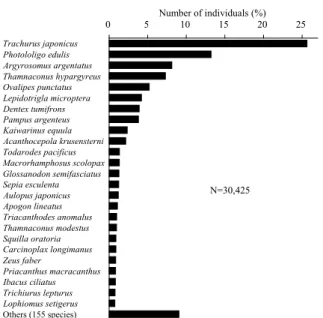
Fish accounted for 140 species (22,901 individuals, 2,196.5 kg), crustacean accounted for 34 species (2,671 individuals, 241.9kg), and cephalopods accounted for 6 species(4,853 individuals, 234.6 kg). Fig.2 shows the composition of catches by number of individuals per species.
The fish species for which more than 1,000 individuals (percent of total catch is shown in parentheses)were caught are Trachurus japonicas(7,800 individuals, 25.6%), Photololigo edulis(4,017 individuals, 13.2%), Argyrosomus argentatus(2,470 individuals, 8.1%), Thamnaconus discarded6-10). The research and development of fishing
gear to reduce the by-catch will promote the rational use of resources and a reduction in time spent sorting on the fishing vessel. This is essential for the sustainability of the fishery.
Since the fish fauna in the demersal fishing grounds of the East China Sea is rich in species diversity, the composition of the catches is also predicted to be diverse. There are many references on the volume of catches from the fishing grounds1,2), but the reports on catches,
including discards, are limited. To provide basic data for the protection of resources in the demersal fishing grounds of the East China Sea, we surveyed the species composition of catches and by-catches.
MATERIALS AND METHODS
Fishing Gear Used for the Experimental Trawling
For the experimental trawling survey, we used a bottom trawl net based on the design of a trawl net used by the training vessel Koyo-maru. This trawl net was 44.8 m in full length, 29.6 m in head rope length, and 60 mm in cod-end mesh size. The mouth of the trawl net had a vertical span (net mouth height) of 10.5 m and a horizontal span (net mouth span) of 13.5 m.
Outline of the Experimental Trawling
In April from 1997 to 2003, the experimental trawling was conducted on a continental shelf area at a depth of 60 to 150 m in the East China Sea (Fig. 1). Table 1 shows an outline of the sample areas and trawl net conditions. The area was investigated 41 times in daytime only. Towing speed was 2.3 to 3.8 knots and the duration of towing was 60 to 180 minutes for each tow. The total towing distance was 267 miles and the total sampled area was 6.68 km2.
Handling of Catch
After trawling, the catch was identified to species level and the individuals of each species were counted and weighed11). For a species with fewer than 100 individuals,
body measurement was conducted on all individuals. For species with 100 or more individuals, body measurement
was conducted on about 100 individuals per tow following Fig. 1. Study areas for the bottom trawl.
200m 125°E 130°E 35°N 30°N Experimental trawling grounds
Table 1. Outline of experimental operations
Depth Towing speed Towing distance
( )
1
11 Apr. 1997 31-15.8N, 127-43.3E
07:00
126
140.5
3.1
6.2
2
31-11.2N, 127-50.9E
10:01
120
148.0
3.2
6.3
3
31-08.0N, 127-57.1E
12:57
120
149.5
3.1
6.3
4
31-15.7N, 127-54.6E
15:50
60
140.5
3.1
3.5
5
12 Apr. 1997 30-09.8N, 127-20.0E
07:05
120
120.0
3.1
6.3
6
30-01.2N, 127-20.4E
10:08
120
123.0
3.1
6.4
7
29-56.0N, 127-20.1E
12:55
120
124.0
3.2
6.5
8
14 Apr. 1998 28-54.1N, 125-43.9E
07:10
120
117.0
3.2
6.7
9
28-48.6N, 125-40.4E
09:59
155
107.0
3.7
8.7
10
29-02.4N, 125-41.6E
13:59
120
105.0
3.7
6.5
11
15 Apr. 1998 27-56.3N, 125-27.2E
06:51
120
110.0
3.3
6.5
12
27-47.2N, 125-26.8E
09:36
150
113.0
3.5
8.6
13
27-36.1N, 125-28.6E
12:57
120
113.0
3.5
7.0
14
14 Apr. 1999 28-42.2N, 126-24.6E
07:42
123
123.0
3.2
6.9
15
28-32.8N, 126-29.6E
10:16
124
134.0
3.1
7.3
16
28-24.4N, 126-28.0E
13:08
122
136.0
3.0
7.1
17
15 Apr. 1999 27-08.0N, 125-04.5E
06:55
125
112.0
3.5
7.0
18
27-08.5N, 124-54.9E
09:41
139
107.0
2.7
5.6
19
26-58.5N, 124-52.7E
13:28
122
111.0
3.5
7.7
20
15 Apr. 2000 28-52.5N, 126-40.2E
07:03
129
131.0
3.5
7.4
21
28-48.9N, 126-38.5E
10:01
119
137.0
3.5
6.9
22
28-50.1N, 126-41.6E
12:54
120
139.0
3.5
7.1
23
16 Apr. 2000 27-47.0N, 125-23.7E
06:55
120
110.0
3.3
5.9
24
27-38.1N, 125-23.5E
09:38
137
112.0
3.6
8.6
25
27-26.3N, 125-24.3E
12:43
137
115.0
3.0
7.2
26
14 Apr. 2001 30-15.6N, 125-16.5E
06:54
126
59.6
3.8
8.0
27
29-54.8N, 125-14.5E
10:54
91
62.6
3.5
5.6
28
15 Apr. 2001 27-40.0N, 125-09.0E
06:55
120
105.0
3.3
6.6
29
27-29.5N, 125-07.5E
09:58
120
105.0
3.1
6.2
30
27-19.7N, 125-04.7E
12:57
107
107.0
2.8
6.1
31
13 Apr. 2002 30-25.3N, 125-52.5E
06:38
179
78.5
3.5
7.0
32
30-31.2N, 125-45.4E
10:42
120
72.3
2.1
4.5
33
14 Apr. 2002 27-16.2N, 125-14.3E
06:55
120
115.0
2.7
5.3
34
27-11.2N, 125-05.7E
09:54
120
112.0
2.3
5.2
35
27-03.9N, 124-59.8E
13:04
120
114.0
2.7
5.8
36
15 Apr. 2003 30-15.6N, 125-39.9E
06:53
120
74.7
3.0
6.8
37
30-23.4N, 125-41.5E
09:56
128
67.0
3.0
5.0
38
30-23.0N, 125-48.6E
13:13
122
73.3
3.2
6.5
39
16 Apr. 2003 27-16.9N, 125-10.5E
06:45
120
114.0
2.8
4.8
40
27-11.1N, 125-08.0E
09:44
136
116.0
3.4
7.5
41
27-07.1N, 125-12.0E
12:58
122
116.0
3.0
5.9
Position to start
towing
Time to start
towing
duration (min)
Towing
Haul
Table 2. Catches in the two-level trawl and their landing sizes for those with commercial values. The landing sizes are based on the landing standard table of Yamada Fishery Co. Ltd., Nagasaki.
Category
English name
Scientific name
Number of
individual
Weight
(kg)
Landing size
(mm)
Fish
Japanese horse mackerel
Trachurus japonicus
7800
626.0
140(FL)
*1Silver croaker
Argyrosomus argentatus
2470
82.1
110(TL)
Lesser-spotted leatherjacket
Thamnaconus hypargyreus
2217
148.8
100(TL)
Gurnard
Lepidotrigla microptera
1276
45.2
100(TL)
Yellowback seabream
Dentex tumifrons
1187
109.3
80(FL)
Butterfish
Pampus argenteus
1157
155.4
150(FL)
Whitefin kingfish
Kaiwarinus equula
713
49.1
100(FL)
Bandfish
Acanthocepola krusensterni
653
124.0
Uncommercial
Longspine snipefish
Macrorhamphosus scolopax
404
5.8
Uncommercial
Deepsea smelt
Glossanodon semifasciatus
386
9.6
all
*2Japanese aulopus
Aulopus japonicus
359
18.9
all
Verticalstriped cardinalfish
Apogon lineatus
326
3.0
Uncommercial
Red spikefish
Triacanthodes anomalus
299
5.3
Uncommercial
Black scraper
Thamnaconus modestus
291
41.1
all
John dory
Zeus faber
261
94.2
180(TL)
Rad bigeye
Priacanthus macracanthus
254
39.2
all
Hairtail
Trichiurus lepturus
232
30.3
150(SAL)
Blackmouth angler
Lophiomus setigerus
227
163.5
all
Belanger's croaker
Johnius belengerii
222
13.6
110(TL)
Japanese Spanish mackerel
Scomberomorus niphonius
184
116.9
all
Pacific mackerel
Scomber japonicus
162
31.1
150(FL)
Yellow croaker
Pseudosciaena polyactis
148
11.0
110(TL)
Red tongue sole
Cynoglossus joyneri
129
16.5
all
Nibe croaker
Nibea mitsukurii
126
17.1
110(TL)
Frog flounder
Pleuronichthys cornutus
115
10.9
120(TL)
Lizardfish
Saurida wanieso
99
18.4
all
Gurnard
Lepidotrigla abyssalis
81
3.4
100(TL)
Lantern-belly
Acropoma japonicum
70
0.5
Uncommercial
Skate
Raja acutispina
69
22.7
all
Stripedfin goatfish
Upeneus bensasi
61
6.1
all
Spearnose grenadier
Coelorinchus multispinulosus
48
3.6
Uncommercial
Pinkgray goby
Amblychaeturichthys hexanema
47
1.0
Uncommercial
Tile-colored righteye flounder Poecilopsetta plinthus
40
1.3
200(TL)
Jellynose fish
Ateleopus japonicus
35
9.0
Uncommercial
Brush-tooth lizardfish
Saurida undosquamis
34
4.4
all
Izu scorpionfish
Scorpaena neglecta
33
6.4
all
Cinnamon flounder
Pseudorhombus cinnamoneus
32
1.8
200(TL)
Gurnard
Lepidotrigla guentheri
31
2.6
100(TL)
Largescale flounder
Engyprosopon grandisquama
27
1.2
Uncommercial
Japanese stargazer
Uranoscopus japonicus
26
3.1
all
Brotula
Hoplobrotula armata
25
7.8
all
Devil searobin
Lepidotrigla kishinouyei
25
0.8
100(TL)
Gurnard
Pterygotrigla hemisticta
23
2.8
Uncommercial
Grey goblinfish
Minous monodactylus
21
1.1
Uncommercial
Japanese splitfin
Synagrops japonicus
21
1.0
Uncommercial
Sea toad
Chaunax abei
19
3.9
Uncommercial
Red flathead
Bembras japonica
17
1.6
Uncommercial
Brown-spotted catshark
Halaelurus buergeri
15
4.2
all
Gurnard
Lepidotrigla kanagashira
15
0.7
100(TL)
Comb goby
Ctenotrypauchen microcephalus
14
0.3
Uncommercial
Graceful catshark
Proscyllium habereri
13
5.3
all
Sepia stingray
Urolophus aurantiacus
13
3.5
Uncommercial
Largescale flounder
Psettina tosana
13
0.9
Uncommercial
Purple flying gurnard
Dactyloptena orientalis
12
2.2
Uncommercial
Marbled rockfish
Sebastiscus marmoratus
12
0.9
all
Fivespot flounder
Pseudorhombus pentophthalmus
12
0.7
Uncommercial
Gurnard
Lepidotrigla japonica
12
0.4
100(TL)
Brotula
Neobythites sivicola
11
3.6
all
Mi-iuy croaker
Miichthys miiuy
10
11.6
110(TL)
Acutenose skate
Raja tengu
9
5.0
all
Gurnard
Lepidotrigla hime
9
0.3
100(TL)
Brown-backed toadfish
Lagocephalus wheeleri
8
4.4
100(TL)
Large-scale flounder
Citharoides macrolepidotus
8
0.6
Uncommercial
Blackfoot firefish
Parapterois heterurus
8
0.3
Uncommercial
Red tilefish
Branchiostegus japonicus
7
3.8
all
Pacific rudderfish
Psenopsis anomala
7
1.4
130(FL)
Japanese barracuda
Sphyraena japonica
7
1.0
all
Pineconefish
Monocentris japonica
7
0.7
300(TL)
Japanese sillago
Sillago japonica
7
0.4
all
Greater amberjack
Seriola dumerili
6
12.0
all
Banjo fish
Banjos banjos
6
2.0
all
Kwangtung skate
Dipturus kwangtungensis
6
2.0
all
Cornetfish
Fistularia commersonii
6
0.9
all
Sabre-gills
Champsodon snyderi
6
0.6
Uncommercial
Rat-tail
Hoplichthys gilberti
6
0.4
Uncommercial
Striated frogfish
Phrynelox tridens
6
0.4
Uncommercial
Daggertooth pike conger
Muraenesox cinereus
5
5.8
all
Blunthead puffer
Sphoeroides pachygaster
5
2.2
100(TL)
Starry handfish
Halieutaea stellata
5
0.5
Uncommercial
Grouper
Chelidoperca hirundinacea
5
0.3
all
Largescale flounder
Engyprosopon multisquama
5
0.3
Uncommercial
Red dragonet
Foetorepus altivelis
5
0.3
100(TL)
Bluefin searobin
Chelidonichthys spinosus
4
1.1
100(TL)
Japanese sleeper ray
Narke japonica
4
0.8
Uncommercial
Sailfin armourhead
Histiopterus typus
4
0.6
all
Black-throat seaperch
Doederleinia berycoides
4
0.4
120(FL)
Red firefish
Pterois lunulata
4
0.4
Uncommercial
Velvetfish
Erisphex potti
4
0.3
Uncommercial
Whitespotted conger
Conger myriaster
3
1.2
all
Japanese bullhead shark
Heterodontus japonicus
3
0.9
all
Japanese anchovy
Engraulis japonicus
3
0.3
all
Cockscomb firefish
Ebosia bleekeri
3
0.2
Uncommercial
Longnose seabat
Malthopsis annulifera
3
0.1
Uncommercial
Hammerhead shark
Sphyrna zygaene
2
13.0
all
Flying gurnard
Daicocus peterseni
2
0.8
Uncommercial
White flower croaker
Nibea albiflora
2
0.8
110(TL)
Ocellate spot skate
Raja kenojei
2
0.7
all
Scorpionfish
Sebastiscus tertius
2
0.6
all
Japanese parrotfish
Oplegnathus fasciatus
2
0.5
130(FL)
Dragonets
Bathycallionymus kaianus
2
0.2
Uncommercial
Redtail scad
Decapterus Akaadsi
2
0.2
140(FL)
Stonefish
Minous quincarinatus
2
0.2
all
Tongue flounder
Plagiopsetta glossa
2
0.2
Uncommercial
Roughscale flounder
Pseudorhombus oligodon
2
0.2
200(TL)
Dragonet
Repomucenus richardsonii
2
0.2
Uncommercial
Snake mackerel
Rexea prometheoides
2
0.2
all
Scalloped hammerhead
Sphyrna lewini
1
5.0
all
Atlantic Bonito
Sarda orientalis
1
2.1
all
Striped jack
Pseudocaranx dentex
1
1.2
all
Brown-backed toadfish
Lagocephalus gloveri
1
1.0
100(TL)
Bamboo sole
Heteromycteris japonicus
1
0.4
all
Cobia
Rachycentron canadum
1
0.3
all
Japanese codlet
Bregmaceros japonicus
1
0.2
Uncommercial
Belted beard grunt
Hapalogenys mucronatus
1
0.2
all
Stripey
Microcanthus strigatus
1
0.2
all
Striped eel catfish
Plotosus lineatus
1
0.2
Uncommercial
Triangular boxfish
Tetrosomus concatenatus
1
0.2
Uncommercial
Stargazer
Uranoscopus tosae
1
0.2
all
Dragonets
Bathycallionymus formosanus
1
0.1
Uncommercial
Croaker
Collichthys niveatus
1
0.1
all
Genko sole
Cynoglossus interruptus
1
0.1
all
Lizardfish
Harpadon microchir
1
0.1
Uncommercial
Redfin velvetfish
Hypodytes rubripinnis
1
0.1
Uncommercial
Devil stringer
Inimicus japonicus
1
0.1
all
Lance flounder
Laeops kitaharae
1
0.1
all
Lumpfish
Lethotremus awae
1
0.1
Uncommercial
Saddled weever
Parapercis sexfasciata
1
0.1
all
Threeband sweetlip
Plectorhynchus cinctus
1
0.1
all
Frog flounder
Pleuronichthys sp.
1
0.1
120(TL)
Wavyband sole
Pseudaesopia japonica
1
0.1
Uncommercial
Largetooth flounder
Pseudorhombus arsius
1
0.1
Uncommercial
Dragonet
Repomucenus huguenini
1
0.1
Uncommercial
Oilfish
Ruvettus pretiosus
1
0.1
all
Slender lizardfish
Saurida elongata
1
0.1
all
Bigeye scad
Selar crumenophthalmus
1
0.1
140(FL)
Deepwater scorpionfish
Setarches guentheri
1
0.1
all
Red barracuda
Sphyraena pinguis
1
0.1
all
Crossmark lizardfish
Synodus macropus
1
0.1
Uncommercial
Crustacean Swimming crab
Ovalipes punctatus
1579
163.9
100(CW)
Mantis shrimp
Squilla oratoria
267
9.3
all
Crab
Carcinoplax longimanus
266
16.8
Uncommercial
Japanese fan lobster
Ibacus ciliatus
247
27.6
all
Crimson swimming crab
Charybdis miles
84
7.6
Uncommercial
Southern velvet shrimp
Metapenaeopsis palmensis
24
0.4
Uncommercial
Chinese mud shrimp
Solenocera koelbeli
23
0.6
Uncommercial
Shrimp
Solenocera melantho
20
0.4
all
Spider crab
Leptomithrax edwardsi
19
1.0
Uncommercial
Shrimp
Plesionika narval
16
1.5
all
Fleshy prawn
Penaeus orientalis
15
0.5
all
Mantis shrimp
Squilla raphidea
13
0.5
all
Crab
Calappa lophos
12
4.5
Uncommercial
Mantis shrimp
Odontodactylus japonicus
11
3.2
Uncommercial
Japanese swimming crab
Charybdis japonica
8
0.3
Uncommercial
Morotoge shrimp
Pandalopsis japonica
8
0.2
all
Swimming crab
Charybdis riversandersoni
7
0.4
Uncommercial
Swimming crab
Portunus trituberculatus
6
0.9
all
Mantis shrimp
Kempina mikado
3
0.2
all
Swiminng crab
Portunus hastatoides
3
0.2
Uncommercial
Spotted swimming crab
Charybdis bimaculata
2
0.2
Uncommercial
Red banded lobster
Metanephrops thomsoni
2
0.1
all
Japanese sand shrimp
Crangon affinis
1
0.2
Uncommercial
Spider crab
Achaeus japonicus
1
0.1
Uncommercial
Crab
Actaea orientalis
1
0.1
Uncommercial
Crab
Actaea savignyi
1
0.1
Uncommercial
Crab
Dromia dehaani
1
0.1
Uncommercial
Crab
Hepatoporus orientalis
1
0.1
Uncommercial
Crab
Leucosia sp.
1
0.1
Uncommercial
Crab
Myra fugax
1
0.1
Uncommercial
Kuruma prawn
Penaeus japonicus
1
0.1
all
Kinglet rock shrimp
Sicyonia cristata
1
0.1
Uncommercial
Cephalopod Swordtip squid
Photololigo edulis
4017
149.3
70(ML)
Pacific flying squid
Todarodes pacificus
408
50.8
70(ML)
Golden cuttlefish
Sepia esculenta
377
14.5
50(ML)
Common octopus
Octopus vulgaris
34
15.4
all
Grass octopus
Octopus minor
13
1.4
Uncommercial
Bigfin squid
Sepioteuthis lessoniana
3
2.2
all
Kisslip cuttlefish
Sepia lycidas
2
1.0
all
*2: All in the column of landing size means that all catches are brought to market.
*1: FL: Fork length, TL: Total length, SAL: Snout-anus length, CW: Carapace width, ML: Mantle length
hypargyreus(2,217 individuals, 7.3%), Ovalipes punctatus (1,579 individuals, 5.2%), Lepidotrigla microptera(1,276 individuals, 4.2%), Dentex tumifrons(1,187 individuals, 3.9%), and Pampus argenteus(1,157 individuals, 3.8%). These eight species accounted for about 70% of the total catches.
The 100 species with the number of individuals caught being less than 10 accounted for about half of the total catch. The diversity of catches was investigated from the number of individuals by species (Table 2). The Simpson's index of diversity was 0.10512).
Catch of Unmarketable Fish
The catches were classified into marketable fish and unmarketable fish and evaluated by numbers of individuals and weights of catches. Fig. 3 shows the composition of catches by weight per species.
Of the 180 species caught, 113 species were marketable fish totaling 28,000 individuals and 2,500 kg. While 67 species were unmarketable fish totaled 2,600 individuals and 220 kg. Unmarketable fish accounted for 8.7% in the number of individuals and 8.1% of the total weight of the catches. The main species of unmarketable fish by number
of individuals were Acanthocepola krusensterni(653 individuals, 2.1%)and Macrorhamphosus scolopax(404 individuals, 1.3%). These two species accounted for about 40% of the unmarketable fish by number of individuals. Catch of Marketable Fish Discarded
Based on the landing body size, individuals of the main marketable fish species were classified into individuals to be landed and those to be discarded and the ratios were investigated.
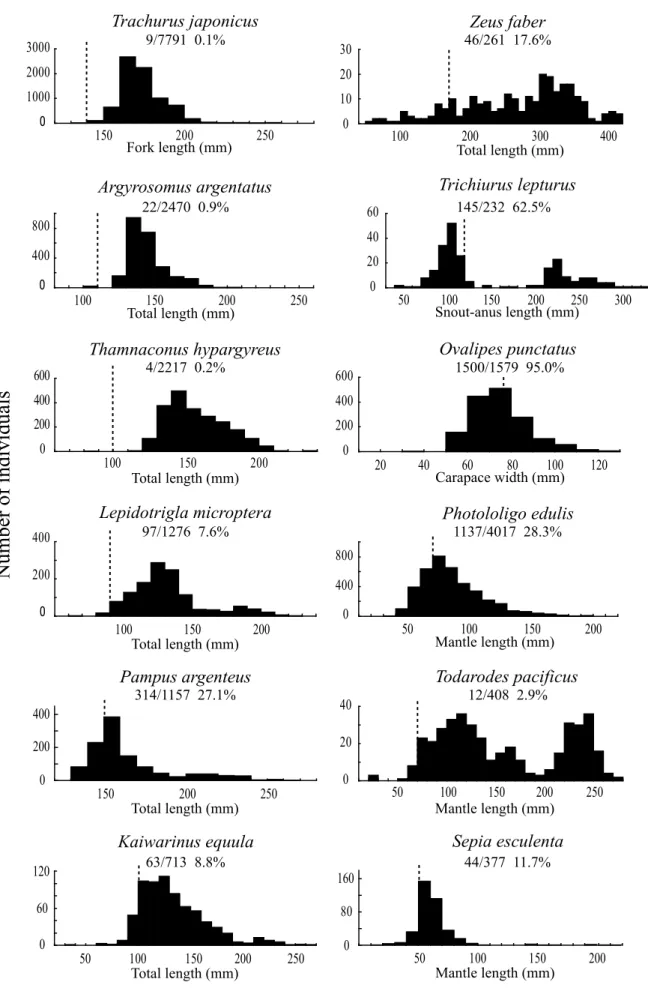
Of the 113 species of marketable fish, 12 species comprised a comparatively large proportion of the number of individuals : Trachurus japonicus, Argyrosomus argentatus, Thamnaconus hypargyreus, Lepidotrigla microptera, Pampus argenteus, Kaiwarinus equula, Zeus faber, Trichiurus lepturus, Ovalipes punctatus, Photololigo edulis, Todarodes pacificus, and Sepia esculenta.
Fig. 4 shows the body size composition of these 12 species. In the figure, the broken line indicates the marketable size. Individuals of marketable size or greater were landed and ones smaller than this size were discarded. Based on this standard, the discard rate of each species was investigated. Here, the discard rate equals the percentage of discarded individuals among the total number of individuals by species.
The species with discard rates over 50% were Ovalipes punctatus(95.0%)and Trichiurus lepturus(62.5%). The
species with discard rates below 10% were Trachurus japonicus, Argyrosomus argentatus, Thamnaconus hypargyreus, Lepidotrigla microptera, Kaiwarinus equula, and Todarodes pacificus.
For the 113 species of marketable fish, the number of discarded individuals was investigated by the same method. The individuals too small for landing totaled 3,559 and accounted for 12.8% of the total number of marketable fish.
DISCUSSION
Compared with other fishing grounds, the fishing grounds of the East China Sea have a diversity of species. According to other reports, the fishing grounds have complicated ecosystems resulting from this diversity of species.
We investigated species diversity by using Simpson's index to characterize the composition of the fish catch. Kishida et al.(1980)reported great diversity at 0.2 or less on Simpson's index of diversity13). Judging from this
report, the shoal distribution is complicated and the catch diversity is very great in the area of the sea surveyed this time.
This survey clarified that of the total 6,200 individuals Fig. 2. Catch composition in number of individuals.
Data were complied from every year.
Fig. 3. Catch composition in weight. Data were complied from every year.
0 5 10 15 20 25 Trachurus japonicus Photololigo edulis Argyrosomus argentatus Thamnaconus hypargyreus Ovalipes punctatus Lepidotrigla microptera Dentex tumifrons Pampus argenteus Kaiwarinus equula Acanthocepola krusensterni Todarodes pacificus Macrorhamphosus scolopax Glossanodon semifasciatus Sepia esculenta Aulopus japonicus Apogon lineatus Triacanthodes anomalus Thamnaconus modestus Squilla oratoria Carcinoplax longimanus Zeus faber Priacanthus macracanthus Ibacus ciliatus Trichiurus lepturus Lophiomus setigerus Others (155 species) Number of individuals (%) N=30,425 0 5 10 15 20 25 Trachurus japonicus Photololigo edulis Argyrosomus argentatus Thamnaconus hypargyreus Ovalipes punctatus Lepidotrigla microptera Dentex tumifrons Pampus argenteus Kaiwarinus equula Acanthocepola krusensterni Todarodes pacificus Macrorhamphosus scolopax Glossanodon semifasciatus Sepia esculenta Aulopus japonicus Apogon lineatus Triacanthodes anomalus Thamnaconus modestus Squilla oratoria Carcinoplax longimanus Zeus faber Priacanthus macracanthus Ibacus ciliatus Trichiurus lepturus Lophiomus setigerus Others (155 species) Number of individuals (%) N=30,425
9/7791 0.1%
46/261 17.6%
22/2470 0.9%
145/232 62.5%
4/2217 0.2%
1500/1579 95.0%
97/1276 7.6%
1137/4017 28.3%
63/713 8.8%
44/377 11.7%
314/1157 27.1%
12/408 2.9%
150
200
250
0
1000
2000
3000
Trachurus japonicus
Fork length (mm)
0
20
50
100
150
200
250
300
40
60
Trichiurus lepturus
Snout-anus length (mm)
20
40
60
80
100
120
0
200
400
600
Ovalipes punctatus
Carapace width (mm)
50
100
150
200
0
400
800
Photololigo edulis
Mantle length (mm)
0
20
50
100
150
200
250
40
Todarodes pacificus
Mantle length (mm)
150
100
200
0
200
400
600
Thamnaconus hypargyreus
Total length (mm)
0
10
100
200
300
400
20
30
Zeus faber
Total length (mm)
150
200
250
100
0
400
800
Argyrosomus argentatus
Total length (mm)
100
150
200
0
200
400
Lepidotrigla microptera
Total length (mm)
Number of individuals
0
200
400
150
200
250
Pampus argenteus
Total length (mm)
0
60
120
100
150
200
250
50
Kaiwarinus equula
Total length (mm)
0
80
160
100
150
200
50
Sepia esculenta
Mantle length (mm)
2)Ministry of Agriculture, Forestry and Fisheries Economic Affairs Bureau Statistics and Information Department : Fishery/cultured work production statistics annual report(2003).
3)Tokai T, Omoto S et al. : Mesh Selectivity of Unmarketable Fish by a Small Trawl Fishery in the Seto Inland Sea. Nippon Suisan Gakkaishi, 60, 347-352 (1994)
4)FAO:Discards in the world’s marine fisheries, FAO Fisheries Technical Paper, 470(2005)
5) Aoyama T: Selective Action of Trawl Nets on Fish. Bulletin of the Japanese Society of Scientific Fisheries, 31, 848-861(1965)
6)Main J and Sangster GI : Trawling experiments with a Two-level net to minimize the undersized gadoid by-catch in a Nepfhrops fishery. Fish Res., 3, 131-145 (1985)
7)Isaksen B, Valdemarsen JW et al.: Reduction of fish by-catch in shrimp trawl using a rigid separator. Fish Res., 13, 335-352(1992)
8)Nagamatsu K, Kubota K et al.: Separation Efficiency of a Two-level Trawl with a Separation Device. J Nat Fish Univ, 46, 155-162 (1998)
9)Nagamatsu K, Kubota K et al.: Separation Efficiency and Size-selectivity of a Two-level Trawl with a Separation Grid-panel. J Nat Fish Univ, 47, 93-102 (1999)
10)Nagamatsu K, Kubota K et al.: Separation Efficiency of a Two-level Trawl Using a Separation Girid-Panel with Different Mesh Sizes. J Nat Fish Univ, 48, 1-10 (1999)
11)Masuda H, Amaoka et al. : The Fishes of the Japanese Archipelago. Tokai University Press, Tokyo(1988) 12)Kinoshita S and Takeda K : Gunsyu Seitaigaku
Nyumon. Kyoritsu Syuppan, Tokyo, 123-124(1989) 13)Kishida S, Kitajima T : On the Species-area Relation
and Diversity of Demersal Fishes in the East China Sea. Bulletin of the Seikai Regional Fisheries Research Laboratory, 50, 53-63(1980)
discarded, which account for 20% of the total number of individuals caught, 2,600 were unmarketable and 3,600 were too small for landing. In the sea area, however, the fish fauna changed seasonally and the composition of catches changed accordingly. As the composition of catches changes, the volume of discarded and the composition of discarded species also changed. In particular, the discard rate of marketable fish is predicted to fluctuate by season, according to the stage of growth. To clarify the actual conditions of discard in the East China Sea, a year-round survey is necessary.
Among the species of marketable fish, Ovalipes punctatus and Trichiurus lepturus showed high discard rates. In particular, the discard rate of Ovalipes punctatus was 95%, indicating a waste of resources. Individuals discarded at sea are expected to survive. However, considering temperature differences between habitats near the seabed and on the fishing vessels and also damage to fish during sorting, the survival rate of discarded individuals may be low.
If these individuals can escape from a trawl net during towing, they will grow to landing body sizes and increase the fishery production. In addition to the mesh size regulation, which is expected to result in size selectivity by the cod-end size, the research and development of fishing gear for species and size selectivity are expected to be promoted and implemented.
The East China Sea is shared by Japan and surrounding countries. To manage resources and promote a sustainable fishery in the fishing grounds, these countries should create opportunities of discussing the survey fishing gear and techniques and for conducting surveys to assess catches accurately.
REFERENCES
1)Ministry of Agriculture, Forestry and Fisheries Economic Affairs Bureau Statistics and Information Department : Fishery/cultured work production statistics annual report(1965).