Report on the Survey of the Archaeological
Materials of Prehistoric Pakistan in the Aichi
Prefectural Ceramic Museum (Part 2) Kulli Ware
journal or
publication title
The bulletin of Tsurumi University. Pt. 4,
Studies in humanities, social and natural
sciences
number
47
page range
53-115
year
2010-03
クッリ式彩文土器
─ 愛知県陶磁資料館寄託のパキスタン先史土器群(2) ─
Report on the Survey of the Archaeological Materials of Prehistoric Pakistan
in the Aichi Prefectural Ceramic Museum.
Part 2: Kulli Ware.
宗 秀明、小茄子川 歩、遠藤 仁、木村 聡、上野剛史
Hideaki SHUDAI, Ayumu KONASUKAWA, Hitoshi ENDO
−,
Satoshi KIMURA and Tsuyoshi UENO
「鶴見大学紀要」第47号 第4部
クッリ式彩文土器
― 愛知県陶磁資料館寄託のパキスタン先史土器群(2)─
Report on the Survey of the Archaeological Materials of Prehistoric Pakistan in the Aichi Prefectural Ceramic Museum.
Part 2: Kulli Ware.
宗
秀明*、小茄子川 歩**、遠藤 仁***、木村 聡****、上野 剛史****
(*鶴見大学、**デカン大学院大学、***総合地球環境学研究所、****東海大学大学院)
SHUDAI Hideaki *, KONASUKAWA Ayumu**, ENDO Hitoshi ***, KIMURA Satoshi****, UENO Tsuyoshi****
* Turumi University, Kanagawa/Japan.
** Department of Archaeology, Deccan College, Post-Graduate & Research Institute, Deemed University, Pune/India. *** Research Institute for Humanity and Nature, Kyoto/Japan.
**** Graduate School of Tokai University, Kanagawa/Japan.
要旨: 本稿は、愛知県陶磁資料館に寄託されている彩文土器調査報告の続編である。前稿で述べたように、総数133点 におよぶ彩文土器は、現在のパキスタン・イスラーム共和国南西部にあたるバローチスターン丘陵部に展開した先 史諸文化の所産である。前稿で報告したナール式土器、今回報告するクッリ式土器の他に、丘陵部北部のクエッタ 地域一帯で製作されたファイズ・ムハンマド式土器、それにイラン高原東南部に接するマクラーン地方のダシュト 川流域で作られた土器(エミール彩文灰色土器)が含まれている。これらの土器群は、紀元前4千年紀後半から前2 千年紀初頭までの長期にわたる時間幅と、それぞれに個性豊かな彩文と製作技法によってバローチスターン先・原 史諸文化の多様さを示している。そして、バローチスターン丘陵部で長期にわたり展開した地域間交流と土器製作 技法の復元に多大な情報を提供するものである。こうした理由から、筆者らは愛知県陶磁資料館に寄託されている 土器群をいち早く共有・活用できるデータとするために、その資料化を進めてきた。 今回報告するクッリ式土器は、前稿で報告したナール式土器と時期を違えて、バローチスターン丘陵南部に展開 した土器群である。編年的には、アラビア海沿岸における海洋交易が活発化した前3千年紀末から前2千年紀初頭に 広範に展開したとされ、インダス文明と併行して展開した土器様式であると理解されている。その特徴は、次のよ うな彩文様式である。大きな丸い目をもったコブウシやネコ科(おそらくチーター)、アイベックスなどの動物文 様とボダイジュやイトスギなどから構成される植物文様が、様々な幾何学的小型文様に周囲を囲まれるようにして、 胴部上半に設定されたキャンパスに描かれる。それは、各彩文要素が個別に描かれるのではなく、一定の規則に従 って物語を構成するかのようである。 以下では、愛知県陶磁資料館に寄託されているクッリ式土器について、特に彩文要素とその構成パターン、およ び製作技法に着目して報告し、その上でクッリ式土器に代表されるクッリ文化の編年的位置づけを近年の研究成果 に基づいて再検討した。その結果クッリ式土器は、すくなくともインダス文明前期もしくはハラッパー式土器古段 階まで遡る可能性を指摘した。 なお、愛知県陶磁資料館に寄託されるファイズ・ムハンマド式土器などを含むその他の土器群と人物や動物を中 心とする土偶群に関しては、機会を改めて報告したい。
Introduction
As mentioned in the last report, more than 100 prehistoric painted potteries of Pakistan have been stored in the Aichi Prefectural Ceramic Museum, Japan. They are the private collection own by an individual who lives in Tokyo, and entrusted to the museum. Almost all of them are preserved in entirely, not in fragments, and then we suppose that they would be unearthed from burials by illegal diggings. They could be classified in the Wares of Nal, Kulli, Faiz Mohammad and Emir grey, etc. belonging to ranging from the later half of the 4th to the beginning of the 2nd millennium B.C. by their form and painted motives. We have not seen these fine and good conditioned prehistoric materials even in Pakistan itself. In the light of its archaeological precious meaning, whatever it is the pottery from illegal diggings, we are convinced that these materials will be helpful to consider the cultures of prehistoric Balochistan and Indus Civilization1).
We had firstly observed with surprisingly some of the collection in the exhibition hall and others packed in wooden cases made of a paulownia tree like caps for the tea ceremony in the storeroom of the museum on 8th September 2005, and started to draw and take photographs of these materials for making the catalog of the potteries in the working space of the Aichi Prefectural Ceramic Museum from 8th to 15th September 2007. The second season of research at the Aichi Ceramic Museum had been held from 16th to 24th June 2008. And the third season of research had been held from 13th to 17th September 2009. We report here the potteries of Kulli type which were observed in a great detail. Other potteries and figurines will be reported in the following volumes.
Member of participants for the first to the third researches were KONISHI Masatoshi (Professor emeritus of Rikkyo University), SHUDAI Hideaki (Tsurumi University), KONASUKAWA Ayumu (Department of Archaeology, Deccan College, Post-Graduate & Research Institute, Deemed University), ENDO Hitoshi (Research Institute for Humanity and Nature), KIMURA Satoshi (Graduate School of Tokai University), UENO Tsuyoshi (Graduate School of Tokai University), YONEYAMA Akane (Cyber University) and SHUDAI Fukiko (Kamakura Archaeological Institute).
1. Geographical Features of the Balochistan (Indo-Iranian Borderlands) Area
The Balochistan (Indo-Iranian Borderlands) area is the vast hilly region that is constituted of a part of the North-West Frontier Province in Pakistan, the Kandahar and the Helmand regions of Afghanistan and the Sistan to Balochistan regions of Iranian side (fig. 1; table. 1). This area is separated from the Indus valley by the Sulaiman Range and the Kirthar Range, and almost of area is occupied by highly hills more than 700m above see level. By the Zargun range of about 3000m a.s.l. to the north of the Quetta, the Harboi range in the Kalat and the lower mountain ranges which spread over to the Arabian sea, the Balochistan area can be divided into the three main areas, which is constituted of the Zhob-Loralai and the Quetta in the north, the Kalat in the middle and the Khuzdar in the south. Some perennial rivers, such as the Nal, the Hab and the Mashkai, etc. flow down between the mountain ranges extended in the north-south direction, to the north-south of the Arabian sea, and these rivers provide important passages to interact with regions.
Some rivers penetrates the Sulaiman and the Kirthar Ranges from Balochistan to the Indus plain, and formed fertile fans on the eastern foothills of Balochistan hills. Bolan river flow down from Quetta region to eastward, and made Kachi plain next to the Indus plain. Zhob and Gomal rivers with many other small ones created a large fertile fan, such as Gomal plain, between the Balochistan and the Indus plain.
A rainfall of the southern region has about 100mm and the northern region has almost 400mm in a year, but almost of them in December to March as rain and snow. The effect of the south-western summer monsoon on the rainfall is very rare. For these geographical and seasonal features, the cultivated land is estimated less than 4% in all Balochistan area (Ute Franke-Vogt 2008). This percentage includes the irrigated land. So, the potential for the agriculture in the Balochistan is recognized very low. But this situation does not mean that prehistoric people could not dwell in the Balochistan. Many prehistoric sites, which are belonging to various periods, concentrated on the fertile funs and valleys in the Balochistan provide us the image of vividly life in prehistoric time. People of the prehistoric Balochistan must Report on the Survey of the Archaeological Materials of Prehistoric Pakistan in the Aichi Prefectural Ceramic Museum.
Fig. 1 Map showing the major sites discussed in this paper (the original drawing of a map was made by Dr. UESUGI Akinori)
Report on the Survey of the Archaeological Materials of Prehistoric Pakistan in the Aichi Prefectural Ceramic Museum.
make a life on the fertile funs and riverbanks for agriculture at most.
Although the Balochistan does not have sufficient land for cultivation, this area produces various mineral resources to the people. Copper, lead, zinc and barytine as mineral; gray colour chert, lime stone, sandstone, alabaster and marble as stone; agate, vesuvianite, grossularite stone and lapis lazuli, etc. as semiprecious stone, can be collected along the Sulaiman Range and the Kirthar Range.
The important passes between the Indus valley and the west, including Iranian plateau and Afghanistan, exist in the Balochistan. Typical passes are Bolan and Khojak in Quetta where link the Indus valley with Kandahar through the Kachi plain, Bata and Parachinar passes which links the Indus valley with Afghanistan through the Gomal plain and Bannu basin, and coastal passes link the Indus valley with Southeastern Iranian Plateau through the Makran coast. Prehistoric sites are concentrated on fertile fans, basins and riverbanks along these passes, as the spots of the important interrelationship too.
It could be said that Balochistan was the most important place for cultural relation for east to west and north to south directions. Although the population density and the potential rate for the cultivated land are very low, the Balochistan must provide many opportunities of the interrelation of various cultures and regions.
2. Kulli culture and Kulli Ware
(1) Background to the study of Kulli Culture and Kulli Ware
The site of Kulli is situated in long. 26°15’00”, lat. 65°00’00”,in the Kolwa, Khuzdar district in the Balochistan. Location of Kulli is in the central part of southern Balochistan as well as the site of Nal, and could be recognized an important place for the interexchange route between Awaran and Makran coast. A Mound of Kulli approximately 365m (N-S) by 274m (E-W) by 9.15m (H) and spreading over 10ha. A number of prehistoric sites have been confirmed in the southern Balochistan other than Kulli, some of which had been excavated as Nindowari (Casal 1966) and Niai Buthi (Fairservis 1975; Franke-Vogt, U. and S. ul-Haq. 2008), etc. What many prehistoric sites had been in this valley means that ecologically, economically and politically Kulli area had been a
significant place in the prehistoric Balochistan.
The discovery of the site of Kulli goes back to 1928. The first excavation was leaded by Stein, A. as a part of exploration of the southern part of Balochistan (Stein 1931). According to his description, Stein had visited to the site on March in 1928 and had made a map of the mound, and excavated at the northwestern part of the mound in around a week. Several walls of architectures made of shale were already lost away at the highest part of the mound, and many pottery shreds including Kulli Ware were scattered around those walls. Furthermore cairn burials similar to the burial found at Moghul Ghundai in northern Balochistan were discovered at northern half of the mound. Mealing stones, pestles, various beads made of lapis lazuli, agate, carnelian and black stone (possibly jasper), objects made of bronze and gold, bangles made of bone and shell were discovered besides Kulli Ware. And many human and animal figurines were also reported. These figurines are recognized as one of characteristic artifacts of Kulli culture as well as Kulli Ware.
Stein recognizes the site of Mehi as one of the important sites having cultural relationship with Kulli. He had been researched at Mehi on the end of March in 1928 following trial excavation at Kulli. The site of Mehi is a mound site measured approximately 301m (N-S) by 329m (E-W) by 15m (H) and spreading over an area of 9.9ha. The size of Mehi is approximately same as that of Kulli. Several walls of architectures made of shale and clay were already lost at the highest part of the mound. First excavation had been performed at the eastern part of the mound, and a part of architecture was uncovered with Kulli Ware, which were scattered on the floor level in the trench IV. Several animal figurines having same features with figurines from Kulli also excavated. The most interesting archaeological remain discovered at Mehi is burials. Two types of burial activities were reported. The cremated bones with some burial goods such as potteries and figurines in a large size pot as a cinerary vessel is the first type. Second type is certainly to burry cremated bones directly in the burial pit. In trenches I and VIII, a large pot including fragments of human bones, ashes and potsherds were uncovered at the point under around 1.20m from the present surface, and accumulated six cranial bones with potteries and bangles for a infant
were uncovered at the point under 1.50m from the present surface. Accumulated cranial bones included of infants and adults. Stein, A. supposed that the selection of cranials for accumulation had been performed at this place after cremation, because carbonized fragments and ashes were scattered around the cranial accumulation. Furthermore it is worthwhile noted that potteries of BMAC (the Bactria Margiana Archaeological Complex) culture were discovered with burials.
Stein estimated the following process of cultural changes. Lower layer of Shahi Tump → Chalcolithic of Zhob region → Kulli culture → Nal culture. This scheme was based on the fact that Nal Ware, which is distributed widely in southern Balochistan, was not discovered from Kulli and Mehi, and the archaeological information from Shahi Tump.
However, after the Stein’s explorations in Southern Balochistan, the significances of Kulli Ware and culture discovered from Kulli and Mehi had not been studied on account of suspending explorations in there.
Piggott, S. discussed about Kulli Ware in his book on South Asian archaeology (Piggott 1950). He pointed out that Kulli culture played an important role as an intermediary on the ancient trade activities, which were performed between the West (Iranian plateau, Mesopotamia, etc.) and the Indus Civilization, that was based on analysis of the Kulli Ware found from sites of Kulli and Mehi uncovered by Stein. And he suggested chronologically that Kulli culture almost correspond to the Indus Civilization, and the decline of Kulli culture could be place at nearly the final phase of the Indus Civilization based on the discovery of the layers including Kulli Ware at the site of Shahi Tump.
Casal, J.M. excavated Nindowari that is situated at Jhalawan in the Kalat region of Balochistan from 1962 to 1965, and stated on the significance and the chronological position of Kulli Ware in the tentative excavation report (Casal 1966). He discovered Kulli Ware, figurines, three Indus type seals and one seal having a geometrical motif, etc. from the occupational layer and cultural deposit of the warehouse in the areas A and B of the main mound. According to these situations and the layout of architecture, he surmised that the main occupation period of Nindowari belongs to the Kulli culture and the site of
Nindowari was a palace or religious center, not a mere dwelling city or village. And he supposed that Nal Ware gathered from the site exists under the Kulli occupational layer.
Although Casal pointed out by himself, it could be said that the site of Nindowari could provide a lots of important information to us to examine the substance of the Kulli culture and Kulli-Nal interrelationship. And he surmised that the Kulli Ware chronologically corresponds to the Harappan culture as consulting the pottery shapes and painting motives of Kulli Ware and Harappan Ware. But we have to wait for publishing the full report of the excavation of Nindowari, which is regulated by G. Quivron, to discuss more.
Fairservis, W.A. who had rich experience of explorations at various regions of Balochistan, discussed about the formation and developmental processes of cultures throughout Southern Balochistan in his book‘The Roots of Ancient India’ (1971). His perspectives are based on results of his explorations and excavations at Las Bela region of Southern Balochistan. Las Bela region is situated in Southeastern to Kulli and Mehi. This region includes narrow plains where are a fertile and a densely populated region in Balochistan area. Fairservis researched the site of Niai Buthi and a group of sites that was named as the Edith Shahr Complex2)by him
and assumed the prosperity and decline of sites were belonging to the period ranging from Nal to Kulli culture by stratigraphical and superficial perspectives.
In Niai Buthi, he divided cultural deposits into the lower layers (Period I) and the upper layers (Period II) and confirmed that thinly-made painted potteries having geometric motives (including Nal Ware) were found mainly from Period I, and Kulli Ware having animal motives and Harappan Ware were found mainly from Period II. Based on his perspectives, all of concerning pottery traditions in Southern Balochistan was recognized as‘Kulli Ware’. And Kulli Ware having animal motives mainly found from Period II was called as‘late Kulli Ware’, thinly-made painted potteries having geometric motives (including Nal Ware) was called as‘early Kulli Ware’. He pointed out that‘early Kulli Ware’belongs to the pre-/ Early Harappan period and‘late Kulli Ware’ belongs to the Harappan period. But he did not
Report on the Survey of the Archaeological Materials of Prehistoric Pakistan in the Aichi Prefectural Ceramic Museum.
discuss about significances of‘late Kulli Ware’. In early 1980’s, Possehl, G.L. re-examined Kulli culture (Possehl 1986). He draw and studied archaeological materials collected by Stein, A. stored in the National Museum of New Delhi and evaluated that Kulli culture is simultaneous with the Indus Civilization. He understood that the Indus Civilization is a union formed by several regional societies and recognized Kulli culture represented by painted potteries as a regional culture of the Indus Civilization. In other words, Possehl, G. L. prescribed that Kulli culture is a part of the Indus Civilization. Excavations at Nausharo, that have been started from 1986, had given important informations on the chronological position of Kulli Ware and Kulli culture to South Asian archaeologists (Jarrige, J.-F. 1994). Nausharo is situated at Kachi Plain, where is located at the eastern edge of Balochistan, and have included a long cultural deposits from period I (=Mehrgarh period VII) to period IV (=the later part of Indus Civilization). Kulli Ware was discovered with Harappan Ware and potteries of BMAC culture from period IV, estimated circa 2200 to 2000 BCE. It is worth to note that Kulli Ware was firstly excavated straitigraphically at Nausharo.
Kulli-related potteries have been recently excavated from several cultural layers at Miri Qalat in Makran region and Nal in Southern Balochistan too.
In Miri Qalat, Kulli-related potteries and Harappan Ware are discovered from period IV (Besenval 1994, 2005). It shows that Kulli-related potteries are simultaneous with Harappan Ware.
The Joint German Archaeological Mission to the Southeastern Balochistan leaded by Ute Franke-Vogt had been explored and discovered amount of 291 sites belonging to the period from the later part of the 5th millennium BC to the Islamic period and the British period by the mission with the Department of Archaeology & Museums, Government of Pakistan since 1997 to 2000. They were reported and indicated many sites including Kulli cultural occupational layers. Especially, in Bakkar Buthi, which is situated at the Kanrach Valley in Las Bela region of the Balochistan, Harappan Ware and Kulli Ware were excavated from the different layers. That is to say, Kulli Ware was excavated from the layer that is above the layer yielding Harappan Ware only. And
the mixed situation of both Wares was also recognized (Franke-Vogt, U., Saleem Shams Ul-Haq and M. H. Khan Khattak 2000). In the excavations at Niai Buthi, the Kulli-related potteries were discovered from the layers including Nal Ware (Franke-Vogt, U. and S. ul-Haq 2008). Examination on the typological continuity of both Wares is very important to discuss about Kulli-Nal interrelationship. We will have to examine again the chronological issues of prehistoric Balochistan after publishing the full report of this mission.
At Nal, painted potteries having animal motives similar to ones of Kulli Ware were discovered from period III, and Kulli-related potteries were reported from period IV (Franke-Vogt 2005, 2008; Franke-Vogt & Ibrahim 2005). Detailed aspects of these potteries, however, have not been known, because published materials had not been reported sufficiently. Ute Franke-Vogt, who is leader of excavations at Nal, evaluated period III as the end of pre-/ Early Harappan period or the transitional phase to mature Harappan period, and period IV as the later part of the 3rd millennium BC. Although the typical Kulli Ware is not found from period IV, it could be said that excavations at Nal have very important information on studying the regional chronology of Southern Balochistan during the formation phase of Kulli Ware.
Kondo, H., A. Uesugi and A. Konasukawa verified the significance of Kulli Ware in the prehistoric South-West Asia (Kondo, Uesugi and Konasukawa 2007). Through the examination of the formation process of pottery shapes and painting patterns of Kulli Ware stored in the Okayama Orient Museum, Japan, they stressed the significance of relationships between Kulli culture and prehistoric Western world including Southeastern Iranian Plateau and the Persian Gulf, etc., and concluded that Kulli Ware could be the pottery style extended over the Southern Balochistan from the later part of the 3rd millennium BC to the first part of the 2nd millennium BC.
Uesugi, A. and A. Konasukawa examined typological changes of Harappan painting pottery with the guidance of preceded important works by Kamada, H. (Kamada 1990) and Quivron, G. (Quivron 2000) as four phases of Harappan pottery like below, the formation phase (=Chanhu-daro Ia, Nausharo ID),
Report on the Survey of the Archaeological Materials of Prehistoric Pakistan in the Aichi Prefectural Ceramic Museum.
the early phase (=Nausharo II, Amri IIIA, Harappa 3A), the middle phase (=Nausharo III, Amri IIIB, Harappa 3B), the later phase (=Nausharo IV, Amri IIIC, Harappa 3C) (Uesugi and Konasukawa 2008). They pointed out that the relationships of Harappan painting style and that of Kulli Ware are recognized in the middle phase and onward. And they concluded that the most developed phase of Kulli Ware and culture was during the later part of the 3rd millennium BC to the first part of the 2nd millennium BC.
Quivron typologically re-examined pottery uncovered from Kulli and Mehi by Stein compared with pottery from Nausharo (Quivron 2008), and stressed that Kulli Ware uncovered from Kulli and Mehi can be subdivided, especially based on the changes of painting motives, into‘Early Kulli period’ and‘Late Kulli-Mehi period’. Quivron indicate chronologically the former period is the pre-/ Early Harappan times or the first sub-period of the Mature Indus period, and the later one is to the second and third sub-periods of the Mature Indus period. Quivron’s perspective can be recognized as the argument for stressing the significance of complex inter-regional relationship system on the formation and development processes of Kulli Ware. Although this perspective on the cultural formation by the typological changes of Kulli Ware is very important, we could not accept the Quivron’s chronological perspectives on Kulli Ware at the present. Because the data that‘Early Kulli period’is correspond to the pre-/Early Harappan times or the first sub period of the Mature Indus period is formed by a few unpublished materials from Nindowari and Amri only. We have to wait for the full report of the excavation at Nindowari that is conducted by Quivron himself, to re-examine the Quivorn’s argument.
The study of the chronological position of Kulli Ware and culture is very important issue to understand the social system of the Indus Civilization. Therefore, we would like to awaken that the consideration of the chronological position of Kulli Ware must be discussed carefully.
Jarrige, J.-F. and Quivron discussed dynamically the formation and developmental processes of the Indus Civilization on the perspectives of the continuous relationship which had been maintained for a long time between Indus and the prehistoric
Western Asia, including Mesopotamia, Iranian Plateau, Central Asia and the Persian Gulf (Jarrige and Quivron 2008). They pointed out mainly that the important period of the relationship with the Indus Civilization and Kulli culture is during circa 2200/2100 to 1900/1800BC, especially many potteries indicating the relationship with Kulli Ware are uncovered from not only Nausharo but also Amri, Mohenjo-daro and Harappa in the later phase of the Indus Civilization (=Nausharo IV). And, they express that the relationships between the Indus Civilization and BMAC had very important effect on the transformation of the Indus society in the same period, and concluded that the transformation of the Indus society was based on the relationships with these cultures. This hypothesis could be the new perspective on the issue about cultural transformation of the final phase of the Indus society. But, the study of the chronological positions of the‘Kulli-Mehi style pottery’and many artifacts uncovered from the later phase of Mohenjo-daro must be discussed very carefully. So, we have to re-examine this hypothesis after the increasing of archaeological materials having a good context, as well as the hypothesis advocated by Quivron (Quivron 2008).
(2) Short summary
South Asian archaeologists have discussed about evaluation of Kulli Ware based on archaeological materials found by Stein and pointed out the relationships between Kulli culture and the Indus valley, Iranian Plateau and Mesopotamia.
It could be stressed that stratigraphical discoveries of Kulli Ware are recently excavated, such as at Nausharo, and reinforce former studies and demand more analyses of developmental processes of Kulli Ware and Kulli culture. However, as results of the recent excavations are not reported sufficiently, the understanding of Kulli Ware will be change greatly based on further researches.
In this situation, we will discuss the significance of Kulli Ware and culture in this paper, based on examination of Kulli Ware stored in the Aichi Prefectural Ceramic Museum. The main subjects of this paper are to consider the manufacturing techniques and painting patterns of Kulli Ware, and to understand the formation and developmental processes of Kulli Ware and to re-examine the
chronological position of Kulli Ware.
3. Kulli Ware in the Aichi Prefectural Ceramic Museum: Manufacturing Techniques and Painting Motives
The potteries stored in the Aichi Prefectural Ceramic Museum include 11 potteries as typical Kulli Ware and 5 potteries as Kulli-related potteries. As it will be discussed in this paper, the typical Kulli Ware decorated by the characteristic animal motif having an encircled large round eye on the main campus which is set at the middle portion of the body by parallel lines. Although many painted potteries of various geometric designs are collected other than the typical Kulli Ware from the excavation of Kulli, the archaeological information is restricted to distinguish that these potteries belong to the same period or different period.
In these contexts, we limitedly use the designation of‘Kulli Ware’in this paper to express the potteries decorated by the characteristic animal motif having an encircled large round eye3). And we will treat the
painted pottery group having rows of stylized ibex without large round eye in the narrow campus and more two other examples as Kulli-related potteries. As mentioned in the later part of this paper, we consider that the former group has various different features as compare to Kulli Ware and these potteries could be recognized as the preceding pottery type of Kulli Ware.
As we will see later the various features of Kulli Ware and Kulli-related potteries in the Aichi Prefectural Ceramic Museum, all of these potteries are typical examples of Kulli Ware and Kulli-related potteries. This view for the pottery is according to the study of making techniques and painted motives of Kulli Ware and Kulli-related potteries (Kondo, Uesugi and Konasukawa 2007). So, the manufacturing techniques and the painting motives of Kulli Ware will be the main subjects in this report as it follows.
The vessels are made of medium fine paste without any gritty ingredient, though the fine sand temper is clearly visible. The clay is well levigated as it gives a compact feel to the surface and the core of the body. Uneven rubbed marks seen on different parts of pottery indicate that the slow turntable was used on forming the pottery, and we can see also the
traces of the clay ring building techniques on the surface of some complete potteries. But some potteries have a cutting mark with thread on the outer face of the base. It means that fast-wheel was used to make some of Kulli Ware. Basically, Kulli Ware is formed by hand modeling with employing the technique of clay coil ring building on slow or fast turn-table, and finished by scraping and smoothening with spatulas or fingers. And some potteries have the traces of burnishing technique on the outer wall of bodies. Thickness is ranging 0.3 to 0.9 cm.
In most cases, the pottery vessels are covered by whitish slip with smooth surfaces and are painted by various motives including animal, naturalistic and geometric patterns in black pigment. These motives will be discussed later in detail.
The vessels are very well fired using probably the closed kiln, but it was in the oxidizing atmosphere to fire the pottery. The colour of core of the body will be described in this volume. Kulli Ware in the Aichi Prefectural Ceramic Museum can be classified into the following vessel’s types: canister, open mouthed jar, open mouthed globular pot, non-necked globular pot, straight-sided bowl, nail-headed rim bowl, straight-sided cup, etc. We will discuss about Kulli Ware and Kulli-related potteries individually in the next part.
On the recognition of coluors of pottery clay and painting, it is depended on“revised standard soil color charts”published in Japan.
(a) Painting Motives of Kulli Ware and Kulli-related potteries in the Aichi Prefectural Ceramic Museum
All of Kulli Ware and Kulli-related potteries in the Aichi Prefectural Ceramic Museum are decorated by various motives including animal, naturalistic, geometric and other tiny motives (Figs. 2, 3). Animal and naturalistic motives are basically paited as a main motif, while other tiny motives are painted around the main motives. In this part, various painting motives decorated on the potteries in the Aichi Prefectural Ceramic Museum are confirmed. Regarding of painting patterns, it will be discussed later.
1) Animal motives
The animal motives are consisting of humped bull, feline animal, ibex, fish and bird. Each of motives is
Report on the Survey of the Archaeological Materials of Prehistoric Pakistan in the Aichi Prefectural Ceramic Museum.
Fig. 2 Animal motives of Kulli Ware in the Aichi Prefectural Ceramic Museum drawn clearly one by one and physical features of
animals are also expressed clearly. A large round eye characterizes the motives of humped bull. According to decoration patterns of the body and the direction of the head of the bull, humped bull motives can be divided into the three types as A, B and C types. A and C types have a right-facing head, but only type B has left-facing head. The feature of the decoration pattern of type A is as follows. Firstly, outline is painted by black pigment; secondly straight lines, etc fill up the inside.
Although the feline animal is discriminated as cheetah, tiger or leopard, it is very difficult to specify the species. The feline animal is expressed an animal having a large round eye and the body is decorated by same pattern as the humped bull. Some of the ibex motives probably express as blackbuck whatever the motifs expressed as a main motif or as
rows of ibex on the narrow campus. The ibex motives can be divided into three types, A, B and C types. Type A is expressed by same style as humped bull and feline animal. The inside of the outline of the body is filled by decorations. Type B also has a large round eye, but the expressed pattern of the body is different from type A. The body of type B is painted by lines drawing in black and a foreleg is expressed like fusing with a plant (as will be mentioned as cypress). Direction of the animal head is expressed like looking back posture from right to left. Type C is recognized as a tiny motif, which is expressed around a main motif. This motif is painted as two in one set or rows of ibex. All of ibex has a right-facing head.
The motif of bird is expressed as a main motif painted on the inside of shallow bowl (type A) or as a tiny motif expressed around a main motif (types B
Fig. 3 Naturalistic and other motives of Kulli Ware in the Aichi Prefectural Ceramic Museum and C). Type A having a large round eye is
expressed powerfully like as spreading his / her wings. It seems a very strange and curious design which we have not seen the design like this so far. Types B and C look like row of flying birds.
Fish motif is expressed on the inside of shallow bowl as a main motif. The inside of the body is filled with wavy and straight lines. It enables fishes to be
realistic expression. And this fish motif also has a large round eye as well as other animals.
2) Naturalistic motives
Naturalistic motives are consisting of mainly pipal and cypress. Each of motives is expressed by various painting styles. The nomenclature of pipal means an Indian linden tree and pipal as painting motif was a very popular design during the period from the pre-/
Report on the Survey of the Archaeological Materials of Prehistoric Pakistan in the Aichi Prefectural Ceramic Museum.
Early Harappan periods to the Harappan period. A leaf of pipal is expressed as sacred gem (man
・i) or heart shapes through various periods and regions of South Asia. Pipal motif decorated on Kulli Ware also has the same design feature. Types A and B could be recognized as a stylized pipal tree, which bearing leaves and fruits or flowers. Type C is expressed as a tree with right and left extended branches bearing leaves or flowers. Type D is expressed by a different pattern from types A, B and C. While type D has three stylized pipal leaves on the top of the tree, it could be said that type D is not an expression of pipal tree.
The motives of cypress are consisting of five variations, which include expressions of a straight tree only or a straight tree with curved branches extended to right and left direction. All of straight trees and branches are decorated with short vertical lines. Although it is very difficult to distinguish this motif as cypress tree, this motif is called as cypress in this paper as an expedient measure. The reason why this expression pattern is characteristically recognized on the pottery in the Southeastern Iranian plateau. The motives of cypress can be divided into four types, A, B, C and D.
As far as other motif is concerned, the motif of ‘pipal plus cypress’is recognized. Types A and B are expressed as a tree having a pipal leaf on the top with some cypress like branches extended right-left direction. Other three types of motif are recognized as plant motif. Type A could be expressed as a water plant.
3) Other motives
Other motives are consisting of a stuff to hitch a humped bull, sun-like motif, tiny motif, curved line motif (Sigma motif) and temple motif (or comb-like motif). These motives are basically expressed around a main motif, not as a main motif. The motif of stuff for hitching a humped bull could be understood as a motif expressed some plant. This type of motif is observed on the other Kulli Ware as well. The sun-like motif is expressed as a dot surrounded by circular or curved lines, including types A, B and C. This motif is placed around a main motif or expressed as rows at the narrow campus of the body. Tiny motives can be divided into three types as A, B and C. These motives are basically placed around a humped bull. Almost of curved line motives have
two convex portions and one reentrant portion. Although this motif could be understood as expression of a bird or a snake, it is very difficult to distinguish. So-called temple motif (sometimes called as hut motif) is understood as an expression of the facade of certain architecture. The representative example of this motif is observed on the chlorite vessels (factory sites of chlorite vessels are uncovered at Southeastern part of the Iranian Plateau, the Gulf and the Failaka). In the Balochistan region, this motif is observed as the pottery paintings during the period from the pre-/Early Harappan period to the first phase of the Harappan period (Quivron 2000). And this motif is sometimes called as‘comb-like motif’ that is based on the shape of this (Quivron 2000). The temple motives observed on the potteries in the Aichi Prefectural Ceramic Museum can be divided into six types as A, B, C, D, E and F. Types A and B could be called as‘comb-like motif’rather than temple motif.
(b) Kulli Ware and Kulli-related potteries in the Aichi Prefectural Ceramic Museum
a. Kulli Ware
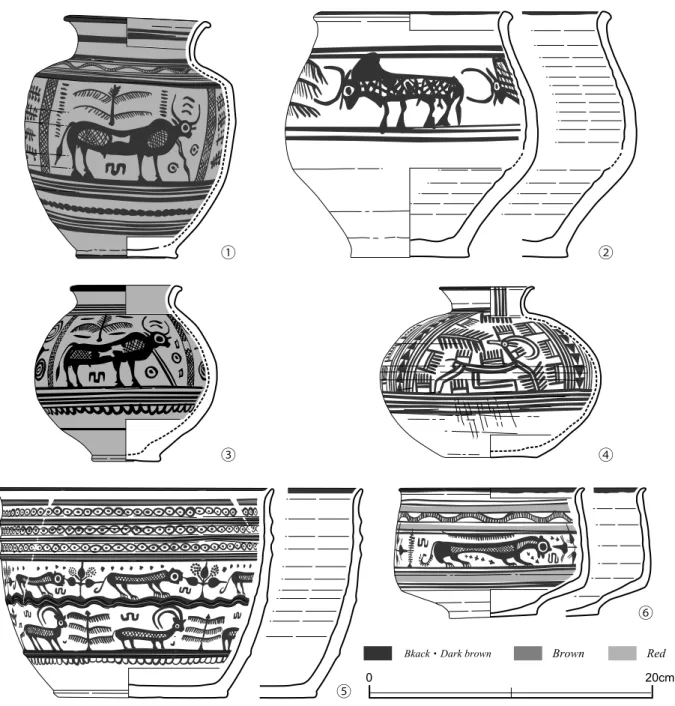
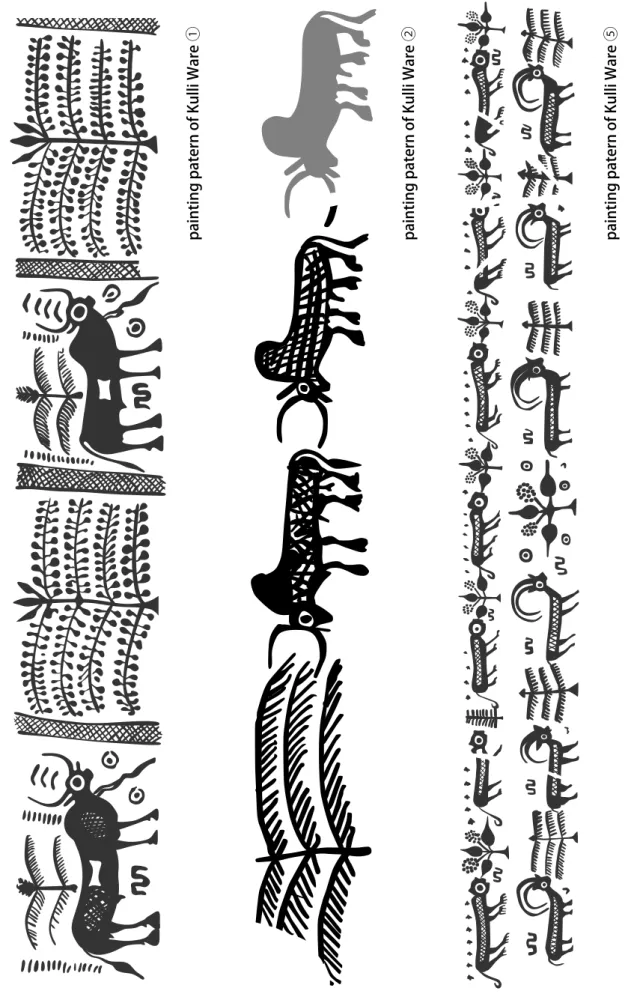
① figures. 4-①, 5-① and plate. 1-1, 2 and 3. (display no. 003)
■Form:Canister
■Rim Diameter: 9.7 cm, Base Diameter: 7.0 cm,
Height:17.2 cm, Thickness:0.4 to 0.5 cm.
■Surface Finishing, Colour of the Body and Other Features: Marks of rotating smooth with fingers or a spatula are observed on the internal and external surfaces. We can trace following manufacturing steps according to observation on the external surface. Firstly, a rough shape of the pottery is formed by the clay coil building technique on the slow turntable. Secondly, pottery is smoothed with a spatula or fingers after scraping with a spatula in horizon. The external surface is burnishing possibly with leather or cloth after painting. On making the base, firstly setting a pottery upside down and attaching clay cord on a base for making a ring base. And a base is finished by smoothing with fingers, which is indicated by the concentric circle-like marks inside of a ring base. The center portion of a base is slightly depressed. Colours of the body indicate 5YR7/8 (surface), 10R 4/8 (slip), 2.5YR2/1 (paint) on the internal, 5YR7/8 (surface), 10YR8/3∼8/4 and 10R4/8
(slip), 2.5YR2/1 (paint) on the external and 10R6/8 on the core. Fabric is good and firing condition is hard.
■Slip Past and Painting Motif: Reddish slip is visible on the internal and external surfaces. Black bands are observed around the rim of the both surfaces. Painting motives on the external surface consist of two humped bulls (type A), two pipal trees (type D), two cypress trees (type C), sun-like motives (type C), bird-like motives, curve-lined motives, cross-hatched lines and bands (horizontal and wavy styles), etc. Firstly, black bands and vertical cross-hatched lines make campuses for paintings. Black bands and
vertical cross-hatched lines have two functions for the decoration and the dividing a surface to several campuses. Secondly, each motives are arranged in main campuses. All of motives are painted in black on the reddish slip. And two bulls having a head facing right are expressed as being hitched on the ground by rope-like motif. A humped bulls and a cypress tree are decorating with a relationship. It is worthwhile noted that each motives are arranged around a humped bull. And a symbol-like motif is observed on the external surface of the base (Plate. 1 -3).
Report on the Survey of the Archaeological Materials of Prehistoric Pakistan, at the Aichi Prefectural Ceramic Museum.
Fig. 5 Painting patterns of Kulli Ware in the Aichi Prefectura
② figures. 4-②, 5-② and plate. 1-3, 4 and 5. (display no. 039)
■Form:Open mouthed jar
■Rim Diameter: 12.9 cm, Base Diameter: 8.4 cm,
Height:17.35 cm, Thickness:0.3 cm.
■Surface Finishing, Colour of the Body and Other Features: Marks of rotating smooth with fingers or a spatula are observed on the internal and external surfaces. A cutting mark with thread is visible on the external surface of the base. So we can understand that this pottery was made by the throwing technique, and marks of rotating smooth on the internal surface indicate the trace of the throwing technique rather than smoothing with fingers or a spatula. We can trace following manufacturing steps according to observation on the external surface. Firstly, a rough shape of the pottery is formed by the throwing technique on the fast wheel. Secondly, pottery is smoothed with a spatula or fingers in horizon. The base is a flat by cutting with thread. The center portion of the base is slightly depressed. Colours of the body indicate 10YR6/6 and 7.5YR8/4 (surface), 5YR3/1 (paint) on the internal, 10YR8/3 (surface or slip), 5YR3/1∼2/1 (paint) on the external and 10R6/6 on the core. Fabric is good and firing condition is hard.
■Slip Past and Painting Motif: Whitish slip is visible on the rim portion of internal and overall of the external surface. Black band is observed around the rim on the internal and external surfaces. Painting motives on the external surface consist of two (maybe three) humped bulls (type B), one cypress tree (type B) and horizontally bands. Firstly, campuses for paintings are made by black bands as same as above. Secondly, each motives are arranged in the main campus. All of motives are painted in black on the whitish slip. And two bulls are expressed by facing left direction.
■Remarks:It is worthwhile noted that this pottery is made by the throwing technique. And two (maybe three) painted bulls have a head facing left.
③ figure. 4-③ and plates. 1-7, 8 and 2-1, 2. (no. 040) ■Form:Open mouthed globular pot
■Rim Diameter: 7.0 cm, Base Diameter: 4.6 cm,
Height:12.5 cm. Thickness:0.4 to 0.5 cm.
■Surface Finishing, Colour of the Body and Other Features: Marks of rotating smooth with fingers or a
spatula are observed on the internal and external surfaces. We could understand that marks of rotating smooth on the internal surface indicate trace of the throwing technique rather than smoothing with fingers or a spatula. We can trace following manufacturing steps according to observation on the external surface. Firstly, the pottery is thrown a rough shape on the fast wheel. Secondly, pottery is smoothed with a spatula or fingers in horizon. Regarding of base, setting a pottery upside down and attaching a clay cord for making a ring base. And a base is finished with smoothing by fingers which is indicated by concentric circle-like marks. The center portion of the base is slightly depressed. Colours of the body indicate 10R6/8 (surface), 7.5R4/6 (slip) on the internal, 10R6/8 (surface), 7.5R4/6 and 10YR8/2 (slip), 2.5YR2/1 (paint) on the external and 10R6/8 on the core. Fabric is good and firing condition is hard.
■Slip Past and Painting Motif: Reddish slip is visible on the rim portion of the internal and overall of the external surface. And we can observe the whitish slip under the reddish slip at the various parts of the surface. Black band is observed around the rim on the external surface. Painting motives on the external surface consist of two humped bulls (type A), two pipal trees (type B), cypress trees (type C), curved line motives, sun-like motives (type C), a series of loop, a sign and bands (horizontal and vertical types), etc. Firstly, black bands which have two functions of decoration and making a main campus for paintings. Secondly, each motives are arranged in a main campus. One sign is painted around the base (plate. 2-1). All of motives are painted in black pigment on the reddish slip. And two humped bulls are expressed by facing right direction.
④ figure. 4-④ and plate. 2-3 and 4. (dispaly no. 071) ■Form:Shallow mouthed pot
■Rim Diameter: 6.5 cm, Base Diameter: 6.5 cm,
Height:12.15 cm, Thickness:0.3 to 0.4 cm.
■Surface Finishing, Colour of the Body and Other Features: Marks of rotating smooth with fingers or a spatula are observed on the internal and external rim. We can trace following manufacturing steps according to observation on the both surfaces. Firstly, a rough shape of the pottery is formed by the clay coil building technique on the slow turntable. A joining point and finger impressions are observed on
Report on the Survey of the Archaeological Materials of Prehistoric Pakistan in the Aichi Prefectural Ceramic Museum.
the internal neck and shoulder parts. Secondly, pottery is smoothed with a spatula or fingers after scraping from the middle to the upper external surface in horizon. Horizontal scraping marks are observed clearly on the lower external surface. The base is finished to be flat by scraping. Marks of scraping do not indicate the definite directions. Colours of the body indicate 10YR 8/3 (surface or slip) on the internal, 5YR7/8 (surface or slip), 10R3/3∼3/6 (paint) on the external and 5YR6/8 on the core. Fabric is good and firing condition is hard.
■Slip Past and Painting Motif:Whitish slip is visible on the internal and external surfaces. Black bands are observed around the rim of the both surfaces. Three sets of four vertical black lines are expressed from the rim to the shoulder of the internal surface. Painting motives on the external surface consist of three ibexs (type B), six cypress-like motives, temple motives (type E), three rows of triangles (vertical) and bands (horizontally and vertical styles), etc. And those motives are expressed as the three units. Firstly, campuses for painting are made by black bands and three vertical rows of triangles. These have two functions of decoration and making the three main campuses. Secondly, each motives are arranged in the three main campuses. All of motives are painted in black on whitish slip. And three ibexes having a head facing left are expressed as a style of ‘ibex plus cypress’. In other words, a front leg of ibex is expressed as a cypress. Furthermore, it is worthwhile noted that each motif is arranged around a ibex on a principle.
⑤ figures. 4-⑤, 5-⑤ and plate. 2-5, 6, 7 and 8. (display no. 35)
■Form:Open mouthed jar with clay cords
■Rim Diameter: 19.3 cm, Base Diameter: 12.3 cm,
Height:14.8 cm, Thickness:0.4 (rim) to 0.9 (body).
■Surface Finishing, Colour of the Body and Other Features:Marks of rotating smooth with fingers or a spatula are observed on the internal surface. We can trace following manufacturing steps according to observation on the external surface. Firstly, the coil building technique on the slow turntable forms a rough shape of the pottery. Secondly, pottery is fixed by smoothing with a spatula or fingers after scraping with a spatula in horizon. Although we can not observe scraping marks on the external surface
because of smoothing with a spatula after scraping, it could be stressed that rotating speed is slow by the observation of scraping and smoothing marks. Thirdly, six clay bands made of pinching out the wall are made. Regarding of the base, firstly setting a pottery upside down and attaching a clay-disc for making a ring base. And the base is finished with smoothing with fingers which is indicated by the concentric circle-like marks inside of a ring base. After painting, the middle to upper external surface is possibly burnishing by a cloth. Colours of the body indicate 2.5YR7/3∼7/4 (surface), 2.5YR4/1 (paint) on the internal, 7.5YR6/3 and 2.5YR7/4 (surface or slip), 10R3/1∼4/4 (paint) on the external and 10R6/6 on the core. Fabric is good and firing condition is hard.
■Slip Past and Painting Motif: Slip is not visible on both sides. Black band is observed around the rim on the internal and external surfaces. Painting motives on the external surface consist of ibexes (type A), feline animals, rows of sun-like motif (type C), a loop-like motif and pipal trees (type A), cypress (type A), ‘pipal plus cypress’(type B), dots, curved line motives and bands (horizontal and wavy), etc. Firstly, campuses for painting are made by clay cords and black bands which have two functions of decoration and dividing a surface into several campuses. Secondly, each series of motif is arranged in the each campus. A series of motives consist of feline animals, pipal trees (type A), cypress (type A), dots and curved line motives is expressed in the upper part of the main campus, on the other hand a series of motif constituted of ibexes (type A), pipal trees (type A), ‘pipal plus cypress trees (type B)’, sun-like motives (type C) and curved line motives is expressed in the lower part of the main campus. All of motives are painted in black and dark brown pigments. And all of ibexes and feline animals are expressed by right direction without exceptions.
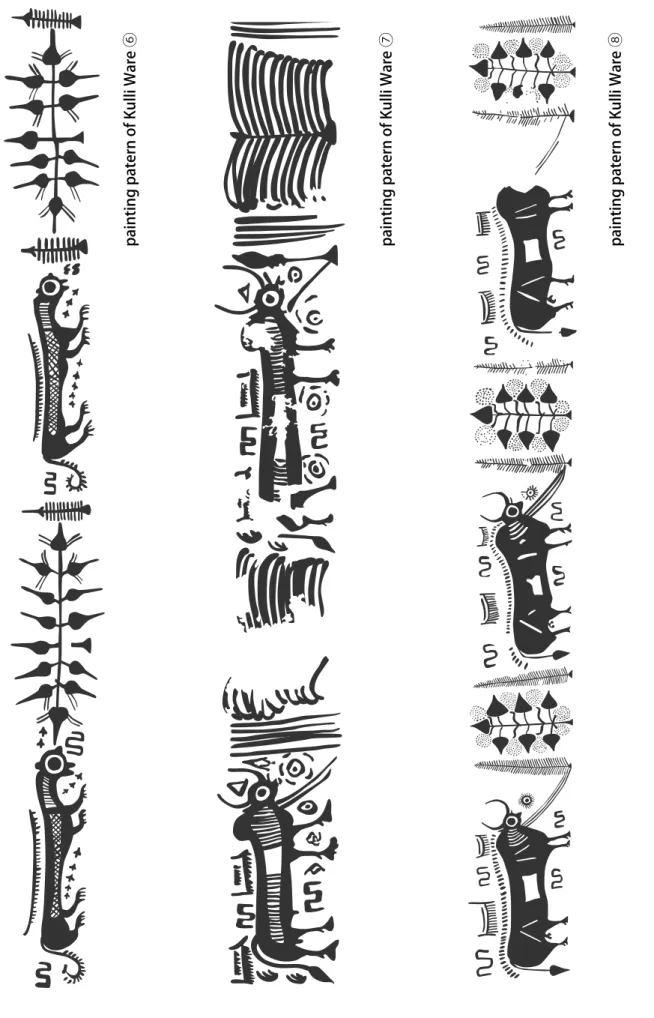
⑥ figures. 4-⑥, 6-⑥ and plate. 3-1 and 2. (no. 032) ■Form: Straight-sided bowl
■Rim Diameter: 13.1 cm, Base Diameter: 6.2 cm,
Height:6.2 cm, Thickness: 0.5 to 0.9 (carination).
■Surface Finishing, Colour of the Body and Other Features: Marks of rotating smooth with fingers or a spatula are observed on the internal surface. Its marks indicate a spiral trace from the base to the rim portion. This spiral trace on the internal surface is
Fig. 6 Painting patterns of Kulli Ware in the Aichi Prefectura
Report on the Survey of the Archaeological Materials of Prehistoric Pakistan in the Aichi Prefectural Ceramic Museum.
based on smoothing with fingers on the fast wheel or turn-table, but does not indicate that this pottery is a complete wheel made one. We can trace following manufacturing steps according to observation on the external surface. Firstly, the coil building technique on the slow turntable forms a rough shape of the pottery. An upper part and a lower part of the body could be made possibly in separate. Secondly, pottery is fixed by smoothing with a spatula or fingers after joining parts and scraping with a spatula in horizon. Although we can not observe scraping marks on the portion from the middle to the upper part of the body because of smoothing with a spatula after scraping, scraping marks are visible on the lower part of the body. It can be pointed out that the speed of wheel is fast on the observation of scraping and smoothing marks. The base is flat and is finished by smoothing with fingers. After paintings, the middle to the upper external surface is possibly burnishing by a cloth. Colours of the body indicate 10YR8/2∼8/3 (slip), 7.5YR3/2 (paint) on the internal, 5YR7/4∼7/6 (surface), 10YR8/2∼8/3 (slip), 7.5YR2/1∼3/1∼3/6 (paint) on the external. Fabric is good and firing condition is hard.
■Slip Past and Painting Motif: Although slip is not visible on the internal side, the external surface indicates the whitish slip before painting. Black band is observed around the rim on the internal and external surfaces. Painting motives on the external surface consist of two feline animals, two pipal trees (type C), three cypresses (type A), birds (type B), two temple (comb-like) motives (type A), curved line motives and bands (horizontal and wavy), etc. Firstly, two campuses for painting are made by black bands. Secondly, a wavy band filled in vertical black lines is arranged in the upper campus and two feline animals, two pipal trees, three cypresses, birds and curved line motives are arranged in the lower campus. It is worthwhile noted that motives of the lower campus are arranged like as other ① to ⑤ pottery. Two feline animals have a head of right direction. All of motives are painted in black and dark brown pigments.
⑦ figures. 6-⑦, 7-⑦ and plate. 3-3. (display no. 042) ■Form:Open mouthed jar
■Rim Diameter: 24.1 cm, Base Diameter: 10.9 cm,
Height:20.0 cm, Thickness:0.9 to 1.1 cm.
■Surface Finishing, Colour of the Body and Other Features: Marks of rotating smooth with fingers or a spatula are observed on the internal and external surfaces. Marks of rotating smooth on the internal surface indicate possibly the trace of the building technique by the fast turntable rather than smoothing with fingers or a spatula. We can trace following manufacturing steps according to observation on the external surface. Firstly, the clay coil building technique on the fast turntable forms a rough shape of the pottery. Secondly, pottery is smoothed with a spatula or fingers in horizon. Manufacturing technique of the lower external surface is not clear because of being very rough. The center portion of the flat base is slightly depressed. Marks of smoothing indicate uncertain directions. Colours of the body indicate 5YR8/4∼7/4 and 7.5YR8/2 (surface or slip), 5YR3/1 (paint) on the internal, 10YR6/8 (surface), 5YR8/3 (slip), 10R3/1 (paint) on the external and 2.5YR7/6 on the core. Fabric is good and firing condition is hard.
■Slip Past and Painting Motif: Whitish slip is visible on the internal and external surfaces. Black bands are observed around the rim of the both surfaces and on the internal wall. Vertical black short lines are expressed on the portion ranging from the flat space to the internal surface of the rim. Painting motives on the external surface consist of two humped bulls (type A), two cypress trees (type D), temple motives (type C), sun-like motives (types B and C), tiny motives (types A, B and C), curved-line motives, and bands. Firstly, campuses for painting are made by black bands which have a function of decoration too. Secondly, each motives are arranged in the main campus. All of motives are painted in black on the whitish slip. And two bulls having a head facing right are expressed as a humped bull hitching on the ground by rope-like motif. Furthermore, it is important feature that each motif is arranged around a humped bull.
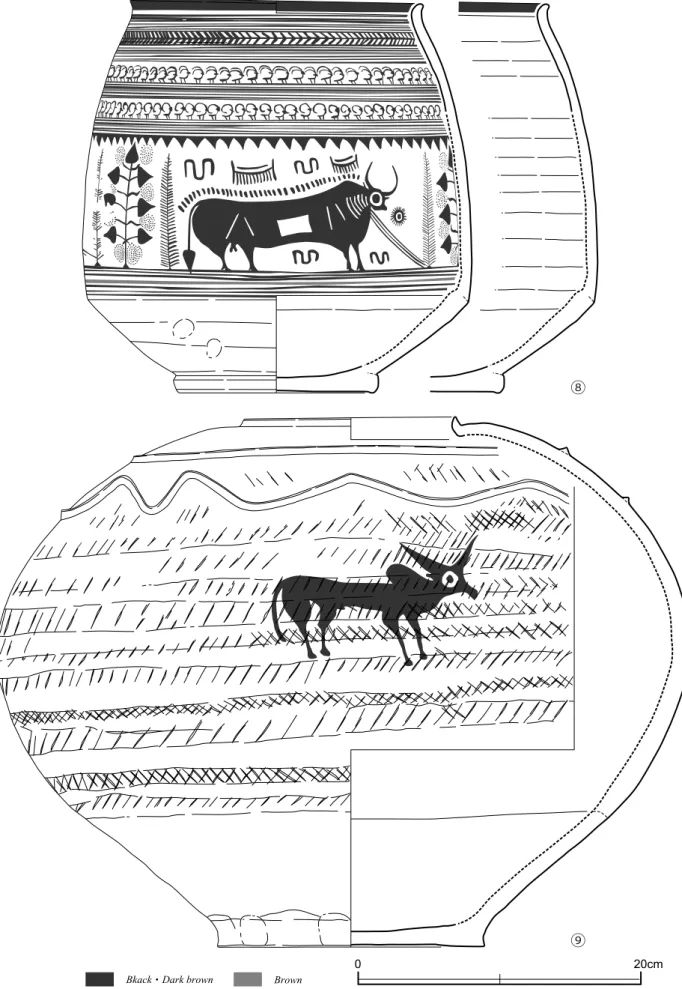
⑧ figures. 6-⑧, 8-⑧ and plate. 3-4, 5 and 6. (display no. 080)
■Form: Open mouthed jar
■Rim Diameter: 20.4 cm, Base Diameter: 14.0 cm,
Height:27.9 cm, Thickness:0.7 to 0.8 cm.
■Surface Finishing, Colour of the Body and Other Features: Marks of rotating smooth with fingers or a
spatula are observed on the internal and external surfaces. We can trace following manufacturing steps according to observations on both surfaces. Firstly, a rough shape of the pottery is formed by the clay coil building technique on the slow turntable. Secondly, pottery is smoothed with a spatula or fingers after scraping with a spatula in horizon. Scraping marks and several finger impressions are observed in the lower portion of the external surface. The base, firstly a pottery is set upside down and a clay disc attached for making a ring base. And the base is finished with smoothing with fingers, its marks
indicate concentric circle-like mark. The center portion of the base is slightly depressed. Colours of the body indicate 5YR7/8 (surface or slip), 7.5YR3/1 (paint) on the internal, 5YR7/8 (surface), 10YR8/2∼ 8/3 (slip), 7.5YR3/1∼3/2 and 10R4/8 (paint) on the external. Fabric is good and firing condition is hard.
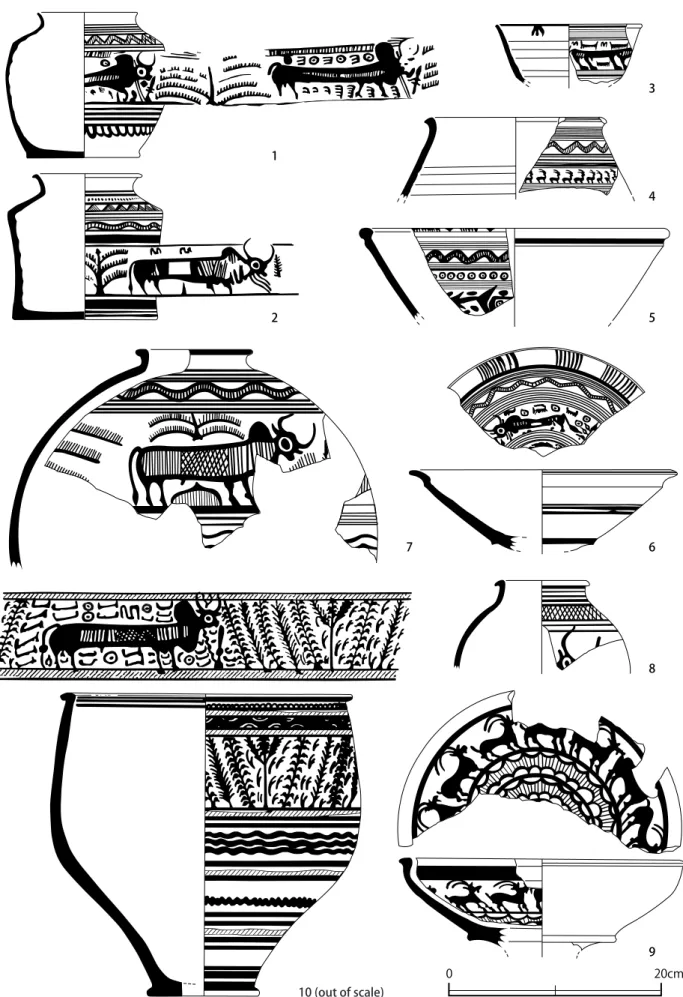
■Slip Past and Painting Motif: Whitish slip is visible on the external surface. Black bands are observed around the rim of the both surfaces. Painting motives on the external surface consist of two humped bulls (type A), three pipal trees (type A), six cypress trees (type A), sun-like motives (type A), temple motives Fig. 7 Kulli Ware in the Aichi Prefectural Ceramic Museum (2)
Report on the Survey of the Archaeological Materials of Prehistoric Pakistan in the Aichi Prefectural Ceramic Museum.
(type F), dots, curved line motives, two rows of ibex (type C), a row of rightward-pointing arrow-like motif, a row of downward-pointing triangle and horizontal bands. Firstly, campuses for painting are made by black bands which have a function of decoration too. Secondly, each motives are arranged in the main campuses. All of motives are painted in black and reddish brown on the whitish slip. And two bulls having a head facing right are expressed like ‘humped bull plus cypress’. Actually a humped bull is fastened with a cypress tree by a rope-like motif. And it is worth to note that each motif is arranged around a humped bull.
⑨ figure. 8-⑨ and plate. 3-7 and 8. (transient no. 017) ■Form:Non-necked globular pot
■Rim Diameter: 15.0 cm, Base Diameter: 18.8 cm,
Height:37.6 cm, Thickness:0.6 to 0.8 cm.
■Surface Finishing, Colour of the Body and Other Features: Marks of rotating smooth with fingers or a spatula are observed on the internal and external surfaces. We can trace following manufacturing steps according to the observation on the both surfaces. Firstly, a rough shape of the pottery is formed by the clay coil building technique on the slow turn-table. Several joining points of clay coils are observed on the lower part of the body. Secondly, pottery is smoothed with a spatula or fingers, and scraping by a spatula in horizon. Scraping marks on the external surface are very visible and characteristic. Their marks show X-like shape in some parts, because the scraping is performed on the turn-table. Thirdly, two clay cords (horizontal and wavy) are attached to the upper part of the body after scraping. The base is flat and the center portion of the base is slightly depressed. Marks of smoothing indicate uncertain directions. Colours of the body indicate the unclear situation on the internal, 10YR8/2∼ 8/3 (slip), 2.5YR2/2 (paint) on the external and N5/-4/-3 on the core. Fabric is good and firing condition is hard.
■Slip Past and Painting Motif: Whitish slip is visible on the external surface. Painting motif on the external surface consist of one humped bull (type C). The motif of bull is painted in black on the whitish slip. And a bull having a head facing right has a large round eye as well as other animal motives of Kulli Ware.
■Remarks: The painting style of this pottery is
recognized as Kulli style. But several features such as the shape of the body and the manufacturing technique are very different from other Kulli Ware. It is worthwhile noted that this pottery has the gray core.
⑩ figure. 9-⑩ and plate. 4-1 and 2. (display no. 038) ■Form:Nail-headed rim bowl
■Rim Diameter: 23.0 cm, Base Diameter: 10.4 cm,
Height:8.9 cm, Thickness:0.6 cm.
■Surface Finishing, Colour of the Body and Other Features: Marks of rotating smooth with fingers or a spatula are observed on the internal surface. We can trace following manufacturing steps according to observation on the external surface. Firstly, the coil building technique on the slow turntable forms a rough shape of the pottery. Secondly, pottery is fixed by smoothing with a spatula or fingers after scraping with a spatula in horizon. While we can not observe scraping marks on the middle to the upper part of the body because of smoothing with a spatula after scraping, scraping marks are visible on the lower part of the body. We can see that the wheel speed of turning is slow on the observation of scraping and smoothing marks. The base is a ring base made of attaching a clay cord, and finished by smoothing with fingers. Colours of the body indicate 2.5YR6/8 (slip), 2.5YR3/1 (paint) on the internal, 10YR8/2 (surface), 2.5YR6/8 (slip), 2.5YR3/1 (paint) on the external and 2.5YR5/8 on the core. Fabric is good and firing condition is hard.
■Slip Past and Painting Motif: Reddish slip is visible on the internal surface and the upper portion of the external surface. And the lower external surface is covered by the whitish slip under the reddish one. Black band is observed around the rim on the internal and external surfaces. Painting motives on the internal surface consist of two fishes, two plants (type A) and several bands. Two fishes and two plant motives are painted alternately. All of motives are painted in black and dark brown pigments on the reddish slip.
■Remarks: The shape of nail-headed rim correspond to one of the characteristic features of Harappan Ware.
⑪ figure. 9-⑪ and plate. 4-3 and 4. (display no. 043) ■Form:Open mouthed bowl
Report on the Survey of the Archaeological Materials of Prehistoric Pakistan in the Aichi Prefectural Ceramic Museum.
■Rim Diameter: 12.5 cm, Base Diameter: 5.25 cm,
Height:3.8 cm, Thickness:0.3 to 0.4 cm.
■Surface Finishing, Colour of the Body and Other Features:Marks of rotating smooth with fingers or a spatula are observed on the internal surface. Some finger impressions are recognized on the wall of the lower internal body. We can trace following manufacturing steps according to observation on the external surface. Firstly, a rough shape of the pottery is formed by the coil building technique on the slow turntable. Secondly, pottery is fixed by smoothing with a spatula or fingers after scraping with a spatula in horizon. We can observe scraping marks on the lower to the upper part of the body because of smoothing with a spatula insufficiently after scraping. We can see that the wheel speed of turning is slow on observation of scraping and smoothing marks. The base is a ring base made of attaching a clay disc and is finished by smoothing with fingers after scraping. Colours of the body indicate 2.5YR7/4 (surface or slip), 7.5R4/6 (paint) on the internal, 2.5YR7/4 (surface or slip), 7.5R4/6 (paint)
on the external and 10R6/6 on the core. Fabric is good and firing condition is hard.
■Slip Past and Painting Motif: Whitish slip is visible on the internal and external surfaces. Reddish brown band is observed around the rim on the internal and external surfaces. Painting motives on the internal surface consist of a humped bull (type C), two birds (type A) and two bands. All of animal motives have large round eyes which occupy a greater part of the face. All of motives are painted in reddish brown pigments on the whitish slip.
■Remarks: The painting style of animals on this pottery is very different from the typical Kulli Ware. Animals are drown by reddish brown colour.
b. Kulli-related potteries
⑫ figure. 10-⑫ and plates. 4-5, 6, 7, 8 and 5-1. (display no. 009)
■Form:Open mouthed pot with clay cords
■Rim Diameter: 9.4 cm, Base Diameter: 8.5 cm,
Height: 18.7 cm, Thickness:0.5 cm.
■Surface Finishing, Colour of the Body and Other
Features: Marks of rotating smooth with fingers or a spatula are observed on the internal surface. We can trace following manufacturing steps according to observation on the external surface. Firstly, the coil building technique on the slow turntable forms a rough shape of the pottery. The upper part and the lower part of the body could be made separately. Secondly, pottery is fixed by smoothing with a spatula or fingers after scraping with a spatula in horizon. Although we can not observe scraping marks on the middle to the upper body because of smoothing with a spatula after scraping, scraping marks are visible on the lower part of the body. We can see that the wheel speed of turning is slow on observation of scraping and smoothing marks. Thirdly, six clay bands made of pinching out the wall are made. The external surface is possibly burnishing with a cloth or a spatula on the turntable after painting. As setting a pottery upside down, a clay cord is attached on the base for making a ring
base, and a base is finished with smoothing by fingers. Colours of the body indicate 5YR7/4 (surface), 5YR4/1∼5/1 (paint) on the internal, 5YR7/4 (surface or slip), 5YR3/1 and 2.5RY 6/8 (paint) on the external and 10R6/8 on the core. Fabric is good and firing condition is hard.
■Slip Past and Painting Motif: Slip is not visible on both surfaces. Black band is observed around the rim on the internal and external surfaces. Painting motives on the external surface consist of rows of ibex (type C), rows of sun-like motif (type C), rows of triangle, a series of loop and bands (horizontal and wavy). Firstly, pinched out clay bands and black bands have two functions of decoration and dividing a surface into several campuses for paintings. Secondly, each series of motives are arranged in the each campus. All of motives are painted in black pigment. And ibexes are expressed by facing right direction without an exception.