Terrestrial Kilometric Radiation Observed by
JIKIKEN-Brief Report
著者
Morioka Akira, Oya Hiroshi, Miyatake Sadao,
Ono Takayaki
雑誌名
Science reports of the Tohoku University. Ser.
5, Geophysics
巻
26
号
1
ページ
15-20
発行年
1979-10
URL
http://hdl.handle.net/10097/44763
Terrestrial Kilometric Radiation Observed
by JIKIKEN—Brief
Report
AKIRA MORIOKA, HIROSHI OYA, SADAO MIYATAKE* and TAKAYUKI ONO
Geophysical Institute, Tohoku University, Sendai 980, Japan
(Received April 20, 1979)
Abstract: The electric fields in a frequency range from 10 kHz to 3 MHz have been observed using very long dipole antenna (102 m tip to tip) installed on JIKIKEN
satellite. In the astronomical mode of the natural plasma waves (NPW-A), the
measurements have been carried out with scanning rate of 2 sec/sweep. The results
provide very extensive survey of the terrestrial kilometric radio waves (TKR).
The enhancement of TKR makes very clear coincidence with the initiation of the substorm in the magnetosphere that was defined by occurrence of Pi2 puslations.
It is clarified by this work that the terrestrial kilometric radio waves can observed
almost all the night-hours when the satellite is located in a sutiable position; only the
band width and the intensity of the emitted radio waves change corresponding to the substorm activity. From the fine structure of the TKR emission spectrum, the
movement of the radio source along the magnetic field lines is also verified; the
source region moves with the average velocity in a range from 5 to 10Km/sec, toward
the lower level.
1. Introduction
The characteristics of the terrestrial kilometric radiation have been investigated analyzing the data obtained by the JIKIKEN satellite that has the orbit in the inner magnetosphere. The natural plasma wave experiment-astronomy mode (NPW-A) on JIKIKEN is designed to observe the planetary and solar radio waves in the frequency range from 10 kHz to 3 MHz using the long dipole antenna. The spectrum of the signals is obtained by the high speed swept frequency type spectrum analyzer on board. The observed data are transmitted to the ground using the analog channel telemeter, and provide us dynamic spectrum with very high resolution.
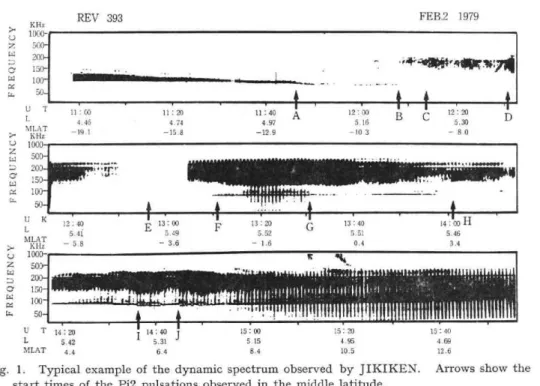
The typical example of the dynamic spectrum of the wave phenomena obtained by JIKIKEN in the magnetosphere on Feb. 2 1979 is shown in Fig. 1. Three kinds of emissions are identified in the figure; i.e., i) UHR emission which is received continuously during all the observed period on this day, ii) terrestrial kilometric radiation which began to be observed at about 12h00mUT (L=5.2) and faded out at 15h1Om (L=5.1) around the apogee (L=5.5), and iii) pure HF emissions which have the falling-tone structure and are identified to be some celestial origines. The purpose * Department of Radio Communication, University of Electro-Communications, Chofu, Tokyo
182, Japan
16 AKIRA MORIOKA ET AL. KHz 1000- 7 500- 150-w 100- U U z CC REV 393 FEB.2 1979 U T 11 : OC L 4.4-C MazT -19.1 1000 500 200
150)111W
100 50 U K 12: 40 L 5 .41 MLAT KlIz 5.8 -15.8 -12.9 -10 .3''4":**Pftvgioric74
- 8.0 1000 500 200 150 100 50 U - L - 3.6 - 1.6 0.4 H .46 3.4 U i 14 : 20 1 14 : 40 j 10 . 00 i5. Di L 5.42 5.31 5 15 4.95 MLAT 4.4 6 4 8.4 10.5Fig. 1. Typical example of the dynamic spectrum observed by JIKIKEN. start times of the Pi2 pulsations observed in the middle latitude.
4.69 12.6
Arrows show the
of this paper is to make a preliminary report on the characteristics of terrestrial kilometric radiation (TKR) clarified by the dynamic spectrum with fine structure.
2. Occurrence of TKR Emissions
As seen in Fig. 1, TKR emissions appear in the frequency range from 120 kHz to 500 kHz, and the intensity and the band-width of TKR have the time dependent characteristics. The arrows in the figure indicate the start times of the irregular type fluctuations of geomagnetic field (Pi 2) observed on the midlatitude (Onagawa Magnetic Observatory). Each time given by the arrows coincides well with the sudden enhancement of both the intensity and the band-width of TKR. The evidence of the coincidence between the enhancement of the TKR and Pi 2 pulsations on the ground makes us confirmation that TKR is strongly correlated with the substorm activity in the polar region, as has pointed out by Gurnett (1974) who compared the satellite radio wave data with auroral photographs from the DAPP satellite.
3. Relation of TKR Emissions to Geomagnetic Activity
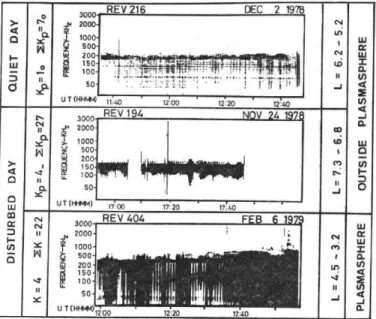
It is quite impressive feature that even on the quiet day of the geomagnetic activity, the TKR is observed though the intensity is low and spectrum is limitted into a relatively narrow band-width. An example of TKR on a magnetically quiet day is shown in the upper panel of Fig. 2. As shown in the figure a weak emission is radiated intermittently though X Kp is only 70.
band frequency range (see Fig. 2). The spectrum in this case varies vividly with time . When the satellite moves into the plasmasphere on disturbed days, the observed TKR emission and its relation to substorm indicate very different feature compared with the case in the outside plasmasphere. In the bottom panel in Fig. 2, the dynamic spectrum of TKR emission observed on Feb. 6 1979, two days after a geomagnetic storm onset, is shown for the case observed in the plasmasphere . The component which belongs
a t-w 5 0 ›.. a a o w co cc = I-u) FE r2 16 x VI o II 44 r^ CV II a X II 4 ii Y CNI CV II Y IN ...1; Y 3000 IN 2000 t000 500 200 150 100 50 tJ T (HHNINO REV 216 3000REV 194 44 2000 1000 (-)z 500 200 8,150 E 100 50 UT(FFM) 3000 2000 1000 500 w200 150
g100
50 U T 0-11-11*0 17:40 12:40 U"; 11 —J c*, N N cri • us 11J C0 0. 0. Ui 0 ILJ 0. 4 A 4 —7Fig. 2. Dependence on geomagnetic activity; upper panel; on magnetically quiet day in the outside plasmasphere, middle panel; on magnetically disturbed day in the outside
plasmasphere, bottom panel; on the disurbed day in the plasmasphere.
to TKR can be observed in a higer frequency range from 300 kHz to 600 kHz , that is higher than the case of the observation in the outside plasmasphere , due to a cutoff effect by plasma in the plasmasphere . In the low frequency range, it is evident that another branch of radio wave emissions with an intense broad frequency band can be observed sporadically; these emissions are also correlated with the enhancement of TKR.
4. Directivity of the Observed TKR
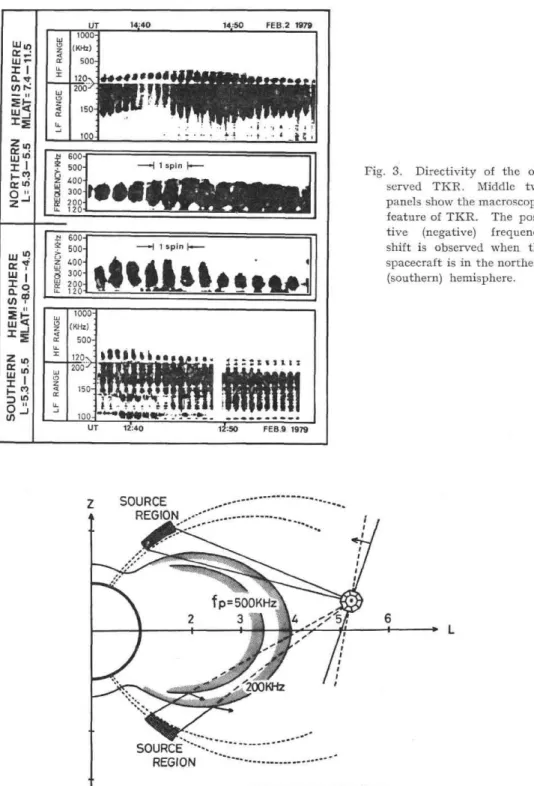
The swept frequency receiver installed on JIKIKEN has two sweep ranges; both of the LF band (10 kHz to 200 kHz) and the HF band (120 kHz to 3 MHz) as shown in the top and the bottom panels , of Fig. 3. The dynamic spectral pattern of TKR is repeated from 120 kHz to 200 kHz being compressed in the coordinate of the frequency. This compressed part is useful to investigate the macroscopic feature of TKR spectrum as shown in the middle two panels of Fig. 3. It is clearly shown that the observed TKR shows a positive frequency shift in the period of 1/2 spin modulation when the spacecraft is located in the northern hemisphere , while an opposite frequency
18 AKIRA MORIOKA ET AL. L11m MW III ,- 2 I a. v. u) P.:
E
i
w _, 2E Z in cc . W 111 II I--01 min 01 1.1 Z ul W- CC I LLI 1 I 0- • 03 N' i" 4 u, a r Ei z . cc 6 ut I 1— cl Lf? 0 1000 (KHz) 500 120, 14:40 ,!! 14:50 FEB.2tati
600 500 400 300 200 120illakps•
1000 (KHz) 500 120-. iStlitia. 1979Fig. 3. Directivity of the ob-served TKR. Middle two panels show the macroscopic feature of TKR. The posi-tive (negative) frequency shift is observed when the spacecraft is in the northern (southern) hemisphere. z SOURCE REGION .. ,• -•• •••^ ..••• fp= ••^•• 2
5000 11
1
3 % 4 ,.-75 -, 1 •:, 6 SOURCE 4,100KHzli
URCE REGION L Fig.VIEW FROM THE SUN
4. The observed frequency shift of TKR suggests that the direction of the maximum gain
of the dipole antenna sweeps only the northern source region when the satellite is located in
the northern hemisphere, while antenna sweeps only the southern source region when
shift is revealed when the satellite is located in the southern hemisphere. This evidence reflects the following mechanism. As the spin axis of the spacecraft is oriented to the
direction of the sun during the period of the observation with counter clockwise rotation of 94 sec period viewed from the sun, the direction of the maximum gain of the dipole antenna sweeps the earth's northern polar region from higher to lower altitudes, i.e., sweeps from lower to higher altitudes in the southern hemisphere. In the period of the observation when JIKIKEN is located in the northern hemisphere, only the terrestrial kilometric radiation generated in the northern polar region can arrive at the satellite, because the southern source is hidden by the plasmapause, and vice versa. So that, the observed frequency shift shows that the lower frequency component of TKR is generated at relatively higher altitude and the higher frequency component at lower altitude. These relations are shown schematically in Fig. 4.
5. Generation Region of TKR
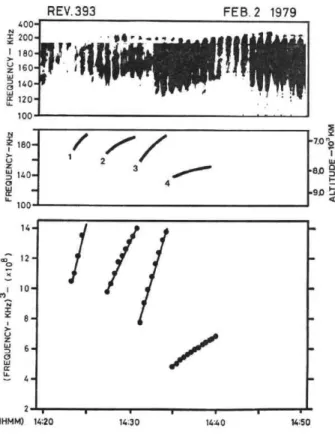
The dynamic spectrum of TKR sometimes shows the fine drifting structure which is characterized by the rising tone. The examples with schematic indication are shown in the top and middle panels of Fig. 5. This drift rate of the frequency indicates very interesting feature that the frequency drift is taking place in proportion to cubic power low with time as shown in the bottom panel of Fig. 5. This result indicates that the source agency of the TKR, whoes generation mechanism is very closely related to the
Fig. 5. The fine structure of TKR. The frequency drift is taking place in propori-tion to cubic power low with time. This result indicates that the generation region is moving down to the Earth with the decelation.
N = ›- U Z 41 D C f/ U CC LL 400 200 180 160 140 120 100 Y 180 5- u z w 140 0 LY_ 100 14 12 °D.-. 0 .- x c.,I 1 0 r; x SC 8 ›- LI z nui 6 a La cr t i" --- 4 REV. 393 FEB. 2 1979 p ., 2 UT (HHMM) 14:20
/
7.0 "0 tu 8.0 g 9.0 -+ 4 14:30 14:40 14:5020 AKIRA MORIOKA ET AL.
electron cyclotron frequency, is moving down toward the earth's polar region with sharp deceleration of velocity. The most probable generation mechanism of TKR is that the electrostatic wave near the upper hybrid frequency generated by injected energetic particles escapes to outer space in a form of electromagnetic waves (Oya. 1974).
6. Conclusion
The properties of TKR were investigated in detail using the high resolusion spectrum analyzer installed on JIKIKEN. It is evident that the most intense portion of TKR is generated at the altitude from 5,000 km to 10,000 km associated with the auroral particles, and its generation mechanism is strongly related with the local electron cyclotron frequency. The results suggest that the wave generation is made in a frequency range between the local electron cyclotron and the upper hybrid
frequencies.
Acknowledgement: This work has been carried out as EXOS-B Project of Institute of Space and Aeronautical Science, University of Tokyo. We would like to express our sincere thanks to Prof. T. Obayashi, Manager of this project, and all the members of EXOS-B project relating to the satellite assembly, rocket launching, and the satellite tracking.
References
Gurnett, D.A., 1974: The earth as a radio source: Terrestial kilometric radiation, J. Geophys. Res., 79, 4227-4238.
Oya, H., 1974: Origin of Jovian decameter wave emission — Coversion from the electron cyclotron plasma wave to the ordinary mode electromagnetic wave, Planet. Space Sci., 22, 687-708.