An investigation of the linguistic encoding of
motion and state-change events in English and
Japanese through Talmy's typology
著者
斎藤 珠代
学位授与機関
Tohoku University
平成 22 年度(2010年)修士論文
An investigation of the linguistic encoding of motion and state-change
events in English and Japanese through Talmy’s typology
(タルミーの類型論における日英語の移動と変化の言語表現)
国際文化研究科 国際文化交流論 (言語コミュニケーション論講座) A9KM1009 斎藤 珠代
Contents
1. Introduction 2 2. The framework of this research 4 2.1. Talmy’s framing typology 4 2.1.1. Lexicalization 4 2.1.2. Two framing types 5 2.1.3. Macro-event and exceptional phenomenon 6 2.2. Critical views 8 2.2.1 Matsumoto (2003) 8
2.2.1.1. Three interpretations of Talmy’s typology and
the best reformation of them 8 2.2.1.2. The relationships between the best interpretation
and the other two 11 2.2.2. Beavers et al. (2010) 13 2.2.2.1. Three-way typology 13 2.2.2.2. V-framed behaviors in S-framed languages 14 2.2.2.3. S-framed behaviors in V-framed languages 15 2.2.2.4. ‘E-framed language’ also has other type’s behaviors 19 2.2.2.5. Reasons why those mixed behaviors happen 20 2.2.3. Bohnemeyer (2007, 2010) 22 2.2.3.1. Macro-event property (MEP) 22 2.2.3.2. Motion event in the light of MEP 24 2.2.3.3. Causality in the light of MEP 24 2.2.4. Summary 25 3. Research Question 26 4. Methodology 28 4.1. Parallel corpus method and literature used 28 4.2. ‘Motion’ and ‘state-change’: the question under review 31 4.3. Criteria to identify both frames 32
5. Data 35 5.1. The number of total data and percentage of S-framed 35 5.2. Data of ‘motion’ 38 5.2.1. The unexpected framing types in English and Japanese 38 5.2.2. The fictive motion 39 5.2.3. Richness of manner-of-motion verb in English 39 5.2.4. Japanese tends to encode a variety of events in verbs 42 5.3. Data of ‘state-change’ 46 5.3.1. Manner verb in state-change 46 5.3.2. Typical pairs and unexpected pairs 47 5.3.3. Expressions using formulas 49 5.3.4. When English uses no verb 50 6. Discussion 52 6.1. Matsumoto (2003) 52 6.2. Beavers et al. (2010) 53 6.3. Bohnemeyer et al. (2007, 2010) 56 6.3.1. Bohnemeyer’s point: time-scale 56 6.3.2. Durative vs. momentaneous change 57 6.3.3. Reformation of durative vs. momentaneous: atelic vs. telic 60 6.3.4. V-framed expression with perfective meaning: Death and Break 64 6.3.5. The focus on process or result 66 6.3.6. S-framed has a clear delimitation 68 6.3.7. Exceptional data 70 6.3.8. Summary 71 7. Conclusions 72 Acknowledgement 74 Appendix 75 References 77 Literary works 79
An investigation of the linguistic encoding of motion and
state-change events in English and Japanese
through Talmy’s typology
(タルミーの類型論における日英語の移動と変化の言語表現)
国際文化交流論専攻(言語コミュニケーション論講座) A9KM1009 斎藤 珠代 1.研究の目的
本研究の目的は Leonard Talmy の類型論を検証することである。Talmy(2000)は世界の 言語が「動詞枠付け言語」および「衛星枠付け言語」に分かれると考え、言語類型論にお いて大きな影響力をもっている。そして、世界で起こる出来事には大きく分けて 5 種類の 出来事があるとして、これを「マクロ・イベント」と呼んだ。1つの言語は 5 つのマクロ・ イベントすべてにおいて、上記に掲げた 2 類型、「動詞枠付け」か「衛星枠付け」のパタ ーンを示すというのが彼の理論だが、英語においては Talmy 自身が認めているように「状 態変化」のマクロ・イベントにおいて両枠付け型の混在が見られる。この点の検証を試み た先行研究には小野(2004)があり、本研究では小野の方法論を踏襲してデータ数を増や し、さらなる検討を試みた。また、データから実際に「状態変化」において両フレームの 混在を確認し、英語が一貫して「衛星枠付け」パターンを示さないことを確かめた上で、 その理由を考察することも、本研究の目的である。 2.理論的枠組み 本研究の理論的枠組は上記に記したとおり、Talmy の類型論である。Talmy(2000)は世 界で起こる出来事のうち、2 種類の出来事が統合されて単節で表される出来事が 5 種類あ ることを指摘し、それらをマクロ・イベントと呼んだ。「移動」と「状態変化」がその 5 種類に含まれるが、「移動」の場合、The ball rolled in. という文はボールが「転がった」 ことと「入って行った」ことの 2 種類のイベントが単節に統合されている。また「状態変 化」の場合は、The candle blew out. という文では蝋燭に「何かが吹き付けた」ことと、 蝋燭が「消えた」ことが単節に統合されている。このような場合、その出来事はマクロ・ イベントとなる。そして、それぞれのマクロ・イベントには「中核スキーマ」と呼ばれる 要素がある。移動の中核スキーマは「経路」であり、状態変化の場合は「変化した状態」
であり、それらを文法的要素のどこで表現するかで「動詞枠付け言語」と「衛星枠付け言 語」に分かれる。たとえば上記の「移動」の文では「経路」は in、「状態変化」では「変 化した状態」は out という動詞以外の部分(この場合不変化詞)で表されているので、英 語は「衛星枠付け言語」となる。日本語では中核スキーマは「移動」、「状態変化」ともに 「入っていく」、「吹き消される」という動詞で表現されるので、動詞枠付け言語となる。 しかし、Talmy 自身が認めているように、状態変化では英語が衛星枠付け言語に類型化さ れるにもかかわらず動詞枠付け型の文が同程度に用いられる。この例外をどう説明するか が1つの課題である。これに対して、本研究では 3 つの先行研究を取り上げている。 1つは Matsumoto(2003)である。Matsumoto は Talmy の 2 類型を「主要部枠付け言語」 と「非主要部枠付け言語」と解釈し直している。そして様態動詞の多い言語が衛星枠付け 言語になり、経路動詞の多い言語が動詞枠付け言語になると考える見方に対して、ある言 語内での様態動詞や経路動詞の多さはこの枠付け理論とは独立した係数で、枠付け理論と は関係ないとしている。問題は様態動詞が多いかどうかではなく、それらが文のどこに表 現されるかである。
2 つ目の先行研究は Beavers et al.(2010)である。Beavers et al.は1つの言語内でいく つもの枠付けパターンが確認されることを例証し、枠付け型は何の言語かによって決まる のではないとしている。むしろ、関係するのは文法的要素の組み合わせのうちどのような 形がその言語において可能か、である。可能な組み合わせは予測がつかないので、言語ご とにすべてのマクロ・イベントを通して枠付け型を同定するのは不可能である。
3 つ目の先行研究は Bohnemeyer et al.(2007,2010)である。Bohnemeyer et al.は Talmy とは全く別の類型論を展開している。彼らは「出来事は空間のみでなく時間軸上でおこる」 という点に着目し、類型の基準となる新しい尺度としてマクロイベントプロパティ(MEP) という尺度を設定している。この尺度によって「移動」事象を調査したところ、3 種類に 類型化され、それらは Talmy の2類型と重なる結果となったが、「状態変化」を調査した 結果は Talmy の類型論とは全く関係のない結果となった。 3.問題設定と研究方法 Talmy の 2 類型が言語ごとに分かれるのか、日本語と英語において調査する。その際、 Talmy の唱える 5 つのマクロ・イベントのうち、最も原型的な「移動」事象と、英語にお ける両枠付けの混在が問題となっている「状態変化」事象を取り上げて比較検討する。方
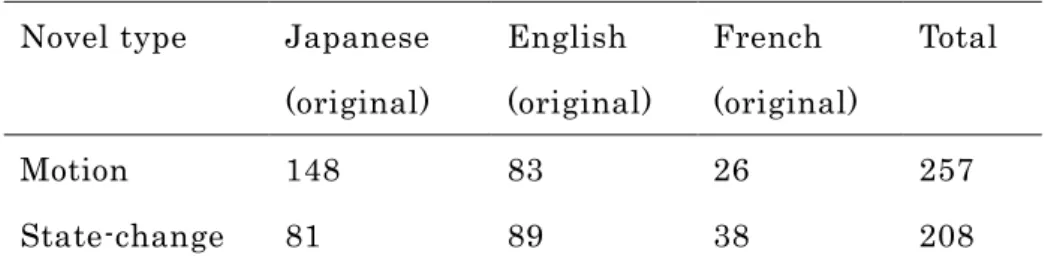
法は小野を踏襲して「パラレル・コーパス」の手法を用いる。これは文学作品の原作と翻 訳から手作業でデータを収集する方法で、任意のページを開き、「移動」と「状態変化」の 表現を見つけたらその対訳で対応する表現を拾っていく方法である。本研究では、特定の 動詞などではなく「出来事」がどう表現されるかが問題となり、データベースで検索して データを集めることは不可能なので、手作業で行った。日本語作品 10 作品と英語作品 10 作品(原典と対訳)を用い、収集したデータ総数は日本語と英語のペアで「移動」で 257 ペア、 「状態変化」で 208 ペアとなった。これらのペアが動詞枠付けか衛星枠付けのどちらに適 合するか確認したと同時に、具体的な言語表現の違いから両枠付けの特徴がみられるかど うか調べた。そして、「状態変化」において英語で両枠付け型の混在が確認されたため、そ の理由を先行研究から検証した。 4.結論 データから、予想通り「移動」においては日本語では動詞枠付けパターンが優勢で、英 語では衛星枠付けパターンが優勢であることが確認された。一方、「状態変化」では日本語 では移動と同様に動詞枠付けが優勢を保ちながら若干衛星枠付けの割合が増え、英語では ほぼ半々で両枠付け型が混在していた。この原因について、先行研究から以下の点を導い た。 Matsumoto は様態動詞の多さは枠付け型と関係がないという主張をしている。問題は様 態動詞や経路動詞を文のどの部分に統合するかであり、その豊富さではないからである。 と同時に Matsumoto は英語が様態を動詞に現しやすい言語であることを指摘している。 英語の「移動」においては様態が動詞に現われるので経路は動詞以外の部分で表現され、 結果として衛星枠付け型となる。しかし「状態変化」においては元来、様態を伴わないこ とが多い。代わりに原因や付帯状況が現われることがあるが、移動において様態が伴われ るのに比較すると少ない。「移動」はものが動くのでその様態が話題となりやすいと考えら れる。したがって、様態が現れにくい「状態変化」では様態のかわりに他の要素を動詞に 表現することが可能となり、中核スキーマである「変化した状態」が表現されれば動詞枠 付け型を示すこととなる。 Beavers et al.は、枠付けパターンはその言語で利用できる文法要素の組み合わせの結果 決まると主張した。集めたデータで衛星にどんな要素が使われているか調べたところ、「移 動」では日本語の衛星は極端に少なく、英語の衛星は豊富であった。このことから、日本
語では希少な衛星を使うより動詞で経路を表現する方が優勢になるため動詞枠付け型を示 し、英語では豊富な衛星に経路を統合できるので衛星枠付け型を示すことが容易に予測で きる。また、「状態変化」では日本語の衛星は若干増え、英語では「移動」ほど豊富ではな かった。このことから、英語では「移動」で衛星を用いてあらわすことができる中核スキ ーマが「状態変化」では衛星の少なさから代わりに動詞によって表現され、結果として動 詞枠付け型となっているのではないかと考えられる。 Bohnemeyer et al.は「移動」では「中間経路」を基準に類型化を行っていたが、「状態 変化」では「接触:Contact」という要素を考慮に入れている。これは衝撃が起こってか ら状態変化が起こるまでの空間的・時間的近接性のことである。ここから、状態変化にお ける時間的近接性にどんな種類があるか考えると、瞬間相(状態変化が瞬時に完了する)か 継続相(徐々に変化していく)の2種に分かれることが導かれる。集めたデータを確認する と英語で動詞枠付け型を示す表現は、継続相が非常に多くみられ、逆に衛星枠付け型の表 現は瞬間相(炎や灯りが消えるという表現が典型的)が多くみられた。また、さらに考察を 進めると、衛星枠付け型の表現の衛星は動詞の継続性を完了させる機能をもっているよう に見えた。たとえば、「薄らいでいく」という表現は fade という動詞が用いられているが、 「完全に消え失せ」という表現は fade out となり、衛星の out がついている。この衛星 out が動詞 fade の継続相を完了させる働きをもつのではないかという仮説がたつ。また、 衛星枠付け型は瞬間相なので結果に焦点があり、動詞枠付け型は継続相なので経過に焦点 があるように見える例も多く見つかった。さらに、この点から衛星枠付け型は結果を焦点 として、変化の始まりと終わりを囲むように輪郭がはっきりとしていて、動詞枠付け型は 経過全体に焦点があるので出来事の輪郭がぼやけているとも言える。このようなアスペク トの違いが英語の状態変化における両枠付けの混在の原因となっていると考えられる。 5.今後の課題 Bohnemeyer et al.から導いたアスペクトに関する仮説は、例外となる表現が 3 つ見つか っている。動詞枠付け型なのに瞬間相を暗示する副詞が含まれている表現である。この例 外について説明する原理を見つけることが必要である。また、Bohnemeyer et al.から導い たアスペクトの説に関しては、観察から導いた仮説にとどまっており、さらなる分析が必 要である。
1
An investigation of the linguistic encoding of motion and state-change
events in English and Japanese through Talmy’s typology
Tamayo Saito
The Department of Linguistic Communication
Abstract
The purpose of this paper is to examine Leonard Talmy’s framing typology. Talmy (2000a, b) argues an influential typology which proposes that languages fall into two types: satellite-framed language and verb-framed language based on event encoding systems. He presents five categories of event called ‘macro-event’. In this paper, we choose two events among the macro-events and examine how their behaviors parallel in English and Japanese. If Talmy’s two-way typology thoroughly covers all events, those two events show the same framing patterns in English and Japanese respectively in parallel. However, it is presumed that the event of ‘state-change’ in English is not parallel to the event of ‘motion’ since several exceptions in ‘state-change’ are found by Talmy. This paper investigates this point based on the evidence of linguistic data from several novels and their translations of English and Japanese. Three previous researches suggest why they are not parallel, and findings from collected data illustrate aspectual phase to shed light on this point.
2 1. Introduction
Languages reflect human and their world. The world is objective and event happening in the world is also objective to speakers of any language. However, different languages express the same event in slightly or markedly different ways. Take English and Japanese and let us look at the event, “I went to Kyoto. The transportation I used was an airplane.” To the statement, “Please express this event the simplest way in a single sentence of English”, five native English speakers, (three Americans, one Australian, and one Canadian) responded “I flew to Kyoto” is natural. On the contrary, native Japanese speakers tend to answer “I went to Kyoto by airplane (plane, air).” This is supposed to be a literal translation of a Japanese expression below:
(1) Watashi-wa hikooki-de Kyooto-ni ikimashita. I-TOP by.airplane Kyoto-GOAL go-PST ‘I went to Kyoto by airplane.’
Regarding this answer, native English speakers all said it was odd but it might be possible if ‘how to get there’ was particularly in question. One American informant mentioned that in English, they use verbs like ‘fly’, ‘drive’, and ‘walk’ rather than ‘go’. The verbs he mentioned are manner-of-motion verbs. This difference of expression suggests that English encodes ‘how to get to the place’ in verbs. On the contrary, Japanese encodes it outside verbs, for instance, in an adverbial phrase. It is said that there are over six thousands languages in the world. According to the small survey above, English and Japanese are predicted to fall in different types.
Language typology theories categorize languages of the world into many types and aim to explain universalities and diversities of languages. Among those typologies, Talmy’s two-way typology is one of the most influential ones and has been discussed by a number of researchers. To employ Talmy’s theory, the result of the small survey above means that English is categorized as a ‘manner language’ and Japanese is a
3
‘path language’. We adopt Talmy’s typology as the framework of this paper.
The goals of this study are to examine whether Talmy’s framing typology covers all kind of event, and if not, investigate why it has exceptional phenomena.
In chapter 2 we will outline the framework theory: Talmy’s typology, effective reformation of it by Matsumoto (2003), critical perspective against Talmy’s typology by Beavers et al.(2010), and other types of typology by Bohenemeyer (2010). Chapter 3 clarifies the research question. Chapter 4 explains the methodology of collecting data, and chapter 5 explores detailed data. Chapter 6 solves the research question and chapter 7 concludes.
4 2. The framework of this research
2.1. Talmy’s framing typology 2.1.1. Lexicalization
Talmy proposes that the world’s languages fall into two types: verb-framed language and satellite-framed language. Before we describe those two types, it will be useful to clarify the notion of ‘conflation’ (or ‘lexicalization’).
Language expresses meanings and concepts in its grammatical resources and the ways to express concepts differ depending on each language. One of the well-known examples is expressions of ‘snow’. There are a number of words which means ‘snow’ in Inuktitut. The list of (2) shows just some part of them.
(2) aput ‘snow on the ground’
qana ‘falling snow’
piqsirpoq ‘drifting snow’
qimuqsuq ‘snow drift’
(O’Grady & Archibald 2004: 185)
The examples above show how concepts are integrated in one word. This process is called lexicalization. Inuktitut word “qana” lexicalizes the two concepts ‘falling’ and ‘snow’ in a single word while English expresses the same meaning in separate words. This example indicates that lexicalization patterns differ from language to language. This example of ‘snow’ is a case of the lexicalization of a ‘noun’. Let us next discuss the lexicalization of a ‘verb’, which is stated in Talmy (2000b). There are many kinds of verbs: verb of motion, perception, emotion, et alia. Among those kinds, motion verb is cross-linguistically the most common and prototypical one. According to Talmy, motion has four factors: ‘motion’, ‘moved thing’, ‘manner of movement’, and ‘path’. English lexicalizes mainly ‘motion’ and ‘manner of motion’ in a single word. On the contrary, Spanish and Japanese lexicalize mainly ‘motion’ and ‘path’.
5 Motion + Manner
(3) The rock rolled down the hill. (Talmy 2000b: 30) (4) She limped through the house. (O’Grady & Archibald 2004: 185)
In (3) and (4), ‘roll’ and ‘limp’ lexicalize both motion and manner.
Motion + Path
(5) La botella entró en la cueva, rodando. ‘The bottle entered the cave, rolling.’ (Spanish)
(O’Grady & Archibald 2004: 186)
(6) Taro-wa yama-o nobotta. Taro-TOP mountain-ACC climb-PST ‘Taro climbed the mountain.’ (Japanese)
In (5), ‘entró’ lexicalizes motion and path. Likewise, ‘noboru’ in (6) is a verb lexicalizing motion and path.
2.1.2. Two framing types
Talmy defines ‘path’ as ‘core schema’ of motion event. Talmy (2000b) explains that in accordance with how to encode ‘path’, languages fall into either type of ‘verb-framed language’ or ‘satellite-framed language’. As English tends to encode path outside verbs, it is classified as satellite-framed language. Meanwhile, since Spanish and Japanese tend to encode path in verbs, they are classified as verb-framed language. The example sentences below have underlines on the part of ‘path’.
(7) John walked into the room. (S-framed)
(8) Jon-wa aruite heya-e haitta. Jon-TOP by.walking room-GOAL enter-PST
6
In (7), path is encoded in the part ‘into the room’ which is outside verbs. Thus, English is classified as satellite-framed language. On the other hand, in (8), a verb ‘hairu’ encodes path, which makes Japanese classified as verb-framed language.
The definition of ‘satellite’ by Talmy is:
Certain immediate constituents of a verb root other than inflections, auxiliaries, or nominal arguments… (Talmy 1985:102)
…the grammatical category of any constituent other than a noun-phrase or prepositional- phrase complement that is in a sister relation to the verb root. It relates to the verb root as a dependent to a head. (Talmy 2000b:102)
As to motion, ‘path’ is important as ‘core schema’, which identifies event category. If path is encoded in verb as in (8), that language is classified as verb-framed language, and if encoded in satellite as in (7), it is categorized as satellite-framed language. It is determined by frequency and colloquialism, depending on how dominant each frame is in a given language.
2.1.3. Macro-event and exceptional phenomenon
Talmy (2000a) proposes additional notion which is beyond ‘motion’ event stated above. Talmy argues there are five integrated events in the world. They are called the ‘macro-event’. Motion event is one of those five macro-events.
(9) The ball rolled in. (Talmy 2000a: 214)
The example sentence above integrates two unitary events: The ball rolled, and the ball moved in. Manner and motion are integrated in one clause. The fact that two unitary events are integrated in one event identifies the motion as one of the macro- events.
(10) The candle blew out. (Talmy 2000a: 214)
The expression above also can be separated into two clauses: The candle went out because something blew on it. In this sense, this state-change event is also
7 macro-event.
Other than those two events ‘motion’ and ‘state-change’, there are five macro-events as shown in (11). The important element, which identifies each event called ‘core schema’, is written in parentheses and underlined in the example sentences.
(11)
1. motion (path)
The ball rolled in.
2. temporal contouring (aspect) They talked on.
3. state change (changed property) The candle blew out.
4. action correlating (correlation) She sang along.
5. realization (fulfillment or confirmation) The police hunted the fugitive down.
In the example sentences in (11), all core schemas underlined are encoded as satellites, not verbs. Thus, English is categorized as a satellite-framed language. Talmy regards a satellite-framed language shows the same frame in all five macro-events. Equally, a verb-framed language shows verb-framing in every macro-event. In sum, framing typology is determined by each language and one language consistently shows one framing type.
However, Talmy recognizes exceptions of this typology. Among the macro-events, in the ‘state-change’ event, both framing types emerge with almost equal frequency in colloquial expressions in English.
(12) He choked to death on a bone. (S-framed) (13) He died from choking. (V-framed)
8 (14) I burned him to death. (S-framed) (15) I killed him by burning him. (V-framed)
(16) I kicked the door shut. (S-framed) (17) I shut the door with a kick. (V-framed)
(18) I shook him awake. (S-framed)
(19) I awoke him with a shake. (V-framed)
(20) * I kicked the window broken. (S-framed) (21) I broke the window with a kick. (V-framed)
(Talmy 2000a: 241)
In the last set of sentences of (20) and (21), S-framed is grammatically no longer acceptable. Only V-framed is a grammatical sentence. Contrary to the motion event, the state-change event includes those exceptional phenomena. We, in this paper, will confirm whether this exceptional phenomenon is really found or not. And if it is found, we will explore why this symptom occurs in English. Three related researched by Matsumoto, Beavers et al., and Bohnemeyer et al. are presented in the following section. After reviewing those three previous researches, we will prove that state-change event includes both framing types equally in English based on data from literatures. Among five macro-events, two of them, ‘motion’ and ‘state-change’ are selected and data related to those are gathered from original text of novels and their translations in Japanese and English. Detail method is explained in chapter 7.
2.2. Critical views
2.2.1. Matsumoto (2003)
2.2.1.1. Three interpretations of Talmy’s typology and the best reformation of them
Matsumoto (2003) interprets Talmy’s typology and clarifies his point. He also proposes modification of Talmy’s typology. Through Matsumoto’s research, we can understand Talmy’s point more clearly.
9
first interpretation argues that his typology depends on how rich manner verb and path verb are in a given language. Since verb-framed languages encode path in verbs, they naturally have rich set of path-verb. On the contrary, as satellite-framed languages encode paths with satellites, verbs can encode other semantic elements, such as manner and cause. This is because satellite-framed languages have a richer set of manner-of-motion verbs. This view is compatible with Talmy’s early observation of ‘lexicalization patterns’. In the context of this view, ‘verb’ is a lexical element. Matsumoto calls this view ‘the verb repertoire view’.
The second interpretation deals with ‘verb’ as a syntactic category, not a lexical category as dealt in the first view. In this view, verb-framed language is interpreted as ‘head-framed language’ and satellite-framed language as ‘nonhead-framed language’. A verb is the head of a sentence, thus the verb is treated as a syntactic category, not a lexical one. Note that Talmy’s concept of ‘satellite’ is a grammatical category, including an affix and a participle. If a satellite is defined as a syntactic category, a verb also should be understood as syntactic one. Furthermore, in this view, it is possible to solve complicated and unclear cases of several languages. Sometimes ‘satellites’ also emerges as ‘verbs’.
(22) Taro-wa ie-ni aruite haitta. Taro-TOP house-GOAL by.walking enter-PST
‘Taro entered a house by walking.’ (Japanese)
The sentence above includes path verb ‘haitta’ and participle ‘aruite’. However, ‘aruite’ is also a verb as a grammatical category, which leads to the conclusion that the satellite part is also a verb in this case. But if ‘aruite’ is regarded as not a satellite but nonhead, ambiguity of the concept of satellite can be eliminated. Chinese has the similar phenomenon.
(23) Ta zǒu jìn jìaoshì. She walk enter classroom. ‘She walked into the classroom.’
10
Chinese is regarded as a satellite-framed language. In the above sentence, ‘zǒu’ is manner-of-motion verb, and ‘jìn’ is path verb which is regarded as a satellite. Having two verbs in one clause complicates this case. However, if ‘jìn’ is understood as nonhead, Chinese is without any complexity categorized as a nonhead-framed language. Moreover, this view can solve the ambiguity of Talmy’s concept of ‘satellite’. One other example is prepositional phrase in English. According to Talmy’s definition, a prepositional phrase is not regarded as a satellite even though it behaves like a satellite.
(24) John walked through the building.
The underlined part ‘through the building’ is not regarded as a satellite as it is prepositional phrase, however, if we understand this phrase as nonhead, this sentence can be nonhead-framed without an ambiguity. Talmy wrote to Matsumoto that his position was just that. His view of head-framed and nonhead-framed is called ‘sentence structure view’.
The third view concerns the nature of manner-of-motion verbs. This view argues that Manner language is the one in which a manner-of-motion verb can appear with a path positional phrase. Thus, verb encodes manner, and path is encoded in satellite. Meanwhile, Path language is the one in which a manner-of-motion verb cannot appear with a path positional phrase. Consequently, path element is encoded in verb and the language type becomes verb-framed. Japanese is a verb-framed language and most path positional phrases cannot appear with manner-of-motion verbs as shown below:
(25) ?? Taro-wa eki-ni arui-ta. Taro-TOP station-GOAL walk-PST ‘Taro walked to the station.’
(26) Taro-wa eki-ni itta. Taro-TOP station-GOAL go-PST
11
‘Aruita’ in (25) is manner-of-motion verb and cannot appear with goal marker. ‘Itta’ in (26) is path verb and this sentence is grammatically acceptable with goal marker. This view considers that language type is defined according to whether the manner-of-motion verb in them can appear with a path positional phrase or not. Matsumoto calls this view the ‘manner verb difference view’.
As pointed out above, Talmy supports the second position, the sentence structure view. The head- vs. nonhead-framed position more accurately captures the notion of Talmy’s verb- vs. satellite-framed typology. This position is close to Talmy’s intention and can avoid the misunderstanding of ‘verb’.
Summarized above, Talmy’s typology can be reformed as the second position, ‘sentence structure view’. Then the remaining question is how the first and the third position relate to this position. Let us consider the first position, ‘verb repertoire view’ to begin with, and next move to the third position, ‘manner verb difference view’.
2.2.1.2. The relationships between the best interpretation and the other two
The first position, ‘verb repertoire view’ argues that verb-framed language is the language which has a rich set of path verbs, and satellite-framed language is the one with a rich set of manner-of-motion verbs. Some languages, however, are exceptions to this position. French, a language regarded as head-framed (verb-framed), has relatively rich manner-of-motion verbs. Fong & Poulin (ms) list about 71 manner-of-motion verbs in French. Another example is Hindi. Hindi is considered as a head-framed (verb-framed) language. However, Hindi also has rich manner-of-motion verbs. According to Narasimhan (1998), it has 23 manner-of-motion verbs. Another example is the Bantu language Tswana, which has a number of manner-of-motion verbs. The discrepancies in nonhead-framed (satellite-framed) languages are those of Chinese and Thai. Chinese and Thai have a serial verb construction, which allow single clauses to have multiple verbs, one of them head and the others nonhead. Since path is encoded nonhead parts, Chinese and Thai are regarded as nonhead-framed (satellite-framed) languages. However, Chinese and Thai have rich sets of path verbs, which are encoded as nonhead parts. Those exceptions shows that if a head-framed
12
(verb-framed) language has rich manner-of-motion verbs, it might be encoded at nonhead parts, and similarly, if a nonhead framed (satellite-framed) language has rich path verbs, it might be encoded at nonhead parts. Thus it is concluded that the richness of path and manner verbs has no relation to the framing typology. Furthermore, richness of manner verbs is not only found in the motion verb but also in other semantic fields. For example, English has a rich set of manner-of-speaking words, some of which include onomatopoeic flavors:
(27) babble, bark, bawl, bellow, bleat, boom, bray, burble, cackle, call, carol, chant, chatter, chirp, cluck, coo, croak, croon, crow, cry, drawl, drone, gabble, gibber, growl, grumble, grunt, hiss, holler, hoot, howl, jabber, lilt, lisp, moan, mumble, murmur, mutter, purr, rage, rasp, roar, rumble, scream, screech, shout, shriek, sing, snap, snarl, snuffle, splutter, squall, squawk, squeak, squeal, stammer, stutter, thunder, tick, trill, trumpet, twitter, wail, warble, wheeze, whimper, whine, whisper, whistle, whoop, yammer, yap, yell, yep, yodel (Levin(1993))
On the contrary Japanese tends to express such manners in adverbials, which also include onomatopoeic terms.
(28) gami-gami ‘complaining noisily’, hiso-hiso ‘whispering secretly’, kyaa-kyaa ‘in long high-pitched screams’, mogo-mogo ‘indistinctly’, pecha-kucha ‘chattering’, pera-pera ‘in a jabber, fluently’, uda-uda ‘incoherently at length’ (Matsumoto 2003: 412)
Matsumoto calls it the manner categorization parameter. English is a manner-in-verb language and Japanese is a manner-in-adverbial language. This concerns lexicalization and is independent from framing typology which concerns where in a sentence manner is used.
Finally, let us discuss the relationship between framing typology and the third position, ‘manner verb difference view’. This view claims that head-framed
13
(verb-framed) language is the one in which a goal marker cannot occur with a manner-of-motion verb. However, in Japanese, even though it is a verb-framed language, goal phrases sometimes occur with manner-of-motion verbs.
(29) ?? Taro-wa eki-ni aruita Taro Top station to walk-Pst
‘Taro walked to the station.’ (Matsumoto 2003: 407)
(30) Jon wa eki no hooe hashit-ta. Jon Top station Gen direction Dir run-Pst
‘John ran toward the station.’ (Matsumoto 2003: 415)
Both ‘auita’ in (29) and ‘hashitta’ in (30) are manner-of-motion verbs. However, (30) is grammatically acceptable event with goal phrase. When considering why this occurs, it is found that the goal marker ‘ni’ is understood as a locative marker in Japanese besides being a goal-marker. Such type of goal markers cannot occur with manner-of-motion verbs since manner-of-motion verbs do not necessarily entail that entity changes the location. This suggests that the third view depends not on framing typology but on the feature of prepositions of goal markers. Matsumoto concludes this view is also independent of framing typology.
2.2.2. Beavers et al. (2010)
Talmy argues that a language defines two framing type, and one particular language has one frame throughout all macro-events. Matsumoto reformed and interpreted Talmy’s typology as head- vs. nonhead framed typology. On the other hand, Beavers et al. (2010) argue that the typology is relevant to an availability of grammatical resources, and both S-framed and V-framed often coexist in a single language. They consider linguistic encoding patterns cannot be governed by only one parameter. Language typology, for them, is related to more complicated parameters.
2.2.2.1. Three-way typology
14
three types, adding E-framed to Talmy’s two-way typology. Firstly, let us outline this three-way typology.
(31) (a) S(atellite)-framed: Manner is encoded as a MAIN VERB; path must be a satellite.
John limped in the house. (English; also Russian, German) (b) V(erb)-framed: Path is encoded as a MAIN VERB; manner must be a
subordinate adjunct.
Je suis entrè dans la maison (en boitant). I am entered in the house in limping
‘I entered the house (limping).’
(French; also Spanish, Turkish, Japanese, Hebrew) (c) E(quipollentely)-framed: Manner and path are both encoded as MAIN VERBS. Oli omohe la o vbi oa
the man run enter at house
‘The man ran into the house.’ (Emai- Schaefer 1986: 181; also Thai) (Beavers et al. 2010:333)
If a single parameter governs categorization, the three-way typology above is clearly divided. However, in reality, putative S-framed languages often show V-framed behaviors, putative V-framed languages show S-framed behaviors, and E-framed languages show S-or V-framed behaviors. It is obvious that languages have two or three types in a single language. Let us make certain how each language includes an unexpected type in it.
2.2.2.2. V-framed behaviors in S-framed languages
The first type is the case in which S-framed languages include V-framed behaviors. S-framed languages encode manner in a main verb and path in a satellite, which entails S-framed languages having a poor set of path verbs. However, some S-framed languages have a rich set of path verbs. In English, path verbs like ‘enter’, ‘exit’, ‘ascend’, ‘descend’ are originally from Latin and have formal flavor. But Chinese, a
15
putative S-framed language, has many path verbs which are not stilted and formal. Rather, path verb expression is sometimes more natural than manner verb expression as shown below:
(32) (a) tā shàng-le chē 3SG go.up PRF vehicle ‘(S)he boarded the vehicle.’
(b) tā tiào/zǒu/tà-shàng-le chē 3SG jump/walk/step-go.up-PRF vehicle ‘(S)he jumped/ walked/stepped onto the vehicle.’
(Beavers et al. 2010: 350)
Sometimes (32) (a), a path verb expression is more natural than the manner verb expression of (b), which has literary flavor. This data indicates that S-framed language has a feature of V-framed one.
2.2.2.3. S-framed behaviors in V-framed languages
The second type is the case in which V-framed languages include S-framed behaviors. Widely observed in literature is that manner-of-motion verbs do not appear with goal phrases in V-framed languages as shown below:
(33) (a) Je suis allé a la librairie. I am gone to the bookstore ‘I went to the bookstore.’
(b) ?? J’ai boité à la librairie. I-have limped to the bookstore
‘I limped to the bookstore.’ (French)
(34) (a) La botella fue a la cueva. the bottle went to the cave ‘The bottle went to the cave.’
16 (b) ?? La botella flotó a la cueva. the bottle floated to the cave
‘The bottle floated to the cave.’ (Spanish)
(35) (a) John-wa kishi-ni itta. John-TOP shore-to went ‘John went to the shore.’
(b) ?? John-wa kishi-ni oyoida/tadayotta/hatta. John-TOP shore-to swam/drifted/crawled
‘John swam/drifted/crawled to the shore.’ (Japanese)
(Beavers et al 2010:341-342)
(33) shows that a path verb allé ‘gone’ can appear with a goal marker a la librairie ‘to the bookstore’ in (a), but manner-of-motion verb boité ‘limp’ cannot emerge with goal marker. Likewise, (34) shows a path verb fue ‘went’ can appear with goal phrase a la cueva ‘to the cave’, but the combination of a manner-of-motion verb flotó ‘floated’ with the same goal phrase sounds odd. (35)(a) combines a path verb itta ‘went’ and a path phrase kishi-ni ‘shore-to’ and it is grammatically acceptable. Meanwhile, (b) is a combination of a manner-of-motion verb oyoida/tadayotta/hatta ‘swam/drifted/crawled’ with path phrase which is not clear if grammatically acceptable or not. However, the ‘until’-phrase can take a manner-of-motion verb in verb-framed languages.
(36) (a) The bottle floated as far as/up to/ ? until the cave. (English) (b) La cire coule jusqu’au bord de la table.
the wax flowed until.to.the.edge of the table
‘The wax flowed to the edge of the table.’ (French) (c) La botella flotó hasta la cueva.
the bottle floated until the cave
17 (d) John-wa kishi-made oyoida/tadayotta. John-TOP shore-until swam/drifted
‘John swam/drifted to the shore.’ (Japanese)
(Beavers et al. 2010:345-346)
English (S-framed) sentence above, (36) (a) does not naturally take until marker. However, French (V-framed) sentence of (b) have a manner-of-motion verb coule ‘flowed’ with until marker. Spanish (V-framed) sentence of (c) also have flotó ‘floated’ with until-marker, and Japanese (V-framed) of (d) also has a combination of
oyoida/tadayotta ‘swam/drifted’ with until marker. Beavers et al. take ‘until’ phrase as one of goal phrases. Accurately, these ‘until’ markers can used outside motion event also, i.e. it is understood as a general delimitation rather than goal-marker of a motion event.
(37) (a) Ohiru-made kore-o shite-kudasai. Noon-until this-ACC do-please
‘Please do this until noon.’ (Temporal) (b) Yuka-kara yane-made nan-meetoru arimasu ka?
floor-from roof-until how.many-meters are Q
‘How many meters from the floor to the roof?’ (Spatial) (c) Kono hooru-wa nisen-nin-made haireru.
this hall-TOP 2,000-CLF.people-until hold
‘This hall can hold up to 2,000 people.’ (Numerical) (d) Hikooki-ga deru-made robii-de tomodachi-to hanashite ita.
plane-NOM leave-until lobby-at friend-with talking was
‘Until the plane left I was talking with my friend in the lobby.’ (Propositional)
(Beavers et al. 2010:346)
The examples above in (37) indicate until-marker made covers the meaning of temporal (a), spatial (b), numerical (c), and propositional (d). Beavers et al. argue that ‘until’ marker is understood as a goal when it is used in a motion event. The data in
18
(36) indicates that V-framed languages behave like S-framed languages, having a goal marker with a manner-of-motion verb.
The other discrepancy in a V-framed language is that path is encoded in outside verbs. In the Tsuwana language, path markers appear in an applicative and a postverbal phrase. The phenomena that path is encoded outside verbs is a typical property of S-framed languages. This also indicates that the V-framed language has S-framed behavior. Another S-framed pattern in a V-framed language is satellite particles in present-day spoken Italian, a putative V-framed language. Particles and prefixes are canonical satellites in S-framed languages. However, a verb particle with ground phrase can appear with manner-of-motion verbs in Italian.
(38) (a) Gianni è corso via subito dopo la partita.
Gianni be.3SG run.PART.PAST away immediately after the game ‘Gianni ran away immediately after the game.’
(b) Luigi è saltato fuori all’improvviso.
Luigi be.3SG jump.PART.PAST out suddenly
‘Luigi suddenly popped up.’ (Italian)
(Beavers et al. 2010: 349)
Manner-of-motion verb corso ‘run’ appears with particle via ‘away’ in (38) (a), likewise,
saltato ‘jump’ exists with particle fuori ‘out’ in (38) (b). French has directional verb affixes. It has ac-courir ‘to-run’ and é-ciuler ‘out-flow’. The French preposition dans
‘in’ occasionally combines with manner-of-motion verbs.
(39) Il court dans le jardin. he runs in the garden
‘He runs into the garden.’ (French) (Beavers et al. 2010: 349)
In (39) manner-of-motion verb court ‘run’ occurs with particle dans ‘in’. Even though French is one of the strongly V-framed languages, exceptional data is found as shown above. This data suggests that the distinction between Talmy’s two types is subtle.
19
2.2.2.4. ‘E-framed language’ also has other type’s behaviors
The third observation concerns Equipolentlly-framed languages. It is the third type added to the Talmy’s two-way Typology. This type also shows other framing types’ behaviors. The definition of E-framed language is that it contains more than one verb in a single clause. It includes, for example, a serial verb construction and VV compounds shown below:
(40) Serial verb construction (Chinese) wǒ pǎo chū le chúfang. I run exit/out PERF kitchen
‘I ran out of the kitchen.’ (Beavers et al. 2010: 354)
The sentence above has two verbs in a single clause. The one is ‘pǎo’, manner-of-motion verb, and the other is ‘chū’, path verb.
(41) Japanese VV compound
(a) kake-agaru (run-go.up) ‘run up’ (b) hai-noboru (crawl-climb) ‘crawl up’
(c) kake-mawaru (run-go.around) ‘run around’ (d) tobi-mawaru (jump-go.around) ‘jump around’
(Beavers et al. 2010:354)
(41) (a) includes two verbs which are compounded, ‘kakeru’ and ‘agaru’. They are compounded and make a VV compound. Verbs of This type are listed in (41).
In order to be Equipollently-framed, each verb in a single clause should have the same status in the sentence. However, according to several observations, in some languages path verb is the grammatical head, and manner verb is subordinate, and vice versa. When they behave that way, it is concluded that they represent either V-framed or S-framed type. It depends on the view of Matsumoto, a head- vs. nonhead framed view. If each of them is regarded as a head, the language in question is head-framed or nonhead-framed. Although there is no clear consensus now and further
20
research is required, Beavers et al. continues to take them as E-framed because more than a single verb in a single clause shows the different encoding way from the standard S-framed and V-framed view.
2.2.2.5. Reasons why those mixed behaviors happen
As described above, one language has more than one framing type in it. So, let us next investigate why it occurs. Beavers et al. argues that framing type is a matter of combinations of grammatical resources. They define grammatical resources as follows:
(42) (a) Lexical: manner and result verb roots/stem/affixes, spatial adpositons and particles, boundary markers
(b) Morphological: case markers, applicative affixes, aspectual affixes, compounding
(c) Syntactic: adjunction, verb serialization, subordination
(Beavers et al. 2010: 334)
Each language has available options among the resources above, and the combinations of them determine language framing types. The resources above are not restricted to motion event. Thus languages fall into many types in each event according to the availability and combination of resources. For example, as to motion event, framing types are determined as follows:
(43)
(a) Path as V : If path is expressed in V for a given expression, then
(i) if the language has monoclausal multiverb constructions, manner may also be expressed as a V.
(ii) if the language has manner adverbials (ideophones, subordinate clauses, adverbs), they may encode manner.
(b) Manner as V : If manner is expressed in V for a given expression, then (i) if the language has monoclausal mutiverb constructions, path may also be
21
(ii) if the language has appropriate result satellites (affixes, applicatives, semantic cases, adpositions, particles), these may encode path.
(iii) if the language has until-markers, these may be used to encode path.
(Beavers et al. 2010:360)
Because one verb can encode either path or manner, classification is divided into two types as in (43) (a) and (b) above. Beavers et al. conclude that we cannot predict available options in a given language. For instance, Japanese and French are both V-framed language and both have the same option ‘until-marker’. However, Japanese has a VV compound system, thus, Japanese allows V-framed and E-framed. There are varieties of types which are consequences of the available encoding options.
(43) (a) encodes a path in verbs and (b) encode manner in verbs as stated above. The third pattern of option combination is the case that verbs do not encode both path and manner. They are both encoded outside of verbs.
(44)
(a) John moved stealthily out of the bedroom. (manner=adverb, path=adposition) (b) John stole out of the bedroom. (manner=V, path=adposition) (c) John left/exited the bedroom stealthily. (path=V, manner=adverb)
(Beavers et al. 2010: 367)
This third possibility is the consequence of available resources in English. Resources here are path verbs, manner verbs, and pure motion verbs, plus result and manner satellites. The fact that English has those resources makes English possible to have this third pattern.
Beavers et al. conclude that Talmy’s typology is a by-product of interaction of grammatical resources, which is based on more basic parameters than Talmy’s single parameter ‘core schema’. And which option is used is determined by economic efficiency. When multiple options are available in a given language, it allows less complex pattern, which is easier to process. Consequently, efficiency determines framing types. For example, in English, the manner verb and path satellite pattern is the least
22
marked, naturally (44) (b) is preferable as it is the easiest to process.
2.2.3. Bohnemeyer (2007, 2010)
Bohnemeyer et al. propose the other type of language typology, which employs a new measure to compare different languages. It is, by them, called ‘Macro-event property’.
2.2.3.1. Macro-event property (MEP)
Events in the world happen not only in space but also in time scale; i.e. duration. Bohnemeyer et al. pay attention to the aspect of ‘time scale’. And when comparing different languages, they consider some measure is necessary. For instance, some language like Kalam does not have episodic verb. They express the event of ‘hunt’ by several activities’ accumulation of (45). (46) shows one example expression in Kalam.
(45) 1 2 3 4 5 6 GO KILL BRING IT COOK IT EAT IT RETURN FORTH GAME TO CAMP HOME OR HOME
(46) …mneb ak lgl mdek
land that having.come.about it:existed:DS
kmn ak pak dad apl, ty ty
game that kill carry having.come what what
gl, adl ňbek…
having.done having.cooked he:ate
‘…when that land came into existence, people hunted game mammals [and cooked and ate them]’ (Pawley 1987:338)
(Bohnemeyer et al. 2010)
The question here is how compact the same event is packaged in the surface of languages. Both languages’ expressions mean the same kind of event ‘hunt’. However, English encodes it in a single word ‘hunt’ and Kalam encodes in a serial construction of
23
several divided sub events. This example illustrates how languages encode the same event differently. And even in a single language, compactness differs as shown below:
(47) a. Sally broke the vase.
b. The vase was broken by Sally.
c. Sally knocked over the vase and it broke. d. Sally broke the vase by knocking it over. e. Sally knocked over the vase. It broke.
f. The vase broke. Sally knocked it over.
g. The vase broke because Sally knocked it over. h. Sally hit the vase. It fell and broke.
(Bohnemeyer et al. 2007: 496)
Because a single language shows the varieties above, in different languages, a higher number of variations may be expected. Then how can you compare event structures cross-linguistically? This is the starting point of Bohnemeyer et al. and they propose a new type of measure to compare diverse languages: macro-event property (MEP). The definition of MEP is:
An event-denoting construction has the MEP iff it combines only with those time-positional or durational operators that have scope over all subevents it entails.
(Bohnemeyer et al. 2010)
For example, the following sentences have the time-positional adverb ‘instantly’. However, only sentence (48) (a) has MEP since ‘instantly’ has a scope over both subevents ‘push’ and ‘open’.
(48) a. Floyd pushed the door open instantly. (MEP) b. Floyd pushed the door and it opened instantly. (N/A) c. Floyd pushed the door instantly and it opened. (N/A)
24
‘instantly’ covers only ‘push’. Thus, those two lack of MEP.
2.2.3.2. Motion event in the light of MEP
Bohnemeyer et al. (2007) deal with a ‘motion’ event by adopting MEP as a measuring scale. They investigated eighteen diverse languages and categorized them into three types according to MEP behaviors. The ‘route’ is the important element when categorizing them. Type I can encode departure from ‘source’, arrival at ‘goal’ and intermediate ‘route’ in a single MEP. English is type I. Type II can encode only departure and arrival in a single MEP, encoding ‘route’ in another MEP. Japanese is this type. Type III, like Yukatek, is the language which encodes all three elements separately.
(49) a. He went from this tree across the river to that house. (MEP)
b. Kare-wa kono ki-no tokoro kara kawa-o watatte he-TOP this.tree-GEN place from river-LOC by.crossing
ano ie made itta. that house until go-PST
‘He went from this tree to that house, crossing the river.’
To apply these three types to Talmy’s theory, Type I accords with Talmy’s S-framed and Type II, V-framed. Type III is extreme V-framed, with which we are not now concerned. It is presumed that this is because S-framed can encode an event by using a satellite phrase without a verb. Then ‘route’ can be expressed by a satellite, not using a verb which includes tense. That enables multiple events (all subevents) to be in one scale of time, i.e. a single MEP. On the contrary V-framed languages tend to encode each event using a verb, which includes tense, thus, ‘route’ has another MEP and they are categorized as Type II.
2.2.3.3. Causality in the light of MEP
Bohnemeyer et al. (2010) extend the MEP-adopting survey to the event of ‘causal chain’. In causal chain, the three kind of important factors are Mediation, Contact, and
25
Force Dynamics. Mediation includes Causer (CR), Causee (CE), Instrument (IN), and Affectee (AF). In the case of the event ‘John made Mary break the plate with a hummer’, John is CR, Mary is CE, hammer is IN, and the plate is AF. Contact includes contiguity of time and space. If someone hit the table and the plates on it broke two minutes later, its time contiguity is not tighter than if it broke immediately after the shock. And if someone hit the plate with a hammer, its contiguity is tighter than hitting the table on which the plate sits. Force Dynamics is related to force when a causal chain takes place. If someone dropped a plate and it shattered, gravity takes a role in the event of breaking the plate which is not included when someone hit the plate with a hammer and it broke. According to those three elements, they investigate four languages and categorize them by MEP. The result has no relation to S-framed and V-framed in Talmy’s typology.
2.2.4. Summary
In this section we observed three critical views against Talmy’s typology. Matsumoto discussed three interpretations of Talmy’s typology, among which head- vs. nonhead-framed typology can reform Talmy’s intention the best. The other two views were independent from this position. Beavers et al. proposed two other standpoints to Talmy’s typology. The first one added E-framed to two-say typology of Talmy’s. The second one was the view that framing types were a by-product of several grammatical resources and combinations of them, which was affected by process efficiency. And finally, Bohnemeyer et al. suggested a new measure of comparing diverse languages: macro-event property (MEP). As to a motion event it showed accordance with Talmy’s typology, however as to causal chain event, it had no relationship to Talmy’s typology.
26 3. Research Question
The previous chapter outlined Talmy’s framing typology followed by three critical views against it. Talmy proposes two-way typology in which he insists that languages fall into either satellite-framed or verb-framed according to encoding type of ‘core schema’. And these two types are consistently shown throughout five macro-events in a single language. However, Talmy recognizes several exceptions in English in ‘state-change’ event, in which V-framed are frequently appear colloquially though English is putative S-framed. The three previous researches, on the contrary, argue framing type is not determined by a language kind. Matsumoto reforms Talmy’s typology to head- vs. nonhead-framed and clarifies that it is independent of the richness of manner-verb in a given language. He proposes manner language does not always satellite-framed language, because the problem is not how manner verbs are rich but where in part manner verb are encoded. Beavers et al. illustrates a number of examples which verifies a single language show more than one framing type. S-framed languages have V-framed behaviors, V-framed languages have S-framed behaviors, and E-framed languages show S-framed and V-framed properties. It is obvious the framing type is not determined by language kind, contrary to what Talmy expects. Bohnemeyer et al. investigates ‘motion’ and ‘causal chain (state-change)’ event with the newly produced measure of MEP. The result of ‘motion’ indicates that eighteen languages fall into three types. Type I matches with Talmy’s S-framed language. And Type II and Type III accord with Talmy’s V-framed. However, in state-change event, the result has no relation to Talmy’s two-way typology. It suggests Talmy’s theory can be applied to only ‘motion’ event and other events might show different typologies. In sum, three previous researches summarized above insist that Talmy’s two way typology cannot be shown throughout every event in a single language.
Ono (2004) examines Talmy’s typology over two macro-events ‘motion’ and ‘state-change’. He collects linguistic expressions from literature of English and Japanese (original and its translation) and investigates how they encode events and maintains statistics of S-framed and V-framed. His result shows both ‘motion’ and
27
‘state-change’ show V-framed in Japanese and S-framed in English in parallel. He concludes Talmy’s two-way typology is verified in Japanese and English over two macro-events ‘motion’ and ‘state-change’. However, the amount of Ono’s data is limited and it has not been clear yet if they are truly parallel. The three previous researches also are critical against parallelism of two framing types. We have two research questions in this study: the one is examine whether Japanese and English are parallel in ‘motion’ and ‘state-change’, showing V-framed and S-framed respectively and consistently. The method for this investigation is as same as Ono’s and many more data than Ono are collected. The other research question is if the result is not parallel, to explores the reasons why they are not parallel.
28 4. Methodology
4.1. Parallel corpus method and literature used
The purpose of this study is to examine Talmy’s typology over two macro-events, ‘motion’ and ‘state-change’. As a method, we will adopt ‘parallel corpus’, the method that gathers data from original text and translated text of literature. Specifically, I gathered phrases describing ‘motion’ and ‘state-change’ events in original texts and then searched for the corresponding phrases in the translated texts. This method was practiced by individual search, not by database. This methodology has been used before by Slobin (1996), comparing English and Spanish, and Ohara (2002), and Ono (2004), comparing English and Japanese. The list of novels I selected is presented in (50). The selected novels are Japanese original texts with their English translations (#1 to #5), English original texts with their Japanese translations (#6 to #9), and French original text and its English translation and Japanese translation (#10e and #10j). A total of 20 literary works (9 original novels with their 9 translated editions and two translations of a French novel) were investigated.
(50) Japanese original text
1j. Soseki Natsume (Japan): Kusa Makura [The three-cornered world] 1950 1e. Alan Turney (England) The Three-Cornered World 1965
2j. Shusaku Endo (Japan): Chinmoku [Scilence] 1981 2e. William Johnston(Ireland) Silence 1982
3j. Osamu Dazai (Japan): Ningen Shikkaku [No longer human] 1990 3e. Donald Keene(U.S.A.): NO LONGER HUMAN 1958
4j. Haruki Murakami (Japan): Noruwei no mori [Norwegian wood] 1991 4e. Jay Rubin(U.S.A.): Norwegian Wood 2003
5j. Yasunari Kawabata (Japan): Yukiguni [The snow country] 1956 5e. Edward G. Seidensticker (U.S.A.): The Snow Country 1996
English original text
29
6j. Shunji Shimizu (Japan): Soshite Daremo Inakunatta [And then there were none](1976)
7e. Somerset Maugham (England): Of human Bondage 1915
7j. Yoshio Nakano (Japan): Ningen no Kizuna [Oh human bondage] 1959 8e. George Orwell (England): 1984 1950
8j. Tetsuo Shinjo (Japan): 1984nen [1984] 1972
9e. Lucy Maud Montgomery (Canada): Anne of Green Gables 1908 9j. Hanako Muraoka (Japan): Akage no An [Anne of Green Gables] 1954
French original text
(Antoine de Saint-Exupery (France): Le Petit Prince 1943) 10e. Richard Howard (U.S.A.): The Little Prince 2000
10j. Natsuki Ikezawa (Japan): Hoshi no Ôjisama [The little prince] 2005
The process of ‘parallel corpus’ is when one opens to a page at random and after finding ‘motion’ or ‘state-change’ expressions, the counterpart expressions in its translations are searched for by individual search without using a computer database. Since this study does not concern particular verbs and expressions but concerns ‘events’, it is impossible to search automatically in a database by inputting some words. It is only possible to gather parallel expressions by individual search. Pairs of expressions are gathered and checked as to whether they are S-framed or V-framed to confirm Talmy’s theory. Furthermore, some significant differences found between both encoding systems are also brought under review. When we read literature and their translations, we often find interesting structural differences between originals and translations, which indicate typologically different properties of languages. For example, the data of ‘motion’ below shows typical English and Japanese structures, S-framed and V-framed respectively.
The each collected data has a number whose numbering system is (1: ‘motion’ or 2: ‘state-change’, novel #, sentence#). For example, (1, 2j, 5) means (motion, CHINMOKU, sentence 5) and (2, 5e, 10) means (state-change, The Snow Country, sentence 10). I will