T
he anaplastic lymphoma kinase (ALK) gene is
located on chromosome 2p23 and expressed in
fetal neural cells. The ALK gene is phosphorylated and
activated to control cell proliferation, survival, and
differentiation during the development of the nervous
system [1]. ALK t(2 ; 5) chromosomal translocation
was first reported in anaplastic large cell lymphomas
(ALCLs) in 1994 [2]. ALCL, also known as Ki-1
lym-phoma or large-cell anaplastic lymlym-phoma, is a subtype
of human non-Hodgkin’s lymphoma that is
character-ized by the expression of CD30 (Ki-1 antigen) and a
peculiar large anaplastic morphology that mimics
Reed-Sternberg cells [3,4]. The t(2 ; 5)(p23 ; q35)
chromosomal translocation, which forms the
nucleop-hosmin (NPM)-ALK chimeric protein (p80
NPM/ALK), was
first reported in Japan [5,6] and the United States [7].
Shiota et al. also report that p80-positive ALCL is a
distinct entity both clinically and pathogenetically and
should be differentiated from p80-negative ALCL [8].
Subsequently, more than 25 patterns of ALK fusion
partners have been reported [9,10]. In 2007 in Japan,
the echinoderm microtubule-associated protein-like 4
(EML4)- ALK fusion gene was found to cause lung
can-cer [11]. This gene has been discovered in about 3-5%
of non-small cell lung cancer (NSCLC) patients [12].
ALK tyrosine kinase is automatically activated by
mul-timerization with fusion partners, causing cancers
through the overexpression of cell proliferation signals.
CopyrightⒸ 2020 by Okayama University Medical School.
http ://escholarship.lib.okayama-u.ac.jp/amo/
Review
Anaplastic Lymphoma Kinase Fusion:
A Review of Therapeutic Drugs and Treatment Strategies
Go Makimoto
a,b*§
, Kadoaki Ohashi
c
, Yoshinobu Maeda
b
, and Katsuyuki Kiura
c
a
Department of Respiratory Medicine, National Hospital Organization Iwakuni Clinical Center,
Iwakuni, Yamaguchi 740-8510, Japan,
bDepartment of Hematology, Oncology and Respiratory Medicine,
Okayama University Graduate School of Medicine, Dentistry and Pharmaceutical Sciences,
cDepartment of Respiratory Medicine, Okayama University Hospital, Okayama 700-8558, Japan
The prognosis of advanced non-small cell lung cancer (NSCLC) patients has improved in recent decades,
espe-cially for patients with an oncogenic driver mutation. Anaplastic lymphoma kinase (ALK) tyrosine kinase
inhibitors (TKIs) are effective for patients with the echinoderm microtubule-associated protein-like 4-ALK fusion
gene. Several ALK-TKIs have been established: the first-generation ALK-TKI, crizotinib; second-generation
ALK-TKIs, alectinib and ceritinib; and third-generation ALK-TKI, lorlatinib. Some ALK-TKIs are effective
for tumors that are resistant to other ALK-TKIs; however, as is known in epidermal growth factor receptor-
mutant lung cancer, tumor resistance is inevitable. ALK-positive NSCLCs acquire resistance via various
mech-anisms, making it a heterogeneous disease. Therefore, it is necessary to develop next-generation treatment
strategies, such as the use of next-generation ALK-TKIs for secondary mutations, or combination therapies
with ALK-TKIs and other TKIs. In this review, we summarize the development and use of ALK-TKIs, prior
pivotal clinical trials, and resistance mechanisms.
Key words: lung cancer, anaplastic lymphoma kinase, tyrosine kinase inhibitors, resistance mechanism
Received May 13, 2020 ; accepted June 25, 2020.
*Corresponding author. Phone : +81-827-34-1000; Fax : +81-827-35-5600
E-mail : [email protected] (G. Makimoto)
§The Winner of the 2019 Incentive Award of the Okayama Medical
Hence, a blockade of ALK tyrosine kinase activation
significantly inhibits cell proliferation in ALK fusion
gene-positive cancer. Subsequently, several ALK
tyro-sine kinase inhibitors (TKIs) have been developed and
evaluated for efficacy in pivotal EML4-ALK-positive
NSCLC clinical trials. A total of four ALK-TKIs are
currently approved in Japan: the first-generation
ALK-TKI crizotinib; second-generation ALK-ALK-TKIs alectinib
and ceritinib; and third-generation ALK-TKI
lorlati-nib. Notably, the second-generation ALK-TKI alectinib
showed a high objective response rate (93.5%) and long
progression-free survival (3-year progression-free
sur-vival rate: 62%) for ALK-positive NSCLC [13]. In
addi-tion, alectinib is associated with fewer severe adverse
effects such as diarrhea and nausea than crizotinib
(described below) [14,15]. Thus, alectinib is widely
used as the first-line treatment in ALK-positive lung
cancer patients. However, acquired resistance is
inevi-table, and is an important clinical issue. In this review,
we summarize the development of ALK-TKIs, prior
pivotal clinical trials, and mechanisms of resistance to
ALK-TKIs.
The Development of ALK-TKIs and Results of
Pivotal Clinical Trials
Crizotinib.
Crizotinib was the first molecular-
targeted drug approved for EML4-ALK fusion-positive
NSCLC. It was approved in 2012 based on the PROFILE
1007 study, a randomized phase 3 trial comparing
crizotinib with standard cytotoxic chemotherapy
(pemetrexed or docetaxel) in patients with locally
advanced or metastatic ALK-positive lung cancer who
had previously received one platinum-based regimen
[16]. Patients were randomly assigned to the crizotinib
arm (n=173) or the standard chemotherapy arm
(n=174: pemetrexed 58%, docetaxel 42%). The
pri-mary endpoint was median progression-free survival
(mPFS), which was 7.7 months in the crizotinib arm
and 3.0 months in the chemotherapy arm (hazard ratio
[HR], 0.49; 95% confidence interval [CI], 0.37-0.64;
p<0.001). Subsequently, in 2014, a phase 3 trial
com-paring the mPFS with crizotinib in cytotoxic
chemo-therapy as the first-line chemo-therapy in patients with
advanced ALK-positive NSCLC (PROFILE1014) was
reported (Table 1) [17,18]. In the PROFILE1014 study,
the primary endpoint was mPFS, which was 10.9
months in the crizotinib arm and 7.0 months in the
chemotherapy arm (HR 0.45; 95% CI, 0.35-0.60;
p <0.001). Based on this result, crizotinib was
approved as the first-line treatment for ALK-positive
advanced NSCLC. Although crizotinib was the first
approved drug for treating ALK-positive NSCLC, it has
some limitations with regard to its safety profile i.e., it
causes visual impairment, diarrhea, vomiting, and liver
damage. Adverse effects arise because crizotinib
inhib-its not only ALK but also other kinases such as MET
proto-oncogene, receptor tyrosine kinase (MET), and
c-ROS oncogene 1 (ROS1). Crizotinib has been approved
for ROS1 fusion gene-positive NSCLCs [19,20].
Alectinib.
The second-generation ALK-TKI
alec-tinib was first approved in Japan in 2014. First, two
phase 1/2 trials were conducted: the AF-001JP trial for
crizotinib-untreated patients, and the AF-002JG trial
for crizotinib-resistant patients (Table 2). Although
these trials were single-arm studies, alectinib showed an
unprecedented high response rate (93.5%), a long
mPFS (not reached), and a high 3-year PFS rate (62%)
in the AF-001JP trial [13,21], and a high response rate
(55%) in the AF-002JG trial [22]. Based on these
prom-ising results, two phase 2 trials were conducted to
investigate the anti-tumor activity of alectinib for
crizo-tinib-resistant ALK-positive NSCLCs. Ou et al. report
that the response rate was 50% (95%CI, 41-59%) and
the mPFS was 8.9 months (95%CI, 5.6-11.3 months)
Table 1 Prior pivotal randomized phase 3 clinical trials on ALK-positive non-small-cell lung cancer (NSCLC) (ALK-TKI naive)
Study name Ref. ALK-TKI Comparative arm Treatment line Patients (n) mPFS(months) PFS HR [95% CI] mOS(months) OS HR [95% CI] PROFILE1014 [17,18] Crizotinib Chemotherapy Naïve 172 10.9 vs 7.0 0.45 [0.35-0.60] NR vs 47.5 0.346 [0.081-0.718] J-ALEX [14,25] Alectinib Crizotinib ALK-TKI naïve 103 34.1 vs 10.2 0.37 [0.26-0.52] NR vs 43.7 0.80 [0.35-1.82]*ALEX [15,26] Alectinib Crizotinib Naïve 152 34.8 vs 10.9 0.43 [0.32-0.58] NR vs NR 0.76 [0.50-1.15] ASCEND-4 [30] Ceritinib Chemotherapy Naïve 189 16.6 vs 8.1 0.55 [0.42-0.73] NR vs 26.2 0.73 [0.50-1.08] ALTA-1L [36] Brigatinib Crizotinib ALK-TKI naïve 137 NR vs 9.8 0.49 [0.33-0.74] NR vs NR 0.98 [0.50-1.93] ALK, anaplastic lymphoma kinase; TKI, tyrosine kinase inhibitor; mPFS, median progression-free survival; HR, hazard ratio; CI, confidence interval; mOS, median overall survival; NR, not reached.
[23]. Shaw et al. also obtained similar results, reporting
a response rate of 48% (95%CI, 36-60%) and mPFS of
8.1 months (95%CI, 6.2-12.6 months) [24]. Subsequently,
two randomized phase 3 trials were conducted to
com-pare the mPFS of alectinib with that of crizotinib in
ALK inhibitor-naive ALK-positive NSCLC patients
(Table 1). The first study, the J-ALEX trial, conducted
in Japan, showed significant prolongation of mPFS in
the alectinib arm (300 mg twice daily) (alectinib for
34.1 months vs. crizotinib for 10.2 months; HR, 0.37;
95%CI, 0.26-0.52; p<0.0001) [14,25], and the
occur-rence of grade 3 or 4 adverse events was more frequent
with crizotinib (60.6%) than with alectinib (36.9%).
Another study, the ALEX trial, was conducted as a
global phase 3 study excluding Japan. In this trial, the
PFS rate was significantly higher in the alectinib arm
(600 mg twice daily) than in the crizotinib arm (1-year
event-free survival rate, 68.4% [95%CI, 61.0-75.9] vs.
48.7% [95%CI, 40.4-56.9]; p<0.001), and the mPFS
with alectinib was 34.8 months compared to 10.9
months with crizotinib (HR 0.43, 95%CI, 0.32-0.58;
p<0.001) [15,26]. In addition, tumor progression to
the central nervous system was less frequent in the
alec-tinib group (12%) compared to the crizoalec-tinib group
(45%). Consequently, alectinib was recommended as
the first-line therapy for ALK-positive advanced NSCLCs.
Ceritinib.
Another second-generation ALK-TKI,
ceritinib, was approved in 2016. The ASCEND-1 trial
was a phase 1 clinical trial to assess the efficacy of
ceri-tinib in ALK inhibitor-pretreated and ALK inhibitor-
naïve NSCLC patients [27,28]. The overall response
rate was 56.4% (95%CI, 48.5-64.2%) in ALK
inhibi-tor-pretreated patients (n=163) and 72.3% (95%CI,
61.4-81.6%) in ALK inhibitor-naïve patients (n=83).
The median PFS was 6.9 months (95%CI, 5.6-8.7
months) in ALK inhibitor-pretreated patients and 18.4
months (95%CI, 11.1-not reached (NR)) in ALK
inhib-itor-naïve patients. Next, the ASCEND-2 phase 2 trial
was conducted to evaluate efficacy and safety in
ALK-positive NSCLC patients who had been treated with at
least one platinum-based chemotherapy and had
expe-rienced tumor progression after crizotinib treatment
[29] (Table 2). The overall response rate was 38.6%
(95%CI, 30.5-47.2%), and the mPFS was 5.7 months
(95%CI, 5.4-7.6 months); therefore, ceritinib was
approved for crizotinib-resistant ALK-positive NSCLCs.
Randomized phase 3 trials were subsequently
conduct-ed: the ASCEND-4 and ASCEND-5 trials. The
ASCEND-4 trial, which compared first-line ceritinib
with platinum-based chemotherapy (cisplatin or
carbo-platin/pemetrexed), showed that mPFS was 16.6
months (95%CI, 12.6-27.2) in the ceritinib arm and 8.1
months (95%CI, 5.8-11.1) in the chemotherapy arm
(HR 0.55, 95%CI, 0.42-0.73; p<0.00001) (Table 1)
[30]. After that, ceritinib was approved for ALK
inhib-itor-naïve NSCLC in 2017. The ASCEND-5 trial,
which compared ceritinib with chemotherapy
(peme-trexed or docetaxel) in patients who had previously
Table 2 Prior pivotal clinical trials on ALK-positive non-small-cell lung cancer (NSCLC) (ALK-TKI pretreated)
Study name Ref. First Author Phase Prior treatment ALK-TKI Patients (n) ORR (%)[95% CI] mPFS (months)[95% CI] mOS (months)[95% CI] AF002JG [22] Gadgeel SM 1/2 Crizotinib Alectinib 47 55 NA NA Alectinib [23] Ou SH 2 Crizotinib Alectinib 138 50 [41-59] 8.9 [5.6-11.3] NA Alectinib [24] Shaw AT 2 Crizotinib Alectinib 87 48 [36-60] 8.1 [6.2-12.6] NA
ASCEND-1 [28] Kim DW 1 Crizotinib Ceritinib 163 56.4 [48.5-64.2] 6.9 [5.6-8.7] 16.7 [14.8-NR] ASCEND-2 [29] Crino L 2 Platinum doublet
Crizotinib Ceritinib 140 38.6 [30.5-47.2] 5.7 [5.4-7.6] 14.9 [13.5-NR] ASCEND-5 [31] Shaw AT 3 Platinum doublet
Crizotinib Ceritinib orPEM/DOC 115116 39.1 [30.2-48.7]6.9 [3.0-13.1] 5.4 [4.1-6.9]1.6 [1.4-2.8] 18.1 [13.4-23.9]20.1 [11.9-25.1] ASCEND-9 [32] Hida T 2 Alectinib ±
Crizotinib Ceritinib 20 25 [8.7-49.1] 3.7 [1.9-5.3] NA Lorlatinib [33] Shaw AT 1 ALK-TKI Lorlatinib 41 46 [31-63] 9.6 [3.4-16.6] NA Lorlatinib [34] Solomon BJ 2 228
EXP2-3A Crizotinib Lorlatinib 59 69.5 [56.1-80.8] NR [12.5-NR] NA EXP3B Other ALK-TKI Lorlatinib 28 32.1 [15.9-52.4] 5.5 [2.7--9.0] NA EXP4-5 2-3 ALK-TKI Lorlatinib 111 38.7 [29.6-48.5] 6.9 [5.4-9.5] NA ALTA [35] Camidge DR 2 Crizotinib Brigatinib (90)
Brigatinib (180) 112110 40 [29-52]59 [47-70] 12.9 [9.3-NR]8.8 [5.6-11.1] NR [NR-NR]NR [17.8-NR] ALK, anaplastic lymphoma kinase; TKI, tyrosine kinase inhibitor; ORR, objective response rate; mPFS, median progression free survival; mOS, median overall survival; NR, not reached; PEM, pemetrexed; DOC, docetaxel; NA, not accessed.
received chemotherapy and crizotinib, demonstrated
that ceritinib yielded a significant improvement in
mPFS compared to chemotherapy (5.4 months [95%CI,
4.1-6.9] for ceritinib vs. 1.6 months [95%CI, 1.4-2.8]
for chemotherapy; HR 0.49 [0.36-0.67]; p<0.0001)
(Table 2) [31]. The ASCEND-9 trial was conducted to
examine ceritinib efficacy for alectinib-resistant
ALK-positive NSCLC. A total of 20 alectinib-resistant
patients were enrolled in this prospective phase 2 study,
which found an overall response rate of 25%
(95%CI: 8.7-49.1), a disease control rate of 70.0%
(95%CI: 45.7-88.1), and mPFS of 3.7 months (95%CI:
1.9-5.3) (Table 2) [32]. No trial has yet compared the
effects of ceritinib with those of alectinib. However,
ceritinib has more frequent gastrointestinal toxicities
than alectinib (the ALEX study), including diarrhea
(85% vs. 12%), nausea (80% vs. 14%), and vomiting
(65% vs. 7%). Therefore, ceritinib is considered a
sal-vage treatment option for crizotinib- or
alectinib-resis-tant ALK-positive lung cancers.
Lorlatinib.
The third-generation ALK-TKI
lorla-tinib was developed as a selective and brain-penetrant
ALK inhibitor. In a phase 1 study, which was a single-
arm, first-in-human dose-escalation study, lorlatinib
demonstrated an objective response in 19/41 patients
(46%; 95%CI: 31-63) who had received two or more
ALK-TKIs [33]. A subsequent global phase 2 study was
conducted to evaluate the efficacy of lorlatinib.
ALK-positive NSCLC patients were enrolled into different
expansions as follows: ALK treatment-naïve (EXP1,
n=30); previously received crizotinib without (EXP2,
n=27) or with (EXP3A; n=32) chemotherapy;
re-ceived one previous non-crizotinib ALK-TKI, with or
without chemotherapy (EXP3B, n=28); received two
(EXP4, n=66) or three (EXP5, n=46) previous
ALK-TKIs with or without chemotherapy (Table 2). The
primary endpoint was overall and intracranial tumor
response. In the EXP1 group, the objective response
rate was 27/30 (90.0%; 95%CI, 73.5-97.9), and
intra-cranial responses were observed in 2/3 of patients
(66.7%; 95%CI, 9.4-99.2). In the EXP2-5 groups, the
objective response rate was 93/198 (47.0%; 95%CI,
39.9-54.2), and intracranial responses were observed in
51/81 patients (63.0%; 95%CI, 51.5-73.4). In the
sub-group analysis, the objective response rate was 41/59
(69.5%; 95%CI, 56.1-80.8) in EXP2-3A, 9/28 (32.1%;
95%CI, 15.9-52.4) in EXP3B, and 43/111 (38.7%;
95%CI, 29.6-48.5) in EXP4-5. Objective intracranial
response was achieved in 20/23 patients (87.0%;
95%CI, 66.4-97.2) in EXP2-3A, 5/9 (55.6%; 95%CI,
21.2-86.3) in EXP3B and 26/49 (53.1%; 95% CI,
38.3-67.5) in EXP4-5 [34]. Thus, lorlatinib was approved in
2018 for ALK-TKI-resistant or intolerant ALK-positive
NSCLCs. In this trial, relatively unique adverse effects
were observed, such as hypercholesterolemia (81%),
hypertriglyceridemia (60%) edema (43%), and
cogni-tive defects (18%). A randomized phase 3 study, the
CROWN trial (NCT03052608), comparing lorlatinib
with crizotinib as a first-line treatment for ALK-positive
NSCLC patients, is now recruiting.
Brigatinib.
The approval of brigatinib was
accel-erated in the United States in April 2017 for the
treat-ment of ALK-positive NSCLC patients who had
resis-tance to or were intolerant to crizotinib. A randomized
phase 2 trial, ALTA, was the rationale for this approval
(Table 2) [35]. In this study, crizotinib-resistant
ALK-positive advanced NSCLC patients were randomly
assigned (1 : 1) to receive brigatinib at 90 mg once daily
(arm A) or 180 mg once daily with a 7-day lead-in at
90 mg (arm B). The objective response rate, mPFS,
and median overall survival were 32/80 (40%; 95%CI,
29-52), 8.8 months (95%CI, 5.6-11.1), and NR (95%CI,
NR-NR) in arm A, respectively, and 43/73 (59%;
95%CI, 47-70), 12.9 months (95%CI, 9.3-NR) and NR
(95%CI, 17.8-NR) in arm B. In patients with brain
metastases, the intracranial objective response rate was
12/26 (46%; 95%CI, 27-67) in arm A, and 12/18 (67%;
95%CI, 41-87) in arm B. Thus, brigatinib yielded
sub-stantial intracranial responses in crizotinib-resistant
ALK-positive NSCLC. In the first-line setting, the
ALTA-1L randomized phase 3 trial was conducted to
compare brigatinib with crizotinib for the treatment of
ALK inhibitor-naïve ALK-positive NSCLC patients
(Table 1) [36]. The mPFS, which was the primary
end-point, was NR in the brigatinib arm and 9.8 months
(95%CI, 9.0-12.9) in the crizotinib arm (HR 0.49;
95%CI, 0.33-0.74; p<0.001). In Japan, a single-arm,
multicenter, phase 2 study of brigatinib in Japanese
patients with ALK-positive NSCLC (NCT03410108) is
currently recruiting to evaluate the efficacy of brigatinib.
Mechanisms of Drug Resistance to Alectinib
Primary resistance to ALK-TKIs.
Although there
have been few reports on primary resistance to
alec-tinib, several cases of primary resistance to crizotinib
have been reported [37], with the following reported
primary resistance mechanisms: MYC amplification
[38], a new ALK fusion partner (Cap
methyltransfer-ase 1-ALK fusion) [39], epidermal growth factor
receptor (EGFR) mutation [40,41], KRAS mutation
[42] and BIM polymorphism [43]. These primary
resis-tances are relatively rare compared to the secondary
resistance discussed below; hence, their precise
mech-anisms have not yet been clarified.
Secondary resistance to alectinib.
As in the case
of other molecular-targeted therapies for advanced
NSCLC, acquired resistance to ALK-TKI is an
inevita-ble clinical proinevita-blem. Alectinib is recommended as the
first-line therapy for ALK-positive advanced NSCLCs;
we therefore focus on resistance to alectinib in this
sec-tion. To date, several mechanisms of resistance to
alec-tinib, such as secondary resistance ALK mutations
[44-49], bypass track activation via MET gene amplification
[50,51], MET activation via hepatocyte growth factor
autocrine stimulation [52], EGFR ligand amphiregulin
overexpression [51], and transformation to small-cell
lung cancer [53-55] have been reported in clinical
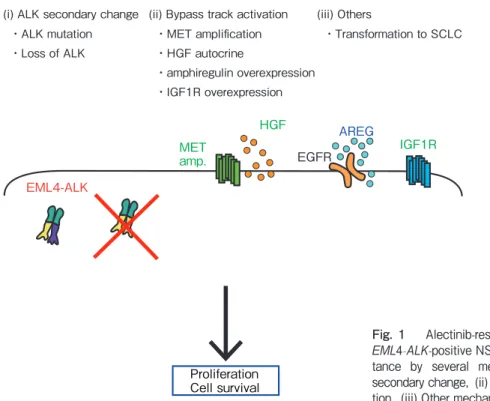
sam-ples (Figure 1). Several types of secondary resistance
ALK mutations have been reported. Secondary
resis-tance mutations to alectinib, which is widely used as a
first-line TKI treatment for ALK-positive NSCLC,
include I1171N, G1202R, I1171S, I1171T, and V1180L
[48,56]. Of these secondary mutations, all other than
G1202R are sensitive to ceritinib or lorlatinib, and the
G1202R mutation is sensitive to lorlatinib [57].
After sequential ALK-TKI treatment, compound
ALK mutations can occur. Yoda et al. report that
sequential ALK-TKIs may induce the emergence of
compound ALK mutations [58], and several compound
mutations have been found, such as L1196M+G1202R
and C1156Y+L1198F. In addition, interestingly, the
C1156Y mutation is known as a crizotinib-resistant
mutation, while the C1156Y+L1198F compound
mutation, which occurs after crizotinib-lorlatinib
sequential therapy, is sensitive to crizotinib [59].
Okada et al. recently reported the sensitivity of ALK
inhibitors for compound ALK mutations using in silico
simulation. In their study, the I1171N+L1256F
com-pound mutation was found to be highly resistant to
lorlatinib but more sensitive to alectinib than the
I1171N mutation alone. The L1256F mutation was the
first highly lorlatinib-resistant single mutation but,
interestingly, it is highly sensitive to alectinib [60].
Thus, variations in ALK secondary mutations are very
complicated.
MET
amp.
HGF
EGFR
AREG
Proliferation
Cell survival
EML4-ALK
(i) ALK secondary change ・ALK mutation ・Loss of ALK
(ii) Bypass track activation ・MET amplification ・HGF autocrine ・amphiregulin overexpression ・IGF1R overexpression (iii) Others ・Transformation to SCLC
IGF1R
Fig. 1 Alectinib-resistant mechanisms.
EML4-ALK-positive NSCLCs acquire
resis-tance by several mechanisms: (i) ALK
secondary change, (ii) Bypass track
activa-tion, (iii) Other mechanisms.
Rapidly acquired resistance to alectinib.
Alectinib
is considered the standard therapy for patients with
NSCLC harboring ALK fusion genes. However, some
patients rapidly acquire resistance to alectinib, resulting
in highly unfavorable prognoses. The underlying
mechanisms for rapid resistance to alectinib remain to
be clarified, but we previously reported that a high
tumor mutation burden could be a contributing factor
[51]. In our previous report, we used next-generation
sequencing to analyze ALK-positive clinical samples
(treatment-naïve samples and autopsy samples) from
one patient who developed rapid resistance to alectinib
within 3 months. Our comprehensive analysis revealed
the heterogeneous tumor evolution of autopsy samples
compared to treatment-naïve samples.
Treatment Strategy for ALK-positive Lung
Cancer
Based on pivotal clinical studies, mild adverse effects,
and a stunning disease control rate, alectinib is often
used as the first-line ALK-TKI. Regarding second-line
therapy, several sequential ALK-TKI treatment trials
have been reported to date (Table 2). Nevertheless,
there are limited data on the efficacy of ALK-TKIs after
resistance to alectinib has been acquired. Therefore,
there is no definite treatment sequence used in
ALK-TKI treatment at present.
When resistance is induced by a secondary mutation
in the ALK kinase domain, a second- or
third-genera-tion ALK-TKI such as ceritinib, brigatinib, or lorlatinib
is expected to overcome the resistance. Notably,
G1202R, a highly resistant mutation to first- and
sec-ond-generation ALK-TKIs, is sensitive to the third-
generation ALK-TKI lorlatinib. The G1202R mutation
is more frequently observed in alectinib-resistant
spec-imens than in crizotinib- or ceritinib-resistant
speci-mens [56]; hence, alectinib followed by lorlatinib may
be the best ALK-TKI sequence in such cases. Where
resistant mutations other than G1202R are present,
such as I1171T/N/S, V1180L, or L1196M, ceritinib
may also be useful as a second-line treatment [56]. On
the other hand, for patients who acquired resistance via
bypass pathway activation, crizotinib (for MET gene
amplification), ceritinib (for insulin-like growth factor
[IGF]-1R activation), and alectinib or lorlatinib (for
P-glycoprotein overexpression) [61] are the candidates
of choice for second-line treatment.
The identification of the best treatment sequence or
combination therapies for drug-resistant lung cancer
has been a challenge [58]. Currently, several
combina-tion therapies with ALK-inhibitors and other
molecu-lar-targeting agents developed for lung cancers are
ongoing in clinical trials. These include the following:
1) MEK-inhibitors: NCT03202940, alectinib combined
with cobimetinib; NCT03087448, ceritinib combined
with trametinib; 2) anti-vascular endothelial growth
factor (VEGF) antibodies: NCT02521051, alectinib
combined with bevacizumab; and 3) immunotherapy:
NCT02393625, ceritinib combined with nivolumab;
NCT01998126, crizotinib combined with nivolumab or
ipilimumab; NCT02013219, alectinib combined with
atezolizumab. Regarding combination therapy with
ALK-TKIs and immune checkpoint inhibitors, Group E
in the CheckMate 370 study was the phase 1/2 cohort
testing the safety and tolerability of crizotinib plus
nivolumab as a first-line treatment for ALK-positive
NSCLC. However, 5/13 patients (38%) developed
severe hepatic toxicities, and two died, leading to
dis-continuation of the treatment [62].
Recently, genome analyzing technology such as
liquid biopsy has been evolving rapidly; hence, cancer
gene profiles could soon be evaluable using blood
drop-let samples. If liquid biopsy becomes widespread,
treatment strategies will improve because it will be
pos-sible to evaluate and select treatment options in a more
timely manner [63].
On the other hand, delivering systemic
chemo-therapy is also essential to treat ALK-positive NSCLC
patients. Pemetrexed is reported to be effective for
ALK-positive NSCLCs [64,65]. Park et al.
retrospec-tively reported that pemetrexed monotherapy as a
sec-ond-line treatment showed a better overall response rate
and mPFS in ALK-positive patients than in wild-type
patients (29.0% vs. 11.8%; p=0.013; 8.7 months vs. 1.9
months; p<0.001). Hence, pemetrexed-containing
chemotherapy is the treatment option of choice when
the tumor is resistant to ALK-TKIs.
Conclusions
We reviewed the pivotal clinical studies and
mecha-nisms of resistance to ALK-TKIs. ALK-positive
NSCLCs acquire resistance via various mechanisms,
making it a heterogeneous disease. Therefore, it is
essential to develop next-generation treatment
strate-gies, such as using next-generation ALK-TKIs for
sec-ondary mutations or combination therapy with
ALK-TKIs and other ALK-TKIs.
References
1. Yao S, Cheng M, Zhang Q, Wasik M, Kelsh R and Winkler C: Anaplastic lymphoma kinase is required for neurogenesis in the developing central nervous system of zebrafish. PLoS One (2013) 8: e63757.
2. Morris SW, Kirstein MN, Valentine MB, Dittmer KG, Shapiro DN, Saltman DL and Look AT: Fusion of a kinase gene, ALK, to a nucleolar protein gene, NPM, in non-Hodgkinʼs lymphoma. Science (1994) 263: 1 281-1284.
3. Stein H, Mason DY, Gerdes J, OʼConnor N, Wainscoat J, Pallesen G, Gatter K, Falini B, Delsol G, Lemke H and et al. : The expression of the Hodgkinʼs disease associated antigen Ki-1 in reactive and neoplastic lym-phoid tissue: evidence that Reed-Sternberg cells and histiocytic malig-nancies are derived from activated lymphoid cells. Blood (1985) 66: 848-858.
4. Agnarsson BA and Kadin ME: Ki-1 positive large cell lymphoma. A mor-phologic and immunologic study of 19 cases. Am J Surg Pathol (1988) 12: 264-274.
5. Shiota M, Fujimoto J, Semba T, Satoh H, Yamamoto T and Mori S: Hyperphosphorylation of a novel 80 kDa protein-tyrosine kinase similar to Ltk in a human Ki-1 lymphoma cell line, AMS3. Oncogene (1994) 9: 1567-1574.
6. Shiota M, Fujimoto J, Takenaga M, Satoh H, Ichinohasama R, Abe M, Nakano M, Yamamoto T and Mori S: Diagnosis of t(2 ; 5)(p23 ; q35)- associated Ki-1 lymphoma with immunohistochemistry. Blood (1994) 84: 3648-3652.
7. Morris SW, Kirstein MN, Valentine MB, Dittmer K, Shapiro DN, Look AT and Saltman DL: Fusion of a kinase gene, ALK, to a nucleolar pro-tein gene, NPM, in non-Hodgkinʼs lymphoma. Science (1995) 267: 316-317.
8. Shiota M, Nakamura S, Ichinohasama R, Abe M, Akagi T, Takeshita M, Mori N, Fujimoto J, Miyauchi J, Mikata A, Nanba K, Takami T, Yamabe H, Takano Y, Izumo T, Nagatani T, Mohri N, Nasu K, Satoh H, Katano H, Fujimoto J, Yamamoto T and Mori S: Anaplastic large cell lympho-mas expressing the novel chimeric protein p80NPM/ALK: a distinct clini-copathologic entity. Blood (1995) 86: 1954-1960.
9. Cao Z, Gao Q, Fu M, Ni N, Pei Y and Ou WB: Anaplastic lymphoma kinase fusions: Roles in cancer and therapeutic perspectives. Oncol Lett (2019) 17: 2020-2030.
10. Katayama R, Lovly CM and Shaw AT: Therapeutic targeting of anaplas-tic lymphoma kinase in lung cancer: a paradigm for precision cancer medicine. Clin Cancer Res (2015) 21: 2227-2235.
11. Soda M, Choi YL, Enomoto M, Takada S, Yamashita Y, Ishikawa S, Fujiwara S, Watanabe H, Kurashina K, Hatanaka H, Bando M, Ohno S, Ishikawa Y, Aburatani H, Niki T, Sohara Y, Sugiyama Y and Mano H: Identification of the transforming EML4-ALK fusion gene in non-small-cell lung cancer. Nature (2007) 448: 561-566.
12. Shaw AT, Yeap BY, Mino-Kenudson M, Digumarthy SR, Costa DB, Heist RS, Solomon B, Stubbs H, Admane S, McDermott U, Settleman J, Kobayashi S, Mark EJ, Rodig SJ, Chirieac LR, Kwak EL, Lynch TJ and Iafrate AJ: Clinical features and outcome of patients with non-small-cell lung cancer who harbor EML4-ALK. J Clin Oncol (2009) 27: 4247-4253. 13. Tamura T, Kiura K, Seto T, Nakagawa K, Maemondo M, Inoue A, Hida T,
Yoshioka H, Harada M, Ohe Y, Nogami N, Murakami H, Kuriki H, Shimada T, Tanaka T, Takeuchi K and Nishio M: Three-Year Follow-Up of an Alectinib Phase I/II Study in ALK-Positive Non-Small-Cell Lung Cancer: AF-001JP. J Clin Oncol (2017) 35: 1515-1521.
14. Hida T, Nokihara H, Kondo M, Kim YH, Azuma K, Seto T, Takiguchi Y, Nishio M, Yoshioka H, Imamura F, Hotta K, Watanabe S, Goto K, Satouchi M, Kozuki T, Shukuya T, Nakagawa K, Mitsudomi T, Yamamoto N, Asakawa T, Asabe R, Tanaka T and Tamura T: Alectinib
versus crizotinib in patients with ALK-positive non-small-cell lung cancer (J-ALEX): an open-label, randomised phase 3 trial. Lancet (2017) 390: 29-39.
15. Peters S, Camidge DR, Shaw AT, Gadgeel S, Ahn JS, Kim DW, Ou SI, Perol M, Dziadziuszko R, Rosell R, Zeaiter A, Mitry E, Golding S, Balas B, Noe J, Morcos PN and Mok T: Alectinib versus Crizotinib in Untreated ALK-Positive Non-Small-Cell Lung Cancer. N Engl J Med (2017) 377: 829-838.
16. Shaw AT, Kim DW, Nakagawa K, Seto T, Crino L, Ahn MJ, De Pas T, Besse B, Solomon BJ, Blackhall F, Wu YL, Thomas M, OʼByrne KJ, Moro-Sibilot D, Camidge DR, Mok T, Hirsh V, Riely GJ, Iyer S, Tassell V, Polli A, Wilner KD and Janne PA: Crizotinib versus chemotherapy in advanced ALK-positive lung cancer. N Engl J Med (2013) 368: 2385-2394.
17. Solomon BJ, Mok T, Kim DW, Wu YL, Nakagawa K, Mekhail T, Felip E, Cappuzzo F, Paolini J, Usari T, Iyer S, Reisman A, Wilner KD, Tursi J and Blackhall F: First-line crizotinib versus chemotherapy in ALK-positive lung cancer. N Engl J Med (2014) 371: 2167-2177.
18. Solomon BJ, Kim DW, Wu YL, Nakagawa K, Mekhail T, Felip E, Cappuzzo F, Paolini J, Usari T, Tang Y, Wilner KD, Blackhall F and Mok TS: Final Overall Survival Analysis From a Study Comparing First-Line Crizotinib Versus Chemotherapy in ALK-Mutation-Positive Non-Small-Cell Lung Cancer. J Clin Oncol (2018) 36: 2251-2258.
19. Shaw AT, Ou SH, Bang YJ, Camidge DR, Solomon BJ, Salgia R, Riely GJ, Varella-Garcia M, Shapiro GI, Costa DB, Doebele RC, Le LP, Zheng Z, Tan W, Stephenson P, Shreeve SM, Tye LM, Christensen JG, Wilner KD, Clark JW and Iafrate AJ: Crizotinib in ROS1-rearranged non-small-cell lung cancer. N Engl J Med (2014) 371: 1963-1971.
20. Shaw AT, Riely GJ, Bang YJ, Kim DW, Camidge DR, Solomon BJ, Varella-Garcia M, Iafrate AJ, Shapiro GI, Usari T, Wang SC, Wilner KD, Clark JW and Ou SI: Crizotinib in ROS1-rearranged advanced non-small-cell lung cancer (NSCLC): updated results, including overall survival, from PROFILE 1001. Ann Oncol (2019) 30: 1121-1126.
21. Seto T, Kiura K, Nishio M, Nakagawa K, Maemondo M, Inoue A, Hida T, Yamamoto N, Yoshioka H, Harada M, Ohe Y, Nogami N, Takeuchi K, Shimada T, Tanaka T and Tamura T: CH5424802 (RO5424802) for patients with ALK-rearranged advanced non-small-cell lung cancer (AF-001JP study): a single-arm, open-label, phase 1-2 study. Lancet Oncol (2013) 14: 590-598.
22. Gadgeel SM, Gandhi L, Riely GJ, Chiappori AA, West HL, Azada MC, Morcos PN, Lee RM, Garcia L, Yu L, Boisserie F, Di Laurenzio L, Golding S, Sato J, Yokoyama S, Tanaka T and Ou SH: Safety and activity of alectinib against systemic disease and brain metastases in patients with crizotinib-resistant ALK-rearranged non-small-cell lung can-cer (AF-002JG): results from the dose-finding portion of a phase 1/2 study. Lancet Oncol (2014) 15: 1119-1128.
23. Ou SH, Ahn JS, De Petris L, Govindan R, Yang JC, Hughes B, Lena H, Moro-Sibilot D, Bearz A, Ramirez SV, Mekhail T, Spira A, Bordogna W, Balas B, Morcos PN, Monnet A, Zeaiter A and Kim DW: Alectinib in Crizotinib-Refractory ALK-Rearranged Non-Small-Cell Lung Cancer: A Phase II Global Study. J Clin Oncol (2016) 34: 661-668.
24. Shaw AT, Gandhi L, Gadgeel S, Riely GJ, Cetnar J, West H, Camidge DR, Socinski MA, Chiappori A, Mekhail T, Chao BH, Borghaei H, Gold KA, Zeaiter A, Bordogna W, Balas B, Puig O, Henschel V and Ou SI: Alectinib in ALK-positive, crizotinib-resistant, non-small-cell lung cancer: a single-group, multicentre, phase 2 trial. Lancet Oncol (2016) 17: 234-242.
25. Nakagawa K, Hida T, Nokihara H, Morise M, Azuma K, Kim YH, Seto T, Takiguchi Y, Nishio M, Yoshioka H, Kumagai T, Hotta K, Watanabe S, Goto K, Satouchi M, Kozuki T, Koyama R, Mitsudomi T, Yamamoto N, Asakawa T, Hayashi M, Hasegawa W and Tamura T: Final progres-sion-free survival results from the J-ALEX study of alectinib versus crizo-tinib in ALK-positive non-small-cell lung cancer. Lung Cancer (2020) 139: 195-199.
26. Camidge DR, Dziadziuszko R, Peters S, Mok T, Noe J, Nowicka M, Gadgeel SM, Cheema P, Pavlakis N, de Marinis F, Cho BC, Zhang L,
Moro-Sibilot D, Liu T, Bordogna W, Balas B, Muller B and Shaw AT: Updated Efficacy and Safety Data and Impact of the EML4-ALK Fusion Variant on the Efficacy of Alectinib in Untreated ALK-Positive Advanced Non-Small Cell Lung Cancer in the Global Phase III ALEX Study. J Thorac Oncol (2019) 14: 1233-1243.
27. Shaw AT, Kim DW, Mehra R, Tan DS, Felip E, Chow LQ, Camidge DR, Vansteenkiste J, Sharma S, De Pas T, Riely GJ, Solomon BJ, Wolf J, Thomas M, Schuler M, Liu G, Santoro A, Lau YY, Goldwasser M, Boral AL and Engelman JA: Ceritinib in ALK-rearranged non-small-cell lung cancer. N Engl J Med (2014) 370: 1189-1197.
28. Kim DW, Mehra R, Tan DSW, Felip E, Chow LQM, Camidge DR, Vansteenkiste J, Sharma S, De Pas T, Riely GJ, Solomon BJ, Wolf J, Thomas M, Schuler M, Liu G, Santoro A, Sutradhar S, Li S, Szczudlo T, Yovine A and Shaw AT: Activity and safety of ceritinib in patients with ALK-rearranged non-small-cell lung cancer (ASCEND-1): updated results from the multicentre, open-label, phase 1 trial. Lancet Oncol (2016) 17: 452-463.
29. Crino L, Ahn MJ, De Marinis F, Groen HJ, Wakelee H, Hida T, Mok T, Spigel D, Felip E, Nishio M, Scagliotti G, Branle F, Emeremni C, Quadrigli M, Zhang J and Shaw AT: Multicenter Phase II Study of Whole-Body and Intracranial Activity With Ceritinib in Patients With ALK-Rearranged Non-Small-Cell Lung Cancer Previously Treated With Chemotherapy and Crizotinib: Results From ASCEND-2. J Clin Oncol (2016) 34: 2866-2873.
30. Soria JC, Tan DSW, Chiari R, Wu YL, Paz-Ares L, Wolf J, Geater SL, Orlov S, Cortinovis D, Yu CJ, Hochmair M, Cortot AB, Tsai CM, Moro-Sibilot D, Campelo RG, McCulloch T, Sen P, Dugan M, Pantano S, Branle F, Massacesi C and de Castro G, Jr. : First-line ceritinib versus platinum-based chemotherapy in advanced ALK-rearranged non-small-cell lung cancer (ASCEND-4): a randomised, open-label, phase 3 study. Lancet (2017) 389: 917-929.
31. Shaw AT, Kim TM, Crino L, Gridelli C, Kiura K, Liu G, Novello S, Bearz A, Gautschi O, Mok T, Nishio M, Scagliotti G, Spigel DR, Deudon S, Zheng C, Pantano S, Urban P, Massacesi C, Viraswami-Appanna K and Felip E: Ceritinib versus chemotherapy in patients with ALK-rearranged non-small-cell lung cancer previously given chemotherapy and crizotinib (ASCEND-5): a randomised, controlled, open-label, phase 3 trial. Lancet Oncol (2017) 18: 874-886.
32. Hida T, Seto T, Horinouchi H, Maemondo M, Takeda M, Hotta K, Hirai F, Kim YH, Matsumoto S, Ito M, Ayukawa K, Tokushige K, Yonemura M, Mitsudomi T and Nishio M: Phase II study of ceritinib in alectinib-pre-treated patients with anaplastic lymphoma kinase-rearranged metastatic non-small-cell lung cancer in Japan: ASCEND-9. Cancer Sci (2018) 109: 2863-2872.
33. Shaw AT, Felip E, Bauer TM, Besse B, Navarro A, Postel-Vinay S, Gainor JF, Johnson M, Dietrich J, James LP, Clancy JS, Chen J, Martini JF, Abbattista A and Solomon BJ: Lorlatinib in non-small-cell lung cancer with ALK or ROS1 rearrangement: an international, multi-centre, open-label, single-arm first-in-man phase 1 trial. Lancet Oncol (2017) 18: 1590-1599.
34. Solomon BJ, Besse B, Bauer TM, Felip E, Soo RA, Camidge DR, Chiari R, Bearz A, Lin CC, Gadgeel SM, Riely GJ, Tan EH, Seto T, James LP, Clancy JS, Abbattista A, Martini JF, Chen J, Peltz G, Thurm H, Ou SI and Shaw AT: Lorlatinib in patients with ALK-positive non-small-cell lung cancer: results from a global phase 2 study. Lancet Oncol (2018) 19: 1654-1667.
35. Camidge DR, Kim DW, Tiseo M, Langer CJ, Ahn MJ, Shaw AT, Huber RM, Hochmair MJ, Lee DH, Bazhenova LA, Gold KA, Ou SI, West HL, Reichmann W, Haney J, Clackson T, Kerstein D and Gettinger SN: Exploratory Analysis of Brigatinib Activity in Patients With Anaplastic Lymphoma Kinase-Positive Non-Small-Cell Lung Cancer and Brain Metastases in Two Clinical Trials. J Clin Oncol (2018) 36: 2693-2701. 36. Camidge DR, Kim HR, Ahn MJ, Yang JC, Han JY, Lee JS, Hochmair
MJ, Li JY, Chang GC, Lee KH, Gridelli C, Delmonte A, Garcia Campelo R, Kim DW, Bearz A, Griesinger F, Morabito A, Felip E, Califano R, Ghosh S, Spira A, Gettinger SN, Tiseo M, Gupta N, Haney
J, Kerstein D and Popat S: Brigatinib versus Crizotinib in ALK-Positive Non-Small-Cell Lung Cancer. N Engl J Med (2018) 379: 2027-2039. 37. Ma D, Zhang Y, Xing P, Hao X, Wang M, Wang Y, Shan L, Xin T,
Liang H, Du Y, Zhang Z, Liang L and Li J: Clinical features and out-comes of ALK rearranged non-small cell lung cancer with primary resis-tance to crizotinib. Thorac Cancer (2019) 10: 1213-1219.
38. Rihawi K, Alfieri R, Fiorentino M, Fontana F, Capizzi E, Cavazzoni A, Terracciano M, La Monica S, Ferrarini A, Buson G, Petronini PG and Ardizzoni A: MYC Amplification as a Potential Mechanism of Primary Resistance to Crizotinib in ALK-Rearranged Non-Small Cell Lung Cancer: A Brief Report. Transl Oncol (2019) 12: 116-121.
39. Du X, Shao Y, Gao H, Zhang X, Zhang H, Ban Y, Qin H and Tai Y: CMTR1-ALK: an ALK fusion in a patient with no response to ALK inhibi-tor crizotinib. Cancer Biol Ther (2018) 19: 962-966.
40. Zhang L, Li Y, Zhang S, Gao C, Nie K and Ji Y: Primary resistance to crizotinib treatment in a non-small cell lung cancer patient with an EML4-ALK rearrangement: a case report. Cancer Biol Med (2018) 15: 178-181. 41. Wang W, Jiang X, Song Z and Zhang Y: Patients harboring EGFR muta-tion after primary resistance to crizotinib and response to EGFR-tyrosine kinase inhibitor. Onco Targets Ther (2016) 9: 211-215.
42. Mengoli MC, Barbieri F, Bertolini F, Tiseo M and Rossi G: K-RAS muta-tions indicating primary resistance to crizotinib in ALK-rearranged adeno-carcinomas of the lung: Report of two cases and review of the literature. Lung Cancer (2016) 93: 55-58.
43. Zhang L, Jiang T, Li X, Wang Y, Zhao C, Zhao S, Xi L, Zhang S, Liu X, Jia Y, Yang H, Shi J, Su C, Ren S and Zhou C: Clinical features of Bim deletion polymorphism and its relation with crizotinib primary resis-tance in Chinese patients with ALK/ROS1 fusion-positive non-small cell lung cancer. Cancer (2017) 123: 2927-2935.
44. Toyokawa G, Hirai F, Inamasu E, Yoshida T, Nosaki K, Takenaka T, Yamaguchi M, Seto T, Takenoyama M and Ichinose Y: Secondary muta-tions at I1171 in the ALK gene confer resistance to both Crizotinib and Alectinib. J Thorac Oncol (2014) 9: e86-87.
45. Ou SH, Milliken JC, Azada MC, Miller VA, Ali SM and Klempner SJ: ALK F1174V mutation confers sensitivity while ALK I1171 mutation con-fers resistance to alectinib. The importance of serial biopsy post progres-sion. Lung Cancer (2016) 91: 70-72.
46. Ou SH, Klempner SJ, Greenbowe JR, Azada M, Schrock AB, Ali SM, Ross JS, Stephens PJ and Miller VA: Identification of a novel HIP1-ALK fusion variant in Non-Small-Cell Lung Cancer (NSCLC) and discovery of ALK I1171 (I1171N/S) mutations in two ALK-rearranged NSCLC patients with resistance to Alectinib. J Thorac Oncol (2014) 9: 1821-1825. 47. Makuuchi Y, Hayashi H, Haratani K, Tanizaki J, Tanaka K, Takeda M,
Sakai K, Shimizu S, Ito A, Nishio K and Nakagawa K: A case of ALK-rearranged non-small cell lung cancer that responded to ceritinib after development of resistance to alectinib. Oncotarget (2018) 9: 23315-23319. 48. Katayama R, Friboulet L, Koike S, Lockerman EL, Khan TM, Gainor JF,
Iafrate AJ, Takeuchi K, Taiji M, Okuno Y, Fujita N, Engelman JA and Shaw AT: Two novel ALK mutations mediate acquired resistance to the next-generation ALK inhibitor alectinib. Clin Cancer Res (2014) 20: 5686-5696.
49. Ignatius Ou SH, Azada M, Hsiang DJ, Herman JM, Kain TS, Siwak-Tapp C, Casey C, He J, Ali SM, Klempner SJ and Miller VA: Next-generation sequencing reveals a Novel NSCLC ALK F1174V mutation and confirms ALK G1202R mutation confers high-level resistance to alec-tinib (CH5424802/RO5424802) in ALK-rearranged NSCLC patients who progressed on crizotinib. J Thorac Oncol (2014) 9: 549-553.
50. Gouji T, Takashi S, Mitsuhiro T and Yukito I: Crizotinib can overcome acquired resistance to CH5424802: is amplification of the MET gene a key factor? J Thorac Oncol (2014) 9: e27-28.
51. Makimoto G, Ohashi K, Tomida S, Nishii K, Matsubara T, Kayatani H, Higo H, Ninomiya K, Sato A, Watanabe H, Kano H, Ninomiya T, Kubo T, Rai K, Ichihara E, Hotta K, Tabata M, Toyooka S, Takata M, Maeda Y and Kiura K: Rapid Acquisition of Alectinib Resistance in ALK-Positive Lung Cancer With High Tumor Mutation Burden. J Thorac Oncol (2019) 14: 2009-2018.
52. Isozaki H, Ichihara E, Takigawa N, Ohashi K, Ochi N, Yasugi M, Ninomiya T, Yamane H, Hotta K, Sakai K, Matsumoto K, Hosokawa S, Bessho A, Sendo T, Tanimoto M and Kiura K: Non-Small Cell Lung Cancer Cells Acquire Resistance to the ALK Inhibitor Alectinib by Activating Alternative Receptor Tyrosine Kinases. Cancer Res (2016) 76: 1506-1516.
53. Takegawa N, Hayashi H, Iizuka N, Takahama T, Ueda H, Tanaka K, Takeda M and Nakagawa K: Transformation of ALK rearrangement-posi-tive adenocarcinoma to small-cell lung cancer in association with acquired resistance to alectinib. Ann Oncol (2016) 27: 953-955. 54. Miyamoto S, Ikushima S, Ono R, Awano N, Kondo K, Furuhata Y,
Fukumoto K and Kumasaka T: Transformation to small-cell lung cancer as a mechanism of acquired resistance to crizotinib and alectinib. Jpn J Clin Oncol (2016) 46: 170-173.
55. Fujita S, Masago K, Katakami N and Yatabe Y: Transformation to SCLC after Treatment with the ALK Inhibitor Alectinib. J Thorac Oncol (2016) 11: e67-72.
56. Gainor JF, Dardaei L, Yoda S, Friboulet L, Leshchiner I, Katayama R, Dagogo-Jack I, Gadgeel S, Schultz K, Singh M, Chin E, Parks M, Lee D, DiCecca RH, Lockerman E, Huynh T, Logan J, Ritterhouse LL, Le LP, Muniappan A, Digumarthy S, Channick C, Keyes C, Getz G, Dias-Santagata D, Heist RS, Lennerz J, Sequist LV, Benes CH, Iafrate AJ, Mino-Kenudson M, Engelman JA and Shaw AT: Molecular Mechanisms of Resistance to First- and Second-Generation ALK Inhibitors in ALK-Rearranged Lung Cancer. Cancer Discov (2016) 6: 1118-1133. 57. Zou HY, Friboulet L, Kodack DP, Engstrom LD, Li Q, West M, Tang
RW, Wang H, Tsaparikos K, Wang J, Timofeevski S, Katayama R, Dinh DM, Lam H, Lam JL, Yamazaki S, Hu W, Patel B, Bezwada D, Frias RL, Lifshits E, Mahmood S, Gainor JF, Affolter T, Lappin PB, Gukasyan H, Lee N, Deng S, Jain RK, Johnson TW, Shaw AT, Fantin VR and Smeal T: PF-06463922, an ALK/ROS1 Inhibitor, Overcomes Resistance to First and Second Generation ALK Inhibitors in Preclinical Models. Cancer Cell (2015) 28: 70-81.
58. Yoda S, Lin JJ, Lawrence MS, Burke BJ, Friboulet L, Langenbucher A, Dardaei L, Prutisto-Chang K, Dagogo-Jack I, Timofeevski S, Hubbeling H, Gainor JF, Ferris LA, Riley AK, Kattermann KE, Timonina D, Heist RS, Iafrate AJ, Benes CH, Lennerz JK, Mino-Kenudson M, Engelman JA, Johnson TW, Hata AN and Shaw AT: Sequential ALK Inhibitors Can Select for Lorlatinib-Resistant Compound ALK Mutations in ALK-Positive Lung Cancer. Cancer Discov (2018) 8: 714-729.
59. Shaw AT, Friboulet L, Leshchiner I, Gainor JF, Bergqvist S, Brooun A,
Burke BJ, Deng YL, Liu W, Dardaei L, Frias RL, Schultz KR, Logan J, James LP, Smeal T, Timofeevski S, Katayama R, Iafrate AJ, Le L, McTigue M, Getz G, Johnson TW and Engelman JA: Resensitization to Crizotinib by the Lorlatinib ALK Resistance Mutation L1198F. N Engl J Med (2016) 374: 54-61.
60. Okada K, Araki M, Sakashita T, Ma B, Kanada R, Yanagitani N, Horiike A, Koike S, Oh-Hara T, Watanabe K, Tamai K, Maemondo M, Nishio M, Ishikawa T, Okuno Y, Fujita N and Katayama R: Prediction of ALK mutations mediating ALK-TKIs resistance and drug re-purposing to overcome the resistance. EBioMedicine (2019) 41: 105-119.
61. Katayama R, Sakashita T, Yanagitani N, Ninomiya H, Horiike A, Friboulet L, Gainor JF, Motoi N, Dobashi A, Sakata S, Tambo Y, Kitazono S, Sato S, Koike S, John Iafrate A, Mino-Kenudson M, Ishikawa Y, Shaw AT, Engelman JA, Takeuchi K, Nishio M and Fujita N: P-glycoprotein Mediates Ceritinib Resistance in Anaplastic Lymphoma Kinase-rearranged Non-small Cell Lung Cancer. EBioMedicine (2016) 3: 54-66.
62. Spigel DR, Reynolds C, Waterhouse D, Garon EB, Chandler J, Babu S, Thurmes P, Spira A, Jotte R, Zhu J, Lin WH and Blumenschein G, Jr. : Phase 1/2 Study of the Safety and Tolerability of Nivolumab Plus Crizotinib for the First-Line Treatment of Anaplastic Lymphoma Kinase Translocation - Positive Advanced Non-Small Cell Lung Cancer (CheckMate 370). J Thorac Oncol (2018) 13: 682-688.
63. Dagogo-Jack I, Brannon AR, Ferris LA, Campbell CD, Lin JJ, Schultz KR, Ackil J, Stevens S, Dardaei L, Yoda S, Hubbeling H, Digumarthy SR, Riester M, Hata AN, Sequist LV, Lennes IT, Iafrate AJ, Heist RS, Azzoli CG, Farago AF, Engelman JA, Lennerz JK, Benes CH, Leary RJ, Shaw AT and Gainor JF: Tracking the Evolution of Resistance to ALK Tyrosine Kinase Inhibitors through Longitudinal Analysis of Circulating Tumor DNA. JCO Precis Oncol (2018 (in press). doi: 10.1200/ PO.17.00160.).
64. Park S, Park TS, Choi CM, Lee DH, Kim SW, Lee JS, Kim WS, Song JS and Lee JC: Survival Benefit of Pemetrexed in Lung Adenocarcinoma Patients With Anaplastic Lymphoma Kinase Gene Rearrangements. Clin Lung Cancer (2015) 16: e83-89.
65. Lin JJ, Schoenfeld AJ, Zhu VW, Yeap BY, Chin E, Rooney M, Plodkowski AJ, Digumarthy SR, Dagogo-Jack I, Gainor JF, Ou SI, Riely GJ and Shaw AT: Efficacy of Platinum/Pemetrexed Combination Chemotherapy in ALK-Positive NSCLC Refractory to Second-Generation ALK Inhibitors. J Thorac Oncol (2020) 15: 258-265.