Is There a Meaningful Level of Activity
Restriction for Hospitalized Pregnant Women ?
: A Single-Case Experimental Investigation
著者
Nakamura Yasuka, Yoshizawa Toyoko, Atogami
Fumi, Ito Naoko
journal or
publication title
東北大学医学部保健学科紀要
volume
24
number
1
page range
29-37
year
2015-01-31
URL
http://hdl.handle.net/10097/59638
Original Paper
Is There a Meaningful Level of Activity Restriction for Hospitalized
Pregnant Women ? : A Single
-Case Experimental Investigation
Yasuka N
akamura1, Toyoko Y
oshizawa1, Fumi A
togami1and Naoko I
to21Women’s Health Nursing, Course of Nursing, Tohoku University Graduate school of Medicine 2Tohoku University Hospital
入院妊婦の動静制限にはどのような意味があるのか ?
─ シングルケーススタディ ─
中 村 康 香1,吉沢豊予子1,跡 上 富 美1,伊 藤 直 子2
1東北大学大学院医学系研究科 保健学専攻 ウィメンズヘルス看護学分野
2東北大学病院
Key words : activity restriction, physical activity, pregnancy, hospitalization
Aim : To examine the physical activities of daily living performed by pregnant woman on their working, non-working, and hospitalization days. Physical activity was objectively measured for these days in the same
pregnancy period and compared.
Methods : A single-subject study design was employed. The participant was 35-year-old who was asked
to write down the types of physical activities of daily living she performed throughout the duration of the experi-ment. She also wore an accelerometer, which was used to measure daily amount of physical activity.
Results : Data from four working days, three non-working days, and four hospitalization days were
ana-lyzed. Daily physical activity counts for days when the participant was hospitalized were fewer, both statistical-ly (p=.012) and visualstatistical-ly, when compared with counts for working days. Additionalstatistical-ly, the results showed that physical activities of daily living performed during hospitalization largely involved washing at the basin as well as showering. The majority of such activities on non-working days consisted of going to the toilet and going out
(e.g., shopping). On working days, these activities were more varied.
Conclusion : Individuals are often restricted in the types and amount of physical activity they can perform while hospitalized. According to the results obtained in this study, hospitalized pregnant women, for whom rest is mandated, may not require further restrictions to their physical activities of daily living while in hospital. Further research on outcomes of activity restriction for mothers as well as infants is needed.
Background
Declining birth and total fertility rates in Japan have raised much concern. In contrast, preterm
births have reportedly increased by approximately a thousand over the past decade, from 60,377 births in 2000 to 61,315 in 20101), even though their
Yasuka Nakamura・Toyoko Yoshizawa・et al
in Japan. Nakabayashi2) reported that, 17% of all
births involved preterm labor, and 46.7% had a preg-nancy complication in Japan.
Pregnant women hospitalized for preterm labor in Japan are generally restricted in the physical activi-ties of daily living they are allowed to perform. Threatened premature delivery is often treated with intravenous ritodrine hydrochloride or magnesium sulfate ; however, treatment guidelines also stipu-late bed rest or activity restriction during hospital-ization3), thought to help increase uterine blood flow,
reduce pressure on the cervix, and suppress uterine contractions4-6)
, despite a lack of empirical support. However, it is questionable as to whether preg-nant women who are prescribed bed rest or activity restriction at home can perform as they are advised. Arii and Natori4) compared the activities of
outpa-tients receiving treatment for threatened premature delivery with those of women having normal preg-nancies. The two groups did not differ significantly in average number of steps walked or energy con-sumed in activities. Women who were prescribed bed rest at home could not comply because they needed to care for their children, meet household demands, or work, or did not feel sick, lacked part-ner or familial support, or experienced discomfort while doing so4,7).
On the contrary, the amount of activity performed by hospitalized pregnant women was less than half that of normal pregnant or non-pregnant women in
another study8). However, the influence of different
degrees of activity restriction was not examined. In Japan, the primary approach to reducing the total amount of activity performed per day by hospitalized pregnant women is through the prescription of spe-cific levels of daily activity, which differ according to patient condition and each hospital’s practices and established guidelines9,10). Thus, it is difficult to
ap-ply the study results to actual clinical situations. The physical activity levels of pregnant women are influenced by a variety of factors that not only
include their hospitalization statuses11), but also the
trimesters they are in and the progress of their preg-nancies12,13). They also depend on the
measure-ment tools employed in research to record or evalu-ate physical activity, which include subjective (e.g., daily self-reports, questionnaires, and retrospective
interviews) and objective measures of physical activ-ity (e.g., pedometers or accelerometers affixed to women’s waists, wrists, or ankles)14). Rousham,
Clarke and Gross12) examined the health benefits of
physical activity for pregnant women, and found that the personality variable of extroversion had an effect on maternal health behaviors15).
Most recent studies have not considered possible influences of measurement bias due to occupation type, personal health beliefs, gestational age, phy-sique, personal habits, or situations surrounding pregnancy on study results. Therefore, the pur-pose of this study was to examine physical activities of daily living performed by pregnant women on their working, non-working, and hospitalization
days. Physical activity was objectively measured for these days in the same pregnancy period and compared.
Methods
-Study Design
A single-subject study design was used. -Participant
Purposive sampling was employed ; the research-ers searched for potential participants among their co-workers, acquaintances, and social circles and
in-vited the woman to participate. The participant eventually recruited into the study was a healthy, married woman, aged 35 years, who was employed full-time in an education research post and was
ex-pecting her first child. She was in her third trimes-ter, had gained approximately 8 kg (Body Mass Index or BMI=20), and had not experienced any complica-tions with regard to fetal growth. She had under-gone combined heparin (self-injected)/aspirin
thera-py and was scheduled to be hospitalized at around 33 weeks’ gestation in order to stop heparin use.
-Measurement Data
The participant was asked to wear an actigraph monitor for 24 hours over a period of about 2 weeks that included days on which she worked, did not work, and was hospitalized. At the same time, she recorded her activities in a daily activity diary by in-dicating the types of physical activities of daily living she performed with check marks.
-Instruments
To measure amount of daily physical activity, the Actiwatch2TM (Philips Respironics GK) was used.
The Actiwatch2TM is a portable measuring device
measuring 23×43×10 mm in size and weighing only 16 g. It looks and is worn much like a wristwatch, and is waterproof. The Actiwatch2TM is a two-axis
vertical solid-state piezoelectric accelerometer with
a sensitivity of 0.01 G and a sampling rate of 32 Hz. The integrated value of current generated by move-ment was detected and recorded as an activity count when it exceeded the threshold. Configurable ep-och lengths were 0.25 to 15 minutes. A 1-minute
epoch length was adopted in this study, as in previ-ous investigations16,17). The participant wore the
Actiwatch2TM on her dominant ankle in the present
study for several reasons : to avoid the discomfort of wearing it on her wrist throughout the duration of the 24-hour continuous infusion, minimize the error
associated with isolated arm movement, and more appropriately reflect gross body movements and postural shifts12).
The daily activity diary was prepared by research-ers for this study. Considering the burden that might be incurred by having to record information on activities performed throughout the entire day, the participant was asked to check the daily activi-ties she performed within the span of no more than an hour. Daily life activities listed in the diary in-cluded sleeping, going to the toilet, preparing and consuming food, bathing, cleaning oneself at the ba-sin, commuting, working while sitting or standing, shopping, going out, watching TV, and undergoing medical examinations.
Demographic data were also collected, including information on the participant’s age ; height and weight ; occupation ; and marital, pregnancy, and working status.
This study was approved by the Ethics Commit-tee of Tohoku University Graduate School of Medi-cine (Approval number : 2012-1-599).
-Data Analysis
Data were analyzed by using Actiware software (Philips Respironics GK), which allowed the retriev-al of recorded activity data, displayed activity as ac-tograms, and provided activity counts for every ep-och length. High activity count indicated that woman has lot activities. Since activity counts were not collected for the entire 24 hours on the first and last days of the experiment, the data for these two days were excluded from the analysis. Both visual inspection and statistical methods were adopted in the assessments of data obtained through this single case study. Visual inspection of graphed data and visual checks have traditionally been used for assessing differences, and are still widely used today for this purpose18). On the other hand, an
ar-ray of statistical data analysis methods for single
-case experimental research designs has been devel-oped. Because of these reasons, both approaches
Yasuka Nakamura・Toyoko Yoshizawa・et al
to assessment (i.e., visual inspection and statistical methods) were adopted in this study. Statistical analyses in this study were conducted using the SPSS Statistics ver.19.0J for Windows.
Results
The participant wore the Actiwatch2TM for 2
weeks continuously, from Week 33, Day 0/7 to Week 34, Day 5/7 of her pregnancy. Data gathered on the first and last days of the 14-day measurement period
were excluded from the analysis because activity counts were not obtained for the entire 24 hours. Data for the days on which the participant was ad-mitted to and discharged from the hospital were also excluded from the analysis, as neither fell under any of the three specified categories of days examined in this study. In all, data from 4 working days, 3 non
-working days, and 4 hospitalized days were eventu-ally analyzed.
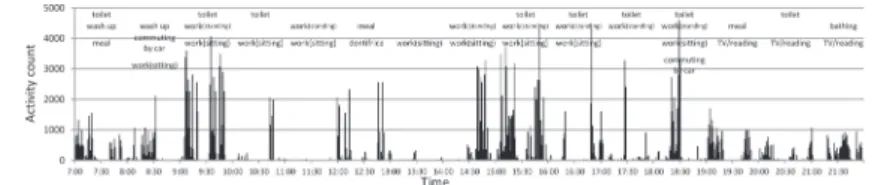
Figure 2 presents an example of a graph depicting daily activity counts from 7 a.m. to 10 p.m. on one of the days for which physical activity data were ob-tained.
-Daily Activity Summary for Working Days
The participant typically awoke at around 7 a.m., took her breakfast, and commuted to her workplace by car. She worked mainly in a sitting position, and sometimes in a standing position to deliver a lecture or conduct an experiment. At around 6 p.m. in the evening, she returned home, prepared dinner, and took a shower or bath. She went to bed at about 10 to 11 p.m. at night. The maximum number of activity counts recorded for a working day ranged from 4,616 to 5,735 counts per minute. She
per-Figure 2-3. Example of daily activity count over time on hospitalized day (Day1 ; 7 : 00-22 : 00)
Items of activities were carried out during that time is shown in the upper part of plot area
Figure 2-2. Example of daily activity count over time on non-working day (Day3 ; 7 : 00-22 : 00)
Items of activities were carried out during that time is shown in the upper part of plot area
Figure 2-1. Example of daily activity count over time on working day (Day4 ; 7 : 00-22 : 00)
formed a variety of physical activities during which maximum activity counts were recorded, such as shopping, completing errands, having lunch, going to the toilet, working while standing, and commut-ing by car. Maximum activity counts were most frequently recorded in the evening.
- Daily Activity Summary for Non-Working
Days
The participant usually awoke at around 7 to 8 a.m. in the morning, took her breakfast, cleaned her room, and spent some time watching TV or reading a book. More than once during the day, she would go out for approximately 2 hours to shop or take a walk. Sometimes, she took a nap for a few hours in the daytime. She usually took a shower or bath af-ter dinner, and went to bed at around 11 p.m. at night. The maximum number of activity counts
re-corded for non-working days ranged from 3,185 to
3,834 counts per minute. Physical activities during which maximum activity counts were recorded were shopping and going to the toilet. Maximum activity counts on these days were usually recorded during the daytime.
- Daily Activity Summary for Hospitalized
Days
She was allowed to move relatively freely while being hospitalized in the ward. She could have her meals while sitting up, go to the toilet, take a shower every day, and meet with visitors at the lobby in the ward. However, she was not permitted to leave the ward. The 24-hour continuous infusion was
stopped on the second day that she was hospitalized. The maximum number of activity counts recorded for days on which the participant was hospitalized
Table 1. Daily activity count
n mean SD min max
WORKING 4 330,381.25 106,165.69 262,237.00 486,618.00 NONWORKING 3 217,823.33 41,404.63 171,053.00 249,796.00 HOSPITALIZED 4 147,317.50 25,687.48 112,219.00 172,598.00
Table 2. maximum activity count in a day and the items of activity at the time maximum activity count
(per min.) amount activity countTime at the max. Items of activity at the time WORKING
-DAY1 5,065 8 : 26, 11 : 05, 13 : 29, 18 : 21 Toilet, shopping, task, lunch
-DAY2 5,735 16 : 35 Toilet
-DAY3 5,065 19 : 41 Standing work, commuting by car -DAY4 4,616 18 : 29 Standing work, commuting by car
NONWORKING
-DAY1 3,285 10 : 32-33 Toilet, shopping
-DAY2 3,185 18 : 43 shopping
-DAY3 3,834 12 : 49-50 shopping
HOSPITALIZED
-DAY1 1,938 7 : 01 Basin, breakfast
-DAY2 3,389 10 : 10 Taking a shower
-DAY3 2,815 6 : 47, 6 : 54 Basin, breakfast
Yasuka Nakamura・Toyoko Yoshizawa・et al
ranged from 1,938 to 4,207 counts per minute. Maximum activity counts were recorded while tak-ing a shower, at the basin, and havtak-ing breakfast. Maximum activity counts were most often recorded in the morning, before noon.
Amount of daily physical activity as measured by activity counts is detailed in Table 1. Mean daily physical activity counts for working, non-working,
and hospitalized days were 330,381.25, 217,823.33, and 147,318.50, respectively. The results of a Kruskal-Wallis test indicated significant differences
between the three categories of days in terms of amount of physical activity performed (H(2)=8.326,
p=0.016). Post-hoc tests further revealed that
dai-ly physical activity counts for hospitalized days were significantly lower than those recorded for working days (Bonferroni-adjusted p-value=0.012).
Physi-cal activity counts recorded on working days were more widely scattered (SD=106,165.69), while those for non-working days and days on which the
participant was hospitalized demonstrated less varia-tion (SD=41,404.63 and 25,687.48, respectively). Figure 3 depicts box plots of daily physical activ-ity counts for each of the respective categories of days. A visual inspection of graphed data for the three different types of days showed that amount of daily physical activity tended to decrease in the following order : working days, non-working days,
and hospitalized days. Differences in daily physical activity levels were apparent between working days and days during which the participant was hospital-ized. In contrast, variations in daily physical activ-ity levels were not as apparent between working and non-working days, and non-working days and days
hospitalized, because the ranges of maximum and minimum activity counts for these days overlapped.
Discussion
In this study, in order to remove potential mea-surement bias caused by occupation type, personal
Figure 3. Amount of daily physical activity
Box plot explanation ; Upper and lower hinge of the box represent 75th percentile and 25th percentile,
health beliefs, gestational age, personal habits, phy-sique, and situations surrounding pregnancy, the amount of physical activity was measured using a single-case research design on working days, non
-working days, and hospitalized days. The results showed that daily physical activity counts of hospi-talized were both statistically and visually lower than were those for working days. Although no previ-ous study has compared amounts of physical activity performed by pregnant women between days on which they are hospitalized and days on which they work, a few studies have investigated the amount of physical activity of women who are hospitalized. Natori, Arii, Okabe, Kobayashi and Takizawa19)
re-ported that hospitalized women (n=8) engaged in significantly less physical activity than did normal pregnant women (n=15 ; 6 working women, 9 non
-working women). Arii and Natori4) also found that
the amount of daily physical activity was significantly lower in women who were hospitalized (n=11) than in normal pregnant women (n=12 ; no descriptions about the women’s occupations). Although the lev-el of activity restriction implemented in a hospital setting4,19) was a factor in this study as in others, the
results of our study imply that hospitalization itself reduces the amount of physical activity performed regardless of the extent to which activities are re-stricted in hospital.
In addition, the present study revealed that physi-cal activities of daily living performed by the partici-pant during hospitalization largely involved washing her face and brushing her teeth at the basin, having breakfast, and showering. The majority of such ac-tivities on non-working days consisted of going to
the toilet and going out. On working days, these activities were more varied, including going to the toilet, shopping, completing errands, having lunch, working while standing, and commuting by car. Na-tori, Arii, Okabe, Kobayashi and Takizawa19)
investi-gated both the content and activity counts of daily living activities performed by pregnant women at
home and during hospitalization. They reported that activities requiring large amounts of physical activity were those related to daily living (e.g., housework, as well as cleaning-, transport-, and
rec-reation-related activities) as opposed to those
asso-ciated with hospitalization (e.g., undergoing medical examinations, meeting with visitors, transferring by the wheelchair). Taking a shower, categorized as Level 4 activity, required an amount of physical ac-tivity similar to that involved in swimming or stair
-climbing in Natori, Arii, Okabe, Kobayashi and Takizawa19). It is important to let hospitalized
women know that certain activities, such as taking a shower and washing her face and brushing her teeth at the wash basin would require considerable amounts of physical activity to complete. There-fore, it is better for hospitalized pregnant women under activity restriction to avoid engaging in daily living tasks that require large amounts of physical activity at the same time. Furthermore, taking a longer time to perform activities would make them less exacting8). Clarke, Rousham, Gross, Halligan
and Bosio20) have suggested that activity type and
social contexts surrounding activities affect physical activity patterns during pregnancy more. Individu-al guidance on activity restriction is needed, taking into account one’s social background.
From these observations, it is necessary for health care providers to provide pregnant women with individual guidance for activity restriction, tak-ing into account their social background, rather than just prescribing activity restriction.
Study Limitations
Since data were obtained from a single participant, the accumulation of more cases for investigation is needed. Second, it is necessary to consider differ-ences in daily physical activity in terms of occupa-tion. Further research is required to reveal specific characteristics of physical activity patterns or amounts of physical activity required according to
Yasuka Nakamura・Toyoko Yoshizawa・et al
various types of occupations, in order to enable health care providers to link guidance provided to expectant mothers on activity restriction with re-views of their daily physical activity. In this study, information on the participant’s health beliefs and personal habits were not collected. In evaluating daily physical activity and behavior, it would be es-sential to consider the influence of these variables on individual physical activity. Further, the varying levels of activity restriction in hospital settings and the progress of pregnancies should both be consid-ered when providing expectant mothers with con-crete instructions pertaining to the performance of physical activities of daily living.
Conclusion
Using a single-subject study design, this study
objectively examined physical activities of daily liv-ing performed by a pregnant woman on her workliv-ing, non-working and hospitalization days in the same
pregnancy period and compared. Mean daily physi-cal activity counts on hospitalization days were sta-tistically and visually lower than for working days. While physical activities of daily living varied on working days, going to the toilet and shopping were predominant on non-working days, and taking a
shower, having breakfast, and cleaning up at the ba-sin were tasks that required large activity counts during hospitalization. According to the results ob-tained in this study, hospitalized pregnant women, for whom rest is mandated, may not require further restrictions to their physical activities of daily living while in hospital. Further research on outcomes of activity restriction for mothers as well as infants is needed, as is concrete guidance for expectant moth-ers regarding activity restriction and recommended levels of physical activity.
Acknowledgements
This work was supported by a JSPS (Japan Society for the Promotion of Science) KAKENHI Grant
Number 24593351. The part of this study was pre-sented at 34th Academic Conference of Japan
Acade-my of Nursing.
References
1) Health Labuor and Welfare Statistics Assosiation : Kousei no shihyou zoukan : Kokumineisei no doukou [Suppl. Jounal of Health and Welfare Statistics : Health in Japan : recent vital statistics] Tokyo, 2012
2) Nakabayashi, M. : High-risk pregnancy : recent trend,
Rinshou Fujinka Sanka [Clinical Gynecology and Ob-stetrics], 64(10), 1367-1371, 2010
3) Japan Society of Obstetrics and Gynecology : sanfujin-ka shinryo gaidorain ; sannsanfujin-kahen 2014 [Guideline of obstetrics and gynecology diagnosis and treatment ; Obstetrics 2014], Tokyo, 2014
4) Arii, Y., Natori, H. : Comparison of the contents and intensity of activities of daily living between normal pregnant women and women treated as outpatients for threatened premature delivery, Japanese Journal of Maternal Health, 48(1), 74-81, 2007
5) Tsuchiya, K. : Seppakusouzannninnpu to ansei [Preg-nant women with threatened premature delivery and bed rest ], The Japanese Journal for Midwives, 52(7), 40-44, 1998
6) Sprague, A.E. : The evolution of bed rest as a clinical intervention, J. Obstet. Gynecol. Neonatal. Nurs.,
33(5), 542-549, 2004
7) Josten, L.E., Savik, K., Mullett, S.E., Campbell, R., Vincent, P. : Bedrest compliance for women with preg-nancy problems, Birth, 22(1), 1-12, 1995
8) Natori, H., Arii, Y., Okabe, K., Kobayashi, Y., Takizawa, M. : Assessment of contents of the activity and life ac-tive mass of pregnant women during hospitalization, Journal of Japan Maternal Nursing, 5(1), 8-14, 2005
9) Kawaji, M. : Studies on premature labor index, preg-nant extension week numbers and bed rest level for pregnant women with imminent abortion, The Japa-nese Journal for Midwives, 52(7), 587-591, 1998
10) Matsuura, S. : Bed Rest chiryou wo Hitsuyou to sareta ninpu no taiken to ninshiki wo akirakanisuru kenkyuu, Nagano College of Nursing, Komagane, 2004
11) Vanderspank, D., Bernier, S.M., Sopper, M.M., Watson, P., Mottola, M.F. : Activity restriction increases de-oxypyridinoline excretion in hospitalized high-risk
16(1), 7-15, 2014
12) Rousham, E.K., Clarke, P.E., Gross, H. : Significant changes in physical activity among pregnant women in the UK as assessed by accelerometry and self-
report-ed activity, Eur. J. Clin. Nutr., 60(3), 393-400, 2006
13) Evenson, K.R., Wen, F. : Prevalence and correlates of objectively measured physical activity and sedentary behavior among US pregnant women, Prev. Med.,
53(1-2), 39-43, 2011
14) Downs, D.S., Chasan-Taber, L., Evenson, K.R.,
Leifer-man, J., Yeo, S. : Physical activity and pregnancy : past and present evidence and future recommendations, Res. Q. Exerc. Sport., 83(4), 485-502, 2012
15) Clarke, P. : Maternal daily activity in low risk pregnan-cy : a longitudinal study, Loughborough University, Leicestershire, 2001
16) Hawkins, M., Pekow, P., Chasan-Taber, L. : Physical
Activity, Sedentary Behavior, and C-reactive Protein in
Pregnancy, Med. Sci. Sports Exerc., 46(2), 284-292,
2014
17) Loprinzi, P.D., Fitzgerald, E.M., Cardinal, B.J. : Physi-cal activity and depression symptoms among pregnant women from the National Health and Nutrition Exami-nation Survey 2005-2006, J. Obstet. Gynecol.
Neona-tal. Nurs., 41(2), 227-235, 2012
18) Takahashi, T., Yamada, T. : Analyzing effect size indi-ces for single-case research data, Japanese journal of
behavior analysis, 22(1), 49-67, 2008
19) Natori, H., Arii, Y., Okabe, K., Kobayashi, Y., Takizawa, M. : Assessment of contents of the activity and life ac-tive mass of pregnant women during hospitalization, Journal of Japan Maternity Nursing, 5(1), 8-14, 2005
20) Clarke, P.E., Rousham, E.K., Gross, H., Halligan, A.W., Bosio, P. : Activity patterns and time allocation during pregnancy : a longitudinal study of British women, Ann. Hum. Biol., 32(3), 247-258, 2005