The limited predictability of phonics
in a word-based count adjusted for word frequency
単語ごとのカウントによる頻度を考慮したフォニックスの予測力
Hiroto Noguchi
Abstract Phonics is a well-known method for teaching reading in Englisheducation. The method, however, has been the subject of heated debate. Researchers who support the use of phonics claim that it has high predictability. However, when learners read actual texts, they find it difficult to read most of the words using phonic generalizations. The purpose of this article is to show that a rule-based count is not realistic and demonstrate the results of a word-based count that takes word frequency into consideration. As a result, this article reports that phonics has significantly less predictability than expected.
Keywords phonics, graphophonetics, English education, frequency
要旨 フォニックスの有効性は長きにわたって議論されており、フォニックスの推進 派は予測力の高さをこの教授法を推奨する根拠の1つとしてきたが、ルールに当て はまらないものが多い。本稿の目的は、実際に英文を読んだ際にどれほどフォニッ クスが有効かを検討することにある。ここでは、フォニックスのルール単位ではな く、語単位でその使用頻度を考慮することにより、実際のリーディングにより近い 形で検証する。結果として、フォニックスの有効性はこれまで主張されてきたもの よりもはるかに低いことを指摘する。 キーワード フォニックス、つづり字と発音、英語教育、頻度 1.Introduction
Over the past few decades, there has been great discussion on the effectiveness of phonics for teaching English. In support of phonics, some studies have shown that the predictability of phonics is high by counting the number of sounds that can be predicted without considering word frequency. The problem seems to lie in the way the researchers calculated predictability, and little attention has been paid to their methods. Therefore, the number of words predicted by phonics should also be counted, and the frequency of each word must be taken into account to appropriately evaluate phonics. The present study discusses the predictability of phonic generalizations through a word-based count that takes word frequency into consideration.
The structure of this article is as follows. Section 2 reviews previous studies. Section 3 describes the methods used. Section 4 provides the results of the survey. Section 5
discusses the results. Section 6 concludes the article by summarizing the main ideas and discussing limitations.
2.Previous studies
Quantitative studies on phonics can be classified according to their degree of support for the teaching method. For example, Shibuya (2011) shows that phonics is an effective teaching method because it enables learners to predict 80% of the high-frequency nouns taught in Japanese junior high schools. On the other hand, Clymer (1996) asserts that only 18 out of 45 generalizations are useful while the others are of limited value. Johnston (2001) and Obara (2016) claim that phonics is useful to a certain extent. To the best of the authorʼs knowledge, these studies count the number of sounds that can be predicted in types. The question remains whether phonics is useful for learners to actually read English texts.
The first factor to be considered is the way that previous studies calculated predictability. They counted the number of sounds that can be predicted as can be seen in (2a). However, when learners of English use phonics to read a sentence as in (1a), they usually judge the utility of phonics word by word as in (2b). While the former method gets 75% for accuracy, the latter gets only 40%. The unit used critically changes the results. (1) a. I am writing in English.
b. /aɪæmɹaɪtɪŋɪnɪŋɡlɪʃ/
(2) a. i a m w r i t i ng i n e ng l i sh (12/16 = 75%) b. i am writing in english (2/5 = 40%)
Moreover, when learners read texts, some words appear more than once. In other words, they do not read all entries in dictionaries from the beginning. Some words can appear more frequently than others. This suggests that word frequency should also be taken into account. Fry (2004) also points this out as the weighting (type/token) problem.
3.Methods 3.1.Data
This survey used the 5000 most frequently used words in American English and their frequencies (Davies & Gardner, 2010). The data were downloaded from the authorsʼ website.1 The pronunciations of the words were provided using the CMU dictionary (1998).
Furthermore, their phonetic transcription codes were converted into IPA symbols to represent the sounds using the letters used in phonics rules.
3.2.Survey
The pronunciation of each word was predicted using phonics (Gakken, 2009). As examples, the top 10 most frequently used words with predictable pronunciations are shown in (3a) while their unpredictable counterparts are shown in (3b). The rules were applied to the words in the longest match manner using Python as can be seen in (4). As some letters or clusters correspond to more than one sound, all possible combinations were generated. When one of the candidates matched the real pronunciation of the word, the word was classified as predictable. The number of times that the word appeared in the corpus (Davies & Gardner, 2010) was multiplied.
(3) a. in, it, that, for, with, on, say, this, they, at b. the, be, and, of, a, to, have, I, you, he2
(4) a. MAKE b. MeɪK c. meɪk
4.Results
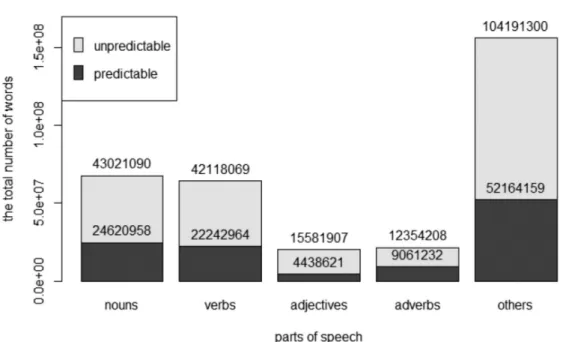
Figure 1 shows the predictability of phonics for the total number of words in the data when word frequency was considered. The results show that only 34% of the tokens can be predicted using phonics rules. Figure 2 shows the predictability of phonics for the total number of words grouped by parts of speech. The predictability for each category in parts of speech is not high as Figure 2 demonstrates.
Additionally, the predictability of phonics tended to be higher when it was calculated using fewer words by types as in Figure 3. On the other hand, when the predictability was measured using tokens, it was stable as Figure 4 illustrates.
2 Some readers may point out that some of these words can be predicted by phonics. This is due to the regional differences in vowel sounds. In addition, vowel sounds are not reduced when they are not stressed in the CMU dictionary, and this is the reason why the author chose to use this dictionary.
Figure 1. The total number of words with pronunciations that are predictable or
Figure 2. The total number of words (grouped by parts of speech) that are predictable or unpredictable based on phonics.
Figure 3. The cumulative predictability of phonics by types
Furthermore, stop words were excluded in Python3 to ensure that functional words
would not affect the results. After that, the predictability was calculated in the same way as for the results in Figure 1. As a result, Figure 5 was created. Although the result was slightly better than before excluding stop words, the predictability was still 37%.
Figure 5. The total number of words (excluding stop words) that are predictable or unpredictable based on phonics.
5.Discussion
It is evident from these findings that the predictability of phonics is limited even when word frequency, parts of speech, or stop words are taken into account. As far as words are used as a unit for calculating the predictability of phonics, phonics helps learners pronounce only about one third of a text. More attention should be paid to this fact. Teachers who use phonics must keep this limitation in mind.
6.Conclusion
There is no doubt that phonics enables learners to pronounce only about one third of the words in a text. A limitation of this research is that the author was unable to take frequency into account using a conventional, sound-counting method. The outcomes of the present study may be useful for English education.
(Part-time lecturer, Department of English)
ACKNOWLEDGEMENT
I would like to express my gratitude to the young learners who kept telling me the exceptions of phonics when I taught them English using that teaching method.
REFERENCES
Clymer, T. (1996). The utility of phonic generalizations in the primary grades. The Reading Teacher,
50(3), 182-187.
Davies, M., & Gardner, D. (2013). A frequency dictionary of contemporary American English: Word
sketches, collocates and thematic lists. Routledge.
Fry, E. (2004). Phonics: A large phoneme-grapheme frequency count revised. Journal of Literacy
Research, 36(1), 85-98.
Gakken. (Ed.). (2009). The Anchor English-Japanese dictionary of daily use. Gakken.
Johnston, F. P. (2001). The utility of phonic generalizations: Let's take another look at Clymer's conclusions. The Reading Teacher, 55(2), 132-143.
Obara, Y. (2016). An application of phonic generalizations for Japanese English learners. Shobi
Journal of Policy Studies, 22, 167-184.
Shibuya, T. (2011). Soki eigo kyoiku ni okeru fonikkusu donyu no kanosei [The possibility of introducing phonics to early English education]. Language & Civilization, 9, 113-123.
The CMU Pronouncing Dictionary. (1998). Carnegie-Mellon University Pronouncing Dictionary for
American English. Version 0.7. Retrieved from [http://www.speech.cs.cmu.edu/cgi-bin/
cmudict].
AppendixⅠ:list of deleted words
in, to, that, for, on, this, but, his, not, by, as, can, her, all, about, will, up, there, so, when, out, just, now, than, other, more, because, no, only, very, through, down, after, over, most, own, while, where, such, each, off, before, under, both, until, once, above, below, I, the, be, and, of, a, have, it, you, he, with, do, they, at, we, from, she, or, what, their, who, if, my, which, them, some, me, into, him, your, how, then, its, our, these, here, those, any, should, too, between, why, same, against, again, few, during, himself, themselves, itself, myself, herself, yourself, whom, nor, being, ourselves, yours, hers, ours, any