RIMS-1661
Gr¨
obner Basis, Mordell-Weil Lattices and
Deformation of Singularities
By
Tetsuji SHIODA
March 2009
Gr¨
obner Basis, Mordell-Weil Lattices and
Deformation of Singularities
Tetsuji Shioda
∗March 4, 2009
Abstract
We call a section of an elliptic surface to be everywhere integral if it is disjoint from the zero-section. The set of everywhere integral sections of an elliptic surface is always a finite set. We pose the basic problem about this set when the base curve is P1. In the case of a rational elliptic
surface, we obtain a complete answer, described in terms of the root lattice
E8 and its roots. Our results are related to some problems in Gr¨obner
basis, Mordell-Weil lattices and deformation of singularities, which have served as the motivation and idea of proof as well.
1
Introduction
Let S be a smooth projective surface having an elliptic fibration f : S→ C with the zero-section O over a curve C, and let E be the generic fibre of f which is an elliptic curve over the function field K = k(C) (k is a base field of any characteristic). Assume that S has at least one singular fibre. Then the group
M = E(K) of K-rational points is finitely generated (Mordell-Weil theorem).
It can be identified with the group of sections of f . For each P in E(K), we denote by (P ) the image curve of the corresponding section C → S; the curve (P ) may be also called a “section” without confusion.
An element P of M is called everywhere integral ([15]) if (P ) is disjoint from the zero-section (O). LetP be the set of all everywhere integral sections P ∈ M:
P = {P ∈ M|(P ) ∩ (O) = ∅} (1.1)
Theorem 1.1 The setP is a finite subset of the Mordell-Weil group M.
Proof By the height formula [10, Theorem 8.6], we have for any P ∈ M hP, P i = 2χ + 2(P O) − X
w∈Rf
contrw(P ), (1.2)
where the notation is as follows: χ is the arithmetic genus of S (a positive integer), (P O) is the intersection number of two irreducible curves (P ) and (O) on S, and contrw(P ) is the local contribution at w (a non-negative rational
number); the summation is over the set Rf of the points w∈ C with f−1(w)
reducible. If P belongs to the setP, then it follows that hP, P i ≤ 2χ. Thus
P forms a set of points with bounded height in M, and hence it is a finite set.
(Recall that, by the theory of Mordell-Weil lattices ([10]), the height pairing is positive-definite on M modulo torsion.) q.e.d.
Now consider the case: C = P1, K = k(t). For the sake of simplicity, we
assume in the following that the base field k is algebraically closed. Suppose that E/K is given by a generalized Weierstrass equation:
E : y2+ a1xy + a3y = x3+ a2x2+ a4x + a6 (1.3)
and O is the point at infinity (x : y : 1) = (0 : 1 : 0). Without loss of generality, we assume that the coefficients aν are polynomials in t and “minimal” in the
sense that if, for some l∈ k[t], aν is divisible by lν for all ν, then l must be a
constant (i.e. l∈ k). Then we have
deg aν ≤ νχ (ν = 1, 2, 3, 4, 6) (1.4)
where χ is the arithmetic genus of S, which is known to be characterized as the smallest integer satisfying the the above condition.
Lemma 1.2 Let P ∈ M = E(K). Then P = (x, y) belongs to the set P if and
only if x, y are polynomials in t such that
deg(x)≤ 2χ, deg(y)≤ 3χ. (1.5)
Proof See the proof of [15, Theorem 2]. q.e.d.
Let P = (x, y) : ½ x = x0+ x1t +· · · + x2χt2χ y = y0+ y1t +· · · + y3χt3χ, (1.6) and let z = z(P ) = (x0, x1,· · · , x2χ, y0, y1,· · · , y3χ). (1.7)
Then, substituting (1.6) into (1.3), we obtain a polynomial identity in t:
y2+· · · − (x3+· · · + a6) = φ0+ φ1t +· · · + φ6χt6χ. (1.8)
Let us denote by I the ideal generated by the coefficients φd of td in the
poly-nomial ring R:
I := (φ0, . . . , φ6χ)⊂ R := k[x0, x1,· · · , x2χ, y0, y1,· · · , y3χ]. (1.9)
We call I the defining ideal ofP. Obviously we have
with V (I) denoting, as usual, the affine scheme of common zeroes of I in the affine space. The map P 7→ z(P ) defines a bijection from P to the reduced part
V (I)red of V (I), and in particular, we have
n := #P = #V (I)red (1.11)
Note that V (I)red= V ( √
I) where√I denotes the radical of I.
Now we consider the (irredundant) primary decomposition of the ideal I:
I = q1∩ · · · ∩ qn (1.12)
and the associated prime decomposition of the radical√I: √
I = p1∩ · · · ∩ pn. (1.13)
Here each qi is a primary ideal in the polynomial ring R and pi = √qi is a
prime ideal. In fact, pi is the maximal ideal of the point z(P )∈ V (I) defined
by (1.7) for the corresponding P = Pi∈ P. Let us call
µ(Pi) := dimkR/qi (1.14)
the multiplicity of Pi∈ P (cf. [3, Ch.4], [8, Ch.4].)
We study the following question:
Question 1.3 Given an elliptic surface S over P1 of arithmetic genus χ, with
the generic fibre E given by (1.3) and (1.4) as above, what are (i) the number of everywhere integral sections : n = #P, (ii) the linear dimension: dimkR/I, and (iii) the multiplicity µ(Pi) = dimkR/qi for each i≤ n?
Note that, by the Chinese Remainder theorem, we have
dimkR/I = n X i=1 dimkR/qi= n X i=1 µ(Pi). (1.15)
Hence (ii) will follow from (iii).
Before going further, we present an explicit example.
Example 1.4 Let E/k(t) be the elliptic curve
y2= x3+ t5+ 1. (1.16)
Here we assume k has characteristic 0 or p > 5. Then (i) the number of everywhere integral sections n = #P is equal to 240. (ii) The linear dimension
dimkR/I is equal to 240, too. (iii) For all P ∈ P, the multiplicity µ(P ) is equal to 1.
Proof Let us show that dimkR/Iλ = 240 by a direct computation using the
method of Gr¨obner basis. To simplify the notation, we replace the ideal
by a similar ideal
I0⊂ R0= k[u, x0, x1, y0, y1, y2]
by letting x2= u2, y3= u3. (Note that x32− y32is contained in I.) The Gr¨obner
basis method yields a “shape basis” of I0, i.e. a set of generators of I0 of the form:
I0= (Ψ240(u), xi− φi(u), yj− ψj(u)|i = 0, 1, j = 0, 1, 2)
where Ψ, φi, ψj are polynomials of u and Ψ is a separable polynomial of degree
240. (The explicit form of the polynomial Ψ can be found in [12] or [14] if desired.) Therefore we have
dimkR/I = dimkR0/I0= dim k[u]/(Ψ(u)) = 240.
Moreover the k-algebra R/I ∼= k[u]/(Ψ(u)) is isomorphic to a direct sum of 240 copies of k, which shows that I =√I and the primary decomposition of I is given by the 240 maximal ideals corresponding to the 240 roots of the
polynomial Ψ(u). In other words,P consists of n = 240 elements and µ(P ) = 1
for each P . q.e.d.
In this paper, we give a complete answer to Question 1.3 in the case χ = 1, i.e. where S is a rational elliptic surface. The main result (Theorems 2.1) will be stated in the next section, whose proof will be given in§4. In §3 we study the behavior of the 240 roots in the E8-frame of a rational elliptic surface under
specialization and obtain a basic theorem (Theorem 3.4). As a by-product, we obtain a simple proof of the fact that the Mordell-Weil group M is generated by the setP of everywhere integral sections (Theorem 3.5), whose known proof depends on some case-by-case checking ([9]). In§5, a few examples are given as illustration of our main result. Actually rational elliptic surfaces are classified by Oguiso-Shioda [9] in terms of the trivial lattice and Mordell-Weil lattice. For each type, we have determined the data n, m(P )(P ∈ P) appearing in Theorem 2.1, but the results will be given elsewhere. In the final section§6, we discuss some open questions in case χ > 1.
As for the title of this paper, Gr¨obner basis computation is useful, as the above example shows, in dealing with Question 1.3 when S or E is explicitly given. We have profitably used the software “Risa/asir” (developped by the authors of [8]) for some numerical experiments and for direct verification of our results based on the theory of Mordell-Weil lattices and geometry of elliptic surfaces. The idea from deformation of singularities (cf. [12]) is disguised as the specialization arguments in the proof of our main results.
Convention: Throughout the paper, we keep the notation of §1; we some-times writePS, IS, . . . to specify the dependence ofP, I, . . . on the elliptic surface S under consideration. We continue to assume that k is algebraically closed.
2
Answer in case χ = 1
To state our main results, let us first recall some basic facts on rational elliptic surfaces, fixing the notation (cf. [9], [10,§10]).
Let N = NS(S) denote the N´eron-Severi lattice of an elliptic surface S with a section. Let U be the rank two unimodular sublattice of N spanned by the classes of the zero-section (O) and any fibre F . Let V = U⊥ be the orthogonal complement of U in N , which is called the frame of S; we have N = U⊕ V . If S is a rational elliptic surface (RES), the frame V is a negative-definite even unimodular lattice of rank 8, and hence it is isomorphic to E8−, the opposite lattice of the root lattice E8(cf. [2, Ch.4]).
NS(S) = U⊕ V, V ∼= E−8. (2.1) Thus we call the frame V of a RES as the E8-frame.
LetD = DS ⊂ V be the subset of “roots” in V : D = {cl(D) ∈ V |D2=
−2}. (2.2)
By the above, it forms a root system of type E8. In particular, we have
#D = 240. (2.3)
For any P ∈ P = PS, we set
D(P ) := (P )− (O) − F. (2.4)
Then we have D(P ) ⊥ U and D(P )2 =
−2, hence D(P ) ∈ D. (N.B. Here
and in what follows, we sometimes write D ∈ D by abbreviating cl(D) ∈ D, where cl(D) denotes the class of a divisor D in N . We write D1 ≡ D2 if
cl(D1) = cl(D2) in N .)
On the other hand, each reducible fibre f−1(v)(v∈ Rf) is decomposed as a
sum of its irreducible components with positive integer coefficients :
f−1(v) = Θv,0+ mXv−1
i=1
kv,iΘv,i (2.5)
where Θv,0is the unique component intersecting the zero-section (O) and where mv denotes the number of the irreducible components. Let Tv denote the
sub-lattice of N generated by Θv,i(i = 1, . . . mv− 1). It is known (see [6]) that each
Θv,i has self-intersection number−2 (i.e. Θv,i∈ D) and Tv is a (negative) root
lattice of ADE-type determined by the type of the reducible fibre. Let T be the sublattice of the E8-frame V defined by
T =⊕v∈RfTv⊂ V ∼= E
−
8 (2.6)
which is called the trivial lattice of S. Now our main result is the following:
Theorem 2.1 Assume that S is a rational elliptic surface. Then (i) the number
of everywhere integral sections n = #P is bounded by 240:
and we have
n = 240⇐⇒ T = 0. (2.8)
(ii)
dimkR/I = 240− ν(T ) (2.9)
where ν(T ) is the number of roots in the trivial lattice T .
(iii) For each i≤ n, the multiplicity µ(Pi) (see (1.14)) is equal to the com-binatorial multiplicity m(Pi) to be defined below. In other words, we have
µ(P ) = m(P ) for all P ∈ P. (2.10)
Definition 2.2 For any P ∈ P, let Rf(P ) denote the subset of v ∈ Rf such
that (P ) intersects some non-identity component Θv,i(i 6= 0) of f−1(v). The root graph associated with P , denoted by ∆(P ), is the connected graph with the
vertices
D(P ), Θv,i (v∈ Rf(P ), i6= 0), (2.11)
where two vertices α, β are connected by an edge iff the intersection number
α· β = 1. By a distinguished root of ∆(P ), we mean a linear combination of the
vertices of the form:
D = D(P ) +X v,i
nv,iΘv,i (nv,i∈ Z, ≥ 0) (2.12)
satisfying D2 =
−2. Further we denote by m(P ) the number of distinguished
roots in the root graph ∆(P ), and call it the combinatorial multiplicity of P . The proof will be given in§4, after we establish the relationship of the two setsP and D for a given RES (Theorem 3.4) in the next section..
3
Relationship of
P and D
For a rational elliptic surface, the Mordell-Weil group M = E(K) is isomorphic to the quotient group of the N´eron-Severi group N by the subgroup U⊕ T , hence to the quotient group V /T :
M ∼= N/(U⊕ T ) ∼= V /T (3.1) where V and T =⊕Tv are defined before in§2 (see [9], [10]).
Now we study the relation ofP and D, by restricting the natural projection
π : V → V/T ∼= M , to the set of the rootsD ⊂ V :
π :D → M. (3.2)
Lemma 3.1 Assume T = 0. Then the Mordell-Weil lattice M is isomorphic
to E8, and P is equal to the set of sections P ∈ M of height hP, P i = 2. In this
case, the map π gives a bijection: D → P. The inverse map P → D is given by P7→ D(P ).
Proof If T = 0, the rational elliptic surface f : S→ P1 has no reducible fibres, and hence M ∼= E8(see [10,§10] or [9]). Now the height formula (1.1) says that
for any P ∈ M
hP, P i = 2 + 2(P O)
where (P O) is the intersection number of (P ) and (O). Hence P has height 2 iff (P O) = 0, i.e. iff P ∈ P.
As the set of roots in E8, bothP and D have the same cardinality 240. Thus
the map P 7→ D(P ) gives a bijection P → D, and it is clear that π(D(P )) = P for any P . Hence the assertion. q.e.d.
Lemma 3.2 Suppose S is any rational elliptic surface. Let ˜S be a generic ra-tional elliptic surface (see§4.1), and we consider a smooth specialization ˜S→ S preserving the elliptic fibration and the zero-section. Then it induces an isomor-phism of the N´eron-Severi lattices
σ : NS( ˜S)−→ NS(S),∼ (3.3)
which gives rise to a bijectionDS˜→ DS.
Proof In general, a specialization of smooth projective surfaces ˜S→ S induces
an injective homomorphism NS( ˜S) ,→ NS(S) preserving the intersection
pair-ings. In the case of RES, it gives a lattice isomorphism of NS( ˜S) onto NS(S) in
view of (2.1), which preserves the sublattices U, V by assumption. It is obvious that the set of rootsD in V , (2.2), is also preserved, proving the last assertion.
q.e.d.
(N.B. This result may be called the conservation law of the E8-roots on RES
under specialization or deformation: cf. [12])
Lemma 3.3 For any D∈ DS, π(D) = P belongs toPS unless π(D) = O. In this case, we have
D≡ D(P ) + γ (γ ∈ T ) (3.4)
where γ is a linear combination of Θv,i(v∈ Rf, i > 0) with non-negative integer coefficients.
Proof Fix D∈ DS, and assume that π(D) = P 6= O. We claim that P ∈ PS.
We may suppose that S is in the situation described in Lemma 3.2. Then there exists some ˜D ∈ DS˜ such that σ( ˜D) = D. Applying Lemma 3.1 to ˜S
(which obviously has T = 0), we have ˜
D = D( ˜P ) := ( ˜P )− ( ˜O)− ˜F (3.5) for some ˜P ∈ PS˜, where ˜O (or ˜F ) denotes the zero-section (or a fibre) of ˜S.
Suppose that, under the specialization, the irreducible curve ˜Γ := ( ˜P ) on ˜S
reduces to an effective divisor on S: Γ =X
j
with the irreducible components Γj. By the conservation of intersection
num-bers, we have
1 = (˜Γ ˜F ) = (ΓF ) =X j
(ΓjF )
with each (ΓjF )≥ 0. Hence there exists a unique Γj, say j = 1, such that
(Γ1F ) = 1, (ΓjF ) = 0 (j6= 1).
Then Γ1is a section of S, i.e. Γ1= (P1) for some P1∈ M, and all other Γj are
contained in fibres. Obviously P1 is equal to P = π(D).
Next, in the intersection number relation:
0 = (˜Γ( ˜O)) = (Γ(O)) = (P O) +X j>1
(Γj(O)),
observe that (P O)≥ 0 (because P 6= O by assumption) and (ΓjO)≥ 0. Hence
we have (P O) = 0 and (ΓjO) = 0. The former implies that P ∈ PS, as
claimed, while the latter implies that the other components Γj(j > 1), if any, are
among the non-identity components Θv,i(i > 0) of reducible fibres. Therefore
˜
D specializes via σ to the following:
D∗= (P )− (O) − (F ) + γ, γ = X
v,i>0
mv,iΘv,i∈ T (3.6)
where mv,iare some non-negative integers. On the other hand, since σ( ˜D) = D,
we have D≡ D∗. This proves Lemma 3.3. q.e.d.
Theorem 3.4 For any rational elliptic surface S with a section, let D be the
set of roots in the E8-frame. Then the map π : D → P ∪ {O} is a surjective
map unless T = 0, andD is decomposed into the disjoint union: D = π−1(O)G G
P∈P
π−1(P ). (3.7)
The inverse image π−1(O) is the set of roots in T (it is empty if T = 0). For
any P ∈ P, we have
π−1(P ) ={D ∈ D | D ≡ D(P ) + X
v,i>0
mv,iΘv,i (mv,i≥ 0)} (3.8)
which is equal to the set of distinguished roots in the root graph ∆(P ) defined in §2. In particular, its cardinality is equal to the combinatorial multiplicity of P :
m(P ) = #π−1(P ), (3.9)
and X
P∈P
Proof This is clear by Lemma 3.1 and 3.3. The decomposition (3.7) of D is
just the union of the inverse images of π, and counting the cardinality gives the
relation (3.10). q.e.d.
As a by-product of the above proof, we obtain a conceptual proof of the following fact (see [9, Theorem 2.5], [10, Theorem 10.8]), which has been proven by using the classification of RES plus some case-by-case checking:
Theorem 3.5 For any rational elliptic surface with a section (defined over an
algebraically closed field of arbitarary characterisitic), the Mordell-Weil group is generated by the setP of sections P which are disjoint from the zero-section. Proof It is well-known that the root lattice E8is generated by a basis consisting
of eight roots (see e.g. [2]). Hence the E8-frame V is generated by the setD of
roots. Since we have M ∼= V /T by (3.1), M is generated by π(D), hence by P by the first part of Lemma 3.3. q.e.d.
4
Proof of Theorem 2.1
4.1
The case T = 0
First we consider the case T = 0. By Lemma 3.1, Theorem 2.1 reduces to the following statement:
Theorem 4.1 Assume that S is a rational elliptic surface with T = 0. Then
we have
n = dimkR/I = 240, µ(P ) = m(P ) = 1 for all P ∈ P. (4.1) Proof It suffices to prove the equality:
dim R/I = 240 (4.2) in the statement (4.1). In fact, we already know that n = #P = 240 and that
m(P ) = 1 for each P ∈ P. The latter holds, because the root graph ∆(P )
consists of the vertex D(P ) alone as T = 0. In view of the Chinese Remainder equality (1.15), we see that the claim (4.2) is equivalent to the following:
µ(P ) = 1 for all P ∈ P. (4.3)
Thus we proceed as follows to show (4.2) (see Lemma 4.3).
First we write down a “universal” rational elliptic surface. In view of the condition (1.4) for χ = 1, we let Sλ denote the elliptic surface defined by the
Weierstrass equation (1.3) where we set
λ = (ai,j) (i≤ 6, i 6= 5, j ≤ i), ai(t) = i
X
j=0
Let
Λ ={λ|Sλ is a RES} (4.5)
and
Λ0={λ ∈ Λ|Sλ is a RES without reducible fibres}. (4.6)
In characteristic different from 2 and 3, one can choose ai(t) = 0 (i = 1, 2, 3)
(i.e. ai,j= 0 for i = 1, 2, 3 and all j) without loss of generality. In any case, Λ
is open in an affine space of suitable dimension, and Λ0is an open subset of Λ.
We denote byPλand Iλ the set of everywhere integral sectionsP of Sλand
its defining ideal, and by V (Iλ) the 0-dimensional affine scheme defined as in §1.
Lemma 4.2 Assume χ = 1. Then{V (Iλ)|λ ∈ Λ} forms a flat family over Λ. Proof (I owe this remark to Takeshi Saito.) For any χ, the ideal Iλis generated
by 6χ + 1 elements by definition, while the number of variables xi, yj is (2χ +
1) + (3χ + 1) = 5χ + 2 (§1). Hence, if χ = 1, V (Iλ) is a complete intersection,
and the flatness follows from [4, Ch.IV]. q.e.d.
Lemma 4.3 Under the same assumption, {V (Iλ)|λ ∈ Λ0} forms a finite flat
family over Λ0.
Proof For any (geometric) point λ∈ Λ0, V (Iλ) consists of 240 points by (1.10)
and Lemma 3.1. The affine coordinates of these points in the ambient affine space of V (Iλ) are given by z(Pm) (1≤ m ≤ 240) (see (1.7)), if we set Pλ = {Pm(1≤ m ≤ 240)}.
Now fix any λ∈ Λ0. Let ˜λ be a generic point of Λ0, and let z( ˜P ) be a generic
point of ˜V := V (I˜λ). Take any specialization σ : ˜λ→ λ, and any specialization
˜
σ of z( ˜P ) over σ. Since ˜V is specialized to V (Iλ), bijectively as the point sets
consisting of 240 points, the point z( ˜P ) must specialize to one of z(Pm)0s, which
are obviously finite. This is the case for any choice of specialization ˜σ, and hence
the family in question is a proper family (cf. [5, Ch.II] or [17, Ch.VII]). Since it is a family of 0-dimensional schemes, the assertion follows. q.e.d.
Lemma 4.4 (i) The dimension dimkR/Iλ is constant for any λ∈ Λ0(k).
(ii) The constant value is equal to 240.
Proof The claim (i) follows from a general result for finite flat morphisms (see
e.g. [7, Prop.8, Lect.6]). Thus, to prove (ii), it suffices to check it at one point
λ∈ Λ0(k). For instance, take λ corresponding to the rational elliptic surface
4.2
General case
Now we prove Theorem 2.1 in general.
For any λ∈ Λ, let Dλ denote the set of roots in the E8-frame (2.1) on Sλ.
Let ˜λ be a generic point of Λ0, and let Pλ˜ ={ ˜Pi (1 ≤ i ≤ 240)}. The set Dλ˜ consists of D( ˜Pi)’s by Lemma 3.1.
Take any point λ∈ Λ(k) and any specialization σ : ˜λ → λ. By Lemma 3.2,
Dλ˜ is mapped bijectively toDλ under the specialization, and, by Lemma 3.3,
each D( ˜Pi) is mapped either to some element of T or to an element of the form
(3.4) for some P ∈ Pλ. For a fixed P ∈ Pλ, the number of ˜Pi’s corresponding
to P in the above sense is equal to the multiplicity µ(P ), because each ˜Pi has
multiplicity 1 by (4.2) which has just been established above. Comparing this with the decomposition (3.7) of D = Dλ in Theorem 3.4, we conclude that µ(P ) = m(P ) for each P ∈ Pλ. This proves the claim (iii) of Theorem 2.1.
Next, to prove (ii), we combine (1.15) with (iii) just proven above: dimkR/Iλ= X P∈P µ(P ) = X P∈P m(P )
By (3.10) in Theorem 3.4, this implies
dimkR/Iλ= 240− ν(T ).
Thus we have proven the claim (ii) of Theorem 2.1. The claim (i) is obvious: we have
n = #P ≤ dimkR/I ≤ 240,
where the first inequality holds by (1.10) and the second one from (ii) above. The assertion (2.8) follows from (ii). This completes the proof of Theorem 2.1.
q.e.d.
4.3
Further information in a special case (cf. [11], [12])
The idea of the above proof is adapted from our previous work [11,§8] and [12], treating a slightly less general family which admits a singular fibre of type II (a cuspidal cubic). We remark here that, if we restrict our attention to that family, everything in the above proof becomes clearer and more explicit.
Namely we consider
Eλ: y2= x3+ x(p0+ p1t + p2t2+ p3t3) + q0+ q1t + q2t2+ q3t3+ t5 (4.7)
where
λ = (p0, p1, p2, p3, q0, q1, q2, q3)∈ A8.
Assume that λ is generic (i.e. p0, . . . , q3 are algebraically independent) over Q, and let k be the algebraic closure of k0 := Q(λ) = Q(p0, . . . , q3). Then
isomorphic to the root lattice E8. Take a basis{P1, . . . .P8} forming the Dynkin
diagram of type E8, and let ui= sp∞(Pi)∈ k, where
sp∞: Eλ(k(t))−→ k (4.8)
denotes the specialization homomorphism: for any P , sp∞(P ) is defined as the unique intersection point of the section (P ) and the singular fibre of type II
f−1(∞).
By the fundamental theorems for the algebraic equations of type E8 ([11,
Theorems 8.3, 8.4, 8.5]), we have the following results:
(i)K = Q(u1, . . . , u8) is the splitting field of Eλ/Q(λ)(t), i.e. we have Eλ(K(t)) = Eλ(k(t)) andK is the smallest extension of Q(λ) with this property.
(ii)K/Q(λ) is a Galois extension with Galois group W (E8) (the Weyl group of
type E8).
(iii) W (E8) acts on the polynomial ring Q[u1, . . . , u8], and the ring of invariants
is equal to Q[λ] := Q[p0, . . . , q3]. In other words,{p0, . . . , q3} forms a set of
fun-damental invariants of W (E8) (of weight 20, 14, 8, 2, 30, 24, 18, 12 respectively).
(iv) The minimal polynomial Φ(X) of u1 over Q(λ) splits completely inK and
it has coefficients in Q[λ]: Φ(X, λ) = 240 Y i=1 (X− ui)∈ Q[λ][X], (4.9)
where each root uiis Z-linear combination of u1, . . . , u8. The 240 uiform a root
system of type E8.
(v) For each i≤ 240, there is a section Pi ∈ Eλ(k(t)) of the form:
Pi= ( 1 u2 i t2+ at + b, 1 u3 i t3+ ct2+ dt + e), sp∞(Pi) = ui (4.10)
where the coefficients a, b, c, d, e belong to Q(λ)(ui)∩ Q[u1, . . . , u8].
Let u := (u1, . . . , u8)∈ A8. Then it follows from (iii) above that the map
φ : u 7→ λ = φ(u) defines a finite ramified Galois covering A8
→ A8 with
Galois group W (E8), which is unramified on the open set U ⊂ A8 where the
“discriminant” δ(λ) (cf. [1]) does not vanish:
δ(λ) = Φ(0, λ) =
240
Y
i=1
ui. (4.11)
Furthermore Su := Sφ(λ) defines a smooth family of rational elliptic surfaces
parametrized by the affine space A8upstairs (see [12, Prop.4.3] and references
given there).
Now we consider specializing the generic point of the affine space upstairs u = (u1, . . . , u8) to some u0 = (u01, . . . , u08). It induces a unique specialization λ =
each Pi as Pi(u) with its coefficients of t lying in Q(λ)(ui)∩ Q[1/ui, u1, . . . , u8].
Hence, as far as u0i 6= 0, Pi has a unique specialization Pi0 with sp∞(P
0
i) = u
0
i.
Thus, if δ(λ0)6= 0, Pi → Pi0 gives a bijection of the set of 240 roots in the
MWL Mλ to that in Mλ0. (N.B. The map ui → u0i is not necessarily injective
even if we assume δ(λ0)6= 0. See [11, p.685] for such an example.) On the other hand, if δ(λ0) = 0, then there exist some i such that u0
i = 0.
In this case, Pi must specialize to O in Mλ0. The number ν of such i’s is equal
to ν(T ), the number of roots in the trivial lattice T ⊂ NS(Sλ0). In other words,
the multiplicity of the factor X in the polynomial Φ(X, λ0) is equal to ν(T ). If
we setPλ0 ={Q1, . . . , Qn}, then we have
Φ(X, λ0) = 240 Y i=1 (X− u0i) = Xν n Y j=1 (X− sp∞(Qj))m(Qj). (4.12)
Thus, for a fixed u0= u0
i, the multiplicity of (X− u0) in Φ(X, λ0) is equal to
the sum of m(Qj)’s such that sp∞(Qj) = u0.
5
Examples
By [9], the Mordell-Weil lattice (abbreviated as MWL) of a rational elliptic surface is classified into 74 types by the triple{T, L, M}, where (i) T =PvTv
is the trivial lattice (2.6), with the opposite sign, embedded in E8, (ii) L is the
narrow MWL E(K)0 which is isomorphic to the orthogonal complement of T
in E8, and (iii) M is the MWL E(K) which is the direct sum of the dual lattice
of L and the torsion group T0/T , where T0 is the primitive closure of T in E8.
For each type{T, L, M}, we have determined the set P ⊂ M, n = #P, and the combinatorial multiplicities m(P ) for each P ∈ P. The summary will be reported elsewhere.
Here we illustrate our results with a few classical examples. Examples in§5.1 are the prototype of the present work treated in the earlier paper [12]. Next
§5.2 shows more complicated new features, dealing with the familiar Legendre
curve.
5.1
Cases of higher Mordell-Weil rank (cf. [12,
§5])
For a rational elliptic surface, the rank r = rkM is bounded by 8 and the higher MW-rank cases correspond to the cases of smaller rkT . The first four cases in [9] are the following (where rkT ≤ 2): (i)T = 0, L = M = E8, (ii)T = A1, L =
E7, M = E7∗, (iii)T = A2, L = E6, M = E6∗, (iv)T = A⊕21 , L = D6, M = D6∗.
The set P of everywhere integral sections in M consists of the roots in the root lattice L and the minimal vectors of M = L∗(the dual lattice of L) for the first three cases. Thus n = #P is equal to the number ν(L) of the roots in L, plus the number of minimal vectors in case (ii) or (iii):
(ii) x x m D(P ) θv,1 (iii) x x x m D(P ) θv,1 θv,2 (iv) x xm x θv0,1 D(P ) θv,1
Figure 1: Root graph ∆(P )
If P ∈ P is a root of L, then the multiplicity m(P ) is 1, because the root graph consists of the single vertex D(P ). On the other hand, if P is a minimal vector of M = L∗, then the multiplicity m(P ) is equal to m(P ) = 2 in case (ii) and m(P ) = 3 in case (iii), because then the root graph ∆(P ) is given, respectively, by Figure 1. Here the root D(P ) is denoted by the encircled vertex and other roots Θv,i in (2.11) by the black vertices. (We write θ for Θ in the
following.)
In case (iv), the setP consists of 60 roots of L = D6, 12 minimal vectors of
height hP, P i = 1 in M = D∗6, plus 64 Q∈ M with height hQ, Qi = 3/2. We have m(P ) = 4 and m(Q) = 2, as shown by Figure 1 (iv) or (ii) respectively. Compare [12,§5].
In each case, check the identity:
126· 1 + 56 · 2 = 238 = 240 − 2, 2 = ν(A1) (5.1)
72· 1 + 54 · 3 = 234 = 240 − 6, 6 = ν(A2) (5.2)
60· 1 + 64 · 2 + 12 · 4 = 236 = 240 − 4, 4 = ν(A⊕21 ) (5.3)
5.2
The Legendre surface
Let E be defined by the Legendre form:
E : y2= x(x− 1)(x − t). (5.4)
Let K = k(t) where k is any field of characteristic6= 2. The elliptic surface defined by this equation is obviously a rational surface, since the function field
K(E) = k(t, x, y) is equal to k(x, y).
There are two singular fibres of type I2 at t = 0, 1 and one of type I2∗ at
t = ∞. The trivial sublattice T = A⊕21 ⊕ D6 is of index 4 in E8, and the
Mordell-Weil group is M = E8/T ∼= (Z/2Z)2, a torsion group of order 4. More
explicitly, we have
E(K) ={O, P1= (0, 0), P2= (1, 0), P3= (t, 0)} (5.5)
Thus P consists of three 2-torsions {P1, P2, P3} and n = #P = 3. Figure
0 1 ∞ ¡¡ ¡¡ ¡¡ ¡¡ @ @ @@ @ @ @ @ ¢¢ ¢¢¢ A A A AA (O) (P3) (P1) P1 θ0,1 θ1,1 θ∞,3 θ0,0 θ1,0 θ∞,0 θ∞,1 θ∞,2
Figure 2: Legendre elliptic surface
0, 1,∞) of three singular fibres. (N.B. Two different sections do not intersect. The picture is not correct in that (P1) and (P3) look as if they intersect.)
We can determine their (combinatorial) multiplicities as follows:
m(P1) = 64, m(P2) = 64, m(P3) = 48 (5.6)
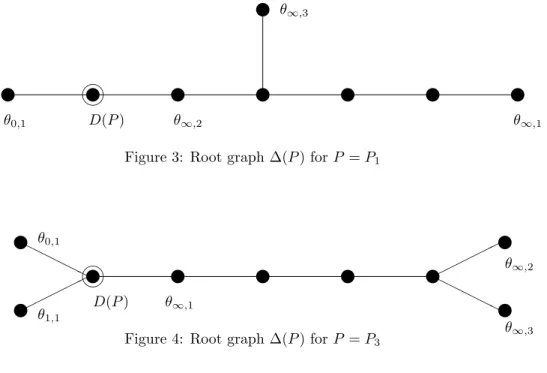
Indeed the root graph ∆(P ) for P = P1is shown by Figure 3 (and similarly
for P = P2), while ∆(P ) for P = P3 is as in Figure 4.
Then, by counting the number of distinguished roots in the root graph ∆(P ), (5.3) can be verified. For instance, to show that m(P1) = 64, consider first the
distinguished roots ξ = D(P ) +· · · not containing the vertex θ0,1 in Figure
3. Thus we seek for the number of “positive roots” in the Dynkin diagram of type E7 whose coefficient of D(P ) is 1. As is well-known (see [1]), there exist
33 positive roots in the Dynkin diagram of type E7 containing the left vertex
D(P ), but one of them is of the form 2D(P ) +· · ·. Hence we have exactly 32 ξ of the required form. Then, considering ξ + θ0,1 for each such ξ, we obtain
another set of 32 distinguished roots. In this way, we check that the number of distinguished roots in the root graph ∆(P1) is equal to 2· 32, i.e. m(P1) = 64.
x xm x x x x x
θ0,1 D(P ) θ∞,2
x θ∞,3
θ∞,1
Figure 3: Root graph ∆(P ) for P = P1
x x HH HHH ©©©© © θ0,1 θ1,1 x x x x x m D(P ) θ∞,1 ©©©© © HH HHH x x θ∞,2 θ∞,3
Figure 4: Root graph ∆(P ) for P = P3
integral section P is a visual counterpart of the height formula for P . For instance, the height formula (1.2) for P = Pi above is:
hP1, P1i = 2 + 0 − 6/4 − 1/2 − 0 (5.7)
hP2, P2i = 2 + 0 − 6/4 − 0 − 1/2 (5.8)
hP3, P3i = 2 + 0 − 1 − 1/2 − 1/2 (5.9)
where the local contribution terms contrv(P ) (see [10, p.229]) on the right hand
side are written in the order of v =∞, 0, 1.
Now Theorem 2.1 implies that, if I denotes the defining ideal ofP, then the primary decomposition of I is of the form I = q1∩q2∩q3, with qicorresponding
to Pi(i = 1, 2, 3), and we have
dimkR/qi= 64(i = 1, 2), dimkR/q3= 48, dimkR/I = 176. (5.10)
As mentioned before, Gr¨obner basis computation allows one to make a direct verification of such a result.
6
Open questions
When the arithmetic genus χ is greater than 1, Question 1.3 remains open. Let us pose a few more specific questions here.
We use the same notation as in§1. In particular, P denotes the set of every-where integral sections (1.1) on a given elliptic surface S over P1 of arithmetic
Question 6.1 Assume that P ∈ P has height hP, P i = 2χ. Is the multiplicity
µ(P ) equal to 1?
The assumption is equivalent to saying that P ∈ P belongs to the narrow Mordell-Weil lattice, or that the sections (P ) and (O) intersect the same irre-ducible component for every reirre-ducible fibre. Question 6.1 is true if χ = 1 by Theorem 2.1, since the assumption implies that the combinatorial multiplicity
m(P ) = 1.
In particular, we ask:
Question 6.2 Assume that the trivial lattice T = 0, or equivalently, there are
no reducible fibres. Then is it true that I =√I?
Next consider the case χ = 2, i.e. S is an elliptic K3 surface.
Question 6.3 What is the maximum cardinality n = #P when S varies among
elliptic K3 surfaces?
Question 6.4 Assume χ = 2. Can one give some combinatorial description of
the multiplicity µ(P ) for P∈ P?
Acknowledgements. I am grateful to Shigefumi Mori and Shigeru Mukai
for inviting me to RIMS, Kyoto University, where I have enjoyed warm hospi-tality and completed this paper in the stimulating atmosphere.
I would like to thank Kazuhiro Yokoyama for his advice about Risa/asir, and Takeshi Saito for his useful comments on the earlier version of this work when I talked on this theme at Tagajo Symposium in March 2008.
References
[1] Bourbaki, N.: Groupes et Alg`ebres de Lie, Chap. 4, 5 et 6, Hermann, Paris (1968).
[2] Conway, J., Sloane, N.: Sphere Packings, Lattices and Groups, Springer-Verlag (1988); 2nd ed.(1993); 3rd ed.(1999).
[3] Cox, D., Little, J.,O’Shea, D.: Using Algebraic Geometry, GTM 185, Springer (1998).
[4] Grothendieck, A.: ´El´ements de G´eometrie Alg´ebrique, IV, Publ. Math. IHES.
[5] Hartshorne, R.: Algebraic Geometry, GTM 52, Springer (1978).
[6] Kodaira, K.: On compact analytic surfaces II-III, Ann. of Math. 77, 563-626(1963); 78, 1-40(1963); Collected Works, III, 1269-1372, Iwanami and Princeton Univ. Press (1975).
[7] Mumford, D.; Lectures on Curves on an Algebraic Surface, Princeton Univ. Press (1966).
[8] Noro, M., Yokoyama, K.; Computational Foundations of Gr¨obner Bases (in Japanese), Tokyo Univ. Press (2003).
[9] Oguiso, K., Shioda, T.: The Mordell–Weil lattice of a rational elliptic surface, Comment. Math. Univ. St. Pauli 40, 83–99 (1991).
[10] Shioda, T.: On the Mordell-Weil lattices, Comment. Math. Univ. St. Pauli 39, 211- 240 (1990).
[11] — : Construction of elliptic curves with high rank via the invariants of the Weyl groups, J. Math. Soc. Japan 43, 673–719 (1991).
[12] — : Mordell-Weil lattices of type E8 and deformation of singularities, in:
Lecture Notes in Math. 1468, 177–202 (1991).
[13] — : Existence of a rational elliptic surface with a given Mordell-Weil lattice, Proc. Japan Acad. 68A, 251–255 (1992).
[14] — : Cyclotomic analogue in the theory of algebraic equations of type
E6, E7, E8, in: Integral Quadratic Forms and Lattices, Contemporary
Mathematics 249, AMS (199?).
[15] — : Integral points and Mordell-Weil lattices, in: A Panorama in Number Theory or The View from Baker’s Garden, Cambridge Univ. Press, 185-193 (2002).
[16] Tate, J: Algorithm for determining the type of a singular fiber in an elliptic pencil, SLN 476, 33-52 (1975).
[17] Weil, A.: Foundations of Algebraic Geometry, AMS Colloq. Publ. 29 (1962).
Tetsuji Shioda
Research Institute for Mathematical Sciences Kyoto University, Kyoto 606-8502, Japan [email protected]
and
Department of Mathematics, Rikkyo University, Tokyo 171, Japan [email protected]