Journal of the Operations Research Society of Japan
Vo!. 37, No. 2, June 1994
A LOWER BOUND OF THE EXPECTED MAXIMUM NUMBER OF VERTEX-DISJOINT s-t PATHS ON PROBABILISTIC GRAPHS
Peng Cheng t Shigeru Masuyama Toyohashi University of Technology
(Received October 26, 1992; Final September 10, 1993)
A bstract The problem of computing the expected maximum number 1Jt (G,p) of vertex-disjoint s-t paths for a probabilistic graph (G,p) is considered in this paper, where G is a two-terminal graph with specified source vertex s and sink vertex t(s
#:
t) in which each edge has a statistically independent failure probability and each vertex is assumed to be failure-free, and p is a vector of failure probabilities of edges. This computing problem is NP-hard, even though graphs are restricted to several special classes of graphs, e.g., planar graphs, s-t out-in bitrees and s-t complete multi-stage graphs. In this paper, we propose a lower bound ~(G,J,p) of 1Jt(G,p) for a probabilistic graph (G,p) based on an s-t path number function f of G. Although the lower bound does not seem to be efficiently computed for a general probabilistic graph, we shall also give a class of probabilistic graphs for which t.he expected maximum number is efficif'ut.ly obt.ained by computing the lower bound.1. Introduction
\Ve consider the problem of computing the expected maximum number w(G,p) of
vertex-disjoint s-t paths (namely, s-t paths sharing no vertex other than s, t,) for a probabilistic graph (G
=
(V,E,s,t),p), where G is a two-terminal graph with specified source vertex s and sink vertex t (s'#
t), P = (p(et), ... ,p(eIEI)) is a vector consisting of failure probabilities p( ei )'s, ei E E, and edges are assumed to fail statistically independently of each other. Computing I}i(G,p) for a probabilistic graph (G,p) is useful for network reliability analysis as compl1ting the expected maximum flow for a probabilistic network [2,7] and s, t-connectedness, namely, probability that there exists at least one operative s-t path in a probabilistic graph [1,5]. Note that the problem of computing W (G,p) contains, asa special case, the problem of computing s, t-connectedness on a probabilistic graph (G,p).
It is known that the problem of computing the expected maximum flow for a probabilistic network is NP-hard and that its lower bound which is efficiently computed is proposed by [2]. Recently, N aga.mochi and Ibaraki [7] clarified that the expected maximum flow for a probabilistic monom network [7] is efficiently computed, as a necessary and sufficient condition by which the lower bound proposed in [2] coincides with the expected maximum flow is that a network is monofil [7]. Although the problem of computing W (G,p) for a
probabilistic directed graph (G, p) is considered as a special case of the problem of computing the expected maximum flow for a probabilistic network where capacity on each edge is one, the lower bound proposed in [2] is not effective for most of such probabilistic networks as the class of probabilistic networks satisfying the necessary and sufficient condition proposed in [7] is very limited. In its introduction [7] refers to previous results on computing the expected maximum flow in a probabilistic network.
On studies of computing the expected maximum number of vertex-disjoint s-t paths in a probabilistic graph, it is shown by [4] that W (G,p) for a probabilistic basically series-parallel
digraph (G, p) is efficiently computed. However, it is known that the problem of computing Currently with Nagoyashokadaigaku College of Information Science and Cultural Studies.
Expected Maximum Vertex-Disjoint sot Paths 97
qr(G,p) for a probabilistic graph (G,p) is NP-·hard, even if G is restricted to several
classes of graphs, e.g., s-t out-in bitrees and s-t complete multi-stage graphs [3]. Thus, it is interesting for us to find its lower bound in order to estimate qr(G,p) for a probabilistic
graph (G, p).
The purpose of this paper is to propose a new lower bound of qr(G,p) for a probabilistic
graph (G,p) and to discuss the effectiveness of the lower bound. This paper is organized as follows: Graph theoretic terms and notations used throughout this paper are introduced in section 2. In section 3, we first give an s-t path number function
f
of G, and define a lower bound qr (G,J,p) of qr (G,p) on a probabilistic graph (G, p) using the s-t pathnum-ber function
f.
In section 4, we evaluate the lower bound by absolute performance radio~
and show the necessary and sufficient condition with respect to an s-t path number(G,p)
function
f
of G by which IJi (G,J,p) coincides with qr (G,p)' Section,5 proposes an algorithmof computing the lowcr bound IJi (G,J,p)' Although the algorithm proposed in this paper is
not polynomia.l time in general, we shall also give a class ofprobabilistic graphs (G,p) for which qr(G,p) is obtained in polynomial time by computing IJi(G,J,p) using this algorithm.
2. Preliminaries
2.1 Graph Theoretic Terminologies and Notations
A two-terminal (undirected) graph G = (V, E,s,t) consists ofa set V of finite vertices and a set E of finite edges (unordered pairs of vertices) , where sand t, called source and 8ink,
respectively, are two distinct specificd vertices of V. The set of all edges incident to some vertex v of a subset V' <::;: V is denoted by E( V')( = {( u, v) EEl u E V' or v E V'}).
In G = (V, E, s, t), a lI-V path rr of lengt.h k from vertex u to vertex v is an
alternating sequence of vertices Vi E V, 0 ~ i ~ A;, and cdges (Vi-i, Vi) E E, 1 ~ i ~ k,
where vertices Vi'S, for 0 ~ i ~ k, are distinct, and two vertices u, v are called end vertices of the u-v path. Let E(rr) be the set of all edges on a u-v path rr. Let Vr(rr) be the set of all internal vertices, i.e., vertices except u, v on a u-v path rr. The set of all
lI-V paths in G is denoted by Puv ( G). s-t paths sharing no vertex other than s, tare
called verte,T-disjoint s-l paths, and the maximum number of vertex-disjoint s-t paths in G is denoted by Kst(G).
In G = (V, E, s, t), the subgraph obtained by removing all edges in U(<::;: E) is de-noted by G - U( =: (V, E - U, s, t)), and the subgraph obtained by removing all vertices
in V'(<::;: V - {s, t}) and all edges incident to some vertex v in V' is denoted by
G - V'(= (V - V', E - E(V'), s, t)). A subset V' is called an s-t vertex-cutset if G -- V'
has no s-t path. An s-t path rr is said to be an s-t vertex-cut-path if Vr ( rr) is an s-t
vertex-cutset. By the well-known Menger's Theorem [6], the minimum cardinality of s-t
vertex-cutset is equal to the maximum number of vertex-disjoint s-t paths for any G. 2.2 A Probabilistic Graph
A probabilistic graph, denoted by (G = (V,E,s,t),p) or (G,p), for short, is defined as follows:
(i) G = (V, E, s, t) is a two-terminal graph, and p is an
IEI
dimensional vector consisting offailure probabilities p(e)'s of edges e E E.(ii) Each edge e of E is in either of the following two states: failed or operative (not failed), having known independcnt failure proba.bility p(e), 0 ~ p(e)
<
1 (or operative probability q(e) = 1 - p(c)).98 P. Cheng & S. Masuyama
For a probabilistic graph (G
=
(V, E, s, t), p), let the subgraph G - U(~ E) correspond to the event fu that all edges of U are failed and all edges of E - U are operative. Clearly, the probability p(G - U) of arising subgraph G - U(~ E) is computed by the following formula:p(G - U) =
IT
p(e)IT
q(e)(= 1 - p(e)). eEU eEE-UIt is clear that L:ucE p( G -- U) = 1.
Now, we define the e:rpected maximum number \If (G,p) of vertex-disjoint s-t paths on a
probabilistic graph (G = (V, E, s, i), p) by the following formula: (1) \If(G,p)
==
E
Kst(G - U)p(G - U).U~E
It is known that the problem of computing \If(G,p) for a probabilistic graph (G, p) is
NP-hard, even if G is restricted to several special classes of graphs like planar graphs, s-t out-in bitrees and s-t multi-stage complete graphs, etc.
[3].
Thus, it is interesting for us to consider a lower bound of \ji (G,p) in order to estimate \If (G,p).3. A Lower Bound of \If (G,p)
We shall define a lower bound of the expected maximum number of vertex-disjoint s-t paths in a probabilistic graph in this section. For this aim, wc need more notations.
For a graph G
=
(V, E, s, i), an s-t path number function f of G is a one-to-one integral function f: Pst(G) I---t {I, ... , IPst(G)I}. For a graph G and an s-t path number function f of G, an s-t path rrk with f(rr) = k is called an s-f path of s-t path number k. Let rrm(G-V/,J) denote the s-t path with the minimum s-f path number m(G - V', f) in G - V'(~ V) with respect toJ,
and let rrm(G-E',j) denote the s-t path with the minimnm s-t path number m(G - E',.f) in G - E'(~ E) with respect tof.
3.1 Finding an s-f Path Number Function
In this subsection we shall demonstrate that an s-t path number function is constructively obtained for a graph G. To do this, we first show that given a graph G = (V, E, s, i), the s-t path set Pst( G) of G can be constructively obtained by a combinatorial method, namely, by enumerating all possible vertex sequences where each vertex is distinct. This procedure is described as follows.
Procedure Find-Pst(G)
Input: A graph G = (V =
is,
VI, V2,"', Vn , I}, E,s,
t).Output: The s-t path set p.t(G). BEGIN Ll. L2. L3. L4. L5. L6. L7. L8. p.t ( G) :=
c?;
P:=c?;
FOR i:= 1 TO n DO s(i):= 1;
{s(i) denotes the number of the ith vertex in a vertex sequence.} FOR i:= 1 TO n DO Mark(i):= 0;
FOR Length = 1 TO n DO BEGIN
FOR i:= Length TO 1 DO BEGIN
IF M ark(i) = 1 THEN BEGIN s( i) := s( i)
+
1; M ark( i) := 0 END; IF s(1)=
n+
1 THEN GOTO L12;L9. L1D_ L11. L12. Ll3. END.
Expected Maximum Vertex-Disjoint s-t Paths
P:= Vs(i)' P
END;
IF 7T : S • P . t is an s-t path THEN p.t ( C) := Pst ( C) U {7T} ;
M ark( Length) := 1; P:= 4>; GOTO L5;
s(l) := 1; END;
Output Pst ( C)
99
o
Clearly, all possible vertex sequences with k vertices, where k = Length, are enumerated by L.5-Lll in Procedure Find-P8t(C). Thus, Procedure Find-P8t(C) correctly finds the s-t path set Pst(C) for a graph C = (V, E, s, t). In general, finding p.t(C) for a graph C requires exponential time with respect to the size of C. However, there may exist some efficient method of finding p.t ( C) for a special gra.ph C. In fact, for a one-layered s-t graph
C whose definition will be given in the subsection 5.2, its s-t path set Pat(C) is obtained in polynomial time with respect to the size of C. Furthermore, if the s-t path set p.t ( C) for
a graph C is given, we can obtain an s-t path number function
f
by the following procedure. Procedure Find-f
Input: The s-t path set Pst(C) of a graph C = (V, E, s, t). Output: An s-t pa.th number function
f.
BEGIN
i := 1;
WHILE Pat(C)
¥
4> DOEND.
BEGIN
Select an s-t path 7T from Pst ( C);
f(7T):=i; i:=i+1;
Delete the s-t path 7T from p.t(C); END;
Output
f
o
As the number of s-t paths in a graph C is an exponential function with respect to the size of C, finding an s-t path number function
f
requires exponential time in general.3.2 Finding Vertex-disjoint s-t Paths
First, we give procedure FVDP to find vertex-disjoint s-t paths in a graph C = (V, E, s, t),
based on an s-t path number function
f
of C.Procedure FVDP
Input: A graph C
=
(V, E, s, t) and an s-t path number functionf
of C.Output: The set of vertex-disjoint s-t paths FV D P( C, f). BEGIN
C':= C; FV DP(C, f) := 4>; WHILE Pst(C' )
¥
4> DOBEGIN
Find 7Tm(GI,f) from Pst(C' );
FV DP(C, f) := FV DP(C, f) U {"-m(GI,f)};
100 P. Cheng & S. Masuyama
s-t paths from Pst(G') having at least one common vertex with Vr(7rm(GI,!)).} END;
Output FV DP(G, J)
END. o
It is clear that FV DP(G, J) obtained by Procedure FVDP is a set of vertex-disjoint s-t paths in G. Namely,
(2) IFV DP(G,
J)I
~ 1I:8t(G), for any G and f of G.Note that we may obtain different FV DP( G, f) using different s-t path number function f of G for a fixed graph G, and FV DP(G, f) for an s-t path number function f of G is not necessarily a set of vertex-disjoint s-t paths of the maximum number in G.
In addition, when we implement the procedure, s-t path set Pst( G) is realized by a list structure where each element corresponds to each s-f path in Pst( G) and stores the informa-tion including the s-t path nnmber, all vertices on the s-t path and the pointer indicating the next element, and having head pointer indicating the first element in the list. Thus, based on the list structure for Pst(G), Procedure FVDP is easily implemented. Certainly, more efficient structures representing p.t ( G) like balanced tree may be also available. We have shown here that Procedure FVDP is actually executable, although there may be more efficient implementation of the procedure.
3.3 Definition of a Lower Bound
Foraprobabilisticgraph (G=(V,E,s,t),p) and an s-lpath number function f of G, we define a value \11 (G,!,p) by the following formula:
(3) \I1(G"f,p)
==
L
IFV DP(G - U, f)lp(G - U). U~EBy (2), \11 (G,J,p) is a lower bound of \11 (G,p) for a probabilistic graph (G, p) and an s-t path number function
f,
namely,\11 (G,!,p) :::; \I1(G,p)l for any (G, p) and f of G. 4. Evaluation of the Lower Bound
4.1 An Absolute Performance Ratio
\Ve now evaluate the lower bound by ~, called absolute performance ratio. Firstly, as
"'(G,p)
~G,J,p) is a lower bound of llT(G,p)l we immediately obtain the following formula.
~(G,J,p)
<
1\11 (G,p)
-For a probabilistic graph (G = (V, E, s, t), p) and an s-t path number function
f
of G, we define Uo==
{U ~~ E 1 FV DP(G - U, f) = 1I:8t(G - Un and U1==
{U ~ E 1FVDP(G - U,f)
<
K.t(G - Un. Clearly,Uo U U1 = {U : U ~ E}
and
Expected Maximum Vel'tex,Disjoint s-t Paths 101
By the definition of Ul , Ul
=
cP implies that W (G,f,p)= W
(G,p) for a probabilistic graph (G, p)and an s-t path nllmber function
f
of G. A necessary and sufficient condition to satisfyUl = cP will be shown in the next subsection. Now, let us assume that Ul -::f cP. Thus,
~G,J,p) W (G,p)
L
FVDP(G-U,f)p(G-U)+
L
FVDP(G-U,f)p(G-U) UEUo UEUlL
Kst(G - U)p(G - U)+
L
Kst(G - U)p(G - U) UEUo UEUlL
Kst(G - U)p(G - U)+
L
FV DP(G - U, f)p(G - U) UEUo UEU1L
Kst(G - U)p(G - U)+
L
Kst(G - U)p(G - U) UEUo !JEUl ( by the definition of Uo )L
FVDP(G - U,f)p(G - U)>
UEUlL
Kst(G - U)p(G - U)>
UEUl( by LUEl1l Kst(G - U)p(G - U)
>
LUEl1l FV DP(G - U, f)p(G - U) )L
peG - U) UEl1l K(G)L
peG - U) UEl1l ( by FV DP(G - [1, f) ~ 1, Kst(G) ~ Kst(G - [1), for U E Ul ) 1 "-st( G)is obtained. Based on the above discussion, we obta.in the following Theorem 1.
Theorem 1. For a.ny probabilistic graph (G,p) and a.ny s-f path number function
f
of G, we have~G,J,p) = \I!(G,p)
when Ul
=
cP, and we haveW
1
1
>
.I(G,J,p)> _ _
W(G,p) Kst(G)o
4.2 A Necessary and Sufficient Condition
Now, we give the necessary and sufficient condition by which w(G,J,p) coincides with 1}'(G,p) for a probabilistic graph (G,p).
Lemma 1. For a probabilistic graph (G
=
(V, E,s,t),p), W(G,f,p)=
W(G,p) if, and only if,the s-t path number function
f
of G satisfies(4 ) IFV DP(G - U, f)1 = Kst(G -- U), for any U s;:; E.
Proof. The if part is obviolls by (1),(2) and (3). SlIppose that IFVDP(G - U,f)1
<
Kst(G - U) for some U s;:; E. Then w(G,J,p)
<
w(G,p) by (1),(2) and (3), which, however,contradicts the assllmption that W(G,J,p) = W(G,p)o Thlls, we have proved the only-if part. 0 Definition 1. An 8-f pat h number funct ion
f
of a graph G is said to be exact iff
102 P. Cheng & S. Masuyama
A graph G = (V, E, s, t) is said to be s-t k-conneded if list ( G) ~ k. A graph G is called an s-t path-cut graph if there is an s-t vertex-cut-path in G. A 7r-cut s-t 2-connected graph G is the graph where 7r is an s-t vertex-cut-path in G and G is s-t 2-connected. A 7r-cut s-t 2-connected graph G = (V, E, s, t) is said to be minimal if, for any edge
e E E - E(7r), the subgraph G - {e} is not 7r-cut s-t 2-connected. In G = (V, E,s, t),
the set of all minimal 7r-cut s-t 2-connected subgraphs of G for an s-t path 7r E Pst( G) is denoted by l3( G, 7r). The following Lemma 2 holds by the definitions.
Lemma 2. For a graph G
=
(V, E, s, t) and an s-t path 7r E Pst(G), l3(G,7r)=I
rpif, and only if, there exist two vertex-disjoint s-t paths 7r', 7r" E Pst ( G) and two vertices v, v' E VI(7r) (v
=I
v') such that v E VI(7r') and v' E VI(7r"). 0 Lemma 3. Ifthereexistsans-tpath 7r satisfying l3(G,7r)=rp in a graph G=(V,E,s,t),then we have
list(G - V1(7r))
=
list (G) - 1.Proof. Clearly, list(G - V1(7r)) ::; list(G) - 1. Assume that list(G - V1(7r))
<
list(G) - 1. Then by Menger's Theorem [6), the subgraph G - V1 ( 7r) has an s-t vertex-cutset V* of the minimum cardinality satisfyingIV* I ::;
Kst( G) - 2. Furthermore, 7r is an s-t vertex-cut-path of G - V*. Moreover, let V' be an s-t vertex-cutset of the minimum cardina.lity in G - V*. Clearly, V' U V* is an s-t vertex-cutset of G. SinceIV*I::;
Kst(G) - 2,IV' I
= list(G - V*) and Kst(G) is equal to the minimum cardinality of s-t vertex-cutset in G by Menger's Theorem [6), we havelist(G) ::;
IV'
U V*I =IV' I
+
IV*I ::; IV'I
+
Kst(G) - 2,namely,
IV'I
= Ii.t( G - V*) ~ 2. This implies that there exist at least two s-t vertex-disjoint s-t paths 7r',7r" in G - V* and v, v' E VI(7r)(V=I
v') (note that 7r is an 8-tvertex-cut-path of G - V*) such that v E V1( 7r') and v' E V1 ( 7r"). Hence, l3( G, 7r)
=I
rp by Lemma 2, which, however, contradicts the assumption of this lemma that l3(G,7r) =9.
oLemma 4. In a graph G = (V, E, s, t), an s-t path number function
J
of G is exa.ct if, and only if, for any U S;;; E, l3(G - U, 7rm(G-U,f)) = rp.Proof. Necessity: Assume that an s-t path number function
J
of G is exact and that for some US;;; E, l3(G - U,7rm(G-U,f))=I
rp. By l3(G - U,7rm(G-U,n)=I
rp, G - U has asubgraph G' E l3(G - U,7rm(G-U,n). Kst(G')
=
2 by the definition of l3(G - U,7rm(G-U,n).As 7r m(G-U,J) is the s-t path with the minimum number and an s-t vertex-cut-path in
G', we have FVDP(G',f) = {7rm(G-U,n} by FVDP. Hence, IFVDP(G',f)I(= 1)
<
Kst(G')(= 2), contradicting the fact that
J
is exact.Sufficiency: Assume that, for any US;;; E, l3(G - U,7rm(G-u,J)) = rp holds. Then it is
easy to prove that
I
FV D P( G - U, f)I
= Kst( G - U) for any U S;;; E by iteratively applyingLemma. 3. 0
By Lemma 1 and Lemma 4, we obtain the following Theorem 2.
Theorem 2. For a probabilistic graph (G,p), W(G,J,p) = W(G,p) if, and only if, the 8-t
path number function
J
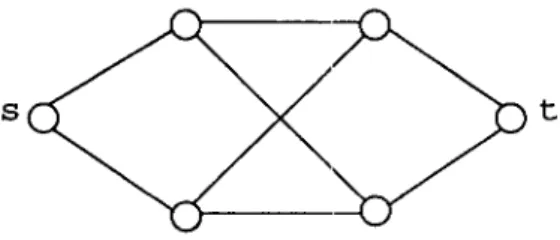
of G satisfies l3(G - U, 7rm(G-U,n) = rp for any US;;; E. 0Note tha.t there may not necessarily exist an exact s-t path number function in any graph. For example, the graph G illustra.ted in Fig.l has no exact s-t path number function
J,
asl3(G,7r)
=I
rp for any 8-t path 7r.5. Computation of the Lower Bound
By (3), we can obta.in an algorithm of computing w(G,J,p) for a probabilistic graph (G,p)
Expected Maximum Vertex- Disjoint sot Paths 103
s
tFigure 1: A two-terminal graph G no having exact s - t path number function.
O(2IEI), i.e., exponential with respect to
IEI,
whereIEI
is a number of all edges in G. Thus we give another algorithm of computing \If (G,J,p) for a probabilistic graph (G, p) and an 8-tpath number function
f
of G. We first wish to recall the procedure FVDP. 5.1 An Algorithm of Computing \If(G,J,p)For a probabilistic graph (G = (V, E, s, t), p) and an s-t path number function
f
of G, let Uf,7r; denote the set of all U ~ E for which 8-t path7ri
is in the set of vertex-disjoint8-t paths FV DP(G - U, f), namely, Uf ,7r; = {U ~ E
l7ri
E FV DP(G - U,fn.
Let p(Eu) be the probability of the event Eu that all edges of U(~ E) are failed and all edges ofE - U( ~ E) are operative, namely, p( Eu) = p( G - U). Let p( Ef,7rJ be the probability of
the event Ef ,7r; that at least one event Eu, for all U E Uf ,7r;, arises. Thus, we have
(5) \If (G,J,p) =
L
IFV DP(G - U, f)lp(G - U) Ur;,E IP .. (G)! =L L
p(G - U) i=1 UEU,.,,; IP .. (G)! =L L
p(Eu) i=1 UEU,.,,; IP,t(G)! =L
p(Ej,7rJ. i=1Clearly, we can compute the lower bound by formula (5) instead of formula (3). From the viewpoint of computational complexity, formula (5) is essentially different from formula (3), as the time complexity of computing \If (G,J,p) for any class of probabilistic graphs (G =
(V, E, s, t), p) is at least O(2IEI) by formula (3) and it is not necessarily exponential time by formula (.5). In fact, for probabilistic one-layered s-t graphs shown in the next subsection, this complexity is polynomial time.
In order to find the event
E
f,7r;' we need more notations. For a graph G = (V, E, 8, t)and an 8-t path number function f of G, let Qj,7r;
= { 7rj
E p.t(G)I
Vr(7ri)n
Vr(7rj) -::Jcp
and f(7rj)=
j<
f(7r;)=
i}. The following Lemma 5 obviously holds by the definitions. Lemma 5. For a graph G = (V, E, s, t) and an s-t path number functionf
of G,U _ { { U ~ E
I
E(7ri) ~ E - U } if Qf,7r; =cp,
j.7r; - {U ~ E
I
E(7ri) ~ E - U and U ~ Uf,7rj for all7rj
E Qf,7r;} if Qf,7r; -::Jcp,
104 P. Cheng & S. Masuyama
For some events
t\,
f2' ... , fm' we denote by f1
f 2··· fm' or, for short,0;:1
fi the event that all events f 1, f 2, ... , fm simultaneously arise, and by fl+
f2+ ... +
fm' or, for short,L:;:1
fi the event that at least one event among f1 , f 2, ... , fm arises. The evento
called whole event satisfies p(O) = 1, and the event0
called empty event satisfies p(0) = O. Let£
denote the complementary event of f. Clearly, the following formulas hold for any two events fi' fj •(6) (7)
f;£:£;
f;0,
f;E;fj = fi .
For a probabilistic graph (G = (V,E,s,t),p), we denote by e the event that edge
e E E is operative (not failed). Then
e
is the event that edge e E E is failed. Namely, p(e)=
p(e) and p(e)=
q(e)(= 1 - p(e)). Thus the event fu for any U ~ E is described as follows:(8) fu =
IT
e
IT
e.eEU eEE-U
For any E' ~ E, we can easily prove the following formula:
(9)
L
fu =U~E'
L
(IT
e
IT
e)
= O.U~E' eEU eEE'-U
For a probabilistic graph (G = (V, E,s, t),p) and an s-t path number function
J,
whenQ f,1r, =
cP,
we have(10) ff,1r, -'
L
fu (by Lemma.5Ur;,E and E(1r;)~E-U
- ( IT
e)
( by (8) )eEE(1r;) u'r;,E-E(1r;l
IT
e ( by (9) ).eEE(1r;)
Note that p(ff,1r,)(= OeEE(1r,)p(e)) is efficiently computed. However, when Qf,1r,
i=
cP,
wehave
(11) ff,1r,
=
L
fu UEUI.",=
L
fu (by Lemma 5 )U~E and E(1r;)~E-U and UflUI,"j for all1rjEQI.".
= (
L
fu) (L
fu)U~E and E(1r;)~E-U Ur;,E and UflU,.,,; for all 1rjEQI.",
= [(
IT
e)
L
f u '](IT
L
fu) (by(8)) eEE(1r;) U'~E-E(1I';) 1I'jEQ I.". UflU",,; and Ur;,E=
IT
eIT
£f,1I'; (by (9) and the definition of ff,1I" ). eEE(1I';) 1rjEQ t,".By (5), (10) and (11), we thus obtain an algorithm of computing W(G,!,p) for a proba-bilistic graph (G = (V, E,s, t),p) and a given s-t path number function
J
of G.Expected Ma;r;imum VerlexDisjoint s-t Paths 105
Note that, in general, the time complexity of the algorithm is not polynomial for a probabilistic graph (G,p) and a given s-t path number function
f
of G, as the events £j,1'jfor all 11"j E Qj,1'i are not necessarily independent of each other, i.e., the probability P(£j,7ri)
where Qj,7ri
1=
<p does not seem to be efficiently computed in general, and in addition tothis, !P.t( G)
I
is not polynomial in the size of a general graph G.However, in the next subsection, we give a dass of probabilistic graphs for which the lower bound is efficiently computed by the algorithm.
5.2 An Example of a Probabilistic Graph where W(G,J,p) IS Polynomially
Com-putable
Definition 2. A graph G = (V, E, s, i) is called one-layered s-t graph if G - {s, t} exactly consists of a simple path, i.e., V
=
{s, Vl, ... , Vn , i} and E=
C(= {c;=
(Vi, v,+dI
i
=
1, ... ,n -1 }) U A(= {ai = (S,1'i)I
for some i, 1 ~ i ~ n }) U B(= {bi = (vi,i)I
for some i, 1 ~ i~ n }). 0
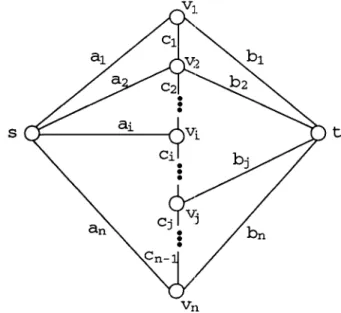
The graph illustrated in Fig.2 is an example of a one-layered s-t graph. We shall show that, for a probabilistic one-layered s-t graph, the expected maximum number of vertex-disjoint s-t paths is efficiently obtained by computing the lower bound.
s
t
Vu
Figure 2: An example of a one-layered s - i graph.
5.2.1 Some Properties of a One-layered s-/ Graph
In a one-layered s-t graph G = (V
=
{s, VI, ... , Vn , I}, E, s, i), we have(12)
for any s-t path 11" E p.t(G), where 1 ~ i,j ~ n, and an s-t path 11" E P.t(G) is denoted
106 P. Cheng & S. Masuyama
Lemma 6. For a one-layered s-t graph G = (V = {s,vl, ... ,vn,t},E,s,t), \Pst(G) \ ~ n 2.
o
Lemma 7. In a one-layered s-t graph G
=
(V, E, s, t), for any two vertex-disjoint s-t paths 7rjlj', 7rjlljll E Pst(G), either max{i',j'}<
min{i",j"} or min{i',j'}>
max{i",j"}. 0Definition 3. In a one-layered s-t graph G
=
(V, E, s, t), for two s-t paths 7rjj, 7rjlj' E Pst(G), 7rjj IS above 7rjljl (or 7rj'jl is below 7rjj) if one of the following conditions holds:(i) min{i,j}
<
min{i',j'}.(ii) min{i,j} = i = j' = min{i',j'}.
(iii) min{i,j} = i = i' = min{i',j'} (iv) min{i,j} = j = j' = min{i',j'} Namely, if all s-t paths in G are arranged as follows:
I
7rll , 7r12, 7r13, 7r22, 7r23, ... ... , , 7rln-il 7rln, 7r2n-il 7r2n, 7r21, 7r31, 7r32, ... , (13) ... , 7rn- ln-l, 7rn- ln, 7rnn -l, 7r nn, and j ~ j'. and i ~ i'. ... , 7rn- l l , 7r ni, 7r n-12, 7rn2,o
then, for two s-t paths 7rjj, 7rjljl in the same row (namely, either (iii) or (iv) in Definition
3), 7rjj is above 7rjljl if 7rjj is to the left of 7rjljl, and for two s-t paths 7rjj, 7rjljl in two different rows (namely, either (i) or (ii) in Definition 3) 7rjj is above 7rj'j' if the row of 7rjj is above the row of 7rjljl.
Lemma 8. In a one-layered s-t graph G = (V, E, s, t), for an s-t path 7rjj E Pst(C), snppose that B(C,7rjj) -.:/=
cp.
Let 7rjljl, 7rjlljll be two vertex-disjoint s-t paths of C' EB( C, 7rjj). Then, 7rjljl (or njlljll) is above 7rjj, and 7rjll j" (or 7rjlj') is below 7rjj.
Proof. For two vertex-disjoint s-t paths 7rjljl, 7rjlljll of C' E B(C,7rjj), without loss of generality, assume that max{i',j'}
<
min{i",j"} by Lemma 7. By C' E B(C,7rjj), for the s-t path 7rjj, we have ai = ai' and bj = bjll (or aj = ai" and bj = bjl, respectively).Otherwise, C' is not aminimal7r-cut s-t2-connected subgraph. As j = j" ~ min{i",j"}
>
max{i',j'} ~ i' = i and i' = i ~ min{i',j'}, namely, min{i,j} = i ~ min{i',j'}, and as j = j" ~ min{i",j"}
>
max{i',j'} ~ j' namely, j ~ j', 7ri'j' is above 7rjj by conditions (i) and (iii) in Definition 3. Furthermore, as min{i,j} = i = i' ~ max{i',j'}<
min{i",j"}, namely, min{i,j}<
min{i",j"}, 7ri"jl is below 7rij by condition (i) in Definition 3. 0 Lemma 9. For a onc-layered s-t graph C=
(V, E, s, t), if the s-t path number function 1" of C satisfies the following Condition 1, then for any U ~ E, 1" satisfies B( C-U,7rm(G-u,r)) =
cp.
Condition 1: For any two s-t paths 7r,7r' E Pst(C), 1"(7r)
<
1"(7r') if, and only if, 7r is above 7r'.Proof. Let 1" be an s-t path number function of C satisfying Condition 1, and let
7rm(G-U,r) : ai, ... , bj be the s-t path with the minimum number in C - U with respect to 1". Suppose that 1" satisfies B(C - U, 7rm(G-U,r)) -.:/=
cp
for some U ~ E. By Lemma S, there exist two vertex-disjoint s-t paths 7r', 7r" in the subgraph C' E B(C - U,7rm(G-U,r)) snch that 7r' (or 7r") is above 7rm(G_u,jO). By Condition 1, 1"(7r')<
1"(7rm(G-u,j0))' which,however, is a contradiction. 0
By the above Lemma 9 and Theorem 2, the following Theorem 3 is immediately obtained. Theorem 3. In a probabilistic one-layered s-t graph (C
=
(V, E, s, t), p), for the s-t path Jlllmber functionf*
of C satisfying Condition 1, \}i (G,r ,pI = \}i (G,p)' 0Expected Maximum Vertex-Disjoint sot Patizs
5.2.2 Computation of IJi(G,Jo,p)
For a probabilistic one-layered s-f graph (G = (11, E, s, t),p), where
(14)
V
E
{s,Vj, ... ,Vn,t },
C( = {Ci = (Vi, Vi+d
I
i = 1, ... , n - I})U A(= {ai = (s,v;)
lIar
all i, 1:::; i:::; n})U B(= {bi = (Vi,t)
I
for all i, 1:::;i:::;
n}),107
let
!*
be the s-t path number function satisfying Condition 1. Furthermore, for short, let£jj denote the event £/o,1rij that at least one everlt £u arises, where U is in Ur,1rij with
respect to
!*
of G. We use Qr,1rij to denote the set of all s-t paths 1rj'i"S satis(yingV(1rjj)
n
V(1rj'i') =/:-ifJ and !*(1rj'i')<
!*(1rji).By Condition 1 and the definitions, we have {*(1rll) = 1. Clearly,
Qr,
1r11 = ifJ. Thus,by (10),(12), we have
(15) £11
=
IT
e=
alb
j •eEE(1rIl )
Lemma 10. For a. probabilistic one-layered s-t graph (G = (V, E, s, t), p), where V, E satisfy (14), let
!*
be an s-f path number function of G satisfying Condition 1.(16) <:'. -
(ni-I )
b·(n
i -j -b)f
?< . <
"I) -al
11'=1 C11' ] 11'=' w, or - _ J _ n, and (1 i)Proof. We prove (16) by induction with respect to j.
When j = 2, Q
r
,1r12 = {1r1l} holds by (13) and the definitions. Thus,IT
eIT
"fxy (by (11) )eEE(r.12) 1rxyEQ,o"r12
a,c,b
2b,
(by (15),(6))is obtained and (16) holds. Suppose that for j
<
k,(18)
and we consider the case of j = k. By (13) and the definitions,
(19) Thus, we have
n
eIT
"fry ( by (11) )al
(rt;~\cw)bk(a,bl)(nj:fS,j)
(by (12),(15),(19) ) al(n~:;~\
c
w)bk·bl
[n;:~
al
(n~,~\
cw )bj
(nL-:\
bw )] (by (6 ),(18) )al
(n;;;~\cw)bk.b,
[m':~ bj(n~-:\ bw )] ( by (6) ).108 P. Cheng & S. Masuyama
By the following formula
we have
bdnJ:~b)(n~~\bw)]
= blb2bl···bk_lblb2· .. bk_2n~-:,II
b
w , ( by (6) )£Ik
=
al(n~-:,II Cw)bk(n~11
b
w )for j = k. Namely, (16) holds by induction.
Similarly, we can prove (1 i) by the method similar to the proof of (16).
Furthermore, we define £* ij to be the event satisfying
(20)
Clearly, £*11 IS
n,
and by Lemma 10, we have(21)
(22)
£*lj
=
al(nL:\
Cw )(nL:\
b
w ), for 2~
j~
n,£*il
(n:;~l
C w )b l(n~-~I
a
w ) , for 2~
i~
n.o
Lemma 11. For a probabilistic one-layered s-t graph (G = (V, E, s, t),p), where V, E satisfy (14), let
r
be an .'I-f path number function of G satisfying Condition 1. For any i, j, where 2 ~ i,j ~ n, we haveif if if and
(24)
The proof of this lemma is lengthy and is shown in appendix.
i
<
j, i>
j, z=] i<
j, i>
j,o
Lemma 12. The event £*;'j', where 1 ~ i',j' ~ n, is independent of each of events ai, Ciand bi, respectively, for all n ~ i ~ max{i',j'}.
Proof. We prove that the event £";'j' is independent of each of events ai, Ci and bi,
respectively, for all n ~ i ~ max{i',j'}, by induction with respect to i'
+
j'.\Vhen i'
+
j' = 2, since i', j' ~ 1, we have i' = j' = 1. As £*11 =n,
therefore, £*11is independent of each of events ai, Ci and b i for all n ~ i ~ max{i',j'} = l.
Assume that £* i'j' is independent of ea.ch of events ai, Ci and bi for all n ~ i ~ max{i',j'} for i'
+
j'<
k, and we consider the case of i'+
j' = k. Assume that i'>
j'. By (24),E,pected Maximum Vertex-Disjoint s-t Paths 109
As j' - 1 ~ hand i'
>
j', we have j'+
h<
i'+
j' = k. By the assumption, each of events ai, Ci and bi for i ~ max{i',j'} is independent of nt:;(£*hjl £*j'h) , and ofCi'-l ... Cjl+l bj,ai' ... ai'-I' Hence, £*;Ij' is independent of each of events ai, Ci and bi for all n ~ i ~ max{i',j'}. Similarly, assuming i'
<
j' or if = j', we can also prove thisresult by the same method. 0
Lemma 13. For any i,j',j", where 1 ~ i,j',j" ~ n, i
>
j',j" and j'i=
j", we have the following facts.Proof. Without loss of generality, assume that j'
>
j". As i>
j'>
j", by (24),(by(24))
£*ij'£* ij" = ai (n::;i' cw) bd n{'':-11 t'* hpt'* j'h
1
(n::;i' aw ) Ci-l ... Cj'-lt'* i'i"ai' ... ai·_1=
0.
By a similar method, we can a.lso prove that t'* J'it'* i"i =
0.
Furthermore, by (24), we have that for j'
>
j", b j" appears as a term in t'*ii" andhi"
appears as a term in t'* j'i, and that for j'<
j", ai' appears as a term in t'* i'i and ai' appears as a term in t'*V" Thus, we can show that £*i,;t'*;i"= 0.
0By Lemmas 10,11,12,13 and the definition of a probabilistic graph, the probability
PI
t'ii)is computed as follows: (25) p( t'ij) q(adq(bd i-I i-I q(ad(IT q(cw))q(bj)(IT p(bw)) w==l w==l i-I i-I
q(Oi)(IT q(Cw))q(bd(IT p(aw ))
tu=1 tu=1
j-l i-I j-l
q(Oi)(IT q(cw))q(bj)[l - E(P(£*hi)
+
P(t'*ih))](IT
p(bw))w=i h=l tu=i
i-I j - I i - I
q(ai)(IT q(cw))q(bj)[l - E(P(t'*hi)
+
P(t'*ih))](IT
p(aw))w==j h=l w=i
i-I
q(ai)q(bi)[l - E(P(t'*hi)
+
P(t'*ih))] h=l if i = j = 1, if n ~ j ~ 2, if n ~ i ~ 2, if 2 ~ i<
j ~ n, if n ~ i>
j 2: 2, if n ~ i = j 2: 2.By (25) and (.5), W(G,!>,p) is obtained by computing p(t'ij) from P(t'll) to p(t'nn) for a probabilistic one-layered s-f graph (G,p) and the s-t path number function
r
of Gsatisfying Condition 1.
5.2.3 Complexity of Computing w(G,!>,p)
For a probabilistic onc-layered s-t graph (G, p). we analyze the time complexity of com-puting W (G,!> ,p)'
110 P. Cheng & S. Masuyama
By Definition 2, whether a graph G = (V, E, s, t) is a one-la.yered s-t graph or not can be decided in O(lVI) time. Moreover, note that by (20), p(£*;j) is obtained in a constant time by the known p( £ij). Therefore, by (25), p( £ij) is computed in O( n) time. As lP.t(G)
I :::;
n2by Lemma 6, W(G,r,p) is computed in O(n3) time by (.5).
Note that for a probabilistic one-la.yered s-t graph (G = (V,E,s,t),p), where 0:::; p(e) :::; 1, e E E, all of the above results also hold. The fact that p(e) = 1, e E E signifies that E does not contain the edge e. i.e., that G satisfies (14) imposes no restriction for computing ~G,r,p) in a probabilistic one-layered s-t graph (G,p). Thus, we immediately obtain the following Theorem 4.
Theorem 4. For a probabilistic one-layered s-t graph (G = (V,E,s,t),p), W(G,p)(=
~G,j.,p)) is computed in
O(1V1
3) time. 06. Concluding Remarks
For a probabilistic graph, we proposed a lower bound for estimating the expected maximum number of vertex-disjoint s-t paths. Although this lower bound does not seem to be effi-ciently computed for a general probabilistic graph, we can effieffi-ciently obtain the expected maximum number of vertex-disjoint s-t paths for a probabilistic one-layered s-t graph using this lower bound, as the lower bound is efficiently computed and is equal to the expected maximum number in this case.
Note that all of the above proof." are irrelevant to the direction of edges in a graph. Hence, all of the above obtained results are also valid for a probabilistic directed graph. Acknowledgments
The authors are grateful to the anonymous referees whose comments are greatly beneficial to improve this paper.
References
[1) Ball M. 0.: "Computationa.l complexity of network reliability analysis: An overview",
IEEE Trans. Reliability, Vol.R-35 (1986), pp.230-239.
(2) Carey M. and Hendrickson C.:" Bounds on expected performa.nce of networks with links subject to failure", Networks, Vol. 14 (1984), pp.349-456.
[3] Cheng P. and Masuyama S.:" Problem of computing the expected maximum number of vertex disjoint s-t paths on probabilistic graphs", Research Report COMP92-1 (1992), Inst. Electron. Infor. Comm. Eng. Japan, pp.I-8( in Japanese).
[4) Cheng P. and Masuyama S.:" Computing the expected maximum number of vertex-disjoint s-t paths in a probabilistic basically series-parallel graphs", IEICE Tmns. on Fundamentals, Vol. E76-A (1993), No. 12, pp.2089-2094.
[5) Colbourn C. J.: The Combinatorics of Network REliability, Oxford University Press (1987).
[6J Even S.: Graph Algorithms, Computer Science Press(1979).
[7J Nagamochi H. and Ibaraki T.:" Maximum flows in probabilistic networks ", Net wo l'ks,
Vol. 21 (1991), pp.645-666. Appendix: Proof of Lemma 11
We prove this lemma by induction with respect to s-t path number J*(-lr;j), where 2 :::; i,j :::; n.
When J*(-lrij)
=
2n, namely, i=
2 and j=
2, by (13) and the definitions, (26) CJr,1r22=
{7r12, ••. ,7rln,7r21, ... ,7rnl}'Expected Maximum Vertex Disjoint s·t Paths 111 Thus, we have
f22
=
IT
eIT
fxy (by (11) )a2b2(nj=2~tj)(m'=2~it)
(by (12),(26))=
aZb2[nj=z
Rt(nL:\ Cw )bj(nL:\
bw )] [m'=2-ai-'-(n-:-;;-~-l c-W----)b-I--,-(n-~--~-l
a-
w""""") , ] (by (16),(17) ) =azb
z [ atn~=lt
C w bzn~=tl
b
w ] [ azn~-:.,\
Cw b ln~=\
aw ] (by (7) ) a2hz£*tZ£*21' (
by (21),(22) ) and (23),(24) hold. Assume that and {ai(n~:\cw)[n~-:"\f*hi
f*;hj(nL:\bw) if i<j,
£ * j j =(n:;;-~j..:.v)bj[n{~~f*h.if*jh (n~-~jaw) ~f ~>~,
[n~-:.,\
f*hi f*ih]
xf z
= J (28)for f*(7T'ij) < k, and we consider the case of f*(-Trij)
=
k. Assume that i < j. By (13) and the definitions,(29) Qr,1riJ = {7T'ti' 7T'li+I" .. ,7T'ln, 7T'Zi, 7T'Zi+I,···,7T'2n, ... , 7T'i-li, 7T'i-li+l, .. " 7T'i-In'
7T'ii, 7T'ii+l, ... , 7T'ij-l,
7T'il, 7T'i+lI, ... , 7T'nl, 7T'i2, 7T'i+12,·· ,7T'n2, ... , 7T'ii-l, 7T'i+li-l, ... , 7T'ni-l }.
Thus, we have
(30) fij
=
IT
eIT
fxy (by (11) )Foranyh,g,where 1:::::h:::::i-1 and j+1:::::g:::::n,since i<j,wehave h:::::j:::::g-!.
Thus, (31)
Since 7T'hg <;;: Qr,1riJ' by this assumption, we have
(32) hj
ah(n~u~lhCw)hg[n~;:'\f'hhlf*hhl] (n~~lhbtu)
(by (27))hj ( by (31),(7) ).
112 P. Cheng & S. Masuyama Note that by iteratively applying
£i£j
+
£i£j
=£j,
(34)
n
=bi + bi
+1b
i + ... + b
j - 1b
ib
iH ···
b
j -2+
b
i
b
i+1 ••• bj-2 bj - 1b
i+
L~:~+l [bg (n~~~ bw)]
+
n~~\ bw.
For 1 ~ h :::; i-I, we have
(n~~i
cw ) bj[n~=i
£hg]
--~~~~~~---~.r--~~.
=
(n~~icw)bj[n~=iah(n~~lhCw)bg[n~~\£·hh'£·h'h (n~~lhbw)]
(by (2i))=
(n~~icw)bj
£'{bi +
L~:~+l [bg(n~-==lh bw)]+(n~:li
btu)}
(by (6) )=
(n~~;cw)bj
£'.
(by (34) )Here,
co'
(ni-I)
[n
h- 1"'*
co. ](ni-
1-b )
" =
ah
w=h Cw
h'=1
C- -hh'c, h'h
w=h w .
Furthermore, by the above formulas, we have
(35)(n~:liCW)bj[n~=ilhg]
=(nL:liCtu)bjah(n:;~hCW) n~;:;\£*hh,Fh'h (n~-~hbw)
= (n~~icw)bj£*hj (by(28)). Moreover, by (33),(35),
(36)
For any h, g, where i
+
1 ~ 9 :::; nand 1 ~ h :::; i - I , we have(3i)
n
g -w=h
1 -a
- --w =
ah'"
a; ...ag-l .
Thus, since
'Trgh
E Qr,1r;j' we have(38)
aj[n;=iH
£*gh)
--~----~~~---~~----~.
=
aj [n;=i+l
ag(n~-==lh
cw ) bh[n~~\
£*
hh,F h' h](n~-==lh
a
w )] (by (2i) )=
a; ( by (3i),(i) ) . Moreover, by (36),(38),(39)
By the following formula
(40)
we have (41 )
Expected Maximum Vertex-Disjoint sot Paths
(ni-1 ) [n
i- 1
'"* '"*] [ni-I
er ]ai
w=i Cw h=1e
hie
ih w=ieiw
=
ai(nL~li
Cw)[n~~;
&*hi &*ih]aibi
[n~~11
£*hi £*;h][n~~i+1ai(n:;:;iCW,)bw[nt,\t'*hi
£*ih](n:;:;ibw')] (by (27))=
a;(nL~liCw) [n~~11
£*hi£*ih]bi[O;~~li+1 bw(O:~\
b w')] (by (6) )=
ai
(nL~li
Cw )[0~~11
£*
hi£*
ih](OL~li
b
w ) . ( by (40) )113
Moreover, by (39),(41), we have
co
(Oi-1 )b [Oi-1L '"* '"* ]
(Oi-
1-b )
"ij
=
ai
w=i Cw
i h=1e hie
ih w=i wand
co*
(Oi-1 ) [Oi-I '"* '"* ] (Oi-1 -b )
e
ij =ai
w=i Cw h=1e hie
ih w=i w .Namely, (23),(24) hold for J*(rrii) = k where i
<
j.Similarly, by assuming that i
>
j or i = j, we can prove (23),(24) for J*(rrii) = k bythe same method. Thus we have proved Lemma 11 by induction. 0
Peng CIIENG and Shigeru MASUYAMA The Department of Knowledge-Based Information Engineering, Toyohashi University of Technology, Toyohashi-shi, 411 Japan