鳴門教育大学学校教育研究紀要
第29号
Bulletin of Center for Collaboration in Community
Naruto University of Education
No.29, Feb., 2015
Student Teachers as Co-developers in Foreign Language Class
− A Case Study of Research-based Teacher Education in Finland −
鳴門教育大学学校教育研究紀要 29,9−20
原 著 論 文
Student Teachers as Co-developers in Foreign Language Class
− A Case Study of Research-based Teacher Education in Finland −
Riitta JAATINEN
School of Education 33014 Tampere University Finland
Abstract:This article is based on a research and development project concerning foreign language teacher
education in the University of Tampere, Finland. In the first part, I give a brief account of what research-based teacher education is in the Finnish context and why we have adopted research orientation in teacher education. I also present the theoretical underpinnings behind our approach in the project and give reasons for the importance of personal research projects in learning to be a teacher. In the second part, I concentrate on presenting the context, structure and content of the process where student teachers are guided and supported toward autonomy through personal research projects. Finally, I present an analysis of development themes found in student teachers' project plans and posters in order to show which aspects of language teaching the soon qualified language teachers see as significant to develop and to disclose their critique of the prevailing situation. In the article, the nature and purpose of doing research in the classroom is advocated, although the approach is sometimes questioned and criticized.
Keywords:Research-based teacher education, foreign language teacher education, teacher development,
teacher autonomy.
Ⅰ.Introduction
This article depicts a research and development project of pre-service teacher education in Tampere University, Finland, during the 2012-2013 academic year. The project focused on foreign language teacher education was carried out in the School of Education in Tampere University. The goals of the project were to experience the development of the research-based approach central in teacher education and develop language education in the comprehensive and upper secondary school context using the concept of (student) teacher autonomy as a signpost. As advocates of a younger generation, what would student teachers consider important in developing foreign language lessons? In addition, on the level of the individual, the purpose was to support the development of each student teacher’s professional identity. The project’s development team consisted of nineteen student teachers, eight supervising teachers and their language classes and the author of this article, i.e. university researcher/lecturer in language education. Our development project can be characterised as a small case study. The
objective in the study was to develop as complete an understanding of the phenomenon as possible; no attempt was made to generalize beyond the single case. (Silverman, 2005, pp. 126-127). The project also had some elements of action research in it. Both the supervising teachers and the student teachers acted to improve their practices. The student teachers carried out teaching experiments in classrooms and reported on their progress. They collaborated with each other, supervising teachers and school students, and reflected on their work critically. They shared and interpreted what they were learning in supervisory groups of the teacher education school and both in seminar and in individual encounters with the university researcher. (Cohen et al., 1994, p. 188.) At the end of the spring semester, the student teachers shared publicly what they had learned: they gave public presentations on their projects, discussed, reasoned and learned from each other's projects in the exhibition arranged by the university teacher education school. They also wrote their seminar papers based on the data collected from their teaching experiments.
teachers' research plans and posters, the university lecturer's and the supervising teachers' observations of the student teachers' research projects and regular reflective discussions in supervisory groups and in seminars. The themes presenting the needs to develop teaching in foreign language classes were drawn from student teachers' research plans and posters. This was done using thematic analysis by familiarizing oneself with the data, interpreting it, searching for the themes, defining and naming the themes and, finally, producing a report. (See Braun and Clarke, 2006.)
In the following sections, I will first give a brief account on the research-based teacher education in the Finnish context and present a few arguments for its necessity in Finland today. Then, I will discuss the theoretical underpinnings of our project and after that describe the project, i.e. the structure and content of the process where student teachers of languages were guided and supported toward autonomous professionals through personal research projects. Finally, I will present an analysis of development themes found in the project plans and posters, and propose a few thoughts of how we are going to continue our development work in the foreign language teacher education of Tampere University.
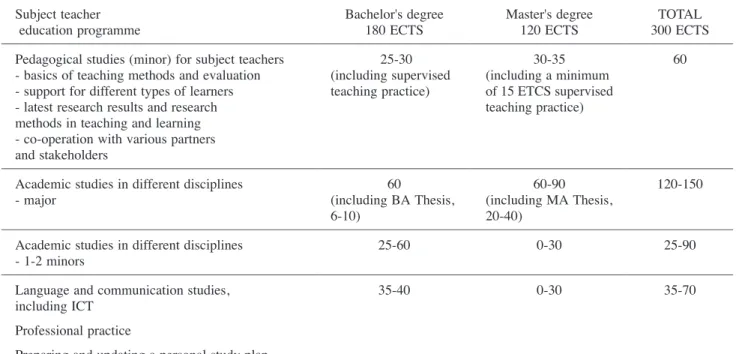
The origin of research orientation in Finnish teacher education can be traced back to the beginning of the 1970s when the responsibility for providing education to prospective teachers was transferred to universities. Teaching at that time was publicly acknowledged as an academic profession with a research knowledge base. The reform processes in Finnish teacher education have been slow (Hanse´ n and Forsman, 2009). In 2005, Finnish universities adopted a two-tier system from the Bologna Process with the combination of a three-year bachelor's degree and two-year master's degree. Today, the basic qualification of a subject teacher in Finland is the master's degree that includes 60 ECTS of pedagogical studies (1 ECTS equals 27 hours of student work.). The pedagogical studies are usually part of both bachelor and master studies as Table 1 by Niemi and Jakku-Sihvonen (2006, p. 39) shows1
.
Subject-specific teacher education is guided by a notion of the teacher as an expert in both educational science and his/her particular field of teaching. The studies provide broad competence for working as a subject teacher at various levels of the educational system. They comprise basic studies in educational science, studies in subject-specific didactics as well as supervised teaching practice usually in a teacher training school. The basic studies in educational science are mainly included in the bachelor’s degree while the studies in
TOTAL 300 ECTS Master's degree 120 ECTS Bachelor's degree 180 ECTS Subject teacher education programme 60 30-35 (including a minimum of 15 ETCS supervised teaching practice) 25-30 (including supervised teaching practice) Pedagogical studies (minor) for subject teachers
- basics of teaching methods and evaluation - support for different types of learners - latest research results and research methods in teaching and learning - co-operation with various partners and stakeholders 120-150 60-90 (including MA Thesis, 20-40) 60 (including BA Thesis, 6-10)
Academic studies in different disciplines - major
25-90 0-30
25-60 Academic studies in different disciplines
- 1-2 minors
35-70 0-30
35-40 Language and communication studies,
including ICT Professional practice
Preparing and updating a personal study plan Optional studies
Table 1. Main components of the teacher education programs for subject teachers2
Ⅱ.Research-based teacher education in Finland - why research orientation is a necessity today
subject-specific didactics, supervised teaching practice, and the personal didactic research projects discussed in this article, form part of the master’s degree. (Niemi and Jakku-Sihvonen 2006, p. 39; see also Kansanen, 2008; Sahlberg, 2011.)
The research-orientation in Finnish teacher education has been advocated using several grounds and reasons. Teachers have to possess the most recent knowledge of the subject(s) they teach and internalize their pedagogical action that is founded on both experiential and theoretical knowledge. Based on a thorough understanding of human growth and development, different cultures and values, they have to be able to transform the subject and their pedagogy in relevant ways to benefit different learners and students from various cultural backgrounds. (This has been a dominant issue especially recently, since Finnish schools are being developed into more inclusive institutions.) Teachers need to have knowledge and skills in designing learning environments, using and developing methods and strategies of teaching and evaluating their students, and developing the school and themselves as professionals. Furthermore, teachers have to be familiar with the curricula and educational institutions as well as non-formal educational settings in society. In addition, Finnish teachers have a wide professional autonomy, which means that teaching often involves making ethical choices and taking individual responsibility. (Darling-Hammond, 2010, pp. 170-173; Niemi and Jakku-Sihvonen, 2006, pp. 41-42; Westbury et.al, 2005, pp. 475-485.) Acting autonomously entails collaboration with students, colleagues and multi-professional networks in school and society, both of which are in a constant change. All these qualifications make the profession very challenging and its research-orientation a necessity.
In this section, I discuss a few theoretical underpinnings that, in my opinion, presuppose the research-based approach focusing on foreign language teacher education. Our project team consisted of student teachers of English and French, foreign language teachers, their students and myself, i.e. the university lecturer. Our research and development work was guided by the concepts of language education,
socio-constructionism, sociocultural theory, narrative approach
and teacher/learner autonomy. In Finland, ' language
education’ is the established term for modern teaching of languages, setting the goals for language teaching. It covers
the field of issues a learner faces when getting familiar with different languages. Hence, it is associated with the development of the learner’s language identity and/or plurilingualism. Essentially consisting of the attribution of meanings to the world and its phenomena, language is seen as an inseparable part of an individual’s existence in the world. When referring to language, culture and identity, it is always important to realise the relations between and interdependence of these concepts. In foreign language teacher education, student teachers are called on to join in inquiries into issues related to teaching and learning languages and linguistic cultures along with more extensive issues concerning multicultural and/or intercultural education and learning as regards both individuals and communities. (Jaatinen, 2007, 2013; Kohonen et al., 2001; Kaikkonen, 2004; Kaikkonen and Kohonen, 2012; Kohonen, 2005 and 2009; see also CEFR.)
‘Socio-constructionism’ explores the ways in which phenomena are socially constructed. According to the theory, the world cannot be known on its own terms, but only through the conceptual and linguistic structures of one's own culture. Culture is mediated to us by significant others. Learning is then social and the language with its concepts important, because it opens the world to us and we creatively shape our reality through social interaction and language. Consequently, learning takes place through social interaction and cooperation with the others. (Berger and Luckman, 1966, p. 151.) Socio-constructionism helps us comprehend and
conceptualize how learning to be a teacher takes place. All
learning (also to become a teacher) is exploring, creating and restructuring conceptual and linguistic structures to change oneself, culture and society in a constant process with others. Such exploratory learning shares the goal of the research process based on 'sociocultural theory', the purpose of which according to Wertsch (1995, p. 56), is “to understand the relationship between human mental functioning, on the other hand, and cultural, historical, and institutional setting, on the other”. (See also Lantolf and Thorne, 2006.)
‘The narrative approach’ is closely associated with the ideas of socio-constructivism. One of its basic arguments is that people constitute their identities through telling or writing narratives/stories of themselves, their environments, their lives. Through narratives people explore, create and
re-create selfhoods, their identities. (Bruner, 2002, p. 85; see
also Ropo and Huttunen 2013.) Developing one' s teacher
identity takes place through a similar research process.
Ⅲ.Theoretical considerations underlying research orientation in foreign language teacher education
Making and responding to interviews, writing field notes or journals, telling stories of one's experiences and interpreting them are typical methods of the narrative approach as well as methods of research-based teacher education. Stories told or written by different people in a community are not separate. They interact and mix - they are interdiscursive and overlapping. (Cotterill and Letherby, 1993, p. 77; see also Ropo, 2009, pp. 142-143.) According to this approach, each research process in teacher education becomes collaborative, a mutually constructed story of the development of a researcher/student teacher, her or his peers, supervisors and significant others.
David Little (1991; 2004) discusses 'learner autonomy' and states that learners should develop in themselves “capacity - for detachment, critical reflection, decision-making and independent action” (1991, p. 4). Jime´ nez, Lamb and Vieira (2008, p. 1) define autonomy as “competence to develop as a self-determined, socially responsible and critically aware participant in (and beyond) educational environments, within a vision of education as (inter)personal empowerment and social transformation”. The same demands and definitions
apply to pupils/students, student teachers and teacher educators equally. According to Kohonen (2007) learning to
be a teacher is based on the student teacher’s commitment and active knowledge construction process with others in various environments. It is cooperative and collaborative and thus best taking place through dialogue and reflective practices. The cognitive-emotional processes, such as thinking, memorizing, and managing emotions are important organizers of all of the tasks that we perform. They enable conscious planning, goal setting, sustaining future-oriented problem solving activities, following, assessing and managing progress on learning, i.e. the skills that help student teachers toward autonomy and self-direction in studies, work and life. (Kaikkonen and Kohonen, 2012; Kohonen, 2007.)
Reflection plays a significant role in the process described above. It enables understanding through the transformation of experience by constructing a bridge between practical experiences and theoretical knowledge in learning situations. It enables us to see ourselves anew. (See van Manen, 1995.) Student teachers must learn to pose relevant questions and goals, act to reach the goals, reflect on themselves and their daily actions at school and develop their work based on that. To succeed in this process of teacher education, student teachers need skills in storing or recording what they have faced, acted, experienced and understood, as well as skills in
dealing with the material and drawing conclusions. They have to act and experiment, observe and record the experienced, reflect and conceptualize it (see Dewey, 1938; Kolb, 1984; Scho¨ n, 1983), and, of course, share the entire process with their peers and teachers. Consequently, the significance of personal research projects in learning to be a teacher lies in the process described. In the following section, I will discuss the structure and content of the process where student teachers of languages are guided and supported toward autonomous professionals through personal research projects.
In the Finnish educational system, teachers have to be capable of autonomous action: they need to be self-determined, critically aware and independent actors in and even beyond educational environments. In the changing circumstances of school and society, therefore, they have to possess capacity for decision-making on their own and with their colleagues. They must have an internalized vision of education as an (inter)personal empowerment and social transformation (see Little, 1991, p. 4 and Jime´ nez, Lamb and Vieira, 2008, p. 1). Our opinion is that without a research-oriented approach it is difficult to succeed or cope in the teaching profession today. Therefore, inquiry is an integral part of the entire education process in the pedagogical studies, whereby the conceptions of the human being, learning and knowledge are critically reviewed and discussed, the concepts of which are also intended to provide student teachers with useful ingredients to construct their own professional growth. We believe that a teacher who is willing and capable to enhance his/her knowledge and professional competence also takes into account the students’ needs as well as the demands that arise from changes in society at large. (Curricula Guides; Sahlberg, 2011, p. 83). Student teachers in foreign language teacher education use personal development portfolios to record, guide, monitor and evaluate their conceptions and growth processes during the pedagogical studies as Figure 1 below shows (Jaatinen, 2013, p. 114; see also Fernsten and Fernsten, 2005).
Ⅳ.The objectives and context of the personal research projects
Since the core prerequisite for implementing research-based education in our framework is the integration of theoretical knowledge with pre-service experiences, we have included a new study unit into our teacher education program. In it, student teachers carry out personal research projects at school, which are combined with a research-oriented dialogue with other participants. In the process, the student teachers are seen as equal developers in teaching and education with their supervising teachers and university lecturer. This requires respect for the uniqueness of every participant and everyone's differing views as well as commitment to research, research-oriented dialogue and collaboration. The purpose is to empower the student teachers to become autonomous actors during their pedagogical studies and develop language education in school in collaboration with us, as well as to learn from each other.
The personal research projects are a part of the study unit called Teacher as a Researcher (5 ECTS) and are part of student teachers' master’s studies (see in Table 1 in this article). The responsibility for implementing the unit lies with both the university lecturers and the supervising teachers at school. The description and competence-based objectives of the unit in the curriculum are as follows:
The study unit emphasizes the research manner in teacher's work. The aim is to support both a subject teacher's identity development and understanding of the continuum between pre- and in-service education. The unit consists of a seminar (2 ECTS) and teaching practice emphasizing experimentation (3 ECTS).
Students research, develop and practice. They implement a practical teaching experiment or development project. Thus, they acquire abilities to develop themselves as teachers, their teaching and schoolwork.
The objective of the study unit is to provide student teachers with
- ability to develop their teachership and act as teachers who research and develop their work.
- understanding that the school is a learning and developing organisation and the abilities to participate in developing the curriculum and ordinary development projects of a school.
- competence in carrying out a research-oriented teaching experiment, designing and implementing a small-scale teaching experiment or development project, reporting on its results and evaluating the adequacy of their reasoning and conclusions.
- skills to analyse and understand the interaction of theory and practice in teaching and education.
- skills in designing and implementing teaching that promotes human growth
- understanding of the diversity and individuality of learners as a resource in teaching and education and skills in individualizing teaching.
- ability to engage in collegial support and participate in multi-professional collaboration.
- understanding of the importance of the continuum between pre- and in-service education in becoming professionals and knowing options of continuing education in their field.
- interest in following current discussions in education Figure 1. Portfolio integrating theoretical studies and teaching practice
and the ability to evaluate their actions and that of their community in relation to the discussions. (Curricula Guides)
The student teachers themselves explicate the development tasks or problems for their personal research projects. Although the purpose is also to develop the practical processes of teaching and education in school in general, the emphasis is on each student teacher's autonomy and teacher development. All of these three areas - theoretical knowledge, experiential knowledge from teaching in schools and reflection on them - serve the purpose of developing the student teacher’s own didactic/pedagogical in-practice theory and thus guide her or him toward professional autonomy.
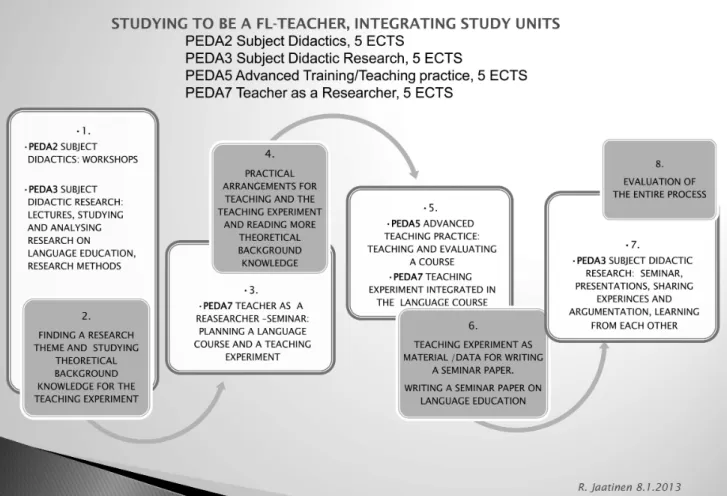
In our foreign language teacher education, we decided to integrate the study unit of Teacher as a Researcher (5 ECTS) with three other study units into one module (20 ECTS in total) to expand the research orientation to cover the entire learning process during the spring semester. Consequently, the study unit is not a distinct or isolated course, but combined with the units of Subject Didactics (workshops),
Subject Didactic Research (lectures and seminar) and
Advanced Teaching Practice (in school). The four study units
form one process in which the student teachers are engaged during the spring semester, i.e. the final period of their pedagogical studies. Implementation and evaluation of the module is based on the joint responsibility and collaboration of the university lecturer in language education, the supervising teachers at school and the student teachers, i.e. their work in teams. Figure 2 shows the order and core contents of the integrated process.
The white blocks in Figure 2 illustrate the study units and the activities contained in them, the shadowed blocks describe the ways in which the units are linked to each other, and the arrows show the direction in which the entire process progresses. The contents and activities of the study units are, of course, partially overlapping. The evaluation of the process is ongoing during the process, although the final evaluation is carried out at the end of the module as shown in the figure.
In this section, I will present the main topics introduced by the student teachers in their project plans and posters and try to analyse what they tell us about our language teaching and needs to change or improve it. This point is significant since the newly qualified language teachers can be seen as possible change agents in schools (Ruohotie-Lyhty, 2011). The student teachers were given a great deal of freedom in choosing their research topics. I (the university lecturer) asked them to undertake a topic that they considered important to develop in their teaching and the language teaching in school in general. The supervising teachers allotted to the student teachers their language classes (one language class for two of them), to which they designed a language course and integrated their research projects in the course. Consequently, the student teachers worked in pairs although they had different projects. Each language class, then, participated in two development projects. (One pair, number 9 and 10 had a joint project.) The project was to be planned to cover the minimum of 3 × 75-minute lesson, but it could also be expanded to last the entire course. I will try to answer questions pertaining to how the personal research projects were implemented in the classrooms and the types of effects they had on student teachers, their autonomy and teacher identity development in subsequent research articles. In this article, I focus only on the analysis of the research topics.
When preparing for the projects, the student teachers had carefully studied the curriculum guidelines of the comprehensive and upper secondary school and, of course, familiarized themselves with the students and the English or French syllabus of the grade they were supposed to teach. They already had the experience of one supervised teaching practice of 5 ECTS credits that was integrated with a 5-credit course on subject didactics. Therefore, they had taught either 15 × 45-minute lessons or 10 × 75-minute lessons and practised the teacher's overall work, not merely teaching, reflecting on their goals, feelings and actions in groups and on their own and had written their considerations and conclusions in portfolios. In addition, what should not be forgotten, each of them had her or his own history of being a student in school for years. Students were encouraged to use that experience as a resource also.
In the following, I first introduce a list of all topics. I have numbered them (the topics 1-15 are by student teachers of
English and 16-19 by those of French) and ordered according to the grades in which the development projects were carried out, starting from upper secondary school and continuing to the primary level of the comprehensive school. The topics are in the form of research questions representing student teachers' cognitions and starting points for their research processes.
(1) In what ways can the news on Internet be utilised in foreign language learning? Can students' consciousness of society be influenced by using news in foreign language instruction? Can the students be tempted to become more interested in news, i.e. what happens in the world? (upper secondary, grade 1)
(2) How can oral language skills be developed? What types of methods can be utilised in the teaching of oral language skills? (upper secondary, grade 1)
(3) Does the reading of literature increase students' knowledge of the culture and does it widen their conception of the world? How can students' cultural knowledge and conceptions of the world be developed and their skills in recognising different genres and basic skills in analysing literature be practised? (secondary, grade 9)
(4) How could the knowledge of the stratification of lexicon be integrated with the teaching of vocabulary in comprehensive school? Can the identification of the style be combined with the reading and interpretation of literary texts? (secondary, grade 9)
(5) How can world ‘Englishes’ be utilised in teaching? Can students' own conceptions of their language skills be strengthened when they become aware of the changing role of English in the world and know that the native speaker is not the only model anymore? (secondary, grade 9)
(6) How can the special characteristics of local cultures be integrated into a language lesson? How to deal with the culture of a certain area as authentically as possible? (secondary, grade 9)
(7) How do comprehensive school students identify genre conventions? How do they identify the conventions used in horror literature and other media? Can students use reading strategies in English genre text? (secondary, grade 9)
(8) Is process writing an efficient and/or sensible method of teaching and practising writing in lower secondary classes? (secondary, grade 9)
(9 and 10) How can comprehensive school students be Ⅴ.Topics of the personal research projects - what do
acquainted with English newspapers in the online environment and with printed newspaper articles? How can newspapers be used in the teaching of grammar, lexicon and cultural knowledge? Moreover, to write their own articles and compose a class newspaper? (joint project of two student teachers, secondary, grade 8) (11) What type of picture of the USA can one get on the basis of the textbooks and on the basis of the media? What is the culture like in reality? How to be critical of the information available? (secondary, grade 8)
(12) What matters do the pupils regard as easy/difficult in the writing? How could we facilitate creative/free writing? (using pictures, literature, movies...) Do the detailed instructions facilitate writing or is it better to let students create freely? (secondary, grade 8)
(13) How do I avoid heteronormativity and gender normativity in my teaching? What types of materials and tasks promote this objective and increase students' tolerance? (primary, grade 6)
(14) Is there any advantage to using literature in foreign language teaching in primary school? Does literature motivate pupils to read? In what ways (action-oriented ways, in particular) can literature be used in language teaching in primary school? (primary, grade 4)
(15) How does a movie workshop serve the teaching of the contents in the curriculum? Does the students' action change in the workshop, when compared to that of “normal” classroom work? How? How does the workshop support the authentic assessment during the course? (primary, grade 3)
────────
(16) What impact does informal learning have on learning a foreign language: How much and what type of informal learning exists and how can it be utilised in foreign language teaching? (upper secondary, grade 2) (17) How to teach the difference of the past tense and passe´ compose´ , so that students can choose the right tense and justify their choice? (upper secondary, grade 2)
(18) What types of (intercultural) authentic encounters have students had? How can authentic encounters, for example with a native speaker, be utilised in studying a foreign language? How can students' experiences be utilised in teaching a foreign language? What types of approaches and activities can be used? How does the Finnish ELP work as a facilitator of intercultural language learning? (secondary, grade 9)
(19) How can students' cultural knowledge be developed
using technology in teaching: What types of cultural features should be introduced/used? What different types of technology can be utilised? How does the utilisation of technology affect the pupils' motivation? Other advantages? (primary, grade 3)
What do these topics reveal us about the student teachers' aspirations, our foreign language teacher education and our language teaching/education? What do the language teachers of the future see significant? Is there any criticism against present practices? What do they want to change, develop and/or improve in their own teaching and in language teaching/education in school? The themes drawn from the student teachers' research plans and posters show a few common elements demonstrating the dialogue and collaboration in subject didactic workshops during the pedagogical studies. However, there are also themes arising from more personal research interests as well as themes that reveal criticism against the prevailing situation in language teaching in Finland.
In the analysis, I have placed the research topics into four main categories, the purpose of which is to give an account of the aspirations of nineteen student teachers to develop themselves as teachers and promote language teaching in school. There are also several sub-categories under the headings of the main categories. The categories are not strictly distinct being to some degree overlapping, and some sub-categories can be found under more than one main category. The four main categories are as follows:
(1) Education oriented themes (2) Language skills oriented themes (3) Integrative research oriented themes (4) Critique oriented themes
Education oriented themes contain several sub-themes
indicating aspirations of the student teachers to do more for their students than teach English or French: they seem to conceptualise their sphere of action to be language education, not just teaching a language, they want their students to develop more holistically. They want to influence students' consciousness of society (student teacher 1), increase their knowledge of culture and conception of the world (student teachers 1, 3, 5, 6, 9, 10, 11, 18, 19), strengthen the students' conceptions of their own language skills (student teacher 5), increase their openness and tolerance toward different genders (student teacher 13), guide students to collaborate (student teacher 15), familiarize the students with benefiting from informal learning (student teacher 16) and their own
experiences (student teacher 18) in language learning, teach students to use media critically (student teachers 1, 11, 16) and familiarize children to use media and technology in language learning (student teachers 15, 19). Several student teachers see the importance of literature in foreign language learning and want to develop their teaching skills using literature (student teachers 3, 4, 7, 12, 14).
Themes pertaining strictly to language skills were surprisingly few. Still, there were some student teachers who wanted to focus on developing certain language skills and their own methodology to teach these skills in their classes: oral language skills (student teacher 2), stratification of vocabulary (student teacher 4), reading strategies (student teacher 7), process writing (student teacher 8), creative writing (student teacher 12), and grammar (student teacher 17).
Integrative research oriented themes in this context refer to
the themes of the research projects where student teachers apply other research knowledge (rather than pedagogic), making use of something they have studied before in another department of the university, in their bachelor's or master's theses, for example. In other words, they integrated research knowledge of two or more sciences in their development projects and their knowledge was based on their own research. This type of integration is considered especially valuable, since we are trying to educate teachers who are able to utilise their knowledge and skills holistically and the knowledge basis of our teacher education is said to be multidisciplinary. Student teachers 4 and 5 were writing their master's theses in the Department of Language, Translation and Literature Studies at the same time as they did their pedagogical studies, one (student teacher 4) on the stratification of words in the English language and another (student teacher 5) on English as a lingua franca and world Englishes. They wanted to use their research knowledge in their projects. Student teacher 6 had written her bachelor's thesis on local cultures of Britain and wanted to introduce her knowledge and materials in the classroom. Student 17 was preparing for her master's thesis on teaching grammar. She wanted to do teaching experiments and collect data for her thesis from her class.
Critique oriented themes indicate directly or indirectly
weaknesses and shortcomings in the prevailing situation and suggest changes or improvements to our language teaching. One indirect critique in the personal research projects is
related to teaching materials used in them and concerns the projects of all other student teachers except those of 2, 8 and 17. The foreign language teaching in Finland has been textbook-centred especially in comprehensive and upper secondary schools. It becomes evident that the student teachers oppose the excessive use of textbooks and want to develop themselves to find, produce, prepare, work with and use other sources in their teaching. Student teacher 1, for example, used 38 international news channels in her class during the course. She advised her students to follow the news regularly and read them critically on their iPads. The student teachers had also expressed the need for using authentic materials regularly in our workshop and seminar discussions.
Another critique directed at textbooks concerns the cultural content of the books, what they show and tell us about the cultural contexts of the target language, which cultural characteristics have been selected in them and which have been left out. Student teacher 6 criticised the lack of local cultures in the English textbooks and using her own materials introduced comprehensive school students to a selection of local customs and celebrations from different parts of Britain. She also arranged British visitors (exchange students from the university) with various accents to come to her class and the students had an opportunity ask questions concerning their localities. Student teacher 11 had been in the United States for quite a long time and possessed a collection of hundreds of photographs that she had taken of the different parts of North America. Her criticism targeted the narrow and limited picture of the USA that the English textbooks and media give us. Her ambition was to try to teach students to be critical of the information they receive from media and textbooks. In her class, she used her own photographs to enlarge the images of the USA.
Also, the vocabulary of the textbooks, especially how words were translated into Finnish in them was criticised. Student teacher 4 had paid attention to the translations of English words in glossaries: often there were only one or two translations with no explanation of their possible limitations concerning style. In addition, the contexts of the textbook in which the “style-sensitive” words occurred were insufficient. Consequently, such shortcomings could lead to an improper use of the word, if it was said or written in stylistically neutral contexts. In her class this student teacher wanted to teach comprehensive school students to recognise words from the glossaries that are stylistically “deviant” and learn
to use them in a correct context. In her research project, she returned to this issue whenever “style-sensitive” words occurred in textbooks. Her project was then, integrated in almost every lesson and became part of regular classroom work.
The research project of student teacher 13 deserves special attention. In her research project, all four themes (education, language skills, integrative research and critique) can be found and it is difficult to decide which category is the most dominant one. Her degree comprised gender research studies and she was therefore extremely curious to know how children are addressed in the classroom, how gender issues are presented in textbooks and how they appeared in classroom practices. Her ambition was to be a teacher who was conscious of heteronormativity and gender normativity and she wanted to avoid them in her teaching. She wanted to be a teacher who promoted openness and tolerance among students. In her research project, she invited the supervising teacher and other student teachers to critically observe her own behaviour from the point of view of heteronormativity, gender normativity and tolerance education when she was teaching. She analysed the English textbook of the grade she was teaching and developed her own learning material and tasks for children from the same perspective. Her topic attracted a large audience and interesting discussion in the teacher training school. In addition, the article based on this research project was published in the language teachers' national journal in Finland (see Salminen, 2013).
Ⅵ.Discussion
The purpose of this article was to report on a development project concerning foreign language teacher education in Tampere University. The goals of the project were to experience the development of research-based approach central in teacher education and develop language education in school context using the concept of (student) teacher autonomy as a signpost. The student teachers were seen as researchers and co-developers in foreign language classes. The specific aim of the case study reported here was to investigate the soon qualified teachers' conceptions of the needs to develop themselves and current foreign language teaching, i.e. what they want to change, develop and/or improve in their own teaching and in language teaching/education in school.
The findings presented here, although from a small-scale,
qualitative case study, add to the understanding of how research-based teacher education can be implemented in practice and how student teachers can be involved in real development projects in school. The research themes drawn from the student teachers' research plans and posters open up both conventional and fresh ideas in the development of individual teachers and language education in general. Many themes show elements discussed in subject didactic workshops during the pedagogical studies, but there are also themes arising from more personal research interests as well as themes that show critique of the prevailing situation in language teaching in Finland. Interesting and worth analysing would be the themes that were completely absent in student teachers' research projects. The themes have been presented under four main headings: education oriented, language skills oriented, integrative research oriented and critique oriented themes. Though I consider the categories illustrative, I admit that they are factitious to some extent; many sub-categories or sub-themes could also fit under another category. However, all of the research topics are open to inspection and readers can assess for themselves how the categories have been created and the study conducted.
In this article, I focused on the analysis of the research topics only. I intend to deal with issues concerning the descriptions of how the student teachers' research projects were executed in the classrooms and the impacts they had on student teachers, their autonomy and teacher identity development later in other research articles. Neither does the study provide information on the experiences and views of students, student teachers and supervising teachers, nor the evaluations of language learning results. They, too, deserve further study.
Acknowledgements
My special thanks go to the people whose support and assistance were indispensable in the completion of this study. I would like to express my gratitude to Dr Yuzo Tanaka, President of Naruto University of Education, for awarding the research scholarship to me. This study was supported by the foreign visiting research program 2013 of Naruto University of Education. I also thank Dr Harumi Ito, professor of language education in Naruto University of Education, for all arrangements associated with my research visit in Naruto. My thanks also go to our project members, i.e. the supervising teachers and students of Tampere University Teacher Training School and, above all, the student teachers of English and French of the academic year
2012-2013 in Tampere University.
References
Berger, P. L. & Luckmann T. (1966). The social construction
of reality: a treatise in the sociology of knowledge. Garden
City, New York: Anchor Books.
Braun, V. & Clarke, V. (2006). Using thematic analysis in psychology. Qualitative research in psychology 3, 77-101. Bruner, J. (2002). Making stories: law, literature, life. New
York: Farrar, Straus and Giroux.
CEFR (2001). Common European framework of reference for
languages: learning, teaching, assessment. Modern Languages
Division. Strasbourg: Council of Europe and Cambridge University Press. Accessed February 28, 2013, from http://www.coe.int/t/dg4/linguistic/Source/Framework_EN.pdf. Cohen, L. & Manion, L. (1994). Research methods in
education, 4th ed. New York: Routledge.
Conelly, F. & Glandinin, D. (1990). Stories of experience and narrative inquiry. Educational researcher 19(5), 2-14. Cotterill, P. & Letherby, G. (1993). Weaving stories: personal
auto/biographies in feminist research. Sociology 27(1), 67-79.
Curricula Guides > School of education 2012-2015. Tampere University. Accessed February 26, 2014 from http: www.uta.fi > Curricula guides > School of education 2012-2015 > Intermediate studies in education > PEDA7 Teacher as researcher 5 ECTS.
Darling-Hammond, L. (2010). The flat world and education.
How America' s commitment to equity will determine our future. New York: Columbia University. Teachers college.
Dewey, J. (1938). Experience and education. New York: Macmillan/ Collier Books.
Fernsten, L., & Fernsten, J. (2005). Portfolio assessment and reflection: Enhancing learning through effective practice.
Reflective Practice 6(2), 303-309.
Hanse´ n, S.-E. & Forsman, L. (2009). Design and dilemmas - Experiences from Finnish teacher education. Didacta Varia. 14(1), 3-23.
Jaatinen, R. (2007). Learning languages, learning life-skills.
Autobiographical reflexive approach to teaching and learning a foreign language. New York: Springer.
Jaatinen, R. (2013). Narrative portfolio in foreign language teacher education. In E. Ropo & M. Huttunen (Eds.)
Puheenvuoroja narratiivisuudesta opetuksessa ja oppimisessa
(pp.65-83). Tampere: Tampere University Press.
Jakku-Sihvonen, R. & Niemi, H. (Eds.) (2006).
Research-based teacher education in Finland - Reflections by
Finnish teacher educators. Research in educational
sciences 25. Turku: Finnish Educational Research Association.
Jime´ nez Raya, M., & Lamb, T. E. (Eds.) (2008). Pedagogy
for autonomy in modern languages education: theory, practice, and teacher education. Dublin: Authentik.
Kaikkonen, P. (2004). Kielenopetus kielikasvatuksena -
Nuoren vieraan kielenopettajan kehityspolut. Jyva¨ skyla¨ : Jyva¨ skyla¨ n yliopiston opettajankoulutuslaitos.
Kaikkonen, P. & Kohonen, V. (2012). Aineenopettaja ainepedagogiikan toteuttajana - autonomia, autenttisuus ja yhteiso¨ llinen toimijuus opettajuuden aineksina. In A.Kallioniemi & A. Virta (Eds.) Ainedidaktiikka
tutkimuskohteena ja tiedonalana (pp.74-97). Kasvatusalan
tutkimuksia 60. Turku: Suomen kasvatustieteellinen seura. Kansanen, P. (2008). Distinctive highlights of Finnish teacher
education. In J. Loima (Ed.) Facing the future - Developing
teacher education (pp.48-68). Helsinki: Palmenia.
Kohonen, V. (2005). Eurooppalaisen kielisalkun kehitta¨ mistyo¨ ja tavoitteet: miten kielisalkku voi edista¨ a¨ kielikasvatusta. In V. Kohonen (Ed.) Eurooppalainen kielisalkku Suomessa (pp.7-44). Helsinki: WSOY.
Kohonen, V. (2007). Towards transformative foreign language education: the subject teacher as a professional social actor. In R. Jakku-Sihvonen & H. Niemi (Eds.) Education
as a societal contributor (pp.181-206). Berlin: Peter Lang.
Kohonen, V. (2009). Autonomy, authenticity and agency in language education: the European language portfolio as a pedagogical resource. In R. Kantelinen, & P. Pollari (Eds.)
Language education and lifelong learning (pp.7-44).
Joensuu: University of Eastern Finland.
Kohonen, V., Kaikkonen, P., Jaatinen R., & Lehtovaara, J. (2001). Experiential learning in foreign language education. London: Pearson Education.
Kolb, D. A. (1984). Experiential learning: experience as the
source of learning and development. Englewood Cliffs,
N.J.: Prentice-Hall.
Lantolf, J. P. & Thorne, S. L. (2006). Sociocultural theory
and the genesis of second language development. Oxford:
OUP.
Little, D. (2001). Learner Autonomy. 1: definitions, issues
and problems. Dublin: Authentik.
Little, D. (2004). Constructing a theory of learner autonomy: some steps along the way. In K. Ma¨ kinen, P. Kaikkonen. & V. Kohonen (Eds.) Future Perspectives in Foreign
Language Education (pp.15-25). Oulu: Oulu University
Press.
teacher education. In R. Jakku-Sihvonen & H. Niemi (Eds.) Research-based teacher education in Finland -
reflections by Finnish teacher educators (pp.31-50).
Research in educational Sciences 25. Turku: Finnish Educational Research Association.
Ropo, E. (2009). Narratiivinen opetussuunnitelma opettajankoulutuksessa. In R. Jaatinen, V. Kohonen, & P. Moilanen (Eds.) Kielikasvatus, opettajuus ja kulttuurienva¨ linen toimijuus (pp.141-157). Helsinki: OKKA.
Ropo, E. & Huttunen, M. (Eds.) (2013). Puheenvuoroja
Narratiivisuudesta Opetuksessa ja Oppimisessa. Tampere:
Tampere University Press.
Ruohotie-Lyhty, M. (2011). Opettajuuden alkutaival.
Vastavalmistuneen vieraan kielen opettajan toimijuus ja ammatillinen kehittyminen (Doctoral disseratation,
University of Jyva¨ skyla¨ , 2011). Jyva¨ skyla¨ studies in Education, Psychology and Social Research 410.
Sahlberg, P. (2011). Finnish lessons. What can the world
learn from educational change in Finland? New York:
Columbia University. Teachers College.
Salminen, E. (2013). Tasa-arvo rikkoo normeja. Tempus 5, 20-22.
Scho¨ n, D. (1983). The reflective practitioner. London: Temple Smith.
Silverman, D. 2005. Doing qualitative research, 2nd ed.
London: SAGE Publications.
Van Manen, M. (1995). On the epistemology of reflective practice. Teachers and teaching: theory and practice 1(1), 33-50.
Wertsch, J. (1995). The need for action in sociocultural research. In J. V. Wertsch, P. del Rio & A. Alvarez (Eds.)
Sociocultural studies of minds (pp.56-74). Cambridge:
CUP.
Westbury, I., Hansen, S.E., Kansanen, P. & Bjo¨ rkvist, O. (2005). Teacher education for research-based practice in expanded roles: Finland's experience. Scandinavian
journal of educational research 49(5), 475-485.
─────────────
1 Each university in Finland has its own applications of the
degree programmes. They are not necessary exactly as the one in Table 1. I use this table in this article just to give an idea of how the teacher's pedagogical studies are included in the bachelor and master degree programmes in Finnish universities.
2 Unlike Niemi and Jakku-Sihvonen (2006, 39), I use the
term 'subject teacher' instead of 'secondary school teacher' here, since the program qualifies Master graduates to teach their subjects at all levels of the Finnish education system,