• 検索結果がありません。

Approximate interval estimation for EPMC for improved linear discriminant rule under high dimensional frame work

N/A
N/A
Protected

Academic year: 2021

シェア "Approximate interval estimation for EPMC for improved linear discriminant rule under high dimensional frame work"

Copied!
35
0
0

読み込み中.... (全文を見る)

全文

(1)

Approximate interval estimation for EPMC

for improved linear discriminant rule

under high dimensional frame work

Masashi Hyodo, Tomohiro Mitani, Tetsuto Himeno

and Takashi Seo

(Received March 9, 2015; Revised June 18, 2015)

Abstract. An observation is to be classified into one of two multivariate

nor-mal populations with equal covariance matrix. In this paper, we consider the

confidence intervals for expected probability of misclassification (EPMC) for

improved linear discriminant rule in two types of data: namely, large sample

data and high dimensional data. Our approximate confidence interval is based

on the asymptotic normality of consistent estimator of EPMC. Using results

of stochastic expression for two bilinear forms and two quadratic forms, we

prove asymptotic normality under two different frameworks. Through

simula-tion study, it is observed that our approximate confidence interval has a good

performance not only in high dimensional and large sample settings, but also

in large sample settings.

AMS 2010 Mathematics Subject Classification. 62H12, 62E30.

Key words and phrases. asymptotic approximations, expected probability of

misclassification, high dimensional data, linear discriminant function.

§1. Introduction

We consider the problem of classifying a future observation vector into one of

the two population groups Π

1

and Π

2

. For each i = 1, 2, Π

i

denotes a

popula-tion from a multivariate normal distribupopula-tion

N

p

i

, Σ), and it is supposed that

x

ij

, j = 1, . . . , N

i

, are observed from the population Π

i

. Here, µ

i

(i = 1, 2)

and Σ are unknown parameters, and they are estimated by the sample mean

vectors x

i

= N

i

−1

N

i

j=1

x

ij

(i = 1, 2) and the pooled sample covariance matrix

S = n

−1

2

i=1

N

i

j=1

(x

ij

− x

i

)(x

ij

− x

i

)

for n = N

1

+ N

2

− 2.

(2)

The linear discriminant function is defined as

e

T (x) = (¯

x

1

− ¯x

2

)

S

−1

{x −

1

2

x

1

+ ¯

x

2

)}.

Observe however that the linear discriminant function e

T (x) has a bias. In

fact,

E[ e

T (x)

|x ∈ Π

i

]

=

n(

−1)

i

−1

2(n

− p − 1)

˜

2

+

n(N

1

− N

2

)p

2(n

− p − 1)N

1

N

2

, i = 1, 2,

where ˜

2

= (µ

1

−µ

2

)

Σ

−1

1

−µ

2

). For this reason, we use the bias-corrected

discriminant function defined as

T (x) = (¯

x

1

− ¯x

2

)

S

−1

{x −

1

2

x

1

+ ¯

x

2

)

} −

n(N

1

− N

2

)p

2(n

− p − 1)N

1

N

2

,

(1.1)

where the subtraction of n(N

1

− N

2

)p/

{2(n − p − 1)N

1

N

2

} in (1.1) is to

guar-antee that E[T (x)|x ∈ Π

i

] = n/{2(n − p − 1)}(−1)

i

−1

˜

2

, i = 1, 2. Now using

T (x), a new observation x is to be assigned to Π

1

if T (x) > 0, and to Π

2

otherwise.

The performance of this discriminant rule is evaluated by its probabilities

of misclassification. The probabilities of misclassification have been obtained

with respect to the distribution of the linear discriminant function e

T (x). There

are different types of misclassification probability associated with e

T (x). These

are the conditional probabilities of misclassification (CPMC) and expected

probabilities of misclassification (EPMC). The CPMC is defined by

L

1

= P [T (x)

≤ 0|x ∈ Π

1

, X], L

2

= P [T (x) > 0

|x ∈ Π

2

, X],

(1.2)

where X = (x

11

, . . . , x

1N

1

, x

21

, . . . , x

2N

2

). We note that the CPMC is the

con-ditional probability of misclassifying an observation x from Π

i

into Π

j

, i, j =

1, 2, i

̸= j. On the other hand, the EPMC is defined by

(1.3)

R

1

= E[L

1

], R

2

= E[L

2

].

We note that the EPMC is the unconditional probability of misclassifying an

observation x from Π

i

into Π

j

, i, j = 1, 2, i

̸= j. Since the exact expression for

the EPMC is very complicated, there are much works for the approximation

of EPMC. The asymptotic approximation of EPMC under a framework such

that N

1

and N

2

are large with p is fixed has been studied. This approximation

is called “large sample approximation”. For a review of these results, see, e.g.,

Okamoto (1963, 1968) and Siotani (1982). Further, asymptotic

approxima-tion of EPMC under a framework that N

1

, N

2

and p are all large have also

(3)

This approximation is called “high dimensional and large sample

approxima-tion”. In addition, Fujikoshi (2000) gave an explicit formula of error bounds

for a high dimensional and large sample approximation of EPMC proposed

by Lachenbruch (1968). However, as their approximations are functions of

unknown parameters, it must be estimated in practice. Based on the large

sample approximation, Lachenbruch and Mickey (1968) proposed the

asymp-totic unbiased estimator of EPMC. On the other hand, Kubokawa, Hyodo and

Srivastava (2013) proposed the second order asymptotic unbiased estimator of

the EPMC in high dimensional and large sample framework.

In this paper, we consider the interval estimations for the EPMC. Since the

exact interval estimations for the EPMC are very difficult problem, there are

some works for the approximate confidence interval. McLachlan (1975)

pro-posed an approximate confidence interval for the CPMC based on the large

sample approximation. Recently, Chung and Han (2009) proposed the

jack-knife confidence interval and the bootstrap confidence interval for the CPMC.

The problems with these methods are listed below.

(A) Since CPMC is conditional probability, it is more desirable to derive

in-terval estimation of EPMC.

(B) Since these methods are based on large sample asymptotic results, these

methods do not perform well in high dimensional settings.

For the problems (A) and (B), we derive the asymptotic distribution of the

estimator of EPMC under the high dimensional and large sample frame works,

and propose the approximate confidence interval for the EPMC.

The organization of this paper is as follows. In Section 2, we propose

consis-tent estimator of EPMC. In Section 3, we propose new approximate confidence

interval of EPMC and show the asymptotic normality of CPMC. In Section

4, we investigate the performances of our approximate confidence intervals

through the numerical studies. The conclusion of our study is summarized in

Section 5. Some preliminary results are given in Appendix.

§2. The consistent estimator of EPMC

In this section, we propose the consistent estimator of the EPMC. Since R

2

can be obtained from R

1

simply by interchanging N

1

and N

2

, we only deal

with R

1

. Let ˜

c = p/n, ˜

γ

1

= N

1

/n, ˜

γ

2

= N

2

/n. We assume the following

asymptotic frameworks, in order to derive limiting value of R

1

.

(A1) n, p

→ ∞ with n(˜c − c) → 0 for some c ∈ (0, 1),

(A2) n, N

1

, N

2

→ ∞ with n(˜γ

1

− γ

1

)

→ 0, n(˜γ

2

− γ

2

)

→ 0

for some γ

1

, γ

2

∈ (0, 1),

(4)

Suppose that x

∈ Π

1

. Under these conditions, a conditional distribution of

T (x) given (x

1

, x

2

, S) is distributed as

N (−U, V ), where

U =(x

1

− x

2

)

S

−1

(x

1

− µ

1

)

(x

1

− x

2

)

S

−1

(x

1

− x

2

)

2

+

n(N

1

− N

2

)p

2(n

− p − 1)N

1

N

2

,

V =(x

1

− x

2

)

S

−1

ΣS

−1

(x

1

− x

2

).

Then, R

1

can be expressed as

R

1

= E

[

Φ

(

U V

−1/2

)]

,

where Φ(

·) denotes the cumulative distribution function of N (0, 1). We rewrite

U and V by using

τ

=

(N

1

N

2

)/(n + 2)Σ

−1/2

1

− µ

2

),

u

1

=

N

1

N

2

n + 2

Σ

−1/2

(x

1

− x

2

),

u

2

=

1

n + 2

Σ

−1/2

(N

1

x

1

+ N

2

x

2

− N

1

µ

1

− N

2

µ

2

),

W

=

−1/2

−1/2

.

It is seen that u

1

, u

2

and W are mutually independently and distributed as

u

1

∼ N

p

(τ , I

p

), u

2

∼ N

p

(0, I

p

) and W

∼ W

p

(n, I

p

), respectively. Using these

variables, we can rewrite U and V as

U =

(N

1

− N

2

)n

2N

1

N

2

u

1

W

−1

u

1

+

n

N

1

N

2

u

1

W

−1

u

2

n

N

1

τ

W

−1

u

1

(2.1)

+

n(N

1

− N

2

)p

2(n

− p − 1)N

1

N

2

,

V =

n

2

(n + 2)

N

1

N

2

u

1

W

−2

u

1

.

(2.2)

Applying Lemma A.1 to (2.1) and (2.2), we obtain the constants U

0

and V

0

as

U

0

=

lim

n,p

→∞

E[U ] =

2

2(1

− c)

,

V

0

=

lim

n,p

→∞

E[V ] =

1

(1

− c)

3

(

2

+

c

γ

1

γ

2

)

.

(5)

Also, the expectations E[(U

− U

0

)

2

] and E[(V

− V

0

)

2

] can be evaluated as

E

[

(U

− U

0

)

2

]

=

1

2n(1

− c)

3

{

4

+

2

γ

2

(

c

γ

1

+ ∆

2

)

(2.3)

+

c(γ

1

− γ

2

)

2

γ

2

1

γ

2

2

}

+ o(n

−1

),

E

[

(V

− V

0

)

2

]

=

2

n(1

− c)

7

[

(c + 4)∆

4

+

2

{

(c + 1)

2

+ c

}

γ

1

γ

2

2

(2.4)

+

c

{

(c + 1)

2

+ c

}

γ

1

2

γ

2

2

]

+ o(n

−1

)

under the asymptotic frameworks (A1)-(A3). (See details in Appendix B and

C.) Thus, using (2.3), (2.4) and Chebyshev’s inequality, we have that U

→ U

p

0

and V

→ V

p

0

. Furthermore, using continuous mapping theorem, we obtain

that

Φ

(

U V

−1/2

)

− Φ

(

U

0

V

0

−1/2

)

p

→ 0

(2.5)

under the asymptotic frameworks (A1)-(A3). On the other hand, it holds that

Φ

(

U V

−1/2

)

− Φ

(

U

0

V

0

−1/2

)

< 1 a.s.

(2.6)

Combining (2.5), (2.6) and dominated convergence theorem, we obtain the

following lemma.

Lemma 2.1. Under the asymptotic frameworks (A1)-(A3), it holds that

R

1

→ Φ

(

(1

− c)

1/2

2

2

2

+ c/(γ

1

γ

2

)

)

.

Since the limiting value of R

1

is a function of ∆

2

, we begin by obtaining

its consistent estimator.

Lemma 2.2. The estimator of ∆

2

is defined by

b

2

=

n

− p − 1

n

(x

1

− x

2

)

S

−1

(x

1

− x

2

)

(n + 2)p

N

1

N

2

.

Under the asymptotic frameworks (A1)-(A3), it holds that b

2 p

→ ∆

2

.

(Proof ) We can rewrite the estimator b

2

(2.7)

b

2

=

(n

− p − 1)(n + 2)

N

1

N

2

u

1

W

−1

u

1

(n + 2)p

N

1

N

2

.

(6)

Applying Lemma A.1 to (2.7), we have

(2.8)

E[( b

2

− ∆

2

)

2

] =

1

n(1

− c)

(

2∆

4

+

4∆

2

γ

1

γ

2

+

2c

γ

1

2

γ

2

2

)

+ o(n

−1

)

under the asymptotic frameworks (A1)-(A3). (See details in Appendix D.)

Thus, using (2.8) and Chebyshev’s inequality, we have b

2

→ ∆

p

2

under the

asymptotic frameworks (A1)-(A3).

Substituting the consistent estimator b

2

into the limiting term Φ(U

0

V

0

−1/2

),

the consistent estimator of R

1

is obtained by

b

R

1

= Φ

(

b

U

0

V

b

1

2

0

)

,

where b

U

0

=

−2

−1

(1

−c)

−1

b

2

and b

V

0

= (1

−c)

−3

{ b

2

+c/(γ

1

γ

2

)

}. The following

corollary is obtained from continuous mapping theorem and consistency of

estimator b

2

.

Corollary 2.1. Under the asymptotic frameworks (A1)-(A3), it holds that

b

R

1

p

→ R

1

.

§3. Approximate interval estimation for EPMC and asymptotic

normality of CPMC

In Section 3.1, we show the asymptotic normality of the estimator of EPMC

under two different frameworks, and propose the approximate confidence

in-terval. In Section 3.2, we also show the asymptotic normality of CPMC.

3.1.

The asymptotic normality of the estimator of EPMC

At first, we derive the asymptotic distribution of the studentized statistics

under the high dimensional frameworks (A1)-(A3). We consider the following

random variable

n

(

b

R

1

− Φ

(

U

0

V

1

2

0

))

.

To show the asymptotic normality of the above random variable, we consider

the stochastic expansions of b

U and b

V . Since the statistics b

U and b

V are the

functions of b

2

, it is essential to derive the stochastic expansion of b

2

. By

using u

1

and W , we rewrite b

2

as

b

2

=

(n

− p − 1)(n + 2)

N

1

N

2

u

1

W

−1

u

1

(n + 2)p

N

1

N

2

.

(7)

Define the variables

v

1

=

˜

v

1

− (p − 2)

2(p

− 2)

, v

2

=

˜

v

2

− (n − p + 1)

2(n

− p + 1)

,

where

˜

v

1

∼ χ

2

p

−2

, ˜

v

2

∼ χ

2

n

−p+1

.

Here, χ

2

a

(a

∈ N) means chi-square distribution with a degrees of freedom.

The estimator b

2

is expanded as

(3.1)

b

2

= ∆

2

+

D

1

n

+ o

p

(n

−1/2

),

where D

1

= g

1

v

1

+ g

2

v

2

+ g

3

u

1

. Here,

u

1

∼ N (0, 1), g

1

=

2c

γ

1

γ

2

, g

2

=

2

(

c + ∆

2

γ

1

γ

2

)

1

− cγ

1

γ

2

, g

3

=

2∆

γ

1

γ

2

and v

1

, v

2

and u

1

are mutually independent. From (3.1), it is noted that

b

U

0

=U

0

+ c

1

D

1

n

+ o

p

(n

−1/2

), b

V

0

= V

0

+ c

2

D

1

n

+ o

p

(n

−1/2

),

(3.2)

for c

1

=

−{2(1 − c)}

−1

and c

2

= (1

− c)

−3

. Using (3.2) and Taylor series

expansion, it follows that

b

U

0

V

b

1

2

0

=U

0

V

1

2

0

+ V

1

2

0

(

c

1

D

1

n

U

0

2V

0

c

2

D

1

n

)

+ o

p

(n

−1/2

)

=U

0

V

1

2

0

+

1

n

Q

1

+ o

p

(n

−1/2

),

where

Q

1

=q

1

v

1

+ q

2

v

2

+ q

3

u

1

.

Here

q

1

=

c(1

− c)

(

2c + ∆

2

γ

1

γ

2

)

2

1

2

γ

2

2

{c(γ

1

γ

2

)

−1

+ ∆

2

}

3/2

, q

2

=

2c + ∆

2

γ

1

γ

2

2

1

γ

2

c(γ

1

γ

2

)

−1

+ ∆

2

,

q

3

=

1

− c

(

2c∆ + ∆

3

γ

1

γ

2

)

2 (c + ∆

2

γ

1

γ

2

)

3/2

.

From the stochastic expansion of b

U

0

V

b

1

2

0

, we have

b

R

1

= Φ

(

(1

− c)

1/2

2

2

2

+ c/(γ

1

γ

2

)

)

+ ϕ

(

(1

− c)

1/2

2

2

2

+ c/(γ

1

γ

2

)

)

Q

1

n

+ o

p

(n

−1/2

),

(3.3)

(8)

where ϕ(·) is the p.d.f. of the standard normal distribution. Note that u

1

is distributed as

N (0, 1), v

1

and v

2

are asymptotically distributed as

N (0, 1)

under the asymptotic framework (A1), and these variables are mutually

inde-pendent. Hence, under the asymptotic frameworks (A1)-(A3), it holds that

n

(

b

R

1

− Φ

(

(1

−c)

1/2

2

2

2

+c/(γ

1

γ

2

)

))

σ

e

(∆

2

)

d

→ N (0, 1),

(3.4)

where

σ

e

(∆

2

)

=

ϕ

(

(1

− c)

1/2

2

2

2

+ c/(γ

1

γ

2

)

) √

q

1

2

+ q

2

2

+ q

3

2

=

ϕ

(

(1

− c)

1/2

2

2

2

+ c/(γ

1

γ

2

)

)

×

(

2c + ∆

2

γ

1

γ

2

) √

c + ∆

2

γ

1

γ

2

(∆

2

γ

1

γ

2

+ 2)

2

1

γ

2

(c + ∆

2

γ

1

γ

2

)

3/2

.

Now turn to evaluate the difference of the limiting value of R

1

and R

1

. The

remainder after using first term of the Taylor series of Φ(

·) at UV

−1/2

=

U

0

V

0

−1/2

is given by

Φ

(2)

(d)

2!

(

U

V

1/2

U

0

V

0

1/2

)

2

for some value d between U V

−1/2

and U

0

V

0

−1/2

, and

(2)

(d)

| is equal or

smaller than 1/(

2πe) uniformly in d

∈ (−∞, ∞). Here, Φ

(2)

(

·) is second

derivative function of Φ(

·). Hence, we have that

R

1

(

Φ

(

U

0

V

0

−1/2

)

+ ϕ

(

U

0

V

0

−1/2

)

E

[

U

V

1/2

U

0

V

0

1/2

])

(3.5)

1

2

2πe

E

(

U

V

1/2

U

0

V

0

1/2

)

2

 .

We note that

U

V

1/2

U

0

V

0

1/2

=

1

V

0

(U

− U

0

) +

U

0

2V

0

3/2

(V

0

− V )

(3.6)

+

U

0

V

0

3/2

1

2

(√

V

0

/V + 1

) +

V

0

2

V

(√

V

0

/V + 1

)

2

(V

0

− V )

2

V

+

1

V

0

+ V

0

/

V

(U

− U

0

)(V

0

− V )

V

.

(9)

From (A.8) and (A.11)

E

[

1

V

0

(U

− U

0

)

]

=

2

2

V

0

(1

− c)

2

n

+ o(n

−1

),

(3.7)

E

[

U

0

2V

0

3/2

(V

0

− V )

]

=

U

0

2n(1

− c)

3

V

3/2

0

{(

4

1

− c

− 1

)

2

(3.8)

+

c

γ

1

γ

2

(

4

1

− c

+ 1

)}

+ o(n

−1

).

Since

V

0

/V + 1 > 1 and

V

(√

V

0

/V + 1

)

2

> 2

V

0

,

E

U

0

V

0

3/2

1

2

(√

V

0

/V + 1

) +

V

0

2

V

(√

V

0

/V + 1

)

2

(V

0

− V )

2

V

(3.9)

<

3

|U

0

|

4V

0

3/2

E

[

(V

0

− V )

2

V

]

.

By using Lemma A.1, we obtain that

E

[

(V

− V

0

)

2

V

]

= O(n

−1

)

(3.10)

under the asymptotic frameworks (A1)-(A3). (See details in Appendix E.)

From (3.9) and (3.10),

(3.11)

E

U

0

V

0

3/2

1

2

(√

V

0

/V + 1

) +

V

0

2

V

(√

V

0

/V + 1

)

2

(V

0

− V )

V

2

 = O(n

−1

).

By using

V

0

+ V

0

/

V >

V

0

> 0 and Cauchy Schwarz inequality,

E

[

1

V

0

+ V

0

/

V

(U

− U

0

)(V

0

− V )

V

]

(3.12)

< E

[

1

V

0

|U − U

0

||V

0

− V |

V

]

1

V

0

E

[

|U − U

0

|

2

V

]√

E

[

|V

0

− V |

2

V

]

.

By using Lemma A.1, we obtain that

E

[

(U

− U

0

)

2

V

]

= O(n

−1

)

(3.13)

(10)

under the asymptotic frameworks (A1)-(A3). (See details in Appendix F.)

From (3.12) and (3.13),

E

[

1

V

0

+ V

0

/

V

(U

− U

0

)(V

0

− V )

V

]

= O(n

−1

).

(3.14)

Combining (3.7),(3.8),(3.11) and (3.14), under the asymptotic frameworks

(A1)-(A3), it holds that

E

[

U

V

1/2

U

0

V

0

1/2

]

= O(n

−1

).

(3.15)

Since

V

0

V + V

0

≥ V

0

> 0,

(

U

V

1/2

U

0

V

0

1/2

)

2

=

(

U

− U

0

V

+

U

0

V

0

V + V

0

V

0

− V

V

)

2

=

(U

− U

0

)

2

V

+

U

0

2

(

V

0

V + V

0

)

2

(V

0

− V )

2

V

+2

U

0

V

0

V + V

0

(U

− U

0

)(V

0

− V )

V

(U

− U

0

)

2

V

+

U

0

2

V

0

2

(V

− V

0

)

2

V

+

2U

0

V

0

|U − U

0

||V − V

0

|

V

.

By using Cauchy Schwarz inequality, we obtain that

E

(

U

V

1/2

U

0

V

0

1/2

)

2

 ≤ E

[

(U

− U

0

)

2

V

]

+

U

2

0

V

0

2

E

[

(V

− V

0

)

2

V

]

(3.16)

+

2|U

0

|

V

0

(

E

[

(U

− U

0

)

2

V

])

1/2

(

E

[

(V

− V

0

)

2

V

])

1/2

.

From (3.10),(3.13) and (3.16), we obtain that

E

(

U

V

1/2

U

0

V

0

1/2

)

2

 = O(n

−1

)

(3.17)

under the asymptotic frameworks (A1)-(A3).

Combining (3.5),(3.15) and

(3.17), under the asymptotic frameworks (A1)-(A3), it holds that

R

1

− Φ

(

(1

− c)

1/2

2

2

2

+ c/(γ

1

γ

2

)

)

= O(n

−1

).

(3.18)

(11)

Theorem 3.1. Under the asymptotic frameworks (A1)-(A3), it holds that

T

e

=

n

(

b

R

1

− R

1

)

σ

e

(∆

2

)

d

→ N (0, 1).

To propose the interval estimation of the EPMC, we need to estimate

σ

e

(∆

2

). We use truncated estimator

ˆ

2

= max( b

2

, 0),

so that the estimator of σ

e

(∆

2

) may be negative. Then it holds that

| max( b

2

, 0)

− ∆

2

| ≤ | b

2

− ∆

2

| a.s.

(3.19)

By using Markov’s inequality, (2.8) and (3.19), we obtain ˆ

2

→ ∆

p

2

under the

asymptotic frameworks (A1)-(A3). Hence, ˆ

2

is a consistent estimator of ∆

2

.

Assigning the truncated estimator ∆

2

to the portion of σ

e

(∆

2

) which may be

negative, we propose

˜

σ

e

( ˆ

2

)

=

ϕ

−

(1

− ˜c)

1/2

ˆ

2

2

ˆ

2

+ ˜

c/(˜

γ

1

γ

˜

2

)

×

(

c + ˆ

2

˜

γ

1

γ

˜

2

) √

˜

c + ˆ

2

γ

˜

1

γ

˜

2

(

ˆ

2

˜

γ

1

γ

˜

2

+ 2

)

2

γ

1

˜

γ

2

(

˜

c + ˆ

2

˜

γ

1

γ

˜

2

)

3/2

.

By using the consistent estimator ˜

σ

e

( ˆ

2

), we obtain the following statistics of

T

e

T

e

=

n

(

b

R

1

− R

1

)

˜

σ

e

( ˆ

2

)

.

Therefore we can obtain the following corollary.

Corollary 3.1. Under the asymptotic frameworks (A1)-(A3), it holds that

T

e

→ N (0, 1).

d

Next, we show that asymptotic normality of T

e

is also established under

the large sample framework

(12)

or

(A

′′

1) : n, p

→ ∞ with p/

n

→ 0.

Under the frameworks (A

1) and (A2) or the frameworks (A

′′

1), (A2) and

(A3), it holds that

R

1

= Φ

(

2

)

+ o(n

−1/2

), Φ

(

U

0

V

0

)

= Φ

(

2

)

+ o(n

−1/2

),

(3.20)

σ

e

(∆

2

) = ϕ

(

2

) √

2

+ 2/γ

1

γ

2

2

2

+ o(1),

(3.21)

˜

σ

e

( ˆ

2

) = ϕ

(

2

) √

2

+ 2/γ

1

γ

2

2

2

+ o

p

(1),

T

e

=

ϕ

(

2

)

σ

e

(∆

2

)

(

2

2

v

2

1

2(γ

1

γ

2

)

1/2

u

1

)

+ o

p

(1).

(3.22)

From (3.20)-(3.22), we have that

T

e

=

1

2

8

+

1

1

γ

2

(

2

2

v

2

1

2(γ

1

γ

2

)

1/2

u

1

)

+ o

p

(1).

Therefore we can obtain the following corollary.

Corollary 3.2. Assume the conditions (A

1) and (A2) or the conditions

(A

′′

1), (A2) and (A3). Then, it holds that

T

e

→ N (0, 1).

d

Remark 3.1. From Corollary 3.1 and 3.2, T

e

has a asymptotic normality not

only under high dimensional and large sample frame work, but also under the

large sample framework.

Based on Corollary 3.1 and 3.2, we propose an approximate 100(1

− α)

percentile confidence interval for EPMC as following:

C

T

1

=

[

b

R

1

+

˜

σ

e

( b

2

)

n

y

1

α

2

, b

R

1

+

˜

σ

e

( b

2

)

n

y

α

2

]

,

(3.23)

(13)

3.2.

Asymptotic normality of CPMC

In this section, we show asymptotic normality of CPMC. The CPMC can be

expressed as

L

1

= Φ

(

U V

1

2

)

.

Applying Lemma A.1 to (2.1) and (2.2), we obtain

U

=

˜

2

n

v

2

+

{

np(N

1

− N

2

)

2N

1

N

2

(n

− p − 1)

n(N

1

− N

2

)

2N

1

N

2

˜

v

2

(

u

2

1

+ u

2

2

+ ˜

v

1

)}

+

nu

3

˜

v

2

N

1

N

2

v

u

u

t

(

˜

N

1

N

2

n + 2

+ u

1

)

2

+ u

2

2

+ ˜

v

1

nu

4

˜

v

2

N

1

N

2

˜

v

3

˜

v

4

v

u

u

t

(

˜

N

1

N

2

n + 2

+ u

1

)

2

+ u

2

2

+ ˜

v

1

∆n

˜

˜

v

2

(n + 2)N

1

N

2

(

N

1

u

1

+ N

2

u

2

˜

v

3

˜

v

4

)

,

V

=

{

˜

2

n

2

˜

v

2

2

(

1 +

v

˜

3

˜

v

4

)

+

n

2

(n + 2)

N

1

N

2

v

˜

2

2

(

1 +

v

˜

3

˜

v

4

) (

u

2

1

+ u

2

2

+ ˜

v

1

)

}

+

2 ˜

∆n

2

n + 2

˜

v

2

2

N

1

N

2

(

1 +

˜

v

3

˜

v

4

)

u

1

,

where

u

i

∼ N (0, 1) (i = 1, 2, 3, 4),

˜

v

1

∼ χ

2

p

−2

, ˜

v

2

∼ χ

2

n

−p+1

, ˜

v

3

∼ χ

2

p

−1

, ˜

v

4

∼ χ

2

n

−p+2

,

and these variables are mutually independent. Define the variables

v

1

=

˜

v

1

− (p − 2)

2(p

− 2)

, v

2

=

˜

v

2

− (n − p + 1)

2(n

− p + 1)

,

v

3

=

˜

v

3

− (p − 1)

2(p

− 1)

, v

4

=

˜

v

4

− (n − p + 2)

2(n

− p + 2)

.

Note that

˜

v

1

=

(p

− 2) +

2(p

− 2)v

1

,

˜

v

2

=

(n

− p + 1) +

2(n

− p + 1)v

2

,

˜

v

3

=

(p

− 1) +

2(p

− 1)v

3

,

˜

v

4

=

(n

− p + 2) +

2(n

− p + 2)v

4

,

(14)

and v

1

, v

2

, v

3

and v

4

are asymptotically distributed as

N (0, 1) under the

asymptotic framework (A1). By using Taylor series expansion based on these

variables, we can expand U stochastically,

U = U

0

+

1

n

U

1

+ o

p

(n

−1/2

),

(3.24)

where

U

0

=

1

2(1

− c)

2

,

U

1

=

c(γ

2

− γ

1

)

2(1

− c)γ

1

γ

2

v

1

+

{

c(γ

1

− γ

2

) + ∆

2

γ

1

γ

2

}

2(1

− c)

3/2

γ

1

γ

2

v

2

γ

1

(1

− c)√γ

2

u

1

2

(1

− c)

3/2

γ

1

u

2

+

c + ∆

2

γ

1

γ

2

(1

− c)√γ

1

γ

2

u

3

c(c + ∆

2

γ

1

γ

2

)

(1

− c)

3/2

γ

1

γ

2

u

4

.

Using similar arguments, we can expand V stochastically,

V = V

0

+

V

1

n

+ o

p

(n

−1/2

),

(3.25)

where

V

0

=

1

(1

− c)

3

(

c

γ

1

γ

2

+ ∆

2

)

,

V

1

=

2c

(1

− c)

3

γ

1

γ

2

v

1

2

2

(

c + ∆

2

γ

1

γ

2

)

(1

− c)

7/2

γ

1

γ

2

v

2

+

2c

(

c + ∆

2

γ

1

γ

2

)

(1

− c)

3

γ

1

γ

2

v

3

2c

(

c + ∆

2

γ

1

γ

2

)

(1

− c)

7/2

γ

1

γ

2

v

4

+

2∆

(1

− c)

3

γ

1

γ

2

u

1

.

By using (3.24), (3.25) and Taylor series expansion, it follows that

U V

1

2

=

U

0

V

1

2

0

+

1

nV

0

1/2

{

U

1

U

0

2V

0

V

1

}

+ o

p

(n

−1/2

)

=

U

0

V

1

2

0

+

W

1

n

+ o

p

(n

−1/2

),

where

W

1

= w

1

v

1

+ w

2

v

2

+ w

3

v

3

+ w

4

v

4

+ w

5

u

1

+ w

6

u

2

+ w

7

u

3

+ w

8

u

4

.

(15)

Here,

w

1

=

c(1

− c)∆

2

2

1

γ

2

{c(γ

1

γ

2

)

−1

+ ∆

2

}

3/2

+

c(1

− c)(γ

2

− γ

1

)

1

γ

2

c(γ

1

γ

2

)

−1

+ ∆

2

,

w

2

=

(1

− 2γ

2

)c

1

γ

2

c(γ

1

γ

2

)

−1

+ ∆

2

,

w

3

=

c(1

− c)∆

2

2

2

c(γ

1

γ

2

)

−1

+ ∆

2

, w

4

=

c∆

2

2

2

c(γ

1

γ

2

)

−1

+ ∆

2

,

w

5

=

1

− c∆

3

2

γ

1

γ

2

{c(γ

1

γ

2

)

−1

+ ∆

2

}

3/2

1

− c∆γ

1

γ

1

γ

2

c(γ

1

γ

2

)

−1

+ ∆

2

,

w

6

=

c∆γ

2

γ

1

γ

2

c(γ

1

γ

2

)

−1

+ ∆

2

, w

7

=

1

− c, w

8

=

c.

Using the Taylor series expansion, L

1

is expressed as

L

1

=Φ(U

0

V

1

2

0

) + ϕ(U

0

V

1

2

0

)

W

1

n

+ o

p

(n

−1/2

).

Since the random variables v

1

, v

2

, v

3

, v

4

, u

1

, u

2

, u

3

and u

4

in W

1

are mutually

independent and asymptotically (or exactly) distributed as

N (0, 1), we obtain

the following theorem.

Theorem 3.2. Under the asymptotic frameworks (A1)-(A3), it holds that

n(L

1

− R

1

)

→ N (0, σ

d

2

(∆

2

)),

where σ

2

(∆

2

)

2

=

{ϕ(U

0

V

1

2

0

)

}

2

8

i=1

w

2

i

.

Next, we evaluate asymptotic property of L

1

under the large sample

frame-work. We assume the conditions (A

1) and (A2) or the conditions (A

′′

1), (A2)

and (A3). Then it holds that

L

1

=

Φ

(

2

)

+ ϕ

(

2

)

1

n

(

γ

2

− γ

1

2

γ

1

γ

2

u

1

+ u

3

)

+ o

p

(n

−1/2

).

Thus, we obtain the following corollary.

Corollary 3.3. Assume the conditions (A

1) and (A2) or the conditions

(A

′′

1), (A2) and (A3). Then, it holds that

n

(

L

1

− Φ

(

2

))

d

→ N

(

0,

1

1

γ

2

ϕ

2

(

2

))

.

(16)

Remark 3.2. We consider the relation between the optimal rule

T

opt

(x) >(resp.≤)0 ⇒ x ∈ Π

1

(resp.Π

2

),

(3.26)

and our suggested rule

e

T (x)>(resp.≤)0 ⇒ x ∈ Π

1

(resp.Π

2

),

(3.27)

where

T

opt

(x)

=

1

− µ

2

)

Σ

−1

{x −

1

2

1

+ µ

2

)},

e

T (x)

=

x

1

− ¯x

2

)

S

−1

{x −

1

2

x

1

+ ¯

x

2

)

}.

From Corollary 3.3, we note that the distribution of the CPMC of the rule

(3.27) under the condition (A

1) or (A

′′

1) approaches a normal distribution

with standard deviation shrinking in proportion to 1/

n around the error rate

of the optimal rule (3.26).

§4. Simulation study

In this section, we investigate the performance of proposed approximate

con-fidence intervals (3.23).

In order to evaluate coverage probabilities of the

approximate confidence intervals and the expected lengths, a Monte Carlo

study is conducted. Without loss of generality, multivariate normal random

samples are generated from Π

1

:

N

p

(0, I

p

) and Π

2

:

N

p

((

5, 0

p

−1

)

, I

p

). The

values of N

1

, N

2

and p are chosen as follows:

(CaseA)

p = 100, 200,

n + 2

p

= 2, 3, 4, (N

1

: N

2

) = (1 : 1), (3 : 1), (1 : 3),

(CaseB)

p = 5, n + 2 = 100, 300, 500, (N

1

: N

2

) = (1 : 1), (3 : 1), (1 : 3).

In above configuration, we calculate the following coverage probabilities

CP =

{( b

R

1

, b

2

)

|R

1

∈ C

T

e

}

simsize

,

and the following expected lengths of approximate confidence interval

EL = E[n

−1/2

σ

˜

e

( b

2

)(y

α/2

− y

1

−α/2

)],

where ♯

{·} denotes number of element of set {·}, simsize denotes replication

number of simulation. We also estimate the expected length by using Monte

Carlo simulation as follows:

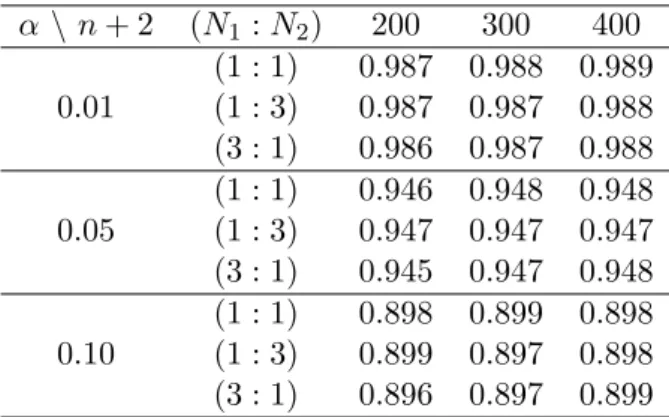
Table 1. The coverage probabilities (p = 100) α \ n + 2 (N 1 : N 2 ) 200 300 400 (1 : 1) 0.987 0.988 0.989 0.01 (1 : 3) 0.987 0.987 0.988 (3 : 1) 0.986 0.987 0.988 (1 : 1) 0.946 0.948 0.948 0.05 (1 : 3) 0.947 0.947 0.947 (3 : 1) 0.945 0.947 0.948 (1 : 1) 0
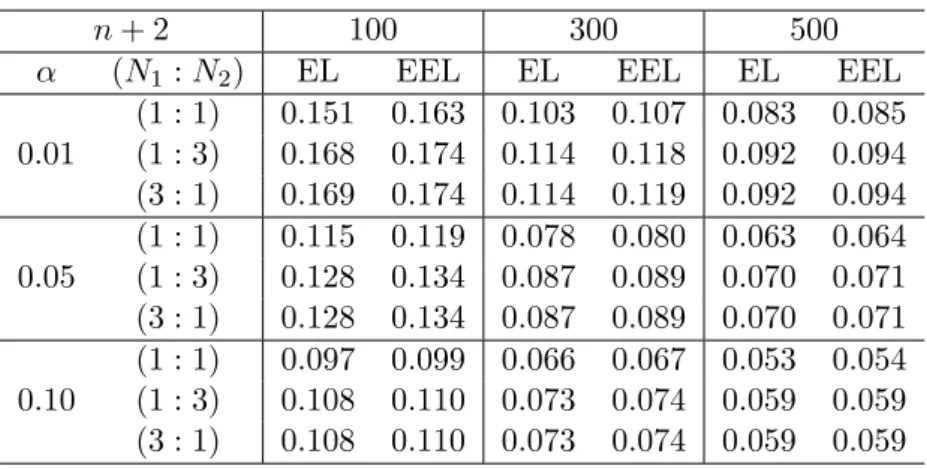
Table 6. The expected lengths (p = 5)
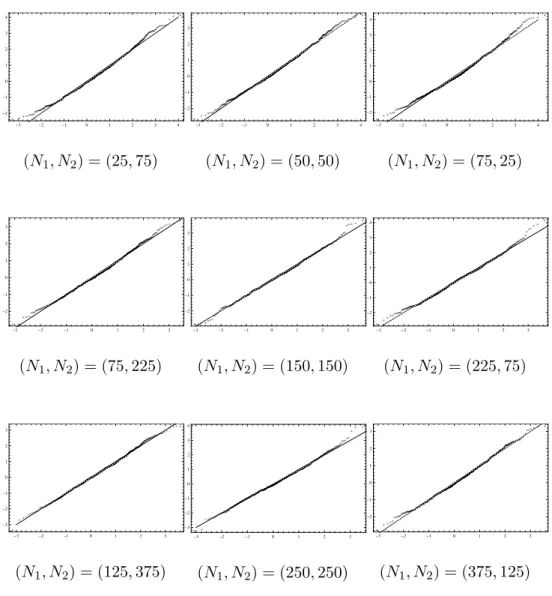
Figure 1. Q-Q plots of B N 1 ,N 2 for Case B
Figure 2. Q-Q plots of H p,N 1 ,N 2 in Case A (p = 100)
+2

参照

関連したドキュメント

We substantially im- prove the numerical constants involved in existing statements for linear forms in two logarithms, obtained from Baker’s method or Schneider’s method

It is suggested by our method that most of the quadratic algebras for all St¨ ackel equivalence classes of 3D second order quantum superintegrable systems on conformally flat

The author, with the aid of an equivalent integral equation, proved the existence and uniqueness of the classical solution for a mixed problem with an integral condition for

In this paper we develop and analyze new local convex ap- proximation methods with explicit solutions of non-linear problems for unconstrained op- timization for large-scale systems

Our main result below gives a new upper bound that, for large n, is better than all previous bounds..

Next, we prove bounds for the dimensions of p-adic MLV-spaces in Section 3, assuming results in Section 4, and make a conjecture about a special element in the motivic Galois group

Transirico, “Second order elliptic equations in weighted Sobolev spaces on unbounded domains,” Rendiconti della Accademia Nazionale delle Scienze detta dei XL.. Memorie di

The following result about dim X r−1 when p | r is stated without proof, as it follows from the more general Lemma 4.3 in Section 4..