Abstract
Information disclosure is currently accelerating in Japanese general hospitals, while in psychiatric hospitals it has still been closed and opaque. we performed a questionnaire survey to investigate the awareness and need of people of a patients' group and a health professionals' group on information disclosure in psychiatric hospitals.
there were 42 subjects for analysis, which consisted of 17 persons with a mental disorder and 25 health professions.
among 48 items, there were significant differences for 11 survey items between the patients' group and the health professionals' group.
It was found that the patients tended to wish information disclosure on human rights such as body restraint and safety in medicine such as medical accidents and hospital discharges due to death, while the administrators and the health professionals did not always agree on information disclosure of them.
the health professionals who opposed information disclosure thought that it would lead to the negative image of psychiatric hospitals.
It is necessary that the administrators and the health professionals minimize the gap on awareness, having the knowledge that a great difference of knowledge and experience exist between them and patients.
It is possible that the occupational therapists hereafter will be able to play a role in minimizing
the gap on awareness between health professionals and patients by having the public know about their services and approaches toward the prevention of accidents.
Introduction
Japanese psychiatric hospitals have the distinctive characteristics of involuntary hospitalization, closed wards, and restrictions on behavior. these are not apparent in other medical facilities. the public has less opportunity to learn about psychiatric hospitals because of the closed- and locked-door policies(Ito et al, 2004).
Psychiatric hospitals are sometimes subject to inspections by the national or local government, such as on-the-site instruction in accordance with the law on mental health and welfare for the People with mental disorders and supervision in accordance with the medical Service law. the ministry of health, labor and welfare (mhlw) collects basic data on psychiatric institutions in Japan annually, but the data are not disclosed to the public. the only way Japanese citizens have access to such information is to submit a request to the government to disclose the information based on information disclosure ordinances established by each local government. By using this method, mental health and welfare information from mhlw was disclosed in the following prefectures: osaka (osaka center for human Rights on Psychiatric medical care nPo, 2000); tokyo (tokyo center for human Rights
Stakeholders' awareness, need and Future Prospects of Information disclosure in Japanese Psychiatric hospitals
toshio hasegawa1 and teruko Iwasaki2 key words : Psychiatric hospital, Information disclosure, occupational therapy
1 department of occupational therapy, Faculty of medical technology, niigatauniversity of health and welfare.
2 Professor emeritus, niigata university of health and welfare
on Psychiatric medical care, 2000); Saitama (association for thinking medical care in Saitama, 2005), kyoto (Report of human Right center for Psychiatric medical care in kyoto and Shiga from takehata,h. et al, 2004); Shimane (takehata,h.et al, 2004); Shizuoka (Fujieda tomono-kai, 2002) and niigata (niigata nukumorinokai, 2004). however, it has been really difficult for anyone to get information disclosure from mhlw through local authorities.
For example, in one case in niigata it took two years for nPo to have information disclosed.
having many problems as stated above in the field of mental health, the Government published
"Visions Reform of mental health and medical welfare" (national center of neurology and Psychiatry, 2004). It aims "to advance the basic policy of shifting Japan's mental health and medical welfare from hospitalized medical treatment to living in the community" (p1), and realize the importance of "improvement of public awareness" of mental illness as the basic direction for the reform and national priority policies. the government also set basic policy directions to
"promote subjective understanding by providing basic information on mental illness; promote change in attitude and appropriate behavior based on improved understanding of mental illness; and promote local activities via the media for specific target audiences".
In spite of the current trend for improvement on both public awareness about mental illness as mentioned above and information disclosure in general hospitals, psychiatric hospitals still remain closed and opaque (Ito et al , 2004;
hasegawa, 2004). as it is presumed through our nPo activities that there is some difference in awareness and need of information disclosure between information providers and recipients in psychiatric hospitals, we attempted to compare awareness and need for information disclosure items among the stakeholders of psychiatric care focusing on occupational therapists. Regarding
prior studies on this theme, no research paper was found in the field of occupational therapy in Japan and one paper in the other field. This research will contribute to meet needs of psychiatric patients in occupational therapy and their families through our activities in their treatment.
Study Objectives
In order to study on awareness and need of information disclosure among the stakeholders involved in psychiatric care, we conducted a questionnaire survey by focusing on their need for medical information items to be disclosed.
In the survey, we aimed also to indentify the opinions of occupational therapists regarding information disclosure on occupational therapy and discussed future prospects in the field.
Study Methods Study Subjects
consent forms and questionnaires were distributed to 117 persons, of whom 92 people including persons with mental disorder living in a community were from incorporated nPo promoting information disclosure in psychiatric care, and 25 were health professionals including 18 occupational therapists who were members of a Psychiatric Occupational Therapy Study Group.
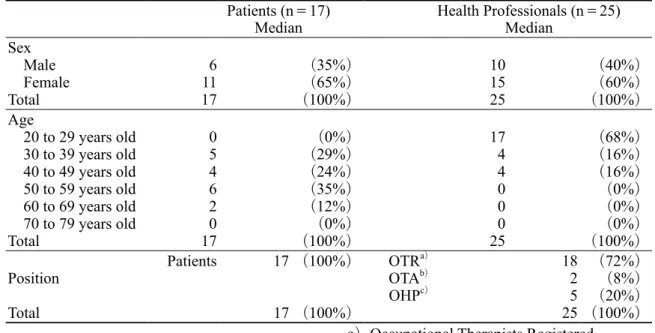
62 persons who signed the consent form participated in this survey (collection rate: 53.0%, 62/117) (table 1). among the 62 ,17 were patients and 25 were health professionals totaling 42, who were chosen for analysis.
Survey Items
the following 48 items were chosen, which could be easily answered by the respondents in six categories with reference to mhlw (2004), and three more items related to personal attributes, including free comments.
the six categories consist of (1) structural factors of hospitals (11 items such as numbers of all beds, beds in closed wards, single isolation
rooms, doctors and other health professionals); (2) treatment system factors (20 items such as numbers of in and out-patients in various conditions, availability of occupational therapy, day care and visiting nurse, staff training, and electroshock therapy); (3) factors of devices for comfortableness and privacy maintenance (5 items such as availability of medical counseling, bathing and individual rocker); (4) human rights' factors (6 items such as factors of isolation, restriction and communication condition); (5) factors of safety issues for medical matters (4 items such as numbers of medical accidents, its reason and numbers of discharge by death); and (6) factors of hospitalization (2 items such as duration of hospitalization).
Responses to each question were graded as follows: "no need to disclose" = 1 point; "not necessarily disclose" = 2 points; "either one is ok" = 3 points; "hope to disclose if possible" = 4 points; should actively disclose = 5 points.
Free comments were asked only to the members of the Psychiatric occupational therapy Study Group to describe freely on whether
psychiatric hospital information to be disclosed or not, and also about information disclosure in occupational therapy, because the Board of nPo suggested to simplify the questioner for the patients and their families. Respondents could give free comments to their answers.
Method of Data Analysis
the rated number and percentage of respondents to each question item were calculated and compared between the patients' group and the health professionals' group. the calculated scores for each group were compared using the nonparametric mann-whitney u test. the levels of significance were set to p < 0.05. SPSS 14.0 for windows was used for analyses. Free comments were coded and summarized according to codes with similar meanings.
Ethical consideration
this survey was approved by the ethics committee of niigata university of health and welfare. the survey was performed from September 10 to 30, 2006.
Table 1 Details of Study Respondents
Patients (n=17)
median health Professionals (n=25)
median
Sexmale 6 (35%) 10 (40%)
Female 11 (65%) 15 (60%)
total 17 (100%) 25 (100%)
age20 to 29 years old 0 (0%) 17 (68%)
30 to 39 years old 5 (29%) 4 (16%)
40 to 49 years old 4 (24%) 4 (16%)
50 to 59 years old 6 (35%) 0 (0%)
60 to 69 years old 2 (12%) 0 (0%)
70 to 79 years old 0 (0%) 0 (0%)
total 17 (100%) 25 (100%)
Patients 17(100%) otRa) 18 (72%)
Position otab) 2 (8%)
ohPc) 5 (20%)
total 17(100%) 25(100%)
a)occupational therapists Registered b)occupational therapist assistants c)other health Professionals
Results
In the comparison between the patient group and the health professional group, significant differences were observed in 11 out of 48 items (table 2).
though the results of the above-described six items were similar to the comparison between the patient and the non-patient groups, significant statistical differences were observed in the following 11 items: in structural information, number of nurses(p = 0.006); number of psychiatric social workers (p = 0.007);number of occupational therapists (p = 0.013); in treatment system information, number of patients visiting after consultation hours (p = 0.01); number of hospitalized emergency patients (p = 0.039);
providing occupational therapies (p = 0.003);
providing day care (p = 0.000); in information on human rights, number of body-restrained patients (p = 0.048); in information on safety in medicine, number of medical accidents (p = 0.005); and details of medical accidents (p=
0.015); annual number of hospital discharges due to death (p =0.000) .
the result of free comments from occupational therapists were coded and summarized according to codes with similar meanings. there were 63 comments.
● To the question, "What information do you think the psychiatric hospitals have to disclose?" there were a total of 22 comments, of which six are on the stay in hospital, four are on the number of hospital staff, three are on the involvement in community, two are on the treatment details, two are on the facilities, and five are on other matters.
● To the question, "What information do you not want the psychiatric hospitals to disclose?" there were a total of 13 comments, of which seven are on the information possibly leading to negative
impression of psychiatric hospitals, such as electroshock therapy, patient isolation, and body restraint, two are on privacy, four are on other matters (number of social hospitalization, number of patient discharges due to death, disclosure of medical records, and medical fees including occupational therapy fee). Respondents commented specifically of "information possibly making patients feel anxious"; "disclosing only the number of patient discharges due to death when it is unclear whether they died of self- injury/injuring others, diseases, or other reasons, may cause misunderstandings";
"information possibly enhancing the scary impression of psychiatric hospitals"; and
"information possibly giving people negative impression of the hospitals."
● To the question, "What do you think about information disclosure for occupational therapy currently performed at psychiatric hospitals?" there were a total of 16 comments, of which ten commented as "the details and the necessity of occupational therapy should be disclosed because occupational therapy itself is not known well by people", five said, "the purpose and the effectiveness of occupational therapy should be disclosed", and one said, "I do not want to disclose the medical fees for occupational therapy."
● To the question, "What do you think overall about information disclosure in psychiatric hospitals?" there were a total of 12 comments, of which five agreed with the need for information disclosure, and the following comment was added: "by being open to the public, psychiatric hospitals themselves need to change." there were three neutral comments such as "information disclosure should be promoted if it does not become an impediment to patients receiving care." Four disagreed with the information
disclosure, and the following comment was added: "it may cause misunderstandings among people who do not know much about psychiatry, depending on what information is disclosed."
Discussion
Information Disclosure Survey Items
In previous studies, the people who were compared with the patients' group are the patients' families and administrators.
Ito made the survey with 36 items for three groups with patient, patient's family and administrative board of psychiatric hospital such as local government and public health center. (Ito
et al, 2004) they reported as followed. the patients' group wanted to disclose the information concerning with their treatment directly such as numbers of accident, committee of medical accident, restriction of telephone and the result of supervision of psychiatric hospital. Family group and administrative board group agreed with similar items to disclose the number of medical stuffs and beds, treatment system of emergency and outpatient. conversely 70 percent and over of administrative board did not agree to disclose with the number of patient isolation, body- restrained, electroshock therapy, medical accident and the result of supervision of psychiatric hospital. Ito did not show the data to compare Table 2 Each Survey Item and Results of Comparison between Patient Group and Health
Professional Group
Survey Item
Patients
(n=17)
median
health Professionals
(n=25)
median
P Value
Structural Information
1 number of nurses 4 5 0.006**
2 number of psychiatric social workers 4 5 0.007**
3 number of occupational therapists 4 5 0.013*
treatment System Information
4 number of patients visiting after
consultation hours 5 3 0.010*
5 number of hospitalized emergency patients 5 3 0.039*
6 Providing occupational therapies 5 5 0.003**
7 Providing day care 5 5 0.000**
Information on human
Rights 8 number of body-restrained
patients 5 3 0.048*
Information on Safety in medicine
9 number of medical accidents 5 4 0.005**
10 details of medical accidents 5 4 0.015*
11 annual number of hospital discharges due
to death 5 3 0.000**
mann-whitney u test,* p<0.05 ** p<0.01
with groups statistically, but we included almost all their items and got the similar tendency of result with him.
asada et al (2007) implemented a questionnaire survey with 86 items in ten categories. the participants were patient group which consisted of 83 persons and patient's family group which consisted of 81 persons as recipient of mental health care, and administrator group of psychiatric hospital which consisted of 23 persons as their providers. among these differences, while patients wanted to have information related with treatment plan and discharge, family members emphasized to have the information on second opinions and associations of family members.
asada mentioned that the items more than 20%
of administrators objected to disclosure were the following: "letting patients take medicine so that they do not notice it;" "sharing information with lobbying organizations;" "sharing information by both patients and family member;" "disclosure of medical records;" and "introduction of the security company for visit," including the following same items as ours: "physical restraint;"
"isolated room;" "electroshock therapy;" and
"number of emergency patients. "In asada's research, he did not use any statistical analysis.
It could not simply be compared because each study had different research items, but among 9 items above, there were items that may give a negative impression, such as body restraint, electroshock therapy, etc.
the point of view in this study is that the people who were compared with the patients' group are the health professionals, mainly consisting of occupational therapists. In this study, different from previous studies, the analysis was done statistically. It was attempted to reveal the awareness of the health professionals including occupational therapists, not of the administrators in mental health.
In this survey, as for structural information, the
items that the health professionals agreed on disclosure are the number of nurses, the number of psychiatric social workers, and the number of occupational therapists. In Ito's survey, it was also shown that the families and the administrators tended to wish information disclosure on the number of health professionals.
In this survey, although the number of the beds in isolation wards or the number of seclusion rooms are among the same structural information, it seems that the health professionals would rather disclose the information on the number of nurses, psychiatric social workers, and occupational therapists. one of the reasons may be that the numbers of co-medicals often reflects the quality of medical treatment.
among 4 items the differences of which were found in treatment system information, the items that the patients wished to have disclosed are the number of patients visiting after consultation hours and the number of hospitalized emergency patients. these are the items of information that is a matter of urgency to patients, compared with other items.
In information on human rights, the item that patients wished to have disclosed was the number of body-restrained patients.
that is probably because the number of body- restrained patients may be related to restricting patients' rights, compared with communication on visiting conduction, having cash possession restrictions or not in the ward, and the number of isolation. In information on safety in medicine, the patients more strongly wished to have access to information such as the number of medical accidents, the details of medical accidents, and the annual number of hospital discharges due to death, than having medical safety committee or not. In Ito's survey, it was also found that the patients wished to have access to information on the number of medical accidents.
this may show that patients wish to know more specific information concerning their safety.
In free comments, the largest amount of reports that health professionals did not wish to disclose were 7 ― about electroshock therapy, seclusion, and body restraint. In their comments, those respondents recognized disclosure of such information to increase the negative image of psychiatric hospitals.
In asada's research, electroshock therapy and body restraint are among the items that more than 20% of the administrators objected to disclose.
It is likely that both the health professionals and the administrators tend not to wish information disclosure on them.
taking all this into consideration, it was found that the patients tended to wish information disclosure on human rights such as body restraint and safety in medicine such as medical accidents and hospital discharges due to death, while the administrators and the medical professionals did not always agree on information disclosure of them.
In mental health care, advanced medical judgment is required in using seclusion and body restraint, etc.
therefore, there is a great difference of knowledge and experience between the patients and the health professionals.
takezawa pointed out that there was a great difference of knowledge and experience between health care providers and health care demanders.
In mental health care, there is also a great difference of knowledge and experience. It seems that the awareness gap between the patients and the health professionals has been caused by the great difference of knowledge and experience among other things. It is necessary for the administrators and the health professionals to know what information the patients wish for, and to explain the information to them with care so that there will not be any misunderstanding.
hereafter, as for the information disclosure on safety in medicine that patients wish for, considering some health professionals' anxiety
that the negative image will increase by information disclosure, it is necessary that more accurate and careful information disclosure and how to disclose it should be discussed. It also seems that the gap on awareness needs to be minimized.
Information Disclosure in Occupational Therapy In the free comments by members of the Psychiatric Occupational Therapy Study Group, 10 persons (the largest number) commented that the details and the need for occupational therapy should be disclosed because the public not knew well of psychiatric occupational therapy. they commented also that the purpose and effectiveness of occupational therapy should be disclosed because of the benefit of patients and their families. occupational therapists presumably hoped that public understanding of their jobs will be promoted by disclosing information.
Handling of Medical Accidents by Occupational Therapists
there have been few opportunities for occupational therapists to encounter medical accidents, but occupational therapists must prepare for information disclosure, because patients wish to have it. at the same time, occupational therapists should know the details of the accident when it happens and how it happens, and by all means should try to reduce it.
the Japanese association of occupational therapists (Jaot) created and distributed the Accident Prevention Manual for Occupational Therapy in 2005 to encourage domestic members to pay attention to accident prevention measures.
In this manual, medical accidents encountered by psychiatric occupational therapists, such as leaving the hospital without permission and violence by patients, are described in detail.
Jaot is currently working on a revision to the manual. the result of this survey supports the idea that Jaot should promote such activities
more aggressively to the public.
In addition to these activities it is important that Jaot have the public know the purpose, the effectiveness and the benefits of psychiatric occupational therapy. that is because the public can get a chance to know about the psychiatric occupational therapy itself, the management of its risk, and the details of their work within hospitals.
those activities might also indirectly lead to promotion on disclosure of information by psychiatric hospitals.
It is possible that the occupational therapists hereafter will be able to play a role in minimizing the gap on awareness between health professionals and patients by having the public know about their services and approaches toward the prevention of accidents.
Conclusion
taking all this into consideration, it was found that the patients tended to wish information disclosure on human rights such as body restraint and safety in medicine such as medical accidents and hospital discharges due to death, while the administrators and the medical professionals did not always agree on information disclosure of them.
It is necessary that the administrators and the medical professionals minimize the gap on awareness, having the knowledge that a great difference of knowledge and experience exists between them and patients.
It is possible that the occupational therapists hereafter will be able to play a role in minimizing the gap on awareness between health professionals and patients by having the public know about their services and approaches toward the prevention of accidents.
The significance and limit of this research
this research is one of the very few studies analyzed statistically on information disclosure in psychiatric medical care.
the margin of this study is that the patients in this research are the members of the nPo concerned with mental health care, so there is a possibility that their interests in current problems on psychiatric medical care might be higher.
Nevertheless, there is a certain significance in this study because the research could be conducted even though there is few studies on information disclosure which involve the patients themselves.
henceforth, it is preferable that new measures be adopted so that a wider range of patients with mental disorder can participate in research.
Acknowledgment
we wish to express our gratitude to the following individuals for their cooperation in this questionnaire survey: the steering committee of the incorporated nPo and its members, and the members of the Psychiatric occupational therapy Study Group.
References
asada, t.,Inoue, S., kuroda, k. and nakatani, m.
(2007). a research on information disclosure and transparency of psychiatric hospitals. In yoshizumi. a (ed.). A study on actual condition of patients' utilization, evaluation of functions and results, and current situation of information disclosure in psychiatric hospitals (in Japanese).
Fujieda tomono-kai (association for friends of Fujieda) (2002) . A survey of psychiatric hospitals in Japan conducted by users of psychiatric hospitals (in Japanese).
hasegawa, t.(2004). disclosure of mental health information by incorporated nonprofit organization: on the occasion of publication of "niigata mental healthcare Information magazine" (in Japanese). Niigata Journal of Health and Welfare. 4(1) 57-62.
Ito, t. oohara,m. kawazoe,y. kobayasi,n.
Satomi,k. et al (2004). human rights of
hospitalized mentally handicapped individuals, In asai、k. . (ed.)., Research report on securing human rights of patients with mental disorder during hospitalization (in Japanese).
Japanese association of occupational therapists (2005). the Accident Prevention Manual for Occupational Therapy (in Japanese).
ministry of health, labor and welfare in Japan (2004). Statistical Data on Mental Health and Welfare 2003. (in Japanese).
national center of neurology and Psychiatry (2004). Visions in Reform of mental health and medical welfare.(in Japanese). http://
www.ncnp.go.jp/nimh/keikaku/vision/
e7.html 2009/06/10 (in english) niigata nukumorinokai, Incorporated nPo (2004).
Niigata Psychiatric Care Information Magazine, 79-80 (in Japanese).
osaka center for human Rights on Psychiatric medical care nPo (2000). Open the door:
Bare facts on current situation of psychiatric hospitals in Osaka. (in Japanese).
Saitamakenn no Iryo-o-kangaeru kai (association for thinking psychiatric medical care in Saitama Prefecture) (2005).Looking at psychiatric hospitals in Saitama Prefecture from data (in Japanese).
takehata,h. kawazoe,y. Ito,t. oohara,m, kobayasi,n. et al (2005). Study on actual Situation of Information disclosure activities by citizens and its Importance- Study on Information disclosure and Securing of human right (2). hospital・
c o m m u n i t y c a r e i n Psychiatry48(2),2001-202.
takezawa, J. (2006). Performance Indicator - current Situation and challenges in Japan (in Japanese). Hospital, 7, 526-531.
tokyo center for human Rights on Psychiatric medical care (2000). Current situation of psychiatric hospitals in Tokyo. (in Japanese).