development and reproduction of its vector, Laodelphax striatellus
journal or
publication title
Virus Genes
volume 53
number 6
page range 898‑905
year 2017‑06
URL http://id.nii.ac.jp/1578/00002598/
doi: 10.1007/s11262-017-1473-8
--Manuscript Draft--
Manuscript Number: VIRU-D-17-00138R1
Full Title: Quantitative analysis of Rice stripe virus in a transovarial transmission cycle during the development and reproduction of its vector, Laodelphax striatellus
Article Type: Original Article
Section/Category: Plant Virus
Keywords: small brown planthopper; Tenuivirus; rice stripe disease Corresponding Author: Mitsuru Okuda, Ph.D.
Central Region Agricultural Research Center, NARO Tsukuba, Ibaraki JAPAN
Corresponding Author Secondary Information:
Corresponding Author's Institution: Central Region Agricultural Research Center, NARO Corresponding Author's Secondary
Institution:
First Author: Mitsuru Okuda, Ph.D.
First Author Secondary Information:
Order of Authors: Mitsuru Okuda, Ph.D.
Takuya Shiba Masahiro Hirae Order of Authors Secondary Information:
Funding Information: Japan Society for the Promotion of Science
(16H04887)
Dr. Mitsuru Okuda
Abstract: The amount of Rice stripe virus (RSV) maintained through transovarial transmission was analyzed during the development and reproduction of its vector, Laodelphax striatellus. Reverse transcription-quantitative PCR analysis was used to quantify RNA expressed from the RSV coat protein (CP) gene as an estimate of RSV content in nymphs and adults of L. striatellus at various developmental stages. The 18S ribosome RNA gene of L. striatellus was chosen as the reference for calculating RSV CP expression by using the comparative Ct method. Based on the CP transcript levels, the amount of RSV did not differ significantly throughout the nymphal stage or between adult females of different ages; however, RSV content tended to increase slightly as males became older. The average RSV content in males was 1.30 to 2.49 times that in females. The amount of RSV in L. striatellus adults was compared between
generations. The RSV content of female adults did not differ significantly between the parent and progeny populations three of three different females. L. striatellus grown to adults on a susceptible cultivar and five RSV-resistant cultivars were compared to analyze whether the amount of RSV varied among cultivars. Although the amount of RSV in L. striatellus adults differed significantly among the six rice cultivars evaluated, the difference seemed independent of whether resistance genes were present. In addition, the percentage of viruliferous insects was similar among cultivars.
Dear Dr. A. Lorena Passarelli,
Manuscript reference #VIRU-D-17-00138
Please find attached a revised version of our manuscript “Quantitative analysis of Rice stripe virus in a transovarial transmission cycle during the development and reproduction of its vector, Laodelphax striatellus”, which we would like to resubmit for publication in Virus Genes.
Your comments and those of the reviewers were highly insightful and enabled us to greatly improve the quality of our manuscript. Below are our point-by-point responses to each of the comments.
Revisions in the text are shown using the tracked changes function. We hope that the
revisions in the manuscript and our accompanying responses will ensure that our manuscript is now suitable for publication in Virus Genes.
We look forward to hearing from you at your earliest convenience.
Yours sincerely, Mitsuru Okuda, Ph. D
Address: 2-1-18 Kannondai, Tsukuba, Ibaraki 305-0856 JAPAN Tel: +81-29-838-8838, Fax: +81-29-838-8837
E-mail: [email protected]
Reviewer #1:
Aims/Objectives of the research. The last paragraph of the introduction states two objectives or "questions" that are answered in the manuscript. First (1), what is the behavior of RSV concentration in L. striatellus during various developmental stages of the insect. Second (2), concentration of RSV was analyzed in L. striatellus grown on different rice cultivars (seems the question is: Does RSV content in its insect vector change depending on the rice cultivar on which the insect feeds?). The rationale for such question is not stated or guided in the introduction. It is helpful to the readers if authors provide the rationale and previous data (references) to support their hypothesis/question in the introduction.
As the reviewer commented, the aim of this study is to analyze the amount of RSV in L. striatellus during its development and reproduction. We also analyzed the amount of RSV and the percentage of transovarial transmission to identify if resistant cultivars influence them.
The introduction is revised to describe these points more clearly.
Selection of the reference gene. A good reference gene should be expressed consistently through different tissues and life stages of the organism of interest. Therefore, an assay to select the most appropriate gene, should include samples from different life stages (ages) and/or tissues. Several samples (replication) are necessary for the appropriate statistical comparisons and to measure the degree of variation. However, in Materials and Methods, I understood that a single sample (1 sample) consisting of a pool of RNA extracted from 20 adults was used.
Later on, in the results section the authors show data and information that suggests there were replicates and samples representing different growth stages. This is confusing, the experimental procedure and design should be clearly stated. I consider that an approach using a single pooled sample is not appropriated to select a reference gene.
To choose the reference gene for relative quantification, Ct values of
α1-tubulin,
𝛽- actin, 5.8S rRNA, and 18S rRNA genes were determined for RNA of 20 viruliferous L.
striatellus at different growth stages, and the stability of their expression was statistically analyzed using NormFinder and BestKeeper. The sentence was revised to describe it more clearly. To calculate the relative quantities of gene expression by using the comparative CT method, a reference sample, which normalize Ct values in each qPCR reaction (each plate), was used. The reference sample was a mixture of RNA extracted from 20 viruliferous L.
striatellus adults (different samples from those used in Bestkeeper and Normfinder analyses).
The sentence was revised to describe it more clearly.
Terminology. Just an observation how I am costumed to read abbreviations regarding real-time PCR. But I have seen different usages as well. Generally, "RT-PCR" states for retrotranscription followed by end point PCR reaction. Real-time PCR is quantitative PCR and is denoted as "qPCR". Thus, retrotranscription real time PCR is "RT-qPCR".
There seems to be a lot of words expressing a quantification method of RNA by real-
time PCR, among them, "reverse transcription-quantitative PCR (RT-qPCR)" is the most
commonly used in scientific articles. Therefore, "real-time RT-PCR" was replace with "RT-
qPCR" in the manuscript.
The sentences were rewritten to be more clearly understandable.
Page 7, lines 4 to 6. I do not understand what is meant by "…5-fold serial dilutions of L.
straitellus RNA (from 500ng/µl to 0.16ng/µl) was quantified …". The point is that samples were diluted to a final concentration of 0.16ng/µl to test by real-time PCR or serial dilution series (several dilutions per sample) were tested?
One RNA sample was diluted from 500ng/µl to 0.16ng/µl, and used for RT-qPCR analysis in order to calculate the efficiency of PCR for each primer set. The sentence was revised to describe it more clearly.
Page 8, Lines 22 to 31. Analysis of RSV content in different generations of L. striatellus. This section of material and methods requires more detail and specificity in writing. It seems the three male-female pairs were placed in a single cage. Later on, it is mentioned that progenies were designated G1a, G1b and G1c. Therefore, I assumed that each male-female pair was kept apart. For example, in line 24, change "was" to "were", it refers to three pairs. Also eliminate
"a" and change "cage" to "cages". It will read; … were placed in separate cages …. The information on how many 7-day-old adult females were collected per each male-female pair is included in figure 2, but I consider it is helpful to have it clearly stated in Mat&Met, as well.
As the reviewer suggested, the male and female pairs were separately placed in a cage to obtain progenies, and the amount of RSV in the progeny populations were analyzed. The sentence was revised to describe it more clearly.
Page 10, Lines 48 to 50. It is stated that a comparison of RSV content in parents versus progeny was not different. However, de description to how was done this comparison, number of individuals, etc.. is not clear in Mat&Met.
The sentence was revised to describe it more clearly.
About the rice resistant cultivars. Does, the rice plants exhibit real resistance: no virus replication or systemic infection? Rather, is it a tolerance phenotype; low virus titer, attenuated symptoms, restricted systemic movement of the virus, etc…? If tolerance is the situation, it would be interesting to measure the virus titer in the plants on which the insects fed. It would have been a nice data to compare against the virus content in the insects fed on each rice cultivar.
The resistant cultivars used in the study are infected with RSV under high infection pressure as explained in the text. The titre of RSV in the cultivars was not measured because they were changed every week to prevent RSV infection. The sentence was revised to describe it more clearly.
The Manuscript VIRU-D-17-00138 entitled “Quantitative analysis of
Rice stripe virus in a transovarial transmission cycle during the development and reproduction of its vector, Laodelphax striatellus” with Dr. Okuda as contact author reports the changes, or lack thereof,of viral loads within the insect vector of a persistent-propagative and transovarially transmitted
and adults used for the different experiments conducted here were transferred to new seedlings every 7 days to “prevent” their acquisition of RSV from RSV-infected seedlings. Isn’t this too much time to truly avoid RSV inoculation into the plants by potentially viruliferous insects?
Followed by replication within the rice plants and the subsequent acquisition by these nymphs and adults?
This requires at least some clarification by the authors referencing previous work stating that 7 days is enough to prevent acquisition of RSV from RSV-infected rice seedling by
L.striatellus nymphs and adults. Nonetheless, other procedures for experimentation,
identification of a stable and reliable reference gene for determining the relative amount of RSV CP transcripts in the L. striatellus body, and statistical analyses used here are appropriate for the biological assays conducted.
In this study, the nymphs and adults were transferred to new seedlings every 7 days to prevent their acquisition of RSV from RSV-infected seedlings. Normally, although inoculation access period for RSV transmission to rice seedlings is less than 24 hours, it takes at least 6 days to showed typical disease symptom on the inoculated plants. Actually, we observed few seedlings showed clear symptoms when we changed them. According to the previous report, L. striatellus do not acquire RSV from rice plants showing no symptoms. In addition, about a half of tested insects in the population analyzed in our experiments were non-viruliferous, and RSV could not be detected by RT-qPCR. If RSV was acquired from RSV-infected rice seedlings, small amount of RSV should be detected by RT-qPCR. Thus, we asuure that the acquisition from infected rice seedlings was very limited, and all viruliferous insects obtained in the experiments are transovarial transmission.
In Figure 3 on the bottom panel (for males) the bar for the Koshihikari rice cultivar is missing the letter from the Tukey’s multiple comparisons test.
As described in the text, only two viruliferous male adults were obtained from Koshihikari, so that they were excluded from statistical analysis. The annotation was added also in the figure legend.
Minor corrections
In line 36 on page 6, it should say “cylindrical cage (diameter, 9 cm) where they remained together”.
The sentence was revised according to the suggestion.
The sentence was revised according to the suggestion.
In line 46 on page 9, it should say “showed acceptable efficiencies” instead of similar high efficiencies as 88.4%, 89.7%, and 89.3% efficiencies for α1-tubulin, 5.8S rRNA, and 18S rRNA, respectively, are not really similar to the 99.8% efficiency of the RSV CP primer pair.
The sentence was revised according to the suggestion.
In the
Author Contributions section, it is not specified who exactly conducted theexperiments reported in this manuscript.
The Author Contributions section was revised to show who conducted the experiments.
In line 20 on page 16, the authors have two #6 references. Correct to have one #5 and one #6.
The sentence was revised according to the suggestion.
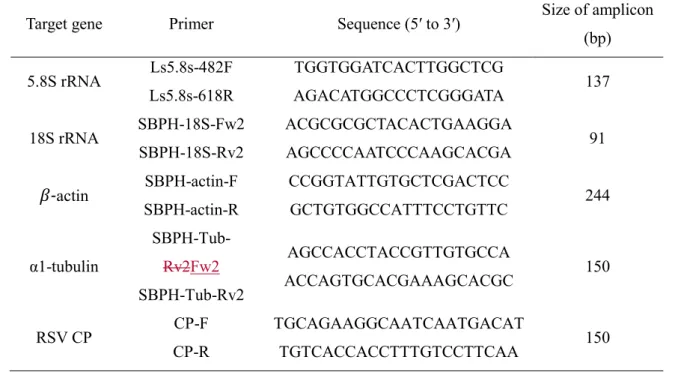
In line 22 on page 18 within Table 1, the authors have SBPH-Tub-Rv2 twice while it should have been SBPH-Tub-Fw2 for the forward primer in the pair.
The sentence was revised according to the suggestion.
Ultimately, I recommend this manuscript be accepted with significant revisions (i.e. until the
authors provide clear and compelling evidence of the proven fact that transferring L. striatellus
nymphs and adults to new seedlings every 7 days really prevent acquisition of RSV from RSV-
infected seedlings to differentiate that from transovarial transmission) before publication in
Virus Genes.
Quantitative analysis of Rice stripe virus in a transovarial transmission cycle during the development and reproduction of its vector, Laodelphax striatellus
Mitsuru Okuda
*, Takuya Shiba, and Masahiro Hirae
Agricultural Research Center, National Agriculture and Food Research Organization (NARO), 2-1-18 Kan-nondai, Tsukuba, Ibaraki 305-0856, Japan
*
Corresponding author: Mitsuru Okuda; Tel, +81-29-838-8885; Fax, +81-838-8484; E- mail, [email protected]
1 2 3 4 5 6 7 8 9 10 11 12 13 14 15 16 17 18 19 20 21 22 23 24 25 26 27 28 29 30 31 32 33 34 35 36 37 38 39 40 41 42 43 44 45 46 47 48 49 50 51 52 53 54 55 56 57 58 59 60
Abstract
The amount of Rice stripe virus (RSV) maintained through transovarial transmission was analyzed during the development and reproduction of its vector,
Laodelphaxstriatellus. Reverse transcription–quantitative PCR analysis was used to quantify RNA expressed from the RSV coat protein (CP) gene as an estimate of RSV content in nymphs and adults of L. striatellus at various developmental stages. The 18S ribosome RNA gene of L. striatellus was chosen as the reference for calculating RSV CP expression by using the comparative Ct method. Based on the CP transcript levels, the amount of RSV did not differ significantly throughout the nymphal stage or between adult females of different ages; however, RSV content tended to increase slightly as males became older. The average RSV content in males was 1.30 to 2.49 times that in females. The amount of RSV in L. striatellus adults was compared between generations. The RSV content of female adults did not differ significantly between the parent and progeny populations three of three different females. L. striatellus grown to adults on a susceptible cultivar and five RSV-resistant cultivars were compared to analyze whether the amount of RSV varied among cultivars. Although the amount of RSV in L. striatellus adults differed significantly among the six rice cultivars evaluated, the difference seemed independent of whether resistance genes were present. In addition, the percentage of viruliferous insects was similar among cultivars.
2 3 4 5 6 7 8 9 10 11 12 13 14 15 16 17 18 19 20 21 22 23 24 25 26 27 28 29 30 31 32 33 34 35 36 37 38 39 40 41 42 43 44 45 46 47 48 49 50 51 52 53 54 55 56 57 58 59 60
List of authors
Mitsuru Okuda*, Agricultural Research Center, National Agriculture and Food Research Organization (NARO), 2-1-18 Kan-nondai, Tsukuba, Ibaraki 305-0856, Japan
Takuya Shiba, Agricultural Research Center, National Agriculture and Food Research Organization (NARO), 2-1-18 Kan-nondai, Tsukuba, Ibaraki 305-0856, Japan
Masahiro Hirae, Agricultural Research Center, National Agriculture and Food Research Organization (NARO), 2-1-18 Kan-nondai, Tsukuba, Ibaraki 305-0856, Japan
*
Corresponding author: Mitsuru Okuda; Tel, +81-29-838-8885; Fax, +81-838-8484; E- mail, [email protected]
2 3 4 5 6 7 8 9 10 11 12 13 14 15 16 17 18 19 20 21 22 23 24 25 26 27 28 29 30 31 32 33 34 35 36 37 38 39 40 41 42 43 44 45 46 47 48 49 50 51 52 53 54 55 56 57 58 59 60
1
Keywords: small brown planthopper, Tenuivirus, rice stripe disease
2
3
2 3 4 5 6 7 8 9 10 11 12 13 14 15 16 17 18 19 20 21 22 23 24 25 26 27 28 29 30 31 32 33 34 35 36 37 38 39 40 41 42 43 44 45 46 47 48 49 50 51 52 53 54 55 56 57 58 59 60
Introduction 4
Rice stripe virus (RSV) belonging to the genus Tenuivirus [1] causes chlorotic stripes,
5
mottling, and necrotic streaks on the leaves of rice (Oriza sativa). Plants severely infected 6
with RSV often show panicle sterility, resulting in lower yield [2]. RSV occurs in many 7
Asian countries, including Japan, Korea, and China. In Japan, rice stripe disease 8
devastated rice production from 1960 to 1985 [3]. Although the disease gradually 9
subsided from 1985 to 2004, its incidence began to increase again in 2005. In 2015, more 10
than 137,000 hectares of rice fields, accounting for approximately 9% of the total 11
cultivated area in Japan, were affected by RSV [4]. Therefore, effective control measures 12
are urgently needed. 13
Virus particles of RSV contains four single-stranded RNA molecules (RNA1 through 14
RNA4), and their seven genes are encoded in negative or ambisense orientation [5, 6]. 15
RSV is persistently transmitted by Laodelphax striatellus and other planthoppers [2]. The 16
virus propagates in the insect vectors and is transmitted from female adults to their 17
progeny at the egg stage. Under experimental conditions, the percentage of eggs 18
exhibiting transovarial transmission was estimated to be greater than 90% [7]. Thus, 19
transovarial transmission of RSV is considered the main reason for the high viruliferous 20
rate in nature, which makes rice stripe disease difficult to control. Understanding how 21
RSV is maintained in L. striatellus during its development and reproduction is one of the 22
keys to developing effective control measures against this disease. 23
Rice cultivars resistant to viruses are widely used to minimize the damage due to virus 24
infection [8]. Breeding programs to introduce a resistance gene (Stvb-i) from an Indica- 25
type rice cultivar Modan, which shows high resistance to RSV [9], successfully yielded 26
resistant cultivars, which effectively control RSV disease in some areas. However, 27
because RSV is transmitted transovarially, the percentage of viruliferous insects 28
decreases slowly even in areas where resistant cultivars are grown. Therefore, susceptible 29
cultivars grown in the same area as resistant ones may be at increased risk of infection 30
due to the decreased emphasis on vector control, consequently increasing the number of 31
vectors in an area. If a resistant cultivar directly decreases transovarial transmission or 32
the amount of RSV in
L. striatellus, cultivating resistant cultivars would be useful in33
2 3 4 5 6 7 8 9 10 11 12 13 14 15 16 17 18 19 20 21 22 23 24 25 26 27 28 29 30 31 32 33 34 35 36 37 38 39 40 41 42 43 44 45 46 47 48 49 50 51 52 53 54 55 56 57 58 59 60
suppressing the incidence of rice stripe disease in a region. Some cultivars show 34
resistance to L. striatellus due to antixenosis or tolerance to the insect [10]. However, the 35
host factors that affect transovarial transmission or the amount of RSV remain unclear. 36
In the current study, the RSV levels in L. striatellus adults grown on different rice 37
cultivars were analyzed. 38
Recent developments in molecular techniques have made it possible to quantify viral 39
RNA in their hosts [11]. Because of its sensitivity, reverse transcription–quantitative PCR 40
(RT-qPCR) analysis is one of the most widely used methods of RNA quantification. 41
Zhang et al. [12] developed a RT-qPCR–based method for quantifying expression of RSV 42
coat protein (CP) RNA in rice tissues and L. striatellus. However, although transovarial 43
transmission plays an important role in the life cycle of RSV, whether the amount of RSV 44
maintained in
L. striatellus via transovarial transmission changes during various45
developmental stages has not yet been well characterized. In this study, the amount of 46
RSV maintained via transovarial transmission was analyzed during the development and 47
reproduction of its vector, L. striatellus. 48
49 50
Materials and methods 51
Insect population 52
Adults of L. striatellus were collected from rice plants showing typical symptoms of 53
rice stripe disease in Ibaraki Prefecture, Japan. They were maintained in an insect cage 54
(340 mm × 260 mm × 340 mm, Sanshin Industrial, Kanagawa, Japan) containing rice 55
seedlings under controlled conditions of temperature (25 °C) and photoperiod (16 h light, 56
8 h dark). To increase the percentage of viruliferous insects, male–female pairs were 57
transferred to rice seedlings in a cylindrical cage (diameter, 9 cm) where they remained 58
together for 5 days to lay eggs, after which females were separately tested to determine 59
whether they were viruliferous by using a simplified enzyme-linked immunosorbent 60
assay (ELISA) [13, 14]. Descendants of the viruliferous females were collected, 61
maintained, and used for this study. 62
2 3 4 5 6 7 8 9 10 11 12 13 14 15 16 17 18 19 20 21 22 23 24 25 26 27 28 29 30 31 32 33 34 35 36 37 38 39 40 41 42 43 44 45 46 47 48 49 50 51 52 53 54 55 56 57 58 59 60
Preparation of RNA templates from insects 63
Each adult or nymph of L. striatellus was collected into a disposable homogenizing 64
tube containing zirconia beads (Biomasher IV, Nippi, Tokyo, Japan), homogenized with 65
250 µl of ISOGEN II (Nippon Gene, Toyama, Japan) using a Multibeads Shocker (Yasui 66
Kikai, Tokyo, Japan), and kept at –80 °C until RNA extraction. RNA was extracted 67
according to the manufacturer’s recommended procedure, except 1 µl of glycogen (20 68
mg/ml) was added during the nucleic acid precipitation step, and dissolved in distilled 69
water. The concentration of RNA in the prepared solutions was measured using a Qubit 70
Fluorometer (Life Technologies, Carlsbad, CA, USA). 71
Quantification of RSV in L. striatellus 72
RT-qPCR analysis was used to quantify RNA expressed from the RSV coat protein 73
(CP) gene as an estimate of the RSV content in L. striatellus. The primer set CP-F and 74
CP-R [15] was used to detect RSV CP RNA. RT-qPCR analysis was performed using 75
RNA Direct SYBR qPCR Mix (Toyobo, Tokyo, Japan) and an MX3000P system (Agilent 76
Technologies, Santa Clara, CA, USA). After reverse transcription at 61 °C for 20 min and 77
denaturation at 95 °C for 30 s, the PCR conditions consisted of 40 cycles of 95 °C for 15 78
s, 55 °C for 15 s, and 74 °C for 30 s. The intensity of SYBR Green I fluorescence 79
(wavelength, 497 nm) was measured at the end of each cycle. The cycle threshold (Ct), 80
in which the fluorescent signal reaches a threshold value, was determined using software 81
provided with the MX3000P. When the Ct of RSV CP transcripts for a sample exceeded 82
30, the insect was regarded as non-viruliferous and was excluded from the analysis. 83
Duplicate reactions were performed for each sample, and the reaction was repeated when 84
the difference between the two Ct values exceeded 0.5. After PCR analysis was completed, 85
amplification specificity was validated using melting curve analysis, which consisted of 86
denaturation at 95 °C for 60 s and annealing at 55 °C at 30 s, followed by continuous 87
measurement of fluorescence intensity at increasing temperatures of 0.1 °C per second 88
until the temperature reached 90 °C. 89
To choose an appropriate reference gene for determining the relative amount of RSV 90
CP transcripts in the L. striatellus body, α1-tubulin, 𝛽-actin, 5.8S rRNA, and 18S rRNA 91
genes (GenBank accession numbers AY508717, AY192151, AB625609, and AB085211, 92
2 3 4 5 6 7 8 9 10 11 12 13 14 15 16 17 18 19 20 21 22 23 24 25 26 27 28 29 30 31 32 33 34 35 36 37 38 39 40 41 42 43 44 45 46 47 48 49 50 51 52 53 54 55 56 57 58 59 60
respectively) were selected. Primers for the actin gene were published previously [16]; 93
primers corresponding to the other genes were designed using a Geneious software 94
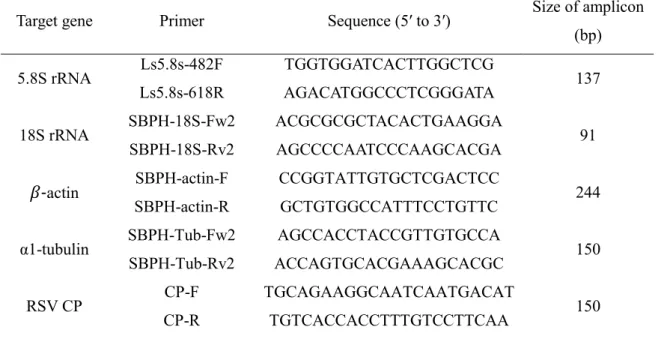
(Biomatters, Auckland, New Zealand) (Table 1). First, the Ct values of RT-qPCR using 95
these primer sets were obtained from 5-fold serial dilutions of the RNA of 20 viruliferous 96
L. striatellus (from 500 ng/µl to 0.16 ng/µl) to calculate amplification efficiencies. Second, 97
to choose the most appropriate gene for reference, the Ct values of these four genes were 98
obtained from each RNA of 20 viruliferous L. striatellus at different growth stages (four 99
isolates each of 2nd-, 4th-, and 5th-instar nymphs and 1–4- and 7–12-day-old adults), and 100
the stability of their expression was statistically analyzed by using NormFinder [17] and 101
BestKeeper [18]. Genes with lower stability values in the Normfinder analysis and higher 102
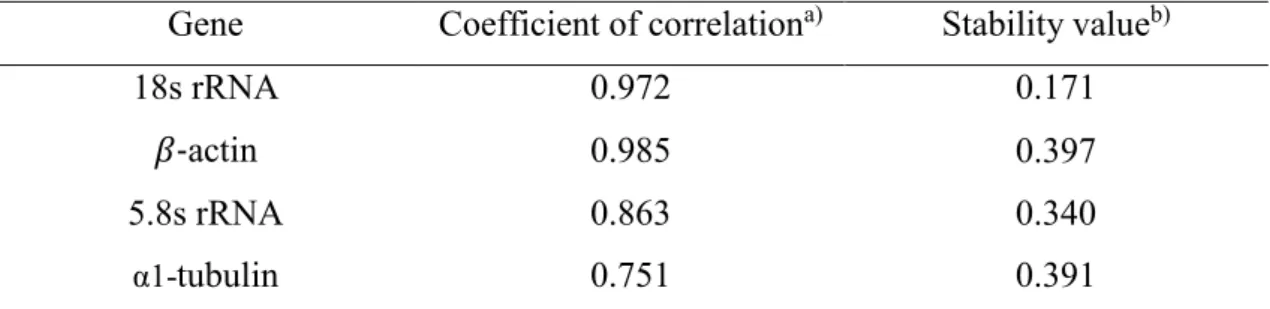
coefficient of correlation in the BestKeeper analysis was regarded more stable. Then, the 103
Ct values of RSV CP and the reference gene were obtained for each L. striatellus RNA 104
sample. The relative quantities of RSV CP transcripts were calculated according to the 105
comparative C
Tmethod [19]. The mixture of RNA extracted from 20 viruliferous L. 106
striatellus adults was used as the reference sample for the comparative C
Tmethod in each 107
reaction. 108
Analysis of RSV content in L. striatellus nymphs and adults 109
Seedlings of rice (cv. Koshihikari) at the first to second true-leaf stage were put in the 110
insect cage with the viruliferous L. striatellus population for 2 days. Insects were then 111
removed, and the seedlings were placed under a cylindrical cage covered with nylon mesh 112
and kept in the growth cabinet (25 °C; 16 h light: 8 h dark photoperiod). Nymphs were 113
collected at 2, 9, 13, and 16 days after first-instar nymphs emerged; 0-, 7-, 14-, and 21- 114
day-old adults were also collected. The nymphs and adults were transferred to new 115
seedlings every 7 days to prevent their acquisition of RSV from RSV-infected seedlings. 116
RNA was extracted from each insect, and the amount of RSV CP RNA was measured by 117
RT-qPCR. 118
Analysis of RSV content in different generations of L. striatellus 119
Male–female pairs of the viruliferous population (designated as G0) were separately 120
placed in individual cages containing rice seedlings (cv. Koshihikari) to obtain progeny. 121
The adult females were removed after 7 days and were assessed by RT-qPCR to determine 122
2 3 4 5 6 7 8 9 10 11 12 13 14 15 16 17 18 19 20 21 22 23 24 25 26 27 28 29 30 31 32 33 34 35 36 37 38 39 40 41 42 43 44 45 46 47 48 49 50 51 52 53 54 55 56 57 58 59 60
whether they were viruliferous. The progeny of three different viruliferous females 123
(designated as G1a, G1b, and G1c) were grown to adults as described above and collected 124
at 7 days after emerging. The number of samples from G1a, G1b and G1c were 24, 15, 125
and 16, respectively. RNA was extracted from each sample, and the amount of RSV was 126
measured by RT-qPCR analysis. 127
Analysis of the RSV content in L. striatellus on different rice cultivars 128
The susceptible cultivar Koshihikari and the RSV-resistant cultivars Asahino-yume 129
(stv-bi), Koshihikari Kinchushi SBL1 (stv-a and stv-b), and near-isogenic lines of 130
Koshihikari—NIL-STV2 (stv-b), NIL-STV11 (stv-a), and NIL-STV2/STV11 (stv-a and 131
stv-b) [20]—were used to assess whether RSV content in L. striatellus varies among 132
cultivars. Seedlings (first to second true-leaf stage) of these plants were placed in the 133
same insect cage with a viruliferous L. striatellus population for 2 days. After insects 134
were removed, the seedlings of each cultivar were placed under individual cylindrical 135
cages with nylon mesh, and the progenies were grown to the adult stage as described 136
above. Insects were transferred to new seedlings of the same cultivar every 7 days to 137
prevent their acquisition of RSV from seedlings. RNA was extracted from approximately 138
7-day-old adults, and the amount of RSV was measured by RT-qPCR analysis. 139
140
Statistical analysis 141
Statistical analyses were performed using Prism 7 for Mac OS X (Graph Pad 142
Software, La Jolla, CA, USA). The percentage of viruliferous insects was analyzed using 143
the chi-square test. The amount of RSV in L. striatellus nymphs was compared between 144
growth stages by using one-way ANOVA followed by Tukey’s multiple-comparisons test. 145
The amount of RSV in L. striatellus adults at different ages was compared by two-way 146
ANOVA to determine whether an interaction between sex and age was present, followed 147
by Tukey’s multiple-comparisons test, in which data from males and females were 148
analyzed separately. The RSV content was compared between males and females at the 149
same age by using two-sided Student’s t-test and between female parents and their 150
progenies by using one-way ANOVA followed by Dunnett’s multiple-comparisons test. 151
The amount of RSV grown on different cultivars was analyzed using one-way ANOVA 152
2 3 4 5 6 7 8 9 10 11 12 13 14 15 16 17 18 19 20 21 22 23 24 25 26 27 28 29 30 31 32 33 34 35 36 37 38 39 40 41 42 43 44 45 46 47 48 49 50 51 52 53 54 55 56 57 58 59 60
followed by Tukey’s multiple-comparisons test. Data were regarded significantly 153
different when P < 0.05. 154
155
Results 156
Validation of RT-qPCR primers 157
RT-qPCR analysis of 5-fold serial dilutions of viruliferous L. striatellus RNA 158
revealed increases in fluorescence intensity specific to RSV CP at 0.16 ng/µl to 500 ng/µl; 159
the signal intensity of non-viruliferous samples increased very slowly or did not increase 160
(data not shown). A calibration curve indicating the regression coefficient between the Ct 161
and the quantity of the diluted cDNA demonstrated the high (99.8%) efficiency of the 162
PCR analysis. The Ct and corresponding calibration curves for four housekeeping genes 163
of L. striatellus—α1-tubulin,
𝛽-actin, 5.8S rRNA, and 18S rRNA—showed acceptable164
efficiencies (88.4%, 95.79%, 89.7%, and 89.3%, respectively). The Ct of RT-qPCR 165
analysis for the housekeeping genes was analyzed for stability by using RNA of 166
viruliferous L. striatellus (n = 20) at different growth stages. Results of Bestkeeper and 167
Normfinder analyses indicated that 18S rRNA was the most suitable gene for 168
standardizing expression levels throughout the development of viruliferous L. striatellus 169
(Table 2). Therefore, the expression of 18S rRNA was used as a reference in further 170
analyses. 171
172
Quantification of RSV throughout the development of L. striatellus 173
174
RSV CP transcript levels, as a measure of RSV content, in 2-, 9-, 13-, and 16-day- 175
old nymphs and 0-, 7-, 14-, and 21-day-old adults of L. striatellus were detected by using 176
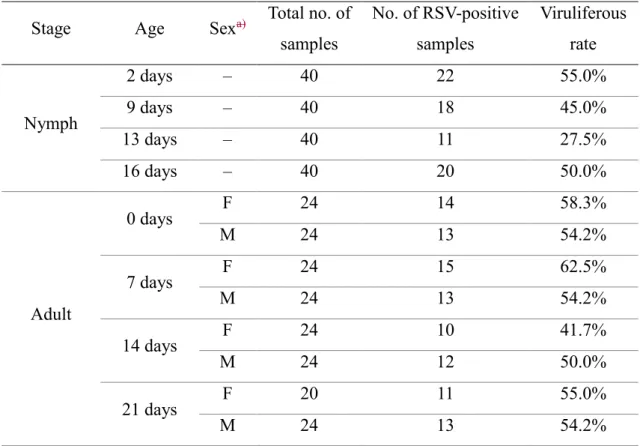
RT-qPCR analysis. The percentage of viruliferous insects did not differ significantly 177
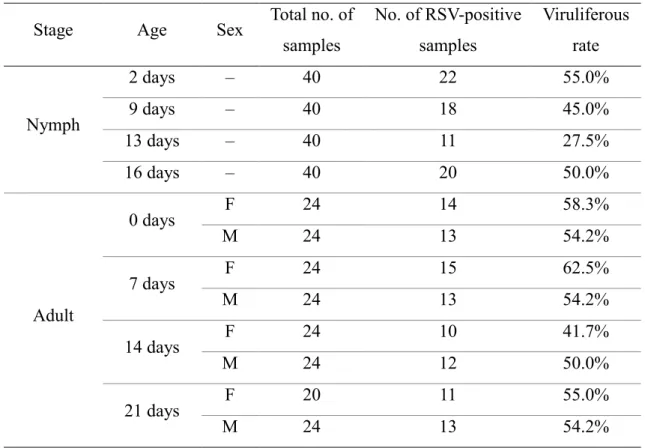
between nymphal stages, adult stages, or males and females (chi-square test, P = 0.34) 178
(Table 3). The RSV content did not differ significantly throughout the growth of nymphs 179
(Tukey’s multiple comparisons test, P > 0.05) (Fig. 1). Two-way ANOVA failed to reveal 180
any significant interaction between sex and age in adults (P = 0.085), but significant 181
effects of sex (P < 0.0001) and age (P = 0.011) were present. The RSV content was 182
significantly higher in males than females at 7 and 21 days (Student’s t-test, P < 0.0001 183
and P = 0.012) but not at the other time points. The average amount of RSV in male adults 184
2 3 4 5 6 7 8 9 10 11 12 13 14 15 16 17 18 19 20 21 22 23 24 25 26 27 28 29 30 31 32 33 34 35 36 37 38 39 40 41 42 43 44 45 46 47 48 49 50 51 52 53 54 55 56 57 58 59 60
at 0, 7, 14, and 21 days was 1.30, 2.49, 1.40, and 2.09 times, respectively, that of their 185
age-matched female counterparts. 186
In female adults, the RSV content did not differ between age groups (Tukey’s 187
multiple comparisons test, P > 0.05). In male adults, the RSV content at 21 days was 188
significantly higher than that at 0 days (Dunnett’s multiple comparisons test, P = 0.01) 189
and demonstrated a statistical trend toward increasing RSV content with age (P = 0.017). 190
191
Comparison of RSV content between parents and their progenies of L. striatellus 192
The RSV content of L. striatellus female adults and their female progenies was 193
compared (Fig. 2). The RSV content of the viruliferous females in the parent population 194
(G0) ranged from 0.21 to 2.1 when the mean value of viruliferous females was set as 1, 195
compared with 0.42 to 2.1 in the G1a, 0.66 to 2.4 in G1b, and 0.36 to 1.4 in G1c. The 196
efficiencies of the transovarial transmission were 83%, 73%, and 94%, respectively. RSV 197
content did not differ significantly between parents and their progenies (Dunnett’s 198
multiple-comparisons test, P > 0.05). 199
200
Quantification of RSV content in L. striatellus adults grown on different hosts 201
RSV CP RNA in L. striatellus adults grown on six rice cultivars was detected by 202
using RT-qPCR (Fig. 3). The percentage of viruliferous insects did not differ among 203
cultivars (chi-square test, P = 0.27 for males and P = 0.66 for females) (Table 4). The 204
mean RSV content of female L. striatellus adults differed slightly between cultivars and 205
ranged from 0.64 to 1.74 when the average value of parent females was set as 1. The RSV 206
content of adult females grown on NIL-STV11 was significantly higher than that of those 207
grown on Koshihikari, Koshihikari Kinchushi SBL1, NIL-STV2/STV11, or Asahino- 208
yume (Tukey’s multiple comparisons test, P = 0.02, 0.008, 0.006, and 0.005, respectively). 209
The mean RSV content in male L. striatellus adults also varied among cultivars, 210
ranging from 1.0 to 3.52 relative to the average value of parent female adults. Because 211
only two viruliferous male adults were obtained from Koshihikari, they were excluded 212
from statistical analysis. Male adults grown on NIL-STV11 showed the highest RSV 213
content, which was significantly higher than those grown on Koshihikari Kinchushi SBL1 214
or Asahino-yume (Tukey’s multiple-comparisons test, P = 0.004 and 0.006, respectively). 215
The average amount of RSV in males was 1.42 to 3.27 times that of females grown on 216
2 3 4 5 6 7 8 9 10 11 12 13 14 15 16 17 18 19 20 21 22 23 24 25 26 27 28 29 30 31 32 33 34 35 36 37 38 39 40 41 42 43 44 45 46 47 48 49 50 51 52 53 54 55 56 57 58 59 60
the same cultivars. 217 218
Discussion 219
In this study, the amount of RSV maintained transovarially was analyzed throughout 220
the development of its vector, L. striatellus. RT-qPCR analysis was used to quantify RSV 221
CP RNA, as a measure of RSV content. Selecting an appropriate reference gene is 222
essential for quantifying RNA by using RT-qPCR analysis [21]. According to the results 223
of NormFinder and BestKeeper analyses, the expression of the 18S rRNA gene was the 224
most consistent among the candidates tested. The 18S rRNA gene has been reported as 225
one of the most stable genes in the planthopper Delphacodes kuscheli [22]. In addition, 226
the expression level of the 18S rRNA gene is sufficiently high that it is useful when the 227
RNA yield is low, such as when evaluating tiny insects or early-stage nymphs. The 228
nymphs and adults were transferred to new seedlings every 7 days to prevent their 229
acquisition of RSV from RSV-infected seedlings. Although the inoculation access period 230
for RSV transmission to rice seedlings is typically less than 24 hours, it takes at least 6 231
days for the inoculated plants to showed characteristic disease symptoms [7]. In fact, few 232
seedlings had clear disease symptoms at the 7-day point when we transferred the insects 233
to fresh seedlings. L. striatellus does not acquire RSV from rice plants that show no 234
disease symptoms [7]. In addition, about half of the tested insects in the populations we 235
analyzed were non-viruliferous, and RT-qPCR analysis was unable to detect any RSV in 236
these non-viruliferous samples. If RSV was acquired from RSV-infected rice seedlings, 237
then RT-qPCR analysis should detect even a small amount of RSV. Thus, the acquisition 238
of RSV from infected rice seedlings was likely very limited, and all viruliferous insects 239
obtained in the experiments were due to transovarial transmission. 240
The relative amount of RSV maintained in L. striatellus via transovarial transmission 241
remained consistent throughout the nymphal stage. The amount of total RNA in insects 242
increases throughout the nymphal stages as body size increases. This similarity in the 243
relative RSV content throughout the nymphal stage indicates that RSV multiplies in 244
synchrony with the multiplication of the host cells. After emergence, the relative RSV 245
content of female adults remained consistent regardless of their age; however the RSV 246
content in male adults showed a tendency to increase as they became older. Overall these 247
data indicate that RSV replication stopped or plateaued after the vector became an adult. 248
2 3 4 5 6 7 8 9 10 11 12 13 14 15 16 17 18 19 20 21 22 23 24 25 26 27 28 29 30 31 32 33 34 35 36 37 38 39 40 41 42 43 44 45 46 47 48 49 50 51 52 53 54 55 56 57 58 59 60
RSV reportedly multiplied after its injection into healthy L. striatellus adults [23]. 249
Therefore, there may be a limit to the amount of RSV content that a single L. striatellus 250
cell can accommodate, and cells might be nearly saturated with RSV when the virus is 251
passed to insect progeny through transovarial transmission. 252
The relative amount of RSV in male adults was about two times that in females, and 253
the difference became more pronounced with age. In contrast, the transmission of RSV 254
to plants by L. striatellus female adults is more efficient than that by males [7]. This 255
apparent contradiction may reflect differences in body size or feeding behavior between 256
sexes. Compared with males, female adults tend to prolong sucking, to obtain sufficient 257
nutrition for laying eggs; this feeding behavior might increase opportunities for virus 258
transmission. 259
The efficiency of transovarial transmission of RSV in L striatellus is estimated to 260
exceed 90% under experimental conditions [7]. In the current study, the rate of 261
transovarial transmission was similar (73% to 94%) among the three populations of 262
viruliferous female adults evaluated. In addition, our RT-qPCR assay did not detect 263
RSV in any of the non-viruliferous progenies born from viruliferous females, even though 264
the theoretical lower limit of RSV detection of the method we used was 10
5times lower 265
than the average amount we obtained. This result suggests that either no RSV particles 266
were transferred to the eggs of non-viruliferous insects or that RSV was completely 267
excluded at a very early stage of development. Li et al. [24] reported that the VP1 protein 268
of Himetobi P virus (HiPV) may facilitate the accumulation of RSV in L. striatellus . 269
Further analysis of the distribution of HiPV to eggs might reveal the mechanism of 270
transovarial transmission of RSV. 271
The resistance gene Stv-bi, which originates from the Indian cultivar Modan [25], has 272
been introduced into many of the rice cultivars currently commercially available in Japan. 273
Two molecular markers for resistance genes, stv-a and stv-b, which originate from an 274
upland variety of rice [26], were identified recently and are now being used for breeding 275
resistant cultivars, such as an isogenic line of Koshihikari [27]. Although the precise 276
mechanisms by which these genes convey resistance have not been identified, our current 277
results show that these resistant cultivars have no effect on the percentage of viruliferous 278
insects, at least within the span of a single generation. Our preliminary experiments have 279
2 3 4 5 6 7 8 9 10 11 12 13 14 15 16 17 18 19 20 21 22 23 24 25 26 27 28 29 30 31 32 33 34 35 36 37 38 39 40 41 42 43 44 45 46 47 48 49 50 51 52 53 54 55 56 57 58 59 60
indicated that the efficiency of transovarial transmission does not differ between L. 280
striatellus populations grown on Koshihikari and Asahino-yume (Stv-bi) over at least four 281
generations (Okuda, unpublished data). Other experiments have shown that the 282
percentage of RSV-viruliferous L. striatellus decreased in paddy fields where cultivars 283
resistant to RSV were grown [28]. Our current results suggest that this decrease merely 284
reflects that (1) the percentage of transovarial transmission is approximately 90%, and (2) 285
the likelihood of acquiring RSV from resistant cultivars is lower than that from 286
susceptible ones because of the lower number of diseased plants. However, because 287
resistant cultivars carrying Stv-bi succumb to RSV infection under high inoculation 288
pressure [29], cultivating these cultivars in areas where the incidence of RSV is very high 289
should be accompanied by appropriate control measures against L. striatellus, such as 290
insecticides. 291
Although the RSV content in L. striatellus differed among rice cultivars, the 292
difference seemed unrelated to the resistance genes present. In particular, the RSV content 293
in L. striatellus grown on NIL-STV2/STV11, which carries both stv-a and stv-b, was the 294
highest among the six cultivars evaluated, whereas Koshihikari Kinchushi SBL1, which 295
also carries both stv-a and stv-b, did not differ from Koshihikari in this regard. Differences 296
in nutritional status among plants might affect the metabolism of vector insects. The 297
influence of the amount of RSV in L. striatellus on the efficiency of its transmission to 298
plants has yet to be determined. Symbiotic microorganisms in insects have recently been 299
reported to influence the amount of insect-borne plant viruses transmitted and the 300
efficiency of this transmission [30, 31]. Although more research is needed to reveal the 301
mechanisms by which RSV accumulates in L. striatellus, the findings of the current study 302
might facilitate the selection of new resistant varieties that decrease the amount of RSV 303
in the vectors. 304
This study focused on RSV maintained in L. striatellus via transovarial transmission. 305
This process is a major reason for the devastating effect of this virus in the field. However, 306
because the efficiency of transovarial transmission is not 100%, L. striatellus must 307
somehow acquire RSV from infected plants to maintain a constant viruliferous rate in the 308
field. Little is known about the molecular mechanisms through which L. striatellus 309
acquires RSV from virus-infected rice plants. Further study is needed to reveal how RSV 310
is maintained in L. striatellus populations. 311
2 3 4 5 6 7 8 9 10 11 12 13 14 15 16 17 18 19 20 21 22 23 24 25 26 27 28 29 30 31 32 33 34 35 36 37 38 39 40 41 42 43 44 45 46 47 48 49 50 51 52 53 54 55 56 57 58 59 60
312 313 314
AUTHOR CONTRIBUTIONS 315
Mitsuru Okuda designed the experiments, conducted all experiments, analyzed the data, 316
prepared figures and tables, and drafted the paper; Takuya Shiba cooperated in 317
designing the experiments, performed statistical analysis of the data, and reviewed 318
drafts of the paper; Masahiro Hirae collected and maintained L. striatellus populations, 319
cooperated in designing the experiments, and reviewed drafts of the paper. 320
321
ACKNOWLEDGMENTS 322
We thank Dr. Osamu Ideta and Dr. Hideo Maeda for providing RSV-resistant rice seeds 323
and their helpful suggestions for this study. This work was supported by the Japan Society 324
for the Promotion of Science (JSPS) KAKENHI grant number 16H04887. 325
326
CONFLICT OF INTERESTS 327
The authors declare that they have no conflict of interest. 328
329
ETHICAL APPROVAL 330
This article does not contain any studies with human participants or animals performed 331
by any of the authors. 332
333
2 3 4 5 6 7 8 9 10 11 12 13 14 15 16 17 18 19 20 21 22 23 24 25 26 27 28 29 30 31 32 33 34 35 36 37 38 39 40 41 42 43 44 45 46 47 48 49 50 51 52 53 54 55 56 57 58 59 60
Figure legends 334 335
Figure 1. 336
RSV content in 2-, 9-, 13-, and 16-day-old nymphs, and 0-, 7-, 14-, and 21-day-old adults 337
of L. striatellus, measured as the relative RSV CP transcript level compared to the 18S 338
transcript level. Sample numbers are shown in Table 3. Each value was calculated by the 339
comparative Ct method. Data are shown as the mean and the 95% confidence interval of 340
the means, where that of 2-day-old nymphs is set as 1. Asterisks indicate significant 341
differences (P < 0.05) among nymphs (Tukey’s multiple comparisons test) or between 342
males and females at the same age (two-sided Student’s t-test); ns, not significant. F, 343
female; M, male. 344
345
Figure 2. 346
RSV content in female parents of L. striatellus (G0) and their female progenies (G1a, 347
G1b and G1c), measured as the relative RSV CP transcript level compared to the 18S 348
transcript level. Each value was calculated by the comparative Ct method. Data are shown 349
as the mean and the 95% confidence interval of the means, where that of G0 is set as 1. 350
The percentages of viruliferous insects (no. positive/ no. evaluated) are shown above each 351
bar. 352
353
Figure 3. 354
RSV content in L. striatellus parents and their progenies grown on rice cultivars 355
Koshihikari; Koshihikari Kinchushi SBL1 (SBL1); near-isogenic lines of Koshihikari, 356
NIL-STV2 (STV2), NIL-STV11 (STV11), and NIL-STV2/STV11 (STV2/STV11); and 357
Asahino-yume, measured as the relative RSV CP transcript level compared to the 18S 358
transcript level. Each value was calculated by the comparative Ct method. Data are shown 359
as the mean and the 95% confidence interval of the means, where that of the female 360
parents is set as 1. Different letters above each bar represent significant differences 361
(Tukey’s multiple comparisons test, P < 0.05). Because only two viruliferous male adults 362
were obtained from Koshihikari, they were excluded from statistical analysis. 363
364
2 3 4 5 6 7 8 9 10 11 12 13 14 15 16 17 18 19 20 21 22 23 24 25 26 27 28 29 30 31 32 33 34 35 36 37 38 39 40 41 42 43 44 45 46 47 48 49 50 51 52 53 54 55 56 57 58 59 60
References 365
1. A. M. Q. King, M. J. Adams, E. J. Lefkowitz, E. B. Carstens, Ninth report of the 366
international committee on taxonomy of viruses. (Elsevier, London, 2011), pp. 771– 367
776. 368
2. H. Hibino, Adv. Dis. Vector Res. 6, 209–241 (1990). 369
3. H. Hibino, Annu. Rev. Phytopathol. 34, 249-274 (1996). 370
4. JPP-NET. (Japan Plant Protection Association), http://web1.jppn.ne.jp/. Accessed 10 371
March 2017. 372
5. S. Toriyama, M. Takahashi, Y. Sano, T. Shimizu, A. Ishihama, J. Gen. Virol. 75, 3569– 373
3579 (1994). 374
6. C. Hamamatsu, S. Toriyama, T. Toyoda, A. Ishihama, J. Gen. Virol. 74, 1125–1131 375
(1993). 376
7. A. Shinkai, Bull. Nat. Inst. Agric. Sci. Ser. C 14, 1–112 (1962) (in Japanese). 377
8. D. Fargette, A. Ghesquière, L. Albar, J. M. Thresh, in Natural Resistance Mechanisms 378
of Plants to Viruses, ed. By G. Loebenstein, J. P. Carr JP (Springer, Dordrecht, the 379
Netherland, 2006), pp. 431–446. 380
9. O. Washio, A. Ezuka, Y. Sakurai, K. Toriyama, Jpn. J. Breeding 17, 91–98 (1967). 381
10. C.-X. Duan, S.-X. Zhang, C.-L. Lei, Z.-J. Cheng, H.-Q. Zhai, J.-M. Wan, Rice Sci. 382
15, 36-42 (2008). 383
11. N. Capote, E. Bertolini, M. Cambra, Nutrition and Natural Resources. 4 (053), 1–17 384
(2009). 385
12. X. Zhang, X. Wang, G. H. Zhou, J. Virol. Methods 151, 181–187 (2008). 386
13. Y. Takahashi, T. Omura, K. Shohara, T. Tsuchizaki, Ann. Phytopathol. Soc. Japan 53, 387
254–257 (1987). 388
14. A. Sugiyama, T. Shiba, M. Okuda, M. Hirae, Y. Ohto, Jpn. J. Appl. Entomol. Zool. 389
58, 356–359 (2014) (in Japanese). 390
15. S. Li, X. Li, L. Sun, Y. Zhou, Acta Virol. 56,75-79 (2012). 391
2 3 4 5 6 7 8 9 10 11 12 13 14 15 16 17 18 19 20 21 22 23 24 25 26 27 28 29 30 31 32 33 34 35 36 37 38 39 40 41 42 43 44 45 46 47 48 49 50 51 52 53 54 55 56 57 58 59 60
16. K. Matsukura, T. Towata, K. Yoshida, J. Sakai, M. Okuda, M. Onuki, M. Matsumura, 392
Phytopathology 105, 550–554 (2015). 393
17. C. L. Andersen, J. L. Jensen, T. F. Orntoft, Cancer Res. 64, 5245–5250 (2004). 394
18. W. M. Pfaffl, A. Tichopad, C. Prgomet, P. T. Neuvians, Biotechnol. Lett. 26, 509–515 395
(2004). 396
19. J. L. Kenneth, D. S. Thomas, Methods 25, 402–408 (2001). 397
20. H. Maeda, K. Matsushita, S. Iida, Y. Sunohara, Breed. Sci. 56, 359-364 (2006). 398
21. B. Kozera, M. Rapacz, J. Appl. Genet. 54, 391–406 (2013). 399
22. G. A. Maroniche, M. Sagadín, V. C. Mongelli, G. A. Truol, del Vas M, Virol. J. 8, 400
308–315 (2011). 401
23. S. Okuyama, K. Yora, H. Asuyama, Ann. Phytopathol. Soc. Japan 34, 255–262 (1968). 402
24. S. Li, S. S. Ge, X. Wang, L. J. Sun, Z. W. Liu, Y. J. Zhou, Viruses 7, 1492–1504 (2015). 403
25. Y. Hayano-Saito, T. Tsuji, K. Fujii, K. Saito, M. Iwasaki, A. Saito, Theor. Appl. Genet. 404
96, 1044–1049 (1998). 405
26. O. Washio, A. Ezuka, Y. Sakurai, K. Toriyama, Jpn J. Breed. 18, 96-101 (1968). 406
27. H. Maeda, K. Matsushita, S. Iida, Y. Sunohara, JARQ 44, 101-107 (2010). 407
28. T. Kanda, S. Noda, M. Murakami, Proc. Kanto-Tosan Plant Prot. Soc. 36, 25-26 408
(1989) (in Japanese). 409
29. S. Noda, T. Omura, M. Murakami, T. Tsuchizaki, Ann. Phytopath. Soc. Japan 57, 410
259–262 (1991) (in Japanese). 411
30. E. Frago, M. Dicke, H. C. J. Godfray, Trends Ecol. Evol. 12, 705-711 (2012). 412
31. Q. Su, H. Pan, B. Liu, D. Chu, W. Xie, Q. Wu, S. Wang, B. Xu, Y. Zhang, Sci. Rep. 413
3: Article number 1367 (2013). 414
415
2 3 4 5 6 7 8 9 10 11 12 13 14 15 16 17 18 19 20 21 22 23 24 25 26 27 28 29 30 31 32 33 34 35 36 37 38 39 40 41 42 43 44 45 46 47 48 49 50 51 52 53 54 55 56 57 58 59 60
Tables 416 417
Table 1. List of primers used in RT-qPCR analysis 418
Target gene Primer Sequence (5′ to 3′) Size of amplicon (bp) 5.8S rRNA Ls5.8s-482F
Ls5.8s-618R
TGGTGGATCACTTGGCTCG
AGACATGGCCCTCGGGATA 137 18S rRNA SBPH-18S-Fw2
SBPH-18S-Rv2
ACGCGCGCTACACTGAAGGA
AGCCCCAATCCCAAGCACGA 91 𝛽-actin SBPH-actin-F
SBPH-actin-R
CCGGTATTGTGCTCGACTCC
GCTGTGGCCATTTCCTGTTC 244 α1-tubulin SBPH-Tub-Fw2
SBPH-Tub-Rv2
AGCCACCTACCGTTGTGCCA
ACCAGTGCACGAAAGCACGC 150 RSV CP CP-F
CP-R
TGCAGAAGGCAATCAATGACAT
TGTCACCACCTTTGTCCTTCAA 150
419
2 3 4 5 6 7 8 9 10 11 12 13 14 15 16 17 18 19 20 21 22 23 24 25 26 27 28 29 30 31 32 33 34 35 36 37 38 39 40 41 42 43 44 45 46 47 48 49 50 51 52 53 54 55 56 57 58 59 60
Table 2. Stability values of candidate reference genes across developmental stages of L.
striatellus.
Gene Coefficient of correlation
a)Stability value
b)18s rRNA 0.972 0.171
𝛽-
actin 0.985 0.397
5.8s rRNA 0.863 0.340
α1-
tubulin 0.751 0.391
a)
Values were calculated by using Bestkeeper. Higher values indicate greater similarity in expression levels between developmental stages.
b)
Values were calculated by using NormFinder. Lower values indicate greater similarity in expression levels between developmental stages.
2 3 4 5 6 7 8 9 10 11 12 13 14 15 16 17 18 19 20 21 22 23 24 25 26 27 28 29 30 31 32 33 34 35 36 37 38 39 40 41 42 43 44 45 46 47 48 49 50 51 52 53 54 55 56 57 58 59 60
Table 3. Percentage of viruliferous insects at each developmental stage Stage Age Sex Total no. of
samples
No. of RSV-positive samples
Viruliferous rate
Nymph
2 days – 40 22 55.0%
9 days – 40 18 45.0%
13 days – 40 11 27.5%
16 days – 40 20 50.0%
Adult
0 days F 24 14 58.3%
M 24 13 54.2%
7 days F 24 15 62.5%
M 24 13 54.2%
14 days F 24 10 41.7%
M 24 12 50.0%
21 days F 20 11 55.0%
M 24 13 54.2%
F, female; M, male
2 3 4 5 6 7 8 9 10 11 12 13 14 15 16 17 18 19 20 21 22 23 24 25 26 27 28 29 30 31 32 33 34 35 36 37 38 39 40 41 42 43 44 45 46 47 48 49 50 51 52 53 54 55 56 57 58 59 60
Table 4. Percentage of viruliferous insects for parent population and their progenies grown on six rice cultivars
Generation Host Sex Total no. of samples
No. of RSV- positive samples
Viruliferous rate
Parents Koshihikari F 20 8 40%
M 20 8 40%
Progenies
Koshihikari F 28 7 25%
M 16 2 13%
Asahino- yume
F 28 10 36%
M 16 7 44%
NIL-STV2 F 16 9 56%
M 16 7 44%
NIL-STV11 F 16 6 38%
M 16 7 44%
NIL- STV2/STV
11
F 16 7 44%
M 16 7 44%
SBL F 28 11 39%
M 16 10 63%
F, female; M, male
2 3 4 5 6 7 8 9 10 11 12 13 14 15 16 17 18 19 20 21 22 23 24 25 26 27 28 29 30 31 32 33 34 35 36 37 38 39 40 41 42 43 44 45 46 47 48 49 50 51 52 53 54 55 56 57 58 59 60
Quantitative analysis of Rice stripe virus in a transovarial transmission cycle during the development and reproduction of its vector, Laodelphax striatellus
Mitsuru Okuda
*, Takuya Shiba, and Masahiro Hirae
Agricultural Research Center, National Agriculture and Food Research Organization (NARO), 2-1-18 Kan-nondai, Tsukuba, Ibaraki 305-0856, Japan
*
Corresponding author: Mitsuru Okuda; Tel, +81-29-838-8885; Fax, +81-838-8484; E-
mail, [email protected]
Abstract
The amount of Rice stripe virus (RSV) maintained through transovarial transmission was analyzed during the development and reproduction of its vector,
Laodelphaxstriatellus. Reverse transcription–-quantitative PCR Real-time reverse transcription–
polymerase chain reaction (RT-PCR) analysis was used to quantify RNA expressed from the RSV coat protein (CP) gene as an estimate of RSV content in nymphs and adults of
L. striatellus at various developmental stages.The 18S ribosome RNA gene of
L.striatellus
was chosen as the reference for calculating RSV CP expression from the RSV CP gene by using the comparative Ct methodwas normalized to that of the 18S ribosome RNA gene of L. striatellus. Based on the CP transcript levels, the amount of RSV did not differ significantly throughout the nymphal stage or between adult females of different ages; however, RSV content tended to increase slightly as males became older.
The average RSV content in males was 1.30 to 2.49 times that in females. The amount of
RSV in L. striatellus adults was compared between generations. The RSV content of
female adults did not differ significantly between the parents and progeny populations
three of three different females.
L. striatellus grown to adults on a susceptible cultivarand five RSV-resistant cultivars were compared to analyze whether the amount of RSV
varied among cultivars. Although the amount of RSV in L. striatellus adults differed
significantly among the six rice cultivars evaluated, the difference seemed independent
of whether resistance genes were present. In addition, the percentage of viruliferous
insects was similar among cultivars.
List of authors
Mitsuru Okuda*, Agricultural Research Center, National Agriculture and Food Research Organization (NARO), 2-1-18 Kan-nondai, Tsukuba, Ibaraki 305-0856, Japan
Takuya Shiba, Agricultural Research Center, National Agriculture and Food Research Organization (NARO), 2-1-18 Kan-nondai, Tsukuba, Ibaraki 305-0856, Japan
Masahiro Hirae, Agricultural Research Center, National Agriculture and Food Research Organization (NARO), 2-1-18 Kan-nondai, Tsukuba, Ibaraki 305-0856, Japan
*
Corresponding author: Mitsuru Okuda; Tel, +81-29-838-8885; Fax, +81-838-8484; E-
mail, [email protected]
1
Keywords: small brown planthopper, Tenuivirus, rice stripe disease
2
3
Introduction 4
Rice stripe virus (RSV) belonging to the genus Tenuivirus [1] causes chlorotic stripes,