INTRODUCTION
Pancreatic trauma reportedly accounts for 0.2% of all types of trauma and 5%-7% of abdominal trauma, with trauma-related organ damage being extremely rare [1,2]. Thus, very few detailed reports exist on the long-term outcomes of pancreatic trauma, particularly in terms of functional outcomes, such as endocrine and exocrine function. Once pancreatic endocrine dys-
function, particularly diabetes mellitus (DM), occurs, patients become more susceptible to serious complica- tions such as retinopathy and nephropathy. In addition, decreased exocrine function can cause malnutrition and diarrhea from fat malabsorption, resulting in re- duced quality of life. Studying and clarifying the ef- fects of differences in the type and severity of pancre- atic injury and in the treatment of pancreatic trauma on pancreatic function, long-term outcomes, and life- Summary: The objective of this study is to retrospectively assess long-term outcomes and late complications of pancreatic trauma. We studied 14 patients with pancreatic trauma who were treated at the Advanced Emergency Medical Service Center, Kurume University Hospital, between 1981 and 2012 and discharged alive.
Relevant data were extracted from patient records and a retrospective patient questionnaire and blood test were completed to evaluate pancreatic function. The median patient age at the time of the survey was 49 years; the median post-injury period was 23 years and 5 months. The comorbidity rates for pancreatic endocrine and exo- crine dysfunctions were 35.7% and 33.3%, respectively. No new-onset diabetes mellitus (DM) was seen within 3 years of trauma, except in 1 patient who underwent pancreaticoduodenectomy. DM developed >15 years after trauma in 2 patients each in the pancreatectomy and non-pancreatectomy groups. Diarrhea exacerbated by fat intake was seen in 3 and 1 patient in the pancreatectomy and non-pancreatectomy groups, respectively. Both com- plications were more common in the pancreatectomy group, but without statistical significance. Although post- surgical pancreatic dysfunction may be absent at discharge, treatment for pancreatic trauma should take into account the possibility that pancreatectomy may accelerate DM onset.
Key words pancreatic trauma, pancreatic function, pancreatic injury, long-term outcomes, post-trauma new- onset DM, exocrine dysfunction
Long-Term Outcomes of Pancreatic Function Following Pancreatic Trauma
TOSHIO MORITA, OSAMU TAKASU, TERUO SAKAMOTO, SHINJIROU MORI*, ATSUO NAKAMURA, MASAKAZU NABETA, NOBUHISA HIRAYU,
MARIKO MOROKI AND NORIO YAMASHITA
Department of Emergency and Critical Care Medicine, Kurume University School of Medicine and
*Advanced Emergency Medical Service Center, Kurume University Hospital, Kurume 830-0011 Japan
Received 28 December 2015, accepted 24 October 2016 J-STAGE advance publication 3 April 2017
Edited by KOUJI OKUDA
Corresponding Author: Toshio Morita, Department of Emergency and Critical Care Medicine, Kurume University School of Medicine, Kurume, Fukuoka 830-0011, Japan. Tel: +81-942-31-7732 Fax: +81-942-35-3920, Email: [email protected]
Abbreviations: DM, diabetes mellitus; AIS, abbreviated injury score; ISS, injury severity score; JAST type 2008, the Japanese Association for the Surgery of Trauma Classification for Pancreatic Injury 2008; PNI, Onodera’s prognostic nutritional index; DP, distal pancreatectomy; PD, pancreaticoduodenectomy;
DR, drainage; RP, repair of the parenchyma.
Original Contribution
style are, therefore, an important challenge.
We conducted a retrospective case study to deter- mine whether late complications and long-term out- comes differ by the characteristics and treatment of pancreatic trauma.
MATERIALS AND METHODS
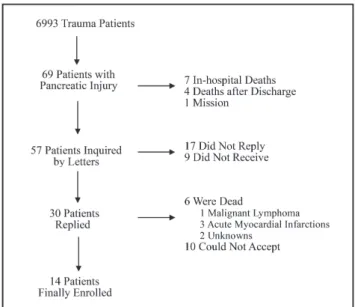
The study was approved by the Ethics Committee of Kurume University (research number: 13279). In total, 6,993 patients were managed for trauma at the Advanced Emergency Medical Service Center of Kurume University Hospital during the 32-year period from 1981 to 2012. Of these, 69 had been diagnosed with pancreatic trauma and 62 were discharged alive.
We obtained voluntary consent to participate, both over the phone and in writing, from 14 patients. We then retrospectively reviewed the medical records of these patients and conducted interviews and hematological tests. The flowchart showing the enrollment of patients in the study is presented in Figure 1.
Retrospective Survey of Medical Records
Medical records were used to extract data regard- ing age, sex, mechanism of trauma, abbreviated injury
score (AIS), injury severity score (ISS), the Japanese Association for the Surgery of Trauma Classification for Pancreatic Injury 2008 (JAST type 2008; Table 1) [3], concomitant injury, use of surgery, surgical method, pancreatic complications, length of hospitalization, and outcomes.
Interview and Hematological Test
After giving their consent to participate in the study, the patients answered a written questionnaire before undergoing an outpatient examination and blood test.
To assess endocrine dysfunction, the presence of post- trauma new-onset DM requiring treatment was sur- veyed by the questionnaire, and HbA1c levels were measured by hematological testing. In addition, to as- sess exocrine dysfunction, the same questionnaire was used to check for the presence of diarrhea after fat in- take, chronic diarrhea, or use of oral pancreatic enzyme preparations. Amylase, lipase, and trypsin levels were determined by hematological testing. To assess nutri- tional status, the presence of obvious weight loss was checked and the body mass index (BMI) was calcu- lated from the height and weight recorded at the time of the survey. Serum albumin levels, total lymphocyte count, and total cholesterol levels were also measured, and Onodera’s prognostic nutritional index (PNI) was calculated [4].
Presentation of Results and Statistical Processing After testing the data for normality, any values out- side the normal distribution were expressed as median (interquartile range). Intergroup comparisons were performed using the Wilcoxon test, and ratios were tested using the chi-square test and Fisher’s exact test.
The statistical software used was JMP Pro 11.0.0 (SAS Institute Inc., Cary, NC, USA).
Fig. 1. Flowchart showing the enrollment of patients in the study.
A total of 6,993 patients had been managed for trauma at the Advanced Emergency Medical Service Center of Kurume University Hospital during a 32-year period. Of these, 69 had been diagnosed with pancreatic trauma and 62 were discharged alive. Eventually, 14 patients who provided voluntary consent to participate, both over the phone and in writing, were enrolled in the study.
TABLE 1.
JAST 2008 Type
Type Injury description
I Subcapsular injury
II Superficial injury
III Deep injury
a Simple deep injury
b Complex deep injury
Type IIIa (simple deep injury) is defined as pancreatic injury of greater than one-half of the gland without main pancreatic duct disruption. Type IIIb (complex deep injury) is defined as pancreatic injury with main pancreatic duct disruption.
JAST, Japanese Association for the Surgery of Trauma Classifica- tion for Pancreatic Injury
RESULTS Characteristics of Participants
The characteristics of the participants are listed in Table 2. The median age at the time of trauma was 28.5 years (range: 18.5-39 years), and there were more males than females. All cases involved blunt trauma, and the most common mechanism of trauma was steer- ing wheel injury. JAST (2008) type III injuries ac- counted for the majority of injuries [10/14 (71.4%) pa-
tients].
Of the 14 participants, 12 (85.7%) had undergone surgery, with 5 patients undergoing distal pancreatec- tomy (DP) and 1 patient undergoing pancreaticoduo- denectomy (PD). Only 1 patient had suffered isolated pancreatic trauma, whereas the other 13 patients had suffered additional organ damage. In the order of fre- quency, concomitantly injured organs were the liver [8/14 (57.1%) patients], spleen [4/14 (28.6%)], and duodenum [3/14 (21.4%)]. The median length of hos- pitalization was 48.5 days (range: 27.5-80.5 days). The
TABLE 2.
Characteristics of Patients Patient
no. Age, y Gen-
der ISS Accident
situation Patient
situation JAST
type Associated injuries Pancreas- specific
surgery Complications LOS in hospital,
d
Follow-up period
1 19 F 16 MVA driver seat belt IIIa liver NOM Pseudocyst 30 3y6m
2 22 M 21 MBA rider pole IIIb liver, scapula NOM Pseudocyst 49 4y2m
3 29 F 24 MVA co-driver seat belt IIIb
liver, spleen, stomach, Rt.
kidney, small bowel,
colon, cervical spine DR Non 184 9y11m
4 34 M 16 MVA driver steering
wheel II duodenum DR Abdominal
abscess 51 28y7m
5 19 F 5 MVA driver steering
wheel II non RP
Pancreatic fistula, pancrea- titis, abdominal
abscess
80 14y4m
6 48 M 9 MVA driver steering
wheel II duodenum, mesentery,
stomach, SMV RP Non 25 24y5m
7 35 M 16 MVA driver steering
wheel IIIb liver, spleen, SMV RP Pancreatic fistula, abdomi-
nal abscess 82 26y9m
8 36 M 4 MVA driver steering
wheel II liver RP Non 34 29y1m
9 49 M 9 Work related worker iron plate 2t IIIa liver, spleen, Lt. kidney,
heart DP Non 28 6y6m
10 53 M 45 MBA rider handle IIIb liver, spleen, diaphragm,
lung, pelvis, tibia DP Non 48 10y2m
11 16 M 9 MBA rider handle IIIb mesentery DP Pancreatic
fistula, abdomi-
nal abscess 64 22y3m
12 16 M 29 MBA rider handle IIIa spleen DP Non 17 26y1m
13 17 F 21 MBA rider handle IIIb renal artery, splenic artery,
clavicle DP Abdominal
abscess 93 26y2m
14 28 M 30 MVA driver steering
wheel IIIb duodenum, face, lower leg PD Non 26 26y11m
d, days; DP, distal pancreatectomy; DR, only drainage; F, female; ISS, injury severity score; JAST, Japanese Association for the Surgery of Trauma Classification for Pancreatic Injury; LOS, length of stay; Lt., left; M, male; m, months; MBA, motor bike accident; MVA, motor vehicle accident; NOM, non-operative management; PD, pancreaticoduodenectomy; Rt., right; RP, repair of parenchyma; SMV, superior mesenteric vein; y, years
most common complication related to pancreatic in- jury was pancreatic fistula [3/14 (21.4%)], followed by pancreatic pseudocyst [2/14 (14.3%) patients] and pancreatitis [1/14 (7.1%)].
Questionnaire Results
The questionnaire results are presented in Table 3.
The median age of the 14 patients at the time of the survey was 49 years (range: 37-62.3 years), and the median post-injury period was 23 years 5 months (range: 9 years 1 month to 26 years 11 months). Of the 14 patients, 5 (35.7%) developed new-onset DM, with 2 receiving insulin therapy; all 5 patients had under- gone surgery. In addition, 4 (33.3%) of the 14 patients developed diarrhea exacerbated by fat intake. No ex- treme obesity or malnutrition was evident in any of the patients from their BMI.
Timing of DM Onset
Insulin-based glycemic control was necessary only for Patient 14 after PD, and he has continued insulin therapy. No new-onset DM was seen within 3 years of trauma in any of the other patients; however, DM de- veloped in 4 patients more than 15 years after the
trauma (Patients 4, 8, 11, and 12). Patient 4 was a 34-year-old man who had undergone drainage (DR) by laparotomy and developed DM at 50 years of age.
Patient 8 was a 36-year-old man who had undergone repair of the parenchyma (RP) by laparotomy and de- veloped DM at 60 years of age. Patients 11 and 12 were both 16-year-old males who had undergone DP and developed DM at 35 and 40 years of age, respectively.
Hematological Test Results
The hematological test results are presented in Table 4. No patient exhibited clearly low serum albu- min or lipid levels. PNI was low in Patient 14 (who re- quired insulin therapy and suffered from daily diar- rhea) and Patient 6 (who had chronic kidney disease).
Patient 9 had no history of DM treatment but had an elevated HbA1c level of 6.7%.
Comparison between Pancreatectomy and Non- pancreatectomy Groups
To study the effects of parenchymal volume reduc- tion on long-term outcomes, an intergroup comparison was conducted between pancreatectomy and non-pan- createctomy groups (Table 5). The pancreatectomy TABLE 3.
Summary of the Questionnaire Patient
no. BMI Pre-
trauma DM
Post- trauma
DM
Therapy for
DM Diarrhea Steatorrhea Oral pancre-atic enzymes Body weight
loss Chronic
pancreatitis Others
1 19. 1 - - - - - - - -
2 18.6 - - - - - - - - Fatty liver
3 22.9 - - - - - - - -
4 16.8 - + Insulin with
medication - - - - - AMI, brain
infarction
5 23.4 - - - - + - - -
6 22.7 - - - - - - - - Multiple my-
eloma, CKD
7 18.1 - - - - - - - - Fatty liver
8 23.2 - + Medication - - - - - Fatty liver
9 23.3 - - - - - - - -
10 23.9 - - - - - - - -
11 25.3 - + Medication - + - - - Fatty liver
12 23.4 - + Medication - + - - -
13 28.2 - - - - - - - -
14 21.8 - + Insulin with
medication - + + - -
- = negative response; + = positive response
AMI, acute myocardial infarction; BMI, body mass index; CKD, chronic kidney disease; DM, diabetes mellitus
group comprised patients who had undergone pancre- atic parenchymal resection, such as DP or PD (i.e., Patients 9-14). The non-pancreatectomy group com- prised patients who had not required pancreatectomy, such as RP or DR (i.e., Patients 3-8), and those who had not undergone surgery (i.e., Patients 1 and 2).
Post-trauma new-onset DM occurred in 3/6 (50%) patients in the pancreatectomy group and in 2/8 (25%) patients in the non-pancreatectomy group. Chronic di- arrhea was seen only in 1 patient in the pancreatec- tomy group (Patient 14) who had undergone PD and had been regularly using oral pancreatic enzyme prep- arations. Steatorrhea after fat intake was seen in 3/6 (50%) patients in the pancreatectomy group and in 1/8 (12.5%) patients in the non-pancreatectomy group. A statistically significant difference was only seen for BMI in the intergroup comparison.
DISCUSSION
A search of PubMed revealed only two reports on pancreatic functional outcomes after pancreatic trauma. One was by Cogbill et al. [5], who examined endocrine function (impaired glucose tolerance) after DP, and the other was by Al-Ahmadi et al. [2], who conducted phone interviews of 19 patients with pan-
creatic injury at a single facility over a 5-year period.
Cogbill et al. saw no impairment in glucose tolerance requiring insulin in DP patients even after 80% distal pancreatectomy and reported that there was no onset of exocrine dysfunction in an evaluation of pancreatic enzyme usage. However, their survey was conducted at discharge and the long-term outcomes of the pa- tients were not reported. In contrast, Al-Ahmadi et al.
reported that endocrine dysfunction occurred in 15.8%
of patients over a 5-year period at a single facility, but they found no cases of exocrine dysfunction. However, follow-up in that study was limited to a maximum of 5 years. Considering the present findings, we believe that 5 years may not be sufficiently long to examine pan- creatic functional outcomes.
Pancreatic endocrine and exocrine functions are believed to depend on the absolute amount of pancre- atic parenchymal cells. However, a negative correlation exists between insulin secretory capacity and age in healthy individuals [6]. Thus, when the absolute amount of parenchymal cells decreases following trauma-re- lated PD or DP, dysfunction at a later stage is conceiv- able despite the absence of dysfunction at discharge.
In fact, a study on non-traumatic benign or low-grade tumors that examined the effects of DP on pancreatic endocrine function and onset of DM found that new- TABLE 4.
Laboratory Data Patient no. Albumin g/dl eGFR ml/
min./1.73 m2 Amylase U/l Lipase U/l Total choles-terol mg/dl HbA1c
(NGSP) % TLC Trypsin ng/ml PNI
1 4.49 120.7 75 5 163 6 1411.2 233 52
2 4.44 94.6 94 7 178 5.5 1539.2 131 52.1
3 4.27 63.1 116 33 207 6.3 2028 387 52.8
4 4.46 76.8 65 8 203 6.3 917 79 49.2
5 5.1 138.2 49 10 166 5.4 2197.8 248 62
6 3.18 26.9 89 25 134 6.1 1530 797 39.5
7 4.46 100.6 53 13 199 5.7 1446.9 316 51.8
8 3.96 81.4 70 31 181 7 1147 577 45.3
9 4.29 65.7 89 16 227 6.7 2027.6 350 53
10 4.29 80.9 63 34 201 5.7 3268.8 491 59.2
11 4.65 121.6 59 8 260 8.4 2912 429 61.1
12 4.53 90.9 66 26 169 7 3708 439 63.8
13 4.44 86.8 68 20 243 5.4 1907.4 382 53.9
14 3.42 75.3 68 2 107 8 1259.9 50 40.5
PNI = (10*albumin) + (0.005*TLC)
eGFR, estimated glomerular filtration rate; HbA1c, glycated hemoglobin; NGSP, National Glycohemoglobin Standardization Program; PNI, prog- nostic nutritional index; TLC, total lymphocyte count
onset DM occurred in 20 of 52 (38.5%) patients dur- ing a 12-month postoperative follow-up period; they also found simultaneous elevations in fasting blood glucose and HbA1c levels within 3 months of surgery,
but not immediately after surgery [7]. This supports the clinical importance of examining outcomes for pan- creatic trauma over a long period, rather than only at discharge.
TABLE 5.
Comparison between the Pancreatectomy and Non-pancreatectomy Groups Pancreatectomy
(n = 6) Non-pancreatectomy
(n = 8) p value
Males, % 83.3 62.5 N.S.
Age, y 22.5 (16–50) 31.5 (19.75–35.75) N.S.
ISS 25 (9–33.75) 16 (6–19.75) N.S.
LOS in hospital, d 38 (23.75–71.25) 50 (31–81.5) N.S.
Operative management 6 6 N.S.
JAST 2008 type, no.
I 0 0
II 0 4
IIIa 2 0
IIIb 4 4
Complications, no. (%)
Pancreatitis 0 1
Pseudocyst 0 2
Pancreatic fistula 1 2
Follow-up period 24y2m (9y3m to 26y11m) 19y5m (5y8m to 28y0m) N.S.
BMI 23.6 (22.9–26.0) 20.9 (18.3–23.1) 0.024
Pre-trauma DM 0 0 N.S.
Post-trauma new-onset DM 3 2 N.S.
Medications for DM 3 1 N.S.
Insulin for DM 1 1 N.S.
Oral pancreatic enzymes 0 0 N.S.
Diarrhea 1 0 N.S.
Steatorrhea after fat intake 3 1 N.S.
Chronic pancreatitis 0 0 N.S.
Body weight loss 0 0 N.S.
Amylase, U/l 67 (62–73.2) 72.5 (56–92.75) N.S.
Lipase, U/l 18 (6.5–28) 11.5 (7.3–29.5) N.S.
Trypsin, ng/ml 405.5 (275–452) 282 (156.5–529.5) N.S.
HbA1c (NGSP), % 6.9 (5.6–8.1) 6.05 (5.55–6.3) N.S.
eGFR, ml/min./1.73 m2 83.9 (72.9–98.6) 88 (66.5–115.7) N.S.
Albumin, g/dl 4.37 (4.07–4.56) 4.45 (4.04–4.48) N.S.
Total cholesterol, mg/dl 214 (153.5–247.3) 179.5 (163.8–202) N.S.
TLC 2469.8 (1745.5–3378.6) 1488.5 (1213.1–1905.8) N.S.
PNI 56.6 (49.9–61.8) 51.9 (46.3–52.7) N.S.
BMI, body mass index; d, days; DM, diabetes mellitus; eGFR, estimated glomerular filtration rate; HbA1c, glycated hemoglobin; ISS, injury severity score; JAST, Japanese Association for the Surgery of Trauma Classification for Pancreatic Injury; LOS, length of stay; m, months; NGSP, National Glycohemoglobin Standardization Program; N.S., no significant difference; PNI, prognostic nutritional index;
TLC, total lymphocyte count; y, years
In contrast, when abnormalities in endocrine func- tion, particularly DM, occur during the long-term course after trauma, it is extremely difficult to deter- mine whether they are related to the trauma. In this study, patients were divided into a pancreatectomy group (PD or DP) and a non-pancreatectomy group (DR alone, RP alone, or no surgery). We then attempted to examine whether there were any differences in the incidence of pancreatic endocrine and exocrine dys- function between the 2 groups.
We first looked at the incidence of DM in relation to endocrine function and found that the incidence of DM was higher in the pancreatectomy group (50% in the pancreatectomy group vs 25% in the non-pancrea- tectomy group). However, due to the small sample size (5 patients), we were unable to demonstrate a statisti- cally significant difference in the incidence of DM. In contrast, an examination of the timing of onset revealed that only 1 of the 5 (20%) patients had DM at dis- charge, whereas 4 of the 5 (80%) patients developed DM 15 years after trauma.
Retrospective studies in patients who have under- gone DP for pancreatic tumors or pancreatic disease have reported incidences of endocrine dysfunction ranging from 4.8% to 8% [8-10]. However, the follow- up period in all these studies was less than 21 months after discharge, perhaps because cases of malignancy were included in all reports. Meanwhile, in a retro- spective study of 90 patients with chronic pancreatitis who had undergone DP, it was reported that the rate of DM onset was 23% over a 34-month follow-up period [11]. Two other retrospective studies in patients who had undergone DP for pancreatic tumors reported inci- dences of DM of 14%-19% over follow-up periods of at least 60 months [12,13]. In the present study, 4 of the 5 (80%) patients were diagnosed with DM at least 15 years after trauma. Although a causal relationship with trauma cannot be necessarily inferred, given that the 2 patients who had undergone DP showed DM on- set at a relatively young age (35 and 40 years), a cor- relation between pancreatectomy and DM cannot be entirely ruled out.
In contrast to the data for endocrine dysfunction, incidences of exocrine dysfunction following DP vary greatly (1.6%–61%) [9,11-13]. Although these discrep- ancies in the literature could be due to differences in the background of the participants, the diagnostic cri- teria for dysfunction may also be a likely cause.
Falconi et al. reported an incidence of exocrine dys- function of 18%, which is higher than that in other reports [11]. In their study, steatorrhea was diagnosed by the fecal chymotrypsin test; however, this test is no
longer used in Japan. Shikano et al. diagnosed exo- crine dysfunction in cases where diarrhea was a symp- tom or where diarrhea was improved by pancreatic en- zyme intake and reported an incidence of 2.8%, which is lower than that in other reports [13]. In the present study, in which chronic diarrhea or diarrhea and stea- torrhea exacerbated by fat intake were grounds for di- agnosis, exocrine dysfunction developed at a rate of 33.3%. Other studies have reported pancreatic steator- rhea at a rate of approximately 10%, without the pres- ence of diarrhea [14], suggesting the presence of am- biguity in their diagnosis. The Van de Kamer method [15], which is considered the gold standard for the evaluation of exocrine function, can evaluate steator- rhea quantitatively but is troublesome because all stool needs to be collected for 3 days after ingesting 100 grams of fat-restricted diet for 5 days.
Consequently, we did not use this diagnostic method in the present study. Future long-term follow-up stud- ies for suspected exocrine dysfunction would need to consider the use simpler pancreatic function tests, such as those evaluating fecal elastase-1 [16-18] or 13C compounds [19].
Study Limitations
In this study, we extracted the data from a sample of all patients with trauma over a 32-year period and invited patients with pancreatic trauma to participate.
However, only 22.6% of the patients with pancreatic injury consented to participate, reducing the statistical power of our findings. Furthermore, there was variation in the follow-up periods and differences in the regular- ity of follow-up. Thus, our results may not sufficiently reflect the long-term outcomes of pancreatic injury.
Therefore, future prospective studies will be needed to clarify the long-term outcomes following pancreatic injury.
Conclusions
We studied late complications and long-term out- comes following pancreatic trauma in 14 patients who had been managed at our facility. The comorbidity rates for pancreatic endocrine and exocrine dysfunc- tions were 35.7% and 33.3%, respectively. In patients requiring surgery, late complications occurred even when no pancreatic dysfunction had been seen at dis- charge, suggesting the need for long-term follow-up of such patients. Our findings suggest that management policies for pancreatic trauma should take into account the possibility that the onset of DM may be acceler- ated by pancreatectomy.
CONFLICT OF INTEREST AND SOURCE OF FUNDING: We, the authors of this paper, hereby confirm that there are no conflicts of interest with regard to this paper. This study did not receive any funding.
REFERENCES
1. Borkon MJ, Morrow SE, Koehler EA, Shyr Y, Hilmes MA et al. Operative intervention for complete pancreatic tran- section in children sustaining blunt abdominal trauma: revis- iting an organ salvage technique. Am Surg 2011; 77:612- 2. Al-Ahmadi K and Ahmed N. Outcomes after pancreatic 620.
trauma: experience at a single institution. Can J Surg 2008;
51:118-124.
3. Japanese Association for the Surgery of Trauma Classification committee. Classification of Pancreatic Injury 2008 (in Japanese). J Jpn Assoc Surg Trauma 2008; 22:264.
4. Onodera T, Goseki N, and Kosaki G. Prognostic nutritional index in gastrointestinal surgery of malnourished cancer patients (in Japanese with English abstract). Nihon Geka Gakkai Zasshi 1984; 85:1001-1005.
5. Cogbill TH, Moore EE, Morris JA, Hoyt DB, Jurkovich GJ et al. Distal pancreatectomy for trauma: a multicenter expe- rience. J Trauma 1991; 31:160-1606.
6. Iozzo P, Beck-Nielsen H, Laakso M, Smith U, Yki-Järvinen H et al. Independent influence of age on basal insulin secretion in nondiabetic humans. European Group for the Study of Insulin Resistance. J Clin Endocrinol Metab 1999;
84:863-868.
7. Shirakawa S, Matsumoto I, Toyama H, Makoto Shinzeki, Tetsuo Ajiki et al. Pancreatic volumetric assessment as a pre- dictor of new-onset diabetes following distal pancreatec- tomy. J Gastrointest Surg 2012; 16:2212-2219.
8. Lillemoe KD, Kaushal S, Cameron JL, Sohn TA, Pitt HA et al. Distal pancreatectomy: indications and outcomes in 235 patients. Ann Surg 1999; 229:693–698; discussion 698-700.
9. Shoup M, Brennan MF, McWhite K, Leung DH, Klimstra D et al. The value of splenic preservation with distal pan- createctomy. Arch Surg 2002; 137:164-168.
10. King J, Kazanjian K, Matsumoto J, Reber HA, Yeh MW et al. Distal pancreatectomy: incidence of postoperative dia- betes. J Gastrointest Surg 2008; 12:1548-1553.
11. Hutchins RR, Hart RS, Pacifico M, Bradley NJ, and Williamson RCN. Long-term results of distal pancreatec- tomy for chronic pancreatitis in 90 patients. Ann Surg 2002; 236:612-618.
12. Falconi M, Mantovani W, Crippa S, Mascetta G, Salvia R et al. Pancreatic insufficiency after different resections for benign tumors. Br J Surg 2008; 95:85-91.
13. Shikano T, Nakao A, Kodera Y, Yamada S, Fujii T et al.
Middle pancreatectomy: safety and long-term results.
Surgery 2010; 147:21-29.
14. DiMagno EP, Go VL, and Summerskill WH. Relations between pancreatic enzyme ouputs and malabsorption in severe pancreatic insufficiency. N Engl J Med 1973;
288:813-815.
15. Van de Kamer JH, ten Bokkel Huinink H, and Weyers HA.
Rapid method for the determination of fat in feces. J Biol Chem 1949; 177:347-355.
16. Stein J, Jung M, Sziegoleit A, Zeuzem S, Caspary FW et al. Immunoreactive elastase I: clinical evaluation of a new noninvasive test of pancreatic function. Clin Chem 1996;
42:222-226.
17. Leeds JS, Oppong K, and Sanders DS. The role of fecal elastase-1 in detecting exocrine pancreatic disease. Nat Rev Gastroenterol Hepatol 2011; 8:405-415.
18. Löser C, Möllgaard A, and Fölsch UR. Faecal elastase 1: a novel, highly sensitive, and specific tubeless pancreatic function test. Gut 1996; 39:580-586.
19. Hiele M, Ghoos Y, Rutgeerts P, and Vantrappen G. Starch digestion in normal subjects and patients with pancreatic dis- ease, using a 13CO2 breath test. Gastroenterology 1989;
96:503-509.