著者 加島 巧, 藤内 則光, 川島 浩勝, 橋本 高明, 進野 智子
雑誌名 長崎外大論叢
号 16
ページ 259‑272
発行年 2012‑12‑30
URL http://id.nii.ac.jp/1165/00000111/
英語教師のための基本文献案内⑴
加 島 巧・藤 内 則 光・川 島 浩 勝 橋 本 高 明・進 野 智 子
The Selected Bibliographical Guide for Teachers of English (1)
KASHIMA Takumi, FUJIUCHI Norimitsu, KAWASHIMA Hirokatsu HASHIMOTO Takaaki, SHINNO Tomoko
Abstract
In what follows we offer a bibliographical guide of five basic books for teachers of English. We selected two books on English grammar, one on American structural linguistics and the other on traditional English grammar. The third one concerns English-language pedagogy. The fourth book was chosen from a classic book of epistemology. The last one belongs to psychology.
.Fries, C.C.: 1940 ・・・・・・KASHIMA Takumi
.Jespersen, Otto: 1933 ・・・・FUJIUCHI Norimitsu
.大津由紀雄(編著)『学習英文法を見直したい』, ・・・・・KAWASHIMA Hirokatsu
.Popper, K. R.: 2002 ・・・・・HASHIMOTO Takaaki
.Harris, Judith Rich.: 1998
・・・・・SHINNO Tomoko
序
年度に、現代英語学科で教職課程の科目に関わりを持つ 名の教員が、将来のそして現役の英 語教師にとって有益な書物を一点ずつ紹介することとした。初めの 冊は、アメリカ構造言語学と伝 統文法から古典的な名著を選んでその一部を解題した。 冊目は英語教育の分野から、そして 冊目 は認識論からの一冊を解説している。そして最後は心理学の分野から選んだ。いずれの本も英語教師 にとって有益な書物であると考えている。
.Charles Carpenter Fries (1940).
American English Grammar.
Appleton-Century-Crofts, p.313フリーズ( − )は戦後、日本の英語教育会に颯爽と登場した。それはアメリカ構造言語学
の波と共に。ミシガン大学の English Language Institute の所長にもなり、著書や教育を通じて構造 主義言語学に基づいた外国語教育の普及に大きな影響を与えた。 年(昭和 年)の来日を機にオー ラル・アプローチへの関心が高まることとなった。
は、手紙文を資料として分析することで現代英語の実態を明らかに
するという統計的調査研究である。米国における英語教育は米国の標準英語を教授されなければなら
Class Original Number Remaining in Modern English
Adjusted to Regular (Weak) Pattern
Retaining Strong Forms
I II III IV V VI VII
ないので、そのためには米国の標準英語の実態を正しく把握する必要があるという考えに基づいてい る。本書では、米国政府が保管する , 通の手紙を分析している。手紙の差出人を学歴や職業など を基準に標準英語(Group I, “standard” English)、普通英語(Group II, “popular” or “common”
English)、低俗英語(Group III, “vulgar” English)の つのグループに分け用例を分析し、その違い を例示している。
手紙文を分析した結果、学校での効果的な英語教授法について次の 点が導きだされた結論であ る。(pp. ‐ )
A. We must agree upon the kind of English which it is the obligation of the schools to teach.
B. We must agree to base our teaching upon an accurate, realistic description of the actual practices of informal Standard English and eliminate from our language programs all those matters of dispute for which there is any considerable usage in informal Standard English.
C. We must agree to stimulate among our pupils observation of actual usage and to go as far as possible in giving them a practical equipment for this purpose.
しかし、フリーズの真骨頂は、英語の史的な研究にあると考えられる。
にも随所に史的な情報がちりばめられており、その価値は今も失われていない。英語を教授する者に とって、英語の史的分野の理解は必須の項目の一つだが、たとえば、同書の 、 ページの脚注に示 してある二つの表は、古英語( A.D.〜 A.D.)の時代に複雑な屈折をした言語であったものが、
徐々に変化する姿を、 つあった強変化動詞の数の推移から垣間見ることが出来る。
( 個あった強変化動詞は、現代英語には 個残り、その内 個は規則変化をする動詞となり、
個が不規則動詞となった。その 個の不規則動詞は古英語の時代は次の表の つに分類される。)
Class I Class II Class III Class IV Class V Class VI Class VII abide
bite drive ride rise shine strike slide smile stride write
choose freeze cleave (to split) fly
begin sting drink stink shrink swing sing win sink wring sling bind slink find spring grind swim wind cling run spin fight
bear break steal tear come
bid eat give get lie see sit speak tread weave
draw forsake shake slay stand swear take
fall hold hang blow grow know throw
年 年 年 年 年 Accusative-object before verb
(O-V) .% .% +% .% . %
Accusative-object after verb
(V-O) .% .% ‐% .% . %
英語は総合的な言語(Synthetic language)から分析的な言語(Analytic language)へと変化して 行ったが、その変化を語順の視点から論考しているのが第 章 The Use of Word Order である。フリー ズは例文を提示し、語順がかなり自由であった英語が、SVO(別の表現を使えば、Actor-action-goal)
という現在の姿になった時代を確定している。
戦後、言語学の新しい潮流であった構造言語学を英語教育に取り入れた点でフリーズの功績は高く
評価される。 の出版から 年後に発表した
( )では、Content word(内容語)と Function word(機能語)という概念で品詞を論じ、構造 言語学の重要な概念である直接構成素(Immediate Constituent)も取り扱っている。音素や形態素の分 析では、研究が進んだ。しかし、残念なことに構造言語学ではいくつかの弱点を克服するには至らな かった。時代はチョムスキー(Noam Chomsky − )が変形生成文法(Transformational Generative
Grammar)の誕生を世間に示した ( )の先駆けとなる
( )の出版が目の前に迫っていた。
.Otto Jespersen (1933).
Essentials of English Grammar.
Routledge, ISBN-10: 0415104408, ISBN-13: 978-0415104401, p.388英語には second best という表現がある。 (通称 Essentials)は、
Jespersen の歴史的名著、 (通称 MEG)の要点をまとめた、いわば second best である。確かに MEG は科学的伝統文法最良の文法書ではあるが、一般には入手困難である。そ のため、その要約版であっても、一般に手に入れやすい は、決して second best ではなく、
英語の研究に携わるすべての研究者と学生が持っているべき最良の本の一つといえる。
科学的英文法とはいっても、MEG 出版当時は、一般名詞に目的格を認めるか認めないかを、
Jerspersen と Curme が論争していたことからもわかるとおり、形式的分析と機能的分析が時に相容 れない、伝統的英文法研究が言語学的研究に進む途中の段階であった。その中で、Jespersen の は、その内容の多くに、現代でも学習者や教師が熟読を要する、重要な指針となる構文研 究が含まれていることも、重要な英文法書として称賛されるべき点ではあるが、その著者の Jespersen と当時の他の文法学者とを明確に分けたのは、その内容の中に語類、三階位説、ジャンクションとネ クサスに関する、後に続く文法理論にとって重大な影響を持つ先進的な研究が含まれていたことであ る。
内容解説
語類
語類(word class)は、伝統的な品詞の分類名を用いながらも、その語の機能を根拠に、Jespersen
が提案した語の分類方法である。規範文法成立期に、ラテン文法の影響を受けて定められた英語の
品詞は、意味内容、語形変化、文法的機能と分類の基準が統一的でないことは、現代でも解決できな
い問題として残っている。Jespersen 自身の語類分析も、同様にこの問題を解決していない。例えば、
従来名詞と呼称されていた品詞を、「生物・植物」、「物」、「物質」、「出来事・行為・状態」、「単位、
量」、「特質」の下位区分を含む、「実詞」という語類を提案しているが、これは意味的分類基準であ る。ところで、「代名詞」の語類には、伝統的な代名詞の枠にとらわれずに、直示的な性質をもつも のが、指示的副詞を含めて集合しているので、これは文法的機能を重要視した分類である。その他、
分析できないものは「小辞」としてまとめられている。
語類分析が伝統的な品詞分類の持つ問題点を解決できなかったことは、決してその分析が無意義で あることをしめすものではない。この分析は、当時においても規範的に存在していた伝統的 品詞以 外に、語の分析方法があることを示した画期的なものであり、明確に下位区分された意味基準は、そ れらの語が文中で占める語順が概ね同一であったため、同じように用いられる語は同じ語類であると いう分析を導く。Jespersen は、代名詞の語類に、伝統的には別の品詞である数量詞、冠詞を含んで いるが、その分析は後の C. C. Fries の検出枠とフィラー、Chomsky の範疇分析に引き継がれること となる。
三階位説
三階位(three ranks)とは、文法的にまとまった語句の内部の文法的な重要性、もしくはある語 の別の語への従属関係によって定められるものである。terribly cold weather という名詞句において は、その内部の三つの語の中で、weather が最も重要で、weather に直接従属してその様態を述べる cold が次に重要で、cold に直接従属してその程度を述べる terribly の重要度が最も低い。その重要度 を数字の順位で表した場合、最も重要な語が一位語(primary)、次点の重要度を持つ cold が二位語
(secondary)、最も重要度が低い terribly が三位語(tertiary)であると定義される。
三階位は、これまでは単語の羅列にしか見えなかった句の内部に、何らかの内部構造があることを 示唆する、重要な発見である。この三階位を、名詞句に限らず実際の様々な句に応用したものがジャ ンクション、ならびにネクサスである。これらの分析には、Jespersen 自身にも整理できていない文 法的な知見と、その後の理論の破たんに繋がる綻びが含まれているが、後述するそれらの点は、後に 続く更に重要な発見の糸口になったという点で、決して価値を失うものではない。
の三階位説の記述には、そのあとに続くジャンクション、ならびにネクサスの内容が一 部整理されずに含まれており、例えば同じ三位語であっても、
(1) The sea went mountains high.
(2) Lady Cecily, part pleased, part amused, part sympathetic.
ではそれぞれ下線部の mountains と part では機能が異なり、mountains はネクサス三位語、part は ジャンクション三位語と分析されるが、記述はそれを区別せずにただ三位語の例示とされているの で、読み手側の深い読み込みが必要である。
ジャンクションとネクサス
this furiously barking dog という名詞句を三階位分析すると、dog が一位語、this と barking は二
位語、furiously は三位語である。一方で、上記の名詞句と派生関係にある This dog barks furiously.
においても、上記の分析は並行することができ、dog が一位語、その様態を表す述語 barks が並行的 に二位語、this も二位語、furiously は三位語である。それぞれの例において、二位語の一位語への接 続が異なっているが、this furiously barking dog に見られるものをジャンクション、This dog barks furiously.のものをネクサスとして区別する。特にジャンクション二位語を adjunct、ネクサス二位 語を adnex と呼称する。ジャンクションとネクサスは、節と派生名詞句の間に認識できる並行性を、
統語的に説明した初めてのものの一つである。
ジャンクションでは、一位語と二位語の結合が密接なので、一語に書き換えることが可能である。
(3) a silly person = a fool
ところで、this と barking は同じ二位語でありながら、線形順序では連続していない。Jespersen はこの事実を、語の階位は一位語に対する相対的位置に依るものではないとのみ説明しているが、実 際は名詞句内部には、dog に対する二位語 barking、word group である barking dog に対する二位語 this という抽象的な構造性があり、それが二位語の定義基準が並行しない理由であった。この Jespersen 自身が著しつつも見落としていた事実は、後に Bloomfield の内心構造の発見につながる。
Jespersen はこのジャンクションで、所有格の代名詞に関して、代名詞は一位語としても二位語と しても用いられるという、実に深遠な記述を残している。ジャンクションは一語に書き換えられる性 質があるが、所有格付の名詞句は
(4) my book = my one = mine
と書き換えられる。my one では my は二位語として働くが、mine と書き換えられる場合は、それが 所有代名詞であるため、my が書き換えの結果残った形になり、my を一位語としても解釈出来る。
これは、先に見た代名詞の語類が実詞に先行し、それを二位語として支配するジャンクションを形成 する理論を導くが、Jespersen はそれには深く言及しなかった。実際に生成文法でその知見が決定詞
句として紹介されるのは、実に 年のことであった。
ネクサスは、ジャンクションとの対比によって派生名詞句と節の並行性を初めて記述しただけでな く、命題を項として認識した初めての理論の一つでもあったが、問題を呼んだ理論でもあった。ネク サスは、一位語とネクサス二位語の間に生き生きとした描写が見られると記述があるだけで、それ自 体は一位語と二位語の結合のあり方の呼び名であり、決してそれが節であるという言及はないが、一 般にはジャンクションの考え方を節に当てはめたものであると理解されている。そして、ネクサス分 析が前提とする三階位説が、一位語が語群の中で最も重要なものであるとするため、節の中で最も重 要なものが主語であると解釈されることとなった。これが問題である。
当時はまだ外心構造は定義がなされておらず、節の内の何を一位語に設定しても、節は内心構造と
して分析が不可能である。また、英文法はその後動詞中心の文型の理論を構築していくが、ネクサス
分析はその理論とも互換性がなかった。強固な批判にさらされ、Jespersen 自身ネクサス分析を半ば
取り下げることになったが、Einstein の宇宙方程式における宇宙定数のように、実はネクサス分析は
時代を大幅に先取りした文法理論であった。名詞句と命題という、ともに項となりうるが形式があま りに異なる構造の並行性を記述することを意図し、当時の理論水準ではそれを成し遂げられなかった だけである。
文法理論は、その後節を屈折要素を主要部とした内心構造であると分析し、結果としてネクサスと ジャンクションは統合されることとなったが、当時は屈折形態素すら認識がなく、Jespersen 自身も 節の一位語を屈折要素と分析しえなかった。Jespersen の理論は、正しい方向を向いていたのである が、当時としてはあまりに進みすぎており、後発の理論がその知見に追いつくのに実に数十年の時間 を必要とした。
以上、 は学校英文法を正しく理解しなければならない中学・高校教師にとって必携の文
法書であるだけでなく、理論言語学者もまた読破が必要な参考文献である。この一冊を読まずして、
研究者、および教育者としては名乗ってはならないほど重要な一冊なのである。
.大津由紀雄(編著)『学習英文法を見直したい』( 、研究社)ISBN‐ :
ISBN ‐‐ ‐ ‐ , ページ
平成 年 月文部科学省より「国際共通語としての英語力向上のための つの提言と具体的施策」
が発表さたれたが、そこではグローバル社会で求められる外国語能力として、異なる国や文化の人々 と臆せず積極的にコミュニケーションを図り、物事を論理的に説明したり、相手を説得したりする能 力が挙げられている。その基礎となるものが文法力であることは多くの専門家が認めているところで あるが(論理的な説明を行うためには、カタコトでブロークンな英語では無理である)、大切なこと は、科学文法の知見は活かしながらも、文法を実際の学習や指導等の立場から見つめ直し、その知見 を基に学習・指導に直結した英文法観(学習英文法)を確立し、英語教育に対する今日的ニーズに応 えうる学習環境(指導方法を含む広義の環境)を整えることではないだろうか。
学習英文法と一口に言っても、様々な見方があり(例えば、文法能力の定義方法・発達段階や文型 の扱いの問題)、そのあるべき姿を提示するには、様々な分野の研究成果を整理・統合しなければな らない。本書は、そのような研究に対する前段階的研究として位置づけられ、学習英文法のあり方に ついての議論を喚起することを目的として書かれている。総勢 名の研究者・教諭がそれぞれの専門 の立場から )「基礎論」、 )「方法論」、 )「内容論・授業論」、など つの章で学習英文法を論じ ている。その視点は多岐にわたり、英語教育の理論・実践などに加え、英語教育史やビジネス英語等 まで及んでいる。ここでは、最初の つの章に絞り、それぞれの内容の一部を簡単に紹介する。
第 章「基礎論」では、学習英文法観を構築するための土台作りの議論が展開されている。例えば、
学習英文法が満たすべき条件として、次のような点が挙げられ、学習英文法のあり方に関する基礎的 な考察が行われている(第 節「学習英文法を考えるヒント」大津由紀雄)。
(F)わかりやすいこと
(G)基本の焦点をあてていること
(H)運用に直接的に役立つものであること
(I)以前、学校で習った英語をできるだけ生かせるように工夫されている
(J)説明がわかりにくくてはいけない
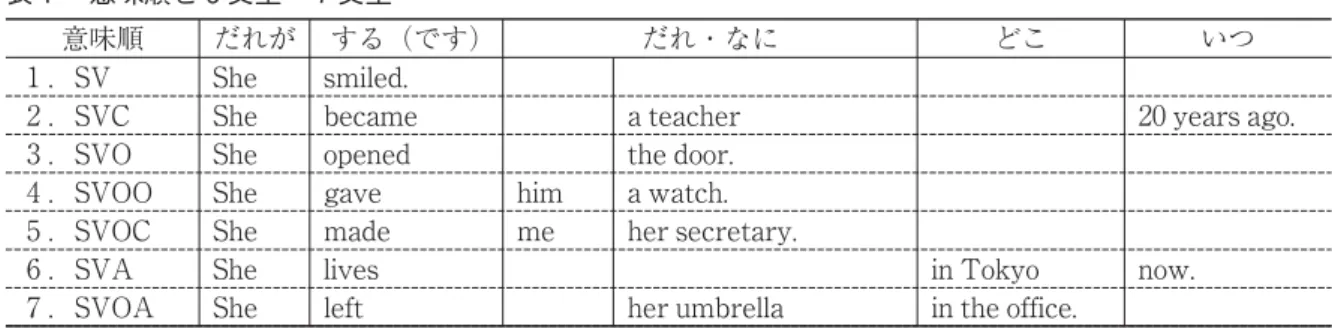
表 意味順と 文型・ 文型
意味順 だれが する(です) だれ・なに どこ いつ
.SV She smiled.
.SVC She became a teacher 20 years ago.
.SVO She opened the door.
.SVOO She gave him a watch.
.SVOC She made me her secretary.
.SVA She lives in Tokyo now.
.SVOA She left her umbrella in the office.
(p. )
(K)文法学習はあくまで英語の運用のためのものであるので、文法のための文法であってはならない
(pp.‐ )
第 章「方法論」では、学習英文法に関する論点を如何に整理し、どのようにデザインしてゆくべ きかが考察されている。学習英文法を具体的にどのように記述・提示するかに関して、例えば、知識 の表象化と組織化の観点から次のような事が議論されている(第 節「学習英文法を考える際の論点 を整理する」亘理陽一)。
)学習文法の提示が「記号的・言語的事実」や「記号的・言語的定義と分類」に偏りすぎており、
「身体的・感覚−運動的な定義・分類」の観点が欠落しているため、文法知識の習得・深化を把 握することが難しくなっているのではないか。
)学習英文法の習得・深化のプロセスは、非線形の質的転換を伴うものと想定しておくほうが学習 英文法研究にとって実りが多いのではないか。
(pp. ‐ )
第 章「内容論・授業論」は、文法指導の立場からより具体的な形で学習英文法を扱っている章で ある。例えば、第 節(「学習者にとって「よりよい文法」とは何か?−「意味順」の提案」田地野 彰)では、文法的誤りに関する本質的議論が行われ、それをベースに意味的情報区分に基づく指導法 が考察、紹介されている。その前提になっているものは、下記の通りである。
)外国語の学習者はだれもが文法的「誤り」をする。
)「誤り」にも「質」に違いがある。
)コミュニケーションの観点から「誤り」の「重みづけ」を行う。
(pp. ‐ )
)の「重みづけ」の例として、語順に関する誤り(文意や意思伝達に重大な影響を与える)が挙
げられ、そのような誤りをさせないような指導の重要性が述べられているが、語順の学習を促進する
文法指導法として、意味を重視した語順指導が考察されている。下記の表は、意味に関する意思伝達
における基礎的要素(「だれが」、「する(です)」、「どこで」等)を学習英文法(文型)の中に埋め込
んだものであるが、そのような意味順をベースにした文法指導の教育効果も論じられている。
全体を読むと、内容的に重複している箇所もあるが、学習英文法について知っておくべきこと、ま た、考えておくべきことが満載されており、学習英文法に関連する領域の広さが分かる。英語教育に おける文法指導/学習のあり方を考えるのに多くの材料を提供してくれる一冊である。
.Karl R. Popper (2002).
The Logic of Scientific Discovery.
New York: Routledge. Pp. xxvii, 513.ISBN 0-415-27844-9 (paperback)
Language instructors are researchers and practitioners at the same time: They are engaged in research into the mechanism of language learning and conducting experiments on the effect of their educational intervention, as they teach their classes daily. With increased attention being paid to continuous improvement of instruction through the PDCA cycle, instructors are now required to justify the way they teach in the planning stage, and then they are also required to evaluate the results and adjust the way they teach after they have executed their instructional plan.
Justification of teaching practices requires language instructors to critically evaluate and relate their practices with the results of the preceding language learning/teaching research, which in turn requires them to be familiar with research methodology. Understanding of research methodology is also essential in conducting formative evaluation on the on-going educational intervention. Therefore, the readers may find interests in Karl Popperʼs (2002) classic in the methodology of empirical science, . The book is philosophical rather than practical, and it is certainly not a how-to manual of research methods. Nevertheless, the reviewer believes that the familiarity with the ideas underlying the method of empirical research is indispensable for fully understanding second language literature and the procedure of formative evaluation.
The book reviewed here is the English translation of the authorʼs original publication in German, , first published in 1934. The English translation of the book, prepared by the author of the book, was first published in 1959, and it has undergone several minor revisions and the addition of appendices. The book is considered a foundational work in epistemology which introduced the basic principles of the method of empirical science.
The book consists of 10 chapters extending over 311 pages with additional 177 pages of appendices and 25 pages of index. The content of some of the chapters and the appendices is very technical, and it is difficult to understand the details fully without a knowledge of logic, mathematics, and theoretical physics. Nevertheless, Part I of the book (Chapters 1 and 2) is very readable, and it conspicuously presents the methodological principles of empirical science.
In the early 20th century, it was commonly believed that a certain inductive method applied to a
set of data would lead to a correct generalization over the data, and researchers were making efforts
to formalize the inductive method leading to a discovery. An inference is called “inductive” if it makes
a universal statement on the basis of particular observations or experiments. However, it is not clear
if it is justified to make a universal statement on the basis of singular statements (of facts confirmed
through observations or experiments), no matter how many singular statements may be shown to be
true. The problem of induction is the question of whether inductive inferences are justified, and if so,
under what conditions.
If inductive inferences are to be justified, then it is necessary to establish a principle of induction by which one can present inductive inferences in a logically acceptable form. The formulation of this principle was taken to be the most important issue by the upholders of inductive logic, because without the principle, science would not be able to distinguish between true theories and false theories.
The principle of inductive logic cannot be logical transformation of a statement to another because if it were, induction reduces to logical deduction, and there would be no problem of inductive logic. Therefore, the principle of inductive logic itself must be a synthetic statement, which in principle can be false. Then, the synthetic statement in turn must be justified on some rational grounds, which is logically impossible.
The principle of inductive logic is necessary to justify induction, which involves making a universal statement on the basis of singular statements that are known to be true. However, the principle of inductive logic itself must be a universal statement, and if the truth of the principle is to be known from experience, which can render only singular statements true or false, then the justification of the principle must appeal to another principle of a higher order. The justification of the principle will then lead to infinite regress.
Popper points out that in principle, there cannot be such a principle of induction that allows for justification of a universal statement on the basis of true singular statements. In order to solve epistemological problems that arise from inductive logic, Popper proposes a deductive method of testing theories. He believes that one cannot arrive at a true generalization through some inductive procedure, and that one can only test hypotheses that are deductively generated from a given idea and falsify the idea on the basis of experience. The deductive testing of theories proceeds as follows.
From a new idea (a hypothesis or a theoretical system) not justified in anyway, conclusions or statements are drawn by logical deduction. The statements are then tested against the conditions on the statements in empirical science. Popper presents the four conditions that statements in empirical science must satisfy.
a). The statements deduced from hypotheses of a theory must be consistent among themselves; i.e., they must represent a logically possible world.
b). The theory must constitute a scientific advance; i.e., it must achieve the goals of science better than other competing theories.
c). The statements in a theory of empirical science must be empirical in character, by being synthetic statements (derived from axioms and non-axiomatic statements), not just tautological deductions from axioms, so that singular statements (predictions) deduced from universal statements of the theory (hypotheses) can be contradicted by facts. They must represent a world of possible experience.
d). The singular statements deduced from a hypothesis must be corroborated by the facts; i.e., they must represent the real world.
Condition (c) is the principle of falsifiability. Falsifiability is the demarcation criterion that
distinguishes between empirical science and metaphysics. Condition (d) is the principle of corroboration. Corroboration leaves the tested hypothesis a possibility of being a correct representation of the real world.
Popper claims that the goal of empirical science is to elucidate the problems of the current theory to make ever lasting revisions of the theory of the real world, and not to achieve some conclusively verified true statements, as positivists envisaged. Universal statements about the real world do not need to be, and in principle, cannot be both verifiable and falsifiable, because only singular statements about specific events can be verified by facts, and because an accumulation of singular statements cannot deduce a universal statement. Thus, even if a singular statement about the real world that is consistent with the universal statements is accepted as true, the universal statements are not shown to be true but are left not yet shown to be false. Meanwhile, universal statements can be falsified, if a singular statement that contradicts the universal statements is accepted as true. While there is no logical method of conceiving a hypothesis, there is a way to test a hypothesis, once it has been conceived. Thus, universal statements in empirical science can be refuted by facts.
Strictly universal statements (i.e., hypotheses) of a theory of empirical science can be expressed in the form of negations of strictly existential statements. The statement “For all X, X has property Y” is equivalent to “It is not that case that for some X, X has property not-Y.” Strictly universal statements in a theory of empirical science do not assert that something exists or something is the case. Instead, they insist on the non-existence of certain things or events. Since a singular statement of the non- existence of certain things or events can be contradicted by a singular observation of such a thing or such an event, this provides a hypothesis with falsifiability.
Strictly existential statements are unfalsifiable, because only a universal statement can contradict them, and because a universal statement can never be verified. Therefore, strictly existential statements are not statements in empirical science.
Scientific statements can be corroborated (i.e., not contradicted) by facts, even though they cannot be verified. The method of empirical science requires that a hypothesis be testable (i.e., falsifiable), and that the hypothesis undergo repeated tests, once it has been posited, until it is falsified or otherwise superseded by another hypothesis that is better in terms of the falsifiablity of the claim.
The methodological principles that Popper presents are those that the readers are probably familiar with, having been introduced to them in science courses in high school or elsewhere, and they will probably be surprised to learn that such foundational methodological principles were not commonly recognized until the mid-20th century. Meanwhile, it is also surprising that the deductive method of theory testing is often not observed by researchers in the field of second language research.
The readers would often encounter, in second language research literature, unfalsifiable claims
(strictly existential statements), ignored counterexamples, and unjustified conclusions uncorroborated
(i.e., contradicted) by the data. The book provides a solid point of view from which language
instructors can critically evaluate studies in second language learning/teaching before applying the
ideas taken from the studies to their teaching practices. It will also assist language instructors with
the design of the evaluation procedure in the PDCA cycle. The reviewer believes that Popperʼs classic work provides anyone engaged in second language research and language teaching with a good reference point in reviewing his/her own research and instructional practices.
References
Popper, K. R. (1934). Vienna, Austria: Verlag von Julius Springer.
.Harris, Judith Rich. (1998)
The Nurture Assumption
Why ChildrenTurn Out the Way Do.Free Press