Impact of Spatial 3D Imaging by Extremely High‑Definition Computational Holography:
Wave‑Field Oriented 3D imaging
著者 Matsushima Kyoji, Nishi Hirohito, Arima Yasuaki, Higashi Kentaro, Nakamura Masaki, Nakahara Sumio
journal or
publication title
IDW'10 : proceedings of the 17th International Display Workshops : December 1(Wed) ‑ 3(Fri), 2010, Fukuoka International Congress Center Fukuoka, Japan
volume 2
page range 1333‑1334
year 2010
URL http://hdl.handle.net/10112/5584
Proc. of 17th Int. Display Workshop (IDW '10), vol. 2, Fukuoka, pp.1333-1334(2010.12.2).
Impact of Spatial 3D Imaging by Extremely High-Definition Computational Holography
— Wave-Field Oriented 3D imaging —
Kyoji Matsushima, Hirohito Nishi, Yasuaki Arima, Kentaro Higashi, Masaki Nakamura, Sumio Nakahara*
Department of Electrical and Electronic Engineering, Kansai University,
* Department of Mechanical Engineering, Kansai University 3-3-35 Yamate-cho, Suita, Osaka 564-8680, Japan
ABSTRACT
Spatial 3D images created by high-definition computational holography are actually demonstrated. The demonstrated 3D images are static images at this stage. However, these presage the great future of 3D displays beyond the Super Hi-Vision because of its strong sensation of depth, which never has been caused by conventional 3D systems.
1. INTRODUCTION
Spatial 3D images reconstructed by full-parallax computational holography are completely different from that of conventional 3D systems that provide only binocular disparity.
Computational holography, usually called Computer-Generated Hologram (CGH), is sometimes expressed as an ideal 3D technology. However, CGHs had been just the subject of academic research for a long time and could not produce fine 3D images with a large sensation of depth.
In computational holography, a fine 3D image commonly requires a large viewing-zone and image size. Both of them lead to a large pixel size. However, conventional “ray-oriented”
point-based methods are much time-consuming and ineffective for creating occluded 3D scene in full-parallax. To get over the limits, the “wave-field oriented” polygon-based method has been proposed for reconstructing 3D surface-modeled object and deep 3D scenes [1, 2].
Some CGH works created by using this new technology are demonstrated as static 3D images. These are not motion pictures at this stage, because the pixel size is too large to display them using electro-holography by currently available devices.
However, the created spatial images presage the great future of 3D display by holography, which will be realized far beyond the Super Hi-Vision. This article is closely connected with the paper in the session of 3D1 [3].
2. SOME CGH WORKS
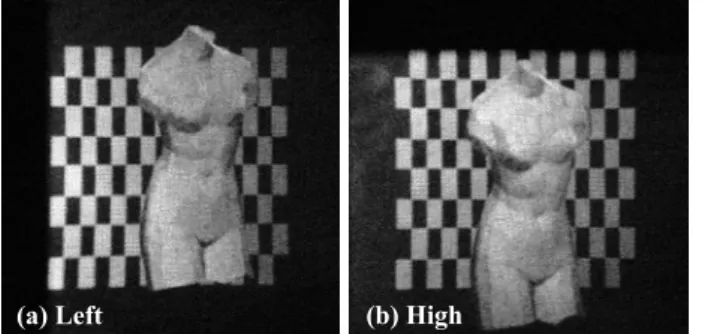
The parameters of some major holograms, produced as the polygon-based high-definition CGH (PBHD-CGH), are summarized in Table 1. These holograms have their own name as is an artistic work, for example “The Venus”. The Venus has pixels sizes of 64K64K, where 1K = 1024. The total number of pixels reaches to 4 G pixels. Another CGH, for example “Aqua 2”, is bigger than The Venus; the pixel size is 8 G pixels. The angle of the viewing zone, determined by the pixel pitches, is also indicated in Table 1. Note that the computation time is measured in a PC with CPUs of Xeon E7330 (2.4 GHz, Quad core) 4 and memory of 96 G Bytes.
2.1 The Venus [2]
The first PBHD-CGH is named The Venus, because the 3D object is similar to the famous statue of the Venus de Milo.
The 3D scene is composed of two objects, as shown in Fig 1.
The one is the 3D object calculated the polygon-based method, another is a background image referred to as the wallpaper.
The computation time was reported approximately 45 h measured by an old PC and implement of the polygon-based method [2], but the new PC and improved program, currently used, reduces the computation time up to 10.1 h. Optical
Fig. 1 The 3D scene of “The Venus”
6.5 6.5 6.5
5.8 6.5
15
15 Hologram
Venus statue Wallpaper
(2D image)
Units: cm
Table 1 Major parameters of CGH works
The Venus*** [2] Moai I/II*** [4] Aqua 2 The moon [6, 8]
Number of pixels [pixels] 65,53665,536 65,53665,536 131,07265,536 131,07265,536
Pixel pitches [m] 1.01.0 1.01.0 0.81.0 0.81.0
Angle of viewing zone [deg] 3735 3737 4637 4637
Number of objects 2 3 10 301**
Total number of polygons* 718 2440 4200 800
Computation time [h] 10.1 27.3 35.5 32.8
* Front face only ** 1 sphere + 300 point sources *** The mesh data for the Venus and moai objects are provided courtesy of INRIA and Yutaka_Ohtake by the AIM@SHAPE Shape Repository, respectively.
(a) (b)
Fig. 3 Optical reconstruction of “Moai II”
The camera is focused on the near moai (a) and the far moai (b).
(b) High (a) Left
reconstruction of The Venus is shown in Fig. 2.
2.2 Moai I and II [4]
These holograms are composed of the same objects.
However, the Moai I has the deeper 3D scene because of a constraint imposed by the Shifted-Fresnel method used for numerical propagation. Since the 3D scene is too deep to view through the window of the CGH by both eyes, the improved CGH, Moai II is created by using the shifted angular spectrum method [5] that is newly developed for PBHD-CGHs. The optical reconstruction and 3D scene are shown in Fig. 3 and 4.
2.3 Aqua 2
The Aqua 2 is created for demonstrating new algorithm for reduction of the computation time in sparse 3D scenes [6]. The sparse 3D scene is the scene composed of many small objects, as shown in Fig. 5. In this case, the silhouette method [7] used for light-shielding requires the same number of calculations of propagation as the objects and thus the long computation time.
The new algorithm based on Babinet’s low and partial field propagation speed up the computation. (See [3] for optical reconstruction)
2.4 The Moon [8]
This hologram is created for demonstrating the new technique of texture-mapping similar to that used in conventional computer graphics. The object of the moon is produced by mapping an astrophotograph to the surface of a sphere formed by polygons, as shown in Fig. 6. Furthermore, the background stars are produced by point sources. In the sense, this CGH is a hybrid of polygon- and point-based methods. (See [3] for optical reconstruction)
3 CONCLUSION
Some PBHD-CGHs are actually demonstrated. These CGHs give an impact to viewers owing to their strong sensation of depth and reality [9, 10].
This work was supported by the JSPS.KAKENHI (21500114).
REFERENCES
[1] K. Matsushima, “Computer-generated holograms for three-dimensional surface objects with shade and texture,”
Appl. Opt. 44, 4607-4614 (2005).
[2] K. Matsushima and S. Nakahara, “Extremely high- definition full-parallax computer-generated hologram created by the polygon-based method,” Appl. Opt. 48, H54-H63 (2009)
[3] K. Matsushima: “Spatial imaging based on extremely high-definition computational holography,” The 7th Intl.
Display Workshops (IDW ’10), 3D1-1(2010).
[4] K. Matsushima, S. Nakahara: High-definition full- parallax CGHs created by using the polygon-based method and the shifted angular spectrum method, SPIE
#7619, 761913-761921 (2010).
[5] K. Matsushima, “Shifted angular spectrum method for off-axis numerical propagation,” Opt. Express 18, 18453-18463 (2010).
[6] K. Matsushima, M. Nakamura, S. Nakahara: “Novel techniques introduced into polygon-based high- definition CGHs,” Digital Holography and Three- Dimensional Imaging 2010, Miami, JMA10 (2010).
[7] K. Matsushima, A. Kondoh: “A wave Optical Algorithm for hidden-surface removal in digitally synthetic full- parallax holograms for three-dimensional objects,” SPIE
#5290, 90-97(2004).
[8] K. Matsushima: “Wave-field rendering in computational holography,” 9th IEEE/ACIS Intl. Conf. on Computer and Information Science, Yamagata, 846-851(2010).
[9] K. Matsushima, M. Nakamura, S. Nakahara, I. Kanaya,
“Computational holography: Real 3D by fast wave-field rendering in ultra-high resolution,” SIGGRAPH 2010, Los Angeles, 77B (2010).
[10] http://www.youtube.com/watch?v=DdOveIue3sc Fig. 2 Optical reconstruction of “The Venus”
Photographs are taken from different angles.
7
13 10
Units: cm
Hologram Wallpaper
Fig.4 The 3D scene of “Moai II”
Fig. 5 The 3D scene of “Aqua 2” 2 2 2 2 2 2 10 2 2
3
Hologram
Units: cm
Hologram Texture-mapped sphere
Domain of point sources (Background stars)
Fig. 6 The 3D scene of “The moon”
15 Units: cm
5.5