United States and Japan
著者 Morio Hiroaki, Yamaguchi Susumu journal or
publication title
情報研究 : 関西大学総合情報学部紀要
volume 50
page range 47‑59
year 2020‑01‑30
URL http://hdl.handle.net/10112/00020150
*1 Faculty of Informatics, Kansai University
*2 Graduate School of Humanities and Sociology, The University of Tokyo
Moral domain judgment:
Cross-cultural differences and commonalities between the United States and Japan
Hiroaki MORIO
*1, Susumu YAMAGUCHI
*2 AbstractAn examination was conducted of the classification of potential misconduct in the moral domain (rather than the non-moral domain). Behaviors in the moral, social-conventional, and personal domains differ with regard to why and how they are regulated. Behaviors in the moral domain often face interference by others due to reasons irrelevant to existing rules or norms. Behaviors in the social-conventional domain are disapproved of and face interference only when contrary explicit or implicit rules exist. Behaviors in the personal domain reflect personal interests and tastes, and thus, they face no interference by others. We predicted and found that Americans consider a wider range of potential misconducts as moral issues compared with Japanese people, who tend to consider the same issues as socially regulated. In tight cultures, such as that observed in Japan, behaviors are regulated by social norms and authorities, and are evaluated as such. However, in loose cultures, such as that observed in the US, misconducts tend to be attributed to the actor’s free choice, and thus, the individual’s morality is at stake. These results support the argument of cultural psychology that moral judgment varies across cultures.
Keywords: moral domain judgment, cross-cultural difference, social norm, moral judgment, cultural psychology
Moral judgment bears special importance among social judgments and evaluations, because it involves a judgment of right and wrong, and thus has significant social consequences. For example, if homosexuality is considered wrong, it would be punished, like in Texas before its
“Homosexual Conduct” law was invalidated by the US Supreme Court. Such moral judgments are not necessarily shared among all individuals in a society. Indeed, individuals’ moral judgments depend on their values, beliefs, and preferences. Thus, homosexuality could be classified as a moral issue or personal preference, depending on one’s beliefs.
In the present study, we focused on the role cultures play in everyday moral judgment. Currently,
there are two lines of research in psychology, one conducted by developmental psychologists and the other by cultural and social psychologists. Both place different weights on the importance of culture in moral judgment. The ongoing controversy between these two camps involves how to treat culture (Kelly & Stich, 2006; Wainryb, 2006) as explained below.
Social-Cognitive Domain Theory
Developmental psychologists formulated traditional theories regarding moral judgment, which emphasize rational and logical thinking as the basis of moral judgment. This line of research underscores harm, welfare, justice, and rights, with its root in the work of Western philosophers
(Haidt, 2008; Smetana, 2006). Theories of Piaget (1965) and Kohlberg (1969) are representativesof such research tradition; they formulated the process of children’s development from lower to higher stages of moral judgment. Their theories emphasize reasoning as the main determinant of moral judgment. In these theories, culture plays a minor role, if any, because factors affecting moral judgment, such as harm, are considered universal across cultures. As a result, universality of moral judgment has been claimed in these theoretical traditions.
Turiel’s social-cognitive domain theory of moral judgment follows the tradition of Piaget and Kohlberg. It posits that morality and social convention are distinct domains, and individuals learn to acquire the distinction between these two domains through social interactions in early developmental stages
(Turiel, 1983, 2003). Behaviors are considered to belong to the moraldomain when their consequences involve harm to or impairment of others’ welfare, or they infringe upon others’ rights. On the other hand, the social-conventional domain is composed of behaviors violating rules regarding authority, tradition, and social norms. Behaviors in the social- conventional domain pertain to rules set by the authority, and social and cultural norms. Behaviors such as eating foods with one’s hands, not wearing school uniforms, and addressing elders by first names are considered to belong to the social-conventional domain. Numerous studies have been conducted to test this theory empirically
(see Smetana, 2006, Wainryb, 2006, Turiel, 2003, forreviews). In a typical study in this research paradigm, children are interviewed on what they think of various transgressions they have experienced in everyday life, or those described in vignettes.
Preschool children are found to largely classify events they encounter in their everyday life into moral or social-conventional domains, using the above criteria
(Nucci & Turiel, 1978).Behaviors can also be classified into the personal domain, which is not concerned with morality
or social conventions. The personal domain consists of behaviors that are the matter of personal
preference or taste. Nucci
(1981) proposed that the domain of personal issues exists in addition tothe moral and social-conventional domains of judgments. Behaviors in the moral, social-
conventional, and personal domains differ in terms of why and how they are regulated. Behaviors
in the moral domain are usually interfered with by others owing to reasons irrelevant to existing rules or norms. On the other hand, behaviors in the social-conventional domain are disapproved and interfered with only when there are corresponding explicit or implicit rules against them.
Behaviors in the personal domain reflect one’s interests and tastes, and thus, they are not interfered with by others.
Cross-cultural differences in domain judgment
While Turiel’s social-cognitive domain theory has its root in Western philosophical thinking and its initial development was based on studies conducted on children in the US
(Nucci &Turiel, 1978), the theory has been tested with children in more than a dozen countries in various regions, including East Asia, Middle East, and Africa (see Wainryb, 2006 for a review). Previous studies have supported the basic principle of the theory, that children in various cultures distinguish behaviors causing direct harm onto others from those prohibited or sanctioned by authorities or norms. These studies made a distinction regarding its generalizability and universality.
For example, Yau and Smetana (1996) interviewed young children aged 4 and 6 years, using 7 vignettes to examine their domain judgments. Three types of vignettes were prepared, to be classified into the moral, social-conventional, or personal domains. Hitting and teasing fell under the moral domain, whereas calling a teacher by her first and last name or eating with one’s fingers fell under the conventional domain. Choice of a snack, a playmate, and an activity during free time were included under the personal domains. After reading the vignettes, children were asked about the protagonists’ behaviors. Yau and Smetana
(1996) found that children consideredtransgressions in the moral vignettes wrong regardless of their geographical location or the presence of authorities. While hitting was judged wrong wherever it was conducted, eating with fingers was judged inappropriate only when there existed rules or authorities against such behavior.
Though Turiel’s theory asserts that “whether it causes harm onto others” is the only criterion that individuals use in the moral domain, the existence of cross-cultural differences is widely acknowledged by researchers
(e.g., Killen & Smetana, 1999; Turiel, 2003; Nucci, Camino, &Sapiro, 1996). In general, developmental psychologists have found some diversity in domain judgments and reasoning across cultures. Yet, they have emphasized the cross-cultural commonalities in their findings and have claimed the universality of domain judgments.
Exceptionally, some studies have provided initial evidence about the effect of culture on domain
judgments. Miller, Bersoff, and Harwood
(1990) examined moral domain judgments on helpingbehaviors. In their study, the degree of need was manipulated in vignettes describing someone
refusing to help others. Their Indian participants tended to view the failure of helping others in moral terms, whereas their American counterparts regarded it in moral terms only in a life- threatening situation. Nucci, Camino, and Sapiro
(1996) found that the social class of Brazilian children influenced their domain judgments. Specifically, lower-class children were more likely to consider conventions as authority-independent and generalizable than were middle-class children.
This cross-cultural difference corresponds to the individual-collectivistic dimension of cultural diversity
(Hofstede, 1980; Oyserman, Coon, & Kemmelmeiser, 2002), because lower-classchildren were considered more collectivistic than were middle-class children (Nucci et al., 1996).
Criticism against the social-cognitive domain theory from a cultural perspective
Cultural psychologists have been critical of Turiel and his followers’ claim that the criterion for moral domain judgment
(i.e., the harm caused by an actor) is universal. Haidt, Koller, andDias
(1993), for example, showed that people with low socio-economic status in the US andBrazil judged harmless but offensive behaviors
(such as using the national flag for cleaningbathroom, incestuous kissing, and masturbating with a dead chicken) as morally wrong. This result indicates that potential misconduct without harm can be classified into the moral domain.
Present approach
The present study aimed to integrate these two lines of research traditions. Developmental psychologists have insisted on the universality of moral judgment. On the other hand, cultural psychologists have focused on culturally variant moral judgments. Indeed, in our view, developmental psychologists used descriptions of potential misconduct universally classified into one domain, such as hitting someone
(in case of the moral domain) or eating food with one’shands
(in case of the social-conventional domain). In those examples, across cultures, researchparticipants were found to be able to distinguish these dimensions from early developmental stages, presumably guided by the fundamental principle that harm is the only criterion for the moral domain
(e.g., Turiel, 2003). On the other hand, cultural psychologists have focused onpotential misconduct without harm, which intended to identify the variability in moral judgments across cultures. Indeed, in Haidt et al.’s
(1993) study, culture and SES were shown to affectindividuals’ moral judgments. In sum, previous studies have not provided convergent evidence regarding the universality or variability of moral judgments across cultures.
The present study therefore employed both perspectives, that of typical misconduct used in
Turiel and his colleagues’ studies, and those used by cultural psychologists. That is, both potential
misconduct with harm and those without harm were used. As mentioned earlier, according to
Turiel’s
(1983, 2003) theory, descriptions of misconduct are categorized into the moral domainonly when they hurt someone, like in stealing and cheating. Misconduct without harm is either
categorized into the social-conventional or personal domain. However, cultural psychologists, such as Sweder, Much, Mahapatra, and Park
(1997), insist that behaviors without harm can beconsidered moral issues in some cultures, suggesting that culture affects the moral judgment of misconduct without harm. The challenge against Turiel’s theory from a cultural perspective, however, has been limited, because respondents’ domain judgments have never been measured explicitly
(i.e., Haidt et al., 1993). Thus, forced-choice style questions were used in the presentstudy, to assess the moral domain judgments directly. Respondents were asked to classify descriptions of potential misconduct into one of the three domains, when they considered them unacceptable.
To examine cultural effects on moral judgments, Japanese and American participants were included in the present sample. Comparison of domain judgments in these two cultures is expected to reveal the aspects of domain judgments that vary with cultures as well as those that remain invariant across cultures.
Predictions
Based on previous studies, we expected that cultural differences would emerge in moral domain judgments of potential misconduct. More specifically, Japanese participants were expected to classify a narrower range of potential misconduct into the moral domain as compared to Americans. The Japanese culture is characterized with tightness
(Triandis, 1989). Tight culturestend to promote norms, and deviation from those norms is often punished by the authority. Thus, people in tight cultures would evaluate potential misconduct in terms of norm and authority, which leads Japanese individuals to classify fewer potential misconducts into the moral domain as compared with Americans, who belong to a loose culture
(in which freedom and deviations areencouraged). Masuda and Nisbett
(2001) reported that East Asians consider more contextualinformation in cognitive tasks. Because information on norms and authority lies in the context of the behavior, Japanese participants’ attention on the context would further lead them to classify misconduct into the social-conventional domain. The other side of the coin is that Japanese participants would tend to classify more potential misconducts into the social-conventional domain as compared to their American counterparts.
Methods
Participants
Participants were 356 American (229 women, 111 men, 16 unknown) and 323 Japanese (159
women and 164 men) undergraduate students who received course credit for their participation in
this study. The mean age of the participants was 19.3
(SD = 1.75) years in the US and 19.8 (SD =1.21) years in Japan.
Moral orientation assessment items.
To assess the moral domain judgments of potential misconducts with or without harm, 28 descriptions of behaviors that may be considered as misconducts were collected
(Table 1),including behaviors sampled from the Morally Debatable Behaviors Scale
(Katz, Santman, &Lonero, 1993), those used by Haidt et al.
(1993), and those originally constructed by the firstauthor of the present paper. The potential misconduct ranged from typically used ones in the Social-Cognitive Domain Theory, which are relatively simple misconducts with harm
(such asstealing) and without harm
(such as eating with hands), to potential misconducts that can becategorized into more than one domain
(such as abortion). The original English version wastranslated into Japanese via back translation
(Brislin, 1980).Respondents were asked to classify the described behaviors into one of the following four categories, with the instruction “Please indicate what you think about each of the following behaviors.” Responses were made in a forced-choice style, and one of four categories was chosen for each behavior description:
A. Acceptable behavior
B. Personally unrewarding, unhealthy, or distasteful C. Socially inappropriate or undesirable
D. Morally or ethically wrong
For those who considered the behavior unacceptable, three reasons were provided to assess their moral domain judgments. Classification of the behavior into the category of morally or ethically wrong behavior
(Category D) means that it is in the moral domain, whereas the“personally unrewarding, unhealthy, or distasteful”
(Category B) and “socially inappropriate orundesirable”
(Category C) categories referred to the personal and social-conventional domain,respectively. The category of acceptable behavior
(Category A) was provided for those who classified the behavior as acceptable and not as a misconduct.
The moral orientation assessment items yielded three scores: moral orientation
(M), socialorientation (S), and personal orientation (P) scores. The moral orientation score was computed as
the number of behaviors classified as “morally or ethically wrong,” reflecting one’s tendency to
judge issues according to their moral implications. The number of behaviors classified as “socially
inappropriate or undesirable” yielded the social orientation score, reflecting one’s tendency to use
social norm and convention as the basis for moral judgments. The personal orientation score was
the number of behaviors considered as “personally unrewarding, unhealthy, or distasteful.” The
Table 1 Proportions of moral judgments by country
Behavior US Japan
A P S M A P S M
1 Taking money from a collection plate* .02 .04 .06 .89 .03 .05 .23 .68 2 Eating a family dog that was run over by a car .02 .28 .15 .55 .02 .31 .10 .57 3 Taking and driving away a car belonging to someone else (joyriding)* .03 .12 .33 .52 .02 .05 .47 .46
4 Not taking a bath for a week .04 .57 .30 .09 .07 .63 .19 .11
5 Cheating on an examination* .04 .30 .16 .49 .11 .13 .47 .29
6 Eating sea turtle eggs even though they are an endangered species .05 .21 .25 .50 .06 .19 .34 .41
7 Failing to report damage they accidentally did to a parked vehicle .08 .16 .37 .39 .05 .13 .49 .32
8 Committing suicide* .08 .18 .08 .66 .14 .22 .26 .38
9 A man having sex with a prostitute* .09 .28 .29 .34 .24 .40 .24 .12
10 Aiding someone to commit suicide* .09 .10 .12 .69 .05 .23 .20 .52
11 A physician rejecting patients with HIV/AIDS out of fear of getting infected* .10 .09 .24 .57 .03 .07 .37 .53
12 Taking a second helping even though there is not enough for everyone* .11 .25 .49 .15 .03 .23 .44 .31
13 Lying for their own interest* .11 .40 .18 .31 .30 .35 .24 .12
14 Cheating on their taxes if they have the chance* .14 .18 .31 .37 .10 .10 .53 .27 15 Buying something they knew was stolen* .14 .24 .21 .41 .10 .28 .41 .21 16 Shredding and discarding an unnecessary flag* .14 .08 .32 .45 .25 .20 .29 .26
17 Keeping some money they found* .16 .18 .21 .44 .20 .15 .41 .25
18 Avoiding a fare on public transport .18 .22 .36 .23 .14 .19 .47 .21
19 Eating food that had fallen on the floor .19 .69 .09 .03 .30 .59 .09 .03
20 Using marijuana or hashish* .30 .43 .15 .12 .06 .21 .31 .43
21 A man dressing like a woman* .31 .17 .32 .20 .57 .32 .07 .04
22 Engaging in homosexual activity* .33 .22 .18 .28 .22 .44 .16 .18
23 A girl having sex under the legal age of consent* .36 .24 .20 .20 .24 .27 .34 .15
24 A woman getting an abortion* .40 .18 .09 .33 .25 .32 .27 .16
25 Smoking in public* .41 .32 .24 .03 .13 .30 .43 .14
26 Getting a divorce* .55 .19 .15 .12 .13 .47 .29 .12
27 Selling their sperm or eggs* .57 .17 .12 .15 .22 .26 .22 .31
28 Getting married despite their parents objections* .62 .21 .11 .06 .51 .27 .18 .03
* p < . 001.
Note. A, P, S, and M correspond to Acceptable, Personal, Social-Conventional, and Moral, respectively. Proportions of judgments for behavior descriptions with an asterisk differed between the US and Japan.
category of acceptable behavior was not used for calculating these scores.
Procedure
Participants were asked to complete a questionnaire, which included the moral orientation assessment items, in their classroom.
Results
Overview of the analysis
First, we examined cultural differences in domain judgments by comparing proportions of behaviors classified into each domain. Then, cultural differences in the three scores of moral orientation were examined to test our predictions. Finally, a Multiple Correspondence Analysis
(MCA) was conducted to visualize the relationships among the domain judgments of misconduct.Cultural differences in domain judgment
The proportions of judgments for each behavior description in the moral orientation assessment by culture have been presented in Table 1. Evidently, there were cultural differences in moral judgments. Specifically, significant cultural differences were found in 22 out of the 28 behavior descriptions
(p < .001, group-wise alpha < .05). Additionally, classifications of the behaviors werenot unanimous among the two cultures. Less than 40% of the behaviors
(39% and 25% for theAmerican and Japanese samples, respectively) had a dominant category with agreement of the majority.
The following three scores were calculated by counting the number of classification to each of the three categories: moral orientation
(M), social orientation (S), and personal orientation (P)scores. The Kuder-Richardson 20 coefficient of reliability for M, S, and P scores were .76, .68,
4 5 6 7 8 9 10
Moral Orientation Social Orientation Personal Orientation
Mean Scores
USA Japan
Figure 1 Mean scores on subscales of the Moral Orientation Scale by culture
and .59, respectively. A satisfactory level of reliability was obtained for the M score, although the reliability coefficients for the S and P scores were lower.
Figure 1 shows the mean moral orientation scores by culture. As predicted, American participants (M = 9.66,
SD = 4.30) classified a wider range of behaviors into the moral domainthan did Japanese participants (M = 7.46, SD = 4.56) (F(1, 682) = 42.19, p < .001). Addition, as predicted, Japanese participants (M = 8.50, SD = 4.44) scored higher on social orientation than did American participants (
M = 6.15, SD = 3.21) (F(1, 682) = 63.47, p < .001). In the personal domain,scores of American (M = 6.99, SD = 3.29) and Japanese participants (M = 7.49,
SD = 3.90) didnot differ significantly (F(1, 682) = 3.365,
p < .07).Structures of moral domain judgments
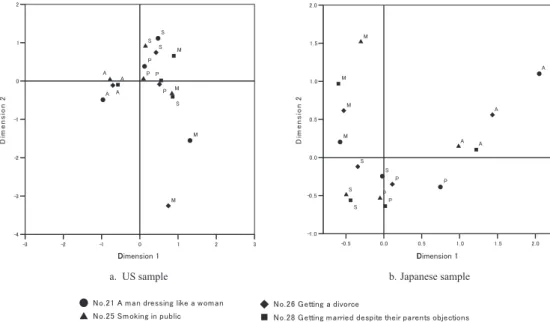
In order to visualize the cross-cultural differences and commonalities in moral domain judgments, categorical responses were mapped into a two-dimensional space using the quantization plot of MCA. In the quantization plot, symbols represent participants’ classifications.
The distance between two symbols is interpreted as the likelihood of concurrence of the two classifications. Thus, two symbols close to each other are more likely to be chosen at the same time by a respondent than are those located far from each other.
To provide a clear picture of the relationships among the participants’ classifications, theoretically different sets of items were analyzed separately using MCA. The first set of items contained the behaviors causing direct harm, for example, lying (No.13). The behaviors presented in the quantization plots
(Figures 2) are those that are typically categorized as issues of moralregulation in previous studies on moral domain judgment. In the case of lying
(No.13), circleswith the letter M, S, P, and A represent American and Japanese participants’ classification for this particular item. In Figure 2a and 2b, the circle with the letter M is closer to the other symbols with the letter M, than to those with other letters. This indicates that those who categorized lying into the moral domain were more likely to categorize other misconducts into the same domain.
Similarly, symbols with the letter A are closer to each other. On the other hand, symbols with the letters S or P are relatively closer to each other than to those with the letters A or M. This means those who categorized one of the behaviors into the social-convention domain are more likely to categorize the other behaviors either in the social-conventional domain or in the personal domain, than to consider them acceptable or to categorize them in the moral domain.
Figure 2a and 2a for the American and Japanese samples show a consistent two-dimensional
structure of domain judgments. The horizontal axis
(Dimension 1) represents the degree ofacceptability. Symbols with the letter A have lower values on this axis, whereas those with the
letter M have higher values. Classifications into the social-conventional and personal domains lie
in the middle. The vertical axis
(Dimension 2) represents the degree to which one perceives thebehavior as a matter of morality or not. At the lower end of this axis lie the acceptable and moral domains, and the social-conventional and personal domains lie at the higher end of this axis.
3 2 1 0 -1 -2 -3 2
1
0
-1
-2
-3
-4
M
S A P
M S
A P M
S
A P
M S
P
A
2.0 1.5 1.0 0.5 0.0 -0.5 2.0
1.5
1.0
0.5
0.0
-0.5
-1.0 M
S P
A M
S
P
A M
S P
M A
S
P
A
No.28 Getting married despite their parents objections No.26 Getting a divorce
No.25 Smoking in public No.21 A man dressing like a woman
Dimension2 Dimension2
D
Dimension 1 DDimension 1
a. US sample b. Japanese sample
No.18 Avoiding a fare on public transport No.17 Keeping some money they found No.15 Buying something they knew was stolen
No.14 Cheating on their taxes if they have the chance No.13 Lying in their own interest
a. US sample b. Japanese sample
1.0 0.5 0.0 -0.5 -1.0 -1.5 -2.0 1.5
1.0
0.5
0.0
-0.5
-1.0
-1.5
Dimension2
Dimension2
M
S
P
A M
S
P A
M
S P A
M
S P A
M
S P A
1 0
-1 -2
D Dimension 1 D
Dimension 1
2.0
1.5
1.0
0.5
0.0
-0.5
-1.0
-1.5
M
S P
A
M
S
P A
M
S P
A M
S P
A
M
S
P A
Figure 2 Quantization plots of stealing, cheating, and lying behaviors for US (a) and Japanese (b) samples.
Figure 3 Quantization plots of behaviors typically categorized into the social-conventional domain for US (a) and Japanese (b) samples.
Scoring low on this dimension corresponded to classification of behaviors in the acceptable or moral domains, meaning that the judgments were governed by morality
(behaviors are eithermorally wrong or acceptable). On the other hand, those who scored high on this dimension tended to classify behaviors more often into the social and personal domains. In these classifications, judgments leave room for contextual consideration.
The second set of behaviors contained descriptions typically classified into the social- conventional domain in previous studies, such as cross-dressing (No.21). Behaviors in this set are not supposed to cause any direct harm to others and they may be acceptable. Figure 3a and 3b show the quantization plot for American and Japanese samples, respectively. These quantization plots showed the same relationships as those observed in Figure 2a and 2b.
Discussion
Responses to the moral orientation assessment items by American and Japanese participants revealed substantial cultural differences in moral domain judgments. As expected, cultural differences were also observed in moral and social orientation scores, such that American participants classified more behaviors into the moral domain and less behaviors into the social- conventional domain than did Japanese participants.
Regarding the controversy over the universality of harm as the only criterion of moral domain judgment, a quick glimpse at Table 1 would be sufficient to convince us that most participants used the moral domain to judge behaviors that do not bring any harm to others. The present study is not the first to report such findings
(e.g., Nichols, 2002, 2004; Haidt, 1993). As a rebuttal,Turiel
(2003) argued that categorizing behaviors not causing direct physical harm to others into the moral domain may be a reflection of broader conceptualization of harm. For example, those who think not taking a bath for a week is a moral issue may possibly consider the psychological harm inflicted by the odor produced by the behavior. Another example is cross-dressing, which might make those who observe the behavior uncomfortable, thus causing psychological harm.
Because there is no empirical evidence to support this claim, its veracity is not certain.
Additionally, this logic, in its extremity, makes morality a matter of preference, which contradicts the Western philosophical perspective that forms the basis of the social cognitive domain theory.
Not only did some American and Japanese participants chose the moral domain for behaviors traditionally considered as conventional in nature, some of them also classified behaviors causing direct harm to others into the personal or social-conventional domains.
The present study revealed not only the significant cultural differences in domain judgments
but also the common structure of moral domains. Relations among domains were similar in both
cultures. It appears that the structure of domains is shared by both cultures, which have the two dimensions of acceptability and morality. However the American and Japanese samples differed in terms of the typical domains they used to judge misconduct, including those which have been considered typically moral or conventional by developmental psychologists.
This study confirmed the cross-cultural differences in moral orientation between Americans and Japanese. There are, however, several limitations regarding the moral orientation assessment items used. First, perhaps because we included a wide variety of potential misconducts, the internal consistency of the social and personal orientation score were was than satisfactory.
Secondly, there is no guarantee that the list of behaviors was exhaustive. With the inclusion of more varied behaviors, different cultural differences may be revealed. Thirdly, the population of this study comprised young American and Japanese students who lived in a highly industrialized and modernized society, as observed in most cross-cultural studies. Participants from countries with different cultural backgrounds and of different age groups would be desirable to examine the generalizability of the present findings. Further research is needed to address these issues.
Acknowledgement: This research was supported by Kansai University’s Overseas Research Program for the academic year of 2016.
References
Brislin, R. W. (1980). Translation and content analysis of oral and written materials. In H. C. Triandis & J. W.
Berry (Eds.), Handbook of Cross Cultural Psychology (pp. 389-444). Boston: Allyn and Bacon: Boston.
Haidt, J. (2008). Morality. Perspectives on Psychological Science, 3, 65-72.
Haidt, J., Koller, S., & Dias, M. (1993). Affect, culture, and morality, or is it wrong to eat your dog? Journal of Personality and Social Psychology, 65, 613-628.
Hofstede, G. (1980). Culture’s consequences: International differences in work-related values. Beverly Hills, CA: Sage.
Katz, R. C., Santman, J., & Lonero, P. (1994). Findings on the revised Morally Debatable Behaviors scale.
Journal of Psychology, 128, 15-21.
Kelly, D. & Stich, S. (2006). Two theories about the cognitive architecture underlying morality. In P.
Carruthers, S. Laurence, & S. Stich (Eds). The innate mind volume 3: Foundations and future (pp. 348
-366). New York: Oxford University Press.
Killen, M. & Smetana, J. G. (1999). Social interactions in preschool classrooms and the development of young children’s conceptions of the personal. Child Development, 70, 486-501.
Kohlberg, L. (1969). Stage and sequence: The cognitive-developmental approach to socialization. In D. A.
Goslin (Ed.), Handbook of socialization theory and research. Chicago: Rand McNally.
Masuda, T., & Nisbett, R. E. (2001). Attending holistically versus analytically: Comparing the context sensitivity of Japanese and Americans. Journal of Personality and Social Psychology, 81, 922-934.
Miller, J. G., Bersoff, D. M., & Harwood, R. L. (1990). Perception of social responsibilities in India and the United states: moral imperatives or personal decisions? Journal of Personality & Social Psychology, 58, 33-47.
Nichols, S. (2002). Norms with feeling: towards a psychological account of moral judgment. Cognition, 84, 221-236.
Nichols, S. (2004). Sentimental rules: On the natural foundations of moral judgment. New York: Oxford University Press.
Nucci, L. P. (1981). Conceptions of personal issues: A domain distinct from moral or societal concepts. Child Development, 52, 114-121.
Nucci, L. P., Camino, C., & Sapiro, C. M. (1996). Social class effects on Northeastern Brazilian children’s conceptions of areas of personal choice and social regulation. Child Development, 67, 1223-1242.
Nucci, L., & Turiel, E. (1978). Social interactions and the development of social concepts in preschool children. Child Development, 49, 400-407.
Oyserman, D., Coon, H., & Kemmelmeier, M. (2002). Rethinking individualism and collectivism: Evaluation of theoretical assumptions and meta-analyses. Psychological Bulletin, 128, 3-72.
Piaget, J. (1965). The moral judgement of the child (M. Gabain, Trans.). New York: Free Press. (Original work published 1932)
Shweder, R. A., Much, N. C., Mahapatra, M., & Park, L. (1997). The “big three” of morality (autonomy, community, and divinity), and the “big three” explanations of suffering. In A. Brandt & P. Rozin (Eds.), Morality and health (pp. 119-169). New York: Routledge.
Smetana, J. G. (2006) Social-cognitive domain theory: Consistencies and variations in children’s moral and social judgments. In. M. Killen & J. G. Smetana (Eds). Handbook of moral development. (pp. 119-153).
Mahwah, NJ, US: Lawrence Erlbaum Associates Publishers.
Triandis, H. C. (1989). The self and social behavior in differing cultural contexts. Psychological Review, 96, 506-520.
Turiel, E. (1983). The development of social knowledge: Morality and convention. Cambridge, UK:
Cambridge University Press.
Turiel, E. (2003). Resistance and subversion in everyday life. Journal of Moral Education, 32, 115-130.
Wainryb, C. (2006). Moral development in culture: Diversity, tolerance, and justice. In. M. Killen & J. G.
Smetana (Eds). Handbook of moral development. (pp. 211-240). Mahwah, NJ, US: Lawrence Erlbaum Associates Publishers.
Yau, J. & Smetana, J. G. (1996). Adolescent-parent conflict among Chinese adolescents in Hong Kong. Child Development., 67, 1262-1275.