• 検索結果がありません。

Issue Positions and Moral Concerns among Japanese College Students:

N/A
N/A
Protected

Academic year: 2021

シェア "Issue Positions and Moral Concerns among Japanese College Students:"

Copied!
13
0
0

読み込み中.... (全文を見る)

全文

(1)

Abstract

The aim of this paper was to explore how the Five Moral Foundations are related to issue posi- tions among Japanese college students. Taking the death penalty as an example of a specific issue,  this study examined how individual issue positions may be predicted by gender, age, political ori- entation, and moral foundations. Seventy Japanese students were asked to respond to a question- naire consisting of questions about their moral concerns, political orientation, and attitudes toward  the death penalty. Factor analysis revealed five moral concerns that were analogous to those of  Graham et al.’ s Moral Foundations Questionnaire (Graham, et al., 2009).  Attitudes toward the  death penalty were most strongly and significantly associated with the Purity and Harm founda- tions. These results were consistent with Koleva et al. (2012)’ s study inasmuch as respondents’  en- dorsement of various moral foundations predicted specific issue positions over and above their de- mographic characteristics and political orientation. It was thus suggested that moral intuition  constituted psychological predispositions underlying specific attitudes toward controversial politi- cal issues and demonstrated the usefulness of Moral Foundations Theory as a lens for examining  individual differences in political attitudes. It was also discovered that the critical moral intuitions  that underlay favorable (or unfavorable) attitudes toward the death penalty were different between  Japanese and Americans. Specifically, concerns about Harm predicted opposition to the death pen- alty in the US, whereas concerns about Purity and Harm predicted support in Japan.

Keywords: Morality; Moral Foundations Theory; death penalty; Japan

Moral judgment as more a product of the

“gut” than the “head”

The modern discipline of moral psychology  was established by Kohlberg (1969). He devel-

oped a stage theory of moral development by  asking people to respond to hypothetical situa- tions in which a main character faced a moral  dilemma and had to make difficult choices. 

Issue Positions and Moral Concerns among Japanese College Students:

How Five Moral Concerns Help Explain Attitudes toward Capital Punishment

Issue Positions and Moral Concerns among Japanese College Students: How Five Moral Concerns Help Explain Attitudes toward Capital Punishment

Seijo University Seijo University

TSUZUKI, Yukie SHINGAKI, Noriko

(2)

(For example, “Should Heinz steal a drug in or- der to save his wife from cancer if he can obtain  the drug no other way?"). Kohlberg was inter- ested in the reasons people offered to justify  their answers. He developed a stage theory fo- cusing on the progressive development of a  child’ s understanding of justice. Thus, Kohlberg’ s  theory was based on the “cognitive” aspects of  morality.

Studies on moral judgment were heavily in- fluenced by a substantial amount of work on  automatic and intuitive processes in areas such  as social psychology and neuroscience during  the 1990s. It is currently accepted by cognitive  scientists that there are two basic and funda- mentally different kinds of mental processes  that are operating in people’ s minds at all  times. These are automatic processing (System  1) and controlled processing (System 2)  (Kahneman 

& Egan, 2011).

The Social Intuitionist Model (SIM) of moral  judgment proposed by Haidt was fully compati- ble with this type of dual-process theory. The  SIM model proposes that moral judgments ap- pear in consciousness automatically and rapid- ly as the result of moral intuitions. In other  words, moral judgments are products of effort- less, associative, heuristic processing, which is  generally referred to as System 1 thinking. 

According to Graham et al. (2013), “moral eval- uation is more a product of the gut than the  head, bearing a closer resemblance to aesthetic  judgment than principle-based reasoning.”

Under the SIM model, moral reasoning is an  effort-laden process, generally referred to as  System 2 thinking. In other words, when a per- son engages in moral reasoning, he or she  searches for arguments that support a judg- ment that has already been made (Haidt, 2001). 

Haidt (2013) also notes that this kind of delib- erate moral reasoning is often initiated by so-

cial requirements to explain and justify one’ s  intuitive “gut” reactions to other people. Simply  put, moral reasoning is done mainly for socially  strategic purposes and more closely resembles  arguing  than  it  does  rational  deliberation 

(Mercier & Sperber, 2011).

Five moral concerns as foundations for mor- al judgment

Haidt developed Moral Foundations Theory 

(MFT; Graham et al., 2013; Haidt & Joseph,  2004) to explain the variety and universality of  moral judgments. Moral Foundations Theory  makes four central claims. First, it proposes  that there is a first draft of the moral mind that  developed in response to evolutionary pres- sures and is organized prior to experience. 

Second, the first draft of the moral mind gets  edited during development within a culture. 

Third, as MFT builds on the Social Intuitionist  Model (SIM), it proposes that moral judgments  happen quickly, often in less than one second  of seeing an action or learning the facts of a  case (Haidt, 2001). Fourth and last, MFT claims  that there are many psychological foundations  of morality and that these foundations emerged  in response to numerous adaptive social chal- lenges throughout evolutionary history.

Graham et al. (2013) identified five categories  of moral intuitions. By relying, to varying de- grees, on the five innate psychological systems,  people construct moral virtues, meanings and  institutions. Each system produces fast, auto- matic, gut-reactions of like and dislike when  certain patterns are perceived in the social  world, which in turn guide judgments of right  and wrong (Koleva, et al., 2012, p.185).

The Five Moral Foundations are: Harm/Care,  Fairness/Reciprocity, Ingroup/Loyalty, Authority/

Respect, and Purity/Sanctity. The Harm/Care 

foundation (hereinafter shortened to Harm) 

(3)

leads people to disapprove of individuals who  inflict pain and suffering on others and to ap- prove of those who prevent or alleviate harm. 

When people learn of suffering of those who  are weak and vulnerable, their urge to care and  protect may become activated and lead to anger  toward the perpetrator. The Fairness/Reciprocity  foundation (Fairness) makes people sensitive to  issues of equality and justice and leads them to  disapprove of individuals who violate these  principles. The Ingroup/Loyalty foundation 

(Ingroup) is based on people’ s attachment to  the groups they belong to, such as family and  country. This foundation leads people to ap- prove of individuals contributing to their own  group’ s welfare and cohesion. The Authority/

Respect foundation (Authority) leads people to  approve of individuals who fulfill the duties as- signed to their position on the social ladder, be  that position one of leadership or one of subor- dination, and it leads them to disapprove of in- dividuals who do not respect authority or tradi- tion. The Purity/Sanctity foundation (Purity) is  based on the emotion of disgust in response to  biological contaminants like pathogens and  parasites, and to various social contaminants  like spiritual corruption or inability to control  base impulses (Koleva et al., 2012).  Schaller  and Park (2011) showed that this concern can  be generalized to avoidance and stigmatization  of those who are different (e.g., xenophobia) 

and to rejection of those whose lifestyles are in- consistent with the group’ s sacred practices 

(e.g., homophobia).

These moral foundations were shaped by  evolutionary processes and are universally  present. They are psychological frameworks for  detecting and reacting emotionally to issues re- lating to Harm, Fairness, Ingroup, Authority, and  Purity (Haidt & Graham, 2007). Although the  moral foundations are universal and innate, 

different societies, subcultures, and individuals  emphasize and elaborate upon different foun- dations to different degrees. Research (Haidt,  Koller, & Dias, 1993) suggests that gender, so- cioeconomic status, and ethnic background all  are associated with differential emphasis on  each moral foundation.

The Five Moral Foundations and the politi- cal spectrum

Graham, Haidt, and Nosek (2009) applied  MFT to examine differences in moral judgment  across the political spectrum within the United  States. Liberalism was hypothesized to be asso- ciated with a morality in which the individual is  the locus of moral value. Protecting individuals  from harm and unfair treatment by other indi- viduals or by the social system would be of  foremost  moral  concern  among  liberals. 

Conservatives, in contrast, were hypothesized  to prefer creating more tightly ordered commu- nities,  in  which  individuals  are  bound  to  well-defined roles, duties, and mutual obliga- tions.

Results from the Graham et al. (2009) study 

were consistent with these hypotheses. It was 

suggested that liberals and conservatives dif-

fered in the weight they put on different moral 

foundations. Specifically, liberals showed great-

er endorsement and use of Harm and Fairness 

and considered these “individualizing founda-

tions” (Graham et al., 2011) to be significantly 

more important than Ingroup, Authority, and 

Purity. In other words, in the liberal view, acts 

are considered as immoral to the extent that 

they do harm to others or treat people in an un-

fair manner. Conservatives, on the other hand, 

endorsed and applied the five foundations more 

equally. Thus, the most striking difference be-

tween liberals and conservatives seems to in-

volve  the  “binding  foundations” (Ingroup, 

(4)

Authority, and Purity) — the ones that are about  binding people together into larger groups or  institutions (Graham et al., 2011). Graham et  al. (2009) noted that these findings help explain  why liberals and conservatives fail to agree on  so many moral issues and often find it difficult  to comprehend how an “ethical” person could  come to hold the beliefs of the other side.

The Five Moral Foundations and issue posi- tions

Hunter (1991), in his book Culture Wars: The  Struggle to Define America, described a dramatic  realignment and polarization that had trans- formed US politics and culture. Hunter pro- posed that these divisions are driven by funda- mentally different and opposed notions of  moral authority. The first of the two polarized  groups was described as orthodox, character- ized by the belief that moral truths exist inde- pendently of human preferences. The other  was  progressive, characterized by the belief that  moral truths must be reinterpreted by each  generation.

Koleva et al. (2012) examined psychological  underpinnings of culture-war attitudes through  the lens of Moral Foundations Theory. Individual  differences in moral intuition were explored as  possible psychological predispositions underly- ing specific attitudes toward controversial polit- ical issues.

Koleva et al. (2012) scored individuals’  moral  disapproval for thirteen controversial issues  and examined the extent to which these scores  were predicted by demographic factors, inter- est in politics, political ideology, and scores on  the Moral Foundations Questionnaire (MFQ; 

Graham et al., 2011). The thirteen issues were  abortion, the death penalty, medical testing on  animals, euthanasia, same-sex marriage, ho- mosexual relations, burning the US flag, having 

a baby outside of wedlock, stem-cell research,  pornography, gambling, casual sex, and animal  cloning.

Disapproval ratings for each issue were re- gressed on age, gender, religious attendance,  interest in politics, political orientation (liberal  vs. conservative), and all five moral foundation  scores. The study showed the usefulness of  Moral Foundations Theory in understanding  the organization of political attitudes. For nine  out of thirteen issues the strongest predictor  was a subscale of the MFQ rather than political  orientation. It was found that Purity was the  best predictor for disapproval on eight out of  thirteen issues. Harm was the strongest predic- tor for disapproval on medical testing on ani- mals. Political orientation was the best predic- tor for only three issues: abortion, flag burning,  and the death penalty. Where moral disapprov- al of the death penalty was concerned, Harm  was the second strongest predictor, after politi- cal orientation.

Koleva et al. (2012) went on to examine indi- vidual judgments about specific policy posi- tions on eleven issues. Participants were asked  to select the position that came closest to their  own from a supplied list of specific positions. 

The  eleven  issues  were  abortion,  defense 

spending, teaching creationism, same-sex mar-

riage, the use of torture in interrogation, global 

warming, burning the US flag, stem-cell re-

search, combating terrorism, illegal immigra-

tion, and gun control. Although political ideolo-

gy was the strongest predictor for nine issues, 

all eleven issues were significantly and unique-

ly associated with two or more moral founda-

tions. Specifically, Purity was the best founda-

tion predictor for endorsing anti-abortion laws, 

favoring a ban on same-sex marriage, opposing 

federal funding for embryonic stem cell re-

search, supporting the teaching of creationism 

(5)

in public schools, and supporting stricter laws  against illegal immigration. Ingroup was the  strongest predictor for favoring a ban on flag-  burning, supporting increased defense spend- ing, and approving of aggressive measures  against terrorism. Harm was the strongest foun- dation predictor for supporting gun control and  banning torture.

Koleva et al. (2012) noted that examining in- dividual issue positions through the lens of  moral intuitions is especially useful in under- standing multiple and potentially conflicting  motives at work. For example, opposition to the  use of torture was most strongly predicted by  Harm, followed by Ingroup and Authority (which  operated in the opposite direction, i.e., approv- al). Looking at an individual’ s moral intuitions  instead of relying solely on an individual’ s  self-placement on the political spectrum would  help us understand the rich tapestry of an indi- vidual’ s political attitudes (Koleva et al.).

Political ideology in Japan

Political parties in Japan have been identified  in terms of their positions along the conserva- tive-progressive ideological spectrum. Scholars  and journalists alike have continued to use  these terms to describe party positions. For ex- ample, the Liberal Democratic Party (LDP) and  the Japanese Communist Party (JCP) have re- spectively been treated as anchoring the con- servative and progressive ends of the party  space for more than 60 years (Endo & Jou,  2014).

However, data indicated that the convention- al view of parties’  ideological positions along  the conservative-progressive spectrum is no  longer shared by Japan’ s younger generation. 

For example, while older respondents continue  to recognize the JCP as the most progressive  party, younger voters view the JCP as occupying 

the middle of the ideological scale (Endo & Jou,  2014).

Inamasu  and  Miura (2015) studied  how  Japanese university students understand the  conservative-progressive dichotomy. The study  indicated that university students tended to be  more “conservative” than older cohorts inas- much as they showed more conservative atti- tudes on some of Japan’ s controversial issues,  such as the Yasukuni Shrine dispute and nucle- ar-energy policy. Their issue positions on col- lective  self-defense  and  amending  Japan’ s  Constitution were not necessarily conservative,  however. Further, students had limited knowl- edge as to which specific issue positions were  associated with which end of the political spec- trum. Thus, the study implied that ideological  self-placement would not necessarily predict  specific issue positions among Japanese univer- sity students.

The death penalty and the Five Moral Foundations

The present study aims to examine how the  Five Moral Foundations may predict individual  issue positions, using the example of the death  penalty. The United States and Japan are the  only G7 countries that still have the death pen- alty. In the US, the proportion of those who  support the death penalty has ranged from 60% 

and up throughout most of the past 80 years. 

Support for the death penalty generally in- creased from the mid-1970s to the mid-1990s,  peaking at 80% in 1994 which was a time when  Americans viewed homicide and violent crime  as the most serious problem facing the nation. 

In recent years, however, there has been a 

trend of declining support for capital punish-

ment, especially among Democrats. Currently, 

55% of US adults are reported to favor the death 

penalty (Jones, 2017).

(6)

Most Americans who favor the death penalty  justify their support for retributive reasons 

(Ellsworth & Gross, 1994). In a 1991 Gallup sur- vey, the most popular justification by far was “a  life for a life,” and fully 50% of pro-death-penal- ty respondents cited retribution as the basis for  their support. Ranked second and cited by 19% 

was incapacitation, i.e., preventing murderers  from killing again. Deterrence was cited by  only 13% of the respondents (Gross, 1997). In  the anti-death-penalty camp, the leading justifi- cation was that “it’ s wrong to take a life,” which  was cited by 41%, followed by “punishment  should be left to God (17%).” Only 11% cited  the possibility of miscarriages of justice (“de- fendants may be wrongly convicted and sen- tenced”) as the prime reason for their opposi- tion.

According to the 2014 Japan Cabinet Office’ s  survey of public opinion on the death penalty,  80.3% of Japanese people supported the death  penalty and 9.7% were opposed. When asked to  justify their support, 53.4% mentioned “consid- eration for the feelings of victims and their  families,” and 52.9% claimed that murderers  should atone by giving up their own lives. Thus,  catering to the feelings of victims and their  families was the top justification for supporting  the death penalty. Among those who opposed  capital punishment, the leading justification  was that “innocent people may be wrongly con- victed and executed” (46.6 %), followed by: “it  is better to keep the criminal alive to atone for  his or her wrongdoing” (41.6%); “even a nation  does  not  have  the  right  to  kill  someone” 

(38.8%); and “it is always wrong and cruel to  take a life” (31.5 %). Thus, although Japan and  the US are similar in the sense that the death  penalty enjoys majority support in both coun- tries, the leading justifications offered for sup- port and opposition are quite different.

Kawai et al. (2015) examined death penalty  supporters’  reasons for their position. The au- thors supplied a list of potential reasons and  asked participants to choose the ones they en- dorsed. The number-one choice was “because  one who killed should pay for the crime with  his or her own life,” (68.7%) followed by “con- sideration for the feelings of victims and their  families.” Those who mentioned the death pen- alty’ s alleged “deterrence effect” was 43.9%.

Watamura, Saeki, Kiyomitsu, and Wakebe 

(2016) surveyed Japanese university students  regarding their positions on the death penalty  and found that those who favored the death  penalty considerably outnumbered those op- posed to it. However, their survey did not indi- cate as large a spread (66% to 17%) between  supporters and opponents as the Japan Cabinet  Office’ s poll had (80% to 10%). Thus, it was  suggested that there might be a generational  difference in issue positions on the death pen- alty.

The purpose of the present study

This study  aims to  explore how  the  Five  Moral Foundations are related to issue posi- tions among Japanese college students. Taking  the death penalty as an example of a specific is- sue, this study examines how individual issue  positions may be predicted by gender, age, po- litical orientation, and moral foundations. In  the present study, it was hypothesized that posi- tions on the death penalty would be more close- ly  related  to  moral  foundations  than  to  self-identified political orientation.

Method

Participants

Participants were 70 Japanese undergraduate 

students (19 male and 51 female) enrolled in an 

(7)

introductory psychology class at a private uni- versity in Tokyo. Their ages ranged from 20 to  23 with a mean of 21.2 years (SD=.65).

Measures

Moral foundations

A Japanese translation of the Moral Foundations  Questionnaire (MFQ) was used for measuring  five moral foundations. Graham et al. (2011) 

developed the MFQ in order to gauge individual  differences in the range of concerns that people  consider morally relevant. Specifically, it mea- sures the degree to which individuals endorse  each of five intuitive systems, Harm, Fairness,  Ingroup, Authority, and Purity. The Japanese  translation  was  hosted  on  the  website  MoralFoundations.org, run by Jonathan Haidt  and his associates.

The MFQ is a 30-item measure which consists  of two parts. The first part concerns moral rele- vance. Participants are asked to rate how rele- vant each of 15 concerns are to them when  making  moral  judgments.  Examples  are: 

“Whether or not someone suffered emotional- ly” (Harm); “Whether or not some people were  treated differently from others” (Fairness); 

“Whether or not someone’ s action showed love  for his or her country” (Ingroup); “Whether or  not someone showed a lack of respect for au- thority” (Authority); and “Whether or not some- one violated standards of purity and decency” 

(Purity).  Participants  rate  each  item  on  a  6-point Likert scale (1=not at all relevant, 6=ex- tremely relevant). These “relevance” subscales  aim to access explicit theories about what is  morally relevant.

The second part concerns moral judgments. 

Participants are asked to rate to what degree  they agree with each of 15 statements that em- body or negate each foundation. Examples are: 

“Compassion for those who are suffering is the 

most crucial virtue” (Harm); “When the gov- ernment makes laws, the number-one principle  should be ensuring that everyone is treated  fairly” ( Fairness); “I am proud of my country’ s  history” (Ingroup); “Respect for authority is  something  all  children  need  to  learn” 

(Authority); and “People should not do things  that are disgusting, even if no one is harmed” 

(Purity). Participants rate each item on the  same 6-point Likert scale. These “judgment” 

subscales take the form of normative declara- tions and assess actual use of moral founda- tions in judgment.

Political orientation

Past studies have shown that Japanese uni- versity students have limited knowledge about  political ideology or the terms “conservatism” 

and “liberalism.” Instead of asking respondent  to place themselves on the political spectrum,  participants were instead asked how they gen- erally felt toward the LDP and JCP respectively  on a 4-point Likert scale (1=not favorable, 4=fa- vorable).

Issue positions on the death penalty

Participants were asked how strongly they  supported or opposed the death penalty on a  4-point Likert scale (1=oppose, 4=support).

Procedure

Classrooms of students were asked to partici-

pate in a research study of college students’  be-

liefs on morality. It was explained that partici-

pation was entirely voluntary; that all responses 

would remain anonymous; that the question-

naire would take the last 15 minutes of class 

time; that students who chose not to participate 

would leave class early without penalty, and 

that students who did choose to participate 

would not receive extra credit for it. The refusal 

rate was around 30%.

(8)

Results

Scale for Moral Foundations

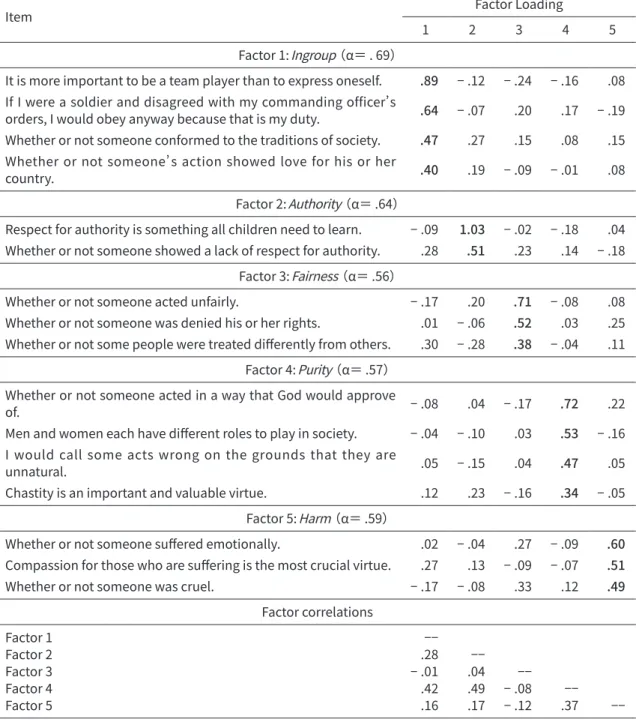
Using the data from 70 respondents, explor- atory factor analysis was conducted to deter- mine the factor structure of the MFQ’ s Japanese  translation. The Questionnaire’ s 30 items were  submitted to a principal factor analysis using a  promax rotation. The scree plot indicated a  five-factor solution. The factor solution ex- plained 60.5% of the total variance. To be re- tained, an item had to present a factor loading  of greater than .33 in only one factor; any items  presenting factor loadings of above .33 in more  than one factor or in no factors were discarded. 

The results indicated 16 items corresponding to  five factors, each with 2 to 4 items.

The first factor was composed of 4 items: “It  is more important to be a team player than to  express oneself”; “If I were a soldier and dis- agreed with my commanding officer’ s orders, I  would obey anyway because that is my duty”; 

“Whether or not someone conformed to the tra- ditions of society”; and “Whether or not some- one’ s actions showed love for his or her coun- try.” These four items are a mixture of the  Ingroup and Authority factors of the original  MFQ’ s structure. These items reflect individu- als’  tendency to humbly self-efface and their  unwillingness to stick out in their community,  prioritizing the role assigned to them by the  collective rather than their individual wishes  for self-actualization. This factor was consid- ered analogous to the original MFQ’ s Ingroup  factor and will therefore also be referred to as  Ingroup, for simplicity's sake.

The second factor was composed of 2 items: 

“Respect for authority is something all children  need to learn”; and “Whether or not someone  showed a lack of respect for authority.” This  factor represents an individual’ s tendency to 

respect authority in hierarchical relationships. 

Both items are extracted directly from the origi- nal MFQ’ s Authority factor, and this factor will  therefore also be referred to as Authority.

The third factor was composed of 3 items: 

“Whether  or  not  someone  acted  unfairly”; 

“Whether or not someone was denied his or her  rights”; and “Whether or not some people were  treated differently from others.” They all come  from the original Fairness factor of the English- language MFQ, which will be referred to as the  Fairness factor here, as well.

The fourth factor was composed of 4 items: 

“Whether or not someone acted in a way that  God would approve of”; “Men and women each  have different roles to play in society”; “I would  call some acts wrong on the grounds that they  are unnatural”; and “Chastity is an important  and valuable virtue.” Of the four items, three  came from the Purity factor of the original  Questionnaire, and one from the Authority fac- tor. These items represent an individual’ s belief  in and acceptance of an inviolable, foreor- dained  way  of  living.  This  factor  is  most  analogous to the Purity factor of the original  MFQ and will therefore be referred to hereafter  as the Purity factor, again, for simplicity's sake.

The fifth factor was composed of 3 items: 

“Whether or not someone suffered emotional- ly”; “Compassion for those who are suffering is  the most crucial virtue”; and “Whether or not  someone was cruel.” All of these items came  from the Harm factor of the original MFQ and  so will be referred to as Harm here as well.

These factors accounted for 21.4%, 12.6%, 

10.0%, 9.1%, and 7.4% of the total variance, re-

spectively. The internal consistency alpha val-

ues of the 5 factors were: .69 for Ingroup; .64 for 

Authority; .56 for Fairness; .57 for Purity; and .59 

for Harm. Reliability coefficients were accept-

able considering the limited number of items 

(9)

(2-4).

Table 2 presents means, standard deviations,  and correlations between research variables. 

Ingroup was significantly and positively related  to Authority (r=.35, p<.01) and Purity (r=.33,  p<.01). Purity was also significantly and posi-

tively related to Authority (r=.32, p<.01). Harm  and Fairness were significantly and positively  related ( r=.37, p<.01).

The mean of issue positions on death penalty  was 2.91 (SD=.81). Specifically, 31.4% indicated 

“oppose” (3.0%) or “oppose if forced to choose” 

Table 1. Summary of Factor Loadings for the Japanese Translation of the Moral Foundations Questionnaire

Item Factor Loading

1 2 3 4 5

Factor 1: Ingroup (α= . 69)

It is more important to be a team player than to express oneself. .89 − .12 − .24 − .16 .08 If I were a soldier and disagreed with my commanding officer’ s

orders, I would obey anyway because that is my duty. .64 − .07 .20 .17 − .19 Whether or not someone conformed to the traditions of society. .47 .27 .15 .08 .15 Whether or not someone’ s action showed love for his or her

country. .40 .19 − .09 − .01 .08

Factor 2: Authority (α= .64)

Respect for authority is something all children need to learn. − .09 1.03 − .02 − .18 .04 Whether or not someone showed a lack of respect for authority. .28 .51 .23 .14 − .18

Factor 3: Fairness (α= .56)

Whether or not someone acted unfairly. − .17 .20 .71 − .08 .08

Whether or not someone was denied his or her rights. .01 − .06 .52 .03 .25 Whether or not some people were treated differently from others. .30 − .28 .38 − .04 .11

Factor 4: Purity (α= .57)

Whether or not someone acted in a way that God would approve

of. − .08 .04 − .17 .72 .22

Men and women each have different roles to play in society. − .04 − .10 .03 .53 − .16 I would call some acts wrong on the grounds that they are

unnatural. .05 − .15 .04 .47 .05

Chastity is an important and valuable virtue. .12 .23 − .16 .34 − .05 Factor 5: Harm (α= .59)

Whether or not someone suffered emotionally. .02 − .04 .27 − .09 .60 Compassion for those who are suffering is the most crucial virtue. .27 .13 − .09 − .07 .51

Whether or not someone was cruel. − .17 − .08 .33 .12 .49

Factor correlations

Factor 1 −−

Factor 2 .28 −−

Factor 3 − .01 .04 −−

Factor 4 .42 .49 − .08 −−

Factor 5 .16 .17 − .12 .37 −−

(10)

(28.4%) on retaining the death penalty, and  68.7% indicated “support” (25.4%) or “support  if forced to choose” (43.3%). Issue positions on  the death penalty did not have any significant  relationship with gender, with any of the moral  foundations, or with political orientation.

Favorable  attitudes  toward  LDP (Japan’ s  Liberal  Democratic  Party) were  related  to  Ingroup (r=.33, p<.01), Authority (r=.37, p<.01),  and  Purity (r=.30, p<.01). On the other hand, fa- vorable attitudes toward JCP (the Japanese  Communist Party) were negatively and signifi- cantly related to  Fairness (r=-.25, p<.05).

Issue positions on the death penalty and the Five Moral Foundations.

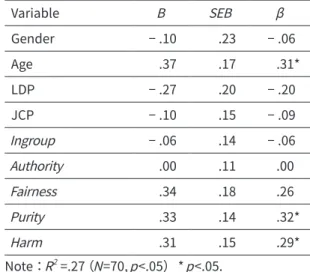
Issue positions on the death penalty were re- gressed  on  age,  gender (dummy-coded  as  1=male and 2=female), political orientation,  and all five moral foundation scores. As pre- sented in Table 3, issue positions on the death  penalty were positively and significantly related  to concerns about Purity and Harm. Specifically,  endorsement of Purity and Harm predicted sup- port for the death penalty. Purity emerged as  the foundation that best predicted favorable is- sue positions on the death penalty. Neither po- litical orientation nor gender predicted issue 

positions on the death penalty.

Discussion

The Japanese translation of the MFQ was fac- tor-analyzed, and five moral foundations emerged  from the Japanese sample. Although some fac- tors in the Japanese scale did not necessarily  retain the original factor structure, the extract- ed five factors were considered highly analo- gous to the Five Moral Foundations of the origi- nal MFQ.

Table 2. Means, Standard Deviations, and Intercorrelations of Research Variables

M SD 1 2 3 4 5 6 7

1. Death Penalty 2.91 .81 .

2. LDP 2.59 .58 − .04

3. JCP 2.14 .67 − .09 − .11

4. Ingroup 3.12 .76 − .03 .33** .09

5. Authority 3.22 1.05 − .01 .37** .01 .35**

6. Fairness 4.71 .66 .09 .05 − .25* .05 .01

7. Purity 3.51 .75 .20 .30* − .01 .33** .32** − .11

8. Harm 4.43 .82 .11 .08 .08 .16 .06 .37** .20

Note: N =70. * p <.05. ** p <.01

Table 3. Regression Analysis Summary for Demographic and Moral Foundation Variables

Predicting Issue positions on Death Penalty

Variable B SEB β

Gender − .10 .23 − .06

Age .37 .17 .31*

LDP − .27 .20 − .20

JCP − .10 .15 − .09

Ingroup − .06 .14 − .06

Authority .00 .11 .00

Fairness .34 .18 .26

Purity .33 .14 .32*

Harm .31 .15 .29*

Note: R

2

=.27 ( N =70, p <.05) * p <.05.

(11)

Ingroup, Authority, and Purity were signifi- cantly and positively correlated with one anoth- er. Harm and Fairness were significantly and  positively related. This pattern of intercorrela- tions among the Five Moral Foundations was  consistent with Graham et al. (2011). In the  present sample, 31.4% of this study’ s partici- pants opposed the death penalty, 68.7% sup- ported retaining the death penalty. The support  rate was lower than the 2014 Cabinet Office sur- vey. However, it was consistent with a study by  Watamura et al. (2016), in which 66% of Japan’ s  youth supported the death penalty.

More favorable attitudes toward LDP were re- lated  to  stronger endorsement of Ingroup,  Authority, and Purity. This was consistent with  the Graham et al. (2009) study in which conser- vatives’  stronger endorsement of these “binding  foundations” constituted the most striking dif- ference between conservatives and liberals.

On the other hand, more favorable attitudes  toward JCP were negatively related to Fairness. 

This was inconsistent with Graham et al. (2009)’ s  study, in which liberals showed greater en- dorsement and use of Harm and Fairness. Haidt 

(2013) noted that there are two subtypes of dis- tributive fairness, i.e., equality and proportion- ality. Liberals tend to prefer equality (everyone  gets the same), whereas conservatives prefer  proportionality or equity (everyone receives re- wards in proportion to his or her individual in- puts). It is possible that those participants who  favored JCP interpreted Fairness as proportion- al fairness. This question should be investigated  and clarified in future studies.

Issue positions on the death penalty and the Five Moral Foundations

Issue positions on the death penalty were  positively and significantly related to Purity and  Harm. Neither political orientation nor gender 

were useful predictors. This is generally consis- tent with Koleva et al. (2012), which demon- strated that endorsement of five moral founda- tions predicted political attitudes above and  beyond demographic characteristics and politi- cal orientation. However, in Koleva et al.’ s  study, political ideology tended to explain the  most variance for specific stands on the politi- cally divisive issues. In this study, political ori- entation was not related to issue positions on  the death penalty. This may be due to Japanese  college students’  limited knowledge of which  issue positions are embraced by which parties,  and more generally, where on the political  spectrum they are considered to lie (Inamasu & 

Miura, 2015).

In this study, Purity and Harm were among  the strongest predictors for issue positions on  the death penalty. Stronger endorsements of  Purity and Harm were related to pro-death-pen- alty views. This, too, was inconsistent with the  results in Koleva et al. (2012), where Harm was  the second strongest moral foundation factor  for disapproval of the death penalty. In Koleva  et al. (2012), the view that the death penalty  was morally reprehensible appeared to be driv- en by Harm, suggesting that death-penalty op- ponents were focusing on the harm committed  at the moment of execution (or the potential  harm attendant to wrongful conviction) rather  than the harm inflicted by the original crime. 

This is plausible, given that as 41% of those  Americans who opposed capital punishment  cited “it’ s wrong to take a life” and 11% cited 

“innocent persons may be wrongly convicted” 

as justifications.

In the present sample, in contrast, Harm was 

positively related to positions favoring the death 

penalty. This may be accounted for by the fact 

that the leading justification for the death pen-

alty was “consideration for the feelings of vic-

(12)

tims and their families,” which 53.4% of the  supporters cited as one of their lead justifica- tions. Thus, Japanese people who support the  death penalty may be focusing on the original  harm inflicted by the convict.

Furthermore, Purity was positively related to  pro-death-penalty  positions.  Koleva  et  al. 

(2012) noted  that Purity scores were most  strongly associated with such issues as same- sex marriage, abortion, cloning, euthanasia,  and stem-cell research. The present result is  consistent with Koleva et al.’ s study attesting to  the role of Purity in many social controversies. 

This may be accounted for by the fact that the  second leading justification for the death penal- ty was that murderers should atone by giving  up their own lives. One can infer that, in the  eyes  of  those  respondents,  “atonement  by  death” qualifies as purification of the original,  unclean act.

In sum, the present study’ s finding that en- dorsements of the Five Moral Foundations pre- dict specific issue positions was generally con- sistent with the findings of Koleva et al. (2012). 

It was thus suggested that moral intuition con- stituted psychological predispositions underly- ing specific attitudes toward controversial polit- ical issues and demonstrated the usefulness of  Moral Foundations Theory as a lens for exam- ining individual differences in political atti- tudes. That said, the present study’ s finding  concerning the association of pro-death-penal- ty attitudes with Harm and Purity concerns was  inconsistent with Koleva et al.’ s finding. Thus,  the critical moral intuitions that underlay fa- vorable (or unfavorable) attitudes toward the  death penalty were different between Japanese  and Americans. Specifically, concerns about  Harm predicted opposition to the death penalty  in the US, whereas concerns about Purity and  Harm predicted support in Japan.

There are clearly limitations to this study. 

The sample was small and restricted to univer- sity students, so the validity of its findings, es- pecially in different age groups, is unknown. 

Subscales on the Japanese version of the MFQ  were composed of only two to four items and  therefore  may  have  captured  only  a  small  amount of the foundations’  scope. The equiva- lence of the Japanese scale to the original MFQ  in terms of reliability, validity, and measure- ment should be explored in forthcoming stud- ies. Finally, the present study was concerned  with issue positions on the death penalty alone. 

Future studies should explore the relationship  of the five moral concerns to other issue posi- tions, such as global warming and same-sex  marriage, which would shed more light on the  psychological underpinnings of specific stands  on  controversial  political  issues  among  Japanese people.

References

Ellsworth, P. C., & Gross, S. R. (1994). Hardening of  the attitudes: Americans' views on the death penal- ty.  Journal of Social Issues, 50 (2) , 19-52.

Endo, M., & Jou, W. (2014). How Does Age Affect Per- ceptions of Parties' Ideological Locations? Japanese  Journal of Electoral Studies, 30 (1) , 96-112.

Graham, J., Haidt, J., Koleva, S., Motyl, M., Iyer, R.,  Wojcik, S. P., & Ditto, P. H. (2013). Moral founda- tions theory: The pragmatic validity of moral plural- ism.  Advances in experimental social psychology, 47 ,  55-130.

Graham, J., Haidt, J., & Nosek, B. A. (2009). Liberals  and conservatives rely on different sets of moral  foundations.  Journal of personality and social psy- chology, 96 (5) , 1029-1046. doi:10.1037/a0015141 Graham, J., Nosek, B. A., Haidt, J., Iyer, R., Koleva, S., 

& Ditto, P. H. (2011). Mapping the moral domain. 

Journal of personality and social psychology, 101 (2) ,  366-385. doi:10.1037/a0021847

Gross, S. R. (1997). Update: American public opinion  on the death penalty-It's getting personal.  Cornell L. 

Rev., 83 , 1448.

Haidt, J. (2001). The emotional dog and its rational  tail: A social intuitionist approach to moral judg- ment.  Psychological Review, 108 (4) ,  814-834. 

doi:10.1037/0033-295X.108.4.814

(13)

Haidt, J. (2013). Of freedom and fairness.  Democracy: 

A Journal of Ideas, 28 , 38-50.

Haidt, J., & Graham, J. (2007). When morality opposes  justice: Conservatives have moral intuitions that lib- erals may not recognize.  Social Justice Research, 20 

(1) , 98-116.

Haidt, J., & Joseph, C. (2004). Intuitive ethics: How in- nately prepared intuitions generate culturally vari- able virtues.  Daedalus, 133 (4) , 55-66.

Haidt, J., Koller, S. H., & Dias, M. G. (1993). Affect,  culture, and morality, or is it wrong to eat your dog? 

Journal of personality and social psychology, 65 (4) ,  613.

Hunter, D., J. . (1991).  Culture wars: The struggle to de- fine America . New York: Basic Books.

Inamasu, K., & Miura, A. (2015). Verificaiton of "con- servative swing of Japanesee university students" 

using online survey: What do the maintain? (「 オ ン

ライン調査を用いた  「 大学生の保守化 」 の検証: 彼らは

何を保守しているのか」『関西学院大学社会学部紀要』

120, 53-63).

Jones, J. M. (2017, October 26). U.S. Death Penalty  Support Lowest Since 1972. Retrieved from https://

news.gallup.com/poll/221030/death-penalty-sup- port-lowest-1972.aspx

Kahneman, D., & Egan, P. (2011).  Thinking, fast and  slow  (Vol. 1): Farrar, Straus & Giroux, New York.

河合幹雄・葛野尋之・木下麻奈子・平山真理・久保秀夫・

木村正人, (2015), 「刑罰とりわけ死刑に関する全国意識

調査基本報告書: 2014 年 3 月調査」『桐蔭法学』22(1),  1-65.

Kohlberg, L. (1969). Stage and sequence: The cogni- tive–developmental approach to socialization. In D. 

A. Goslin (Ed.), Handbook of socialization theory  and research (pp. 347–480). Chicago: Rand McNally. 

Kohlberg, day.

Koleva, S. P., Graham, J., Iyer, R., Ditto, P. H., & Haidt,  J. (2012). Tracing the threads: How five moral con- cerns (especially Purity) help explain culture war  attitudes.  Journal of Research in Personality, 46 (2) ,  184-194.

Mercier, H., & Sperber, D. (2011). Why do humans  reason? Arguments for an argumentative theory.  Be- havioral and brain sciences, 34 (2) , 57-74.

Schaller, M., & Park, J. H. (2011). The behavioral im- mune system (and why it matters).  Current direc- tions in psychological science, 20 (2) , 99-103.

Watamura, E., Saeki, M., Kiyomitsu, N., & Wakebe, T. 

(2016). How Is the Death Penalty System Seen by  Young People in Japan?—An Analysis of a Survey of  University Students.  Advances in Applied Sociology, 6 

(02) , 29.

This work was supported in part by JSPS KAKENHI 

Grant Number JP15K0069, JP18K11966, JP18H00796, 

and by Seijo University TOKUBETSU KENKYU JO-

SEI.

Table 1. Summary of Factor Loadings for the Japanese Translation   of the Moral Foundations Questionnaire
Table 3. Regression Analysis Summary for  Demographic and Moral Foundation Variables

参照

関連したドキュメント

As a research tool for the ATE, various scales have been used in the past; they are, for example, the 96-item version of the Tuckman-Lorge Scale 2) , the semantic differential

Conclusions: The present study demonstrated high HPV prevalence in the anus and urine, and showed a high incidence of anal cytological atypia associated with HR-HPV infections

This study was performed to examine attitudes toward evacuation(wish to stay at home, access evacuation sites)among elderly community residents that were able to choose

  The number of international students at Kanazawa University is increasing every year, and the necessity of improving the international students' Japanese writing skills,

Specifically, three hypothesis were tested: (a) teachers’ concerns can form a hierarchical model (awareness, informational, personal, management, consequences,

The objective of this study is to address the aforementioned concerns of the urban multimodal network equilibrium issue, including 1 assigning traffic based on both user

If you want to study different themes and learn how to talk about them more naturally in English, please apply to join one of my classes.

Princep 4L or Princep Caliber 90 plus Roundup brands: Use as tank mixture for preemergence and postemer- gence control of certain broadleaf and grass weeds where corn will be