• 検索結果がありません。

Wireless LAN Based Indoor Positioning System WiPS and Its Simulation

N/A
N/A
Protected

Academic year: 2021

シェア "Wireless LAN Based Indoor Positioning System WiPS and Its Simulation"

Copied!
5
0
0

読み込み中.... (全文を見る)

全文

(1)

熊本大学学術リポジトリ

Wireless LAN Based Indoor Positioning System WiPS and Its Simulation

journal or

publication title

IEEE Pacific RIM Conference on Communications, Computers, and Signal Processing ‑ Proceedings

volume Vol. I

page range 272‑275

year 2003

URL http://hdl.handle.net/2298/4516

(2)

Wireless LAN Based Indoor Positioning System WiPS and Its Simulation

Teruaki Kitasuka , Tsuneo Nakanishi ∗† and Akira Fukuda

Graduate School of Information Science and Electrical Engineering, Kyushu University 6-1 Kasuga-Koen, Kasuga-shi, Fukuoka 816-8580, JAPAN

System LSI Research Center, Kyushu University Email: { kitasuka, tun, fukuda } @f.csce.kyushu-u.ac.jp

Abstract— The wireless LAN(Wi-Fi) infrastructure is widely used and many location-aware systems and services are re- searched. In this paper, wireless LAN based indoor positioning system WiPS is proposed. WiPS uses wireless LAN technology to measure the location of each mobile terminal. Mobile terminals equip only wireless LAN device to communicate and measure its location, so it can be made without any additional devices for location sensing. Existing wireless LAN based location systems measure the signal strength by only access points. On WiPS, each mobile terminal also measures the signal strength of neighboring terminals. Thereby WiPS can achieve more precise location estimation than existing systems, where there are many mobile terminals. We simulate the case that disntance measurement has probablistic error. The result shows improvement of accuracy in WiPS.

I. I NTRODUCTION

Location sensing technology is very important for an in- frastracture of an ubiquitous computing environment. Outdoor location sensing technology such as GPS is already developed and widely used. For indoor location sensing, there are a few technologies, but they are not widely used currently. If location sensing technology which uses the wireless LAN infrastructure is developed, it will be used widely and can be a popular way.

As indoor location sensing, there are techonologies based on ultrasonic sensor and GPS pseudolite. Both techonologies have to need high installation cost and maintenance cost. A system based on ultrasonic sensor[1] have to install many sensors on a ceiling and connect them to a server. A system of GPS pseudolite[2] also have to install pseudo-satellite.

In this paper, we show the design of proposed positioning system WiPS and the result of its simulation. WiPS uses the signal strength between mobile terminals and access points to calculate the location of mobile terminals. Mobile termi- nals also measure the signal strength of neighboring mobile terminals.

II. D ESIGN OF W I PS A. Features

WiPS uses the wireless LAN infrastructure and provides the location information to mobile users. There were a similar research in Microsoft Research[3] and Ekahau[4]. The concept of WiPS have been presented in [5] already. The major features of WiPS are the followings

Connections between reference host and A Mobile host Reference host

A

B

C

D G1

G2

G3 Gn

Connection between mobile host and A

Fig. 1. Basic design of WiPS. A mobile termianl A measure the signal strength of not only access points G1, G2 and G3, but also mobile terminals B, C and D.

When a density of mobile users i.e. WLAN terminals increases, accuracy of location information becomes high.

In the situation of sparse density of location reference points such as access points, more precise location infor- mation can be provided than usual system.

First feature is matched to a rendevzous in scrouged place such as a hall of an exhibition. Second feature prevents setting cost of many access points from rising.

The signal strength of WLAN radio is used for calculation of the location. However the signal strength does not reflect the distance between terminals directly, because the signal is faded by not only distance but also multi-path and other causes.

To achieve these features, WiPS measures the signal strength by not only access points but also mobile terminals.

Each moblie terminal measures the signal stregth of access point and neighboring mobile terminals. Then WiPS deter- mines mobile terminals’ location by more observations than [3].

In Fig. 1 as an example, a mobile terminal A measures the signal strength of each access point G1, G2 and G3 and also measures it of each mobile terminal B, C and D.

On a latest work such as [3], only access points measure

the signal strength of a mobile termianl. Generally in WiPS,

0-7803-7978-0/03/$17.00 c 2003 IEEE 272

(3)

many observed signal strength data are used to determine the position of mobile terminals. The number of observations of the signal strength are increased in o(n 2 ) , when a number of terminals and access points is denoted by n . For these observations, WiPS can achieves the above two features.

B. Algorithm

In WiPS, a location server gathers the signal strength from each mobile terminal and access point. The server calculates the location of each mobile terminal and notifies each mobile terminal. Each access point knows its own absolute location and notifies the location server with the signal strength.

The process of location calculation on a location server is described below. Basically the steepest descent method is used.

1) Gather the list of signal strength of each pair of terminals and access points.

2) Determine the initial positions of mobile terminals.

3) Iterate the modification of the positions of mobile ter- minals, until convergence.

4) Notify the location to each mobile terminals.

In the Step 1), each mobile terminal and access point sends the packet to the server. The packet contains the signal strength list of neighboring mobile terminals and access points. The neighbor means that the terminal is in a radio communication range of another terminal. Each access point adds the location of itself into the packet.

In the Step 2), the server calculates an initial positions of mobile terminals by neighboring access points and neighbor- ing initialized terminals. For each mobile terminal denoted by A, a server selects the neighboring mobile terminals N A

and access points G A . Already initialized mobile terminals are selected from N and named N A . N A , N A and G A is a set of hosts — mobile terminals or access points. The position of terminal X or access points X is denoted by p X . The initial position of terminal A is determined by

p A = Σ X∈G

A

p X + Σ X∈N

A

p X n(G A ) + n(N A ) .

n(G A ) and n(N A ) are the number of hosts in G A , N A respectively. Initialization is done cyclically until all initial position of mobile terminals are determined.

In the Step 3), mobile terminal positions are refined by the steepest descent method to minimize the expression:

Σ n−1 i=0 Σ n j=i+1 |p i p j | − d i,j ,

when total number of hosts — both mobile terminals and access points — are n , p i is the position of i -th host, and d i,j is the measured distance between i -th and j -th host.

Where the position p (k) i shows the position of i -th host in k -th iteration, p (k+1) i is calculated by

p (k+1) i = p (k) i + α∇(i),

when α is a suitable small value α ( α = 0.05 is used in later simulation), ∇(i) is defined below.

∇(i) = Σ n j=0 u i,j · f (i, j) ,

u i,j is an unit vector from p (k) j to p (k) i . f(i, j) is the difference between the measured distance d i,j and the current estimated distance between i -th and j -th hosts. u i,j and f(i, j) are defined by following equations.

u i,j = p (k) i p (k) j

l i,j , l i,j = p (k) i p (k) j , f (i, j) =

 

 

 

 

 

d i,j l i,j if i and j are neighbors , 0 if i and j are not neighbors

and l i,j > d max ,

d max l i,j if i and j are not neighbors and l i,j d max .

d max is the typical radio communication range.

The iteration is finished when the maximum value of ∇(i) is smaller than a suitable value γ ( γ = 0.01 is used in later simulation).

III. S IMULATION MODEL AND RESULTS

A. Simulation Model

To confirm the precision of location information provided by WiPS, we simulate WiPS in 200m square plain. A radio communication range of each hosts is 100m. 4, 5 or 9 access point is located in the plain and the number of mobile terminal are increased from 5 to 50. The 9 access points case is the case of enough access points, and the case of 4 and 5 access points are the sparse access points case.

In this simulation, our major aim is to confirm the advantage of our distance measurement between mobile terminals. Then, we compare our model with the case that only access points measure the distance to mobile terminals. We also take care that the estimated distance has probabilistic error. However, we don’t take care of a movement of each mobile terminal, a communication delay, and a method of distance estimation from a signal strength.

Fig. 2 shows the location of access points, 1 through 9. In the case of 4 access points, the access points numbered 1 to 4 are used. The access points numbered 1 to 5 are used in the 5 access points case. Mobile terminals are put in the plain in a random manner and they don’t move.

The cover ratio of access points of each case is discussed here. In the case of 9 access points, 95% area of 200m square plain can reach 3 or more access points directly, but 4% area reaches only 2 access points and under 1% area reaches only 1 access points. In the case of 5 access points, only 24% area reaches 3 access points, 53% area reaches 2 access points, and 23% area reaches only 1 access point. In the case of 4 access points, no area reach three access points directly and 2% area does not reach any access points. 74% and 24% area reach respectively only one and two access points.

We simulate under two assumption for each number of

access points. First assumption is measured distance between

hosts has probablistic error. Second assumption is measured

distance has no error. Second assumption is not suitable for

real environment, if the distance is measured by the radio

signal strength. However, we use the second assumption to

273

(4)

2

3 4

5 6

7

8 9

20m 200m

20m 100m

1

100m

20m 200m 100m 20m

Fig. 2. Simulation environment

show the availability on which the density of access points is very low.

In the first assumption, the measured distance is the sum of real distance and probablistic error. The probablistic error is chosen under the normal distribution and is in proportion to the real distance. The proportional error means that, if a real distance between hosts is 100m, we assume the measured dis- tance using signal strength is selected in normal distribution, i.e. between 80m and 120m in 95.5% case. If the distance is half, the error is also half. In the related works[3], [4], they determine the estimated distance from the signal strength in their experiments. But we do not in the simulation.

B. Simulation Results

Fig. 3 shows the result of the assumption that the measured distance contains 20% error in normal distribution. X-axis is the number of mobile terminals and Y-axis is the average error of estimated location. The average error is defined as an average of difference between real position and estimated position of each mobile terminals. On the access point based method, the average error rate is shown as I-R4-E1, I-R5-E1 and I-R9-E1. Each line shows the case of 4, 5 and 9 access points respectively. The average errors are 42.2m, 16.8m, 6.5m in the case of 4, 5, 9 access points respectively. The averages are almost the same when number of mobile terminal is increased.

The result of proposed method is shown as A-R4-E1, A- R5-E1 and A-R9-E1 in Fig. 3. Each A-R n -E1 is the result of n access points case. On the proposed method, the average error decreases as the number of mobile terminal increases.

In the case of 5 mobile terminal, the average errors in 4, 5 and 9 access points are respectively 18.5m(44% of access point based method), 10.9m(65%) and 5.5m(86%). When there

1 10 100

5 10 15 20 25 30 35 40 45 50

average of error distance [m]

number of terminals I-R4-E1 I-R5-E1 I-R9-E1 A-R4-E1 A-R5-E1 A-R9-E1

Fig. 3. Simulation results in the cases that distance mesurement has probablistic error. I- means the result of access points based method, A- means proposed method and -Rn- shows the case of n access points.

are 50 mobile terminals, the average errors are 3.4m(8%), 3.1m(19%) and 2.8m(42%) respectively in 4, 5 and 9 access points cases.

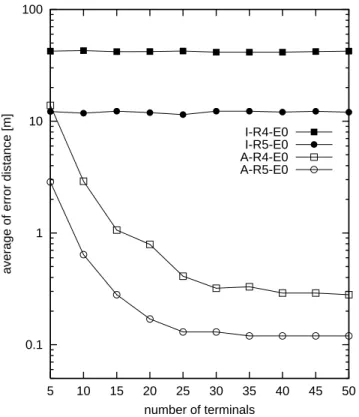
Fig. 4 shows the result of the case assumed that the measured distance is equal to real distance between each pair of hosts. The lines, I-R4-E0 and I-R5-E0, show the access point based method, and the lines A-R4-E0 and A-R5-E0 show the result of the proposed method. *-R4-* and *-R5-* cases are respectively the case of 4 and 5 access points. The result of 9 access points case is not shown in Fig. 4, since the error is almost zero in both access point based method and proposed method.

Access point based method has no improvement along with increasing of mobile terminal, as same as Fig. 3. Proposed method improves the average of error along with the increment of number of mobile terminals. In the case of 4 access points, the average of error access point based method is 42.0m. On the proposed method, the average of error are 13.8m(33%

of 42.0m) and 0.3m(0.7%) respectively in 5 and 50 mobile terminals. In 5 access points case, the average of error access point based method is 12.1m. On the proposed method, the average of error are 2.9m(24% of 12.1m) and 0.1m(1.0%) respectively in 5 and 50 mobile terminals.

Comparing Fig. 3 and Fig. 4, we find that the error of

distance measurement between each pair of hosts has a great

influence on the accuracy of location estimation. However in

both Figs., the number of mobile terminals has an important

(5)

0.1 1 10 100

5 10 15 20 25 30 35 40 45 50

average of error distance [m]

number of terminals I-R4-E0 I-R5-E0 A-R4-E0 A-R5-E0

Fig. 4. Simulation results in the cases of error-free distance measurement. I- means the result of access points based method, A- means proposed method and -Rn- means the case of n access points.

effect on proposed method. The effect is greater on the sparse access points case such as 4 or 5 access points case than 9 access points cases.

Finally, Fig. 5 shows the number of iterations for each case. Operation of each iteration is described in Sec. II. The parameters of iteration are α = 0.05 and γ = 0.01 . We confirm that the number of iterations is not increased when the number of mobile hosts is increased. Especially in the case of the sparse access point such as 4 and 5 access points case, when the number of mobile terminals is increased, iteration is decreased. Complexity of a iteration is o(n 2 ) , where n is the number of hosts, both access points and mobile termials.

Then the complexity of a estimation of all mobile terminals is o(n 2 ) or below.

IV. C ONCLUSION

We proposed indoor positioning system WiPS, and describe its features. WiPS can achieve better accuracy, where many mobile terminals exist, and also in the place of sparse access points. Mobile terminals can help each other to find its location.

Simulation result is shown. Simulation result ensure the features of WiPS. When the number of mobile terminals is increased, the precision is also increased. The accuracy of estimated location is improved in all cases. Complexity of proposed algorithm is not greater than o(n 2 ) on the simulated cases, where n is the number of hosts, both access points and mobile termials.

0 50 100 150 200 250 300 350

5 10 15 20 25 30 35 40 45 50

iteration count

number of terminals A-R4-E0 A-R5-E0 A-R9-E0 A-R4-E1 A-R5-E1 A-R9-E1

Fig. 5. Number of iteration until convergence

A CKNOWLEDGMENT

This research has been partially supported by JPSP Grant-in-Aid for Scientific Research (B) (KAKENHI 12480099), MEXT Grant-in- Aid for Young Scientists (B) (KAKENHI 15700062) and NTT.

R EFERENCE S

[1] Harter, A., Hopper, A., Steggles, P., Ward, A. and Webster, P.: “The Anatomy of a Context-Aware Application,” Proc. of ACM/IEEE MOBI- COM’99, pp. 59–68, Aug. 1999.

[2] Gobb, H.S.: “GPS Pseudolites: Theory, design, and applications,” Ph.D.

Thesis, Stanford University, Sep. 1997.

[3] Bahl, P. and Padmanabhan, V. N.: “RADAR: An In-Building RF-Based User Location and Tracking System,” Proc. IEEE INFOCOM 2000, pp.

775-784, 2000.

[4] Ekahau, Inc.: “Ekahau Positioning Engine 2.0,” http://www.ekahau.com/

[5] Kitasuka, T., Nakanishi, T., Fukuda A.: “Location Estimation System us- ing Wireless Ad-Hoc Network,” Proc. the 5th International Symposium on Wireless Personal Multimedia Communications (WPMC’2002), pp.305- 309, Oct. 2002

275

Fig. 1. Basic design of WiPS. A mobile termianl A measure the signal strength of not only access points G1, G2 and G3, but also mobile terminals B, C and D.
Fig. 2 shows the location of access points, 1 through 9. In the case of 4 access points, the access points numbered 1 to 4 are used
Fig. 2. Simulation environment
Fig. 5. Number of iteration until convergence

参照

関連したドキュメント

カメラと接続するには、カメラのZ( Wi-Fi )ボタンを押してから、スマートデ バイスの Wi-Fi 設定を ON にし、ネゴシエーション中に「 Wireless

Our proposing controller consists of the generator, power conversion circuit (rectifier and capacitor), DC-DC converter and wireless module.. In order to maximize the energy at

High-speed wireless access is available in guest rooms, lobby, 100 Sails Restaurant & Bar and pool area.. Wireless Network: Prince

To this aim, we propose to use categories of fractions of a fundamental category with respect to suitably chosen sytems of morphisms and to investigate quotient categories of those

Standard domino tableaux have already been considered by many authors [33], [6], [34], [8], [1], but, to the best of our knowledge, the expression of the

Finally, we explain the connection to the ergodic capacity of some multiple- antenna wireless communication systems with and without adaptive power al- location.. 2000

mathematical modelling, viscous flow, Czochralski method, single crystal growth, weak solution, operator equation, existence theorem, weighted So- bolev spaces, Rothe method..

We present a complete first-order proof system for complex algebras of multi-algebras of a fixed signature, which is based on a lan- guage whose single primitive relation is