• 検索結果がありません。

A Molecular Dynamics Study on Pressure Dependence of Ag Diffusion in Ag 3 SI

N/A
N/A
Protected

Academic year: 2021

シェア "A Molecular Dynamics Study on Pressure Dependence of Ag Diffusion in Ag 3 SI "

Copied!
6
0
0

読み込み中.... (全文を見る)

全文

(1)

A Molecular Dynamics Study on Pressure Dependence of Ag Diffusion in Ag 3 SI

Masakazu Yarimitsu and Masaru Aniya

Department of Physics, Graduate School of Science and Technology, Kumamoto University, Kumamoto 860-8555, Japan

Keywords: Molecular dynamics, pressure, diffusion, Ag

3

SI.

Abstract. The pressure dependence of the diffusion coefficient in the superionic α- and β-phases of Ag

3

SI has been studied by using the method of molecular dynamics. It is shown that in the high temperature α-phase, the Ag diffusion coefficient decreases with pressure. On the hand, in the intermediate temperature β-phase, the Ag diffusion coefficient exhibits a maximum at around 2.8 GPa. The structural origin of this behavior is discussed through the pressure dependence of the pair distribution functions.

Introduction

Superionic conducting materials are characterized by their high ionic conductivities. Ag

3

SI is one of such materials and has been the subject of numerous studies [1-10]. Ag

3

SI shows two structural phase transitions [3]. At the γ-β transition ( T = 157 K), a disordering of the Ag ions occurs while S and I remain ordered in the CsCl type array. At the β-α transition ( T = 519 K), the arrangement of anions becomes also disordered, changing from a CsCl to an averaged bcc type array. Accompanying such structural changes, discontinuous changes in the ionic conductivity are observed at the phase transition temperatures.

The study of pressure effects provides a useful tool to discriminate the superionic materials and to understand the mechanism of fast ion transport [11]. However, studies on pressure effects in superionic conducting materials are scarce [2,12,13]. In the present report, the pressure dependence of Ag diffusion in Ag

3

SI is studied by using the molecular dynamics method.

Method of Calculation

The atomic motion was calculated within the NPT ensemble. A system of 1080 ions (Ag: 648, S: 216, I: 216) was used. The initial atomic configurations of the β- and α-phases were chosen by taking into consideration the experimentally determined structures of the respective phases [3]. The time step was 1.0 fs and a total of 100.000 steps were taken in the calculation. The temperature chosen were 600 K, 550 K and 500 K. For each of these temperatures, the pressure was varied from 0 GPa to 5 GPa.

The interaction potential used in the calculation was of the Vashishta-Rahman type [14], which

consists of repulsive, Coulomb and charge-dipole interactions. These are written as

(2)

2 j i2

42

j i 2

j i n j i ij

ij

2

) 1

( r

Z e r Z

e Z Z A r

r

V    

 

 

 

 , (1)

where i, j stand for the type of ions, A

ij

is the repulsive strength, e is the elementary charge, σ

i

, Z

i

and α

i

are the particle radii, effective valence and electronic polarizability of the particle i, respectively.

The values of the parameters were those used by Matsunaga and Madden [9].

Results and Discussion

The mean square displacement (MSD) of the ions in Ag

3

SI at T = 600 K and P = 0 GPa is shown in Fig. 1. We can see clearly that only the MSD of Ag has a finite slope at long times, whereas the slopes for S and I are effectively zero. From the slope for Ag, the diffusion coefficient for the Ag ion was estimated to be D = 8.5x10

-6

cm

2

·s

-1

. This value is somewhat smaller than the result of a molecular dynamics calculation reported by another group, which uses a different interatomic potential [5] The MSD shown in Fig. 1 indicates that our molecular dynamics calculation reproduces quite well the characteristics of superionic conductors.

Fig. 1. Mean square displacement (MSD) of the Ag ions in Ag

3

SI at T = 600 K and P = 0 GPa.

Fig. 2. Pressure dependence of Ag diffusion in α -Ag

3

SI at T = 600 K and 550 K.

(3)

Fig. 3. Pressure dependence of Ag diffusion in β -Ag

3

SI at T = 500 K.

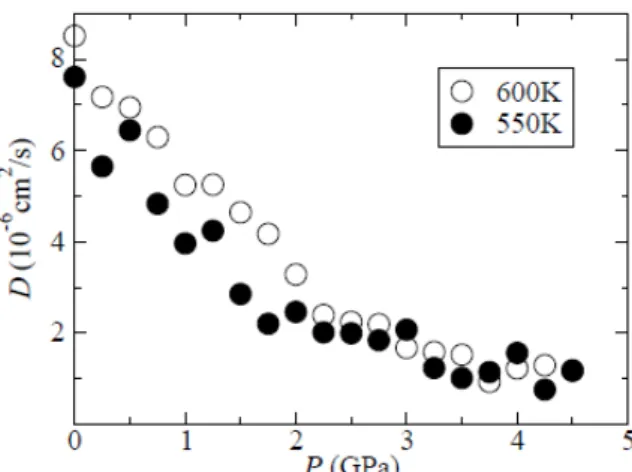
In Fig. 2, the pressure dependence of Ag diffusion in α-Ag

3

SI calculated at T = 600 K and T = 550 K is shown. The figure indicates that the diffusion coefficient in the α-phase decreases by the application of pressure. This behavior is interpreted to result from the decrease of available volume for ionic motion when pressure is applied to the system.

The pressure dependence of Ag diffusion in β-Ag

3

SI calculated at T = 500 K is shown in Fig. 3. We can see that the behavior of the diffusion coefficient against pressure is different from that of the α-phase. It exhibits a maximum at around P = 2.8 GPa. Normally, we expect that the diffusion coefficient will decrease with pressure. Indeed, in alkali halides, the ionic conductivity ( and the diffusion coefficient by the Einstein relation ) decreases with pressure [13]. However, it is known that in the case of superionic materials such as AgI and RbAg

4

I

5

, the ionic conductivity increase with pressure, if the measurements are done in the non superionic low temperature phases [12]. For the case of β-Ag

3

SI, it has been reported that the ionic conductivity increase with pressure [2]. However, a direct comparison with our calculation is not possible because the measurements has been done in a limited small pressure range, P < 0.3 GPa.

Fig. 4. Pressure dependence of the pair distribution functions in α -Ag

3

SI at T = 550 K.

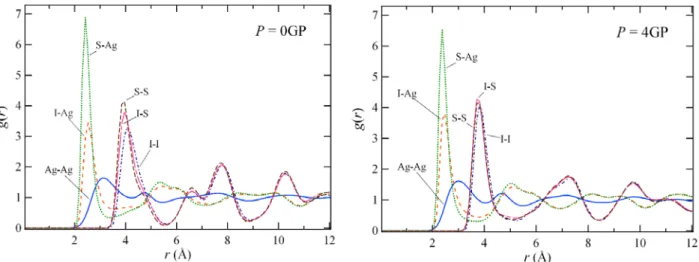
The origin of the behavior shown in Figs. 2 and 3 has been studied from the structural point of view.

Fig. 4 shows the pressure dependence of the pair distribution functions calculated in α-Ag

3

SI at T =

(4)

550 K. We can see that the variations in the pair distribution functions are not so dramatic, although some changes such as the shifts of the peaks towards low value of r, increase of the peak height and disappearance of the left hand side shoulder in the second peaks of S-S, I-S and I-I correlations are observed when a pressure of 4 GPa is applied.

Fig. 5. Pressure dependence of the pair distribution functions in β -Ag

3

SI at T = 500 K.

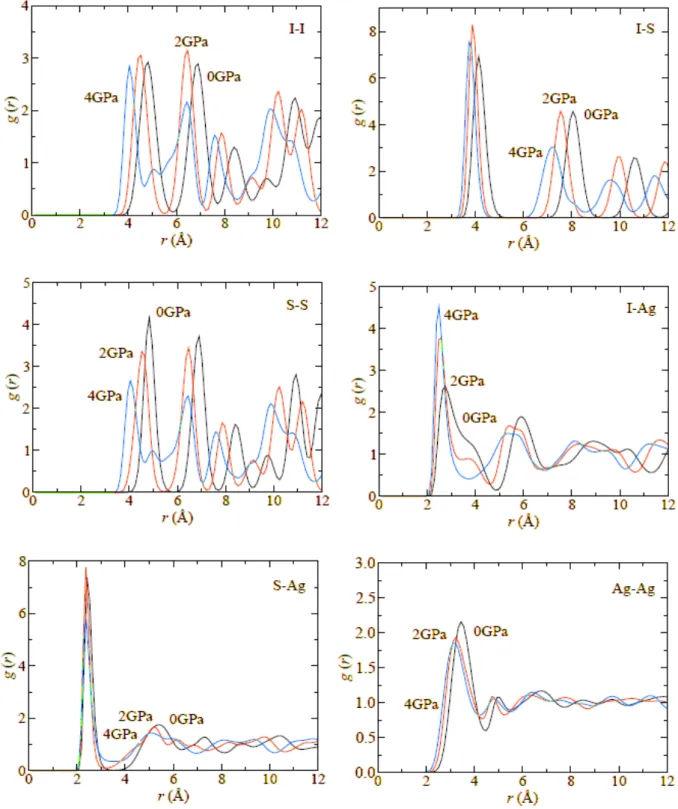
In contrast with the result of α-phase, the pressure dependence of the pair distribution functions in

the β-phase is very sensitive. Fig. 5 shows the results calculated at T = 500 K. Concerning the Ag-Ag

and S-Ag correlations, a systematic variation with pressure is observed. In particular, it is seen that

(5)

the first peak position of the S-Ag correlation remains almost constant. Concerning the I-Ag correlation, the shoulder in the right hand side of the first peak disappears with the application of pressure. Concerning the I-S correlation, a systematic variation of the second and third peak positions is observed. The most interesting behavior related to our purpose is the correlations of S-S and I-I.

These correlations change largely when the applied pressure exceeds approximately 2.8 GPa. In Fig.

5, we can compare the results for P = 2 GPa and 4 GPa.

Fig. 6. Time averaged positions of S (triangle) and I (circle) ions in β -Ag

3

SI at T = 500 K projected onto the (100) plane.

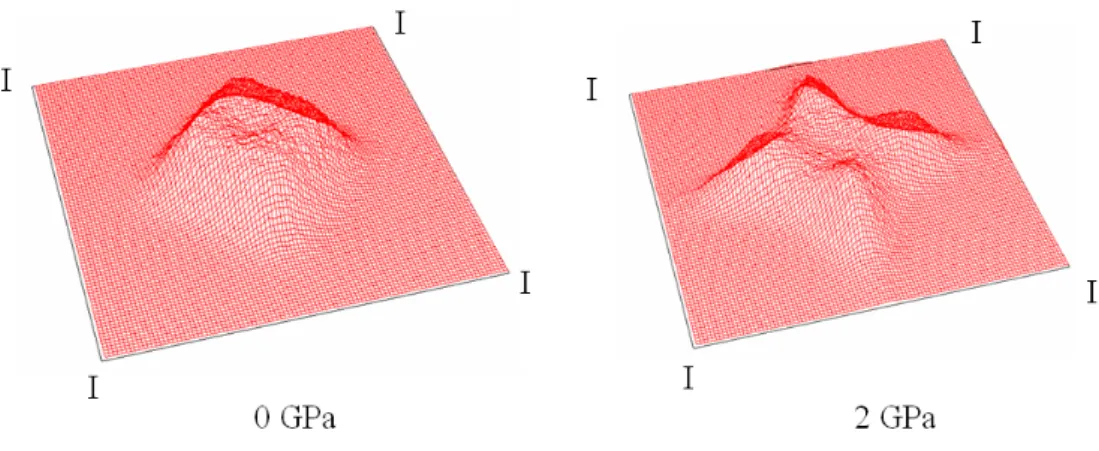
Fig. 7. Pressure dependence of the time averaged distributions of Ag ions in β -Ag

3

SI at T = 500 K projected onto the (100) plane.

Fig. 6 shows more directly the structural changes represented by the pair distribution functions. It

shows the pressure induced changes in the time averaged positions of I and S ions projected onto the

(100) plane of β-Ag

3

SI. As mentioned in the introduction, in the β-phase, I and S are ordered in the

CsCl type array. From Fig. 6, we can see clearly that the positions of I and S become disordered when

pressure is applied. This pressure induced change occurs at around 2.8 GPa. Fig. 7 shows the pressure

effects in the distribution of Ag in the (100) plane. It is seen that the positions where the Ag ions are

located spreads when pressure is applied. It is interesting to note that the distribution shown for P = 2

GPa resembles the distribution of Ag known in AgI [15].

(6)

Summary

The study of materials properties at different temperatures and pressures, provide much information to understand the microscopic mechanism that originate the observed behaviors. In the present study, the pressure dependence of the Ag diffusion coefficient in Ag

3

SI has been investigated by molecular dynamics simulations. Ag

3

SI is a well known superionic conducting material that at ambient pressure exhibits two structural phase transitions, at T = 157 K (from γ- to β-phases) and at T = 519 K (from β- to α-phases). In our study, we have found that in the high temperature α-phase, the Ag diffusion coefficient decreases with the application of pressure. On the other hand, in the intermediate temperature β-phase, the Ag diffusion coefficient exhibits a peaked behavior at around 2.8 GPa. The origin of the behavior has been studied by analyzing the pair distribution functions. The analyses indicate that the peaked behavior is related with the pressure induced disordering of the immobile ion sublattice.

Acknowledgements

The authors thank Mr. S. Hamakawa and Prof. F. Shimojo for their support.

References

[1] B. Reuter and K. Hardel: Naturwiss. Vol. 48 (1961), p. 161

[2] H. Hoshino, H. Yanagiya and M. Shimoji: J. Chem. Soc. Far. Trans. Vol. 70 (1974), p. 281 [3] S. Hoshino, T. Sakuma and Y. Fujii: J. Phys. Soc. Jpn. Vol. 47 (1979), p. 1252

[4] G. Chiodelli, A. Magistris and A. Schiraldi: Z. Phys. Chem. N. F. Vol. 118 (1979), p. 177 [5] S. Ihara and K. Suzuki: J. Phys. Soc. Jpn. Vol. 54 (1985), p. 2607

[6] Y. Seguchi and M. Mekata: J. Phys. Soc. Jpn. Vol. 54 (1985), p. 3447 [7] D. A. Keen and S. Hull: J. Phys.: Condens. Matter Vol. 13 (2001), p. L343 [8] S. Matsunaga: J. Phys. Soc. Jpn. Vol. 72 (2003), p. 1396

[9] S. Matsunaga and P. A. Madden: J. Phys.: Condens. Matter Vol. 16 (2004), p. 181

[10] S. Hull, D. A. Keen, P. A. Madden and M. Wilson: J. Phys.: Condens. Matter Vol. 19 (2007), p. 406214

[11] M. Aniya: Solid State Ionics Vol. 50 (1992), p.125

[12] P. C. Allen and D. Lazarus: Phys. Rev. B Vol. 17 (1978), p. 1913

[13] G. A. Samara, in Solid State Physics, Edited by H. Ehrenreich and D. Turnbull, Volume 38, p.1 (Academic Press, Orlando 1984)

[14] P. Vashishta and A. Rahman: Phys. Rev. Lett. Vol. 40 (1978), p. 1337

[15] R. J. Cava, F. Reidinger and B. J. Wuensch: Solid State Commun. Vol. 24 (1977) p. 411

Fig. 2. Pressure dependence of Ag diffusion in  α -Ag 3 SI at T = 600 K and 550 K.
Fig. 4. Pressure dependence of the pair distribution functions in  α -Ag 3 SI at T = 550 K.
Fig. 5. Pressure dependence of the pair distribution functions in  β -Ag 3 SI at T = 500 K.
Fig. 7. Pressure dependence of the time averaged distributions of Ag ions in  β -Ag 3 SI at T =  500 K projected onto the (100) plane.

参照

関連したドキュメント

In this section, we establish some uniform-in-time energy estimates of the solu- tion under the condition α − F 3 c 0 &gt; 0, based on which the exponential decay rate of the

Furthermore, the upper semicontinuity of the global attractor for a singularly perturbed phase-field model is proved in [12] (see also [11] for a logarithmic nonlinearity) for two

We present sufficient conditions for the existence of solutions to Neu- mann and periodic boundary-value problems for some class of quasilinear ordinary differential equations.. We

In Section 13, we discuss flagged Schur polynomials, vexillary and dominant permutations, and give a simple formula for the polynomials D w , for 312-avoiding permutations.. In

Analogs of this theorem were proved by Roitberg for nonregular elliptic boundary- value problems and for general elliptic systems of differential equations, the mod- ified scale of

“Breuil-M´ezard conjecture and modularity lifting for potentially semistable deformations after

Then it follows immediately from a suitable version of “Hensel’s Lemma” [cf., e.g., the argument of [4], Lemma 2.1] that S may be obtained, as the notation suggests, as the m A

Definition An embeddable tiled surface is a tiled surface which is actually achieved as the graph of singular leaves of some embedded orientable surface with closed braid