DOCTORAL DISSERTATION
Possibility of Intensifying and Socializing the Islamic Banks in Indonesia:
Supporting the Indonesian Financial System Stabilization and Searching for Social Significance in the Islamic Banks in Indonesia
Suryo Budi Santoso Student ID No: 1221072011
Graduate School of Human and Socio-Environmental Studies Division of Human and Socio-Environmental Studies
Kanazawa University
2016
i
TABLE OF CONTENTS
Title:
Possibility of Intensifying and Socializing the Islamic Banks in Indonesia: Supporting the Indonesian Financial System Stabilization and Searching for Social Significance in the Islamic Banks in Indonesia
Pages
Table of Contents……….... i
List of Figures………... iv
List of Tables………... vii
Chapter 1. Introduction... 1
1.1. Review of Previous Theoretical Researches... 2
1.2. Review of Previous Empirical Researches... 11
1.3. Review of Previous Research of Islamic Banks in Indonesia... 20
1.4. Theme and Component of the Doctoral Dissertation... 24
Chapter 2. An Overview of Current Banking Systems in the World: Comparison between Conventional and Islamic Banks... 30
2.1. Introduction... 30
2.2. Volatility of the Global Financial System... 31
2.3. Development of Islamic Banks... 37
2.3.1. Profit and Loss Sharing (PLS) System………... 37
a. Deposit... 39
a-1) Saving Account... 39
a-2) Current Account... 39
a-3) Time Deposit... 40
b. Financing... 40
b-1) PLS (Profit and Loss Sharing)... 41
b-1-1) Mudharabah... 42
b-1-2) Musharakah... 43
b-2) Lease... 44
b-3) Sale and Purchase... 45
b-4) Borrowing and Lending Services... 50
2.3.2. Development of Islamic Banks in the World... 50
2.4. Mixed Banking System [Conventional and Islamic Banking System]... 56
2.4.1. Credit Risk... 59
2.4.2. Liquidity Risk... 60
2.4.3. Market Risk... 62
2.4.4. Interconnection of Risks... 64
ii 2.5. Survey of Comparative Researches on Stability of Islamic Banks and of
Conventional Banks... 68
2.6. Conclusion... 80
Chapter 3. An Overview of the Mixed Banking System in Indonesia: Unstable Financial Situation and Significance of Islamic Banks... 82
3.1. Introduction... 82
3.2. Banking System in Indonesia... 84
3.2.1. Mixed Banking System in Indonesia... 84
3.2.2. The Indonesian Banking Architecture... 94
3.2.3. Stability of the Financial System and Potential Risk... 103
3.3. Islamic Banking Sector in Indonesia and Significance of Its Role... 114
3.3.1. Recent Growth of Islamic Banks in Indonesia... 114
3.3.2. Stability of Islamic Banks in Indonesia during and after the Crisis…... 117
3.4. Conclusion... 124
Chapter 4. Key Factors for Intensification of Islamic Banks in Indonesia: With Some Comparison with Malaysian Case... 125
4.1. Introduction... 125
4.2. Problems for Intensification of Islamic Banks in Indonesia... 130
4.2.1. Human Resources... 130
4.2.2. Suboptimal Financing Structure... 138
4.2.3. Suboptimal Funding Structure... 141
4.3. Key Factors for Intensification of Islamic Banks in Indonesia... 145
4.3.1. Human Resources... 145
4.3.2. Diversification of Islamic Bank Finance and Funding... 150
4.3.3. Utilization of Sukuk... 154
4.4. Comparison with Malaysian Islamic Banks in Some Aspects... 162
4.4.1. Financial Contracts... 162
4.4.2. Islamic Interbank Money Market... 166
4.4.3. Compliance of Sharia System and Government Role... 171
4.5. Conclusion... 175
Chapter 5. A Design of Organized and Continuous [OC] Islamic Bank Socialization Program to Confirm the Social Significance of Islamic Banks in Indonesia... 178
5.1. Introduction... 178
5.2. Preliminary Research... 179
5.2.1. Definition of Socialization... 179
5.2.2. From Marketing to Socialization... 180
5.3. Ongoing Socialization of Islamic Banks in Indonesia... 183
5.3.1. Bank Indonesia... 183
5.3.2. OJK (Otoritas Jasa Keuangan) or FSA (Financial Service Authority)... 186
5.3.3. MES (Masyarakat Ekonomi Syariah: Islamic Economic Society).... 187
5.3.4. PKES (Pusat Komunikasi Ekonomi Syariah: Sharia Economy Communication Center)... 189
5.3.5. Islamic Social Organizations... 191
5.4. Finding and Implication... 193
5.5. An Attempted Sketch of OC Socialization Program... 195
iii
5.5.1. A National Education Program for Socializing Islamic Banks... 196
5.5.2. Training of Ulama for Socializing Islamic Banks in Pengajian... 202
5.5.3. Socializing Islamic Banks in Pengajian... 204
5.6. Conclusion... 209
Chapter 6. Conclusion and Research Contributions... 211
Bibliography... 219
iv
List of Figures
Pages 1.1. Rate of Return Earned in Banks in Malaysia and in Turkey in the Years 1997 to
2010 (in Percentage)... 7
1.2. Share of Islamic Bank Numbers in Total Banking System in the Selected Islamic Countries, 2006 (in Percentage)... 17
1.3. Share of Islamic Bank Assets in Total Banking System in the Selected Islamic Countries, 2013(in Percentage)... 18
2.1. Volatility Linkage among Bank Interest Rates (France, German, and UK) in the Years 1984 to 2000... 33 2.2. Volatility Linkage among Bank Interest Rates (Canada, Japan, and USA) in the Years 1984 to 2000... 33 2.3. Short-term Lending Rates in the Euro Area and the Selected Core Countries: 2000-2013... 34
2.4. Real Interest Rates in Indonesia, Malaysia, Thailand, and Bahrain: 1997-2014 (in Percentage)... 35
2.5. Concept of Profit Sharing... 38
2.6. Concept of Mechanism and Operational System of Islamic Bank... 41
2.7. Concept of Mechanism of Financial Partnerships (Mudharabah)... 42
2.8. Concept of Mechanism of Financial Partnerships (Musharakah)... 43
2.9. Concept of Mechanism of Leasing Transactions in Installment (Ijarah)... 44
2.10. Concept of Mechanism of Selling in Installment/Credit (Murabaha)... 46
2.11. Tawarruq Concept... 49
2.12. The Number of Islamic Banks in the World: 1994-2008... 51
2.13. A Share of Islamic Bank Assets in the World: 1994-2008... 51
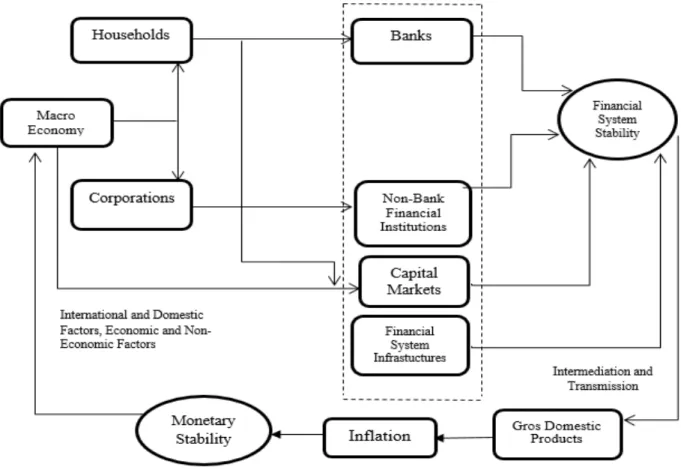
2.14. The Link between Financial System Stability and Monetary Stability... 58
2.15. Average Bank Stock Return by Bank Type: 2005-2009... 65
2.16. Technical Efficiency Scores by Year and Bank Type: 2001-2010……… 70
2.17. Average Operating Profit Ratio: 2005-2010 (in Percentage)... 71
2.18. Profit Ratio to Customer Deposits: 2005-2010 (in Percentage)... 72
2.19. Ratio of Equity to Assets: 2005-2010 (in Percentage)... 73
2.20. Islamic Banking Global Average Growth Trends (in Percentage): 2006-2011... 74
2.21. Comparison of Average Z-Scores... 80
3.1. Recapitulation of Banking Institutions in Indonesia, December 2014... 90
3.2. The Indonesian Banking Architecture (API)... 95
3.3. The Number of Banks by Asset in Indonesia: 2009-2014... 97
3.4. Ratio of Banking Sector Assets to GDP (in Percentage)... 98
3.5. Performance of Banks in Indonesia in the Post Asian Currency Crisis: 2000- 2006 (in Percentage)………... 104
3.6. Total Number of Commercial and Rural Banks in Indonesia: 2007-2012…….. 105
3.7. Total Assets and Fund Distributions of Commercial Banks: 2007-2012 (in Billion IDR)... 106
3.8. Total Assets and Fund Distributions of Rural Banks: 2007-2012 (in Billion IDR)... 106
3.9. The Number of Total Bank Offices of Commercial Banks and Rural Banks: 2007-2012 ………... 107
3.10. Indonesia Interest Rates in 1998 (in Percentage)... 108
3.11. Interest Rates of Bank Indonesia: 1996-2013 (in Percentage)…... 109
v
3.12. Exchange Rates of IDR to USD in the Years 1990 to 2001 (Indonesian Rupiah).. 110
3.13. Exchange Rates of IDR to USD in the Years 2001 to 2013 (Indonesian Rupiah).. 110
3.14. Exchange Rates of IDR to USD in One Year: October 2015-October 2015 (Indonesian Rupiah)…... 111
3.15. Inflation in Indonesia in 1998... 111
3.16. Inflation in Indonesia after Economic Crisis in the Years 1999 to 2012... 112
3.17. The Development of the Banking Sector in Indonesia: 1970-2012……….... 113
3.18. Assets and Fund Distribution of Islamic Banks in Indonesia: 2007-2012…... 115
3.19. The Number of Islamic Commercial Banks, Islamic Business Units, and Islamic Rural Banks: 2007-2012…... 115
3.20. The Number of Offices of Islamic Banks in Indonesia: 2007-2012... 116
3.21. NPF (Non-performing finances) of Islamic Banks and NPL (Non-performing loans) of Conventional Banks in Indonesia: 2000-2007………... 119
3.22. Relationship among Asset Growth Rate of Islamic Banks, Currency Growth Rate and Interest Rate Growth in Indonesia: 2000-2004... 120
3.23. Non-performing Loans of Islamic and Conventional Banks in Indonesia: 2006- 2010 (in Percentage) ……….……… 121
3.24. Capital Adequacy Ratio (CAR) of Islamic and Conventional Banks: 2006-2010 (in Percentage)... 122
3.25. Net Interest Margin of Islamic Banks and Conventional Banks 2006-2010 (in Percentage)... 123
4.1. The Number of Total Commercial and Rural Banks in Indonesia: 2007-2012… 126 4.2. The Number of Islamic Commercial Banks, Islamic Business Units, and Islamic Rural Banks: 2007-2012... 126
4.3. Assets of Islamic Banks and Conventional Banks in Indonesia: 2007-2012... 127
4.4. Islamic Bank Assets in Indonesia and Malaysia: 2007-2012……... 128
4.5. Trend Line of Indonesian Islamic Bank Employees: 2009-2015... 135
4.6. Supply and Demand of Professional Employees of Islamic Banks: 2015-2027... 136
4.7. Supply and Demand of Expert Employees of Islamic Banks: 2015-2027…... 137
4.8. Financing Groups of Islamic Bank by Enterprise Scale (in Billion IDR): 2007- 2012... 138
4.9. Financing by Sector in Islamic Banks in Indonesia: 2007-2012 (in Billion IDR).. 139
4.10. Financing by Sector in Islamic Banks in Malaysia: 2007-2012 (in Million RM)... 140
4.11. Comparison of Long-term and Short-term Time Deposits in Islamic Banks: 2007 -2012... 142
4.12. Structure of Deposits in Islamic Banks: 2007-2012... 142
4.13. Depositor Motivations of Short-term Saving Products in Indonesia in 2008... 144
4.14. Placement of Funds of Islamic Banks in Indonesia in 2012... 151
4.15. Fund Composition of Islamic Banks in Indonesia in 2012... 151
4.16. Share of Funding and Bank Financing in Indonesia in 2012... 152
4.17. Total Assets, Financing, and Depositor Funds in 2013 (in Billion IDR)... 153
4.18. Structure of Sukuk Based on Mudharabah... 156
4.19. Outstanding Volume of Corporate Sukuk by Country and Value in 2010... 157
4.20. The Volume of Sukuk Issued in the World: 2001-2014 (in Million USD)... 158
4.21. The Number of Sukuk and Sukuk Issuers in the World: 2001-2014... 159
4.22. Global Sukuk Issuances by Currency in 2013... 160
4.23. Sukuk Issued by the Indonesian Government... 161
4.24. Islamic Interbank Transaction in Malaysia: 2007-2013 (in Million USD)... 167
4.25. Islamic Interbank Transaction in Indonesia: 2007-2013 (in Million USD)... 167
5.1. Hierarchy of Effective Marketing... 181
vi
5.2. Input, Action, and Output Process of OC Socialization Program... 195
5.3. School System in Indonesia...………... 197
5.4. Formal Education Participation in Indonesia in 2013... 201
5.5. Training of Ulama in OC Program... 203
5.6. The Number of Muslims in Indonesia by Province in 2010... 207
vii
List of Tables
Pages 1.1. The 5 Year CAGR (Compound Annual Growth Rate), Assets, and Market Share
of Islamic Banks in Six RGM: 2008-2012... 14
2.1. Results of Granger Causality Test for Islamic and Conventional TDRs (Time Deposit Returns) Offered under Commercial Banks... 66
3.1. Islamic Banking Units of Regional Development Banks and of Conventional Private Banks... 91
3.2. Full-fledged Islamic Private Banks in Indonesia... 92
4.1. Higher Educational Institutions under Ministry of Religion Which Offer the Curriculum or Program of Islamic Economics, Finance and Banking... 131
4.2. Higher Educational Institutions under Ministry of Research-Technology and Higher Education Which Offer the Curriculum or Program of Islamic Economics, Finance and Banking... 132
4.3. An Assumed Maximum Supply for the Islamic Banks from the Higher Educational Institutions in Indonesia... 134
4.4. The Number of Employees in the Islamic Banks in Indonesia in 2013... 134
4.5. Indonesian Islamic Bank Employees: 2009 to 2015... 135
4.6. The Master Curriculum of Airlangga University on Islamic Economics... 147
4.7. The Curriculum of Islamic Economics in Doctoral Course in Airlangga University... 148
4.8. The Curriculum of Islamic Economics in Doctoral Course in UIN (Universitas Islam Negeri) Sumatra Utara Medan... 149
4.9. Financing by Contract of Bank Muamalat Indonesia in 2013... 163
4.10. BIMB Financing by Contract in 2013... 163
4.11. Sukuk Issuance by Structure in 2013... 165
5.1. An Estimation of the Number of Pengajian for Islamic Bank Socialization... 205
Page | 1
Chapter 1. Introduction
In this introductory chapter, following some reviews of previous researches and an explanation of the theme and component of this doctoral dissertation, will be stated an academic contribution to the Indonesian Islamic banks study that I will attempt to make in this thesis. What I would like to appeal as an academic contribution here is that, through all the chapters, I will be able to construct an approach which synthesizes a way of intensifying Islamic banks in Indonesia in an economic and commercial point of view on the one hand and a way of searching for socializing them in a moral and ethical point of view on the other hand. It should be admitted that Islamic banks originally have been expected to be such financial institutions as these since they appeared in 1960s in the Middle East. If Islamic banks are not large enough to be competitive with conventional banks, they do not expand and provide their services satisfactorily for a lot of potential Muslim users in the world.
Meanwhile, if Islamic banks are not solidly based on the moral principle, they lose their social significance. However, there are few researchers who search for both two possibilities.
Some exclusively stress religious and moral property of Islamic banks and other are more
concerned with how to develop them commercially in the national or the international
financial system, including Indonesian one. An important factor linking these two
possibilities is the stability of Islamic banks since they are thought to be more stable just
because of their strict observance of Islamic law (Sharia). With regard to it too, there are
remarkable researches demonstrating the stability of Islamic banks.
Page | 2 Taking into consideration what I mentioned above, and after reviewing some previous researches in the Chapters 1.1, 1.2, and 1.3 below, I will reveal an academic contribution of the thesis.
1.1. Review of Previous Theoretical Researches
To begin with, we will clarify the standing position of Islamic economics and Islamic finance based on the principle of Islamic economics. According to Khurshid Ahmed, Islamic economics is not value-neutral. Although it is not “an aspect of theology”, nor “an aspect of law”, it has “its own set of values” whereby it operates. A distinctive feature of Islamic economics is, he mentions, that it does not conceal its values in contrast with western economics. Islamic economics deals not only with how human beings behave, but also “how they should behave”. Islamic economics directs human beings “towards the achievement and actualization of justice (‘adl) in human relations” through a set of regularizations “known as halal and haram, that is, what is permitted and what is forbidden” (Ahmed, 2000a).
Ahmed, in another article, also asserts that Islamic economics calls for a change from
interest-based banking and financial system to an equity-based, stake-taking system where
money is used primarily as a means and a measure, where money is a servant not a master,
and where money does not beget money but money is used directly as a facilitator for
production of goods and services (Ahmed, 2000b). Hasanuzzaman also observes that Islamic
economics has a prerequisite that “economic activity is not governed only by human desire
and experience” but also by “injunctions of the Shari’ah”. While it is a ramification of the
Page | 3 social science, he continues, “Islamic economics is not independent of social requirements and moral values” (Hasanuzzaman, 2010)
1.
One of the reasons why Islamic banks are propagated with eagerness in the recent years can be understood by such a fundamental “framework of a value system” of Islamic economics that delineates “the boundaries of the free area” of economic action (Abdul-Rauf, 2010). It is not measured simply by their compatibility with conventional banks, but by the contributions made by Islamic banks towards the betterment, justice, equity and fairness of the whole Islamic community
2. Islamic banks are responsible for promoting establishment and growth of business enterprises soundly so that activities of these enterprises are able to be permitted by the Islamic law (Haroon, 2000).
One of the most strictly prohibited financial behaviors in Islamic economics is taking interest (riba). It is just because people living in the Islamic society should help each other in times of need by supplying money without extra charge. “Prohibition against riba means
1
With regard to the ethics, Vatican’s official newspaper, Observatory Romano, stated that the ethical principle on which Islamic banks bases themselves may bring them closer to their clients and to the true spirit which every financial product and service should assume originally as their mission (Totaro, 2009). The article was also delivered by Temporal with additional remark that strength of Islamic finance lies in the Sharia-compliant and ethical banking transactions (Temporal, 2011).
2
As Ali Basah and Yusuf argue, “Sharia acts as an internal control over Islamic banks alongside secular legislation. Such internal control should make Islamic banks more sensitive towards CSR [Corporate Social Responsibility] and environmental risk management than conventional banks”.
They continue that “In [in] economic activities, in order to achieve social justice, Islam provides a
foundation for establishing socio-economic justice and therefore social responsibility. For example,
Islam imposes obligatory payment of income and wealth (zakat), philanthropic trusts (waqf), alms
and charity (sadaqah), and interest free loans (Qard al Hassan). To ensure socio-economic justice,
zakat is compulsory in Islam and is one of its five pillars. Non-fulfilment of this requirement is a
sin and results in punishment in the Hereafter. Economic competition is encouraged as long as it
is healthy, raises efficiency, and helps promote human well-being” (Basah and Yusuf, 2013: 201).
Page | 4 that one cannot passively invest one’s money in bonds and collect interest; if one wishes to increase one’s wealth, this wealth must be directly invested to yield a profit”
3. This thought leads us immediately to the principle of profit and loss sharing principle (Pryor, 2010).
Provision of financial resources to business undertakings for productive purposes is permissible only on the basis of profit and loss sharing principle. Islam allows a return on capital on the condition that “provider of capital shares also the risks of the business”
(Ahmed, Z., 2000).
El-Galfy and Khiyar assert that money has no intrinsic value in itself in Islamic finance.
“A Muslim cannot lend money to, or receive money from someone and expect to benefit.
This means that interest is not allowed and making money from money is forbidden. Money must be used in a productive way, by which wealth can only be generated through legitimate trade and investment in assets. The principal means of Islamic finance are based on trading.
Any gains relating to the trading are shared between the party providing the capital and the party providing the expertise. As a result, the Islamic banks have developed four main
3
According to a research of Elmawazini and the other (2015) about Islamic finance development
in GCC Countries, Islamic finance has positive and significant impacts on economic growth in
GCC countries. Firstly a main principle of Islamic banking (e.g. zero nominal interest rate) results
in efficient allocation of resources. It is in line with Nobel Prize Laureate, Milton Friedman (See
Friedman and Bordo, 2005). Secondly, the use of zakat funds and interest-free loans (qard hassan)
can reduce the income gap between the poor and the rich and improve socio-economic
development in the society. Zakat funds are imposed on wealth and income of the rich that exceed
their personal spending and normal customs, and they are distributed to the poor for their private
consumption of "consumer goods" (Hassan and Khan, 2007). While zakat and qard hassan are
derived from a kind of charity, they differ from each other in usage: The former are for
consumption and the latter for productive activity in the micro business. At any rate, it is evident
that these two points make the possibility of Islamic banks to develop well in the countries.
Page | 5 Islamic financing techniques, which are: Mudharabah, Musharakah, Ijara and Murabaha
4”.
Since Islamic banks make social investment, such as support of the low-income classes, social works, and sustainable development, these are not in contradiction with rational allocation of resources because they contribute to the long-term development (El-Galfy and Khiyar, 2012).
Then, are there any factors of conventional finance which are similar to Islamic finance? According to a Malaysian leading scholar in the field of Islamic finance, Abbas Mirakhor, there are some basic similarities between modern economics and Islamic economics. Mirakhor and Bao argue that Adam Smith’s “major contribution in his Theory of Moral Sentiments is to envision a coherent moral-ethical social system” and to show how each member of society would enforce need for “an organic coevolution of individual and society”. They also argue that there are some theoretical works which, reflexing such Smith’s thoughts, seek for optimal risk sharing in “a decentralized market economy”. For example, a model of Arrow-Debreu-Hahn shows general equilibrium in a decentralized market economy, where risk is allocated to those who can best bear it and where “securities represent contingent financial claims on the real sector” (Mirakhor and Bao, 2013). Whereas risk sharing is one of the most crucially important factors in Islamic finance, in conventional
4
These four transactional forms will be explained in detail in the second chapter. Here it is suffice
to point out, as Haneef and Smolo list up, that they share the four common features: (1) Asset
which is being sold or leased are real, and “not imaginary or notional”; (2) Seller “owns and
possesses” the goods being sold or leased; (3) Transaction is “a genuine trade transaction with full
intention of giving and taking delivery”, and; (4) “Debt cannot be sold, and thus, the risk associated
with it cannot be transferred to someone else”, being borne by the creditor himself (Haneef and
Smolo, 2014: 29).
Page | 6 economic theory is also mentioned that risk should be allocated among market participant rather than allowing it to be concentrated among borrowers.
Following the arguments of Mirakhor and Bao, Sheng and Singh also point out some similarities between modern (conventional) finance and Islamic finance. Their concerns are rather focused on similarities with regard to prohibition or permissibility of riba (interest).
“(This) rate of discount, which is normally taken to be the market interest rate, is supposed to reflect society’s preference between consumption or utility today and consumption and utility tomorrow. If the two are equally valued, this may be regarded, as the case of Islamic finance, with a zero discount rate or interest rate”. Sheng and Singh find, following the statement cited above, an ethical justification of a zero interest rate in the classic work of Pigou and Ramsey who argued that the time preference should be zero for “the achievement of intergenerational fairness”. A positive discount rate would “greatly favor the current generation at the expense of the future generations” (Sheng and Singh, 2013).
Shen and Singh also cite a doctrine which was referred to by John Maynard Keynes in the General Theory of Employment, Interest, and Money, “the rate of interest is not self- adjusting at a level best suited to the social advantage but consistently tends to rise too high, so that a wise Government is concerned to curb it by statute and custom and even by invoking the sanctions of the moral law”. Keynes criticized the classical school for the reason that it repudiated this doctrine cited above as “childish” and he insisted that the doctrine, far from being repudiated, deserved “rehabilitation and honour” (Sheng and Singh, 2013).
As discussed above, although the fundamental approaches and concepts of modern
economics and those of Islamic economics are quite different from each other, they are
sometimes likely to be approximate to each other, since modern economics, like Islamic
Page | 7 economics, cannot neglect entirely the moral or ethical side of financial activity of human kinds
5.
Figure 1.1. Rate of Return Earned in Banks in Malaysia and in Turkey in the Years 1997 to 2010 (in Percentage)
Source: Cevik and Charap, 2011
Then, we will focus on an analytical issue concerning competition of conventional banking institution and Islamic banking institution. A recent IMF study by Cevik and Charap which compares the rate of return from the two kinds of banking institutions in Malaysia and Turkey in the years 1997 to 2010 confirms that there is not much difference in the rate of return earned by the two groups as a result of competition between them (See the Figure 1.1).
5
Blitz and Long, reviewing historical discourses on regulation of usury, observe that there have
been three kinds of objectives of usury legislation: “protecting the small borrower” in need of
consumption loans; “curbing the monopoly power of the creditor”, and; “regulating the allocation
of resources” (Blitz and Long, 2010). Levy, citing from Smith a statement that “the legal rate, it is
to be observed, though it ought to be somewhat above, ought not to be much above, the lowest
market rate. If the legal rate of interest in Great Britain, for example, was fixed so high as eight or
ten percent, the greater part of the money which was to be lent, would be lent to prodigals and
projectors, who along would be willing to give this high interest”, mentions that usury laws,
according to Smith, can benefit society by reducing the riskiness of society’s investments (Levy,
2010).
Page | 8 While the analysis of Cevik and Charap belongs to empirical researches which will be reviewed in the next section, it makes, in a sense, a theoretical demonstration that, whether it may be Islamic or conventional banking institution, the question of optimality is considered only from a perspective of an individual banking firm and not from the perspective of a whole banking institution (Cevik and Charap, 2011).
Competition of conventional banks and Islamic banks may put the latter even into disadvantageous position. Clement M. Henry observes that, although Islamic economics recommend the long-term and risk sharing financing methods, such as Mudharabah and Musharakah, they cannot entirely evade risk like the long-term lending of conventional banks. Risk sharing methods like Mudarabah or Musharakah “presuppose a high degree of trust between business partners, whereas conventional banks can maintain hands-off relationships with the clients” owing to risk transfer. It means that, without “the mutual trust”
in depth, Islamic financiers would need much higher monitoring costs (Henry, 2004). Moral hazard of clients is likely to arise more probably in Islamic banks than in conventional banks, for borrower may manipulate its profits and losses at the expense of bank. If these issues are resolved, as will be stated later in the second chapter, Islamic banks probably diminish the credit risk. However, it requires much cost and, in the last analysis, impedes their competitiveness. As with funding, the substantial Muslims apparently prefer to “put their saving in Islamic banks” than in conventional banks. Even if the return of funds (deposits) in Islamic banks may be less than the interest expensed by conventional banks, the faithful Muslims convince themselves with depositing their money into Islamic banks. It enables Islamic banks to keep up with conventional banks in overall profitability (Henry, 2004).
However, even the faithful Muslims would be not always willing to deposit their money into
Page | 9 Islamic banks in case that opportunity cost of not depositing their money into conventional banks which also accept Muslims’ money would be relatively high. In short, as Çizakça asserts, “the desire to run the Islamic banking industry in compliance with Shari’ah conflicts with the need to compete with the conventional system and the instinct to act like them”
(Çizakça, 2011).
From what we argued so far is concluded that Islamic economics, Islamic finance and Islamic banks are based on the solid value system, although morality are also identified in the conventional counterparts in some degree, that competitiveness is fundamentally dependent on individual banks, whether they may be Islamic banks or conventional banks, and that Islamic banks do not always have advantages over conventional banks since advantages depend, for instance, on monitoring cost to borrowers or on attractiveness to depositors.
Here should we proceed the other positive aspects of Islamic banking than moral value.
It is financial stability which is naturally related with moral value. With regard to financial
stability, Askari, Iqbal, Krichene, and Mirakhor stress the inherent stability of Islamic
financial system. Islamic financial system can be modeled as “nonspeculative equity
ownership that is intimately linked to the real sector and where demand for new shares is
determined by real savings in the economy”. Islamic banks directly own real assets and
operate like “an equity holding system”. Profitability in Islamic financial system is fully
secured by real economic growth, while profitability in conventional financial system is not
driven by real sector. As Askari and the others point out, Islamic banks are likely to be
immune to the unbacked expansion of credit, firstly because they are assumed to “match
deposit maturities with investment maturities”: Short-term deposits may principally finance
Page | 10 short-term trade operations, and long-term deposits are used usually for long-term investments, and secondly because these long-term investments are to finance real activities in the production of goods and services, not to finance non real activities with a fixed or floating interest rate (Askari et als, 2011).
Askari and the others continue to argue that in Islamic financial system the sectors of firms and households are likely to evaluate the rate of return, not in comparison to interest rate as in conventional financial system, but in comparison to the average rate of return
“determined by real factors given by consumers’ preferences and marginal productivity of capital”. Consequently, savings and real investment plans, rather than credit, determine not only long-term investment by Islamic banks but also equity prices in Islamic stock markets, which eventually decrease “systemic risk caused by credit booms, speculative bubbles, and debt trading” (Askari et al, 2011).
Based on the argument of Askari and the others, the rest of this paper will adopt profitability, liquidity, and solvency (less riskiness) as main indicators of bank stability, implying that when a bank is more profitable, liquid, and solvent, it is more stable. In case of Islamic banks, owing to their moral conservatism, avoidance of speculation, and their tendency to link themselves to the real economic sector, they are intrinsically profitable, liquid, and solvent.
The argument of Askari and the others also leads us to a question: Whether is the
business cycle in Islamic economy more moderate than that in conventional economy? With
regard to this question, Pryor mentions that most of Islamic economists consider that
business cycles are likely to be dampened from the several reasons: There is no movement
of interest rate to induce procyclical investment; Since savings are “tied more closely to
Page | 11 investment”, there is less chance that these two aggregates get out of alignment;
Destabilizing speculation is less probable because banks are “less willing to participate in such schemes than individuals”, and; There is “less incentive to pyramid the financial assets”
that are easily subject to liquidity risks (Pryor, 2010). However, it should be noted that, as Islamic modes of financing are strongly linked to real and physical transactions, it is susceptible sooner or later to the fluctuations of asset prices which are originated in the conventional financial sector and transmit to the Islamic financial sector.
If we are given a theorem that Islamic banks are more stable and, however, are subject to an influence of conventional banks, here we will move to an empirical discussion in order to answer a following question: Are Islamic banks actually more stable than conventional banks and how are they actually susceptible to conventional financial movements?
1.2. Review of Previous Empirical Researches
In considering such question as shown above, it is important, first of all, to ascertain whether or not direct impact of the global financial crisis in the years 2008-2009 on the Islamic banking sector was more limited due to the principles intrinsic to Islamic banking.
Then I will survey here some previous researches which will be followed by an argument in the second chapter.
According to Kayed, Mahlknecht and Hassan, Islamic banks were reluctant to CDS
(credit default swaps) or CDOs (collateralized debt obligations) because risk sharing should
be observed and risk shifting as implemented in these products was prohibited. It enabled
most Islamic banks to stand aloof from the global financial crisis. Islamic banks are
conservative in banking management, are cautious against the structured products and
Page | 12
“sophisticated financial instruments”. Kayed and the others mention that, differently from PLS contracts where both parties are exposed to gain and loss, risk shifting in conventional banking “assures only one party” to gain while the losses are incurred by the other parties.
High-risk speculation brought by excessive optimism was clearly limited by prohibition of
“excessive uncertainty risk” (gharar) and leverage risk which are thought to be avoidable in Islamic finance (Kayed et als, 2011). According to the Islamic Finance and Global Stability Report (2010), “Islamic banks in the Gulf area witnessed 38.2 percent asset growth rate and 20.1 percent profit growth rate compared to 16.3 percent and -6.1 percent, respectively, for their conventional counterparts” in the year 2007-2008 (Salem and Badreldin, 2014).
However, Islamic banking could not escape thoroughly from influences of the global financial crisis whose origins were not in Islamic banking. An IMF report in 2009 states that
“Islamic banks and conventional banks faced similar risks in the global financial crisis in
that (a) the risk profile of Sharia-compliant and conventional contracts are comparable; and
(b) credit risk is the main risk for both types of banks. Unlike conventional banks, however,
Islamic banks are not permitted to have any direct exposure to financial derivatives or
conventional financial institutions’ securities—which were hit hardest during the global
crisis” (IMF, 2009: 10). According to the report, it should be also noted in the same page
that, while “Islamic banks were less affected by the initial impact of the global crisis,
potentially reflecting a stronger first-round effect on conventional banks through mark-to-
market valuations on securities in 2008”, “for the first half of 2009, data indicate slightly
larger declines in profitability for Islamic banks compared to conventional banks, which
could be linked to the second-round effect of the crisis on the real economy, especially real
estate”. “In particular, the weaker performance of Islamic banks in 2009 was largely driven
Page | 13 by the United Arab Emirates and Qatar, where they had a considerably higher exposure to the real estate and construction sectors” (IMF, 2009: 11).
Likewise, Hasan and Dridi (2010) point out the difference of performance of Islamic banks and conventional banks during the financial crisis, using bank-level data covering 2007-2010 for about 120 Islamic and conventional banks in eight countries, of which about one-fourth are Islamic. With regard to Islamic banks, their data “covers over eighty percent of Islamic banks globally if Iran is excluded”. As a result, Islamic banks could limit the adverse impact to profitability caused by the crisis better than conventional banks, yet, at the same time, “weakness in risk management practices in some Islamic banks” emerged clearly by the fact that their profitability declined in 2009 compared to conventional banks: Whereas change in profitability in 2007-2008 was -8.3% in Islamic banks and -34.1% in conventional banks, it was -47.9% and -13.4% respectively in 2007-2009. It is evident that the crisis gave worse damage to Islamic banks in the single year 2009. Therefore, Islamic banks are judged to have shown more stability during the initial stage of the global financial crisis and, however, it was less stable in the subsequent stage. In spite of that, Hasan and Dridi assume that the performances, such as lower leverage and higher solvency, were, over all, contributing factors for financial stability of Islamic banks.
Additionally, in terms of growth in credit and assets, Islamic banks kept better
performance than conventional banks. Islamic banks’ credit and asset growth were “at least
twice higher than that of conventional banks during the crisis” (Growth in credit in 2007-
2009: 40.7% in Islamic banks and 19% in conventional banks; Growth in assets in 2007-
2009: 31.8% in Islamic banks and 12.6% in conventional banks) (Hasan and Dridi, 2010).
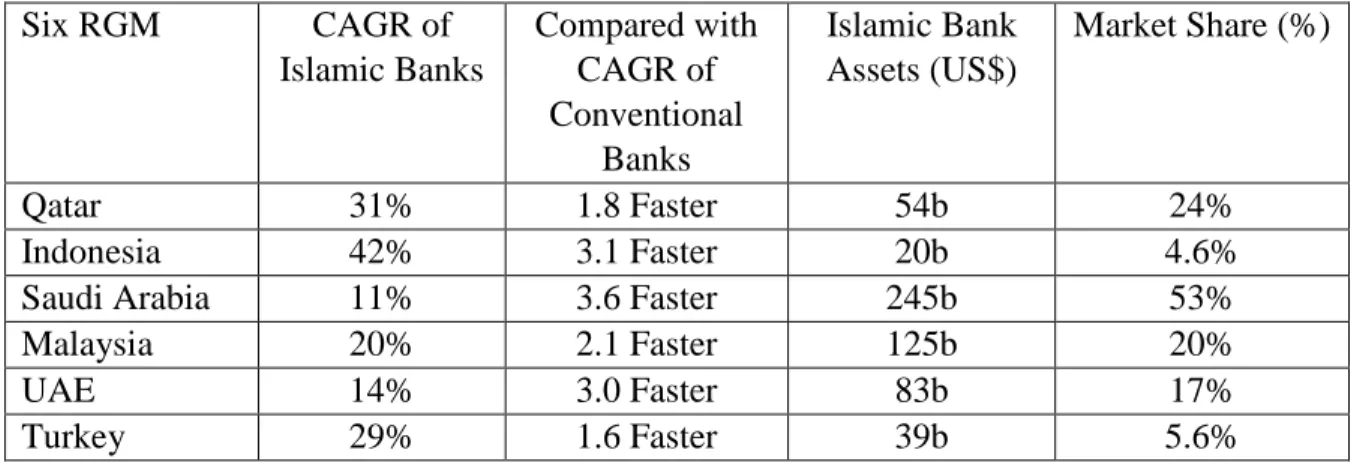
Page | 14 If we take longer-terms after the crisis, as indicated in the Table 1.1, a statistical report in 2013 on competitiveness of Islamic banks published by Ernst and Young, an internationally reputable Islamic finance research institution which declares that their data sources come from central banks in the world, company financial reports, and interviews with banking executives and industry observers, also reveals that Islamic banks obviously grew much faster than conventional banks after the demise of the global financial crisis in the six countries which are called QISMUT (See the Footnote 6).
Table 1.1. The 5 Year CAGR (Compound Annual Growth Rate), Assets, and Market Share of Islamic Banks in Six RGM
6: 2008-2012
Six RGM CAGR of
Islamic Banks
Compared with CAGR of Conventional
Banks
Islamic Bank Assets (US$)
Market Share (%)
Qatar 31% 1.8 Faster 54b 24%
Indonesia 42% 3.1 Faster 20b 4.6%
Saudi Arabia 11% 3.6 Faster 245b 53%
Malaysia 20% 2.1 Faster 125b 20%
UAE 14% 3.0 Faster 83b 17%
Turkey 29% 1.6 Faster 39b 5.6%
Source: Ernst and Young, 2014 (Edited)
In addition, Amba and Almukharreq (2013) investigated impact of the financial crisis on performance of Islamic and conventional banks with analysis of 92 banks in GCC countries: 27 Islamic banks (IB) and 65 conventional banks (CB) in the years 2006 to 2009.
6
RGM (Rapid Growth Market) is a group of 25 selective countries that have a good forecast in
market growth with economies and populations over a certain size, and are strategically important
for business. In particular, six countries of RGM, Qatar, Indonesia, Saudi Arabia, Malaysia, UAE,
and Turkey are called QISMUT where Islamic banks are prospected to grow the fastest in the
world.
Page | 15 First, ROE (return on equity) and ROA (return on asset), indicators of bank profitability declined by 41.33% and 67.60% respectively in Islamic banks (IB), while by 62.72% and 106.83% respectively in conventional banks (CB). However, decline in profitability was not significantly different between IB and CB during the crisis. Second, in respect of capital structure, ratio of equity and ratio of tangible equity decreased in IB by 8.49% and 13.19%
respectively and in CB by 9.34% and 25.71% respectively. It is found that tangible equity ratio had statistically significant difference between IB and CB. Third, ratio of liquid assets to total assets, indicators of liquidity declined by 8.55% in IB and by 13.33% in CB during the crisis from which the authors conclude that there was no significant difference in liquidity between IB and CB during the crisis. Lastly, liabilities are measured based on deposit ratio (ratio of deposits to total assets) and overhead ratio (ratio of overhead costs to total assets).
During the crisis, deposits ratio increased by 7.95% in IB and 6.36% in CB and overhead ratio also increased by 19.40% in IB and 31.83% in CB, meaning that ratio of overhead cost was significantly different between IB and CB during the crisis.
As initial conditions, Islamic banks have higher capital adequacy, are less leveraged, that is, have higher capital-to-assets ratio, and have smaller investment portfolios, all of which indicate the degree of stability, discretion and conservativeness of Islamic banks.
While these financial performances are required to observe the Islamic banking principle,
such as risk sharing (profit and loss sharing), not risk transfer as in conventional banks, and
equity-based financing, not debt-based financing as in conventional banks, these
performances have also effect of alleviating damages of any financial crises. This is the
reason why the degrees of profitability and growth in credit and assets of Islamic banks were
higher or maintained better and why Islamic banks were less affected by deleveraging than
Page | 16 in the case of conventional banks when the financial crisis occurred, even if it hit Islamic banks harsher in the single year 2009 (Hasan and Dridi, 2010).
However, as initial conditions, Islamic banks have also some feeble factors: Managing liquidity in Islamic banking is difficult because infrastructure and tools for liquidity risk management by Islamic banks are still weak; Sharia-compliant interbank money markets led by an interbank rate are insufficient; less reliance on wholesale banks deposits; absence of lender-of-last-resort, and; underdevelopment of Islamic bond markets (sukuk) when compared to conventional counterparts. These factors which will be considered in detail in the second chapter were one of the reasons why, once the impact of the global financial crisis moved to the real economy, Islamic banks in some countries faced the larger losses especially in terms of profitability than their conventional counterparts in 2009 (Hasan and Dridi, 2010).
Here again, we should note that Islamic banks are in competition with conventional banks
7. Imam and Kpodar attempt to identify the factors that are linked to the development of Islamic banking. Using various econometric estimation techniques, and with the sample data of 117 countries for 1992-2006, they concluded that income per capita, share of the Muslims in the population, status as an oil producer (oil prices), economic integration with
7
Beck and the other (2010) found that the number of Islamic banks increased during twelve years
from 1995 to 2007 by 300 percent. Sole (2007) also points out that the growth of Islamic banking
is observed in the world, especially in GCC countries, South East Asia, and in the western countries
where conventional bank are still competitive, being confronted with growth of Islamic banks. In
accordance with their research and perspective, Srairi and Kouki (2015) found that Islamic banking
is viewed as competitive and alternative to the conventional banking in many states of the world,
particularly in GCC countries as well as in some Asian countries, which can be proved by the fact
that Islamic banking assets have been growing at a faster pace (an average annual growth of 20%)
compared with the overall banking assets during the last decade, with the expectation that Islamic
banks will play a growing role in the succeeding years.
Page | 17 Middle Eastern countries (share of trade with these countries) and proximity to two Islamic financial centers, Bahrain and Malaysia, are meaningfully and positively linked to the diffusion of Islamic banks. The diffusion itself is supposed to be indicated by the share of Islamic bank numbers and the share of Islamic bank assets in total banking system. The Figure 1.2 and 1.3 show the share of Islamic bank numbers and the share of Islamic bank assets with recent data respectively. However, whereas most of these factors are formed into Islamic banks’ internal relationships, the analysis cannot fully demonstrate the relationships of Islamic banks to conventional banks (Imam and Kpodar, 2010).
Figure 1.2. Share of Islamic Bank Numbers in Total Banking System in the Selected Islamic Countries, 2006 (in Percentage)
Source: Imam and Kpodar, 2010
However, more importantly, Imam and Kpodar point out that the interest rates of
conventional banks have a negative impact on Islamic banks, which illuminates an aspect of
competition between Islamic banks and conventional banks. If the interest rate of
conventional banks is low, less devout Muslims and non-Muslims consider it as the lowering
of opportunity cost of depositing their money with Islamic banks and are likely to increase
Page | 18 them, and vice versa. Interestingly, a threshold value of interest rate is estimated to be 3.5 percent by Imam and Kpodar. On the other hand, the existence of a developed banking system is a positive factor on Islamic banks, as the dominance of sophisticated and competitive conventional banking system and their products is also accommodative to Islamic banks and stimulates their growth. Islamic banks “acts as a complement to, rather than a substitute for”, conventional banks (Imam and Kpodar, 2010).
Figure 1.3. Share of Islamic Bank Assets in Total Banking System in the Selected Islamic Countries, 2013
8(in Percentage)
Source: Ernst and Young, 2014 (Edited)
8
The data are collected from publicly available data of 70 Islamic banks and 44 conventional banks in the sixteen countries: Qatar, Indonesia, Saudi Arabia, Malaysia, United Arab Emirates, Turkey, Bahrain, Kuwait, Pakistan, Bangladesh, Egypt, Jordan, South Africa, Sudan, United Kingdom, and Brunei. The Figure 1.3 consists of the best nine of these sixteen countries which are prospective countries of Islamic banking in the world. They are estimated to cover approximately 80% of total banking assets in those sixteen countries. While the research has some limitations in that it excludes Iran market because of its singular character and in that it does not cover all data of Islamic windows in conventional banks and subsidiary operations and offshore business in both Islamic and conventional banks, the Figure 1.3 reveals that Islamic bank is going in mainstream more and more in each national market: in Saudi Arabia, Kuwait, and Bahrain by 48.9%, 44.6%, and 27.7% respectively, probably owing to their increasing competitiveness.
0% 10% 20% 30% 40% 50% 60%
Bahrain Saudi Arabia Malaysia United Arab Emirates Kuwait Qatar Turkey Indonesia Pakistan Bangladesh Brunei Darussalam Republic of Yemen
Page | 19 At an initial stage, Islamic finance institutions (IFI) in GCC countries tended to emulate their conventional counterparts in terms of financial products offering, which can be observed in 2011 by the fact that the number of IFI which offer “general investment services” amounts to 13, compared with 16 conventional counterparts
9. IFI entered into the financial market in GCC countries with a purpose of supplying these general investment services for Muslims customers. However, as competition with conventional banks in the investment banking services intensified, IFI tended to supply original financial products “on asset based in line with Sharia based principles” (Tawari, 2015). Thus, in the last analysis, emulation in the early stage of market entry might be thought as a good step for the early infiltration of Islamic banks into the market where conventional banks were dominant.
At the end of the arguments which reviews the previous theoretical and empirical researches, two remarkable qualities of Islamic banks are clarified: 1) Islamic banks have the solid base of moral and ethical values, and are obliged to comply with Sharia, although conventional banks cannot entirely neglect morality and ethics, too; 2) Performances which indicate banking stability were better in Islamic banks than in conventional banks when the severe global financial crisis erupted and in a several years before and after the crisis, which were due to their fundamental discreet and conservative principles, although they could not escape from spillover of crises whose origins were found in conventional finance.
9