島根県立大学 総合政策学会
『総合政策論叢』第30号抜刷
(2015年11月発行)
The Spatial Econometric Analysis of Urban Residents Consumption
in China
Z HAO Xicang, Z HANG Zhongren, P AN Zhiang
Abstract
The paper adopts the method of spatial autocorrelation Moran’s I and spatial error model and spatial lag model of Spatial Econometrics, based on Cobb Douglas function, to analyze the spillover effects of urban residents’ consumption expenditure in China. It turns out that the per capita disposable income (PCDI), the amount of savings (SAVS) of urban residents, gross dependency ratio (GDER) of population have significant effects on the level of urban residents per capita consumption expenditure (PCCE) in China, and PCDI has the greatest influence. Besides, the level of China’s urban residents PCCE has significant spatial spillover effects and has a tendency to cluster in space. The formation of regional consumer groups is conducive to the development of regional economy. To give full play to regional spatial spillover effects among the urban residents’ consumption expenditure, the government should continue to improve the income distribution system and the social security mechanism, reduce urban residents money demand which is hold in case of precautionary motive, and solve any menace from the “rear” of the consumption of urban residents, to break administrative barriers among provinces, in addition to further adjusting consumption structure of urban residents, which makes raising the consumption of urban residents a new point of economic growth in China.
1 Introduction
2 Analytical Models and Data Sources
2.1 Spatial Lag Model and Spatial Error Model 2.2 Spatial Correlation Test
2.3 Spatial Weight Matrix 2.4 Model Construction
3 Spatial Econometric Analysis of China’s Urban Residents’ Consumption Expenditure 3.1 Data Collection and Processing
3.2 Descriptive statistical analysis
3.3 Unit Root Test and Cointegration Test
3.4 Spatial Correlation Test and the Selection of Model 3.5 The Analysis of Spatial Lag Model Fitting Results 4 Conclusions and Enlightenment
The Spatial Econometric Analysis of Urban Residents’ Consumption in China
Xicang Z
HAO, Zhongren Z
HANG, Zhiang P
AN『総合政策論叢』第30号(2015年11月)
島根県立大学 総合政策学会
- 15 -
1 Introduction
Since reform and opening up, the development of China’s economy and society has made considerable progress, people’s income and consumption levels continuously improve. Consumption, investment and export are just like “three carriages” for national economic development. While an export-oriented economy makes for development, domestic consumption including household and government consumption demand become more and more important to promote economic growth. The residents’
consumption demand growth is becoming an important support and leverage for the transformation of the economic growth mode. In 2013, China’s final consumption expenditure made a 50.0% contribution rate to GDP growth, and a 3.9% pull to GDP growth. Through analyzing the key factors affecting the urban residents’ consumption and spatial dependence and heterogeneity of consumption of urban residents in China, this paper aims to comb the development stage of China’s economy, explore the possibilities for building a good consumption environment for urban residents, and then put forward the measures and suggestions for improving the level of urban residents’
consumption, which has important realistic and guiding significance for promoting the development of the national economy.
Lots of researches abroad concentrate on spatial econometrics, the consumption function and consumption behavior. Anselin (1988)1,2) defined spatial econometrics as: A series of methods used to dispose special attribution which is due to spatial factors in the area of economic models is to make a model specification, estimation, testing and prediction for regional economy, which is based on appropriate setting of spatial effects. When it comes to the study of consumption function, the most representative is Keynes’s (1936)3) absolute income hypothesis. As income increases, consumption will increase, but the increase of consumption is less than the increase of income. This relationship between consumption and income is called as the consumption function or propensity to consume. Duesenberry’s (1949)4) relative income hypothesis suggests that consumers will be affected by their past spending habits and consumption levels around them. So consumption is decided relatively. In addition, there is the life cycle theories of consumption of US economist Franco Modigliani5), as well as the permanent income theory of Milton Friedman6). H. Yigit Aydede (2007)7) analyzed social security’s impact on the consumer in a developing country based on time-series data in Turkey.
The analysis showed that social security wealth was the largest component in Turkish household wealth, which obviously had a significant impact on consumer behavior. At present, the domestic research on consumption is mainly about consumption level and the consumption structure. Wu Yuxia (2011)8) thought that consumption played an important role in economic growth, and analyzed the present situation of consumer demand in China and the influence factors of Chinese residents’ consumption factors, such as pre property difference of income uncertainty, the real interest rate, price level, liquidity constraints, consumption habits, consumption structure of residents and the
島根県立大学『総合政策論叢』第30号(2015年11月)
- 16 -
government fiscal expenditure etc. Ma Li, Sun Jingshui (2008)9) analyzed the relationship between China’s urban and rural residents’ consumption and income using the first- order the autoregressive model (FAR) of spatial econometrics, the spatial autoregressive model (SAR) and spatial error model (SEM) and found that China’s PCCE level had significant spatial correlation. There may be a high order correlation besides the first order correlation. Li Qihua (2011)10) analyzed the relationship between urban and rural residents’ consumption spatial correlation and the convergence of urban and rural residents’ consumption in China through spatial correlation in spatial econometrics. It was found out that the spatial correlation of urban and rural residents’ consumption in China increased year by year. The level of urban and rural residents’ consumption and various types of consumer had different Convergence and Divergence. In summary, the scholars mostly conducted academic researches on spatial econometrics. But, there is still much more room for improvement in the setting of urban residents in the consumer spatial econometric model and spatial aspects of weight determination. Therefore, based on C-D function, and combined with different spatial weight matrix, this paper analyses China’s urban residents’ consumption level through a spatial data analysis model and the impact of space effect on consumption levels of urban residents, which has important practical significance and academic value.
2 Analytical Models and Data Sources 2.1 Spatial Lag Model and Spatial Error Model 2.1.1 Spatial Lag Model
Spatial correlation is mainly added to standard linear regression model with two different forms, the first one of which is the lagged item of explained variable (Wy), constituting spatial lag model (SAR). The form of the model is as follows:
⑴ In this formula, dependent variable y is a n×1 vector, representing the dependent variable; X is a n×k data matrix, representing the explanatory variables; W is a n×n spatial weight matrix; Parameterρ, the coefficient of spatial lagged dependent variable Wy, which is called Spatial autoregression coefficient, reflects the spatial dependence of sample observations. ϐ reflects the impact of the explanatory variables on the dependent variable; εis a stochastic error vector.
2.1.2 Spatial Error Model
The second form is to put error structure into the model (E[εiεj]≠0, then constituting the spatial error model (SEM). The form of the model is as follows:
⑵
In this formula, dependent variable y is a n×1 vector; X is a n×k data matrix,
4 2 Analytical Models and Data Sources 2.1 Spatial Lag Model and Spatial Error Model 2.1.1 Spatial Lag Model
Spatial correlation is mainly added to standard linear regression model with two different forms, the first one of which is the lagged item of explained variable(Wy), constituting spatial lag model (SAR). The form of the model is as follows:
) σ , (
~ ε
ε β ρ
2In
0 N
X Wy
y (1)
In this formula, dependent variableyis a n1 vector, representing the dependent variable;
Xis a nk data matrix, representing the explanatory variables; Wis a nn spatial weight matrix; Parameter, the coefficient of spatial lagged dependent variable Wy, which is called Spatial autoregression coefficient, reflects the spatial dependence of sample observations. reflects the impact of the explanatory variables on the dependent variable; εis a stochastic error vector.
2.1.2 Spatial Error Model
The second form is to put error structure into the model(E[εiεj]0, then constituting the spatial error model (SEM). The form of the model is as follows:
) σ , (
~ ε
ε ξ λ ξ
ξ β
2In
0 N
W X y
(2)
In this formula, dependent variable y is a n1vector; X is a nk data matrix, representing the explanatory variables; W is spatial weight matrix; Parameter is the coefficient of spatial correlation error; reflects the impact of the explanatory variables on the dependent variable.
2.2 Spatial Correlation Test
Moran's I, the earliest application in global clustering test, indicates the correlation coefficient between observations and its spatial lag. Over the entire study areas, it tests whether
4 2 Analytical Models and Data Sources 2.1 Spatial Lag Model and Spatial Error Model 2.1.1 Spatial Lag Model
Spatial correlation is mainly added to standard linear regression model with two different forms, the first one of which is the lagged item of explained variable(Wy), constituting spatial lag model (SAR). The form of the model is as follows:
) σ , (
~ ε
ε β ρ
2In
0 N
X Wy
y (1)
In this formula, dependent variableyis a n1 vector, representing the dependent variable;
Xis a nk data matrix, representing the explanatory variables; Wis a nn spatial weight matrix; Parameter, the coefficient of spatial lagged dependent variable Wy, which is called Spatial autoregression coefficient, reflects the spatial dependence of sample observations. reflects the impact of the explanatory variables on the dependent variable; εis a stochastic error vector.
2.1.2 Spatial Error Model
The second form is to put error structure into the model(E[εiεj]0, then constituting the spatial error model (SEM). The form of the model is as follows:
) σ , (
~ ε
ε ξ λ ξ
ξ β
2In
0 N
W X y
(2)
In this formula, dependent variable y is a n1vector; X is a nk data matrix, representing the explanatory variables; W is spatial weight matrix; Parameter is the coefficient of spatial correlation error; reflects the impact of the explanatory variables on the dependent variable.
2.2 Spatial Correlation Test
Moran's I, the earliest application in global clustering test, indicates the correlation coefficient between observations and its spatial lag. Over the entire study areas, it tests whether
The Spatial Econometric Analysis of Urban Residents’ Consumption in China
- 17 -
representing the explanatory variables; W is spatial weight matrix; Parameter λ is the coefficient of spatial correlation error; ϐ reflects the impact of the explanatory variables on the dependent variable.
2.2 Spatial Correlation Test
Moran’s I, the earliest application in global clustering test, indicates the correlation coefficient between observations and its spatial lag. Over the entire study areas, it tests whether the adjacent region is similar or different (spatial positively or negatively correlated), or independent 11). Moran’s I is calculated as follows:
⑶
In this formula, n is the total number of studied regions; wij is spatial weight; xi and xj
are respectively the attributes of region i and region
5
the adjacent region is similar or different (spatial positively or negatively correlated), or independent [11]. Moran's I is calculated as follows:
n
i n
j ij
n 1 i
n 1
j ιj i j
n i
n j
n
i i
ij n
1 i
n 1
j ij i j
w S
) x )(x x (x w )
x x ( w
) x )(x x (x w n Ι
1 1
2
1 1 1
2 (3)
In this formula, n is the total number of studied regions; wij is spatial weight;
xiandxjare respectively the attributes of region iand region j;
n
i xi
x n
1
1 is the average
of the attributes;
n
i xi x
S n
1
2
2 1 ( )
is the variance of the attributes.
Therefore, the range of Moran’s I is consistent with Simple Pearson Correlation Coefficient which varies from -1 to 1. When the value is greater than zero, it means a positive correlation.
When the value is close to 1, it means that the similar attributes aggregate (high values are adjacent to each other, the same as low values). In contrast, when the value is less than 0, it means a negative correlation. When the value is close to -1, it means that the different attributes gather together (high values are adjacent to each other, the same as low values). When the Moran’s I is close to 0, it means that the attributes distribute randomly, or there is no spatial autocorrelation[12].
2.3 Spatial Weight Matrix
It’s the prerequisite and foundation for spatial econometric analysis of introducing spatial weight matrix into spatial econometrics. This section concentrates on four kinds of commonly used spatial weight matrix in spatial econometrics.
(1) Simple weight matrix. Matrix of this type is the most basic and simplest. It’s based mainly on whether two regions are adjacent in space. If they are adjacent, its assigned value 1, otherwise value 0. ROOK adjacent criterion is a common method . Owing to it is easy to be calculated and can reflects the spatial correlation among regions to a certain extent; simple weight matrix is
is the average of
the attributes;
5
the adjacent region is similar or different (spatial positively or negatively correlated), or independent [11]. Moran's I is calculated as follows:
n
i n
j ij
n 1 i
n 1
j ιj i j
n i
n j
n
i i
ij n
1 i
n 1
j ij i j
w S
) x )(x x (x w )
x x ( w
) x )(x x (x w n Ι
1 1
2
1 1 1
2
(3)
In this formula, n is the total number of studied regions; wij is spatial weight;
xiandxjare respectively the attributes of region iand region j;
n
i xi
x n
1
1 is the average
of the attributes;
n
i xi x
S n
1
2
2 1 ( )
is the variance of the attributes.
Therefore, the range of Moran’s I is consistent with Simple Pearson Correlation Coefficient which varies from -1 to 1. When the value is greater than zero, it means a positive correlation.
When the value is close to 1, it means that the similar attributes aggregate (high values are adjacent to each other, the same as low values). In contrast, when the value is less than 0, it means a negative correlation. When the value is close to -1, it means that the different attributes gather together (high values are adjacent to each other, the same as low values). When the Moran’s I is close to 0, it means that the attributes distribute randomly, or there is no spatial autocorrelation[12].
2.3 Spatial Weight Matrix
It’s the prerequisite and foundation for spatial econometric analysis of introducing spatial weight matrix into spatial econometrics. This section concentrates on four kinds of commonly used spatial weight matrix in spatial econometrics.
(1) Simple weight matrix. Matrix of this type is the most basic and simplest. It’s based mainly on whether two regions are adjacent in space. If they are adjacent, its assigned value 1, otherwise value 0. ROOK adjacent criterion is a common method . Owing to it is easy to be calculated and can reflects the spatial correlation among regions to a certain extent; simple weight matrix is
is the variance of the attributes.
Therefore, the range of Moran’s I is consistent with Simple Pearson Correlation Coefficient which varies from -1 to 1. When the value is greater than zero, it means a positive correlation. When the value is close to 1, it means that the similar attributes aggregate (high values are adjacent to each other, the same as low values). In contrast, when the value is less than 0, it means a negative correlation. When the value is close to -1, it means that the different attributes gather together (high values are adjacent to each other, the same as low values). When the Moran’s I is close to 0, it means that the attributes distribute randomly, or there is no spatial autocorrelation12).
2.3 Spatial Weight Matrix
It’s the prerequisite and foundation for spatial econometric analysis of introducing spatial weight matrix into spatial econometrics. This section concentrates on four kinds of commonly used spatial weight matrix in spatial econometrics.
⑴ Simple weight matrix. Matrix of this type is the most basic and simplest. It’s based mainly on whether two regions are adjacent in space. If they are adjacent, its assigned value 1, otherwise value 0. ROOK adjacent criterion is a common method . Owing to it is easy to be calculated and can reflects the spatial correlation among regions to a certain extent; simple weight matrix is widely used by domestic scholars. However, it has some disadvantages: It only reflects the spatial correlation of adjacent areas and splits the economic ties among non-adjacent regions; it ignores the fact that geographically adjacent regions are not certainly correlated. At the same time, it can’t reflect the adjacent degree of center zone among adjacent regions.
5
the adjacent region is similar or different (spatial positively or negatively correlated), or independent [11]. Moran's I is calculated as follows:
n
i n
j ij
n 1 i
n 1
j ιj i j
n i
n j
n
i i
ij n
1 i
n 1
j ij i j
w S
) x )(x x (x w )
x x ( w
) x )(x x (x w n Ι
1 1
2
1 1 1
2 (3)
In this formula, n is the total number of studied regions; wij is spatial weight;
xiandxjare respectively the attributes of region iand region j;
n
i xi
x n
1
1 is the average
of the attributes;
n
i xi x
S n
1
2
2 1 ( )
is the variance of the attributes.
Therefore, the range of Moran’s I is consistent with Simple Pearson Correlation Coefficient which varies from -1 to 1. When the value is greater than zero, it means a positive correlation.
When the value is close to 1, it means that the similar attributes aggregate (high values are adjacent to each other, the same as low values). In contrast, when the value is less than 0, it means a negative correlation. When the value is close to -1, it means that the different attributes gather together (high values are adjacent to each other, the same as low values). When the Moran’s I is close to 0, it means that the attributes distribute randomly, or there is no spatial autocorrelation[12].
2.3 Spatial Weight Matrix
It’s the prerequisite and foundation for spatial econometric analysis of introducing spatial weight matrix into spatial econometrics. This section concentrates on four kinds of commonly used spatial weight matrix in spatial econometrics.
(1) Simple weight matrix. Matrix of this type is the most basic and simplest. It’s based mainly on whether two regions are adjacent in space. If they are adjacent, its assigned value 1, otherwise value 0. ROOK adjacent criterion is a common method . Owing to it is easy to be calculated and can reflects the spatial correlation among regions to a certain extent; simple weight matrix is
島根県立大学『総合政策論叢』第30号(2015年11月)
- 18 -
⑵ Distance weight matrix. It calculates the distance between two regions through the latitude and longitude of each provincial capital. The methods of distance calculation include Cosine Distance, Mahalanobis Distance, Euclidean Distance and Correlation Distance. The paper uses Euclidean Distance to measure the spatial correlation degree
between two regions. The calculation formula is
6
widely used by domestic scholars. However, it has some disadvantages: It only reflects the spatial correlation of adjacent areas and splits the economic ties among non-adjacent regions; it ignores the fact that geographically adjacent regions are not certainly correlated. At the same time, it can’t reflect the adjacent degree of center zone among adjacent regions.
(2) Distance weight matrix. It calculates the distance between two regions through the latitude and longitude of each provincial capital. The methods of distance calculation include Cosine Distance、Mahalanobis Distance、Euclidean Distance and Correlation Distance. The paper uses Euclidean Distance to measure the spatial correlation degree between two regions. The calculation formula is dij (xi xj )2(yi yj )2 , in which (xi,yi ) represents the coordinate of district i, and (xj,yj) stands for coordinate of district j. Since it might decay in inter-regional consumer spending with the increase of distance, we adopt the reciprocal of distance or the square of the reciprocal of distance as weight (Anselin, 1997; Fisher, 2003). The advantages of this type is that it makes up for the defect of simple weight matrix, which can’t measure the possible connections among non-adjacent regions and it can measure the degree of correlation between different areas more accurately. But it also has some shortcomings that it expands the possibility of spatial correlation. If two regions are geographically close, but have less economic connections, then distance weight matrix will overestimate the extent of spillover effects of residents consumer spending.
(3) Economic weight matrix. The weight matrix of this kind does not measure spatial correlation from the perspective of geography, but constructs weight based on the difference of regional economy. Commonly used indicators include Gross Domestic Product (GDP), Per Capita Gross Domestic Product, Per Capita Disposable Income, etc. There is a close connection between adjacent degree of location and development of the economy, especially for the features of China’s eastern, central and western regions. The economic weight matrix makes up for the geographic weight matrix’s possibly underestimating or overestimating spatial correlation, but the adjacent degree of economy does not mean spatial correlation of residents’ consumer spending.
, in which
6
widely used by domestic scholars. However, it has some disadvantages: It only reflects the spatial correlation of adjacent areas and splits the economic ties among non-adjacent regions; it ignores the fact that geographically adjacent regions are not certainly correlated. At the same time, it can’t reflect the adjacent degree of center zone among adjacent regions.
(2) Distance weight matrix. It calculates the distance between two regions through the latitude and longitude of each provincial capital. The methods of distance calculation include Cosine Distance、Mahalanobis Distance、Euclidean Distance and Correlation Distance. The paper uses Euclidean Distance to measure the spatial correlation degree between two regions. The calculation formula is dij (xi xj)2 (yi yj)2 , in which (xi,yi ) represents the coordinate of district i, and (xj,yj ) stands for coordinate of district j. Since it might decay in inter-regional consumer spending with the increase of distance, we adopt the reciprocal of distance or the square of the reciprocal of distance as weight (Anselin, 1997; Fisher, 2003). The advantages of this type is that it makes up for the defect of simple weight matrix, which can’t measure the possible connections among non-adjacent regions and it can measure the degree of correlation between different areas more accurately. But it also has some shortcomings that it expands the possibility of spatial correlation. If two regions are geographically close, but have less economic connections, then distance weight matrix will overestimate the extent of spillover effects of residents consumer spending.
(3) Economic weight matrix. The weight matrix of this kind does not measure spatial correlation from the perspective of geography, but constructs weight based on the difference of regional economy. Commonly used indicators include Gross Domestic Product (GDP), Per Capita Gross Domestic Product, Per Capita Disposable Income, etc. There is a close connection between adjacent degree of location and development of the economy, especially for the features of China’s eastern, central and western regions. The economic weight matrix makes up for the geographic weight matrix’s possibly underestimating or overestimating spatial correlation, but the adjacent degree of economy does not mean spatial correlation of residents’ consumer spending.
represents the coordinate of district i, and
6
widely used by domestic scholars. However, it has some disadvantages: It only reflects the spatial correlation of adjacent areas and splits the economic ties among non-adjacent regions; it ignores the fact that geographically adjacent regions are not certainly correlated. At the same time, it can’t reflect the adjacent degree of center zone among adjacent regions.
(2) Distance weight matrix. It calculates the distance between two regions through the latitude and longitude of each provincial capital. The methods of distance calculation include Cosine Distance、Mahalanobis Distance、Euclidean Distance and Correlation Distance. The paper uses Euclidean Distance to measure the spatial correlation degree between two regions. The calculation formula is dij (xi xj)2 (yi yj )2 , in which (xi,yi ) represents the coordinate of district i, and (xj,yj ) stands for coordinate of district j. Since it might decay in inter-regional consumer spending with the increase of distance, we adopt the reciprocal of distance or the square of the reciprocal of distance as weight (Anselin, 1997; Fisher, 2003). The advantages of this type is that it makes up for the defect of simple weight matrix, which can’t measure the possible connections among non-adjacent regions and it can measure the degree of correlation between different areas more accurately. But it also has some shortcomings that it expands the possibility of spatial correlation. If two regions are geographically close, but have less economic connections, then distance weight matrix will overestimate the extent of spillover effects of residents consumer spending.
(3) Economic weight matrix. The weight matrix of this kind does not measure spatial correlation from the perspective of geography, but constructs weight based on the difference of regional economy. Commonly used indicators include Gross Domestic Product (GDP), Per Capita Gross Domestic Product, Per Capita Disposable Income, etc. There is a close connection between adjacent degree of location and development of the economy, especially for the features of China’s eastern, central and western regions. The economic weight matrix makes up for the geographic weight matrix’s possibly underestimating or overestimating spatial correlation, but the adjacent degree of economy does not mean spatial correlation of residents’ consumer spending.
stands for coordinate of district j. Since it might decay in inter-regional consumer spending with the increase of distance, we adopt the reciprocal of distance or the square of the reciprocal of distance as weight (Anselin, 1997; Fisher, 2003). The advantages of this type is that it makes up for the defect of simple weight matrix, which can’t measure the possible connections among non-adjacent regions and it can measure the degree of correlation between different areas more accurately. But it also has some shortcomings that it expands the possibility of spatial correlation. If two regions are geographically close, but have less economic connections, then distance weight matrix will overestimate the extent of spillover effects of residents consumer spending.
⑶ Economic weight matrix. The weight matrix of this kind does not measure spatial correlation from the perspective of geography, but constructs weight based on the difference of regional economy. Commonly used indicators include Gross Domestic Product (GDP), Per Capita Gross Domestic Product, Per Capita Disposable Income, etc.
There is a close connection between adjacent degree of location and development of the economy, especially for the features of China’s eastern, central and western regions.
The economic weight matrix makes up for the geographic weight matrix’s possibly underestimating or overestimating spatial correlation, but the adjacent degree of economy does not mean spatial correlation of residents’ consumer spending.
⑷ Economic and geographic weight matrix. Residents’ consumer spending spillover tends to have direction, and adjacent regions and economically developed areas have strong spillover effects on economically poor developed ones. The calculation method of economic and geographic weight matrix is: W=w*E. In this formula, w stands for simple weight matrix, and E stands for diagonal matrix of regional Per Capita real GDP mean,
that is
7
(4) Economic and geographic weight matrix. Residents’ consumer spending spillover tends to have direction, and adjacent regions and economically developed areas have strong spillover effects on economically poor developed ones. The calculation method of economic and geographic weight matrix is: W w*E. In this formula, w stands for simple weight matrix, and E stands for diagonal matrix of regional Per Capita real GDP mean, that is
y ) ,y y , ,y y (y diag
E 1 2 n ,
1
0 t
t
t it
0 1
i y
1 t t
y 1 denotes real Per Capita GDP mean of
district i;
1
0 t
t t
n 1
i it
0 1
) y 1 t t ( n
y 1 denotes all regions’ mean value of real Per Capita GDP;
t0 denotes the beginning of study period; t1 denotes the end of study period; n denotes the total number of all districts。
At last, in a practical application, we need to standardize the weight matrix in order to make the sum of each row equals 1. Firstly, we add up the elements of each row of the weight matrix to get the total number; secondly, with each element divided by the total number, we get the standardized weight matrix.
2.4 Model Construction
The analysis model of this paper is based on Cobb-Douglas Production Function, (C-D) and the basic form of C-D function is: YAKαLβ, in this formula, parameter , stands for
capital and labor output elasticity (
0 , 1
) respectively. Based on C-D function, we set the following form as an analysis model in this paper:φ γ β
α SAVS GDER ε
PCDI A
= GDER) SAVS, f(PCDI,
=
PCCE (5)
In this formula, α,β,γ>0, PCCE denotes Per Capita Consumption Expenditure; PCDI denotes Per Capital Disposable Income; SAVS denotes Savings; GDER denotes Gross Dependency Ratio. In order to facilitate the parameter estimation of this model and eliminate the influence of potential heteroscedasticity, we respectively take natural logarithm on both sides of
… denotes real Per Capita GDP
mean of district i;
7
(4) Economic and geographic weight matrix. Residents’ consumer spending spillover tends to have direction, and adjacent regions and economically developed areas have strong spillover effects on economically poor developed ones. The calculation method of economic and geographic weight matrix is: W w*E. In this formula, w stands for simple weight matrix, and E stands for diagonal matrix of regional Per Capita real GDP mean, that is
y ) ,y y , ,y y (y diag
E 1 2 n ,
1
0 t
t
t it
0 1
i y
1 t t
y 1 denotes real Per Capita GDP mean of
district i;
1
0 t
t t
n 1
i it
0 1
) y 1 t t ( n
y 1 denotes all regions’ mean value of real Per Capita GDP;
t0 denotes the beginning of study period; t1 denotes the end of study period; n denotes the total number of all districts。
At last, in a practical application, we need to standardize the weight matrix in order to make the sum of each row equals 1. Firstly, we add up the elements of each row of the weight matrix to get the total number; secondly, with each element divided by the total number, we get the standardized weight matrix.
2.4 Model Construction
The analysis model of this paper is based on Cobb-Douglas Production Function, (C-D) and the basic form of C-D function is: YAKαLβ, in this formula, parameter , stands for
capital and labor output elasticity (
0 , 1
) respectively. Based on C-D function, we set the following form as an analysis model in this paper:φ γ β
α SAVS GDER ε
PCDI A
= GDER) SAVS, f(PCDI,
=
PCCE (5)
In this formula, α,β,γ>0, PCCE denotes Per Capita Consumption Expenditure; PCDI denotes Per Capital Disposable Income; SAVS denotes Savings; GDER denotes Gross Dependency Ratio. In order to facilitate the parameter estimation of this model and eliminate the influence of potential heteroscedasticity, we respectively take natural logarithm on both sides of
denotes all regions’ mean value of real Per
Capita GDP; t0 denotes the beginning of study period; t1 denotes the end of study period;
n denotes the total number of all districts。
At last, in a practical application, we need to standardize the weight matrix in order The Spatial Econometric Analysis of Urban Residents’ Consumption in China
- 19 -
to make the sum of each row equals 1. Firstly, we add up the elements of each row of the weight matrix to get the total number; secondly, with each element divided by the total number, we get the standardized weight matrix.
2.4 Model Construction
The analysis model of this paper is based on Cobb-Douglas Production Function, (C- D) and the basic form of C-D function is: Y=AKαLβ, in this formula, parameter α, ϐ stands for capital and labor output elasticity (0≤α, β≤1) respectively. Based on C-D function, we set the following form as an analysis model in this paper:
⑸
In this formula, α,β,γ> 0, PCCE denotes Per Capita Consumption Expenditure;
PCDI denotes Per Capital Disposable Income; SAVS denotes Savings; GDER denotes Gross Dependency Ratio. In order to facilitate the parameter estimation of this model and eliminate the influence of potential heteroscedasticity, we respectively take natural logarithm on both sides of this model, and get the linear equation model. See equation 6.
⑹
In this formula, i denotes different provincial observation object; t denotes time; εit
is random error and denotes other factors influencing the urban residents’ consumption expenditure.
3 Spatial Econometric Analysis of China’s Urban Residents’ Consumption Expenditure
3.1 Data Collection and Processing
In this paper, the data source of the selected indicators comes from China Statistical Yearbook and China Financial Statistical Yearbook from 2000 to 2014. The units of urban residents PCCE and PCDI are Yuan. To guarantee the comparability of data among different years and eliminate the influence of inflation on urban residents PCCE and PCDI, this paper recalculates PCCE and PCDI based on consumer price index (CPI) of year 1999. Urban residents savings’ unit is One Hundred Million Yuan. GDER consists of Children Dependency Ratio and The Elderly Dependency Ratio①, whose unit is percent.
Due to lack of data of urban GDER, this paper takes total GDER as replacement (total of urban and rural GDER). Because of the lag effect of PCDI and SAVS to PCCE, this paper adopts one year lagged PCDI and SAVS as explained variable in actual analysis.
3.2 Descriptive statistical analysis
① Dependency Ratio refers to the ratio of non-labor population and labor population. GDER=
Children’s Dependency Ratio + The Elderly Dependency Ratio = [underage population (0-14 years old) + the elderly population (65 years old or older)] / labor population.
8
this model, and get the linear equation model. See equation 6.
it it it
it
it α LnPCDI β LnSAVS γ LnGDER ε LnA
=
LnPCCE (6)
In this formula, i denotes different provincial observation object; t denotes time; εit is random error and denotes other factors influencing the urban residents’ consumption expenditure.
3 Spatial Econometric Analysis of China’s Urban Residents’ Consumption Expenditure 3.1 Data Collection and Processing
In this paper, the data source of the selected indicators comes from China Statistical Yearbook and China Financial Statistical Yearbook from 2000 to 2014. The units of urban residents PCCE and PCDI are Yuan. To guarantee the comparability of data among different years and eliminate the influence of inflation on urban residents PCCE and PCDI, this paper recalculates PCCE and PCDI based on consumer price index (CPI) of year 1999. Urban residents savings’ unit is One Hundred Million Yuan. GDER consists of Children Dependency Ratio and The Elderly Dependency Ratio①,whose unit is percent. Due to lack of data of urban GDER, this paper takes total GDER as replacement (total of urban and rural GDER). Because of the lag effect of PCDI and SAVS to PCCE, this paper adopts one year lagged PCDI and SAVS as explained variable in actual analysis.
3.2 Descriptive statistical analysis
The unbalanced regional economic development in China results in the unbalanced distribution of PCCE and PCDI. The section analyses the difference of PCCE and PCDI in 2013 among China’s eastern, central and western regions . According to the classification standards of National Statistical Bureau, China's 31 provinces (autonomous regions and municipalities directly under the central government) are divided into three parts: Eastern, Central and Western Regions.②
①Dependency Ratio refers to the ratio of non-labor population and labor population. GDER=
Children’s Dependency Ratio + The Elderly Dependency Ratio = [underage population (0-14 years old) + the elderly population (65 years old or older)] / labor population.
②According to the statistics classification standards of China National Bureau, Eastern regions include: Zhejiang, Jiangsu, Fujian, Hebei, Liaoning, Beijing, Shanghai, Shandong, Tianjin, Guangdong and Hainan; Central region includes: Anhui, Jiangxi, Jilin, Heilongjiang, Henan,
7
(4) Economic and geographic weight matrix. Residents’ consumer spending spillover tends to have direction, and adjacent regions and economically developed areas have strong spillover effects on economically poor developed ones. The calculation method of economic and geographic weight matrix is: W w*E. In this formula, w stands for simple weight matrix, and E stands for diagonal matrix of regional Per Capita real GDP mean, that is
y ) ,y y , ,y y (y diag
E 1 2 n ,
1
0 t
t
t it
0
i 1 y
1 t t
y 1 denotes real Per Capita GDP mean of
district i;
1
0 t
t t
n 1
i it
0 1
) y 1 t t ( n
y 1 denotes all regions’ mean value of real Per Capita GDP;
t0 denotes the beginning of study period; t1 denotes the end of study period; n denotes the total number of all districts。
At last, in a practical application, we need to standardize the weight matrix in order to make the sum of each row equals 1. Firstly, we add up the elements of each row of the weight matrix to get the total number; secondly, with each element divided by the total number, we get the standardized weight matrix.
2.4 Model Construction
The analysis model of this paper is based on Cobb-Douglas Production Function, (C-D) and the basic form of C-D function is: YAKαLβ, in this formula, parameter , stands for
capital and labor output elasticity (
0 , 1
) respectively. Based on C-D function, we set the following form as an analysis model in this paper:φ γ β
α SAVS GDER ε
PCDI A
= GDER) SAVS, f(PCDI,
=
PCCE (5)
In this formula, α,β,γ>0, PCCE denotes Per Capita Consumption Expenditure; PCDI denotes Per Capital Disposable Income; SAVS denotes Savings; GDER denotes Gross Dependency Ratio. In order to facilitate the parameter estimation of this model and eliminate the influence of potential heteroscedasticity, we respectively take natural logarithm on both sides of
島根県立大学『総合政策論叢』第30号(2015年11月)
- 20 -
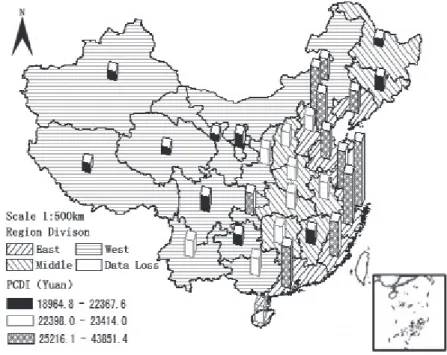
The unbalanced regional economic development in China results in the unbalanced distribution of PCCE and PCDI. The section analyses the difference of PCCE and PCDI in 2013 among China’s eastern, central and western regions. According to the classification standards of National Statistical Bureau, China’s 31 provinces (autonomous regions and municipalities directly under the central government) are divided into three parts: Eastern, Central and Western Regions.② We use statistical software SAS to make China’s PCCE and PCDI statistical map of 2013, as shown in figure 1, figure 2.
Figure 1 shows that if the value of urban residents PCDI is divided into three intervals, there is overlap among provinces of eastern, central and western regions falling in different intervals. And it is not completely consistent with boundaries of eastern, central and western regions. Yunnan, Shaanxi and Guangxi province are located in the western region, but their PCDI are in the second interval (22398~23414 Yuan);
Chongqing and Inner Mongolia autonomous region are located in the western region, but their PCDI are in the third interval (25216.1~43851.4 Yuan); Heilongjiang, Jilin, and Jiangxi province are located in the central region, whose PCDI are in the first interval (18964.8~22367.6 Yuan). Urban residents PCDI of Hebei province which is in the eastern region is in the second range.
② According to the statistics classification standards of China National Bureau, Eastern regions include: Zhejiang, Jiangsu, Fujian, Hebei, Liaoning, Beijing, Shanghai, Shandong, Tianjin, Guangdong and Hainan; Central region includes: Anhui, Jiangxi, Jilin, Heilongjiang, Henan, Hunan, Hubei, and Shanxi; Western regions includs: Qinghai, Xinjiang, Tibet, Gansu, Guangxi, Guizhou, Inner Mongolia, Ningxia, Shaanxi, Yunnan, Sichuan and Chongqing.
9
We use statistical software SAS to make China’s PCCE and PCDI statistical map of 2013, as shown in figure 1, figure 2.
Figure 1 shows that if the value of urban residents PCDI is divided into three intervals, there is overlap among provinces of eastern, central and western regions falling in different intervals.
And it is not completely consistent with boundaries of eastern, central and western regions.
Yunnan, Shaanxi and Guangxi province are located in the western region, but their PCDI are in the second interval (22398 ~ 23414 Yuan); Chongqing and Inner Mongolia autonomous region are located in the western region, but their PCDI are in the third interval (25216.1 ~ 43851.4 Yuan);
Heilongjiang, Jilin, and Jiangxi province are located in the central region, whose PCDI are in the first interval (18964.8 ~ 22367.6 Yuan). Urban residents PCDI of Hebei province which is in the eastern region is in the second range.
Figure 1 Distribution of China's 31 Provinces and Regions’ PCDI of 2013
Hunan, Hubei, and Shanxi; Western regions includs: Qinghai, Xinjiang, Tibet, Gansu, Guangxi, Guizhou, Inner Mongolia, Ningxia, Shaanxi, Yunnan, Sichuan and Chongqing.
Figure 1 Distribution of China’s 31 Provinces and Regions’ PCDI of 2013 The Spatial Econometric Analysis of Urban Residents’ Consumption in China
- 21 -
Figure 2 shows the regional distribution of PCCE of China’s 31 provinces in 2013. As can be seen from Figure 2, provinces who’s PCCE belongs to the third interval mainly distribute in the eastern coast of China. The distribution is consistent with provinces in the third interval in Figure 1, but provinces who’s PCCE belongs to the first and second intervals are more scattered on the spatial distribution.
3.3 Unit Root Test and Cointegration Test 3.3.1 Unit Root Test
Time-series data may have a common trend, which leads to false regression or pseudo regression. Therefore, before the model fitting, a stationarity test must be implemented to examine the panel data. The paper uses Unit Root Test for data stationarity test.
Based on the ADF Unit Root Test provided by software EVIEWS7.2, this section examines the stationarity of every original sequence. After examination, all original
③ See specific data of PCDI and PCCE of 2013 in Appendix B.
10
Figure 2 Distributions of China's 31 Provinces and Regions’ PCCE of 2013③
Figure 2 shows the regional distribution of PCCE of China's 31 provinces in 2013. As can be seen from Figure 2, provinces who’s PCCE belongs to the third interval mainly distribute in the eastern coast of China. The distribution is consistent with provinces in the third interval in Figure 1, but provinces who’s PCCE belongs to the first and second intervals are more scattered on the spatial distribution.
3.3 Unit Root Test and Cointegration Test 3.3.1 Unit Root Test
Time-series data may have a common trend, which leads to false regression or pseudo regression. Therefore, before the model fitting, a stationarity test must be implemented to examine the panel data. The paper uses Unit Root Test for data stationarity test. Based on the ADF Unit Root Test provided by software EVIEWS7.2, this section examines the stationarity of every original sequence. After examination, all original sequences are non-stationary series under the 10% significance level. However, all sequences are stationary series after first order difference, and that is
x
t~I( 1 )
. Specific results are shown in table 1.
③See specific data of PCDI and PCCE of 2013 in Appendix B.
Figure 2 Distributions of China’s 31 Provinces and Regions’ PCCE of 2013③
Table 1 Results of Stationary Test Variables ADF
Test Sig. Conclusion Variables ADF Test Sig. Conclusion lnPCCE 35.578 0.997 Non- Stationary ΔlnPCCE 271.023 0.000 Stationary
lnPCDI 34.727 0.998 Non- Stationary ΔlnPCDI 223.178 0.000 Stationary lnSAVS 10.472 1.000 Non- Stationary ΔlnSAVS 229.817 0.000 Stationary lnGDER 9.674 1.000 Non- Stationary ΔlnGDER 192.714 0.000 Stationary
The null hypothesis (H0) of ADF Test is that there exists a unit root. As can be seen from the test results, after the first order difference, each variable’s null hypothesis is declined under the 1%
significance level. That is to say there is no unit root.
3.3.2 Cointegration Test
The former stationarity test shows that all variables’ logarithm values meet I(1). Now we examine whether there exists a cointegration relationship among the variables selected. Only when there existence a cointegration relationship, it is possible to make regression analysis and reduce the possibility of pseudo regression. EVIEWS7.2 provides three cointegration test methods, and the paper adopts the "Kao (Engle Granger-based)" method, the null hypothesis (H0) of which is that there is no co-integration relationship. To examine the co-integration relationship among variables lnPCCE, lnPCDI, lnSAVS and lnGDER, test result shows that t statistic of ADF is 8.9289, and P value is 0.0000, in the case of 1% significant level, rejecting the null hypothesis. It means that there is a co-integration relationship. Therefore, the original sequence can be used for regression analysis.
3.4 Spatial Correlation Test and the Selection of Model
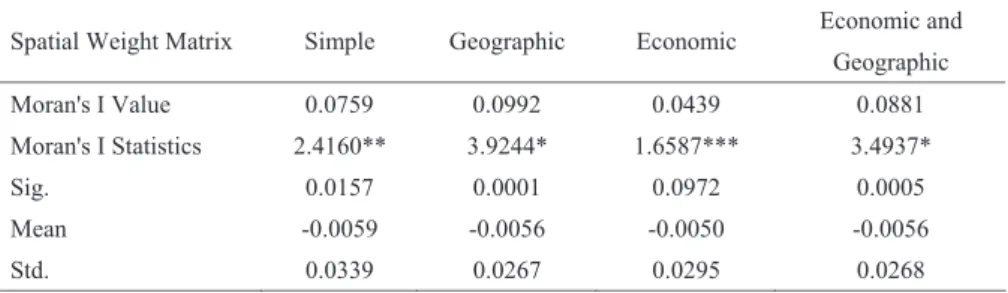
Prior to selecting the fitting model, we must test the spatial autocorrelation of the model, and the output is shown in table 2. The null hypothesis (H0) of Moran's I test is that there does not exist spatial correlation, As can be seen from table 2 , geographic weight matrix, economic and geographic weight matrix, simple weighting matrix and geographic weight matrix all reject the null hypothesis, respectively under the significance level of 1%, 5% and 10%, accepting the provincial spatial correlation hypothesis, which suggests that the provincial urban PCCE in China exists a clear positive correlation dependence (Spatial Dependence) in the spatial distribution and Table 1 Results of Stationary Test
島根県立大学『総合政策論叢』第30号(2015年11月)
- 22 -
sequences are non-stationary series under the 10% significance level. However, all sequences are stationary series after first order difference, and that is xt~ I (1). Specific results are shown in Table 1.
The null hypothesis (H0) of ADF Test is that there exists a unit root. As can be seen from the test results, after the first order difference, each variable’s null hypothesis is declined under the 1% significance level. That is to say there is no unit root.
3.3.2 Cointegration Test
The former stationarity test shows that all variables’ logarithm values meet I (1). Now we examine whether there exists a cointegration relationship among the variables selected. Only when there existence a cointegration relationship, it is possible to make regression analysis and reduce the possibility of pseudo regression. EVIEWS7.2 provides three cointegration test methods, and the paper adopts the “Kao (Engle Granger-based)”
method, the null hypothesis (H0) of which is that there is no co-integration relationship.
To examine the co-integration relationship among variables lnPCCE, lnPCDI, lnSAVS and lnGDER, test result shows that t statistic of ADF is 8.9289, and P value is 0.0000, in the case of 1% significant level, rejecting the null hypothesis. It means that there is a co-integration relationship. Therefore, the original sequence can be used for regression analysis.
3.4 Spatial Correlation Test and the Selection of Model
Prior to selecting the fitting model, we must test the spatial autocorrelation of the model, and the output is shown in Table 2. The null hypothesis (H0) of Moran’s I test is that there does not exist spatial correlation, As can be seen from Table 2, geographic weight matrix, economic and geographic weight matrix, simple weighting matrix and geographic weight matrix all reject the null hypothesis, respectively under the significance level of 1%, 5% and 10%, accepting the provincial spatial correlation hypothesis, which suggests that the provincial urban PCCE in China exists a clear positive correlation dependence (Spatial Dependence) in the spatial distribution and urban PCCE is not the scattered distributed in the spatial, but tends to cluster in space.
That is to say, the higher provincial PCCE is, the higher the surrounding areas’ PCCE is.
12
urban PCCE is not the scattered distributed in the spatial, but tends to cluster in space. That is to say, the higher provincial PCCE is, the higher the surrounding areas’ PCCE is.
Table 2 Spatial Correlation Test(Moran’s I)
Spatial Weight Matrix Simple Geographic Economic Economic and Geographic Moran's I Value 0.0759 0.0992 0.0439 0.0881 Moran's I Statistics 2.4160** 3.9244* 1.6587*** 3.4937*
Sig. 0.0157 0.0001 0.0972 0.0005
Mean -0.0059 -0.0056 -0.0050 -0.0056
Std. 0.0339 0.0267 0.0295 0.0268
NOTES: ***, **, * respectively denotes passing parameter significance test under the significance level of 10%, 5%, 1%.
Therefore, generally speaking, the level of provincial urban PCCE exists significant spatial correlation. That is to say, it has obvious space agglomeration phenomenon. Considering that Moran's I statistics of the economic weight matrix passes the parameter significance test only under the significance level of 10%, we do not analyze this weight matrix when processing actual model fitting.
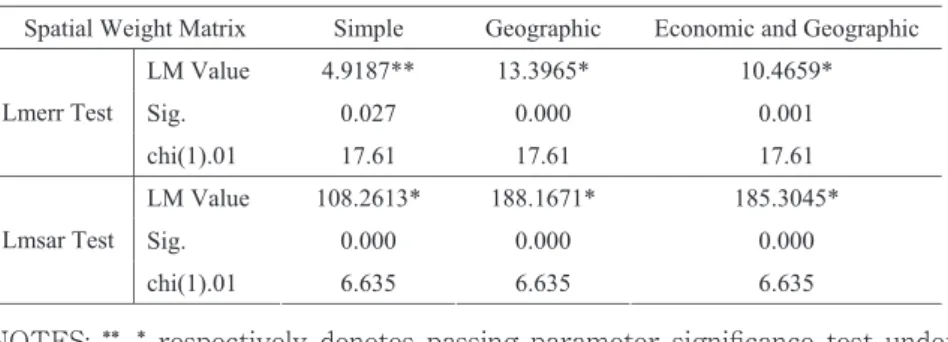
To further determine the model fitting types of geographic, economic and geographic and simple weight matrix, we use Anselin’s (1988) Lmerr and Lmsar spatial correlation test, with Lmerr test examining SEM model and Lmsar test examining SAR model. If Lmsar test is significant and its value is greater than Lmerr test value, we choose SAR model, and vice versa.
The results of two kinds of spatial correlation test are shown in Table 3.
Table 3 Lmsar and Lmsem Test
Spatial Weight Matrix Simple Geographic Economic and Geographic LM Value 4.9187** 13.3965* 10.4659*
Sig. 0.027 0.000 0.001
Lmerr Test
chi(1).01 17.61 17.61 17.61 LM Value 108.2613* 188.1671* 185.3045*
Sig. 0.000 0.000 0.000
Lmsar Test
chi(1).01 6.635 6.635 6.635
NOTES: **, * respectively denotes passing parameter significance test under the significance level of 5%, 1%.
Table 2 Spatial Correlation Test (Moran’s I)
NOTES: ***, **, * respectively denotes passing parameter significance test under the significance level of 10%, 5%, 1%.
The Spatial Econometric Analysis of Urban Residents’ Consumption in China
- 23 -