SYSTEMS BIOLOGICAL APPROACHES FOR UNDERSTANDING SPORULATION MECHANISMS OF
BACILLUS SUBTILIS A DISSERTATION
SUBMITTED TO THE SCHOOL OF FUNDAMENTAL SCIENCE AND TECHNOLOGY OF KEIO UNIVERSITY
IN PARTIAL FULFILLMENT OF THE REQUIREMENTS FOR THE DEGREE OF DOCTOR OF PHILOSOPHY
MINEO MOROHASHI
2007
© Copyright by Mineo Morohashi 2007
All Rights Reserved
ACKNOWLEDGMENTS
First and foremost, I would like to thank my parents, to whom I dedicate this thesis, for bringing me up the way they did, and for having faith in the choices I have made.
Without their support, I could not carry out this thesis project. I also really thank my brother Tomo, my sister Mari, and their family for their continuous support and help.
I am fortunate to have had chance to carry out my project under the supervision of Prof. Kotaro Oka, and as a principal advisor of this thesis. His optimistic and encourage motivated me whenever I was struggling to proceed. Prof. Hiroshi Yanagawa, Prof. Yasubumi Sakakibara, Dr. Rintaro Saito also help me a lot with fruitful discussions and helpful suggestions, and critical reading on my thesis.
I am most grateful to Prof. Yuichiro Anzai’s generosity, by which I could start working on systems biology field, while other lab members were working on robotics.
Dr. Hiroaki Kitano, who invited me to the world of systems biology, is for sure one of fantastic scientists I have ever met. He generously offered me great working environment when I was working at ERATO Kitano Symbiotic Systems Project. He provided me invaluable support at every step along the way. In addition, his sense of design made me sensible to those areas as well. I thank Ms. Yukiko Matsuoka, Ms.
Chie Ushiwata, Ms. Mine Shioiri, who have provided me relaxed time while working.
I am greatly indebted to Dr. Yoshiaki Ohashi, a colleague in Human Metabolome Technologies. His visionary mind and attractive characters inspired me in many ways.
His hard commit to work, yet attractive, made my paper accomplished in great manner.
I would also like to thank co-authors of my paper; Dr. Hamid Bolouri, Prof. John Doyle, Dr. Mark Borisuk, Dr. Amanda Winn, Ms. Kaori Shimizu, Dr. Junji Abe, Prof.
Hirotada Mori, Ms. Saeka Tani, Mr. Kotaro Ishii, Prof. Mitsuhiro Itaya, Dr. Hideaki
Nanamiya, and Prof. Fujio Kawamura.
work in a state-of-art field – metabolomics. While I work in Human Metabolome Technologies, their perspective and support helped me to go forward my project.
Along this long, long, long thesis project (almost seven years), I have been supported by many friends and colleagues; Ms. Nanae Mimura, Drs. Akira Funahashi, Noriko Hiroi, Tomomi Kimura, Theo Sabisch, Mike Hucka, Koji Kyoda, Shugo Hamahashi, Hiroki Ueda, Yasushi Hiraoka, Ayumu Yamamoto, Ding Da-Qiao, Martin Robert, Richard Baran, Masahiro Sugimoto, and Prof. Masatoshi Hagiwara. Their intelligence and kind support broadened my outlook to continue my thesis project.
My colleagues in Anzai Lab are also special to me; Drs. Sotaro Shimada, Nobuyuki Matsushita, Naohiko Kohtake, and Mr. Mitsuhiko Ohta. Sotaro was the only person who stayed in graduate school to get Ph.D., while all other members have left to get job. After few years, other two members have obtained their Ph.D. by chance – I am the next one following them.
Many thanks are also due to people by whom I have been supported at Human Metabolome Technologies. Mr. Takamasa Ishikawa, Mr. Hitoshi Sagawa, Mr. Seira Nakamura, Ms. Gin Maeta, Mr. Kosaku Shinoda, Mr. Atsushi Nagashima, Mr.
Hajime Sato, Ms. Yuki Ueno, Ms. Mutsuko Sato, Ms. Miho Ikeda, Mr. Yuji Sakakibara, Mr. Masatomo Hirabayashi, Ms. Sumiko Kumaki, Ms. Aya Shinoda, Mr.
Akiyoshi Hirayama, Mr. Kazunori Sasaki, Ms. Jun Imoto, Mr. Hideaki Murakami,
Drs. Yoshihiro Ohtaki, Haruyuki Ohkishi, and Shizuo Ao.
• Morohashi, M., Ohashi, Y., Tani, S., Ishii, K., Itaya, M., Nanamiya, H., Kawamura, F., Tomita, M., and Soga, T.
Model based definition of population heterogeneity and its effects on metabolism in sporulating Bacillus subtilis.
J. Biochem. 2007. (In press)
• Morohashi, M., Shimizu, K., Ohashi, Y., Abe, J., Mori, H., Tomita, M., and Soga, T.
P-BOSS: A new filtering method for treasure hunting in metabolomics.
J. Chromatography A. 2007. (In press)
• Funahashi, A., Tanimura, N., Morohashi, M., and Kitano, H.
CellDesigner: a process diagram editor for gene-regulatory and biochemical networks.
BioSilico, 1:159-162, 2003.
• Morohashi, M., Winn, A. E., Borisuk, M. T., Doyle, J., Bolouri, H., and Kitano, H.
Robustness as a measure of plausibility in models of biochemical networks.
J. Theor. Biol. 216:19-30, 2002.
AIC Akaike’s Information Criterion ANOVA Analysis of variance
ATP Adenosine 5’triphosphate
AUTO A software tool for bifurcation analysis
CE Capillary Electrophoresis
CellDesigner A modeling tool for gene-regulatory and biochemical networks
IE Intermediate enzyme
Java An object oriented programming language JWS Java Web Start
KEGG Kyoto Encyclopedia of Genes and Genomes MATLAB A software tool for numerical analysis MPF Maturation promoting factor
MS Mass spectrometry
ODE Ordinary differential equation PCA Principal component analysis PCR polymerase chain reaction
P-BOSS Peak filter based on orphan survival strategy SBML Systems Biology Markup Language
SBGN Systems Biology Graphical Notation SBW Systems Biology Workbench
TOFMS Time-of-flight mass spectrometry
UI User interface
XML Extensible Markup Language
TABLE OF CONTENTS
List of Tables ... iii
List of Figures ... iv
Introduction...1
Structure...5
Chapter 1: Systems Biology and computational approach ...6
Conclusion ...15
Chapter 2: CellDesigner: Development of Genetic/Biochemical Network Editor...16
Introduction...17
Design principles ...17
How does it work? ...26
What distinguishes CellDesigner's technology from others currently available?...27
Future work...28
Conclusion ...30
Chapter 3: Simulation Analysis of Cell Cycle Model of Xenopus ...31
Introduction...32
Materials and methods ...33
Results...34
Discussion and Conclusions ...55
Chapter 4: Development of Filtering Method for CE-MS based Metabolomics...56
Introduction...57
Materials and methods ...58
Results and discussion ...60
Conclusion ...74
Chapter 5: Metabolomics and Simulations upon Bacillus subtilis ...75
Introduction...76
Molecular and biochemical features of sporulation in Bacillus subtilis ...78
Materials and methods ...83
Results and Discussion ...86
ii
Conclusion ...106
Chapter 6: Conclusion...107
Summary of results ...108
Development of analysis tools and methods...108
Application to biological models ...109
Future directions ...110
Issues in systems biology...110
Systems biology in industries ...111
Final remarks ...113
Bibliography ...114
iii
LIST OF TABLES
Number Page
Table 1: Identified standard compound peaks. ...68
Table 2: Threshold values determined according to the max value of f(x). ...69
Table 3: Results between before and after applying P-BOSS ...70
Table 4: Matching ratio of peaks (orphan0 and orphan4 categories only) ...71
Table 5: Removal of ambiguous peaks adjacent to objective peaks...73
Table 6: Parameter values used in this study...89
Table 7: Bacterial strains used in this study...95
Table 8: Clustering of amino acids. ...105
iv
LIST OF FIGURES
Number Page
Figure 1: Structure of this thesis. ...4
Figure 2: Hypothesis driven research in systems biology. ...7
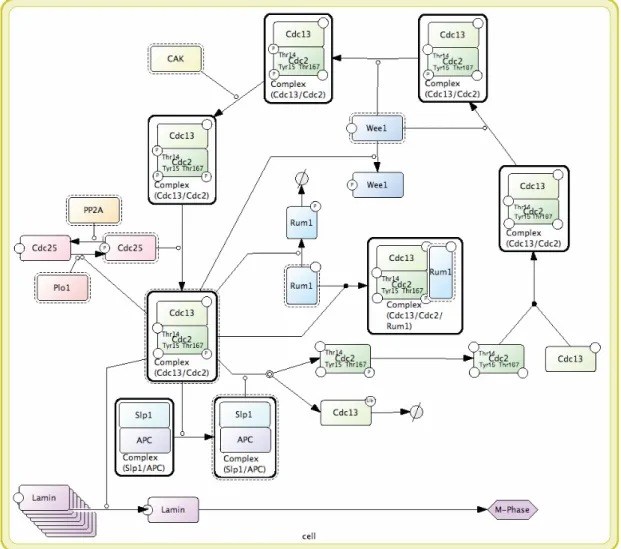
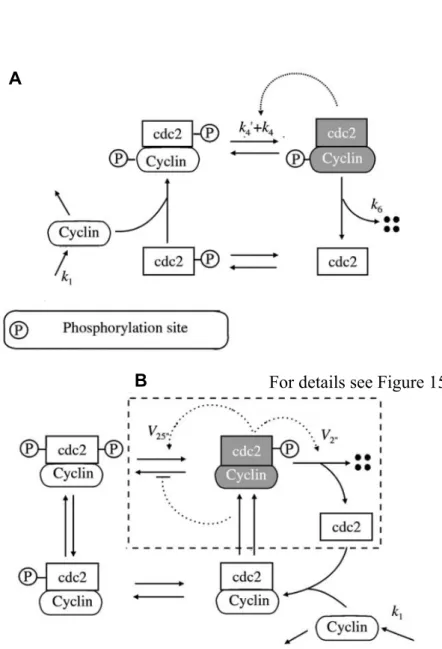
Figure 3: A process diagram representation of MPF cycle...21
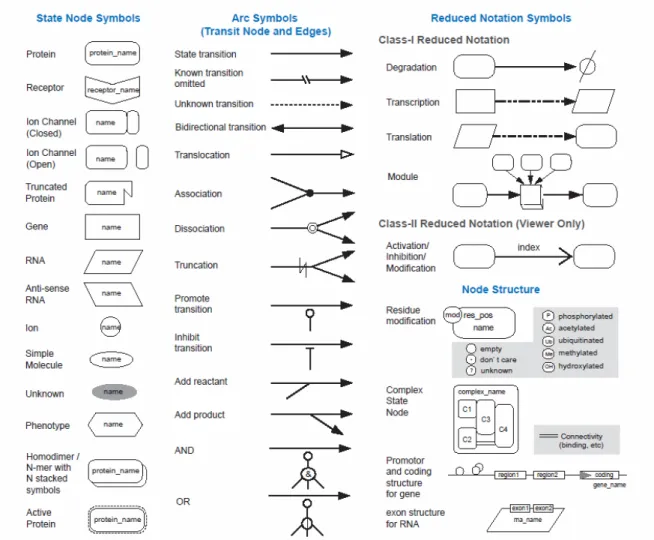
Figure 4: Proposed set of symbols for representing biological networks...22
Figure 5: Screenshot of CellDesigner...23
Figure 6: Schematic representation of two example behavior loci...38
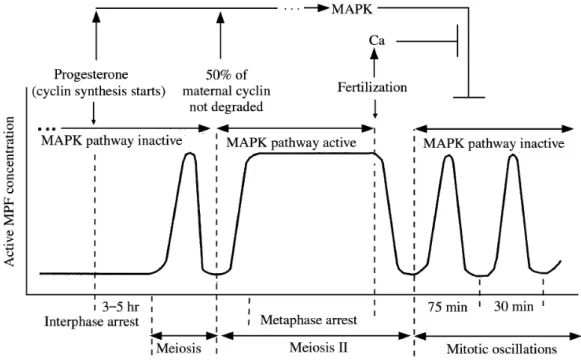
Figure 7: Schematic representation of major events in Xenopus eggs and embryos. ...41
Figure 8: Schematic representations of two models of the Xenopus cell cycle. ...43
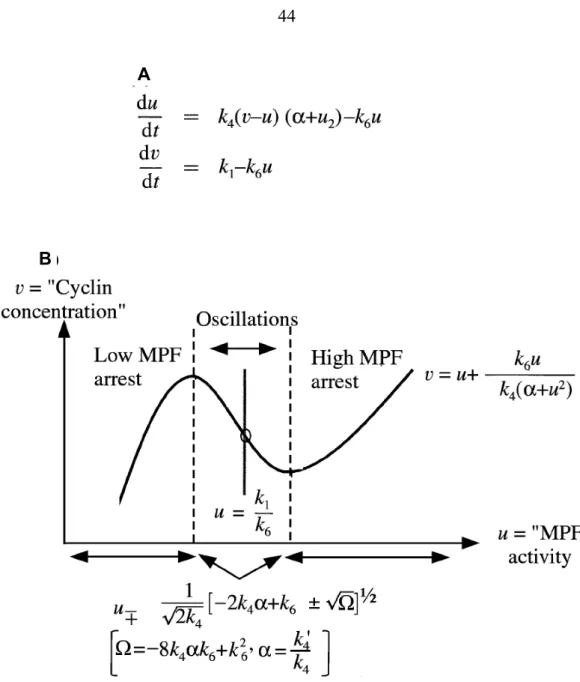
Figure 9: Overview of the reduced, two-equation version of the 1991 model. ...44
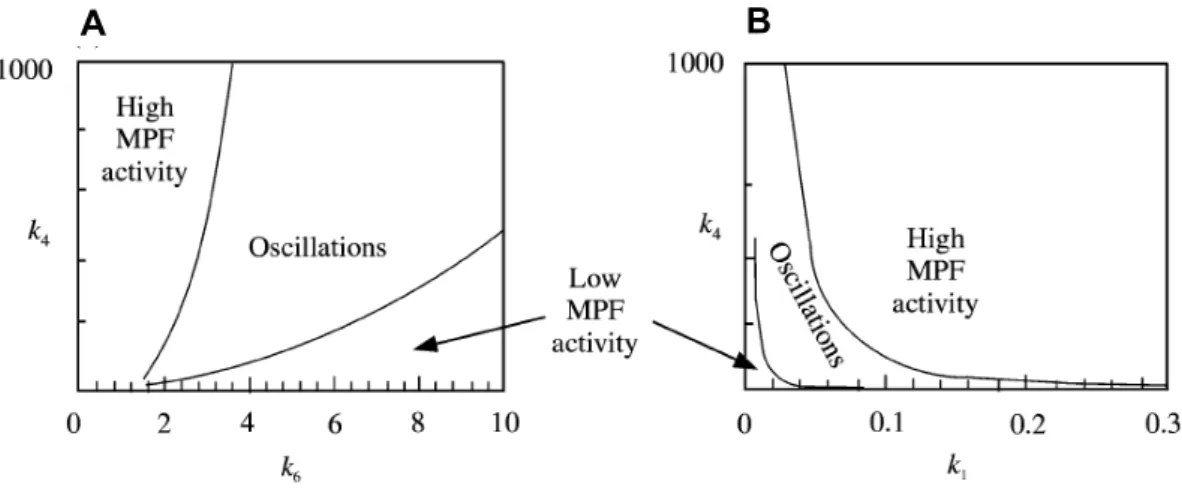
Figure 10: Two-parameter plots showing the regions in parameter space. ...45
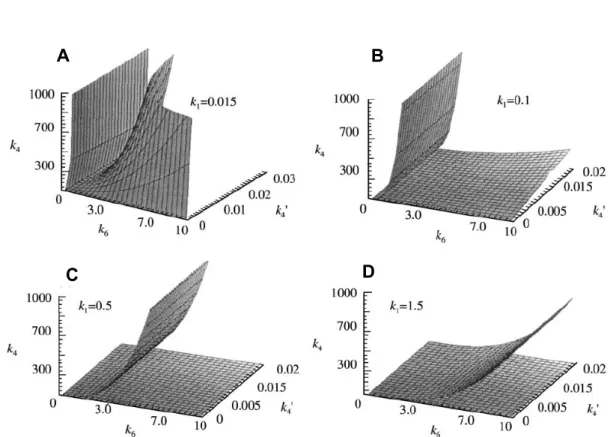
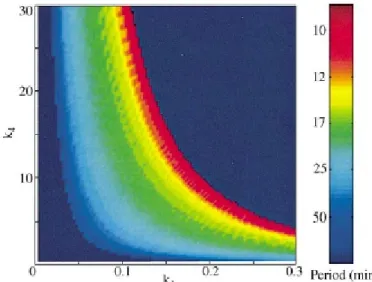
Figure 11: The effect of k1 on the shape of the model behavior in parameter space. ...47
Figure 12: Contour plot of the frequency of oscillations in the 1991 model...48
Figure 13: The effect of k1 on the size/shape of the regions in the 1998 model...50
Figure 14: Cleavage frequency contour plot...51
Figure 15: Details of the additional reactions included in the 1998 model. ...52
Figure 16: The 1998 model optimized to give in vitro like oscillations...53
Figure 17: The 1998 model optimized to give in vivo like oscillations...54
Figure 18: Schematic representation of basic strategy for biomarker search. ...62
Figure 19: Definition of "orphan" categories...63
Figure 20: Percentile rank of four parameters in CE-TOFMS signals. ...64
Figure 21: Schematic representation of filtering process with P-BOSS/AIC...66
Figure 22: Transition of f(x) according to each parameter. ...69
Figure 23: The morphological stages of sporulation. ...79
Figure 24: The sporulation cascade in Bacillus subtilis and selected clostridia...82
Figure 25: Schematic representation of the phosphorelay network in B. subtilis...87
Figure 26: Dependency of sporulation rate upon the feedback coefficients...89
Figure 27: Behavior of the sporulation-decision system upon simulation. ...90
Figure 28: Effects of phosphorelay-associated mutations at sporulation onset...92
v
Figure 29: Effects of phosphorelay-associated mutations at sporulation onset...94
Figure 30: Growth curve of examined strains...98
Figure 31: The metabolic state of sporulating B. subtilis. ...99
Figure 32: Metabolic profiles of nucleotides...102
Figure 33. Metabolic profiling of B. subtilis...104
INTRODUCTION
Science is organized knowledge. Wisdom is organized life.
— Immanuel Kant
Recent biology is filled with complexity and flood of data. Since the discovery of molecular structure of DNA by Watson and Crick (Watson and Crick 1953), molecular biology has emerged as a methodology to understand biological systems from molecular viewpoint. Those approaches have enabled us to manipulate molecules in a way we would like to retrieve information out of them. Such approaches aimed primarily to know functions of each component (e.g., genes or proteins), and thus could have broaden our outlook in each. Their ‘reductionist’
approach is significant in listing all the parts of cells with detail function.
With the appearance of powerful computer processors and extensive data describing the mechanistic details of biological systems, there has been a shift toward
‘integrated’ approach – the focus is on understanding structure and dynamics (Kitano 2002). Besides, the advent of data-processing enabled high throughput data analyses, which resulted in completion of human genome sequence in 2001 (Venter et al. 2001).
While those accomplishments are just a beginning toward system-level understanding
of life, they are definitely significant milestones as a first step from systems biology
perspectives.
What is next then?
Now that genomes over 500 species have already sequenced (e.g., human, mouse, Drosophila, E. coli, and B. subtilis), other -ome technologies have emerged. The primary fields of them are transcriptomics, proteomics, and metabolomics.
Transcriptome is complement of mRNAs transcribed from genome, and transcriptomics refers to the study of the transcriptome using technologies of large- scale generation of mRNA expression profiles (Velculescu et al. 1997). Likewise, proteomics refers to the study of proteome (collection of proteins in the cells), and metabolomics to the study of metabolome (collection of metabolites in the cells (Soga et al. 2003; Morohashi et al. 2007)).
On one hand, systems biology is to infer knowledge from those various types of omics technologies, as mentioned above, which is literally ‘integrated’ approach – here we refer as “bottom up” approach. On the other hand, there is an utterly different approach, which we call as “top down” approach. The problems in biology are exacerbated by an increase in information complexity – no longer can systems be represented as isolated linear or hierarchical structures, instead we find complex interrelationships. Computer simulations can be used to study such systems, with the result that proposed models and hypothesis can be either validated or rejected. These methods can also complement experimental investigation, by testing experimentally measured data and highlighting future strategies of research. Although they complement each other, the top-down approach tends to focus on specific phenomena to understand mechanisms behind them. From the perspective, omics data is not necessary, yet only fraction of them is sufficient.
As mentioned above (see detail in next chapter as well), systems biology is diverse
discipline, and one can take thousands of methodologies depending on what she/he
would like to look into. As a common and significant fact, any approaches need to
comprehensively utilize cutting edge measurement technologies and software
infrastructure. Those technologies should be appropriately developed and well
established, and also should be well linked toward efficient analyses thereafter. Such
efforts have been already underway in the world. One of them is Alliance for Cellular Signaling (AfCS, http://afcs.org), which is aiming at making large-scale measurements with the ultimate goal of creating an in-depth simulation model of cells.
Although we could now obtain large-scale and wide spectrum of data, we are still missing huge amount of components in analysis platform. We thus started to ask ourselves following three questions:
1. Can we perform more efficient analyses than before?
• In order to facilitate systems biology research, various techniques must be employed, thus involving large amount of individual processing. We may need to convert data each time we proceed to next analyses manually. Such obstacles annoy ones to proceed in fast and cost effective manner, and also causing to speed down of research itself. We must keep in mind that any development should contribute to efficiency in research.
2. Can we obtain in-depth understanding of biological systems by employing both top-down and bottom-up approach?
• As mentioned above, both approaches should be well linked to investigate biological systems. Those approaches will be seamlessly combined in future along systems biology research cycle (see next chapter), but we would like to know first that what is the outcome by employing both approach.
3. Can we apply our methods/tools to real cases?
• Development of various tools/methods will speed up and facilitate our research, but at the same time we need to take care of its wide applicability to real cases. One of our aims is to provide the outcome to real cases as a
“useful” one.
Those questions are simple, yet important starting point for examining systems biology research. To answer the questions, we undergo two steps of research:
1. To develop analysis platform
2. To utilize the platform upon test cases
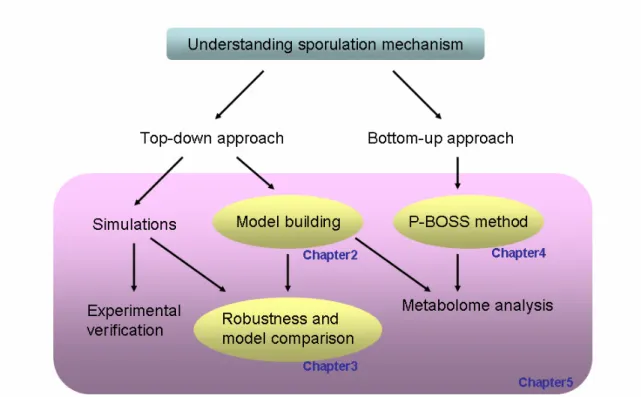
Step 1 could enable us to evaluate question 1, whereas step 2 to evaluate questions 2 and 3. By taking on developing part of systems biology cycle, we believe that we could contribute to further analyses on systems biology field. Ultimately, using sporulation in B. subtilis as a case, our aim is to understand the basis for the bistable mechanisms utilizing above methods. Figure 1 illustrates the structure of this thesis.
Figure 1: Structure of this thesis.
STRUCTURE
This thesis consists of 6 chapters detailing my work. It begins with an introductory chapter that describes the motivation of research together with background information on systems biology and, in particular, simulation and metabolomics approach. Chapter 2 focuses to the development of modeling platform, which we call
“CellDesigner.” Chapter 3 attempts to examine simulation analysis by comparing two
models of Xenopus using robustness as its plausibility measure. Chapter 4 shifts our
focus to bottom-up approach, and describes how metabolome data processing method
is developed for CE-MS based data. Chapter 5 applies above methods to examine
mechanisms of sporulation in B. subtilis, and combines omics and model driven
approach together. Chapter 6 summarizes the results of the work in previous chapters,
and presents a vision for future research in systems biology field.
CHAPTER 1: SYSTEMS BIOLOGY AND COMPUTATIONAL APPROACH
The most incomprehensible thing about the world is that it is at all comprehensible.
— Albert Einstein
Systems biology is defined as an approach to elucidate biological systems, such as cells, for “system-level” understanding (Kitano 2002, 2002; Hood et al. 2004).
Progress in molecular and cell biology has led to the identification of complex
biochemical networks involved in the normal functioning of cells, tissues and organs
and even defects associated with many diseases. While those provide a complete list
of factors, a building block, and relationship among each other, it is not enough to
understand the system. Building them all together may lead to unexpected phenomena,
because of its system characterstics – this cannot be identified by only knowing
function of each factor. For instance, system may possibly cause to catastrophic status
upon prescription of drug, which is because complete dynamics/kinetics of system is
not understood. Those side effects are critical particularly in medical/pharmaceutical
field, and thus we must examine how the individual components dynamically interact,
and predict their outcome. Here comes the systems biology approach.
Figure 2 illustrates the basic research cycle of systems biology, proposed by Kitano (Kitano 2002). Although the cycle resembles that of other science field, even of biology, it is different in a way that comprises both “dry (computational)” and “wet (experimental)” experiments. It is apparent that wide spectrum of technologies is necessary to efficiently conduct the research cycle. We believe following three technologies are inevitable to go for the work:
• Experimental technologies
• Analysis technologies
• Computer technologies
Figure 2: Hypothesis driven research in systems biology.
The image is altered from (Kitano 2002).
Here we will review each technology and discuss what is needed for further research.
Biological knowledge and contradictory issues
Data- and hypothesis- driven modeling
“Dry” experiments (simulations)
System analysis and theory formation
Predictions Experiment
design and experimental device development
“Wet” experiments Experiment data analysis