Acta Med. Nagasaki 42 : 1-9
Atomic Bomb Irradiation-induced Leukemias Revisited :
Summary Data of 50 Years-Long Term Follow Up Study on Survivors
Masao TOMONAGA 1) , Tatsuki MATSUO 2), Dale L. PRESTON 3), John M. BENNETT 4) 1) Department of Hematology, Atomic Disease Institute
2) Division of Blood Transfusion, Nagasaki University School of Medicine, Nagasaki, Japan 3) Department of Statistics, Radiation Effect Research Foundation, Hiroshima, Japan 4) University of Rochester Cancer Center, Rochester, New York, U.S.A.
Under the cooperation between Atomic Bomb Disease Institute (ABDI) of Nagasaki University School of Medicine, Institute of Nuclear Medicine of Hiroshima University and Radiation Effect Research Foundation (RERF), the Life Span Study (LSS) on 93,741 survivors (fixed cohort) and the Open City Study (OCS) on all survivors (unfixed) irrespec- tive of whether they belonged to LSS or not, have been conducted in parallel over 45 years to ensure reliable case detection. For diagnosis and subtyping of detected leukemias, we adopted the FAB classifcation for acute leukemias and for exposure dose of individual survivors, the new dosimetry system 1986 (DS86).
In LSS, 231 leukemia cases were analysed. There was strong evidence of radiation-induced risks for acute myeloid leukemia (AML), acute lymphoid leukemia (ALL) and chronic myeloid leukemia (CML), but not for adult T-cell leukemia (an endemic disease in Nagasaki area) and chronic lymphocytic leukemia. There was also significant difference between three major types with respect to the effects of age at bombing and sex, and in the temporal pattern of the elevated risks. For AML the dose response function was non-linear, whereas there was no evidence against linearity for ALL and CML. The hypothesis of a 0.5 Gy threshold could be rejected for three major types of leukemia. Excess Absolute Risk (EAR) estimates in cases per 10,000 Person Year Sievert (PYSv) were 0.6, 1.1, 0.9 for ALL, AML and CML, respec- tively. The corresponding relative risk at 1.0 Sv were 9.1, 3.3, 6.2, respectively. Although childhood exposure <15 age at bombing apparently induced three major types, the age- related highest risk was observed for ALL.
In OCS, 413 cases with DS86 estimates were used for analy- sis. Type specific incidence rates were calculated indirectly by using the over all incidence of leukemia from LSS data and multiplying these values by the corresponding propor- tions of cases in OCS. In conjunction with LSS data, the effects of radiation were significantly greater on the incidences of ALL and CML than on that of AML. In the high dose group there was a strong evidence for shorter incubation time and faster decline of elevated risk for ALL and CML than for AML. AML risk was apparently persistent through 1980.
Thus, the differential effects of atomic bomb irradiation in inducing three major types of leukemia with respect of age-related and temporal patterns provide us insights into human leukemogenesis. Further investigation on radiation leukememogenesis undoubtedly requires molecular ap- proach to detect type-specific genetic abnormlities including oncogenes and anti-oncogenes.
Introduction
Close relation between radiation exposure and leukemia induction has been well known since the discovery and clinical use of X ray by Roentgen in 1895, a hundred years ago. It passed 50 years after this discovery to the use of atomic bombs in war in 1945. During this period, hazards from exposure to radiation were fequently reported ; among them the most important was the leukemia occur- rence among English patients with anchylosing spondylitis treated with large doses of radiation'). Therefore, it could be suspected that leukemia induction would be observed among atomic bomb survivors of Hiroshima and Nagasaki.
A few years after the atomic bombs physicians in both cities simultaneously began to notice an increased number of patients with leukemia. Under the supervision of former Atomic Bomb Causalty Commission (ABCC) a large cohort study named Leukemia Detection Program (HE39) was started in 1950. Within a decade it was statistically confirmed that atomic bomb irradiation actually induced an increased risk of leukemia among heavily exposed survivors 2). Thus it became a common knowledge for a physician that radiation can cause leukemia. All textbooks of hematology now contain a description about atomic bomb irradiation-induced leukemia. However, it still remains unsolved what molecular or genetic events induce leukemia in blood cells.
Leukemia is a relatively rare disease accounting only 4 % of the cancer deaths in the Radiation Effect Research Foundation (RERF)'s fixed Life Span Study (LSS) cohort.
However, leukemia is estimated to be accounted for 20%
of the excess cancer deaths in this cohort, suggesting its remarkablly high relative risk among all cancers. In order to better understand biological significance of Atomic Bomb-induced leukemias in the context of human leukemogenesis we have analysed comprehensive data obtained from two types of long term leukemia detection programs conducted over 45 years.
Address Correspondence : Dr. Masao Tomonaga, Department of Hematology, Atomic Bomb Disease Institute, Nagasaki University School of Medicine, 1-12-4 Sakamoto, Nagasaki 852-8523, Japan
Epidemiology of leukemia among atomic bomb survivors
(1) Study Design and Cohort
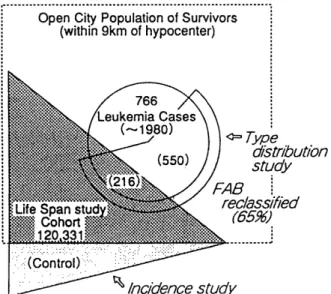
Since 1950 we have conducted two types of leukemia detection program : one is the leukemia registration for the 120,321 persons of RERF's Life Span Study (LSS) cohort consisting of 93,741 survivors who were in either city at the time of the bombings (ATB)3' and 26,580 control cases who were not in either city ATB, and another is the Open City Study (OCS) in which all leukemia cases occurring among survivors who were within 9 km of the hypocenter in either city ATB were registered irrespective of whether they belonged to LSS cohort or not'). The LSS Study was planned for the formal RERF's statistical analysis for diseases induced by atomic bomb irradiation and the OCS for the most reliable leukemia case-detection among many hospitals in Hiroshima and Nagasaki. The total number of the OCS Sample is not known but roughly three fold larger than that of LSS cohort as shown in Fig 1. Each case occuring from outside LSS cohort was care- fully confirmed for residency at bombing and exposure dose was estimated exactly in the same way as in LSS Study.
(3) Leukemia classification
The previous reports of LSS from RERF employed a rather old classification basically derived from Wintrobe's textbook of hematology. The present comprehensive LSS report incorporated an up-dated classification system as employed in the leukemia reclassification study on OCS Sample (RERF technical report 9-91) in order to improve our understanding of differential effects of atomic bomb irradiation on major leukemia types.
(4) Age distribution
Fig. 2 summarizes the composition of the LSS cohort used for this study by age ATB, sex, and vital status at the end of follow-up on 31 December 1987. The cohort con- tained a relatively large population of women (58.4 %) due to the relatively small number of males between the ages of 15 and 50 years as the results of the Warfare. Roughly two thirds of the survivors are Hiroshima cases. It is notable that there were over 16,000 children under age 10 ATB and female preponderance in this cohort.
Fig. 2. LSS cohort : age ATB distribution by sex and vital status.
Fig. 1. Leukemia regisrtry for A-bomb survivors since 1950 (Hiroshima and Nagasaki).
(2) Dosimetry of radiation exposure in individual survivors
Dosimetry of bone marrow kerma employed in the two studies is the 1986 dosimetry system (DS86) which was improved from the previous dosimetry system DS65 by re-evaluation of gamma and neutron doses in both cities by taking into acounts of atomospheric influences such as humidity on radiation diminution.
Life Span Study
(1) Analysis of all leukemia types combined
261 leukemia cases met the basic criteria for the analy- sis. Among these cases, 231 with DS86 kerma estimates between 0 and 4 Gy were used for analysis. Background rates (expected rates in the absence of exposure) can be described by a model in which the log of the rate is a quadratic function of the log of attained age. The age- specific rates for women are about half of those seen in men. There is a statistically significant exposure dose response (P<0.001) that appeared to be non-linear in dose (P<0.008) as indicated in Fig. 3. The hypothesis of a 0.5-Sv threshold could be rejected (P<0.001). Young men
had high excess abosolute risk (EAR) in the period from 5 to 10 years after exposure, but these risks decreased rapidly with time. The EAR for older men are not as high in the early years and declined more slowly than those for younger men. Women tended to have lower EAR than men until roughly 20 years after exposure. The data for older women suggest that the risks have not decreased with time.
risk (ERR) at 1 Sv was 9.1 and EAR was 0.62 per 10,000 PYSv.
Fig. 4. LSS cohort : acute lymphocytic leukemia.
Fig. 3. LSS cohort : leukemia, all types. (A) Time since exposure. (B) Dose response.
(3) Acute Myeloid Leukemia (AML)
There were 103 eligible cases with DS86 doses between 0 and 4 Gy. AML background rates in this cohort could be described by a model in which the log rate varied as a sex-dependent quadratic function of log attained age with an effect of birth cohort of 1910 and 1940. There was a strong evidence of a dose response (P<0.001) and a suggestion of non-linearity as indicated by tests based on either quadratic (P = 0.05) or spline models (P = 0.04).
The 0.5-Gy threshold model did not fit these models (P = 0.05). Thus AML dose response function was different from those for other leukemia subtypes (ALL and CML).
As shown in Fig. 5 age at bombing had a significant effect on the EAR, with the youngest survivors having the highest average absolute risks. The model-based time- averaged ERR is estimated to be 3.3. and the correspond- ing EAR estimate is 1.1 cases per 10,000 PYSv.
(2) Acute Lymphocytic Leukemia (ALL)
Of the 38 ALL cases that met the basic criteria for including in the study, 32 had DS86 kerma estimates between 0 and 4 Gy. Because of the small number of cases and the relatively high percentage of cases with unkown dose, the analysis of effect modifying factors were supple- mented by analyses that used survivors with unknown DS86. Background rates was roughly log linear in attained age. The test for a dose response was highly significant (P<0.001). Our final model for the ALL risk is a linear dose-response model in which the EAR has decreased rapidly with time, about 14% per year. As shown in Fig. 4 children exposed under age 10 had the highest excess risks.
For any age at bombing or time since exposure, the EAR estimates for women were estimated to be less than half those for men. Fig. 4 also shows plots of the EAR for men and women exposed to 1 Sv at the ages of 10, 25 and 40 years. Confidence bands are shown only for males. The model-based summary risk estimates are. excess relative
Fig. 5. LSS cohort : acute myelogenous leukemia.
(4) Chronic Myeloid Leukemia (CML)
Of the 62 cases that were eligible, 57 had DS86 kerma estimates between 0 and 4 Gy. Backgroud rate is roughly proportional to attained age squared. Background rates differed significantly by sex (P = 0.008) with age-specific rates for women about 60% of those for men. As shown in
Fig. 6 the difference between cities was even more pro- nounced (P = 0.003) with rates in Hiroshima for either sex being more than three times those in Nagasaki. The CML data are consistent with a linear nonthreshold dose- response model. The hypothesis of a 0.5-Gy threshold could be rejected for these data (P = 0.003). The model based ERR was 6.2 and EAR 0.9 cases per 10,000 PYSv.
the test for type-specific differences in the shape of the dose-response function was not significant (P = 0.35).
Although this test was not a powerful one, this result suggests that the differences in the shape of the dose- response function decribed above should be interpreted with caution. There was strong evidence against 0.5-Gyz threshold (P = 0.001).
Fig. 6. LSS cohort : choronic myelogenous leukemia, (A) Backround rates. (B) Time since exposure/excess absolute
risk model (1 Sv exposure). Fig. 7. LSS cohort : leukemia joint analysis (leukemia dose-response function).
(5) Joint analysis for ALL, AML and CML
The results of the above described type-specific leukemia analyses suggest that there are differences in the nature of the dose response for each leukemia type. These differences were summarized in Fig. 7 which compared the dose- response curves for the four diagnostic subtypes (ALL, AML, CML and Other) considered above, 5 and 35 years after exposure for three groups of age at bombing. The joint analysis suggests that there are significant inter- leukemia type differences in both the temporal pattern (P
= 0.02) and the nature of the variation of the risk with age ATB (P = 0.002). After allowing for these differences a test for non-linearity in the dose response function, with a common amount of curvature for all three types as- sumed, was statistically significant (P = 0.008), whereas
Open City Study
(1) Leukemia classification and statistics
Since 1986 to 1991, we have attempted to review the hematological data and peripheral blood and bone marrow specimens archived at RERF and at several majour hospi- tals in Hiroshima and Nagasaki in purpose of further clarifying the differential effects of atomic bomb irradia- tion on the major subtypes of human leukemias by classi- fying survivors' .leukemias according to the newly established FAB classification on acute leukemias and myelodysplastic syndromes (MDS), and newly recognized entities such as adult T-cell leukemia (ATL) which is an
virus-induced endemic disease in Nagasaki district. As shown in Fig 1, from 1950 through 1980, 766 cases of leukemia were registered from the Open City Sample, of which 249 occurred in the LSS cohort. We could reclassify 493 (64.4%) cases including 177 LSS cases. Of these reclassified cases, 413 with estimated DS86 kerma were categorized for statistical analysis into four major types;
ALL, AML including MDS, CML, and Other including ATL.
The type specific incidence rates were obtained by estimating the overall incidence of leukemia from the LSS data with a fixed cohort and multiplying these values by the corresponding proportions of cases in OCS. In this way, information relevant to our objectives was extracted from leukemia cases outside the LSS cohort. Since this proportional analysis does not allow direct statistical comparison between leukemia types, ratios of relative risks (RRR) was calculated to compare the effects of dose, age at bombing, city and latency period on the incidence of ALL, CML, and Other relative to their effects on the incidence of AML. AML was chosen as the reference type because it is the most prevalent of all leukemias.
Statistical basis for the RRR analysis was decribed in detail in the RERF technical report (TR 9-91).
Fig. 8. Open City : incidence rate by age (age at time of bombing) leukemia type, dose and calendar years.
(2) Type-specific incidence
The incidence rates of all types of leukemia eventually increased with increasing exposure level in each age at bombing (ATB) category. The relative risks (RR) of radiation exposure (i.e., exposed=not exposed) were also
apparently elevated with increasing dose in all types of leukemia (data not shown). The effects of age at bombing were quite different between the types of leukemia. The RR was most markedly elevated in 0-15 age at bombing category for ALL. In this age group, the RR of ALL was apparently greater than those of CML and AML. Fig. 8 illustrates temporal pattern of the elevated incidence rate of major three types of leukemia according to five expo- sure dose categories and three age at bombing categories.
The elevated incidences for ALL and CML declined rather quickly with time in < 15 age category especially of high dose categories, whereas that for AML was persistently elevated through 1976-80 period especially in the adult age categories especially of high dose categories.
Cases of ATL were observed only in Nagasaki. These cases make up 60% of the Other category. The highest incidence of ATL was observed in the high-dose category (>1000 mGy) in the early period, suggesting a radiation effects on ATL incidence. However, this might be random fluctuation and would not attain statistical significance because there were only two cases in the high dose category
(data not shown).
(3) Comparison of leukemia types
Although statistical methods for testing the effects of radiation exposure, age at bombing, city and period since exposure on type-specific incidence rates are not yet available, relative risk ratios (RRR) are used to compare leukemia types. This method could provide indirect statis- tical evidence for the suggestive findings. RRR were calculated to compare the effects of A-Bomb radiation exposure on the incidence of ALL, CML and Other types relative to its effect on the incidence of AML as mentioned above. As shown in Table 1, for ALL and CML, these ratios are generally significantly > 1 (P = 0.05), even in the lowest exposure categories through 1956-1960 period (P
= 0.05) , and become non-significant by 1966-70. This means that radiation exposure had a greater effects on the rates of CML and AML in early periods than that of AML.
The effects of radiation on Other types did not differ significantly from its effect on AML at any time for all exposure levels.
The fact that RRR of ALL and CML relative to AML are significantly > 1 for the lowest dose category (1-49 mGy) in the period 1950-65 provides statistically signifi- cant evidence for the suggestion that exposures less than 50 mGy produced excesses of ALL and CML. This state- ment naturally presumes that low dose radiation did not have a protective effect against AML induction. RRR of CML relative to AML was 0.12 in the period 1976-80, suggesting statistical support for an excess of AML remained through 1980 in the highest dose category. The RRR of ALL relative to CML was 7.42, providing statisti- cal support for the suggestion that an excess of ALL
Table 1. Ratios of relative risks1 for comparing exposure effects on acute lymphocytic (All), chronic myeloid (CML), and other leukemias (Other) to corresponding effects on acute myeloid leukemia (AML)'
Leukemia Category Time period
typeb (mGy) 1945-50 1951-55 1956-60 1961-65 1966-70 1971-75 1976-80
ALL 0 1.00 1.00 1.00 1.00 1.00 1.00 1.00
1-49 10.92** 7.49** 5.14** 3.52* 2.42 1.66 1.14
50-499 9.99** 5.82`* 3.39** 1.97 1.15 0.67 0.39
500-1499 3.32 3.00** 2.70 * 2.44 2.20 1.98 1.78
? 1500 20.70** 12.25 7.25** 4.29** 2.54 1.50 0.89
CML 0 1.00 1.00 1.00 1.00 1.00 1.00 1.00
1-49 12.10** 7.21** 4.30** 2.56* 1.53 0.91 0.54
50-499 6.91** 5.82** 4.90** 4.12** 3.47** 2.92* 2.46
500-1499 9.88 * * 6.97 * * 4.92 * * 3.47 * * 2.45 1.73 1.22
? 1500 11.68** 5.47** 2.56** 1.20 0.56 0.26 0.12*
Other 0 1.00 1.00 1.00 1.00 1.00 1.00 1.00
1-49 0.14 0.20 0.30 0.45 0.67 1.00 1.49
50-499 0.14 0.24 0.42 0.74 1.29 2.26 3.96
500-1499 2.44 1.52 0.92 0.59 0.37 0.23 0.14
2; 1500 2.03 1.43 1.01 0.71 0.50 0.35 0.25
Other includes adult T-cell Leukemia and other specifically diagnosed leukemias.
aRisk of different leukemia types at given exposure levels , relative to the nonexposed group, divided by thecorresponding relative risk of AML. Relative risk ratios >1.0 suggest a greater radiogenic effect on the given leukemia than on AML ; ratios<1.0 suggest a greater effect of the given level of radiation on AML risk.
bIncluding myelodysplastic syndrome .
*P<0 .10; **P<0.05
Table 2. Ratios of relative risks for city effects8 on background rates of leukemia
City ALL CML Other AML
Hiroshima 1.00 1.00 1.00 1.00
Nagasaki 0.64 0.43* 2.65 * 1.00
(0.31, 1.32)b (0.23, 0.79) (1.36, 5.17)
ALL, acute lymphocytic leukemia ; AML, acute myeloid leukemia ; CML, chronic myeloid leukemia ; and Other, leukemia including abult T cell leukemia and other specifically diagnosed leukemias.
'The risk of these leukemia types in Nagasaki
, relative to those in Hiroshima, divided by the corresponding relative risk of AML.
bThe values within parentheses are the 95% confidence intervals .
*P S0.05
Table 3. Ratios of relative risks for age at the time of the bombings (ATB) effects` on background rates of leukemia
ATB (years) ALL CML Other AML
0-15 1.00 1.00 1.00 1.00
16-35 0.40** 2.00* 1.65 1.00
(0.18, 0.89) b (0.96, 4.17) (0.71, 3.55)
z 36 0.40** 1.93* 7.38* 1.00
(0.18, 0.89) (0.91, 4.08) (1.16, 6.00)
ALL, acute lymphocytic leukemia ; AML, acute myeloid leukemia ; CML, chronic myeloid leukemia ; and Other, leukemia including abult T cell leukemia and other specifically diagnosed leukemias.
(Risk of leukemia types in each ATB category
, relative to the risk in the 0-15-year-old category, divided by the corresponding relative risk of AML.
bThe values with parentheses are the 95% confidence intervals .
*P<0 .10; **P<0.05.
remained through 1980.
As shown in Table 2, the RRR for city effects on back- ground rates of leukemia were marked in CML and Other : estimated risk of CML in Nagasaki relative to Hiroshima was significantly less than that of AML, whereas that of Other types (mainly ATL) was sigificantly greater.
Because there is no consistent difference in relative risks between cities, the city effect on background rates appear to explain a generally higher incidence (except for ATL) in Hiroshima than in Nagasaki.
As showm in Table 3, ratios of the incidences of each leukemia type in 16-35 and >35 relative to that in the youngest age at bombing (0-15) were calculated. ALL was induced at the highest rate in children, whereas CML and AML were induced at the highest rates in older adults.
(4) AML subtypes and exposure levels.
The distribution of AML subtypes in the the lower exposure categories (0-9 mGy, and 10-999 mGy) does not seem to differ greatly from that in the current general population in Japan (data not shown). The distribution in the highest category (> 1000 mGy) was 5 cases (29.4%) for M1, 6 cases (35.3%) for M2, none for M3, 4 cases (23.5%) for M4, and one case (5.9%) each for M5 and M6.
There is a suggestion that M3 is less radiogenic than M1, M2, and M4, but the statistical evidence is not sufficient to support such a conclusion (0.06<P<0.12).
(5) MDS
There were 26 cases of MDS, mostly refractory anemia with excess of blasts (RAEB). These were diagnosed mainly as AML in the previous LSS Study. RRR of MDS relative to AML was significantly >1, suggesting that MDS is more radiogenic than AML (P = 0.04). Most cases of MDS were more than 20 years age at bombing and only two cases under age 20. They developed the disease after a relatively long latency (data not shown).
Fig. 9. Relationship of time since exposure to onset and dose.
(6) Dose and latency according to leukemia types
The relationship between dose and time to onset varied significantly among leukemia types as shown in Fig. 9.
With increasing dose, the times to onset of ALL, AML, and CML all declined siginificantly. However, the rate of decline was significantly greater for ALL and CML than for AML and Other (P<0.05).
Discussion
The statistical analysis based on LSS data generated from a fixed RERF's cohort of survivors and OCS analysis based on leukemia cases detected in the general population of survivors provided basically similar results concerning the incidences of leukemia types, their dose responses, effects of age at bombing, latency periods, and temporal patterns of the elevated risks. Thus, we could utilize fully all available data on leukemias which have been known as the major late effect of atomic bomb irradiation. The principal finding of this comprehensive analyses was that the risk associated with radiation exposure varied signifi- cantly among major types of leukemia. In this respect summary risk analysis by combining all types of leukemia can be misleading. Risk estimator such as dose response, age at bombing, latency period and lesser extent, sex were all dependent on leukemia types. All these results proved importance of reclassification work which allowed us to review atomic bomb irradiation-induced leukemias in the light of the present knowledge on types of human leuke- mia.
The present analysis also emphasizes the importance of allowing for the background incidence rates when assessing radiation-induced leukemia risks. In particular, it is essential to recognize the difference between Hiroshima and Nagasaki for CML and ATL baseline rates when interpreting the data on excess risks for these subtypes.
Earlier mis-understanding of the nature of the excess risks for the two cities (CML risk was much higher in Hiroshima than in Nagasaki) arose because inter-city differences in the backgroud rates were not considered. The present analysis clearly demonstrated that the EAR for CML is higher in Hiroshima than in Nagasaki because of the difference in the background rates and the ERR was actually identical between two cities. However, the differ- ence in the background rate for CML remains as an enigma to be answered in future bacause it is generally believed that annual incidence of CML in Japan as well as in the world is rather constant and no geographic deviation has been so far reported.
Among major three types of leukemia associated with radiation exposure, ALL and CML (at least for males) showed higher ERR than AML and share similar responses characterized by a linear, non-threshold dose response and
an initial high risk followed by a gradual decline. In contrast AML dose response was non-linear. Inspite of this difference, our results suggested that there are detectable excess risks for all types of leukemia at doses below 0.5 Gy. OCS data suggested such excess risks for ALL and CML even in the lowest (< 50 mGy) dose categories.
Although LSS results are not at all inconsistent with those of OCS, the risks at this very low doses was much lower than in the latter study. Since OCS has an inherent limit for statistical consistency due to its indirect method, we need to reserve final conclusion on the effect of extremely low dose of A.Bomb irradiation in inducing leukemias. In other words, this situation seems to reflect a statistical limit derived from the sample size which was determined in 1950 when LSS was started. Unfortunately the LSS sample size seemingly large enough for statistical analysis of common malignancies was rather small for relatively rare diseases such as leukemia. In conclusion the existence of threshold dose for the induction of human leukemia could not be firmly established by the present comprehen- sive analysis. If it existed, it would be a dose lower than 0.5 Gy in all types of leukemia.
The risk for AML decreased with time for younger survivors but remained stable or possibly increased over decades for older survivors. This is a sharp contrast to the early onset and gradual decline of the risks for ALL and CML in childhood exposure group. Although the latency period was apparently dependent on exposure dose in all types of leukemia, that of AML was extremely long compared with those of ALL and CML. This might be a reflection of the differnce in undergoing leukemogenic processes which eventually lead to either type of leukemia.
The temporal pattern for AML among survivors exposed as adults resembles that which has generally been found for solid tumor incidences. The separate analysis for MDS in OCS also suggested a similar trend in temoral pattern.
In this respect, it is important to continue follow up study on the survivors exposed at young age at bombing who are now passing through their cancer-prone age.
The reclassification analysis of OCS sample suggested that it was not difficult to classify atomic bomb survi- vors' leukemias according to the new modern classification systems. The observed morphologies of AML and ALL cases among high-dose exposure groups were basically similar to those of de novo (spontaneous) leukemias that develope in the non-exposed population of either city and in the general population of Japan. A fairly large number of MDS cases, mostly RAEB, were also recognized, and these were also similar to de novo MDS. Subclassification of AML and ALL cases was also not difficult according to FAB classification. It was, however, notable that there was no case of M3 in the high dose group. It has been frequently reported that secondary or therapy-related leukemia/MDS which is another exmple of human leu- kemias with an apparent etiology (anti-cancer drugs), are
somewhat different in clinical and morphological picture from de novo leukemias and MDS. It is also true that CML and ALL rarely occur as therapy-related leukemia'). In this context it may be notable that the atomic bomb survivors' leukemias, induced by a single massive irradiation,are closer to spontaneous leukemias from a morphological point of view.
The prototype leukemia was ALL in those survivors exposed in their childhood. Although there were also excess risks for AML and CML, these were less prominent than that for ALL. It is a general rule that ALL is exclusively dominant in de novo leukemias of childhood. This age- specific dominance of ALL was clearly reproduced in the childhood exposure groups in the early period after bomb- ing, suggesting that atomic bomb irradiation might have augumented ALL-leukemogenesis which seems to be operating in the general population of children. In order to further prove this hypothesis, we need to start molecular investigation on the paraffin-embedded materials such as spleen and bone marrow obtained from autopsied cases of various types of leukemia, since we are now recognizing molecular heterogeneity in ALLs diagnosed according to FAB system. Special reference to molecular detection of bcr/abl gene rearrangement which is an eqivalent of cytogenetic Philadephila translocation, is needed to clarify whether childhood ALL among heavily exposed survivors are Philadelphia translocation-positive or not. It is generally accepted that de novo childhood ALL usually lacks Philadelphia translocation but adult ALL shows 25 to 30% positive rate. Also it is notable that most of the bcr/able rearrangement are minor type in de novo ALL in contrast to the virtually 100% incidence of major type bcr/abl in CML.
Long latency for the induction of AML and MDS and its persistently elevated risks in the adult exposure groups, also raise some interesting questions. It is difficult to exlain such a long latency by a single genetic event induced by radiation which leads to occurrence of AML. There are consistent evidences for chromosomal injury in multi- potent hematopoietic stem cells of heavily-irradiated survivors. We need to suspect multistep leukemogenic factors or events occurring in such wounded stem cells which survive over many years after exposure to radiation but eventually transform. A number of oncogenes and anti-oncogenes have been found to be closely related to pathogenesis of various subtypes of de novo AML and MDS. In this respect molecular analysis is also essential to make clear the relationship between atomic bomb-related AML and de novo AML.
To solve these interesting questions we need to analyse molecularly the leukemia materials such as paraffin- embedded bone marrow and spleen specimens archived at RERF or universities. It is absolutely necessary to prove or disprove that atomic bomb irradiation-induced leu- kemias are genetically similar to de novo leukemias. Such
a molecular technique to identify oncogenes and anti- oncogenes is now under development although it is a hard task to extract enough DNA or RNA from the 30 to 40 years old specimens').
As summarized above, 50 years' long term follow up study on leukemia among atomic bomb survivors provided tremendous amounts of information concerning human leukemogenesis. The bone marrow hematopoietic tissue exposed to significant dose of radiation usually lose hematopoietic activity due to damage to stem cells.
However, the bone marrow usually recover after a few months without obvious abnormality of blood cells. There are a few important studies which suggest that the target cells of radiation injury are hematopoietic stem cells".
However, it is still obscure whether these target cells were directly injured of their genome or reduction in number of stem cells by radiation injury eventually induced abnor- malities in genome of a stem cell as a result of enhanced genetic error by increased cell cycle. In an animal experi- ment using canine showed that a profound reduction in stem cell number precedes the occurrence of leukmia in irradiated dogs'). Similar reduction was also reported in cases of survivors from Bikini hydrogen bomb experiment, although there was no leukemia occurence in this small population'.
In conclusion our understading of radiation leukemo- genesis as a model of human carcinogenesis has advanced considerablly owing to the 50 years-long term survey on leukemia among atomic bomb survivors. To further extend our knowledge and obtain therapeutic hint we need un- doubtedly an further advance in molecular epidemiology.
Aknoledgement
The authors express their sincere thanks to all people who were engaged in this leukemia study program (HE39).
References
1) Court Broun WM, Doll R : Mortality from cancer and other causes after radiotherapy for ankylosing spondylitis. Br Med J 2 : 1327, 1965 2) Ishimaru T, Hoshino T, Ichimaru M, Okada H, Tomiyasu T, Tsuchimoto T, Yamamoto T : Leukemia in atomic bomb survivors,
Hiroshima-Nagasaki, 1 Oct 1950-30 Sep 1966. Rad Res 45: 216, 1971 3) Preston DL, Kusumi S, Tomonaga M, Izumi S, Ron E, Kuramoto A,
Kamada N, Dohy H, Matsuo T, Nonaka H, Thompson DE, Soda M,
Mabuchi K : Cancer incidence in atomic bomb survivors. Part III :
leukemia, lymphoma and multiple myeloma, 1950-1987. Rad Res 137:
s68, 1994
4) Tomonaga M, Matsuo T, Carter RL, Bennett JM, Kuriyama K, Imanaka F, Kusumi S, Mabuchi K, Kuramoto A, Kamada N,
Ichimaru M, Pisciotta AV, Finch SC : Differential effects of atomic
bomb irradiation in inducing major leukemia types (AML, ALL and
CML) : Analysis based upon up-dated diagnostic systems and new
dosimetry system (DS86). TR9-91, Radiation Effects Research
Foundation, Hiroshima, 1991
5) Michels SD, Mckenna RW, Arthur DC, Brunning RD: Therapy-related
acute myeloid leukemia and myelodysplastic syndrome : A clinical morphologic study of 65 cases. Blood 65: 1364, 1985
6) Aure I, Juhbashi T, Sekine M, Tomonaga M, Gale RP : Analysis of bcr/abl abnormalities in mRNA from 20-year-old paraffin-embed-
ded tissue for bcr/abl rearrangement by polymerase chain reaction.
Acta Haematol 90: 5, 1993
7) Amenomori T, Honda T, Otake M, Tomonaga M, Ichimaru M : Growth and differentiation of circulating hematopoietic stem cells
with atomic bomb irradiation-induced Chromosome abnormalities.
Exp Hematol 16: 849, 1988
8) Seed TM: Hematopoietic cell crisis : an early stage of evolving myeloid leukemia following chronic radiation exposure. J Rad Res 32 (Suppl 2):
118, 1991
9) Hirashima K, Sugiyama H : The 1971 Chiba, Japan accident : exposure to iridium 192. The medical basis for radiation accident preparendness
(Hubner KF and Fry SA, ed.), Elsvier North Holland, New York, 179-195,1980