Rebellion and Repression in China, 1966‑1969 : An Overview
著者 G.Walder Andrew
journal or
publication title
Asian Studies
volume 別冊5
page range 5‑25
year 2017‑03
出版者 Shizuoka University. Center for Research on Asia Faculty of Humanities & Social Sciences URL http://doi.org/10.14945/00010094
RebellionandRepressioninChina,1966-1969
―AnOverview―
AndrewG.Walder
ThebroadoutlineofeventsduringthetumultuousearlyphaseoftheCultural Revolutionhaslongbeenfamiliar.Astudent“RedGuard”movementoriginatedin August1966,andwroughthavocinschoolsandnearbyneighborhoods.TheRedGuards splitintofactions,oneofwhichstyledthemselvesas“rebels”(zaofan pai )andtar- getedlocalgovernmentofficials,andafterreceivingMaoʼsopensupportinOctober, gainedstrength.InlateNovemberindustrialworkersjoinedinthefraywitharebel movementoftheirown,andtheytoobrokeintofactions.Streetprotestsbyrebelin- surgentsandclashesbetweendifferentfactionsthreatenedpublicorderandeconomic stabilityinseverallargecities,spurringapivotalpowerseizurebyrebelsinthecityof ShanghaiinJanuary1967.
TheShanghaiactionreceivedtheenthusiasticapprovalofMaoandhisfollowers inBeijing,touchingoffawaveofsimilaractionsinotherprovincesandlargecities.
Thepowerseizuresinmostprovincesfailedtorestoreorderandusheredinanun- stableperiodoffactionalconflictthatragedoutofcontroluntilthearmedforceswere calledupontoestablishorderintheformofnew“RevolutionaryCommittees.”The insurgenciessubsidedgraduallyacrossChinaasorderwaseventuallyimposed,inmost regionsundermartiallaw,latein1968.Theearliestaccounts —initiallypiecedto- getherfromcrypticreportsgleanedfromtheofficialnewspapersandtranscriptsof localradiobroadcasts — laiddownabasicchronologythathasnotbeenfundamen- tallyalteredbysubsequentresearch.
Understandingoftheseeventswasenrichedanddeepenedbylaterscholarship thatdrewonintensiveinterviewingofemigrésinHongKong,RedGuardnewspapers, oralhistoriesandfieldworkconductedinChina,andalargewaveofpreviouslyunavail- abledocumentarysourcesandarchivalresearch.Themuchricherbodyofmaterials availableinthepost-Maoerahassupportednewresearchonavarietyofsubjects:
narrativeaccountsoftheperiodandofMaoʼsrole(MacFarquharandSchoenhals2006), ofconflictinindividualprovincesandcities(BuWeihua2008;DongandWalder2010, 2011,2012;Forster1990;Wang1995),andofthepoliticsofkeyinsurgentgroups (PerryandLi1997;Walder2009).
Thesestudiesfocusonlargecitiesandinstitutionsthatwereattheepicenterof nationalpolitics,andonthestudentsandworkerswhoparticipatedactivelyinthe urbaninsurgencies.Yettruescopeoftheupheavalatthenationallevelremainsobscure.
EarlypublicationsconcludedthattheCulturalRevolutionwasprimarilyanurbanphe- nomenon(Baum1971).Workbasedonpost-Maosourcesindicatedanextensiveimpact intheruralhinterland,thoughdelayed(WalderandSu2003).Publicationsbasedon Mao-erasourcesdescribedinsurgencieswithscantreferencetodeadlyviolence,while post-Maoaccountsemphasizedviolentpersecutionsthatincludedbeatings,torture, andevenmasskillings(Su2006,2011;Walder2009;WalderandSu2003).Earlystud- iesconsideredtheCulturalRevolutiontohaveendedin1968,withtheimpositionof martiallawandformationofRevolutionaryCommittees,andendedtheiraccountsthen (Lee1978;Rosen1982;Walder1978).Butpost-Maosourcesmadeclearthatawave ofstate-directedterrorbeganwiththeimpositionofmartiallaw(MacFarquharand Schoenhals2006;WalderandSu2003).
Thesecontributionshaveonlydeepenedquestionsaboutthetemporalandgeo- graphicscopeofthesepoliticalactivities,theseverityoftherepressionthatfollowed, andultimatelyabouttheimpactoftheseeventsofthisperiodonthepeoplewholived throughthem.InthisresearchIdrawinpartonanunderexploitedsourceofinforma- tiontoaddressthesequestions.Localannals(difang zhi),publishednationwidebegin- ninginthelate1980s,reviveahistoricaltraditionfromChinaʼsimperialpast.The imperialversionswerechroniclesoflocalhistory,surveysofthelocaleconomyand society,biographiesofimperialdegreeholders,prominentfamilies,andotherlocal notables.Survivingannalsfromthelasttwodynasties,theMingandQing,haveserved assourcesofevidenceaboutpatternsofpopularprotestandcollectiveviolence(Rowe 2007;Tong1991).Thepublicationofanewwaveoflocalannalswasmandatedinthe mid-1980s,andbythefirstdecadeofthiscenturyvirtuallyalllocalitieshadpublished one.
Alongefforttocollectrelevantaccountsfromthesepublicationsyieldedanear- completecollectionoflocalaccountsfor2,243localjurisdictions:174citiesand2,069 counties.Theseaccountswerecodedandassembledintoadatabasethatrecordsall oftheeventschronicledinthepublishednarratives,supplementedinsomecasesby otherpublishedsourcesandunpublisheddocumentarymaterials.Theresultingdatabase recordsthemonththataneventoccurred(andspecificday,ifprovided),thetypeof actionthatitrepresented,andanyassociatedinformationaboutitsimpact(deaths,
injuries,victims).Althoughthequalityoflocalaccountsandtheirlevelofdetailvary considerably,intheaggregatetheannalsyieldanextraordinaryamountofinformation.
Thedatabasecontainsinformationabout33,400eventsatthecityorcountylevelfrom June1966toDecember1971accordingtothemonththeyoccurred,andasubsetof 17,829ofthembyaspecificdate.Italsocontainsdatafor24variablesthatdescribe thedemographicorpoliticalcharacteristicsofthelocality,orthefeaturesoftheaccount fromwhichtheeventdatawerecoded.
Thedatabaseincludesonlyasmallfractionofthetotalnumberofpoliticalevents thatoccurrednationwideduringthisperiod.Excludedalmostbydefinitionarethe hundredsofthousandsofsmall-scaleevents — surelyevenmillions — thatoccurred withinindividualschools,factories,andvillages.Onlythelargestandmostconsequen- tialoftheseareevermentionedinhistoriescompiledatthecountyorcitylevel.This isnotaseriousdrawbackforthisproject,whichisaboutinsurgentactivitiesthattar- getedcityorcountygovernmentsandtheirleaders,oractionsbytheforcesoforder tosuppressthem.Activitiesthatdonothaveanimpactbeyondtheboundariesof schoolsorworkplacesdonotbeardirectlyonthequestionsofinterestinthisbook.In otherwords,thesourcesarebiasedtowardreportingeventsthatareofgreatestrele- vance.
However,thedatabasealsocontainsonlyafractionofthelargerandmoreconse- quentialeventsthatarerelevanttothisinquiry—forexample,invasionsofgovernment offices,clashesbetweenrebelgroupsandthearmedforces,armedbattlesbetween insurgentfactions,seizuresofpartyofficials,militarysuppressionofarmedinsurgents, andsoforth.Evenfortheeventsthatarerecordedintheseannals,informationabout theirimpactintermsofthenumberofpeopleinvolved,orthenumberofdeaths,inju- ries,orotherconsequencesoftheactionisalsoincomplete.Duetolimitationsofin- formationavailabletothosewhocompileaccounts,thelevelofeffortandresources putintothecompilation,andtheinherentbiasesreflectedinwhatisconsideredap- propriateorimportantenoughtoreport,alldataofthissortarefiltered.Essentially,a datasetofthiskindisasamplefromanunderlyingpopulationofevents,andanyattempt tousesuchdataforpurposesofstatisticalinferencemustdealcarefullywiththepo- tentialbiasesofthesample(Walder2014).
Asitturnsout,certainmajorpoliticaleventsthatrepresentedimportantturning pointsappeartohavebeenreportedwithgreataccuracyandcompleteness — inpar- ticular,thedateofapowerseizurethatmarkedthecollapseoflocalparty-stateorgans, ortheestablishmentofalocalRevolutionaryCommitteethatmarkedthefoundation
ofanewpoliticalorder.Eventsthatoccurredrepeatedlyandmuchmorecommonly—
forexample,clashesbetweenarmedrebelfactions — areundoubtedlyreportedwith muchlesscompleteness.Butwecanassumethattheyarereportedmorefrequently duringperiodswhentheywereinfactmostcommon.
Asweshallsee,thepatternofeventsreflectedinthedatasetconformsbroadlyto thefamiliarchronologyoftheperiod.Butwealsolearnagreatdealaboutmattersthat havelongbeenobscure:aboutthetimingofeventsacrossallofChina,urbanaswell asrural;theextentandspeedwithwhichtheinsurgencyspreadinbothcityandcoun- tryside;theextenttowhichandspeedwithwhichlocalgovernmentswereoverthrown;
thetimingandimpactofinterventionbylocalarmedforces;andthescaleandimpact ofrepressionappliedtopopularinsurgenciesintheefforttore-establishlocalgovern- ment.Moreover,byclarifyingandsharpeningourunderstandingofthesebroadpatterns, newpuzzlesbecomeapparent,andtheyrequirefurtherinvestigation.
LocalSettings:UrbanversusRural
Aswetraceindicatorsofconflictacrosstimeandspace,wewilldrawondata about2,243citiesandcounties.Itwillbecomeevidentthatsimilarkindsofeventsoc- curredverywidelyinaremarkablycoordinatedfashionacrossthevastmajorityof jurisdictions.Iwilltracethespreadofpoliticaleventsseparatelyacrosscitiesand counties.Thecitieshadmuchlargerandmoreconcentratedpopulationsthanthecoun- ties,andthesepopulationscontainedmuchlargernumbersofstudentsandworkers, thepopulationsfromwhichtheearlyrebelinsurgenciesagainstcityandcountygovern- mentswereprimarilydrawn.Onlyasmallnumberofthejurisdictionswerecities(174).
Therestwerecounties(2,069)whosepopulationswereoverwhelminglyruralandin manycasesgeographicallyremote.
Itisnaturaltoexpectthattheinsurgenciesincitieswerelargerandthatthey developedmorerapidlythanincounties.Eachpoliticaljurisdictionhadonlyonegov- ernmenttowhichrebelinsurgentswouldbedrawn,butthegovernmentsofcitiesfaced vastlylargerpopulationsofstudentsandworkersthantheircounterpartsinthecoun- ties — andtheinsurgenciesthattheyfacedwerepotentiallymuchlargerandmore threatening.Thecitiescontainedanaverageof559,250people — 20ofthemhad populationsinexcessof1million.Theurbanresidentsofcitieswereconcentratedin asinglecorethatcomprised66percentofthetotalpopulation(therestwereinsub- urbancollectivefarms).Thecitiescontainedanaverageof141,202salariedworkers:
10ofthemcontainedmorethan500thousand,3ofthemmorethan1million.Shang- hai,thelargestbyfar,contained2.7million.
Thecounties,whichcomprisedmorethan90percentofalljurisdictions,area strikingcontrast.Anaverageofonly8.6percentofcountypopulationslivedinurban settlements,therestwerescatteredacrossruralcollectivefarms,mostofwhichwere aconsiderabledistancefromcountyseatsonpoorroadnetworks.Thecountyseats, wherepartyandgovernmentheadquarterswerelocated,weretypicallythelargestof thesmalltownsinthecounty,therestofwhichservedastheheadquartersofpeopleʼs communes.Theaveragecountyhadatotalpopulationof311,123,22,767urbanresi- dentsand6,488salariedworkers.Onequarterofthecountieshadfewerthan2,550 salariedworkers;halfhadfewerthan4,880.Thepopulationscapableofsupporting significantrebelinsurgenciesinmostcountyseatswereverysmall — inmanycases smallerthantheworkforceofstateenterprisesinthecities.Theinsurgenciesthat nonethelessmanagedtotakerootincountyseatsdrewonmuchsmallerpopulations, whichwouldleadustoexpectthattheirpotentialimpactwasalsosmaller.
TheInitialMobilizations
Insurgenciesbystudentsandworkersdevelopedveryrapidlyinthelasthalfof 1966,andtheyspreadwidelyandalmostasrapidlyincountiesasincities.Figure1 displaysthespreadoftheinitialsurgeofstudentpoliticalactivism.Foreachjurisdic- tion,werecordedthedateforthefirstmentionoflocalstudent“RedGuard”activity.
Thefigureprovidesthecumulativepercentage,bymonth,ofthejurisdictionsthat reportedactivitiesbylocalRedGuards.ThereisahugejumpinAugust1966,reaching 90percentofcitiesandcloseto95percentbySeptember.Thestudentmovementin countiesalsogrewrapidly,butsomewhatdelayed.ItwouldtakeuntilNovemberfor thepercentagetoreachitsmaximumpenetrationof90percent.Thestudentmovement inthelargercitiesalwaysinvolvedstudentsfromlocaluniversitiesaswellassecondary schools;post-secondarystudentswerealmostcompletelyabsentfromcountyseats.
ThesenumbersonlytelluswhetherlocalstudentsengagedinRedGuardactivi- ties—writingcriticalwallpostersagainstteachersorprincipals,vandalizingtemples orchurches,ortheseizureofteachers,schooladministratorsorgovernmentofficials fordenunciationmeetingsknownas“strugglesessions.”Theydonotconveytherela- tivesizeofstudentmobilizations,althoughwecanassume,giventhelargedifferences instudentpopulations,thatRedGuardswerealargerandmorepoliticallydisruptive
forceincitiesthaninthecountyseats.
RedGuardsinitiallyfocusedentirelyontheirownschoolsandnearbyneighbor- hoods,butbyearlyfallsomeofthembegantolaunchattacksonlocalpoliticalau- thorities,especiallyafterthepivotalOctoberPartyconferenceinBeijingthatencouraged attacksonlocalofficialsfortryingtocontainthestudentrebellion.Thosewhoturned theirrebellionagainstlocalauthoritiesadoptedanewidentityasa“rebelfaction”
(zaofan pai ).ByNovemberworkersalsobegantoorganizetheirownrebelgroups, oftenjoiningforceswithstudentrebels.Theserebelinsurgenciesareconventionally understoodtobetheforcesthatdestabilizedandeventuallyoverthrewlocalgovern- ments,mostfamouslyinShanghai,beginninginJanuary1967.
Figure2tracesthesteadyspreadofrebelchallengestolocalpartyandgovernment officials.Itdisplaysthecumulativepercentageofcitiesandcountiesthatreportedlocal activityby“rebel”organizations.Rebelmovementsspreadmuchmoreslowlythanthe initialRedGuardmobilizationsandalso,itappears,lessextensively.Bytheendof1966, onlysome77percentofcitiesreportedanyrebelactivity,andonly59percentofcoun- ties.ItwouldtakeuntilFebruary1967,morethanamonthafterthefamousShanghai powerseizure,for90percentofcitiestoreportanyrebelactivityatall,bywhichpoint barely80percentofcountieshaddoneso.
Thesefigures,likethosereportedinFigure1,onlytracethenumberofjurisdictions thatreportanyrebelactivity.Theydonotindicatetheextenttowhichlocalrebelmove- mentshadgrowntothepointthattheyhadasignificantpoliticalimpact.Figure3sheds somelightonthisissue.Ittracesthecumulativepercentageofcitiesandcountiesthat reporttheseizureofaleadingofficialinthecityorcountyfora“strugglesession”.In suchastrugglesession — astandardizedrepertoireofprotestduringtheCultural Revolution — anindividualwasforciblyplacedonastageandsubjectedtoshouted accusationsandritualhumiliationofvaryingdegreesofbrutality.Facultyandadmin- istratorsofschoolswerewidelysubjectedtosuchtreatmentfromtheoutsetoftheRed Guardmovement,andrebelworkersalsoroutinelysubjectedofficialsintheirfactories tosuchtreatment.Figure3isbasedonreportsthatatleastonerankingofficialinthe localpartyandgovernmentheadquarterswassubjectedtotreatmentofthissort.This canbeunderstoodasameasureofthemagnitudeandimpactoflocalrebelinsurgen- cies,becausesuchanactionrepresentsalossofcontrolbylocalgovernmentofficials ofakindthatmightindicatetheirvulnerabilitytoarebelpowerseizure.
Bythismeasurethepoliticalimpactofrebelinsurgencieswasmoremodestthan thetrendtracedinFigure2,evenifweassumethatlocalannalsunderreportedthe
initialseizuresoflocalgovernmentofficials.Bytheendof1966only40percentofcit- ies,andonly27percentofcounties,reportedtheseizureoflocalofficials,barelyhalf ofthelocalitiesthatreportedtheexistenceofalocalrebelmovement.NotuntilFebru- ary1967,wellintotheperiodduringwhichpowerseizurestookplace,didthepercent- ageofcitiesreportingthecaptureofofficialsforstrugglesessionsapproach70percent, andincountiescloseto50percent.Bythispointtheseizureofofficialswouldpar- tiallyindicatethefactthatapowerseizurehadalreadyoccurred.
Byanyreasonablecomparativestandardthesefiguresreflectanextraordinary levelofpoliticalmobilization.AlmostallcitiesandcountieshadactiveRedGuardsby October1966,andmorethan90percentofcitiesandcountiesharboredactiverebel groupsbyearly1967.Insurgentactivitiesdevelopedsomewhatmoreslowlyincounties thanincities,butafteradelayofafewmonthsthefiguresforcountiesapproached thatofcities.Thislevelofinsurgentmobilizationisallthemoreremarkablegiventhe smallurbanpopulationsofcountyseatsandtheremotegeographiclocationoflarge numbersofthemorethantwothousandcounties.Thishighlevelofmobilizationpres- entsapuzzlethatcanonlypartlybeexplainedbytheresourcesmadeavailableto insurgentsbytheirelitesponsors,andbyrapidchangesinthepoliticalopportunity structure,especiallytheselectivesuspensionofthestateʼsconsiderableforcesofrepres- sion.Itmakesevenmorepressingthequestionofwhatmotivatedsuchwidespread insurgencies,andindeedwhatwasthenatureoftherebelmovementthatdeveloped sowidelyandrapidlyinthelasthalfof1966.
TheOverthrowofLocalGovernments
ThenextphaseofChinaʼspoliticalupheavalbeganin1967,andwasusheredin bythecelebratedpowerseizureinthecityofShanghaionJanuary6,1967.Theaction wascarriedoutwiththedeepinvolvementofMaoistofficialsinthecapital.Overthe next5days,theauthoritiesof6countiesscatteredacrossotherprovinceswereover- thrown;Shanghaiʼsimpactwasnottrulyfeltuntilitspowerseizurereceivedtheen- thusiasticpraiseofBeijingʼsMaoistauthoritiesinthenationalmediaonJanuary12.
Overthenext10daysnofewerthan75morecitiesandcountiesexperiencedpower seizuresbyrebelforces,andmanylocalannalsnamedtheShanghaiprecedentastheir inspiration.
ThewaveofpowerseizuresacceleratedonJanuary22,1967:onthatdaythe nationalmediaurgedrebelforcesnationwidetoseizepowerovertheirownlocalities
andbringtherebelinsurgencytoavictoriousconclusion.Theeditorialʼsimpactcan belikenedtoatidalwave,orperhapsanexplosion.Overthenext9daysanother1,023 citiesandcountiesexperiencedpowerseizures,bringingthetotalto1,086—justunder halfofallpoliticaljurisdictionsinthecountry.BytheendofFebruary,thenumber reached1,557,andbytheendofMarch,1,727—78percentofallcitiesandcounties inChina.
TheremarkablyrapidspreadofpowerseizuresacrossChina,reachingdeeplyeven intoruralcounties,isportrayedinFigure4.Therearetwopuzzlingaspectstothe numbersportrayedinthisfigure.Thefirstistheirrelationshipwiththecumulative percentagesinFigures2and3.Figure2indicatesreportsofanyrebelactivity,without referencetothesizeandmagnitudeofthelocalrebelinsurgency.Thepercentageof citiesandcountieswithanyrebelactivityinDecember1966(Figure2)isnotmuch higherthanthepercentageofcitiesandcountiesthatexperiencedpowerseizuresin January1967(Figure4).Moreimportantly,only40percentofcitiesreportedrebel insurgenciesthathadseizedofficialsbyDecember1966,andfewerthan28percentof counties(Figure3).Yetthenextmonth70percentofcitiesandmorecloseto50per- centofcountieshadexperiencedpowerseizures(Figure4).Thereisalsoaclosecor- respondencebetweenthenumbersforseizuresofofficialsinJanuaryandFebruary 1967portrayedinFigure3andthefiguresforpowerseizuresportrayedinFigure4for thesamemonths.Theseizureofofficialsacceleratesrapidlyfromthepriormonth, quicklyconvergingwiththenumbersforpowerseizures.Thissuggeststhatthespread ofpowerseizureswasfarmorerapidandextensivethanthescaleofpriorrebelinsur- gencieswouldhavepredicted—itisnotplausibletoassumethatalllocalrebelinsur- genciesacrossChinawereequallystrong.Eitherrebelinsurgenciesexperiencedsud- denlyexplosivegrowthalmosteverywhereinthefirstweeksof1967,ortherewere manypowerseizuresthatoccurredintheabsenceofstrongstudentandworkermove- ments.
ThesecondpuzzlingaspectofFigure4furtherindicatesthatpowerseizuresoc- curredfaroutofproportiontothescaleoflocalstudentandworkerinsurgencies.The percentageofcountiesthatexperiencedpowerseizureslaggedonlyslightlybehindthat ofcities.ByFebruary1967thenumbershadconvergedtothepointthatthegapwas only10percent.Despitethevastlylargerpopulationsofstudentsandworkersincities andtheirgreaterconcentrationinasingleurbancore,countiesexperiencedrebel powerseizuresatalmostashigharateasthecities.Itturnsoutthatapreviouslyne- glectedgroupparticipatedactivelyinrebelchallengestolocalparty-stateleaders—the
cadreswhostaffedthelocalpoliticalbureaucracy.Thesecadres,itturnsout,were activeparticipantsinpowerseizuresfromwithinthegovernmenthierarchyitself,and theywerethedominantforceinthecountyseats(Walder2016).
InterventionbytheArmedForces
ThenextphaseintheseconflictsbeganattheveryendofJanuary.Ifrebelpower seizuresweretobringpopularinsurgenciestoavictoriousconclusion,theyneededthe abilitytoenforcetheirauthority.Maoorderedmilitarysupportforrebelswhohad beguntoseizepoweracrossthecountry,andonJanuary28,1967,theMilitaryAffairs Commissionissuedanorderfortroopsnationwidetosupportrebelswhohadseized powerfromlocalgovernments(MacFarquharandSchoenhals2006,175-177).From thispointforwardlocalpoliticalconflictspivotedawayfromattacksonlocalparty-state authoritiestoanewissue:thedefenseofpowerseizuresbynewclaimantstolocal politicalpower.
Ithaslongbeenclearthatthisearlyattempttoprovidemilitarysupporttorebels failedtostabilizenewstructuresofpowerinmostregionsofChina.Thisraisesques- tionsaboutthetimingandextentofmilitaryintervention.Wasinterventionbythe armedforcestoolatetostabilizetheneworder?Orwasinterventiontoolimitedin geographicscope,leavingrebelsinlargeregionsofChinawithoutthemilitarysupport thattheyhadbeenpromised?
Figure5tracesthespreadofmilitaryintervention.Itdisplaysthecumulativeper- centageoflocaljurisdictionswheremilitaryunitsarefirstmentionedastakinganykind ofactionto“supporttheleft.”Thiscouldsimplybeadeclarationofsupportforthenew powerholders,butitofteninvolvedthesendingofsoldierstoprotectgovernment headquartersortosecureradiostations,postoffices,banks,trainstations,orother locationscrucialtothemaintenanceofpublicorder.ItisclearfromFigure5that militaryinterventionwasextensive,andthatitreachedhighlevelsofcoveragevery earlyin1967.Themilitaryintervenedatthecountylevelalmostasextensivelyasit didinthecities,andthelevelsofmilitaryinterventionmatchalmostexactlytheextent ofthepowerseizures.Itisclear,therefore,thatthereasonwhymilitaryintervention failedtocurtaillocalconflictsatthisearlydatewasnotbecausethearmedforcesfailed tointerveneinlargeregionsofChina.Thecoverageof“militarysupport”wasremark- ablycomplete.
Thisraisesthequestionoftiming.Howlongdidittakeformilitaryunitstoactin
supportofpowerseizures?Forthe471jurisdictionsforwhichweknowtheexactdate ofboththepowerseizureandthefirstmilitaryintervention,themediannumberof daysthatthemilitaryintervenedafterapowerseizureincitieswas25days,andin counties32days.Forthe1,588jurisdictionsforwhichweknowonlythemonthofboth events,themilitaryintervenedanaverageof1.2calendarmonthsafterthepower seizureincities,and1.9monthsincounties.Inlightofthehighlevelsofpopularmo- bilizationthatisalreadyevidentinourdata,andtheremarkablyrapiddevelopmentof rebelinsurgenciesandpowerseizuresacrossChina,aperiodofonemonthormore wouldseemampletimefornewlocalconflictstodevelopbetweenclaimantstopo- liticalpowerandtheiropponents.Insuchasituation,thearmedforceswouldnot simplybeactingto“supporttheleft”,butwouldbeinterveninginthemidstofen- trenchedconflictsbetweenrivalgroupswhoalreadywerecontestingoverlocalpower.
Thisindicatesthatanunderstandingofdevelopmentsduringtheperiodbetweenthe seizureofpowerandtheinterventionofthemilitaryiscrucialforexplainingthe deeplyrootedconflictsthatwouldcontinuethroughout1967.
Thenextphaseofmilitaryinterventionwastheestablishmentofa“MilitaryCon- trolCommittee”—essentiallyaformofmartiallaw.Figure6tracestheformalestab- lishmentofsuchCommitteesacrossChina.Theyassumedmanyofthefunctionsof government.Whenalocalitywasplacedundermilitarycontrol,itmarkedamoreas- sertivestanceonthepartofthemilitaryauthorities,andgenerallyamoreaggressive responsetothosewhocontinuedtochallengetheneworgansofpower.Twonotable thingsareevidentintheFigure.First,ittakesalmosttotheendof1967forMilitary ControlCommitteesincitiestobeestablishedatlevelsthatmatchtheextentof powerseizures.Second,theseCommitteeswereestablishedincountiesfarlessexten- sivelyduring1967thanincities,despitethefactthattheinitialmilitaryintervention incountieswasalmostasrapidandalmostasextensiveasincities.Bytheendof1967 only58percentofcountieshadbeenplacedundermilitarycontrol,farlessthanthe 81percentofcities.Incountieswheremilitarycontrolwasestablished,ittookalmost twiceaslongtodoso.IncitieswhereaMilitaryControlCommitteewasestablished, ittookplaceonaverage1.8calendarmonthsafterthefirstmilitaryintervention;in countiesittook2.9months.Thisindicatesthatthereweredifferencesinthenatureof militaryintervention — andperhapsalsointhenatureoflocalconflicts,thatmade countiesmoredifficulttostabilize.
Thenationalpatternssuggestthatitisimportanttounderstandtheevolutionof politicalconflictsintheperiodimmediatelyafteralocalpowerseizure,beforethe
interventionofthearmedforces,andtheimpactofmilitaryinterventiononthesecon- flicts.Theyalsosuggestthattheremaybesomethingdifferentaboutthenatureof militarycontrolincounties,andperhapsalsoaboutthenatureoflocalconflicts,that aredifferentfromcities,makingthemmoredifficulttostabilize.
TheEscalationofCollectiveViolence
Theinitialinterventionofthearmedforcesdidlittletoquellinsurgentactivity.
Figure7tracesthenumberofreportedarmedconflictsbetweeninsurgentfactions, attacksbyinsurgentsonmilitaryorcivilianauthorities,andanyothereventreport- edlyinitiatedbyinsurgents.Thefiguredisplaysmonthlycountsofsucheventsrelative tothemonthofalocalpowerseizure.Negativenumberstotheleftofthe“0”pointare monthspriortoalocalpowerseizure;positivenumberstotherightaremonthsafter- wards.Thetrendlinedoesnotcastdoubtonthelongstandingobservationthatmilitary interventionfailedtoquelllocalconflicts.Butitdoesshowsomethingmoreinteresting:
popularinsurgenciesactuallyexpandedseveral-foldaftertheinterventionofthearmed forces.
Figure7showsapeakininsurgentactivitysome6monthsbeforealocalpower seizure,andanevenlargerpeakthatcoincidedwiththepowerseizures.Bothofthese peaks,however,aredwarfedbytheescalationininsurgentactivitythatbegan3months afteralocalpowerseizureandthatreachedapeakroughly7monthsafterwards.At thispointthemonthlynumberofreportedinsurgenteventswasroughly4timesthe figureforthemonthofthepowerseizureitself.Forwelloveroneyearafterwards,the numberofinsurgenteventsfarexceededthelevelobservedduringpowerseizures.This tendstoconfirmourearlierobservationthatthespreadofpowerseizuresdidnotap- peartobecloselyrelatedtothescaleoflocalrebelinsurgencies.Relativetowhatcame later,thelevelofpopularmobilizationassociatedwithpowerseizureswasmodest.It alsosuggeststhatbyfarthelargestconflictsduringthisperiodwerenotoverefforts tooverthrowlocalparty-stateofficials.Instead,theyweremotivatedbyconflictsover thepowerseizuresthemselves,bytheinitialactionsofthearmedforces,orboth.
Militaryinterventionmayactuallyhavehadtheadverseimpactofescalatinglocal conflicts — notethatinsurgentactivityinitiallydeclinedimmediatelyafterapower seizure,butreboundedrapidlyatthepointintimethatmilitaryinterventionfirstoc- curred—anaverageof1.8monthsafterthepowerseizure.
Levelsofviolencealsoincreasedmarkedlyalongwiththescaleofinsurgencies.
Figure8recordsthenumberofdeathsattributedtotheinsurgentactivitiesdisplayed inFigure7.Itisstrikingthattheperiodleadinguptopowerseizuresgeneratedthe leastnumberofreporteddeathsfortheentireperiod,andthemonththatcoincided withpowerseizureswasthesmallestofthe8monthlypeaksevidentinthegraph.The largespikeinreporteddeathsinmonth7coincideswiththeevenlargerspikeinnum- berofinsurgenteventsforthatmonthreportedinFigure7,whichinmostregions wouldhavebeeninthesummerof1967.However,violenceappearstohaveescalated furtherin1968.Despitethemuchsmallernumberofinsurgenteventsreportedafter month11inFigure7,thenumberofreporteddeathsismuchhigher.Figure7indicates thatthereweremorethantwiceasmanyinsurgenteventsinmonth7thaninmonth 17,butfarfewerdeaths.Theaveragenumberofreporteddeathspereventwasalmost fourtimeshigheratthepeakin1968thanthepeakin1967.
Themassiveescalationofinsurgentactivityandrelatedviolenceaftermilitary interventionreinforcesourinterestinunderstandingtheconsequencesoftheevents thatfollowedinthemonthorsoafterapowerseizure — clearlyaperiodthatgener- atedmuchlargerandlonger-lastingconflicts,andperhapsbasedondifferentmotivations thantheonesthatledtopowerseizures.Levelsofpopularmobilizationandcollective violencewererelativelymodestintheperiodleadinguptoandduringtheseizureof powerfromlocalparty-stateofficials.Popularinsurgenciesgrewrapidlyroughlyone monthafterpowerseizures,ataboutthetimethatmilitaryforcesfirstintervenedlo- cally.Theviolencecontinuedtoescalatewellinto1968,andreachedapeakshortly beforeinsurgentactivityfinallysubsided.
RebuildingPoliticalOrder
Massinsurgenciesgraduallysubsidedduring1968,adevelopmentthatcoincided withtheformalestablishmentofaRevolutionaryCommitteethatmarkedtheformation ofaneworganofpower.AftertheapprovalofaRevolutionaryCommitteebynew provincialauthorities(whichinturnhadthepriorapprovalofBeijing),thearmed forcestookamoreaggressivestancetowardrebelswhorefusedtodisbandtheirorga- nizationsandceasetheiractivities.Accountsofthisperiodhavelongrecognizedthat theformationofRevolutionaryCommitteesmarkedtheendofmorethantwoyearsof popularmobilization.
Figure9tracestheestablishmentofRevolutionaryCommitteesovermorethan twoyears.Theeffortearlyin1967toformalizepowerseizuresbyquicklyapproving
newlyformedRevolutionaryCommitteesquicklystalled.Bymid-1967only10percent ofjurisdictionshadformedRevolutionaryCommittees—somethingmadeimpossible bytheupsurgeoflocalinsurgentconflictsinthespringofthatyear.Notuntiltheend of1967didtheformationofRevolutionaryCommitteesresume.Theprocessacceler- atedinthefirsthalfof1968.ByNovemberofthatyearmorethan95percentofjuris- dictionshadone,bywhichpointfurtherinsurgentactivitywasrare.
Figure10tracesinsurgentactivityalongsideactionsbyauthoritiesdesignedto suppressit — militaryactionsagainstrebelsorsuppressioncampaignsdesignedto undermineoppositiontolocalauthorities.Insurgentactivityreachedapeakroughly6 monthspriortotheformationofaRevolutionaryCommitteeanddeclinedsteadilyin themonthsleadinguptoitsestablishment.Suppressionactivitiesbymilitaryorcivil- ianauthoritiesgrewrapidlyinthetwomonthsprior,andshortlybeforetheformation ofRevolutionaryCommitteesthereportedactionsofauthoritiesoutnumberedthoseof insurgents.Suppressionactivitiescontinuedathighlevelsduringthefirst4months aftertheformationoftheRevolutionaryCommitteeanddeclinedslowlythereafter, loweringresiduallevelsofinsurgentactivity,whichwasalmostentirelyeliminated afteroneyear.ThetrendlinesinFigure10arewhatonewouldexpectifauthorities weregraduallyconsolidatingtheircontroloverunrulymobilizedgroups.
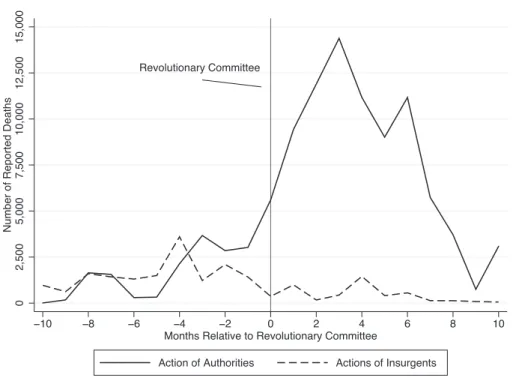
Figure11,however,suggestssomethingverydifferent.Ittracesthenumberof reporteddeathsassociatedwiththeactionsdisplayedinFigure10,andshowsthat repressionbyauthoritiesgeneratedcasualtiesthatfaroutweighedbyseveralordersof magnitudethenumbersgeneratedbytheinsurgencyitwasostensiblymeanttosup- press.Thenumberofdeathsduetoinsurgentactivitiesreachedapeakfourmonths beforetheformationofaRevolutionaryCommitteeanddroppedsteadilythereafter.
Casualtiesduetotheactionsofauthoritiesmatchedtheearlierpeakleveloftheinsur- gencytwomonthspriortotheformationoftheRevolutionaryCommitteeandremained highuntilthatdate,whichwouldsuggesttheapplicationofforcedeemednecessary topermittheCommitteeʼsformation.Surprisingly,however,thenumberofdeaths generatedbytheauthoritiescontinuedtorisetolevelsthatfarexceededanything observedsincethebeginningoftheCulturalRevolution.FourmonthsintoRevolution- aryCommitteesʼreignthenumberofdeathsstillexceededthepreviousmonthlypeak duetotheinsurgencybymorethan5-fold,andlevelsremainedextremelyhighuntil graduallysubsidingafter8months.Thelevelofviolentrepressionfarexceededanything thatcouldreasonablybeinterpretedasnecessarytodemobilizeaninsurgency,andit continuedtoescalatelongafterinsurgentactivitywaseffectivelybroughtundercontrol.
References
Baum,Richard.1971.“TheCulturalRevolutioninthecountryside:anatomyofalimited rebellion.”Pp.367-476inThomasW.Robinson,ed.,The Cultural Revolution in China.Berkeley:UniversityofCaliforniaCenterforChineseStudies.
BuWeihua.2008.Zhonghuarenmingongheguoshi:Di6juan.“Zelanjiushijie”:
Wenhuadagemingdedongluanyuhaojie,1966-1968[HistoryofthePeopleʼs RepublicofChina,vol.6,“Smashingtheoldworld”:Thecatastrophicturmoilofthe CulturalRevolution,1966-1968].HongKong:Zhongwendaxuechubanshe.
DongGuoqiangandAndrewG.Walder.2010.“NanjingʼsFailedʻJanuaryRevolutionʼ of1967:TheInnerPoliticsofaProvincialPowerSeizure.”China Quarterly203:675- 692.
__.2011.“LocalPoliticsintheChineseCulturalRevolution:NanjingunderMilitary Control.”Journal of Asian Studies70:425-447.
__.2012.“FromTrucetoDictatorship:CreatingaRevolutionaryCommitteein Jiangsu.”China Journal68:1-31.
Forster,Keith.1990.Rebellion and Factionalism in a Chinese Province: Zhejiang, 1966- 1976.Armonk,N.Y.:M.E.Sharpe.
Lee,HongYung.1978.The Politics of the Chinese Cultural Revolution: A Case Study.
Berkeley:UniversityofCaliforniaPress.
MacFarquhar,RoderickandMichaelSchoenhals.2006.Maoʼs Last Revolution.
Cambridge,Mass.:BelknapPressofHarvardUniversityPress.
Perry,ElizabethJ.,andLiXun.1997.Proletarian Power: Shanghai in the Cultural Revolution.Boulder:WestviewPress.
Rosen,Stanley.1982.Red Guard Factionalism and the Cultural Revolution in Guangzhou (Canton).Boulder:WestviewPress.
Rowe,WilliamT.2007.Crimson Rain: Seven Centuries of Violence in a Chinese County.
Stanford,Calif.:StanfordUniversityPress.
Su,Yang.2006.“MassKillingsintheCulturalRevolution:AStudyofThreeProvinces.”
Pp.96-123.InEsherick,JosephW.,PaulG.Pickowicz,andAndrewG.Walder,eds.
2006.The Chinese Cultural Revolution as History.Stanford,CA:StanfordUniversity Press.
__.2011.Collective Killings in Rural China during the Cultural Revolution.New York:CambridgeUniversityPress.
Tong,JamesW.1991.Disorder under Heaven: Collective Violence in the Ming Dynasty.
Stanford,Calif.:StanfordUniversityPress.
Walder,AndrewG.1978.Chang Chʼun-chʼiao and Shanghaiʼs January Revolution.Ann Arbor:CenterofChineseStudies,UniversityofMichigan.
__.2009.Fractured Rebellion: The Beijing Red Guard Movement.Cambridge,MA:
HarvardUniversityPress.
__.2014.“RebellionandRepressioninChina,1966-1971.”Social Science History38 (3-4):513-539.
__.“RebellionoftheCadres:The1967ImplosionoftheChineseParty-State.”2016.
China Journal75:102-120.
Walder,AndrewG.,andYangSu.2003.“TheCulturalRevolutionintheCountryside:
Scope,TimingandHumanImpact.”China Quarterly173:74-99.
Wang,Shaoguang.1995.Failure of Charisma: The Cultural Revolution in Wuhan.Hong Kong:OxfordUniversityPress.
20
21 Figure 2.1 The Spread of Student Red Guard Activity, Late 1966
020406080100Percent of Jurisdiction with Red Guard Activity
June July August September October November December
Cities Counties
Figure 1. The Spread of Student Red Guard Activity, Late 1966
Figure 2.2. The Spread of Rebel Insurgencies, Late 1966-Early 1967
020406080100Percent of Jurisdictions with Rebel Activity
July 1966 August September October November DecemberJanuary 1967 February
Cities Counties
Figure 2. The Spread of Rebel Insurgencies, Late 1966-Early 1967
21
23 Figure 2.3 Seizures of Government Officials, Late 1966-Early 1967
020406080100Seizures of Officials, Percent of Jurisdictions
June 1966 July August September October NovemberDecemberJanuary 67 February
Cities Counties
Figure 3. Seizures of Government Officials, Late 1966-Early 1967
Figure 2.4. Rebel Power Seizures over Local Governments, Early 1967
020406080100Percent of jurisdictions reporting power seizures
January February March April May June
December 1966
Cities Counties
Figure 4. Rebel Power Seizures over Local Governments, Early 1967
22
25 Figure 2.5. The Spread of Military Intervention, 1967
020406080100Percent of Jurisdictions with Military "Support"
Jan Feb Mar Apr May Jun Jul Aug Sep Oct Nov Dec Cities Counties
Figure 5. The Spread of Military Intervention, 1967
Figure 2.6. The Creation of Military Control Committees, 1967-1968
020406080100Percent of Jurisdictions with Military Control Committees
Jan 1967 March May July September November Jan 1968 March Cities Counties
Figure 6. The Creation of Military Control Committees, 1967-1968
23 27 Figure 2.7. Insurgent Conflicts, Relative to Local Power Seizures
&!"($!
#!'#!%#
$!"$!#%#"
ï ï ï
#"#%#&!($!
Figure 7. Insurgent Conflicts, Relative to Local Power Seizures
Figure 2.8. Deaths due to Insurgent Conflicts, Relative to Local Power Seizures
#%! $ "
!
ï ï ï ï
" #%!
Figure 8. Deaths due to Insurgent Conflicts, Relative to Local Power Seizures
24
29 Figure 2.9. Establishment of Local Revolutionary Committees
020406080100Percent of Jurisdictions with Revolutionary Committees
Feb 1967 June October Feb 1968 June October Feb 1969 June Cities Counties
Figure 9. Establishment of Local Revolutionary Committees
Figure 2.10. Insurgent Activity Relative to Repression by Authorities
! "
!
ï ï ï ï ï ï ï
!! "
Figure 10. Insurgent Activity Relative to Repression by Authorities
Figure 2.11. Deaths due to Insurgent Actions versus the Actions of Authorities
$#" %""
# ""!
ï ï ï ï ï
"!"$"$#" %""
"#" "! "!!# "!
Figure 11. Deaths due to Insurgent Actions versus the Actions of Authorities