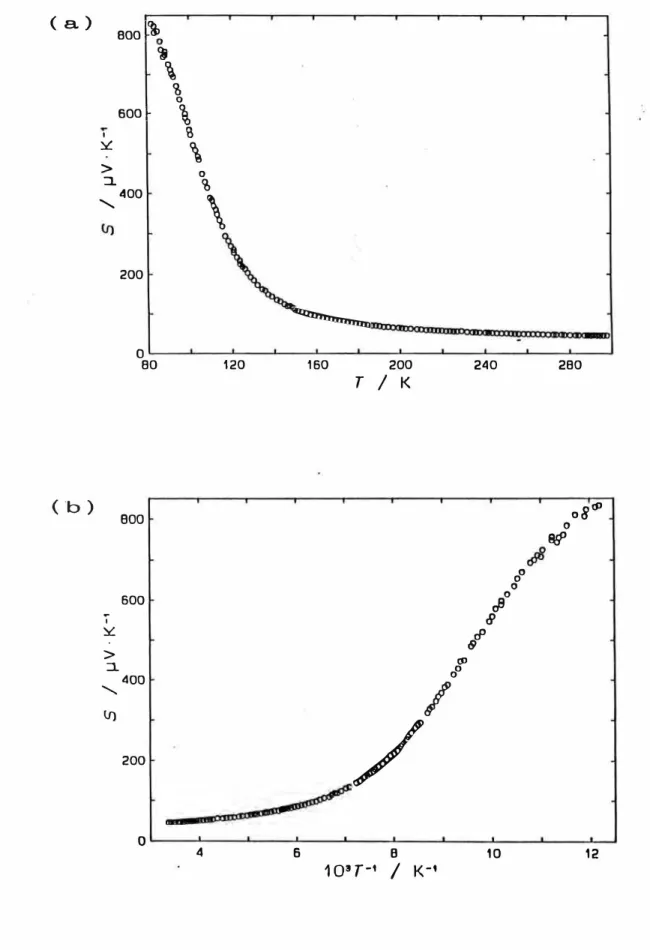
(
修士学位論文
題 名 介o叫c怜;叫proper ti'e..s 叶 p ャ\ ET o.n凶PIME丁叶叫 Sv\\ f-5 (PMfT尖比な·01METラシ乃汎/瑶z..V}
咤氣的ヽ l生)
指導教授 只む珀 希
I"' h 教 授
U4 年 /月 /0 日提出
理学研究科]ぃ犀こ専攻
氏名/囮炉フ¢、 口/J /ロ ー
論文要旨
「DMETおよびDIMETラジカル塩の電気物性」
9083446 吉野 治
一5つのグル
ープに分類された DMET塩のうち, 各グル
ープの代表的な塩について熱 電能を測定した
.グル
ープ1のPFr;, AsFr; 塩については半導体的挙動が観測された.
これは以前の抵抗測定の結果と
一致する. グル
ープ2の B応 塩については2種類のド ナ
ー・ スタックに沿った方向について熱電能を測定した. 金属
ー絶縁体転移(M- I転 移)が約35 Kに観測され, 抵抗測定の結果と
一致した. 熱電能測定の結果, バンド 幅が a軸に沿った方向の方がb軸に沿った方向よりも大きいということがわかった.
また, SDW状態にある半導体領域で, 熱電能の複雑な挙動が観測された. これは新た に行った抵抗率の測定からも確認され, SDW状態の中でさらにバンド構造が複雑に変 化することを示唆するものである
.グル
ープ3の塩では Au(CN)2 塩の熱電能を測定し た
.約180 Kでの相転移, 約28 Kでの M-I転移に対応した熱電能の変化が観測さ れた. 熱電能は 28 K以下で急激な減少を示し, 約20 Kで極小値をとって増大に転 じる. 半導体領域のこの温度付近で抵抗の増大の仕方も変化することがわかっており,
何らかのバンド構造の変化が起こっているものと思われる. グル
ープ4では I 3 と S CN塩の熱電能を測定し, 低温まで金属的な挙動が観測された. この結果は抵抗測定 の結果と
一致した. 熱電能から得られたh塩と S CNのバンド幅はグル
ープ3の
Au(CN)2 塩に比べて減少しており, グル
ープ4の次元性がグル
ープ3に比べて相対的 に高まっていることが実験的に確認できた. この結果を用いて, 低次元有機伝導体に おける超伝導の発現と次元性の関係について考察した
.グル
ープ5の Au Br2 塩は擬二 次元的な物性を持つので試料結晶 の2種類の方向について熱電能の測定を行った. そ の結果, 絶対値は方向に依存するが, 変化の仕方が似た挙動が両方向について観測さ れた.
DMETの誘導体である DIMETの, 新 し く合成されたラジカル塩について抵抗率と熱 電能の測定を行いこれらの塩の性質を特定した. これまでにほとんど報告のない直線 型アニオンの塩を多く調べたが, DIMET塩としてはまれな金属的な塩がいつくか見つ かった. その中でI 3 塩はグル
ープ3, 4の DMET塩と類似の結晶構造を持ち,
DIMETの IBい およびCu(NCS)2 塩と同様の特徴的な熱電能の挙動を示した. これら
はいずれも約40 Kで M-I転移を起こすことがわかった . 低温の半導体領域では熱電
能の符号は負となり, 約30 Kで極小値をとるといった (DMET)2 Au(CN)2によく似た挙
動が観測された. この挙動について考察を試みた . また, これらのDIMET塩は高温側
の金属的領域でも熱電能の特徴的な変化を示すことがわかった . この変化は次元性の
変化に関連すると推測されたことから, さらに抵抗率の異方性の測定を行い, それに
ついて調べた. 他の DIMET塩は B凡 塩が金属的だったのを除くと半導体的な挙動が
確認された. Au Cl2 およびAul2 塩は h塩と類似の構造をとっているにもかかわら
ず, 電気的な性質が13塩と大きく異なっていることがわかったので, これらの塩に
ついて次元性と金属的性質の発現について考察を行った.
Contents
Abstract ー
Chapter 1. Introduction
References to Chapter 1 28 ー
Chapter 2. Experimental
2.1 Measurement of resistivity 2.1.1 Purpose
2.1.2 Principles
2.1.2.1 Four-probe method 2.1.2.2 Montgomery method
2.1.2 3 Metals and semiconductors 2.1.2.4 Resistance jump
2.1.3 Instruments and methods
22 22 22 23 23 25 27 29 29 2 .1. 3 .1 Four-probe method at ambient pressure. . . . 29
2.1.3.2 Montgomery method . . 31
2.1.3.3 Temperature . . 32
2. 1. 3. 4 Four-probe method under pressure . . . 33 2.2 Measurement of thermopower
2.2.1 Principle
2.2.2 Instruments and methods References to Chapter 2
Chapter 3. Reaults.
3.1 Thermopower of DMET salts 3. 1. 1 (DMET) 2 PF 6 (Group 1) 3 .1. 2 (DMET) 2 AsF 6 (Group 1) 3 .1. 3 (DMET) 2 BF 4 (Group 2) 3 .1. 4 (DMET) 2 Re0 4
3.1.5 (DMET) 2 Au(CN) 2 (Group 3) 3 .1. 6 (DMET) 2 1 3 (Group 4)
3.1.7 (DMET) 2 SCN (Group 4) 3.1.8 (DMET) 2 AuBr 2 (Group 5)
35 35 37 42
43
43
43
46
48
55
59
63
63
67
3.2.1 (D IMET) 2 I 3 3.2.2 (DIMET) 2 IBr 2 3.2.3 (DIMET)xCu(NCS) 2 3.2.4 (DIMET) 2 BF 4
3.2.5 (DIMET) 2 AuC1 2 3.2.6 (DIMET) 2 Aul 2 3.2.7 (DIMET) xBr 3
3.2.8 (DI MET)�g (CN) 2
3.3 Thermopower of DIMET salts 3.3.1 (DIMET) 2 1 3
3.3.2 (DIMET) 2 IBr 2
3.3.3 (DI MET) xCu (NCS) 2 3.3.4 (DIMET) 2BF4
3.3.5 (DIMET) 2 AuC1 2 3.3.6 (DIMET) 2 Aul 2 References to Chapter 3
Chapter 4. n· lSUCUSSlOil
4.1 Dimensionality and superconductivity 4.2 Dimensionality and metallic character.
4.3 The anomaly in the resistivity and the thermopower of (DMET) 2 Au (CN) 2 , (DIMET) 2 1 3 ,
(DI MET) 2 1Br 2 and (DIMET) xCu (NCS) 2 ・
71 79 83 85 88 91 93 93 95 95 .101 .105 .109 .113 .116 .118
.120 .120 .125 .129
References to Chapter 4 . . . .132
Chapter 5. Summary . . . . 133
Abstract
Thermopower of some DMET radical salts (DMET = dimethyl(ethylenedithio)tetrathiafluvalene, the first unsymmetrical donor which gives organic superconductors) was measured and some band parameters, i.e. band-gap, bandwidth, were determined.
Resistivity, thermopower and anisotropy of DIMET salts (DIMET
= dimethyl(ethylenedithio)tetrathiafluvalene, a sulfur analog of DMET) were also measured. The characterization of these salts was carried out and the band parameters were determined.
The relation between the superconductivity and/or the appearance of the metallic character and the dimensionality in organic conductors was discussed on the basis of the measurement. Some interesting phenomenon in the resistivity and the thermopower were observed and discussed comparing the behaviors of radical salts.
ー
Chapter 1. Introduction
The search for organic superconductors was accelerated by the successful synthesis of TTF-TCNQ in 1973 and various organic donor/acceptor molecules that give conducting charge transfer (CT) salts have been synthesized .1> Structural formulas of TTF and TCNQ molecules are shown in Fig. 1.l(a) and (b), respectively. (TTF = tetrathiaf luvalene, a donor, TCNQ = tetracyanoquinodimethane, an acceptor) Electrical properties of TTF-TCNQ are metallic from room temperature (RT) down to 60 K. The possibility of superconductivity in organic material was arisen from the wide range metallic behavior that has never been seen in organic materials before that. Since TTF-TCNQ itself undergoes a metal-insulator (M-I) transition at about 60 K, superconductivity is not observed in the material in fact.
TTF-TCNQ has both the stack of TTF molecules and the stack of TCNQ ones. 2, 3 > Neighboring molecules in each stack faces their molecular planes each other, i.e. n ー orbitals of the molecules overlaps each other. Since both overlap in the TTF stack and the TCNQ stack are well to form bands to contribute for electrical conduction, the material shows metallic behavior. The bands formed in this manner is quasi one-dimensional (1D), because the face-to-face interaction of molecular orbitals is much stronger than the side-by-side interaction. The quasi one-dimensionality in TTF-TCNQ is a cause of the M-I transition. It is well known as the Peierls instability that , a 1D system is unstable against the perturbation of the wave number of 2k F , where k F is the Fermi wave number. 4> If a kind of 2k F
―perturbation exists in a 1D metallic material, the band-gap opens at the wave number k=士k F and the material becomes a semiconductor (or an insulator when the gap is large), i.e. a M-I transition occurs. In the case of TTF-TCNQ the perturbation is a charge
density-wave (CDW) that is a kind of wave of charge density coupled to the modulation of the crystal lattice along the stacking direction and the transition is called as "Peierls transition". On cooling down to about 60 K and the Peierls transition occurs in TTF-TCNQ.
Al though the superconductivity was not observed in TTF-TCNQ,
c:>==<:J
Ca) TTF
:x:>= こ三(:
(c) TMTSF
c:x:>=<:x 〗
Ce) BEDT-TTF
:x:>=<:x 〗
Cb) TCNQ NC
ロ
Me Me
Me Me
Cd) TMTTF
:xxx 〗
Cf) DMET
s \|ノ
s
(g) DIMET (h) DMET-TSF
Fig. 1.1. Structural formulas of (a) TTF, (b) TCNQ, (c) TMTSF, (d)
TMTTF, (e) BEDT-TTF, (f) DMET, (g) D !MET and (h) DMET-TSF.
synthesis of chemical derivatives of TTF has been performed to get organic superconductors with great enthusiasm. As a result, it was found that five kinds of TTF-derivatives give more than thirty kinds of superconducting salts with inorganic anions up to now. 4 > Many of these superconductors and conducting (not superconducting) salts of the five and other chemical derivatives of TTF have the composition of two donors and one monovalent inorganic anion. The conduction band of such a 2: 1 salt is formed by overlapping of the highest occupied molecular orbital (HOMO) of each donor molecule. The HOMO of a TTF-derivative molecule accepts two electrons. Because one electron is taken from a pair of donors, when the 2: 1 salt is composed, three of the four electrons from their HOMO's remain in the conduction band, namely the conduction band is 3/4-filled. The Fermi energy can be known if the band structure is established.
TMTSF (TMTSF = tetramethyl(tetraselena)fluvalene, see Fig.
1.l(c)) was synthesized at first of the five ki�ds of sources of the organic superconductors. The first observation of superconductivity in organic materials was reported for (TMTSF) 2 PF 6 at 0.9 K under 12 kbar in 1980. 5> After this discovery, many TMTSF salts of the series of (TMTSF) 2 X (X=AsF 6 , Cl0 4 , FS0 3 etc. called "Bechgaard salts") including more six superconductors, have been reported and various investigation have been performed. Among them the material that possesses the highest superconducting transition temperature (T 0 ) is (TMTSF) 2 TaF 6 (1. 4 K under 12 kbar) 6 >.
Besides superconductivity, one of the most interesting
characters of the Bechgaard salts is a quasi-1D character with very
high conductivity (400 - 800 S/cm at room-temperature) along one
direction.7> The quasi-1D high conductivity of (TMTSF) 2 X is due to
the columnar packing of donor molecules in the crystal as shown in
Fig. 1.2.8> Owing to this face-to-face stacking of donor molecules
along the direction nearly normal to the molecular plane, their n ―
orbitals well overlap to each other and construct a band that
contributes to the electrical conduction. There are shorter contacts
between neighboring donor molecules than the sum of the van der Waals
radii of two Se atoms. Such short contacts between chalcogen atoms
沃
ーー謳―皿ー
沃
"し
a ,
ー
Fig. 1.2. Crystal structure of (TMTSF) 2 PF 6 . Side view of stacks; a'
is the projection of a.
play an important role in the properties of organic conductors.
However, the overlapping of molecular orbitals (MO) along parallel directions to the molecular plane is much less than the former, though some side-by-side short contacts of Se atoms are observed along almost parallel to the b-axis. As a result, the conductivity ratio at RT is oa:o b :oc = 100:1:10- 4 (each subscript means a direction along each crystallographic axis). 9-11)
There are observed other interesting phenomena at low temperature in some Bechgaard salts with PF 6, AsF 6 and so on. One of them is SDW (spin-density-wave) state of the lD system. 1 2 -15> SDW is a wave of spin density of electrons in a conduction band. If SDW appears, spin density is modulated in the space. In contrast to TTF
TCNQ, the gap-opening in some (TMTSF) 2 X is caused by the perturbation due to SDW and the M-1 transition is called the SDW transition. In fact the superconductivity of Bechgaard salts is observed under pressure except Cl0 4 salts and SDW transition occurs at ambient pressure in PF 6, AsF 6 salts and so on. Under some pressure, however, dimensionality of these salts changes from quasi-lD to slightly quasi-2D character because the increase in the side-by-side interaction of MO is 1 arger than that of face-to-face. 5> As a result, the lD instability is suppressed and M-1 transition disappears.
The brief introduction of salts of TMTTF, the sulfur analog of the former, is necessary for the later discussion. (TMTTF = tetramethyltetraselenafluvalene, see Fig. 1.l(d)) Though the shape of molecular and crystal structures of its salts are similar to those of TMTSF, properties of the two series of salts are very different from each other. Most of TMTTF salts reported are slightly metallic or semiconducting, and no superconductor is found among them.17-19>
This is possibly attributed to the decrease in intracolumn
interactions in TMTTF salts as compared to TMTSF ones. Because the
van der Waals radius of S is smaller than that of Se, the overlap
integral between donor molecules in a donor stacking becomes shorter
in TMTTF salts. In other words their band widths must also be
smaller. At the point of searching for superconductors, the TMTTF
series was in failure. However, TMTTF is important for a deeper
understanding of physical properties of organic conductors, since TMTTF salts produced the information about influence of changing donors from TMTSF to TMTTF.
A series of superconducting TMTSF salts is, so to speak, the first generation of organic superconductors. Although many interesting phenomena other than those mentioned above have been observed and investigated, a desire to get high-T 0 superconductors was not satisfied by TMTSF salts. Higher-T c organic materials h a v e b e e n s y n t h e s i z e d w i t h B E D T - T T F (bis(ethylenedithio)tetrathiafluvalene, alternatively abbreviated as ET, see Fig. 1.l(e)). The first observation of superconductivity among them was performed with (BEDT-TTF) 2 Re0 4 , one of the various structures of Re0 4 salts of BEDT-TTF, whose T c is 2 K under a pressure of 7 kbar. 20> After this discovery, about 20 salts of superconducting BEDT-TTF salts have been found. Furthermore T c has been increased up to 12.8 K at 0.3 kbar by the recent synthesis of K-(BEDT-TTF) 2 CuN(CN) 2 Cl (K means a certain type of crystal structure to be explained below) . 2 1, 22 >
The important properties of BEDT-TTF salts are the quasi-two
dimensionality of electrical conduction and wide variety in packing of donor molecules, i.e. crystal structure. Al though almost al 1 conducting (TMTSF) 2 X has the same type of structure with 1D donor stacks shown in Fig. 1.2, BEDT-TTF salts have more than eight types of donor packing. One kind of counter anion sometimes gives several structures of crystals. For example, at least four main different structures are known for 1 3 salts, and they are symbolized as "a-",
".[3-"' "0-" and "K-" 2 . 3 - 2 5) As a result physical properties of BEDT- TTF salts spread over the wide range.
The wide variety in crystal structure is attributed to the shape of BEDT-TTF molecule to a certain extent. 2 6> The molecule has two ethylenedithio units on its ends. These units contribute to side
by-side interaction between donor molecules by extending it-electrons over the molecule and contacting its S atoms which have larger van
der-Waals radii than C atom with those of neighbor donor molecules.
Furthermore a BEDT-TTF molecule in radical salts is not planer
because the six-membered ring including ethylenedi thio unit bends for stability. This results in weakening of face-to-face interaction of donors and increase the dimensionality. The conductivities, p-
(BEDT-TTF) 2 らfor instance, measured in the plane of plates of the sample crystal is nearly isotropic and values of them are about 30 8/cm. 27)
The superconducting DMET salts were discovered in 1987 . 2 8> (DMET
= dimethyl(ethylenedithio)tetrathiafluvalene) As shown in Fig.
1.l(f), DMET has a shape that is formed by connecting a half components of TMTSF and BEDT-TTF molecules each other. A purpose of taking DMET to synthesize radical salts was to get superconductors. Because both TMTSF and BEDT-TTF gave superconductors, it could be expected that DMET which probably inherits a part of . their characters would give superconductors.
Another purpose was to get a systematic understanding of TMTSF and BEDT-TTF whose salts had very different properties as mentioned before. If it can be expected that a DMET molecule has intermediate character of TMTSF and BEDT-TTF molecules, DMET salts have intermediate properties of salts of their parent donors. The third purpose was to develop a new type of donors, namely unsymmetrical ones. Before the discovery of DMET superconductors, some investigators claimed that no unsymmetrical donor gives superconductors due to the disorder probably made by the unsymmetricity of the molecule and disturb a periodic potential of the crystal. However this was not the case. The fourth purpose was to discover new physical properties as the result of the unsymmetricity. Most of these purposes are also common to investigating other unsymmetrical donors.
Since DMET salts are one of the objects of this study, their
known physical properties, especially electrical ones, are briefly
summarized. Conducting DMET salts are classified into five groups
on the basis of the temperature dependence of electrical resistance
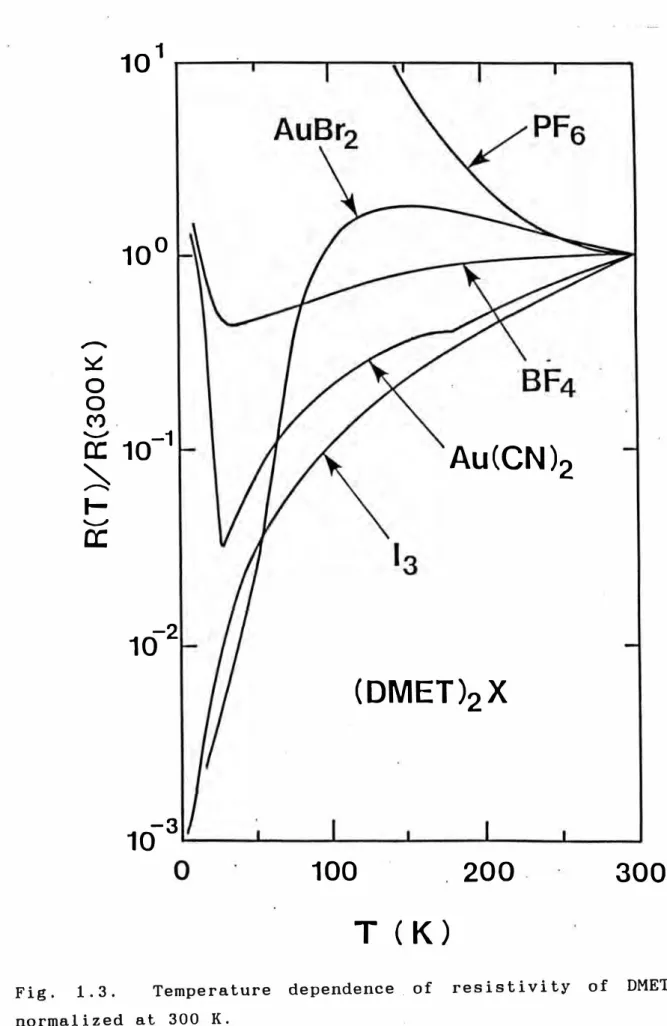
and counter anions. 29-31> The temperature dependence of resistance of
typical DMET salts, at ambient pressure, of each group is shown in
Fig. 1.3.
10 1
10 °
ー 一 ゜ ー
(mooC)a\
(
L)a
10 -2
Au(CN)2
(DMET)2X
10 -3
100
T (K)
200 300
Fig. 1.3. Temperature dependence . of resistivity of DMET salts
normalized at 300 K.
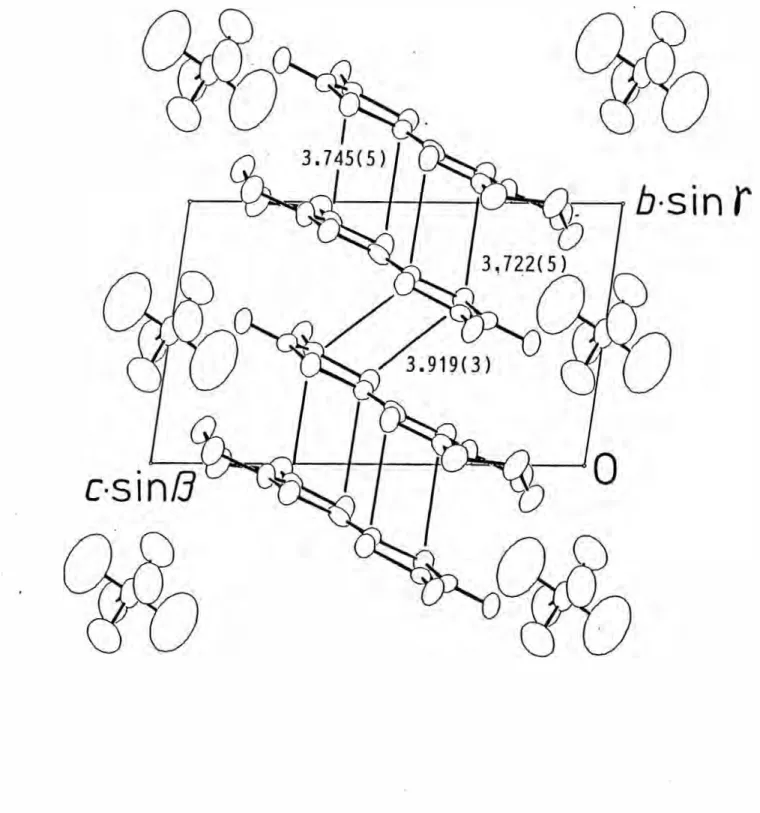
PF 6 , AsF 6 and SbF 6 salts are classified into Group 1. These salts have octahedral counter anions and show semiconducting behavior below RT. Their crystal structure possesses 1D columns of DMET molecule as shown in Fig. 1.4. 32 - 34 > The donor molecules stack turning TMTSF components to opposite directions alternately one by one and the molecular planes tilt from the stacking direction. Though this type of structure is common to DMET and DIMET salts, relatively strong dimerization of donors is characteristic for semiconducting salts like this group.
BF 4 and Cl0 4 salts are classified into Group 2, in short they have tetrahedral anions. 3 0- 34 ) These salts have common features, namely temperature dependence of resistance is metallic down to about 40 K, then becomes semiconducting at a lower temperature.
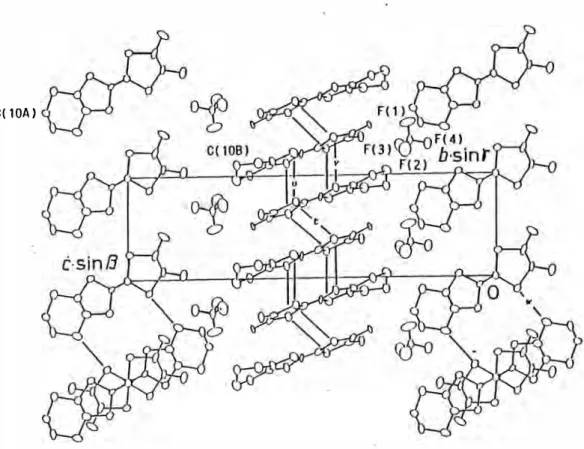
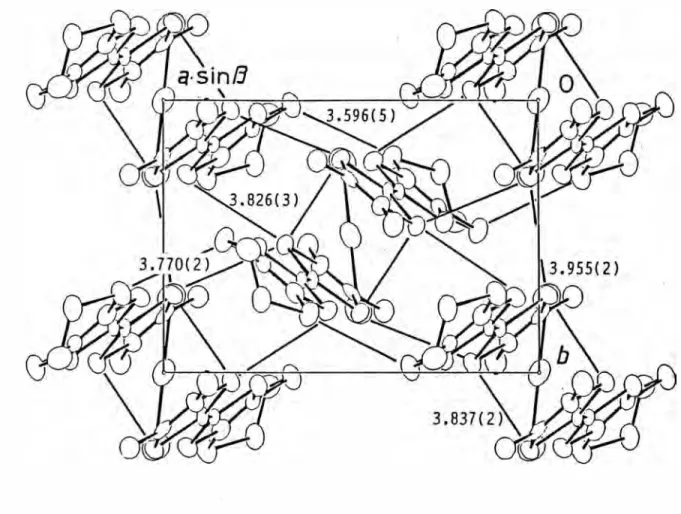
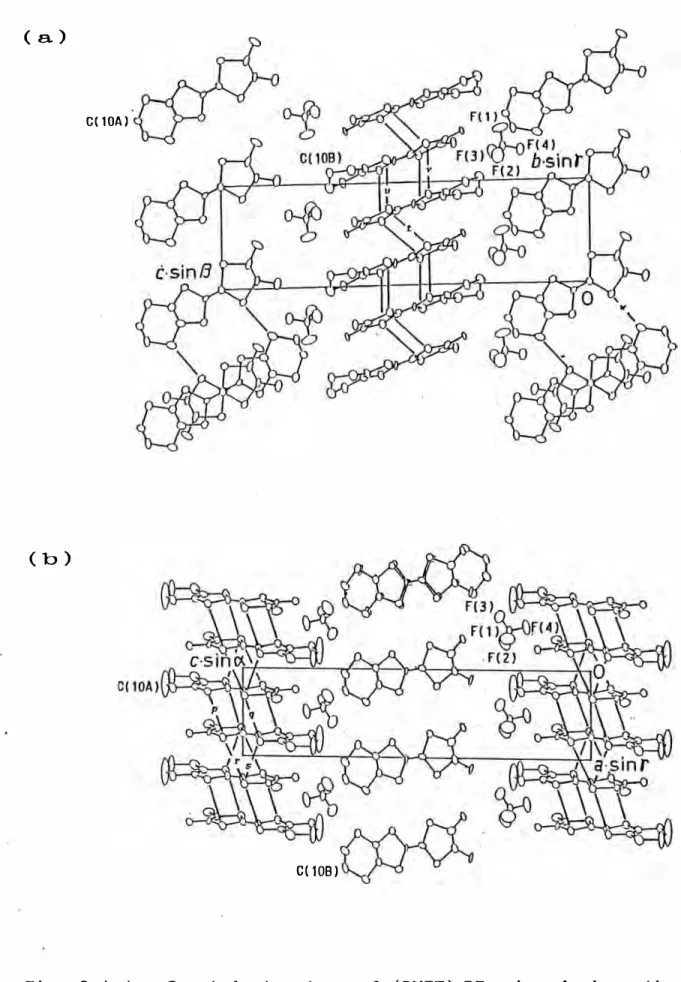
Furthermore each of their crystal has two types of donor stacks, which are almost perpendicular to each other, as shown in Fig.
1.5. 3 5· 36 > This structure is also found in salts with a few kinds of unsymmetrical donors, for example (DIMET) 2 Cl0 4 (DIMET = dimethyl (ethylenedi thio) tetrathiafluvalene, see Fig. 1.1 (g)), 37, 3 8>
( D I M E T) 2 BF 4 39> a n d (D MET-TSF) 2 BF 4 . (DM E T-T SF = dimethyl(ethylenedithio)tetraselenafluvalene, see Fig. 1.l(h)) DIMET and DMET-TSF are derivatives of DMET whose two S atoms of the five
membered rings are substituted by S or Se atoms.
Though Re0 4 salt contains a tet.rahedral anion, the salt has a lD columnar structure and is not classified into any groups. 4 0> In ,addition, a period of this donor stack is four molecules, namely tetrameres are formed. As a result, the Re0 4 salt shows semiconducting behavior below 293 K at ambient pressure, because the period is a cause of gap-opening at k F in 3/4-filled band of 1D material.
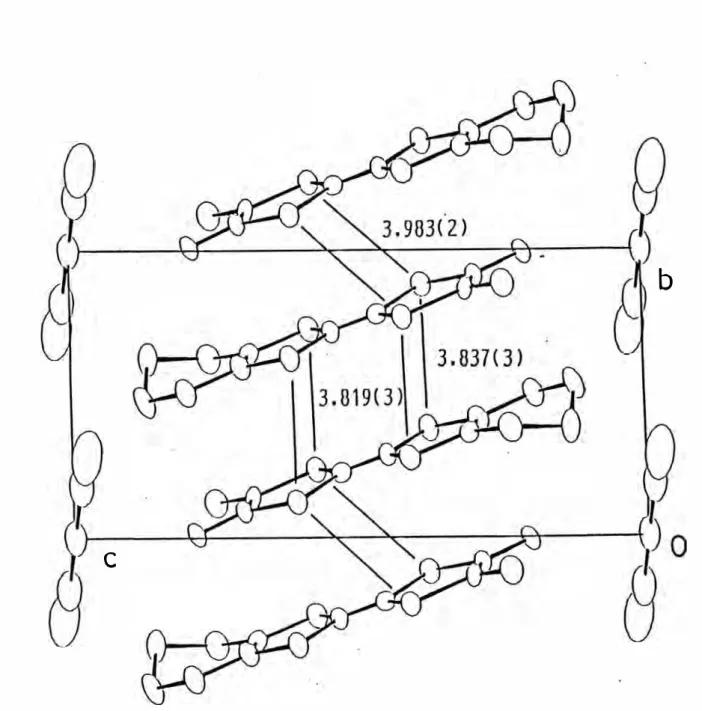
Sal ts in Groups 3 and 4 have 1· 1near anions. 30-34) Group 3 is composed of AuC1 2 , AuI 2 and Au(CN) 2 salts. Their crystal structures are like PF 6 salt mentioned above except the dimerization seen in Group 1, although that of AuC1 2 salt is slightly different from the others. The crystal structure of (DMET) 2 Au(CN) 2 is shown in Fig. 1.6.
The temperature dependence of resistance is metallic down to a low
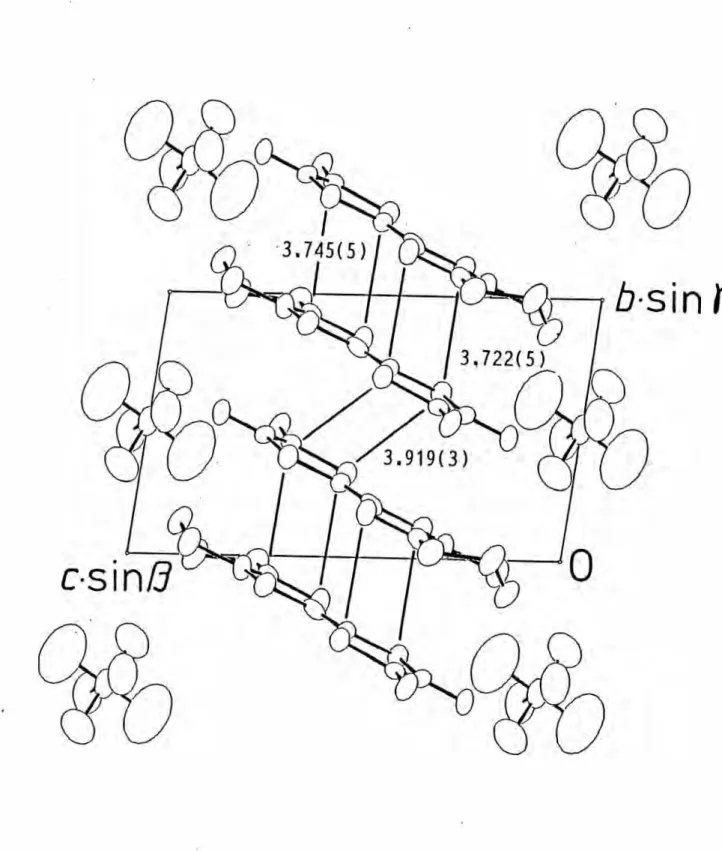
Fig. 1.4. Crystal structure of (DMET) 2 P氏 viewed along the a-axis.
(a)
C(10A)
(b)
C(10A)
C(108)
Fig. 1. 5. Crystal structure of (DMET) 2BF 4 viewed along the b-axis
(a) and viewed along the a-axis (b).
c b
Fig. 1.6. Crystal structure of (DMET) 2 Au(CN) 2 viewed along the a-
axis.
temperature. AuC1 2 salt have a minimum in resistance at about 3 K and the resistance slightly increase down to 1 K, at which a superconducting transition occurs under ambient pressure. The weak increase in resistance suggests the presence of the insulating phase in the phase diagram. Under O kbar Aul 2 and Au(CN) 2 salts undergo a M-I transition at 20 and 28 K, respectively. However they become superconductors at 0.55 K under 5 kbar for the former and 1.1 K under 3.5 kbar for the latter. The common feature of these salts containing Au is the existence of insulating phase. In addition, Au(CN) 2 salt has another phase transition at about 180 K in the metallic regime. This is confirmed by the measurement of heat capacity and detected as an anomaly of the temperature dependence of resistance shown in Fig. 1.3.
I 3 , I 2 Br, IBr 2 , SCN and AuBr 2 salts is classified into Group 4.
They also have linear counter anions and their crystal structures are like that of Group 3. Behavior of resistance with decreasing temperature is metallic down to low temperature and there is no sign of the presence of any insulating phase in the temperature region studied. In Group 4, 1 3 and IBr 2 salts become superconducting at 0.47 and 0.58 K, respectively, at ambient pressure. The other salts of this group have residual resistance at the lowest temperature
(about 0.5 K).
There is another morphology of (DMET) 2 AuBr 2 ・ 3 o- 34 > This is the
only member of Group 5. The crystal structure of this salt is in
,Fig. 1.7 and is like the K-type of BEDT-TTF salts. 2 5• 41 • 42 > Each
component made of paired donor molecules arrayed perpendicular to one
another and constructs 2D donor sheets and neighboring donor sheets
are separated by an anion sheet. This 2D structure.is BEDT-TTF like,
contrary to 1D column structure seen in Groups 1 to 4. This is one
of the evidence that DMET have a intermediate character of TMTSF and
BEDT-TTF. In agreement with its crystal structure, (DMET) 2 AuBr 2 of
Group 5 shows the similar temperature dependence of resistance to the
K-type BEDT-TTF salts. As seen in Fig. 1. 3, at ambient pressure,
resistance of this salt gradually increases with decreasing
temperature from RT to about 150 K like a semiconductor. Then below
Fig. 1.7. Crystal structure of (DMET) 2 AuBr 2 (Z=2) viewed along the
c-ax1s.
about 150 K, resistance turns to decrease and the material becomes a superconductor at 1.9 K. This is the highest T 0 of DMET salts at present.
There are also other investigations of physical properties of the DMET salts. ESR measurement is one of these studies. 43 , 44 > ESR is a effective tool to get microscopic information about·objects, especially it is often used for organic conductors to study SDW, a kind of magnetic ordered state. A knowledge about dimensionality of DMET salts has been brought. An evidence of higher dimensionality of (DMET) 2 I 3 than those of salts in Groups 1 - 3. It was found from temperature dependence of ESR linewidths.
Though many studies were performed, there exist
、few experimental information about band structures of DMET salts, for example a bandwidth, a sign of dominant carrier and so on. If the band structure is revealed, we can discuss about dimensionality of the materials. Furthermore, we will get a guide to synthesize a new material such as superconductors with higher Tc. For these reasons, thermopower of the typical DMET salts of each group, namely PF 6 . AsF 6 (Group 1), BF 4 (Group 2), Au(CN) 2 (Group 3), 1 3 , SCN (Group 4), AuBr 2 (Group 5) and Re0 4 salts, were measured.
The shape of DIMET molecule has already been shown in Fig. 1.1.
Since DI MET is composed of each halves of BEDT-TTF and TMTTF, it contains only S as heteroatoms, though its shape is similar to DMET.
A purpose to investigate DIMET salts is, therefore, to get knowledge about inf 1 uence of changing donor properties for radical salts through the comparison of their properties. Another purpose is to know what happens when BEDT-TTF, a source of superconductors, and TMTTF, giving no superconductors, are combined. There is a possibility to find new organic superconductors or new phenomena in DIMET salts.
The first report of DIMET salts precedes those of DMET salts in fact. DIMET salts of PF 6 , AsF 6 , SbF 6 , Cl0 4 , Re0 4 , Aul 2 , Br, etc.
have been reported since 198 5. 37• 3 5, 4 5- 4 5> Many of them have s imi 1 ar
crystal structures to the corresponding DMET salts. No
superconductor has been found in these DIMET salts and even metallic
salts are few. This is a similar case of TMTSF and TMTTF. However most of counter anions of the salts reported are octahedral or tetrahedral, and only few studies were done on salts with linear.
In the case of DMET salts, superconductors were obtained only using linear anions. For this reason, DIMET salts with linear counter anions must be investigated.
In this study, on DIMET salts of 1 3 , IBr 2 , Br 3 , AuC1 2 , AuI 2 . Ag(CN) 2 , Cu(NCS) 2 (linear), BF 4 (tetrahedral) and PF 6 (octahedral) synthesized at this laboratory, measurement of resistance and thermopower were carried out. Discussion was performed through comparing a DIMET salts with other DIMET and DMET salts and so on.
After this chapter, experimental details are described in the
second chapter. In the third chapter, results of the measurement are
shown in order and properties found in this study are explained for
each salt. The resulting discussion is given in the fourth chapter
and the last chapter concludes this thesis.
References to Chapter 1
1 L. B. Coleman, M. J. Cohen, D. J. Sandman,
F. G. Yamagishi, A. F. Garito and A. J. Reeger, Solid State Commun. 12, 1125(1973).
2 T. E. Phillips, T. J. Kistenmacher, J. P. Ferraris
and D. O. Cowan, J. Chem. Soc. Chem. Commun., 471(1973).
3 T. J. Kistenmacher, T. E. Phillip and D. 0. Cowan, Acta Cryst. B30, 763(1974).
4 See, for example, T. lshigro and K. Yamaji: Organic Superconductors, Springer. Ser. Solid-State. Sci.
Vol.BB(Springer, Berlin, Heidelberg 1990).
5 D. Jerome, A. Mazaud. M. Ribault and K. Bechgaard, J. Physique Lett. 41, L95(1080).
6 S. S. P. Parkin, M. Ribault, D. Jerome and K. Bechgaad, J. Physique, C14, L445(1981).
7 K. Bechgaad, C. S. Jacobsen, K. Mortensen, J. H. Pederson and N. Thorup, Solid State Commun., 33, 1119(1980).
8 N. Thorup, G. Rindorf, H. Soling and K. Bechgaad, Acta Cryst., B37, 1236(1981).
9 C. S. Jacobsen, K. Mortensen, M. Weger and K. Bechgaad, Solid State Commun., 38, 423(1981).
10 K. Murata, H. Anzai, G. Saito, K. Kajimura
and T. lshiguro, J. Phys. Soc. Jpn., 50, 3529(1981).
11 R. L. Greene, P. Haen, S. Z. Huang, E. M. Engler,
M. -Y. Choi and P. M. Chaikin, Mol. Cryst. Liq. Cryst., 79, 183(1982).
12 K. Mortensen, Y. Tomkiewicz and K. Bechgaad, Phys. Rev, 25, 3319(1982).
13 W. M. Walsh Jr., F. Wudl, G. A. Thomas, D. Nalewajek, J. J. Hauser, P. A. Lee and T. Poehler, Phys. Rev. Lett., 45. 829(1980).
14 A. Andrieux, D. Jerome and K. Bechgaad, J. Physique Lett., 42, L87(1982).
15 J. C. Scott, H. J. Pedersen and K. Bechgaad,
Phys. Rev., B24, 475(1981).
16 J. B. Torrance, H. J. Pedersen and K. Bechgaad, Phys. Rev. Lett., 49, 881(1982).
17 B. Liautard, S. Peytaven, G. Brun and M. Maurin, J. Physique, 44, C3-951(1983).
18 K. Mortensen, E. M. Conwell and J.M. Fabre, Phys. Rev., B28, 5856(1983).
19 K. Mortensen and E. M. Engler, Mol. Cryst. Liq. Cryst., 119, 293(1985).
20 S. S. P. Parkin, E. M. Engler, R.R. Schumaker, R. Lagier, V. Y. Lee, J. C. Scott and R. L. Greene, Phys. Rev. Lett., 50, 270(1983).
21 J.M. Williams, A. M. Kini, H. H. Wang, K. D. �arlson, U. Geiser, L. K. Montgomery, G. J. Pyrka, D. M. Watkins, J.M. Kommers, S. J. Boryschuk, A. V. Striby Crouch, W. K. Kwok, J. E. Schilber, D. L. Overmyer, D. Jung and M. -H. Wangbo, Inorg. Chem. 29, 3272(1990).
22 H. H. Wang, K. D. Carlson, U. Geiser, A. M. Kini, A. J. Schultz, J. M. Williams, L. K. Montgomery,
W. K. Kwok, U. Welp, K. G. Vandervoort, S. J. Boryschuk, A. V. Strieby Crouch, J.M. Kommers and D. M. Watkins,
Synth. Metals 42, 1983(1991).
23 I. Hennig, K. Bender, D. Schweitzer, K. Diez, H. Endres, H. J. Keller, A. Gleiz and H. W. Helberg,
Mol. Cryst. Liq. Cryst., 119, 337(1985).
24 H. Kobayashi, R. Kato, A. Kobayashi, Y. Nishino,
K. Kajita and W. Sasaki, Chem. Lett., 1986, 2017(1986).
25 A. Kobayashi, R. Kato, H. Kobayashi, S. Moriyama, Y. Nishino, K. Kajita and W. Sasaki, Chem. Lett., 1987, 459(1987).
26 P. C. W. Leung, T. J. Emge, M.A. Beno, H. H. Wang, J.M. Williams, V. Patrick and P. Coppens,
J. Am. Chem. Soc., 107, 6184(1985).
27 E. B. Yagubskii, I. F. Shchegolev, V. N. Laukhin,
P.A. Kononovich, M. V. Karsovnic, A. V. Zvarykina
and L. I. Bubarov, JETP Lett., 39, 12(1984).
28 K. Kikuchi, M. Kikuchi, T. Namiki, K. Saito, I. Ikemoto, K. Murata, T. Ishigro and K. Kobayashi, Chem. Lett., 931(1987).
29 K. Murata, K. Kikuchi, T. Takahashi, K. Kobayashi, Y. Honda, K. Saito, K. Kanoda, T. Tokiwa, H. Anzai, T. Ishiguro and I. Ikemoto, J. Mol. Electron., 4, 173(1988).
30 K. Kikuchi, K. Saito, I. Ikemoto, K. Murata, T. Ishiguro and K. Kobayashi, Synth. Metals, 27, B269(1988).
31 K. Kikuchi, Y. Ishikawa, K. Saito, I. Ikemoto, and K. Kobayashi, Synth. Metals, 27, B391(1988 _ ).
32 I. Ikemoto, K. Kikuchi, K. Saito, K. Kanoda, T. Takahashi, K. Murata, K. Kobayashi, Mol. Cryst. Liq. Cryst.,
181, 185(1990).
33 K. Kikuchi, I. Ikemoto and K. Kobayashi, Synth. Metals., 19, 551(1987).
34 Y. Ishikawa, M. Sc. Thesis, Department of Chemistry, Faculty of Sc., Tokyo Metropolitan University(1989).
35 Y. Ishikawa, K. Saito, K. Kikuchi, K. Kobayashi
and I. Ikemoto, Bull. Chem. Soc. Jpn., 64, 212(1991).
36 T. G. Takhirov, 0. N. Karasochka, 0. A. D'Yachenko, L. 0. Atovmyan, M. L. Petrov, I. K. Pubtsova
and R. N. Lyubovskaya, Zh. Atrukt. Khim. 30, 114(1989).
37 M. Z. Aldoshina, L. 0. Atovmyan, L. M. Goldenberg, O. N. Krasochka, R. N. Lubovskaya, R. B. Lubovskii, V. A. Marzhanov and M. L. Khidekel,
J. Chem. Soc., Chem., Commun., 1658(1985).
38 H. Endres, R. Heid, H. J. Keller, I. Heinen and D. Schweitzer, Acta Cryst., C43, 115(1987).
39 H. Itoh, B. Sc. Thesis, Department of Chemistry,
Faculty of Sc. , Tokyo Metropolitan University (1991) . 40 K. Saito, Y. Ishikawa, M. Ishibashi, K. Kikuchi,
K. Kobayashi and I. Ikemoto, Bull. Chem. Soc. Jpn., 63,
1865(1990).
41 H. Urayama, H. Yamochi, G. Saito, S. Saito, A. Kawamoto, J. Tanaka, T. Mori, Y. Maruyama, H. Inokuchi, Chem. Lett., 436(1988).
42 G. Saito, H. Urayama, H. Yamochi, K. Oshima, Synth. Metals, 27, A331(1988).
43 K. Kanoda, T. Takahashi, K. Kikuchi, K. Saito, I. Ikemoto and K. Kobayashi, Synth. Metals, 27, B385(1988).
44 K. Kanoda, T. Takahashi, T. Tokiwa, K. Kikuchi, K. Saito, I. Ikemoto and K. Kobayashi, Phys. Rev., B38, 39(1988).
45 R. Laversanne, E. Dupart and P. Delhaes, Mol. Cryst. Liq.
Cryst., 137, 179(1986).
46 R. Laversanne, C. Coulon, J. Amiell, E. Dupart, P. Delhaes, J. P. Morand and C. Manigand,
Solid State Commun., 58, 765(1986).
47 B. Gallois, J. Gaulitier, F. Bechtel, D. Chasseau, C. Hauw and L. Duchasse, Synth. Metals, 19, 419(1987).
48 K. Bender, H. Endres, S. Gartner, E. Gogu, R. Heid,
I. Heinen, H. J. Keller, A. Kraatz and D. Schweitzer,
Synth. Metals, 19, 559(1987).
Chapter 2. Experimental
2.1 Measurement of resistivity
2.1.1 Purpose
One of the most basic measurements for studying organic conductors is measurements of resistivity. When one wants to know whether a material conducts electricity wel 1 or not, he should measure the resistivity. If the resistivity of the material decreases with decreasing temperature, it is apparently "metallic".
If the resistivity, on the contrary, increases with decreasing
it •
II IItemperature, 1s semiconducting . The magnitude of the resistivity itself is important information about the material.
However, the temperature dependence of the resistivity is another point, i.e. there exist a metallic material and a semiconducting one both of which have a comparable magnitude of the resistivity. The temperature dependence of resistance is therefore usually studied.
After one found a new metallic material, the measurement down to lower temperatures is usually made to know whether the superconducting transition occurs or not. One of the characteristics of superconductivity is the zero-resistivity. If the abrupt decrease in resistivity is observed at a low temperature and the resistivity becomes less than the lower limit of the measurement, it is possibly the superconductivity, although other experiments, the Meissner effect for instance, must be made for the confirmation.
An anomaly in resistivity is also observed at other transitions.
An M-I transition is general in studying low dimensional conductors.
When the transition occurs, the temperature dependence changes from metal 1 ic to semiconducting behavior. (Note that an insulator is a kind of semiconductor.) Measurements of the temperature dependence of the resistivity is useful to get the information about such a transition or a change in the electronic state of a material.
The resistivity as a function of pressure is also interesting.
The superconductivity in some organic materials is observed only
under some pressure. The measurement of resist1v1 ty at a low . .
temperature under pressure is important to find a new superconductor, although there are some difficulties.
All described above is the first purpose, namely to know a behavior of a material. There is al so another use in measuring resistivity. That is to estimate the anisotropy (or dimensionality) of the electrical property. The di mens i anal i ty of the sys tern sometimes determines the behavior of low-dimensional (quasi-1D or 2D) materials. Measurement of reflectance spectra is often performed to get information about band parameters such as the effective mass of the carrier, the band width of a metal, the band gap of a semiconductor and so on. From the reflectance spectra using polarized light, one can also elucidate the anisotropic nature of the crystal. Although the optical technique including the measurement of the reflectance spectra is almost conclusive method to get information about the band structure, the optical technique is rather exaggerated for only knowing the temperature dependence of the resistivity and its anisotropy. One had better use the electrical and the optical method properly. To estimate the. anisotropy is only one example of the information from measurements of resistivity and there are also others. However more detailed explanation about the principle, the instrument, the methods of some kind of measurements and the analyses are described in later subsections.
2.1.2 Principles
2.1.2.1 Four-probe method
If two kinds of materials are contacted and the electrical current runs through the connection, the contact resistance usually arises there. It is a obstacle to measure the intrinsic resistance of the sample. The four-probe (or four-wire) method is often used to overcome the difficulty.
In the four-probe method, four wires are connected on the
sample, e.g. a cylinder as shown in Fig. 2.1. The electrical current
I runs through the wire 1, the sample and the wire 2. The voltage
V between the wires 3 and 4 is measured with a voltmeter. It is
worth noting that the current does not run through the connection of
l 3 4 2
> ー
Fig. 2.1. Resistivity measurement with the four-probe method.
l 2
l1
3 4
Fig. 2.2. Resistivity measurement with the Montgomery method.
the sample and the wire 3 or 4. Namely the contact resistance does not arise there. From the Ohm's low, V=RI, the resistance R of a material is the ratio of the voltage V versus the electrical current I. Also the resistance R is proportional to the length 1 between the wires 3 and 4 and to the inverse of the cross section of the sample S. Namely Eq. (2.1) holds in general.
R
=Pl/ S (2. 1)
Since the resistivity p is the coefficient of them, it can be calculated after Eq.(2.1), if one knows V, I, 1 and S.
2. 1. 2. 2 Montgomery method 1 • 2 >
The Montgomery method was developed by Montgomery et al . 1 , 2 >
The method is useful to measure the resistivity along two directions perpendicular to each other at the same time. Four wires are contacted on four corners of the plate-like sample one by one as shown in Fig. 2. 2. To obtain the measurements of the resistivity along the two directions, the shorter and the longer distances between the corner probes along edges of the sample crystal, 1 1 and 1 2 , and the thickness of the sample 1 3 must be measured previously.
At first the current I 1 is supplied between the terminals 1 and 2, then the voltage V 1 between the terminals 3 and 4 is measured. After that the current J 2 is through between the terminals 1 and 3, then .the voltage V 2 between the terminals 2 and 4 is measured. Now R 1 and
島 are defined as Eqs.(2.2).
R 1
=巧/I l ' R戸均/I 2 ・
(2.2(a)) (2.2(b}}
The quantities used for the determination of the resistivity along the short edges P 1 and along the long edges 伍 of the plate are 1 1 ,
1 2 ' 1 3 ' R and R 2
・Several equations to calculate p 1 and臼has been derived in the
Refs. 1 and 2. For an "isotropic" material with the four probes as
same as Fig. 2. 2., the resistivity Pis calculated from the shorter and the longer distances between the two probes along the edges of the isotropic material a and b, the thickness of the material c and R 1 using Eqs. (2.3) to (2.5).
P= (n / 4) [ c I (cM)。] (V 1 / I 1 ) , (2. 3)
(cM) 。 =2�ln[ (l+q n=O 2n+l )/(1-q 2n - 1 )] , (2. 4)
q = exp(-nb/a). (2. 5)
In the case of the isotropic material, the resistivity p is proportional to R 1 or R 2 ・
P=H b ; a ER 1 , (2.6(a))
=