平 成 2 9 年 度
京 都 大 学 大 学 院 理 学 研 究 科
D C 3 回 生 研 究 発 表 会 要旨集
2017年11月27日(月)
物 理 学 第 一 分 野
物理学第一分野DC3回生研究発表会
場所:理学研究科5号館 5階・第四講義室 発表:15分(別に質問10分程度)
2017年11月27日(月)9:00~ 開始
目 次
1. Observation of terahertz-photon dressed exciton in sub-cycle regime
内田 健人( 9:00)
2. Topological and dynamical properties of Majorana fermions in one dimension
太田 卓見( 9:25)
3.
Dynamic mechanism of the microorganism swimming near a non-slip boundary大村 拓也( 9:50)
4.
Ultracold Ytterbium Atoms in a Tunable Non-Primitive Optical Lattice小沢 秀樹(10:15)
10:40~10:50 休憩
5. Concurrency-induced transitions in epidemic dynamics on temporal networks
翁長 朝功(10:50)
6. Interplay of Superconductivity and Spin texture: Application to spintronics and topological phase
髙嶋 梨菜(11:15)
7. Ultrafast disordering of local structure in Xe clusters exposed to intense NIR laser
西山 俊幸(11:40)8. Renormalization Group Analysis of Nonequilibrium Phase Transitions in Driven Disordered Systems
芳賀 大樹(12:05)
12:30~13:30 昼休み
9
.Antiperovskite Oxide Sr3-xSnO:
Discovery of Superconductivity and Deficiency Phase Diagram
オーダ,モーハメッド(13:30)
10
.Uniaxial-Strain Control of Hc2 Anisotropy of Nematic Superconductor SrxBi2Se3
コスティレフ,イワン(13:55)11
.Swelling effect on twist elastic constant in the smectic C liquid crystal
畑 加奈子(14:20)
12
.Magnetoelectric response in electric octupole ordered state
人見 尚典(14:45)
13
.77Se-NMR Studies on Iron-based Superconductors Fe(Se1-xSx)
シ,アンロ(15:10)
Observation of terahertz-photon dressed exciton in sub-cycle regime
Solid State Spectroscopy Group Kento Uchida
Abstract Nonlinear optical response of exciton under intense terahertz electric field has been investigated by using phase-stable terahertz waves and femtosecond laser pulses. We found modulation of absorption spectrum with even-multiples of the terahertz wave frequency, indicating the formation of terahertz-photon dressed state of excitons.
© 2017 Department of Physics, Kyoto University
Strong light-matter interaction gives us an opportunity to access far from equilibrium, and manipulate the material properties with ultrafast time-scale. In particular, under strong light field, electronic state forms non-trivial energy structure different from bare-state and might emerge novel material properties. This state is called photon dressed state, and can be controlled by laser properties. In order to realize ultrafast control of material properties, it is important to understand the response of photon-dressed state in ultrafast time scale.
Excitons in semiconductor, electron-hole pairs bounded together with Coulomb interaction, are good candidates for investigating ultrafast optical response of photon-dressed states. The intra-excitonic transition lies in terahertz (THz) region, and thus, interaction between exciton and THz-photon easily enters highly nonlinear regime with moderate electric field (< 10 kV/cm) [1]. In addition, exciton has a strong absorption near the bandgap of semiconductor, and can be probed by near-infrared (NIR) light through interband transition. THz-photon-dressed excitons have been observed with time-averaged measurements [2,3], however, optical response within the cycle of THz wave (sub-cycle optical response) is unclear.
In this study, we investigated the optical response of exciton driven by phase-stable and strong THz wave with field strength from 0.4 to 6.4 kV/cm [4]. We accessed the sub-cycle response of them by using NIR laser pulse, whose pulse width (0.1 ps) is much shorter than the cycle of THz wave (1.7 ps), as a probe. Figure 1(a) shows time-averaged absorption spectra with and without THz excitation at 10 K. The salient peak at 1s = 1.55 eV is attributed to 1s-heavy-hole exciton, and shows bleaching under THz wave driving. In time domain, according to the THz driving as shown in Fig. 1(b), the absorption change at excitonic resonance 1s shows oscillations with even-multiples of THz frequency THz/2as shown in Fig. 1(c) (black solid line). In addition to absorption change at 1s, those at 1s + 2THz (red dashed line) and 1s + 4THz (blue dotted line) also show strong modulations. Probe energy dependence of modulations
showed that the dominant frequencies of 2THz/2 (red) and 4THz/2 (blue) in each modulation correspond to the energy differences from 1s. The calculation of absorption induced by THz-photon dressed exciton revealed that this photon energy dependence of modulation reflects ladder-like energy levels separated by THz photon energy, which are essential in photon dressed state [4]. Our study elucidated the link between photon-dressed state and the ultrafast optical modulation, and provides way to access electronic states strongly driven by light field.
References
[1] B. Zaks, R. B. Liu, and M. S. Sherwin, Nature 483, 580 (2012).
[2] J. Kono et al., Phys. Rev. Lett. 79, 1758 (1997).
[3] M. Wagner et al., Phys. Rev. Lett. 105, 167401 (2010).
[4] K. Uchida et al., Phys. Rev. Lett. 117, 277402 (2016).
Fig. 1. (a) Absorption spectra with (black line) and without THz excitation (grey area). Absorption with THz excitation is averaged over between time delay of -1.5 ps and 2.5 ps. (b) Temporal profile of THz electric field. (c) Absorption changes as a function of time delay between THz wave and NIR pulse. Black solid, Red dashed and blue dotted lines respectively correspond to photon energies indicated by the arrows in Fig. 1(a). For clarity, absorption changes are vertically offset.
Topological and dynamical properties of Majorana fermions in one dimension
Physics of Matter: Condensed Matter Physics (YITP) Takumi Ohta
Abstract We study the topological and dynamical properties of the one-dimensional Kitaev model of spinless p-wave superconductor with competing interactions. We first map out ground-state phase diagram of the model. Then we study the time evolution of the string correlation function and the entanglement spectrum during the interaction sweep.
© 2017 Department of Physics, Kyoto University
Understanding phases of matter has been the central topic in condensed matter physics. For a long time, the Landau theory based on symmetry breaking and the corresponding local order parameters had been the canonical framework. However, since the discovery of the quantum Hall effect, new phases which we call topological have been theoretically predicted and experimentally realized. These phases cannot be characterized by the Landau theory, but by non-local string order parameters or emergent modes at the boundaries of the system. One of the simplest models which show the topological phases would be the Kitaev model of spinless p-wave superconductor.
[1] In the topological phase, there appears a Majorana edge mode with zero energy at the ends of the system. It has recently been recognized that quantum entanglement is useful to characterize the phases and that the entanglement spectrum which quantifies entanglement between subsystems reflects the edge modes.
Since the proposal of the use of edge modes to the quantum computation, theorists and experimentalists have much interest in the dynamics of topological phases. It has been recently reported that the dynamics of the Majorana edge mode in the Kitaev model depends on the topological properties of the system. [2] Thus it would be interesting to study the dynamics of topological phases from the perspective of entanglement.
In this study, we study the ground-state phase diagram and dynamics of one-dimensional model of Majorana fermions with several competing interactions. We first map out the ground-state phase diagram of the model and characterize the phases by the correlation functions and the entanglement spectrum. We then investigate the dynamical properties during interaction sweeps using the time-dependent Bogoliubov theory. When the sweep speed is slow compared to the typical time scale of the system, both correlation function and entanglement entropy exhibit spatially periodic structures after the system passes the critical interaction strength. [3] On top of this, we find that the entanglement spectrum changes qualitatively in time during the sweep. [4] By explicitly calculating the above quantities for excited states, we attribute these behaviors to the Bogoliubov quasiparticles generated near the critical points. We also show that the entanglement spectrum reflects the pattern of the Majorana correlation even for the excited states.
References
[1] A. Y. Kitaev, Physics-Usp. 44, 131 (2001).
[2] A. Bermudez, L. Amico, and M. A. Martin-Delgado, New. J. Phys. 12, 055014 (2010).
[3] T. Ohta, S. Tanaka, I. Danshita, and K. Totsuka, J. Phys. Soc. Jpn. 84, 063001 (2015).
[4] T. Ohta, S. Tanaka, I. Danshita, and K. Totsuka, Phys. Rev. B 93, 165423 (2016).
Dynamic mechanism of the microorganism swimming near a non-slip boundary
Dissipative Structure and Biological Physics Laboratory Takuya Ohmura
Abstract We investigate the microorganism swimming near a non-slip boundary by both experiment and hydrodynamic numerical calculation. As a result, the novel biological sensing system and the effect of the body shape have been figured out as factors of the non-trivial swimming motion near the wall.
© 2017 Department of Physics, Kyoto University
Can we realize complex cell behavior under simple physical rules? If the mechanism of the cell behavior could be quantified by physics, it would be beneficial in not only biological viewpoint but also engineering and medical applications for micro-machineries. As one of the biophysical approach for motion of swimming cell, hydrodynamic analysis is generally used. When a micrometer-sized cell swims in fluid, the governing equation of the system obeys Stokes equation in low-Reynolds hydrodynamics. After Lighthill firstly has proposed a very simple mathematical model describing swimming microorganisms, which is called the squirmer model [1], many researchers have analyzed the model. In the squirmer model, swimming microorganisms are categorized by external flow filed into three forms, a pusher (e.g. sperm, Escherichia coli), a puller (e.g. Chlamydomonas, Euglena) and a neutral swimmer (e.g. ciliates, Volvox). While this model well reproduces long-range hydrodynamic interactions between swimming cells in bulk water, the motions with short-range interactions are sometimes non-trivial and contradict actual biological behavior. One of the most fundamental interactive problems is interaction with a flat non-slip boundary, which has been reported about microorganisms described as a pusher and a puller have been investigated [2].
Ciliates categorized to a neutral swimmer are known to accumulate near a solid-fluid boundary, where they can get a lot of food and a stable environment. In contrast, a neutral swimmer is repelled away from the wall [3].
To identify the mechanism of the accumulation, we investigated the difference between experiment and hydrodynamic model. Observing one of ciliates, Tetrahymena pyriformis, the single cell slid on a solid wall after colliding the wall (Fig. 1(a)), which contradicts the numerical result of a neutral swimmer (Fig. 1(b)). In other experiments, we found the biological feature of cilia, which generate swimming thrust force while attaching the wall. Numerical results showed that the biological sensing system and the anisotropic shape of cell body are dynamically essential for the sliding motion (Fig. 1(c)) [4].
References
[1] M.J. Lighthill, Comm. Pure Appl. Math. 5, 109–118 (1952).
[2] V. Kantsler, J. Dunkel, M. Polin, & R.E. Goldstein, Proc. Natl. Acad. Sci. U.S.A, 110(4), 1187-1192 (2013).
[3] G.J. Li & A.M. Ardekani, Phys. Rev. E, 90(1), 013010 (2014).
[4] T. Ohmura, Y. Nishigami, A. Taniguchi, S. Nonaka, J. Manabe, T. Ishikawa & M. Ichikawa, submitted.
Fig. 1. (a) Snapshots of the ciliate sliding adjacent to a wall. (b) The isotropic neutral swimmer is repelled away from the wall. (c) The anisotropic swimmer with a novel boundary condition slides on the wall.
Ultracold Ytterbium Atoms in a Tunable Non-Primitive Optical Lattice
Quantum Optics Group Hideki Ozawa
Abstract We present a series of experiments with ultracold ytterbium atoms in a Lieb lattice and dimerized lattice geometry, realized by optical means. In a Lieb lattice experiment, we study the property of a flat band. In a dimerized lattice, we demonstrate the Pomeranchuk effect on the quantum magnetism.
© 2017 Department of Physics, Kyoto University
Ultracold atoms trapped in optical lattices offer a clean and highly flexible experimental platform to investigate exotic phases of condensed matter. Recently, nonprimitive optical lattices with multiple lattice sites per unit cell have been realized, revealing nontrivial ordering and dynamics arising from the orbital degrees of freedom [1]. In our work, we present a series of experiments with ultracold ytterbium (Yb) atoms in a Lieb lattice (Fig.1) and dimerized cubic lattice geometry (Fig.2).
In a Lieb lattice, a flat band appears due to destructive interference of the tunneling. It is a fascinating question whether a Bose-Einstein condensate (BEC) is stable in a flat
band. Experimental study for this question is hindered by the fact that a flat band is in an excited state in the case of Lieb lattice. We have developed a method to coherently transfer a BEC of 174Yb into the flat band of Lieb lattice, and studied the stability of the BEC loaded in the flat band. We also investigate the inter-sublattice dynamics of the system by projecting the sublattice population onto the band population. This measurement shows the formation of the localized state in the flat band [2]. Furthermore, we measure the lowest three bands of an optical Lieb lattice for a BEC in a momentum-resolved manner. A BEC, which is initially prepared around zero quasimomentum in the lattice, is transported to a desired quasimomentum by applying a constant force. The energy dispersion of the lowest band is reproduced by integrating measured group velocities. The excited band energy is reconstructed by measuring the gap from the lowest band with the same quasimomentum, which can be extracted from the oscillation of the sublattice populations after preparing a superposition of the band eigenstates. It is revealed that the second band, which should be flat in a single-particle description, is shifted and distorted around the Brillouin zone edge as the interaction strength increases [3].
A Lieb lattice system has a mathematical analogy to a three-level system with Λ-type transition. Most interestingly, a localized state in a flat band of the Lieb lattice corresponds to the dark state in the three-level system. By adiabatically changing the tunneling amplitudes in an counter-intuitive order, we coherently transfer atoms from one sublattice (B) to another (C) without populating the intermediate sublattice of A, which can be regarded as a spatial analogue of stimulated Raman adiabatic passage [4].
173Yb is characterized by SU(N=2I+1) symmetric repulsive interaction for nuclear spin I=5/2. For this large-spin system, Pomeranchuk cooling is enhanced; large-spin degrees of freedom can effectively cool down the system by absorbing the entropy from motional degrees of freedom. The precise control of the spin degree of freedom provided by optical pumping technique enables us a straightforward comparison between the cases of SU(2) and SU(4). Our important finding is that larger singlet- triplet imbalance is observed in a dimerized cubic lattice for SU(4) spin system compared with SU(2) as a consequence of Pomeranchuk cooling effect. This is an important step towards the realization of novel SU(N>2) quantum magnetism.
References
[1] P. Soltan-Panahi et al., Nature Phys., 8, 71-75 (2012). [2] S. Taie et al., Science Advances 1, e1500854 (2015).
[3] H. Ozawa et al., Phys. Rev. Lett. 118, 175301 (2017). [4] S. Taie et al., arXiv:1708.01100 (2017).
x
y C
A B
Unit cell
x y
z
Fig. 1. Lieb lattice
Fig. 2. Cubic lattice dimerized along the x-axis.
Concurrency-induced transitions in epidemic dynamics on temporal networks
Nonlinear Dynamics Laboratory Tomokatsu Onaga
Abstract: We theoretically investigate the effects of concurrency, the number of neighbors that a node has at a given time point, on the epidemic threshold in the stochastic susceptible-infected-susceptible dynamics on temporal network models. We show that network dynamics can suppress epidemics when the node’s concurrency is low, but can also enhance epidemics when the concurrency is high. We analytically determine different phases of this concurrency-induced transition.
© 2017 Department of Physics, Kyoto University
Social contact networks underlying epidemic processes in humans and animals are highly dynamic. The spreading of infections on such temporal networks can differ dramatically from spreading on static networks. For example, temporal properties of networks, such as long-tailed distributions of inter-contact times, temporal and cross-edge correlation in inter-contact times, and entries and exits of nodes, considerably alter how infections spread in a network [1].
In the present study, we focus on a relatively neglected component of temporal networks, i.e., the number of concurrent contacts that a node has. Even if two temporal networks are the same when aggregated over a time horizon, they may be different as temporal networks due to different levels of concurrency. Concurrency is a longstanding concept in epidemiology, in particular in the context of monogamy or polygamy affecting sexually transmitted infections. The recent numerical works suggest that a level of high concurrency enhances epidemics [2, 3]. However, this finding lacks theoretical underpinning.
In this study, we use the analytically tractable activity-driven model of temporal networks to explicitly modulate the size of the concurrently active network with the structure of the aggregate network fixed. With this machinery, we reveal non-monotonic effects of link concurrency on spreading dynamics [4]. We show that the dynamics of networks can either enhance or suppress infection, depending on the amount of concurrency that individual nodes have. We analytically determine different phases of this concurrency-induced transition (Fig. 1).
5 100
β
c 10 50
τ
1 5 mc
10
0 0.2 0.4 0.6 0.8 1
m die out
enhanced
suppressed
References
[1] P. Holme and J. Saramäki, Phys. Rep. 519, 97 (2012).
[2] C. Bauch and D. A. Rand, Proc. R. Soc. B 267, 2019 (2000).
[3] K.Y. Leung and M. Kretzschmar, AIDS 29, 1097 (2015).
[4] T. Onaga, J. P. Gleeson, and N. Masuda, Phys. Rev. Lett. 119, 108301 (2017).
Fig. 1. Phase diagrams for the epidemic threshold, βc. m denotes concurrency, and τ denotes the time scale of network dynamics. Note that βc takes the same value for all m at τ = 0. In the “die out” phase, infection eventually dies out for any finite β. In the “suppressed” phase, βc is larger than the βc value at τ = 0. In the
“enhanced” phase, βc is smaller than the βc value at τ = 0. The color bar indicates the βc values. In the gray regions, βc > 100.
Interplay of Superconductivity and Spin texture:
Application to spintronics and topological phase
Condensed matter theory Group Rina Takashima
Abstract We study the interplay of superconductivity and magnetism in correlated systems in proximity to a superconductor. We propose that a supercurrent can exert spin-torques on localized spin, topological structures can be realized in Bogoliubov quasiparticle spectrum, and noncollinear spin textures can be induced by a supercurrent.
© 2017 Department of Physics, Kyoto University
Recently, the interplay of superconductivity and magnetism receives renewed interest in a wider range of fields such as spintronics applications [1] and topological phases [2]. The progress in these fields is accelerated not only by exotic theories but also recent experimental advances. For example, the singlet and triplet superconducting proximity effects inside ferromagnets are experimentally observed, and magnetic adatoms or a nanowire on top of a superconductor realize the topological phase in superconductors.
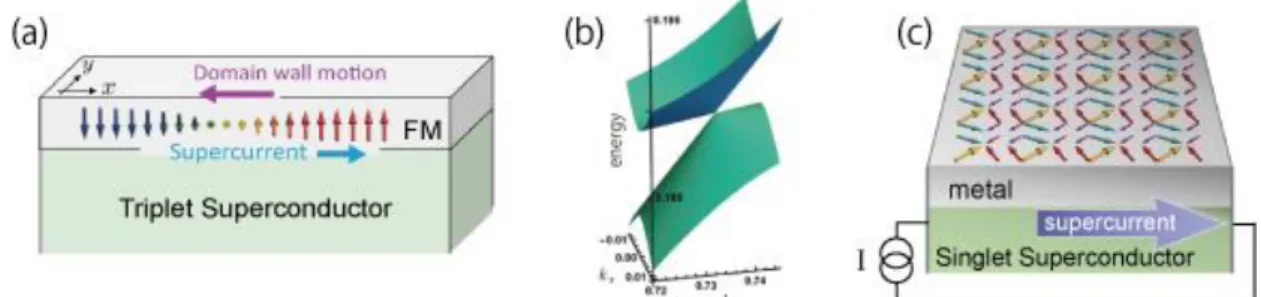
We study such interplay in correlated systems with superconductivity. Firstly, we study supercurrent-induced spin torques that act on localized moments in a metallic magnet with superconductivity. We show that a triplet supercurrent gives rise to a spin-transfer torque, and it can realize an efficient domain wall manipulation compared to the conventional spin-transfer torques [3]. In the presence of the relativistic spin-orbit coupling in an inversion asymmetric system, a singlet supercurrent can also render a spin torque. Considering a cubic chiral magnet, we study the dependence of the spin torque on magnetization directions and the magnitude of the relativistic spin-orbit coupling [4].
Secondly, we study the topological states realized in Bogoliubov quasiparticle spectrum [4]. We show that the above model, a cubic chiral magnet with superconductivity, hosts the Weyl node structures. Depending on the magnitude of chemical potential and spin-orbit coupling, type-I or type-II Weyl quasiparticles are realized.
Thirdly, we propose a way to induce and switch noncollinear spin textures by an applied supercurrent in a correlated metal with superconductivity [5]. Noncollinear spin textures are crucial to engineer topological superconductors and generate triplet Cooper pairs. We show that a supercurrent can lead to phase transitions from a paramagnetic state to noncollinear magnetic phases with helical or vortexlike spin textures.
References
[1] J. Linder and J. W. A. Robinson, Nat. Phys. 11, 307 (2015).
[2] J. Alicea, Rep. Prog. Phys. 75, 076501 (2012).
[3] R. Takashima, S. Fujimoto, and T. Yokoyama, Phys. Rev. B 96, 121203 (R) (2017) [4] R. Takashima, and S. Fujimoto, Phys. Rev. B 94, 235117
[5] R.Takashima, Y. Kato, Y. Yanase, and Y. Motome, arXiv: 1710.11349
Fig. 1. (a) Domain wall dynamics in a ferromagnet (FM) driven by a triplet supercurrent. (b) Type-II Weyl cone in Bogoliubov quasiparticle spectrum. (c) Noncollinear magnetic order induced by a supercurrent.
Ultrafast disordering of local structure in Xe clusters exposed to intense NIR laser
Physics of Disordered Systems Group Toshiyuki Nishiyama
Abstract Time-resolved wide-angle x-ray scattering experiments on giant Xe clusters have been performed to investigate structural changes at the time of interaction between intense near-infrared laser and matter. Ultrafast changes in local structure were observed as a significant decrease of intensity of Bragg spots and broadening of their width. © 2017 Department of Physics, Kyoto University
Noble gas cluster has been used as an ideal model for study of laser-matter interaction due to its characteristics of isolated many-body system. It is well known that a cluster exposed to intense laser undergo highly ionized and can form a nanoscale high-dense plasma, nanoplasma [1]. Elucidation of mechanism of nanoplasma formation is important for understanding of laser-matter interaction, and numerous researches of nanoplasma have been conducted [2, 3]. Recently, small angle x-ray scattering study using intense short pulses delivered from X-ray free- electron laser (XFEL) has been revealed the ultrafast morphology change of giant xenon cluster which is triggered by irradiation of intense near-infrared (NIR) laser [4]. Preceding works rise the question that how the local atomic orders changes in the nanoplasma formation process. Information of atomic scale structural changes will give insight for nanoplasma physics, but experimental information is still lacking.
In this work we present results of time-resolved wide-angle x-ray scattering experiments on xenon (Xe) clusters highly excited by NIR laser. The experiments were carried out at the experimental hutch 2 of the beamline 3 at SACLA in Japan. Xe clusters composed of around 10 million atoms were generated by expanding Xe gas through a conical nozzle with a 200 μm diameter and a 4˚ half-opening angle. The NIR pulses (800 nm, 30 fs FWHM) were irradiated to the Xe clusters. The intensity of the NIR pulses were up to 4.2×10¹⁶ W/cm2. For each NIR shot, a single XFEL pulse (11.2 keV, 10 fs FWHM) was scattered by the heated Xe clusters. The intensity of the XFEL was 3.5×10¹⁷ W/cm2. The scattered x-rays were recorded with a multi-port charge-coupled device (MPCCD) octal sensor [5] installed 100 mm downstream of the interaction point.
We recorded scattered x-ray from single Xe clusters in shot-to-shot manner by using the MPCCD detector. Bragg spots corresponding to reflections from (111), (200) and (220) planes of fcc lattice of Xe were found at the momentum transfer of 1.79, 2.07, 2.93 Å-1 in the MPCCD images of giant Xe clusters. When we irradiated intense NIR pulses to clusters, Bragg spots immediately decreased within several hundred fs, which indicated ultrafast disordering of fcc structure in Xe clusters. We found clear NIR laser intensity dependence in its time scale. Delay dependence of intensity and width of Bragg spots revealed that the intensity decreased significantly in the time scale of a few hundred fs after irradiation of NIR, accompanied with the broadening of width of spots. Delay dependence of spot width is well reproduced by the surface melting model [4], which relates the intensity of Bragg spot to its width by well-known Scherrer equation. The present results suggest that a cluster exposed to NIR laser melts from its surface to the inner core and the local structure of the inner core is maintained for several hundred fs after interaction with NIR laser.
References
[1] H. Wabnitz et al., Nature 420, 482 (2002)
[2] Th. Fennel et al., Rev. Mod. Phys. 82, 1793 (2010) [3] K. R. Ferguson et al., Sci. Adv. 2: e1500837 (2016) [4] T. Gorkhover et al., Nat. Photon. 10, 93-97 (2016)
[5] T. Kameshima et al., Rev. Sci. Instrum. 85, 033110 (2014)
Renormalization Group Analysis of Nonequilibrium Phase Transitions in Driven Disordered Systems
Nonlinear Dynamics Group Taiki Haga
Abstract We investigate the critical behavior of disordered systems driven out of equilibrium. From intuitive arguments, we derive a dimensional reduction property which predicts that the critical exponents of driven disordered systems are the same as those of lower dimensional pure systems. By developing a renormalization group formalism, we consider the condition that the dimensional reduction fails.
© 2017 Department of Physics, Kyoto University
The effect of quenched disorder on the large-scale structure of interacting systems remains an unsettled issue.
The peculiarity of disordered systems comes from the fact that the competition between disorder and interaction leads to multiple meta-stable states, which are local minima of the mesoscopic free energy. One of the most remarkable phenomena associated with meta-stable states is the breakdown of the so-called “dimensional reduction property” in random field spin models. Standard perturbation theory predicts that the critical exponents of the -dimensional random field spin models are the same as those of the -dimensional pure spin models [1]. However, it is known that this dimensional reduction breaks down in low enough dimensions due to a non-perturbative effect associated with multiple meta-stable states. To clarify the mechanism of the breakdown of the dimensional reduction has been a central issue in the statistical mechanics of disordered systems, and recently, a remarkable progress has been achieved by applying a modern renormalization group formalism [2].
A more challenging problem concerning the effect of disorder is to understand the critical behavior of disordered systems driven out of equilibrium in the presence of an external force. One of the well-studied examples is the driven vortex lattices in dirty superconductors [3]. In these systems, vortex lines are driven by Lorentz force in the presence of a random pinning potential. To obtain a clear insight into the underlying physics of such driven disordered systems, it is a natural starting point to introduce a nonequilibrium counterpart of the dimensional reduction property.
In this study, we first introduce a simple model of driven disordered systems, which is a random field spin model driven at a uniform and steady velocity. From intuitive arguments, we derive a novel type of dimensional reduction property, which states that the critical exponents of the -dimensional driven random field spin model are the same as those of the -dimensional pure spin model. Unfortunately, this dimensional reduction can break down in low enough dimensions due to a non-perturbative effect. Therefore, we develop a renormalization group formalism for the driven random field spin model and its critical behavior is investigated. By comparing the actual critical exponents with their dimensional reduction values, we determine the region in the parameter space wherein the dimensional reduction breaks down [4].
As a remarkable corollary of the dimensional reduction, it is expected that a driven disordered system with U(1) symmetry exhibits the Kosterlitz-Thouless transition in three-dimensions. We show that this expectation is certainly correct. Concretely, the system exhibits a quasi-long-range order at weak disorder and a topological phase transition, which is caused by the structural changes in vortices. This is a first example of topological phase transition wherein the interplay between disorder and driving plays a crucial role [5].
References
[1] G. Parisi and N. Sourlas, Phys. Rev. Lett. 43, 744 (1979).
[2] G. Tarjus and M. Tissier, Phys. Rev. B 78, 024203 (2008); 78, 024204 (2008).
[3] G. Blatter, M. V. Feigelman, V. B. Geshkenbein, A. I. Larkin, V. M. Vinokur, Rev. Mod. Phys. 66, 1125 (1994).
[4] T. Haga, arXiv:1704.03644.
[5] T. Haga, arXiv:1703.09486.
Antiperovskite Oxide Sr
3-xSnO:
Discovery of Superconductivity and Deficiency Phase Diagram
Quantum Materials Laboratory Mohamed Oudah
Abstract We report on the discovery of superconductivity in the antiperovskite oxide Sr3-xSnO, and emphasize the effect of Sr deficiency on superconductivity in this material. We discuss the unexpected appearance of two superconducting transitions simultaneously and show the evolution of these two transitions as a function of deficiency x in Sr3-xSnO.
© 2017 Department of Physics, Kyoto University
Antiperovskite oxides A3BO (A = Mg, Ca, Sr, Ba, Yb, Eu; B = Si, Ge, Sn, Pb) have recently been demonstrated to exhibit Dirac electronic dispersion near the Γ point in the Brillouin zone based on first-principles calculations [1,2].Charge balance in this class of material, assuming a typical A2+ and O2- valences, leads to (A2+)3(B4-)(O2-), where the B ions have an unusual 4- state. Such negative valance ions are consistent with theoretical calculations.
Furthermore, antiperovskite oxides with heavier elements have been predicted as topological crystalline insulators [3], due to the inversion of the conduction d band of A2+ and the valance p band of B4-. Finding of superconductivity emerging in such an unusual electronic state would be quite interesting, and an important step towards understanding of superconductivity in topologically nontrivial materials.
To this goal, we synthesized various antiperovskite oxides, including Ca3SnO, Ca3PbO, Sr3SnO, and Sr3PbO.
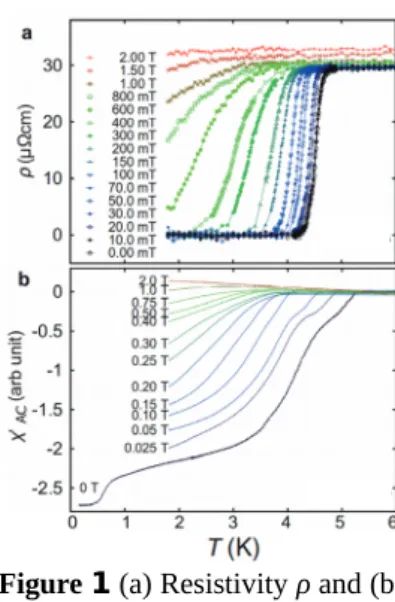
These antiperovskite oxides are air sensitive, and this work required developing various handling and measurement techniques so that exposure to air is minimized. Finally, we discovered the first superconductivity among the antiperovskite oxides in the hole-doped Sr3-xSnO [4], with evidences of zero resistivity (Fig. 1(a)) and diamagnetic Meissner signal below the critical temperature Tc of 5 K (Fig. 1(b)).
The initial synthesis method used suffered from uncontrolled evaporation of Sr and it was difficult to quantify the exact composition needed for superconductivity, but we overcame this hurdle after some modifications. With the improved synthesis method, we successfully tuned the amount of the strontium deficiency, and the volume fraction of the superconductivity at 5 K was increased to about 80% with the optimal deficiency of around x ~ 0.5 [5,6].
We calculated band structures of various “Sr2.5SnO” and found that the shape of the bands are not altered significantly by the Sr deficiency, but the chemical potential is shifted substantially [7]. Interestingly, this compound exhibits double superconducting transitions with the Tc’s of about 5 and 1 K, as demonstrated in the zero field AC susceptibility measurement in Fig. 1(b). We found that the Tc’s at 5 and 1 K do not change significantly as a function of x.
References
[1] T. Kariyado and M. Ogata, J. Phys. Soc. Jpn. 80, 083704 (2011).
[2] T. Kariyado and M. Ogata, J. Phys. Soc. Jpn. 81, 064701 (2012).
[3] T. H. Hsieh, J. Liu, and L. Fu, Phys. Rev. B 90, 081112(R) (2014).
[4] M. Oudah et al., Nat. Commun. 7, 13617 (2016).
[5] M. Oudah et al., in preparation.
[6] J.N. Hausmann, M. Oudah et al., in preparation.
[7] A. Ikeda, T. Fukumoto, M. Oudah et al. to be published in Physica B (2017).
Figure 1 (a) Resistivity ρ and (b) Real part of AC susceptibility χ’AC as a function of temperature of Sr3-xSnO under zero and various magnetic fields. The χ’AC
measurement under 0 T is cooled down to ~0.15 K [4].
Uniaxial-Strain Control of H c2 Anisotropy of Nematic Superconductor Sr x Bi 2 Se 3
Quantum Materials Laboratory Ivan Kostylev
Abstract Motivated by the recent discoveries of nematic superconductivity, characterized by the rotational symmetry breaking in the amplitude of the superconducting wave function, we explore the possibility of controlling nematicity by uniaxial strain. We plan to detect the superconducting nematicity via measuring the upper critical field of Sr0.06Bi2Se3.
© 2017 Department of Physics, Kyoto University
Recently, it has been clarified that novel electronic states in strongly correlated systems can be induced or controlled by the application of uniaxial strain. In my PhD, attempting to control properties of various superconductors by applying strain and measuring its superconducting transition temperature and upper critical field, we utilized a piezo-stack-based device [1], capable of both tensile and compressive strains, for which I have devoted much effort to establish various methods for sensing strain values, mounting samples, measuring sample properties, and evaluating the actual strain using finite element analysis. Then we measured superconducting properties of Pb, Nb-doped SrTiO3, and SrxBi2Se3, the latter of which is focused on in this presentation.
The search for new topological states of matter has motivated the discovery of superconductivity in the topological insulator Bi2Se3 by Cu intercalation [2]. This compound has recently been attracting much attention as the candidate for nematic superconductivity, being characterized by the rotational symmetry breaking of the superconducting wavefunction amplitude with respect to the underlying crystal lattice. Indeed, the trigonal rotational symmetry breaking in CuxBi2Se3 has been discovered by a two-fold field angular anisotropy in NMR and specific heat experiments [3, 4]. These results indicate that CuxBi2Se3 is an odd-parity spin-triplet nematic superconductor with either the so-called Δ4x or Δ4y order parameters. It was recently found that Sr intercalated Bi2Se3
also exhibits superconductivity [5, 6]. Interestingly, rotational symmetry breaking was also observed in the upper- critical field Hc2 measurements of SrxBi2Se3 [7]. Furthermore, a sample dependence of the Hc2 anisotropy was reported [8], suggesting that Δ4x and Δ4y are nearly degenerate and might be switched by external stimuli.
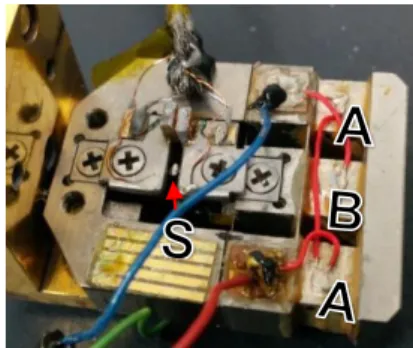
We thus try to control the Δ4x/Δ4y nematicity by using uniaxial strain. For this goal, we investigate the anisotropy of Hc2 of SrxBi2Se3 under strain by measuring the AC magnetic susceptibility. We mount a SrxBi2Se3 single crystal (x=0.06), provided from Prof. Yoichi Ando’s group at Univ. Cologne in Germany, in the strain applying device as shown in Fig. 1. The strain is determined by monitoring the capacitance of a parallel plate capacitor system whose gap changes with applied strain. The device with the sample is then cooled by a dilution refrigerator equipped with a vector magnet capable of two-axis control of magnetic field direction. The susceptibility is measured by the concentric pair of coils surrounding the sample.
The superconducting signal was successfully detected at 3 K, consistent with previous reports. At the maximum applied strain, no measurable changes in the superconducting transition temperature at zero field were observed.
Nevertheless, although the quality of the data needs improvement, there is some evidence for change in the Hc2
anisotropy by uniaxial strain.
References
[1] C. W. Hicks et al., Rev. Sci. Instrum. 85, 65003 (2014).
[2] Y. S. Hor et al., Phys. Rev. Lett. 104, 057001 (2010).
[3] K. Matano et al., Nat. Phys. 12, 852 (2016).
[4] S. Yonezawa et al., Nat. Phys. 13, 123 (2017).
[5] Shruti et al., Phys. Rev. B 92, 20506 (2015).
[6] Z. Liu et al., J. Am. Chem. Soc. 137, 10512 (2015).
[7] Y. Pan et al., Sci. Rep. 6, 28632 (2016).
[8] G. Du et al., Sci. China Phys., Mech. Astron. 60, 037411 (2017).
Fig. 1. Strain applying device with a sample (S) attached to a holder to be mounted in the vector magnet. The two outer (A) and one inner (B) piezoelectric elements apply tensile and compressive strain, respectively.
Fig.1. Dispersion relations for the twist mode of C-director in the pure and swollen SmC phases.
d 0 . 2 / 1
1/ d Solvent
(FO)
(Scattering vector )2 q2[mm-2] Relaxation frequency t-1[ms-1]
0wt%
40wt%
50wt%
Swelling effect on twist elastic constant in the smectic C liquid crystal
Soft Matter Physics Group Kanako Hata
Abstract We introduced a solvent between layers in the smectic C (SmC) liquid crystal, and investigated the swelling effect on interlayer steric interaction. We found that the twist elastic constant directly related to the interlayer steric interaction monotonically decreases with the increase in the swelling ratio.
© 2017 Department of Physics, Kyoto University
Recently, our group found that the repeat distance of the smectic layer can be greatly swollen to about three times thicker than that of original layers[1]. In this phase, a perfluorinated oil (FO) is introduced between layers by the chemical incompatibility of hydrocarbon and perfluorinated carbon chains. Then, we expected that the steric interaction can be continuously tuned by the thickness of the solvent layer and the orientation order will be lost at a certain limit. However, it is mysterious that the SmC phase can be well stabilized in whole concentration range considering that the correlation of C-directors propagates between layers through disordered solvent layers.
In this study, we measured a twist distortion elasticity by dynamic light scattering (DLS) measurement, and rotational viscosity by the electro optic switching behavior, because twist elasticity is directly related to the steric interaction of the interlayer C-director correlation between the layers[1]. From this study, we clarified the role of the microscopic solvent molecules introduced between layers.
In this study, we mixed perfluorinated oil into a smectic liquid crystal, 11-(4’-cyanobiphenyl-4- yloxy) undecyl pentadeca- fluorooctanoate (BI) [2]. Figure 1 shows the dispersion relations for the twist mode of C-director in the mixtures. It is found that t-1 is proportional to q2, as predicted by the hydrodynamic equations t-1=B3q2/ [3] in pure and swollen SmC phases. Here is a rotational viscosity coefficient. Then, in order to evaluate only twist elastic constant, we substituted spontaneous polarizations Ps evaluated by polarization switching current measurement and switching time constants evaluated by transmittance behavior in the electro-optical measurement for equation of C-director motion
PsE (E:Electric field) [4]. As a result, we found that decreases by the swollen effect.Then, we substituted for B3/ estimated from dynamic light scattering and evaluated swollen effect on B3. Figure 2 shows the dependence of B3 on the volume fraction of BI. As indicated in Figure 2, B3 monotonously decreases with increasing mixing ratio of the perfluorinated oil, and it becomes near 1 order weaker in the swollen SmC phase as compared to that in the original SmC phase. We concluded that intercalated solvent molecules prevent the direct collisions between liquid crystal molecules, and weaken the steric interaction to produce the orientation order across the smectic layers.
Reference
[1] K. Hata, et al, submitted
[2] M. Murase, et al, RSC Advances 5, 215-220 (2015) [3] I. Drevenšek, et al, Phys. Rev. A 41, 923 (1990).
[4] S. Kimura, et al, Jpn. J. Appl. Phys. 26, L255 (1987).
Fig.2. The dependence of B3 on the inverse of the volume fraction of BI with respect to the perfluorinated oil.
Magnetoelectric response in electric octupole ordered state
Condensed matter theory group Takanori Hitomi
Abstract Motivated by a growing interest for magnetoelectric response in odd-parity multipole states, we investigate the magnetoelectric effect and spin Hall effect in an odd-parity electric octupole state and reveal several peculiar magnetoelectric properties. We propose a possible realization of the electric octupole order in bilayer high-Tc cuprate superconductors.
© 2017 Department of Physics, Kyoto University
Transport property in noncentrosymmetric systems is one of the major topics in condensed matter physics. This property is characterized by antisymmetric spin-orbit coupling (ASOC), which arises from an inversion symmetry breaking. Most of previous studies considered noncentrosymmetric systems having a crystal structure with lack of the inversion center. On the other hand, the odd-parity multipole order in locally non-centrosymmetric systems has recently attracted a lot of attention. In such systems, a sublattice-dependent ASOC emerges due to the local parity violation at each atomic site. The entanglement of the spontaneous inversion symmetry breaking due to the odd-parity multipole and the sublattice-dependent ASOC leads to exotic magnetoelectric response, e.g., magnetoelectric effect by magnetic quadrupole order in zigzag chains [1] and magnetic toroidal order in honeycomb lattice [2].
In this study, we focus on the magnetoelectric response in the odd-parity electric octupole (EO) state, and investigate the magnetoelectric effect and spin Hall effect in a bilayer Rashba system. We construct a forward scattering model by considering a layer-dependent Rashba ASOC (bilayer Rashba model). By analyzing the model on the basis of the mean-field theory [3], we calculate the magnetoelectric coefficient and spin Hall conductivity by using the Kubo formula. We obtain following consequences: (1) the magnetic moment characterized by the symmetry of the EO moment is induced by the electric field, (2) the spin Hall conductivity is drastically enhanced in the EO state.
Furthermore, we study the bilayer cuprates, YBa2Cu3O7-x (YBCO), which is categorized into the high-Tc
superconductors. A change of nematicity has been detected by the magnetic torque measurement at a temperature higher than the onset temperature of charge density wave state [4]. Moreover, the optical measurements, such as a linear dichroism [5], have pointed out the broken inversion symmetry. These experimental results indicate the possibility of the EO order in the pseudogap regime. We discuss the “hidden order” in YBCO by analyzing the bilayer Rashba model with a weak two-fold anisotropy. From the calculation of the spin susceptibility, we obtain the kink in the temperature dependence of the magnetic torque at the phase transition point and the reduction of the spin susceptibility in the EO ordered phase, which are consistent with experimental observations. We further show that the two-fold magnetic anisotropy is significantly enhanced in the superconducting state because the Van Vleck susceptibility is remarkably anisotropic. Possible experimental test of magnetic anisotropy and characteristic magnetoelectric responses is proposed.
References
[1] Y. Yanase, J. Phys. Soc. Jpn. 83, 014703 (2014).
[2] S. Hayami, H. Kusunose, and Y. Motome, Phys. Rev. B 90, 024432 (2014).
[3] T. Hitomi and Y. Yanase, J. Phys. Soc. Jpn. 85, 124702 (2016).
[4] Y. Sato et al., Nat. Phys. (2017), 10.1038/nphys4205 [5] Y. Lubashevsky et al., Phys. Rev. Lett. 112, 147001 (2014).
77 Se-NMR Studies on Iron-based Superconductors Fe(Se 1-x S x )
Quantum Materials Lab. Anlu Shi
Abstract We have conducted 77Se-Nuclear Magnetic Resonance (NMR) on iron-based superconductors Fe(Se1-xSx) to investigate the normal-state and the superconducting properties in various magnetic fields.
We found that nuclear spin-lattice relaxation rate divided by temperature (T1T)-1is suppressed well above Tc(H). The result is related to the theoretically-predicted preformed pairs.
© 2017 Department of Physics, Kyoto University
In the family of iron-based superconductors (FeSCs), FeSe (Tc ~ 9 K) has the simplest crystalline structure[1], but has some distinct properties from other FeSCs, e.g. it undergoes a structural phase transition below Ts ~ 90 K without a static magnetic ordering and has an extremely small Fermi energy EF (EF ~10 meV). The characteristic parameter, the ratio of superconducting gap () and Fermi energy /EF (~ Tc/Ts) in FeSe is then estimated to be 10-1 which is several orders of magnitude larger than that in conventional-metal superconductors (~ 10-4). Thus the superconductivity in FeSe is suggested to be in the
Bardeen-Cooper-Schrieffer (BCS) – Bose-Einstein condensate (BEC) crossover regime[2]. One of the most intriguing topics in this regime is whether the theoretically-predicted preformed pairs are present or not above Tc[3].
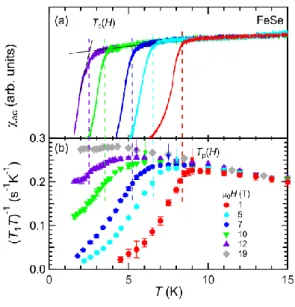
In my thesis, we performed 77Se-NMR measurements on FeSe in various magnetic fields (H) to detect the trace of preformed pairs microscopically. From the measurement of nuclear spin-lattice relaxation rate 1/T1, we found that (T1T)-1 enhanced by antiferromagnetic (AFM) fluctuations below Ts is gradually suppressed below T* ~ 15 K (Fig. 1), and exhibits a broad maximum at Tp(H) above Tc(H) (Fig. 2). This is similar to pseudogap (PG) behavior in the optimally-doped cuprate superconductors YBa2Cu3O7. Since Tp(H) decreases in the same manner as Tc(H) with increasing H, the PG behavior in FeSe is ascribed to superconducting fluctuations presumably originating from the predicted preformed pairs above Tc[4].
We have also studied the chemical pressure effect of FeSe by substituting S for Se. In particular, we performed NMR measurements on Fe(Se0.92S0.08)(Tc ~ 10.1 K, Ts ~ 75 K). We found that the AFM fluctuations below Ts are obviously enhanced in Fe(Se0.92S0.08)(Fig. 1). It suggests that the increase of Tc is due to this result. The PG behavior is also observed in this sample, with the same ratio of Tp/Tc as that of FeSe. Based on these results, we claim that the PG behavior is the intrinsic property of FeSe superconductor, and is related to the formation of preformed pairs above Tc.
References
[1]
F.-C. Hsu et al., Proc. Natl. Acad. Sci. 105, 14262 (2008).[2] S. Kasahara et al., Proc. Natl. Acad. Sci. 111, 16309 (2014).
[3] Q. Chen et al., Phys. Rep. 412, 1 (2005).
[4] A. Shi et al., submitted to JPSJ.
Fig. 2. Temperature dependence of (a) diamagnetic-shielding signals and (b) (T1T)-1 on FeSe in various H below 15 K.
Fig. 1. Temperature dependence of (T1T)-1 on Fe(Se1-xSx) (x = 0, 0.08) in 0H = 12 T.