Short Communication
Suppression of hepatitis B surface antigen production by combination therapy with nucleotide analogues and interferon in children with genotype C
hepatitis B virus infection
Hitoshi Tajiri,
1Tomoko Takano,
1Yasuhito Tanaka,
2Jun Murakami
3and Stephen Brooks
41
Department of Pediatrics, Osaka General Medical Center, Osaka,
2Department of Virology and Liver Unit, Nagoya City University Graduate School of Medical Sciences, Nagoya,
3Division of Pediatrics and Perinatology, Tottori University, Yonago, Japan and
4Department of Microbiology/Immunology, State University of New York at Buffalo, Buffalo, New York, USA
Aim:
Sustained suppression of hepatitis B surface antigen (HBsAg) production after interferon (IFN) treatment has not been reported for children with genotype C chronic hepatitis B virus (HBV) infection, which is prevalent in Asia. Among children with hepatitis B envelope antigen-positive genotype C chronic HBV infection, we compared the efficacy of combination therapy with nucleotide analogues and IFN-αin 11 children with 12 historical cases treated with IFN monotherapy.Methods:
The combination of lamivudine and conventional IFN-αwas introduced for thefirst three patients; the other eight patients were treated with entecavir and pegylated IFN.Results:
Demographic factors as well as baseline HBsAg titers and HBV-DNA levels were similar between the two groups. In the combination therapy group, viral loads were suppressed in 9/11 to below 4.0 log copies/mL both at the end of the therapy(EOT) and at 6 months after EOT. In contrast, in the IFN monother- apy group, suppression of viral loads was observed in 2/12 and 3/12 at EOT and at 6 months after EOT, respectively. In the combination therapy group, HBsAg titers dropped from 4.03 at pretreatment to 2.91 log IU/mL at 6 months after EOT with 4/11 showing a drop to below 1000 IU/mL (one patient achieved HBsAg clearance). In contrast, the amount of HBsAg did not change during the corresponding periods in the IFN monotherapy group.
Conclusions:
Our preliminary results suggest that combina- tion therapy might be effective in the suppression of HBsAg pro- duction as well as HBV-DNA production for children with genotype C chronic HBV infection.Key words:genotype C, HBeAg seroconversion, HBsAg seroconversion, interferon, nucleotide analogue
INTRODUCTION
I NTERFERON (IFN) IS a standard therapy of care for children with chronic hepatitis B virus (HBV) infec- tion.1However, IFN monotherapy has not been satisfac- tory in promoting hepatitis B surface antigen (HBsAg) clearance in children or adults in Japan.
2 Moreover, sustained suppression of HBsAg production after IFN treatment was not reported for children with chronic hepatitis B, including genotype C chronic HBV infection, which is prevalent in Asia.
In adult patients, HBsAg loss after tenofovir plus pegylated interferon-α (PEG-IFN) therapy was recently re- ported and suppression of HBsAg production by combina- tion therapy was associated with HBV genotype A.
3Our survey of published work failed to find any reports on the efficacy of this combination therapy in children with geno- type C chronic HBV infection. In this study, we investigated the efficacy of combination therapy with nucleotide ana- logues and IFN-α in terms of suppression of HBsAg produc- tion as well as other biochemical and virological responses, including alanine aminotransaminase (ALT) normaliza- tion, hepatitis B envelope antigen (HBeAg) seroconver- sion, and suppression of HBV-DNA levels.
METHODS
F ROM 2010 TO 2016, 39 patients with HBeAg-positive genotype C chronic HBV infection and their guardians
Correspondence: Dr. Hitoshi Tajiri, Department of Pediatrics, Osaka General Medical Center, 3-1-56 Bandaihigashi, Sumiyoshi-ku, Osaka 558–
8558, Japan. Email: [email protected]
Conflict of interest:The authors have no conflict of interest.
Financial support:This research was supported by the Japan Agency for Medical Research and Development.
Received 29 January 2018; revision 27 April 2018; accepted 2 July 2018.
Hepatology Research 2018; 48: 1172–1177 doi: 10.1111/hepr.13227
visited our center. Twenty-one of the 39 patients who had a sustained elevation in ALT for more than 6 months had the therapy explained to them. Eleven of the 21 agreed to enroll in the trial therapy (combination therapy group) whereas the other 10 patients had therapy withheld. The remaining 18 had never experienced an elevation in ALT levels and were regarded as asymptomatic carriers. An ele- vation in ALT levels was defined as a level >60 IU/L ac- cording to Jonas et al.
1As a comparison, registered cases that had received IFN monotherapy or PEG-IFN monotherapy were searched using the medical records of children with chronic HBV in- fection, which were collected in a nation-wide survey.
4We identified 82 patients with IFN monotherapy and 14 pa- tients with PEG-IFN monotherapy. Among them, 12 pa- tients with IFN monotherapy and four patients with PEG-IFN monotherapy met the following inclusion criteria: pretreatment HBeAg positivity, availability of lab- oratory data including ALT, HBsAg, HBeAg, and HBV- DNA both at baseline and at 6 months after the end of therapy (EOT), and completion of the scheduled treat- ment regimen as described below. On evaluation of an ef- ficacy of combination therapy, only cases with IFN monotherapy were compared because the number of eligi- ble cases with PEG-IFN monotherapy was too small to compare with the combination therapy group.
The effect on HBsAg production as well as circulating levels of ALT, HBeAg, and HBV-DNA were assessed prior to therapy, at EOT, and every 6 months after EOT in the 11 children with genotype C chronic HBV infection. Liver biopsy specimens were evaluated for the activity of hepati- tis and the degree of fibrosis according to the classification of Desmet et al.
5Treatment regimen
Combination therapy consisted of nucleotide analogues for the first 3 months using lamivudine 3 mg/kg/day plus natural IFN-α 0.1 MU/kg body weight three times a week for 6 months in the first three patients, or entecavir 0.01 mg/kg/day plus PEG-IFN 180 μg/m
2body surface area weekly for 6 months in the remaining eight patients.
The IFN monotherapy group received natural IFN-α 0.1 MU/kg body weight three times a week for 24 weeks.
The PEG-IFN monotherapy group received 180 μg/m
2body surface area weekly for 48 weeks.
Statistical analysis
Differences in mean values and the frequency of patients’
characteristics between groups were compared using the Mann–Whitney U-test and the Fisher’s exact test,
respectively. All statistical analyses were based on two- sided hypotheses tested with a significance level of P < 0.05.
Ethical considerations
The study protocol complied with the ethical guidelines of the Declaration of Helsinki of 1975 (2004 revision) and was approved by the Ethics Committee of Osaka General Medical Center (Osaka, Japan).
RESULTS
Demographic data of children with HBeAg-positive genotype C chronic HBV infection
T HE 11 CHILDREN who underwent the combination therapy from 2010 to 2016 consisted of seven boys and four girls with the average age of 9.2 years at treatment (Table 1). Transmission routes were mother to child in nine patients, father to child in one patient, and grandfa- ther to child in one. Baseline factors including age at treat- ment, gender, transmission routes, and duration of observation were similar between the two groups. Baseline ALT values were greater in the combination therapy group than in the IFN monotherapy group, although it did not reach statistical significance. Both baseline HBsAg titers and HBV-DNA levels were in a similar range when com- paring the two groups. A liver biopsy showed a mild activ- ity of hepatitis (A1) for all patients expect one with a Table 1 Comparison of demographic factors among children with genotype C hepatitis B virus (HBV) infection treated with interferon (IFN) monotherapy or combination therapy
IFN monotherapy
(n= 12)
Combination therapy
(n= 11) P-value
Age, years† 9.2 ± 4.2 9.2 ± 2.9 NS
Male sex,n(%) 4 (33) 7 (62) 0.22
MTCT,n(%) 8 (66) 9 (81) NS
Observation, years† 4.0 ± 1.7 3.4 ± 2.1 0.45 Baseline ALT, IU/L† 155 ± 91 440 ± 375 0.06 Peak ALT, IU/L† 450 ± 605 664 ± 346 0.41 HBsAg, log IU/mL† 4.00 ± 0.30 4.23 ± 0.24 0.11 HBV-DNA, log copies/mL
≥9 4 4 NS
8.0–8.9 4 5
7.0–7.9 4 2
†Mean ± standard deviation.
ALT, alanine aminotransaminase; IFN, interferon; MTCT, mother-to- child transmission; NS, not significant.
Suppression of HBsAg production 1173
Hepatology Research 2018; 48: 1172–1177
moderate degree of hepatitis (A2) (data not shown). A moderate degree of fi brosis (F2) was noted in all patients.
Natural course of children who had combination therapy withheld
Ten patients were followed for ALT, HBsAg, HBeAg, and HBV-DNA with no treatment for a median of 2.7 years.
One of the 10 has had spontaneous seroconversion to HBeAb positive/HBeAg negative after 16 months of follow-up. In the remaining nine patients, HBeAg has remained positive.
Outcome of children with combination therapy or IFN monotherapy
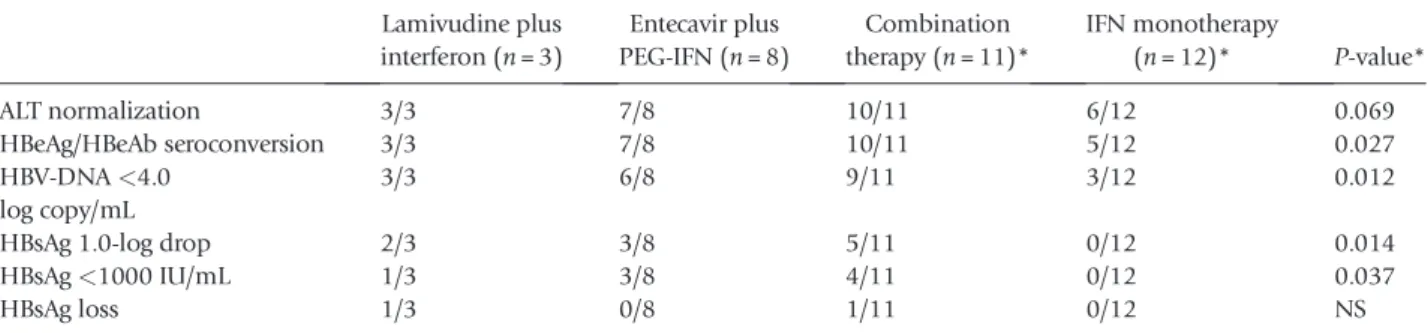
In the combination therapy group, titers of HBeAg were rapidly decreased during the 6 months of therapy in all patients and suppressed in the negative range in eight of the 11 at EOT. Thereafter a loss of HBeAg occurred in two patients and remained positive in one patient at 6 months after EOT (Fig. 1). Hepatitis B envelope antigen seroconversion was signi fi cantly higher in the combina- tion therapy group than in the untreated group (90.9%
vs. 10.0%, P ≤ 0.001). The seroconversion rate at 6 months after EOT was also greater in the combination therapy
group than in the IFN monotherapy group (P = 0.027;
Table 2a).
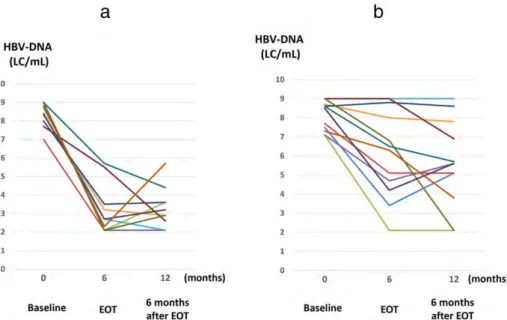
Viral loads were decreased in all patients of the combination therapy group during therapy and were suppressed in most of the patients to below 4.0 log cop- ies/mL (LC/mL) both at EOT and at 6 months after EOT (Fig. 2a). In contrast, in the 12 patients of the IFN monotherapy group, the same degree of suppression of viral loads during the corresponding observation period was observed in only two and three patients at EOT and at 6 months after EOT, respectively (Fig. 2b). The decrease in viral loads at 6 months after EOT was more frequently seen in the combination therapy group than in the IFN monotherapy group (P = 0.012; Table 2a).
In the combination therapy group, HBsAg titers sub- stantially dropped from 4.03 at pretreatment to 2.91 log IU/mL at 6 months after EOT: five of the 11 pa- tients showed more than a 1.0-log drop in the HBsAg titers and in four of the five patients it decreased to
<1000 IU/mL (Fig. 3a). Of note, one of the five patients
achieved HBsAg clearance at 12 months after EOT (case 3).
In contrast, the HBsAg levels did not change during the corresponding observation period in the IFN monother- apy group (Fig. 3b). The difference between the two
Figure 1 Flow diagram of the study of the efficacy of combination therapy with nucleotide analogues and interferon in children with genotype C hepatitis B virus infection, including summary of results. HBeAg, hepatitis B envelope antigen; HBsAg, hepatitis B surface antigen.
1174 H. Tajiri et al. Hepatology Research 2018; 48: 1172–1177
groups at 6 months after EOT was greater in the combina- tion therapy group than in the IFN monotherapy group both for 1.0-log drop and for a drop below 1000 IU/mL (P = 0.014 and P = 0.037, respectively; Table 2a).
There were no differences between the first three pa- tients treated with lamivudine plus interferon and the later eight patients with entecavir plus PEG-IFN in terms of seroconversion rate, suppression of viral loads, 1.0-log drop in HBsAg, or drop below 1000 IU/mL at 6 months after EOT (Table 2a).
Sustainability of the suppression of HBsAg production was partly shown by an 84-month follow-up in cases 2 and 3, both of which showed more than 1.0-log drop at 6 months after the end of the combination therapy (Fig. S1). Moreover, HBsAg titers decreased below 1000 IU/mL after 6 years in case 2. In the IFN monotherapy group, titers of HBsAg were available for most patients be- tween 12 and 36 months after EOT and showed no change compared to those at 6 months after EOT (data not shown).
Outcome of children treated with PEG-IFN monotherapy
In the four patients who underwent PEG-IFN monother- apy, ALT normalization was reported in three, HBeAg seroconversion in two, and suppression of HBV-DNA in two at 6 months after EOT. The amount of HBsAg was repeatedly assessed in three of the four patients and no apparent decrement in HBsAg titers was ob- served in those three patients, either at EOT or 6 months after EOT.
Safety of combination therapy
A similar frequency of bone marrow suppression associ- ated with IFN treatment was observed in the two groups;
leukopenia in two and thrombocytopenia in one for the IFN monotherapy group, and one each for the combina- tion therapy group (Table 2b). Transient elevation in se- rum transaminase levels was also infrequently seen in
Table 2a Comparison of efficacy between interferon (IFN) monotherapy and combination therapy groups among children with genotype C hepatitis B virus (HBV) infectionLamivudine plus interferon (n= 3)
Entecavir plus PEG-IFN (n= 8)
Combination therapy (n= 11)*
IFN monotherapy
(n= 12)* P-value*
ALT normalization 3/3 7/8 10/11 6/12 0.069
HBeAg/HBeAb seroconversion 3/3 7/8 10/11 5/12 0.027
HBV-DNA<4.0 log copy/mL
3/3 6/8 9/11 3/12 0.012
HBsAg 1.0-log drop 2/3 3/8 5/11 0/12 0.014
HBsAg<1000 IU/mL 1/3 3/8 4/11 0/12 0.037
HBsAg loss 1/3 0/8 1/11 0/12 NS
*P-values are shown for these two groups.
ALT, alanine aminotransaminase; HBeAb, hepatitis B envelope antibody; HBeAg, hepatitis B envelope antigen; HBsAg, hepatitis B surface antigen;
NS, not significant; PEG-IFN, pegylated IFN.
Table 2b Comparison of side-effects between interferon (IFN) monotherapy and combination therapy among children with genotype C hepatitis B virus infection
IFN monotherapy (n= 12) Combination therapy (n= 11) P-value
Leukopenia 2 1 NS
Anemia (Hb<10 g/dL) 0 0 NS
Thrombocytopenia (plt<100 000/μL) 1 1 NS
Elevated serum transaminase levels 2 1 NS
Hypothyroidism 0 0 NS
Lethargy 1 0 NS
Mental depression 0 0 NS
Hair loss 0 0 NS
Skin rash 0 0 NS
Hb, hemoglobin; NS, not significant; plt, platelets.
both groups. None of these side-effects was serious enough to warrant cessation of therapy.
DISCUSSION
I N THIS STUDY, all the 11 treated children showed a fa- vorable response to combination therapy with IFN and
nucleotide analogues. Suppression of HBeAg production occurred and serum HBV-DNA levels dropped to
<4.0 LC/mL at 6 months after EOT in most patients. The mean value of HBsAg decreased from 4.03 log at baseline to 2.91 log IU/mL at 6 months among the 11 treated pa- tients and HBsAg dropped below 1000 IU/mL in four pa- tients. Furthermore, one of the four patients achieved
Figure 3 Hepatitis B surface antigen (HBsAg) titers (expressed as logarithms) in two groups of children with genotype C HBV infection treated with combination therapy or interferon (IFN) monotherapy. Baseline values of each group are presented with corresponding es- timations at 6 months after end of treatment (EOT) for the combination therapy group (a) and the IFN monotherapy group (b). [Color figure can be viewed at wileyonlinelibrary.com]
Figure 2 Hepatitis B virus (HBV)-DNA levels in two groups of children with genotype C HBV infection treated with combination ther- apy or interferon (IFN) monotherapy. Baseline values of each group are presented with corresponding estimations at end of treatment (EOT) and at 6 months after EOT for the combination therapy group (a) and the IFN monotherapy group (b). LC, log copies. [Color figure can be viewed at wileyonlinelibrary.com]
1176 H. Tajiri et al. Hepatology Research 2018; 48: 1172–1177
HBsAg clearance 1 year after therapy and it was decreased below 1000 IU/mL in another patient after 6 years. The safety profile of the combination therapy group was simi- lar to the IFN monotherapy group and no serious side- effects were observed in either group.
The first therapeutic trial in children using a similar reg- imen was reported by D’Antiga et al. in 2006.
6They treated 23 immune-tolerant children and achieved HBeAg sero- conversion in five (22%) and HBsAg loss in four (17%).
All of the four patients who cleared HBsAg had genotype B HBV infection. Two of their 23 patients who had geno- type C infection did not respond to the therapy. Similar combination therapy in 112 children with an ALT >1.5 times the upper limit of normal resulted in a higher re- sponse (55% vs. 27%) and more HBsAg loss (12.5% vs.
4.6%) when compared with 52 children who underwent nucleotide analogue lead-in combination therapy.
7Twenty-eight children in an immune-tolerant phase were treated with combination therapy as reported by D’Antiga et al.
8Eleven of the 28 become seronegative for HBeAg and five of the 11 had HBsAg clearance, but the genotype of the subjects was not examined in the latter two studies. Fur- thermore, these studies into the ef fi cacy of combination therapy did not quantitatively assess the change in HBsAg production.
There have been no studies on the ef fi cacy of combina- tion therapy in children with genotype C chronic HBV infection. Therefore, it is unknown whether genotype C- infected children would respond to combination therapy with comparable efficacy as has been seen with genotype B in children.
6A 20-year observation of the natural course of infection in children has shown that those with initial ti- ters of HBsAg <1000 IU/mL were more likely to clear HBsAg than those with higher titers.
9Accordingly, treatment-related suppression of HBsAg production
<1000 IU/mL might lead to clearance of HBsAg in the near future. In this study, four of the 11 patients have achieved a suppression of HBsAg production <1000 IU/mL after the combination therapy. However, long-term observation is required to determine whether clearance of HBsAg might occur in the combination therapy group, as seen in chil- dren who showed low baseline levels of HBsAg and even- tually cleared HBsAg.
9Our preliminary results suggest that combination ther- apy could be effective in suppression of HBsAg production as well as in suppression of both HBeAg and HBV-DNA production for children with chronic genotype C HBV in- fection. Prospective studies are needed to evaluate the effi- cacy of combination therapy and to clarify predictive factors of its ef fi cacy in children with genotype C chronic HBV infection.
ACKNOWLEDGMENTS
T HIS RESEARCH WAS supported by the Japan Agency for Medical Research and Development (grant no.
16fk0210310h0003).
REFERENCES
1 Jonas MM, Block JM, Haber BA et al. Treatment of children with chronic hepatitis B virus infection in the United States: pa- tient selection and therapeutic options.Hepatology2010;52:
2192–205.
2 Takano T, Tajiri H, Etani Y, Miyoshi Y, Tanaka Y, Brooks S. Nat- ural history of chronic hepatitis B virus infection in childhood and efficacy of interferon therapy.Scand J Gastroenterol2015;
50: 892–9.
3 Marcellin P, Ahn SH, Ma Xet al. Combination of tenofovir disoproxil fumarate and peginterferonα-2a increases loss of hepatitis B surface antigen in patients with chronic hepatitis B.Gastroenterology2016;150: 134–440000000000.
4 Takano T, Tajiri H, Hosono Set al. Natural history of chronic hepatitis B virus infection in children in Japan: a comparison of mother-to-child transmission with horizontal transmission.
J Gastroenterol2017;52: 1041–50.
5 Desmet VJ, Gerber M, Hoofnagle JH, Manns M, Scheuer PJ.
Classification of chronic hepatitis: diagnosis, grading and stag- ing.Hepatology1994;19: 1513–20.
6 D’Antiga L, Aw M, Atkins M, Moorat A, Vergani D, Mieli-Vergani G. Combined lamivudine/interferon-alpha treat- ment in“immunotolerant”children perinatally infected with hepatitis B: a pilot study.J Pediatr2006;148: 228–33.
7 Sonneveld MJ, Zoutendijk R, Hansen BE, Janssen HL. Pegylated interferon results in higher serological, but not virological, re- sponse rates when compared to continuous entecavir.Antivir Ther2012;17: 1605–18.
8 Poddar U, Yachha SK, Agarwal J, Krishnani N. Cure for immune-tolerant hepatitis B in children: is it an achievable tar- get with sequential combo therapy with lamivudine and interferon?J Viral Hepat2013;20: 311–16.
9 Chiu YC, Liao SF, Wu JFet al. Factors affecting the natural decay of hepatitis B surface antigen in children with chronic hepatitis B virus infection during long-term follow-up.J Pediatr2014;
165: 767–72.
SUPPORTING INFORMATION
A DDITIONAL SUPPORTING INFORMATION may be found online in the Supporting Information section at the end of the article.
Figure S1 Changes in hepatitis B surface antigen titers over 7 years for 11 children with genotype C hepatitis B virus infection treated with combination therapy.
both groups. None of these side-effects was serious enough to warrant cessation of therapy.
DISCUSSION
I N THIS STUDY, all the 11 treated children showed a fa- vorable response to combination therapy with IFN and
nucleotide analogues. Suppression of HBeAg production occurred and serum HBV-DNA levels dropped to
<4.0 LC/mL at 6 months after EOT in most patients. The mean value of HBsAg decreased from 4.03 log at baseline to 2.91 log IU/mL at 6 months among the 11 treated pa- tients and HBsAg dropped below 1000 IU/mL in four pa- tients. Furthermore, one of the four patients achieved
Figure 3 Hepatitis B surface antigen (HBsAg) titers (expressed as logarithms) in two groups of children with genotype C HBV infection treated with combination therapy or interferon (IFN) monotherapy. Baseline values of each group are presented with corresponding es- timations at 6 months after end of treatment (EOT) for the combination therapy group (a) and the IFN monotherapy group (b). [Color figure can be viewed at wileyonlinelibrary.com]
Figure 2 Hepatitis B virus (HBV)-DNA levels in two groups of children with genotype C HBV infection treated with combination ther- apy or interferon (IFN) monotherapy. Baseline values of each group are presented with corresponding estimations at end of treatment (EOT) and at 6 months after EOT for the combination therapy group (a) and the IFN monotherapy group (b). LC, log copies. [Color figure can be viewed at wileyonlinelibrary.com]