九州大学学術情報リポジトリ
Kyushu University Institutional Repository
順序制約下での分割表に関する統計的推測
安楽, 和夫
https://doi.org/10.11501/3075558
出版情報:Kyushu University, 1994, 博士(理学), 論文博士 バージョン:
STATISTICAL INFERENCE ON CONTINGENCY TABLES UNDER ORDER RESTRICTION
l{azuo Anraku
Department of Childhood Education
S inan Gakuin University
Contents
Preface
Part
1 1Tests for the marginal probabilities in the two-way contingency table under restricted alternatives
Part
2 ... 19Approximately somewhere most pow rful tests for marginal homo
geneity of a squared table under r stricted alternatives
Part
3 ... 37Estimation of odds ratios under order restriction
-}-
Pr f
cIn this th si statistical m thods are xplor d for inf rene on contingency tables under ord r re triction in t rms of th probability parameters of contingency tables.
For t sting a null hypothesis on conting ncy tables against unr stricted alter
natives theory of t sting statistical hypoth has b n well d veloped(Bishop et al., 1975; McCullagh and N lder, 1989; Agr sti, 1990); .g. the likelihood ratio test, the score test, the Wald test and so on. Th di tributions of these test statistics are known to be approximated by chi- quare distributions a the sample sizes increase, under the null hypothesis(Rao, 1973). How v r wh n there are ordered restrictions on the alt rnative hypothe s th th ory of te ting hypotheses is still in develop
ing stage. Recently the m thod ba d on th cumulativ chi-squared statistics have been develop d for thi probl m and th ir charact ri tics have been studied extensively(Hirotsu, 1993). It ha b n tudi d by num rical examinations that the tests which ar based on the cumulativ chi-squared statistics have relatively higher powers in various ord r re tricted alt rnatives than the tests for unrestricted alterna
tives(Hirotsu, 1982). However, th r are ituations that the cumulative chi-squared tests may not be applicable and furthern1ore th cumulative chi-squared tests hav been developed only for the alternativ s with two- ided ord r restriction. Thus there are many problems still open to d velop concerning statistical tests for hypotheses with order restricted alt rnative .
For the estimation of order re trict d param t rs in contingency tables the estimation method for cell probabiliti under order r striction has been inve tigated by minimizing the squar d rrors under ord r r striction(Rob rt on t al., 19 ).
However, there are many probl 1ns in which thi approach i not applicabl , and such problems as estimating odds ratio und r order r striction has not been studi d yet.
In part 1 of this thesis, w consid r th statistical t sting probl m for the null hy-
pothes s that th marginal probabiliti s ar giv n constants against the alternatives that th cumulativ n1arginal probabiliti s are 1 s than the given constants. For example, if w valuat th cliff r nc of two population by taking 1 to K matched data and by using th ranks for ach compon nt , w hav this problem. Let X be a p-dim nsional random v ctor distribut d a the normal distribution with mean IL and varianc �. For testing H : JL = o against ]( : JL 2:: o, Schaafsma and Smid(1966) consid r d the class of tests, C, such as Reject H
if
a' X 2:: canst., for a non-zero p-dimen ional v ctor a, and sugg sted the application of the most stringent principl , denot d by the MSSMP-principle, for the class C. In this part, employing a normal distribution approximation and utilizing the MSSMP-principle, we explore thr e te t statistics which lead to asymptotic te ts for testing the hypotheses. The first statistic is obtained dir tly by applying the MSSMP-principle.
The second and third statistics are con truct d by combining two statistics obtained by applying th MSSMP-principl for th hypoth r garding each of two margins:
the first one simply adds th two stati tic , and th second one uses the likelihood ratio (LR-) principle for the combination. The asymptotic efficiency of the three tests is examined by employing the Pitman ffici ncy, or comparing their asymp
totic powers directly.
In part 2, we consider the tatistical testing problem for the null hypothese of marginal homogeneity of a squar d table against the alternatives that the on of the two marginal distributions i stochastically larger or less than the oth r.
The problem generalizes many practical probl ms. For exampl , wh n the vision in left and right eyes are grad d into s veral lev ls, one would be interesting in testing the equality of th vi ion in left and right eyes again t th sup riority of one of the two ov r the oth r. For this probl m Agresti(19
3)
propos d a test statistic which is a gen ralization of th Mann-Whitn y t st statistic to bivariat case. However, h did not show th th or ti al background for th statistic. It is shown that the test stati tics propos d by Agr ti is asymptotically contain d-)ll-
In the class C consid red by Schaafsma and Smid. Moreover, the MSSMP-test statistic for this problem is deriv d by applying Theor m 2.1 in part 1. W hen the marginal probabiliti s ar uniform, it is shown that th the approximately MSSMP
test coincides with the Mann-Whitn y type t st asymptotically. However, it is shown that the asy1nptotic power of th Mann-Whitney type t st can be substantially less than that of th approximately MSSMP-test wh n the marginal probabilities are not uniform. To compare the performanc of the tests and also of Stuart's test(Stuart, 1955) simulation study is conduct d.
Uesaka(1991) conducted a simulation study to compare the powers of our MSSMP
test the Agresti test the cumulative chi- quar d t st and several other tests, and the study indicated that both our MSSMP-t t and the Agresti test have higher powers than th cumulati v chi- quar d t t and oth r tests as a whole.
For estimation problem under order r tri tion, ext nsive studies have been con
ducted on the isotonic r gr ion which minimize th quar d errors under order restriction(Robertson et al., 198 ). Howev r, ther ar many problems in which the isotonic regression is not applicable. On of th typical example of such problems is the estimation of the odds ratios. In par 3 the problem of estimation of sev
eral odds ratios under order re triction i con ider d. We propose a new method for estimating order restrict d odds ratios. The m thod is based on the estimating equations which generalizes the isotonic r gre sion. In particular, we consider two types of estimating equations ext nsiv ly. The fir t equation is that obtained from the method of conditional maximum lik lihood. For the timator obtained from this equation we show that it coincid s with th conditional maximum lik lihood estima
tor under order restriction. The second stimating equation is th Mantel-Ha nszel estimating function. We show, by a simulation study, that th order restricted esti
mator obtained from this equation is omp titive to th ord r r strict d onditional maximum lik lihood estimator.
I wish to expres n1y sincere gratitud to Professor Takashi Yanagawa for his valuable advic and ncouragem nts during the progress of the thesis. I am also deeply grateful to Professor Takemi Yanagimoto, T he Institute of Statistical Math
ematics. The collaborative studies with him germinated s veral useful ideas in the thesis.
-v-
Part 1
TESTS FOR THE MARGINAL PROB ABILITIES IN THE TWO-WAY CONTINGENCY TABLE UNDER
RESTRI CTED ALTERNATIVES
1.1 Introduction
Put
Denot by
Pab
th(a, b
)-c 11 probability of a (r +
1) x( c + 1)
contingency table.Pa· = LPab
b P·b = LPab,
a a=1, ... ,r+ 1; b= 1,···,c+l.
where
L LPab = LPa· = LP·b = 1.
a b a b
The purpo e of this part is to consider t sting probl m of the hypothesis,
against
H:
Pa· = P�.,
I I
](:
LPa·
<LP�.
a=l a=l
P·b = P.b,
0m m
a= 1, ... ,r; b= 1, ... ,c,
LP·b
<LP?b
l= 1 ... r·
r,n=
1, ...c
b=l b=l
with at least one inequality stirct wher
p�.
andp?6, a =
1... r; b = 1, ... , c,
are given constants.Testing the hypoth
Sl Pa· = p�.
for alla
againstL�=l Pa· :::; L�=l p�.,
l= 1, ... , r,
that is the hypoth s s r garding on of th two margins of a contingency table, has been consid r d by Schaafsma(1966). The problem in this part is concerned with the two margin of a onting ncy table.
Three statistics ar considered in S ction 1.2 which 1 ad to asymptotic tests for testing the hypotheses. Th first statistic i constructed directly by applying the most stringent somewh r n1ost pow rful(MSSMP-) principl discus ed by Schaafsma and Srnid(1966) for a gen ral lass of multivariate on -sid d t t. On the other hand, the second and third statistics are constru t d by ombining two MSSMP-test statistics for th hypothes s r garding each of two margins: th first one simply adds the two statistics, but th cond on us s th lik lihood ratio (LR-) principl for the combination. In S ction
1.3
w consid r an example from2
a multiply matched cas - ontrol study. This supplies a ground for considering the above hypotheses. Th approximat p-valu of thes thr tests ar obtained for the purpose of illustration by using th on -to-thr matched data from a case-control study for studying th association of stomach cane r and nutritious pattern. The asymptotic ffici ncy of th thr tests is consid r d in S ction 1.4 by employing the Pitman efficiency or con1paring th ir asymptotic powers.
1.2 The construction of tests
We consid r first in Sub ection 1.2.1 the MS MP-te t statistic for testing hy
pothese with restrict d alt rnativ s und r a g n ral fram work of multivariate nor
mal distribution, and th n introduc "approximately MSSMP-t st' for H vs. ]{
in Subsectin 1.2.2. Th T-te t and R-t t ar introduc d in Subs ctions 1.2.3 and 1.2.4.
1.2.1
Preliminary
Let X =
(X1,
... , Xh)1 be a random v ctor distribut d as an h-variate normal distribution with meanJL
and known covarianc matrix A =(Atm)·
Consider testing the hypothe isHI
: JL
= o against • !(1: JL �
0(JL #
0)
where
JL �
o means that all components ofJL
are non-negative.For the purpose of constructing explicitly the statistic for testing H1 against } 1 we employ the MSSMP-principle. The g n ral form of th MSSMP-test given by Schaafsma and Smid(1966) is r pr sented by; R
j
ct H1iff
<e,
X >�
contant,
where <
·
, · > is the inn r product d fin d by < u, v >= u1 A -Iv for u, v E Rh, ande
is a non-n gativ v ctor which minimiz s th maximum angl s b tw ne, e �
0, and each aXiS € 1 =(
1, 0, ... , 0)
I, ... , € h =( 0,
..., 0
1)
I.Generally it is difficult to xpr ss th MSSMP-t st stati ti xpli itly. How v r, we may show:
THEOREM
2.1. If A( yf,\U, . .. , Vfhh)' � 0, the MSSMP-test for
H'against
J('
is expr ed by
Reject
H'iff 2: ? =
1Jill Xt
� 2:�1 2:� = 1 A[m Jill� (1.2.1)
where All is the (l, l)-el m nt of A -1 and
Uais the upper a-quantile of the standard normal distribu tion.
PROOF. It is clear that if there exists
e �
o which satisfi s<
e, e1 >
11ell lle11i
<
e, e2 >
11elllle21i
<
e eh >
llellllehll ' (1.2.2)
then the
e
ffilnlmiZ th maximum angl S betw ne
and each axis€1 , €2, ... eh.
Thus the MSSMP-t st is giv n by this
e.
We now obtain the
satisfying(1.2.2).
Put
e' A -1 = (
11... , /h)
th n <e, et >= !t,
and inc!let! I = Jill
it follows thate = cA( v0U, . . . , Vfhh)'
for a con tantc.
Whenc >
0e �
o from the assumptionof the theorem. Substituting thi
e
to th g n ral form w hav( 1.2.1).
Note that the vector
cA( yf,\U, . .. , Vfhh)'
i a normal v ctor of the elliptic quadricx' Ax = c ( > 0)
inRh,
at th pointk( yf,\il, ... , Vfhh)'
withVk =
cf L:i,j J A ii Ajj Aij.
The conditionA( yf,\1T . . . Vfhh)' �
o is atisfied, for example when all random variables X's are positiv ly corr lated , or equally correlated(
also see the application below)
.1.2.2 S-test
Applying the above r sult, we con tru t a stati tic for t sting H against ](. Put Z
l - - n -1 /2
\:""' [La=l ( npa·
0 -na. ) '
Z r+m
- - n
-1
/2
\:""'Lb=l
ffi( np.b - n.b '
0)
4
l = 1, ... , r,
m
= 1, ... , c,
h = r
+c,
l=1, ... ,r,
m =
1,
... ,c,h = r +c.
It is straightforward to how that Z- n-112() is asymptotically distributed as an h-variat normal di tribution with mean o and covarianc matrix
�
=(a1m),
where
for
1 _:::; l _:::;
m.::;
r,for l =
1
... r· m = r + 1, ... , h,(2:�=r+1 P·a-r )(1
-L�r+1 P·b-r)
for r + 1.::; l _:::;
m.::;
h.Since the hypotheses H and ]( are equival nt to H" : 8 = o and ](" : 8
2
o we may use from Theorem 2.1 the following te t statistic for testing H against ](:when the condition
2:�1 .;;;Jz,
I
�h �h* G ;-;;mm v L...-1=1 L...-m=1 a,m v a.
va*
�.( -Ffl,
...'RY 2
o, (1.2.3)is satisfied where
�.
=(aim)
is a consist nt estimator of�
under H and�:;1
=( a:m)
is the invers of�..
We call the test based on S the 5-test. The test is an approximately MSSMP-t st. It follows that th S-t t is asymptotically the uniformly most powerful test for th alt rnatives in th dir ction specified by 8 = 8° =c�( ;;;Jj,
..., .r;Fy,
c > 0, wh rahi
is the (i, i)-el ment of�-1.
1.2.3 T-test
The approximately MSSMP-test for th corr sponding hypothe s regarding on of the margins of the conting ncy tabl has b n consid r d by S haaf ma(1966).
The test statistic is giv n by
where
and
0
-1
+ 0-1
Pt. Pt+1·,
l =1,
..
. , r,Let
T2 W2m,
m = 1, ..
., c
andQ2
be corT sponding ones for the other margin.We consider the following t st statistic T for testing H vs. ](:
where
T
( ) Wtr 1/2 ( ) tv21 1/2 ( ) W2c 1/2 )
IQ1 ' Q2 ' .. . Q2
T is simpler than S and has no restriction. W call the t st ba ed on T the T-test.
T is asymptotically distributed as the tandard normal distribution under H. It is easily seen that S = T, wh n
d
=c( � . .
.p.y
for som positive constantc.
It follows that the T-test is asymptotically the uniformly most powerful test for the alternatives in the direction sp cifi d by () =
81
=c"Ed, c
> 0.1.2.4
R-testKud6
(
1963)
consid r d th LR-principle for testing hypotheses with restrict d alternatives under multivariat normal distribution. Although th t st by the principle is not easily available wh n h 2::
4,
we may apply the prin ipl to the asymptotic distribution of(T1, T2).
Consid r the stati ti ,l (1 - p;)-112(T{
+ T22-2p.T1T2)112
ifT1
2:: 0,T2
2:: 0,R =
(1 - p;)-112(T1 - p.T2)
if T2 < 0, Tt 2::T2, (1 - p;)-112(T2- p.T1)
if Tt < 0,T2
2:: Tt,6
where
p*
a consi t nt in1ator ofp,
th corr lation co fficient of T1 and T2;1 r c
P =
� {; fl JW-U�(Ptm - pfp?m)
(1.2.4)under H. If (T1, T2) w r distribut d xa tly as the bivariate normal distribution
N(J..L1,J.L2, 1 1,
p*),
the statistic R is th LR-t t statistic for the null hypothesis, H" : J..L1 = J..L2 =0,
against the alternative, ]{" : f..LI2: 0,
J..L22: 0.
The test rejects H iff R2:
Ca-, wher Ca- is the critical point at the significance level a. Following Chatt rj e and De(1972) we 1nay obtain an approximate valu of Ca- by solvingwhere
Fx�
and <I> are th di tribution fun tion of th c ntral x2-distribution with 2 degree of freedom and th standard normal di tribution.Before comparing th a ymptotic ffici ncy of the t t ba ed on stati tics
S,
T and R we look at an application of th t t bri fly in the n xt s ction.1.3 An application
Several controls are matched fr quently to a ca in a comparative study by means of extraneous variables. L t Xi be a random sampl from the ca e Yi1 be a random sample from the j-th control 1natch d to the ca j = 1, · · · k and Vi be the vector of ext ran ous variabl s us d for the matching. Suppose that Xi and Yi1, ...
, Yik
are conditionally independ nt and that}i1,
..., Yik
are identically distributed when condition d on Vi. L tF(xlvi)
andG(yivi)
be conditional distribution functions of Xi and}i1
condition d on Vi· W as ume that X's and Y's are two-dimensional random v ctors and thatF
andG
ar continuou . L t= 1, 2, be the marginal distribution functions of
F( ·lv)
and
G
(·
lv
). We discuss th situation wh rFs(-·iv) :::; Gs(xlv)
i presum d. W consider testing the hypothesisfor all x, i = 1, ... ,n; s = 1,2
against
i
=
1, ... ,n; s=
1,2,for all
x
with strict inequality at 1 ast onex,
bas d on ranks of the observations.Denote the compon nts of
Xi
and}ij
by(Xti, X2i)
and(Ytij, Y2ij),
and ..
. ' Ysik, for s=
1, 2 and i= 1,
... , n .We may summarize the paired ranks
(R1i, R2i),
i=
1, ... , n in a(k
+1) x (k
+ 1)contingency table. Let nab b the number of i's satisfying
R1i = a
andR2i = b,
and put
k+I na.
= I:
nab,b=I
k+I n.b
= I:
nab .a=l
We assume
(R1i, R2i),
i=
1. .
. , n ar id ntically distribut d. This assumption is satisfied, for exampl , whenF(x,
y,lv) F (
X- 7/Jt ( (3; v )
' y- 7/;2 ( (3; v ) )
'G(x,
y,lv) = G(x -7/Jt(f3; v),
y-7/;2((3; v)).
Denote the cell probabilities by Pab and put Pa·
=
Lb Pab and P·b=
La Pab· ThenPa·
= P(Rt =a),
P·b= P(R2 =b), a, b =
1,..
., k
+1.
Further, for s
= 1,
2,xFs(xlv )dGs(xlv ), a= 1, .
..
, k,P( Rs
� k + 1)=
1,which are independent of
v
from the assun1ption.It follows from thes formula that th hypoth ses H0 and /(0 are quival ntly represented in the conting ncy tabl as follows:
8
l
H1:
LPa· l/(k
+1), l = 1, ... 'k, a=l
m
LP·b m/(k
+1), m=1, .. ·,k,
b=l
J(l
:LPa·
l <l/(k
+1), l = 1, ... 'k,
a=l
m
LP·b
<m/(k
+1), m=1, .
. ·,k,b=l
with ith r first or last
k
in qualitie strict. W hall apply th tests developed inthis part for testing H1 again t ](1. It is easily n that the condition
(1.2.3)
in Theorem2.1
is satisfi d ifl m=1
... ,k that is, if R1 andR2
ar positiv ly d p ndent.Example.
A case-control study was conducted in a district of Japan to study therelationship of stomach cancer and nutritious pattern. Thr controls are matched to a cas based on sex, location and ag . For an illu trativ purpose we use here the data of the total intake of protein and fat from 55 ca s and 55 x
3
controls in the study. Naturally, two factors ar positiv ly corr lated and it is s n that the joint distribution of the two factor ar positiv ly corr lated and it is seen that the joint distribution of the two factor is sk w d and far away from normal distribution . The ranked data of the two factors are summarized in Tabl1.
Table
1.
T he rank d data of th total intake of protein and fat from 55 cas s and 55 x3
controls in a district of Japan.Rl R2 1 2 3 4
Total1 7 2 2 1 12
2 2
62 2 12
3
14 4
514
4 1 1
510 17
Total
1 1 13 13 18
55A set of first order fficient estimators of th cell probabilities is obtained by . . . .
mtntmtztng
under the restrictions Pi· = P-J = 1/4,
i,j
= 1, . .. ,4 (Rao(1973)). These estimates are list d in Table 2.Table 2. Estimates of cell probabilities of Table 1 under the null hypothesis.
1 2 3 4 Total
1 0.158 0.037 0.040 0.015 0.25 2 0.049 0.123 0.044 0.034 0.25 3 0.022 0.074 0.079 0.075 0.25 4 0.020 0.016 0.0 7 0.126 0.25 Total 0.25 0.25 0.25 0.25 1
T he values of z1, z2, ... , z6, T1, T2 p* and d are calculated as follows;
Z1 = 0.236 Z4 = 0.371, T1 = 1.025,
Z2 = 0.472,
zs = 0.472, T2 = 1.266,
Z3 = 0.43 Z6 = 0.573 p.=0.547
(
4)
1/2d =
5
(1, 1, 1, 1, 1, 1)'.The values of the statistics
S,
T and R and the approximate p-values of the tests based on these statistics are giv n in Table 3.Table 3. The values and approximate p-values of th Statistics Values
s 1.293
T 1.301
R 1.325
10
p-values of th tests 0.097
0.098 0.235
test statistics.
The table shows that the p-values of the S-test and T-test are almost equal. Whereas the p-value of the R-test is considerably larger than those of the other tests. These findings can be explained as follows:
( 1)
Put n =( ;;;fl,
· · ·, �)'.
Then, in this example, it follows by simple calculation thatn'l �
1.
Therefore we have d � c
( ;;;fi,
· · ·, �)'
for some positive constant c. This leads to S = T as we discussed in the text;(2)
Figure1
gives a sketch of the10%
rejection region of the T-test and R-t st: the shaded area for the T-test and the dotted area for the R-test. The broken line is th
20%
contour of the R-test.0
I I I I
Fig. l.
I I
I I
I I
.
...
..
..
.. . . . .
.. . .
.
. . . . . .
..
.P show th sample point of the pr s nt data. Th figur clearly shows the cause of th considerable cliff r nee of th p-valu s b twe n the tests, namely P is almost in th (1, 1) dir ction which makes th R-t st most cons rvative compared to the T-test. If th san1pl point w r , for xampl , at Q in the figur , the results would be rev r d. In general, th T-t st provid s small r p-value than the R-test in the region around the straight lin of th
(
1, 1) dir ction.1.4 Asymptotic comparison of the tests
We fir t compar th S-te t and T-t t in Subs ction 1.4.1 by using the Pit
man effici ncy then compar th asymptotic powers of the T-test and R-test in Subsection 1.4.2.
1.4.1
Comparison of th
S-test and
T-t
For arbitrary fixed
{p�d
uch thatI Q I Q
Pa·
=Pa., P. b
=P. b'
a= 1 ... , r + 1; b = 1, ... , c + 1, we consider the following sequence of alt rnatives:H (n) 1 -1/2£
In :
Pab
=Pab
+ nUab
a= 1 ...
,r + 1; b = 1 . .. c+ 1where
{Dab}
is a set of real numbers such thatr+Ic+l
L L Dab
= 0,a=lb=l
l m
L Da.
� 0,L D.b
� 0,a=l b=
lwith at least one in quality stri t.
l = 1
.
.. , r; m = 1, ... , c,We shall obtain th Pittman efficiency of th -test with r p ct to th T-t t under Htn·
It is easy to see that I'Tvlm * -+ ITvO lm in probability as n -+ oo, under H1n wh r
a
?
m is the ( l, m )-elem nt of the covarianc matrix E g n rat d by th{P�b}.
We1 2
denote by
abm
the(
l, 111) -
1 m nt of�-1.
Also it may be easy to show that, underH1n,
S and T ar asymptotically distributed as normal distributions with unit variances and means�1
and�2
r sp tiv ly as n ---+ CXJ, where� 2-
__Q�112 2::=1 � (l:i=1 8i.)
+Q�112 2:�=1 rw:;; ( I:j=1 8.j )
Jd'�d '
( ( ) 1/2 ( ) 1/2 ( ) 1/2 ( ) 1/2 )
Id
=�II
. • • ,�: ' �:
' • • •
�2:
Then the Pitman efficiency of th S-t t to th T-t st i giv n by
ep(S,
T) =( �: ) 2
(see Mitra(195
))
.We evaluate
ep(S,
T) in detail wh n r = c = 2 andPa·
=P·b
= 1/3, a, b =1, 2, 3. Since 8 param ters ar involv d in
�1
and�2,
the numerical comparison would be voluminou unl th parameters are r stricted in some way.We shall consider a class of
{p�b
· a b = 1, 2 3} generated by the bivariate normal distributionsN(o,
1, 1,p),
-1 <p
< 1, a follows: Let(U1, U2)
be a random vector from this distribution. Putq1(p)
=P(U1
>u1;3,U2
>u1;3), q2(p)
=P(IU11
<U1j3,u2
>U1j3), q3(P)
=P(U1
<-U1j3,u2
>U1j3)
andq4(p)
=P(IU11
<u1;3, IU2I
<u1;3)
wh reu1/3
is the upper 1/3-quantile of the standard normal distribution. Then one of{P�b;
a, b = 1 2, 3} satisfyingP�.
=P:b
= 1/3 is given byWe consider matric s
{P�b;
a, b = 1, 2, 3} g n rat d fromQ
by r peating th following operation;(01) interchanging two rows,
( 02 )
inter hanging two columns,( 03)
interchanging two row and th n two columns.All of the matrices
{P�d
g n rat d satisfy th con traintp�.
=P:b
=1 /3.
Sine
qt(P)
=q3( -p), q2(p)
=q2( -p)
andq4(p)
=q4( -p),
such matrices for all- 1
<p
<1
n1ay be clas ified into the following9
typ s: Puttingqi
=qi(P ),
Type
1. ( ql' q2' q3; q2' q4' q2; q3' q2' ql)' - 1
<p
<1
Typ
2. (ql,q2,q3;q3,q2,ql;q2,q4,q2) - 1
<p
<1 ,
Type
3. (q2, q4, q2; ql, q2, q3; q3, q2, qt), - 1
<p
<1 ,
Typ
4. (ql,q3,q2·q2,q2,q4·q3,q1 q2), - 1
<p
<1 ,
Type
5. (q2,ql,q3;q4 q2,q2;q2,q3 ql), - 1
<p
<1 ,
Type
6. (ql,q3 q2·q3 ql q2;q2,q2,q4) - 1
<p
<1
Type
7. (q4 q2 q2·q2 ql q3;q2,q3,ql) - 1
<p
<1
Typ
8. (q2 ql,q3;q2 q3,ql;q4 q2 q2) - 1
<p
<1
Typ
9. (q2 q2,q4·ql q3 q2·q3 ql q2) - 1
<p
<1 ,
Here the entri s in the parenth s corr ponding to
Pn P12 Pt3. P211 P22, P23; P3I, P32, P33·
Note that the
9
types of{P�d
withp
= -0
.9(0
.1)0
.9
gen rate altogether9
x9
sets of{P�b}.
Next w s lect{Dab}·
Th ep( T)
depends only on the marginals, i.e.( 81., 82., 83: 8.1 8.2 8.3)
in the calculation.( 1 ) (2) (3) (4) (5) (6) (7) (8) (9) (10)
( 0, - 1, 1; 0, 0, 0 ) , ( 0, -1, 1 ; 0, - 1 , 1 ) ( - 1 , 0, 1 ; 0, 0 0 ) ,
(
-1,0, 1; 0, - 1 , 1 ), (- 1 , 0, 1 ; - 1 , 0 1 ) ( - 1 , 1, 0; 0, 0, 0), ( -1, 1, 0; 0, - 1, 1 ) ( - 1 , 1 , 0; - 1, 0, 1 ), ( 0, - 1 , 1; - 1 , 1 , 0), (
-1 ,
-1 , 2; 0, 0, 0),
( 1 1) (12 ) ( 1 3) ( 1 4) ( 1 5) ( 1 6 ) ( 1 7 ) ( 1 8) ( 1 9) (20 )
( - 1 - 1 2· 0
l- 1
'1)
'( - 1 , - 1 , 2; - 1 , 0, 1 ) ( - 1 , -1, 2; - 1 , 1 0 ) ( - 1 , - 1 , 2; - 1 , - 1 , 2 ) , ( -2, 1, 1 ; 0 0, 0 ) , ( -2, 1, 1 ; 0, -1, 1 ), ( -2, 1, 1 ; - 1 , 0 1 ), ( -2, 1, 1 ; - 1 1 , 0 ) ( -2, 1 , 1 ; - 1 , - 1 , 2), (-2, 1, 1 ; -2, 1 , 1 ),
Thus, altogeth r
9
x1 9
x20
=3420
s t of{P�b;
a, b =1 , 2, 3 }
ar gen rat d. It was found that among th se3420
s t, 540
s ts 1 d to p(
S, T) =1
and1 432
sets led to ep ( S,
T)
>1 .
Tabl4
summariz s th values of ep(
, T)
. Th tableshows that the T-t st comp t s w 11 with th S-t t. W found by calculation that
1 4
when the sample siz is large nough, th S-test satisfies th condition (1.2.3) for all s t of
{p�b}
gen rated.Table 4. Th di tribution of ep(S,
T).
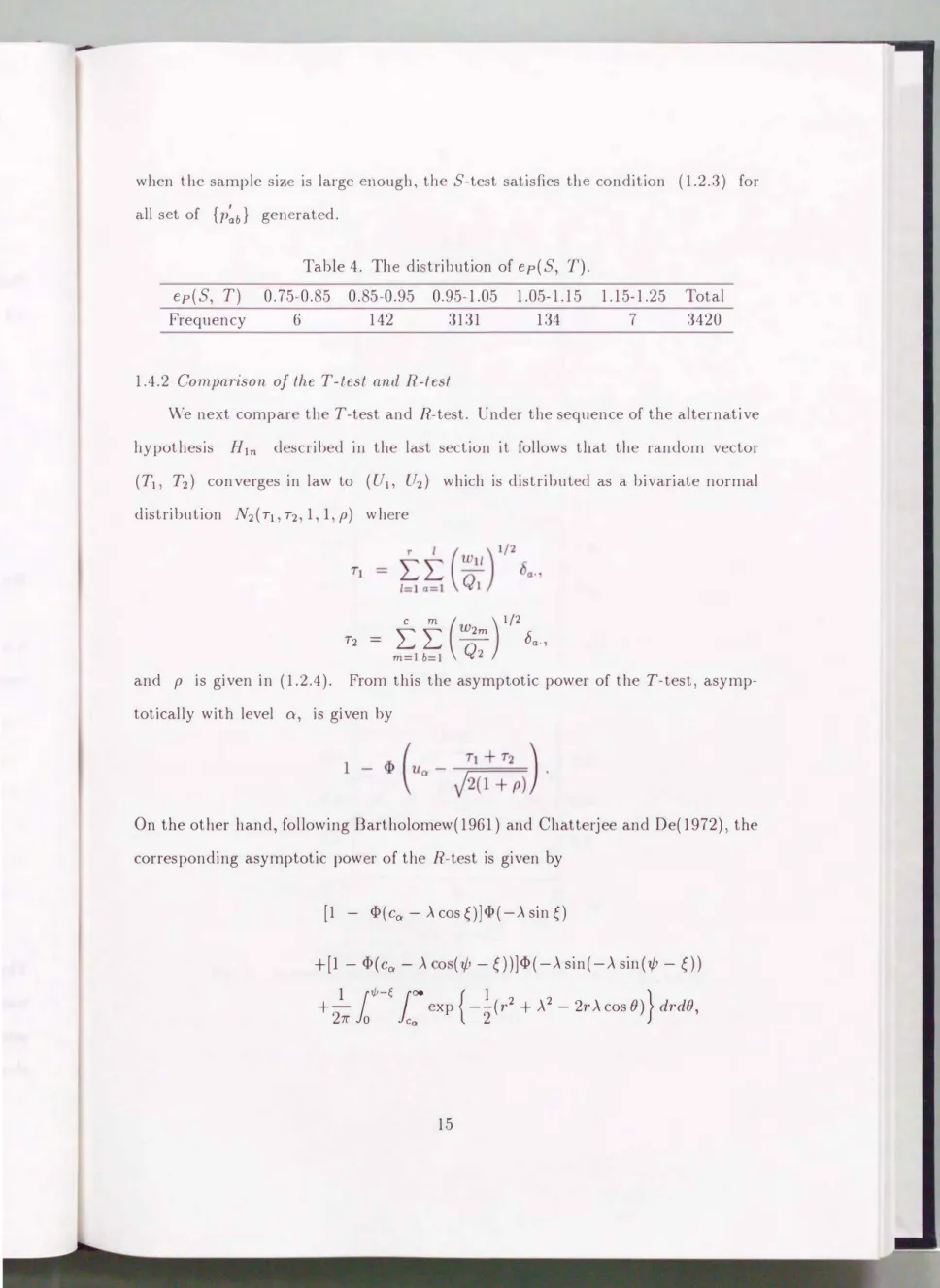
ep(S, T) 0.75-0.85 0.85-0.95 0.95-1.05 1.05-1.15 1.15-1.25 Total
Frequency 6 142 3131 134 7 3420
1.4.2
Comparison of the
T-test and R-test
We next compar th T-test and R-t st. Und r the sequence of the alternative hypothesis H1n described in the last section it follows that the random vector (T1 T2) converges in law to
(U1, U2)
which is distribut d as a bivariate normal distribution N2(T1,T2,1,1,p) wh rec
m ( )
1/272 =
m=l b=I L L
WQ
2m
2 8a.,and p is given in (1.2.4). From this the asymptotic power of the T-test asymp
totically with level a, is given by
On the other hand, following Bartholomew(1961) and Chatterjee and De(1972) the corresponding asymptotic pow r of the R-test is given by
[1
- <I>(ca-
Acos�))<I>(-Asin�)+[1-
<I>(ca-
A o(7/J-
�)))<I>( -A sin( -A sin('l/J- �)) 111/J-e joo {
1+- xp -
-
(r
2 + A2 - 2r A cosB) drdB, }
27r 0 c0 2
flr(C,)
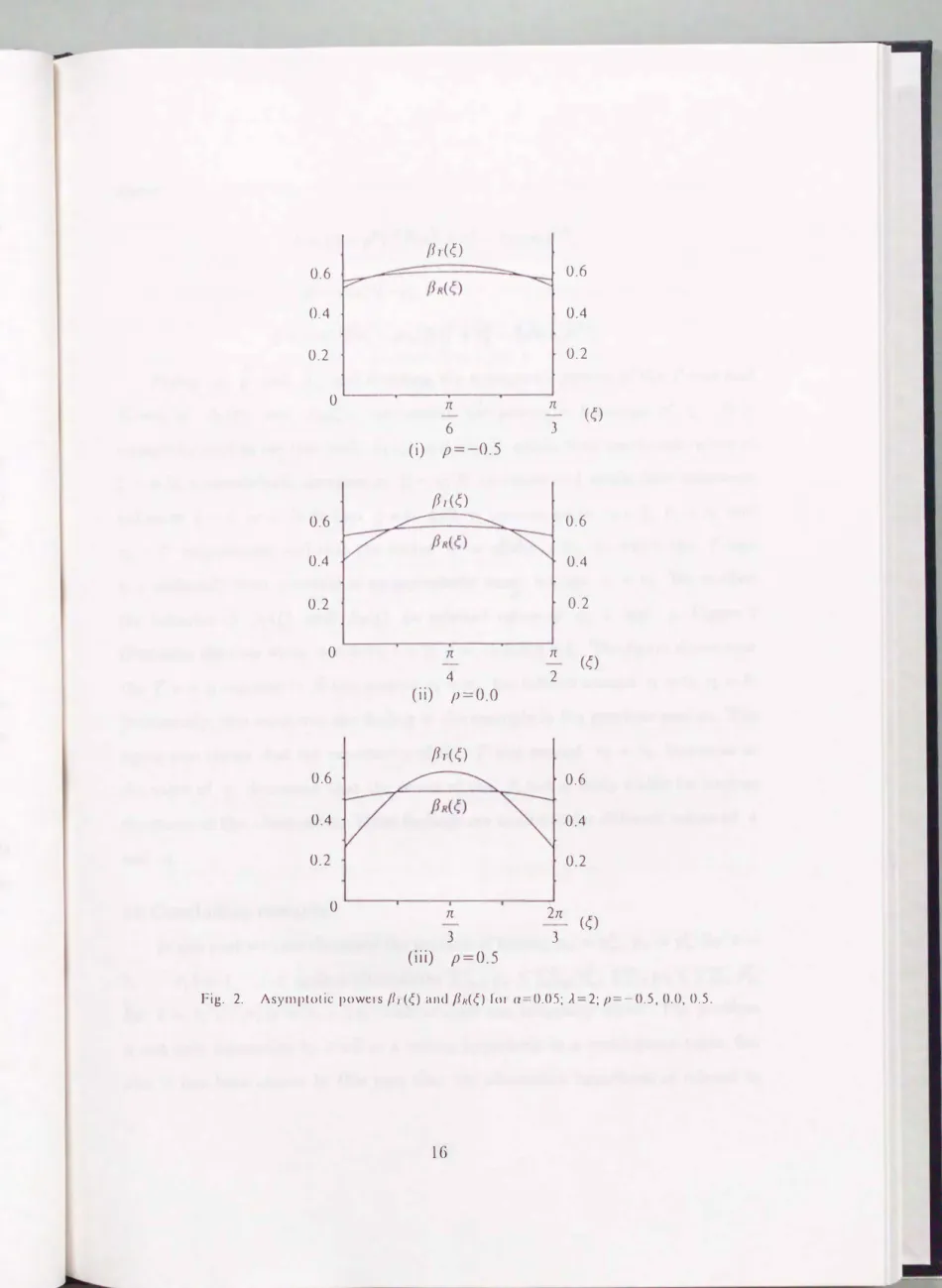
0.6 0.6
0.4 0.4
0.2 0.2
0 n n
({,)
6 J
(i) p=-0.5
fJ
1( {,)
0.6 0.6
0.4 0.4
0.2 0.2
0 n n
((,)
4 2
( ii) p=O.O
fJ
r( (,)
0.6 0.6
0.4 0.4
0.2 0.2
0 n 2n
(C,)
J J
(iii) p=O.S
Fig. 2. Asymptotic powers /11 (¢) und flu(¢) for a=0.05; A=2; p=-0.5, 0.0, 0.5.
16
wher
7/J
= cos-1(-p),
�
= cos-1[(71- p72)/(712
+7i- 2p7172)112].
Fixing a
p
and .A, and d noting th a ymptotic pow rs of the T-test and R-test byf3r(�)
andf3R(�)
w consid r th powers a functions of�·
It is traightforward to s e that bothf3r(�)
andf3R(�)
attain th ir maximum values at�
=7/J/2
symmetrically deer as asI�- 7/J/21
increase and attain their minimum values at � = 0 or7/J.
Not that�
= 0,7/J/2,
'ljJ corr pond to72
= 0,71
=72
and71
= 0 respectively and that th v ctor81
=c�d(c
> 0) to which the T-test is a uniformly most pow rful in an a ymptotic n e impli s71
=72.
We studied the behavior off3r(�)
andf3R(�)
for s lect d valu of a .A and p. Figure2
illustrates the case wh n a= 0.05; .A =
2; p
= -0.5, 0.0 0.5. The figure shows that the T-test is superior to R-test around71
=72
but inf rior around71
= 0,72
= 0.Incidentally this reinforce th finding in th xample in th pr vious section. The figure also shows that the superiority of th T-test around
71
=72
Increase as the value of p decreas s; that the pow r of th R-test is fairly stable for various directions of the alternatives. These findings ar unalter d for different values of .A and a.1.5 Concluding remarks
In this part we hav discuss d th probl m of testing
Pa·
=P�., P-b
=p?b
for a = 1, ... , r; b = 1, ..., c
against alt rnativ2::::�=1 Pa· :::; 2::::�=1 P�., 2::::�1 P·b :::; I:�1 p?b,
for l = 1, ... , r, m = 1, .. .
, c,
with at 1 a t on in quality stri t. Th probl rn is not only interesting by its lf as a t ting hypoth sis in a contingency tabl , but also it has been shown in this part that th alt rnativ hypoth is is relat d tothe on -sid d alt rnative in a comparati v study under a bivariate non parametric formulation.
We have consid r d th thr tests, S-te t, T-t st and R-test. The S-test 1s an approximat ly most string nt som wher most pow rful test. The T-test and R-t t combine approximately most stringent som wh re most powerful tests obtained from each marginal of the canting ncy table. Wher as the T-test simply adds, R-test employs the likelihood ratio crit rion for the combination.
The alternative hypoth si is compo it with restriction and it is difficult to compare th three tests in general. W hav consider d the r stricted family of alternativ hypothesi which is g n rat s by a bivariat normal di tribution for the comparison of the S-test and T-test. Al o w hav directly compar d the asymptotic powers of the T-test and R-t st. Under thes s tups it has been shown that the three tests are competitiv r garding th ir a ymptotic power in particular
i
)
T-test is highly comp titiv with th -t t.ii
)
T-test is superior to th R-test around E(
TI)
= E(
T2)
, but inferior to the R-test around E[
T1]
= 0 or E[
T2]
= 0.iii
)
The superiority of th T-test around E[
T1]
E[
T2]
Increase as the correlation of T1 and T2 decreases.iv
)
The power of th R-test is fairly tabl for various directions of the alternatives.
We could not compare the powers of th S-t st and T-t t dir ctly b cause of the involvement of too many paramet r .
The us fulness of th tests has b en shown by the practical data from a case
control study. It has be n shown that th T-t st has small r p-values than th R-test in the region around th straight lin , T1 = T2.
18
Part
2APPROXIMATELY SOMEWHERE MOST POWERFUL TESTS FOR MARGINAL HOMOGENEI T Y OF A
SQU ARED TABLE UNDER RESTRICTED
ALTERNATIVES
2.1 Introduction
Paired data measur d on a same seal fr qu ntly arise in many applied statistics.
When variables are classifi d into a number of cat gories, data ar summarized into
a square tabl . For an r x r table, we d not th cell and marginal probabilities by Pij, Pi+ and P+j for i, j = 1,
. . .
, r, and th corr sponding observations by nij ni+ and n+j for a ample size of n.For t sting homogen ity of th two marginal distributions;
Ho : Pi+ = P+i, i = 1,
.
. . r- 1Stuart(1955) gave a te t bas d on the tati ti S = d'U-1d where d =
(
n1+-and Uij = -
(
nij + nji)
for i # j i j = 1, ...
r-
1. Aft r hi work, Madansky(1963), Bhapker(1966) and Ir land Ku and Kullback(1969) propo ed other tests.
All of these test statistic asymptotically distribute a th chi- quare distribution with r -1 degrees of freedom( H reaft r w abbreviate as
d.f.)
under H0. These test statistics do not incorporate th ordinal prop rty of the variables. In fact, they are invariant to the permutation of the corr ponding rows and columns of the table and so applicable to any nominal cat gorical data. However ordinal data have often a tendency that eith r marginal distribution is stochastically larger than the other.In practice, such a situation occurs wh n the marginal distributions of the underly
ing distribution differ only in their location . Here our alternatives are represented as follows:
k k
Hl:
L
Pi+ �L
P+i,i=l i=l
k=l, ... ,r-1
or (2.1.1)
k k
L
Pi+ �L
P+i,i=l i=l
k=1, ... ,r-1
20
where at least on in quality is strict. For om sp cifi probability models, above hypoth s are d rived naturally. An xa1npl is giv n by the conditional symmetry model·
Pii
=TJ</Jii
(i
<j)
<Pii
(i
=j)' (2-TJ)<Pji (i>j),
where
L:�=l <Pii
+2 L:i<j <Pij
= 1. On thi mod 1, t sting H0 against H1 reduces to t sting TJ = 1 again t TJ =f 1. Some models giving ri to th s situations are listed in Agre ti(194).
For this testing probl m Agr ti(19
3)
propo ed the Mann-Whitn y test. Froma simulation tudy under an as umption of the bivariate normal distribution with a positive correlation co ffici nt h in i ted on th pow r uperiority of the Mann- Whitney te t over th Bhapkar' test which i ba ed on a chi- quared statistic that uses an estirnat of th non-null covariance matrix in t ad of U in the Stuart's test statistic S. He also recommended t sts ba ed on weighted urns of the marginal differences, but he did not discu in d pth th way how to 1 ct the weights.
In this part these tests based on th weight d urn of marginal differences are called approximately sorn wher most pow rful unbia d(SMPU) te ts as explained in section
2.2.
We must remark that, for orne alternatives in H1, the approximatelySMPU tests may have 1 ss powers than th chi-squar d tests. As a chi-squared test we consider the Stuart's test in thi part. In s ction
2.2
th Mann-Whitney statistic TMw in normalized form is shown to be an approxirnat ly SMPU test statistic. Mor over, an optimal t t among th approximat ly SMPU te t is derived under the most string nt principl . In ction2.3,
th asymptotic powers of the approximately SMPU t sts and th Stuart' test ar studi d und r the s quenc of alternatives converging to H0. S tion2.4
i d vot d to xplore th optimal test when a continuous bivariat distribution is assum d a an und rlying di tribution. In section2.5,
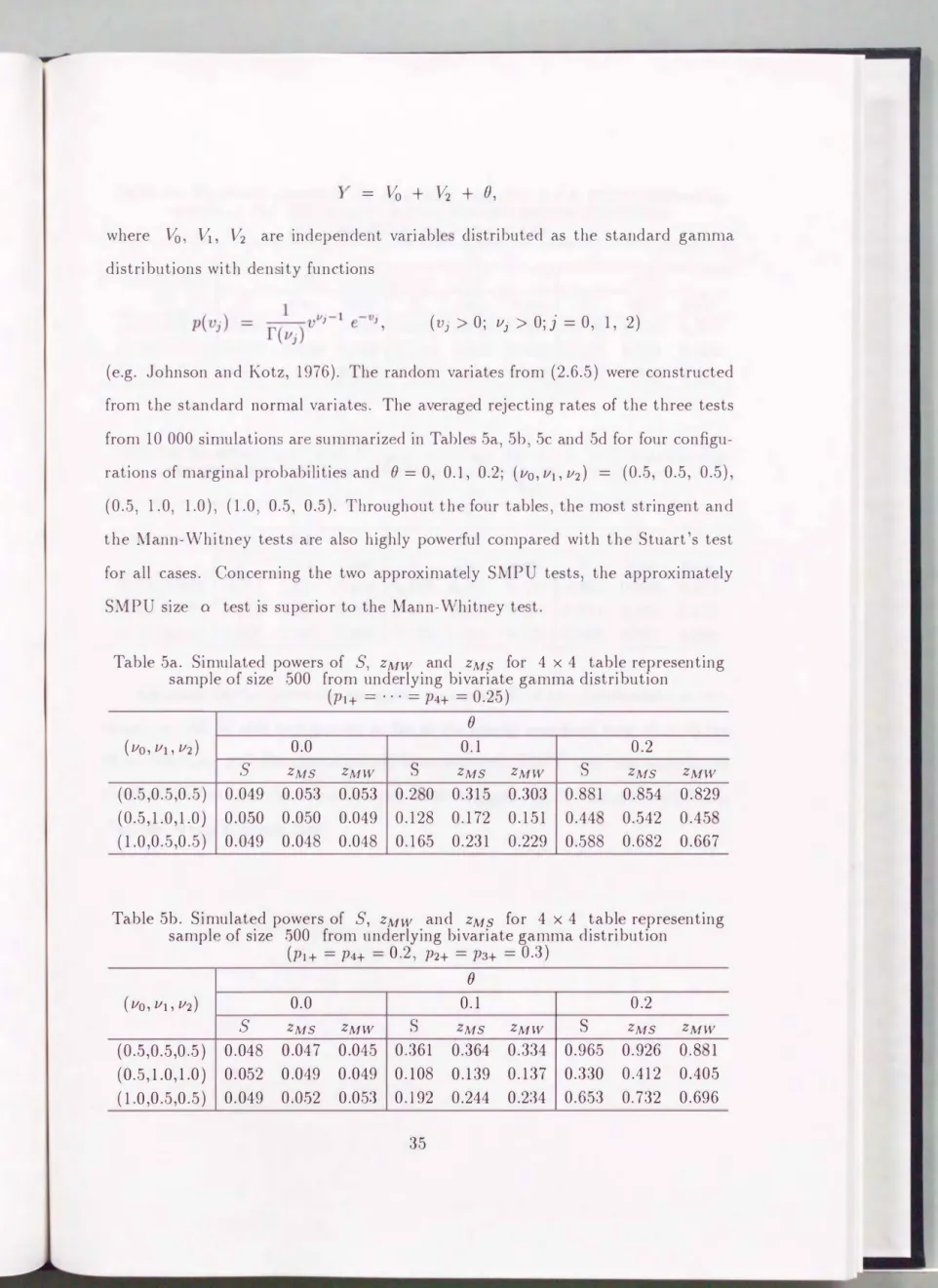
thre tests ar appli d for the unaid d di tan vi ion data. Simulationstudy is performed in section 2.6, assuming a bivariate normal distribution and a bivariate gamma distribution a an und dying distribution.
2.2 Approxin1.ately son1ewhere n1ost powerful unbiased tests We denote the cumulative marginal probabilities by
k P[k]+ LPi+,
i=l k' P+[k'] = LP+j,
j=l
and the corre ponding cumulative observation by n[k]+ and n+[k'J for k, k' 1, ... , r - 1. Then the alternativ s H1 in (2.1.1) is rewritten as
H1 : P[iJ+ < P+[i], z = 1 ... r- 1, or
P[i]+ � P+(iJ, i = 1, ... ,r-1,
where at least one inequality is strict. It is easily s en that the vector
has the mean,
nO = n(P[IJ+ -P+[l], ... , P[r-IJ+ - P+(r-1])'
and the covariance matrix, nE = n(a-ij), wher
i r
O"ij = L L (Pst + Pts) -(P(i]+ -P+(i]) (P[j]+ -P+[j]) s=lt=j+l
for 1 S i S j S r - 1. Especially, und r H0, we have (J = o and
t r
O"ij = L L (Pst + Pts) s=lt=j+l
22
with p's sati fying H0. Throughout this part w assume the covariance matrix � to be nonsingular. For testing 1-!0 again t
H1,
the statistics in our considerations are all repre en ted in t rm of c. In fact, th Stuart's test statistic can be rewritten as S = c'V- 1
c, wh r V= ( Vij)
withVij = L::=1 L:;=j+1 ( nst
+nts)
for1 :s; i :s;
j :s; r-
1. For testing H0 against H1, Agresti(
193)
recommend d the use of the Mann-Whitney statistic,TMw =
l:::(ni+n+j- nj+n+i)·
i<j
Note that TMw
/n
detects the probability cliff r nee,P(X
<Y) - P(X
>Y),
provided that
X
andY
are ind p nd ntly di tributed as the multinomial distributions
P(X
=i) =Pi+,
andP(Y = j) = P+j
fori j = 1 ... , r
respectively. As is well-known the Mann-Whitn y stati tic TMw alg braically coincides with the Wilcoxon statisticMoreover we can easily show that
r-1
TMw
= l:::(ni+
+n(i+1)+)(n[i]+- n+[iJ) i=1
= - L(n+i r-1
+n+(i+1))(n+[i] - n[i]+)·
i=1
Thus we have
Proposition 1.
The Mann- Whitney tatistic is expr ed as
1
r-1
TMw
= 2 � (ni+
+n+i
+n(i+1)+
+n+(i+1))(n[i]+- n+[iJ)·
l=1
Agresti also suggest d the tests based on w ight d urns of marginal cliff r n s,
r-1
Tw = L w;(ni+- n+i),
i=1
but he did not discuss nough th s 1 ction of th w ights. To r present the statistic according to the alt rnative hypoth ses, w employ
r-1
Tw =
L Wi(n[i]+- n+[ij).
i=1
From the larg sampl th ory, the statistic
yin( n -1 c - 8)
asymptotically distributes asNr_1 ( o, �)
that is, the(
r- 1
)-variate normal distribution with meano
and covariance matrix�.
LetX
=(X1, ... , Xr_t)'
be distributed asNr_1(v, f)
with known r. We also us the notationv::; (�)o
which means that all component ofv
are nonpositive (nonn gativ)
. For testing the null hypothesis,v
=o,
against th alternatives,v ::; o
orv � o ( v =f o)
consider a test given by;Reject the null hypothesi if
lw' X II vw'fw
�Uaj2
wh rew � o(
w=f
0)
andua;2
is the uppera/2
quantile of the tandard normal distribution. This test is the most powerful unbiased sizea
t st again t the alternative{v· v
= kr-1
w k=f 0}
and therefore it is called a som wh r most powerful unbia ed(SMPU) size
a
test (Schaafsma and Smid,1966).
In our probl m of testingH0
againstH1,
we call the approximated test based onw'cjvw'Vw
an approximately SMPU test. We remark that the weight vectorw
may d pend on the ample. In fact, the normalized Mann- W hitney test stati tic is given byzMw =
1r'cjV1r'V1r
with
1r
=n-1(n1+
+n+1
+n2+
+n+2, ... , n(r-1)+
+n+(r-1)
+nr+
+n+rY·
We consider an optimal test among th approximat ly SMPU te ts employing the most stringent principle explored by Schaafsma and Smid
(1966).
Let C b the class of SMPU sizea
tests forv
=o
againstv ::; o
orv � o( v =f o)
andf3ct>( v)
be the power of th test ¢ E C atv.
Mor over w u th notationlct>,c(v)
=sup(31/l(v)- f3ct>(v),
1/;EC
24
which is called the shortcorning of the t st
¢
among C. The most stringent SMPU size a test is d fin d by th SMPU iz a test¢
that satisfiessupf'¢,c(v) = inf sup/,p,c(v).
v�O 1/;EC v�O
Thu the most tring nt SMPU t st is th SMPU t t that minimiz s the maximum shortcoming arnong th SMPU t sts( For d tails Schaafsma and Smid, 1966
)
. Weapply this test approximately in our situation, and w call th test an approximately most string nt SMPU size a test.
Put v-1 = (
vij)
ande
=fo( #,
· · ·Jvr-1,r-1
)'
. Then, from Theorem 2.1 of part 1 with a minor modification for th two-sided alternativ s we haveProposition 2. The approximat ly mo t tringent SMP U te t is given by the statistic
ZMW =
e'c!/e've.
2.3 Comparison of the asymptotic powers
To see the behavior of these test stati tics in a neighborhood of p's satisfying
H0,
we consider the following s qu nee of alternatives according to the sample sizewhere
Pi+
=P+i,
i = 1, . . . , r and8'
satisfy (i)I::i=1 2::j=1 8ij
= 0; (ii)8[i)+
=I::i=18k+
= 0 fori= 1, ..
. ,r -1; (iii)8+[i)
=I:i=18+k:::;
0 for i = 1,..
. ,r -1 or8+[i)
� 0 for i= 1, ... ,r- 1, withat l a t on in quality b ing stri t. Unci rH1(n),
as n tends to infinity, the Stuart's stati tic S conv rges in law to the none ntral chi-square distribution,
x;_1(1'�-11)
(cf. Bishop, Fi nb rg and Holland, 1975)
withr -1 d. f. and noncentrality par am t r
1'�-11
wh r1
= (8+[1] ... , 8+[r-1] ) '
and
�
consists of p's.Under
Hin),
the statisti ,Zw ==
w'ciVw'Vw,
with a constant vector
w
==(
WI, .. . , Wr-d
' conv rges in law , as n ---+ oo, to the normal di tribution with m an-w'IIVw''L.w
and unit variance. Similarly, forzMw and ZMs, we have
Proposition 3.
The tatistics
ZMWand
ZMasymptotically distribute as the
normal di tributions with unit variances and m an , - 1r �
11 .j1r�r.1ro, -e.�, 1 .J e�r.eo)
respectively, where 1ro
==(PI+
+P+I
+P2+
+P+2 ... , P(r-I)+
+P+{r-I)
+Pr+
+P+r )'
and f..0
==( y'ail,
..
., J O"r-I,r-I )'
,provided ( O"ij)
==r_-I.
The asymptotic pow r function of the t st ba ed on Zw is given by
where <I>( x) is the standard normal di tribution function. W r trict 8's so a
/'r.-I/
==A
for a fixedA.
Thus th t st ba d on Zw is an asymptotically most powerful unbiased size a test again t th alt rnativ where 1 ==kr.w
for a constantk,
when the power is given byLet
X�,I-a
be the upper a-quanti! of th 2-distribution withk d.f.,
and putWe also define
1-la(/3)
by the positiv solution of 11 to th equation,Then we have
Proposition 4.
For a positive constant
TJ,th test bas d on
Zwhas the power larger than or equal to
TJ •/3r-I
(a,A) if and only if
26
jw'rl/v'w'�w
2:lla(17
·f3(a, A)). (2.3.3)
Let T be the angl between the vectors
1
and�w
with r spect to the inner product,(a, b)= a'�-1b.
Then the inequality(2.3.3)
is equivalent to>
lla(7]·/3r-1(a,A))
COST
1\ .
- VA
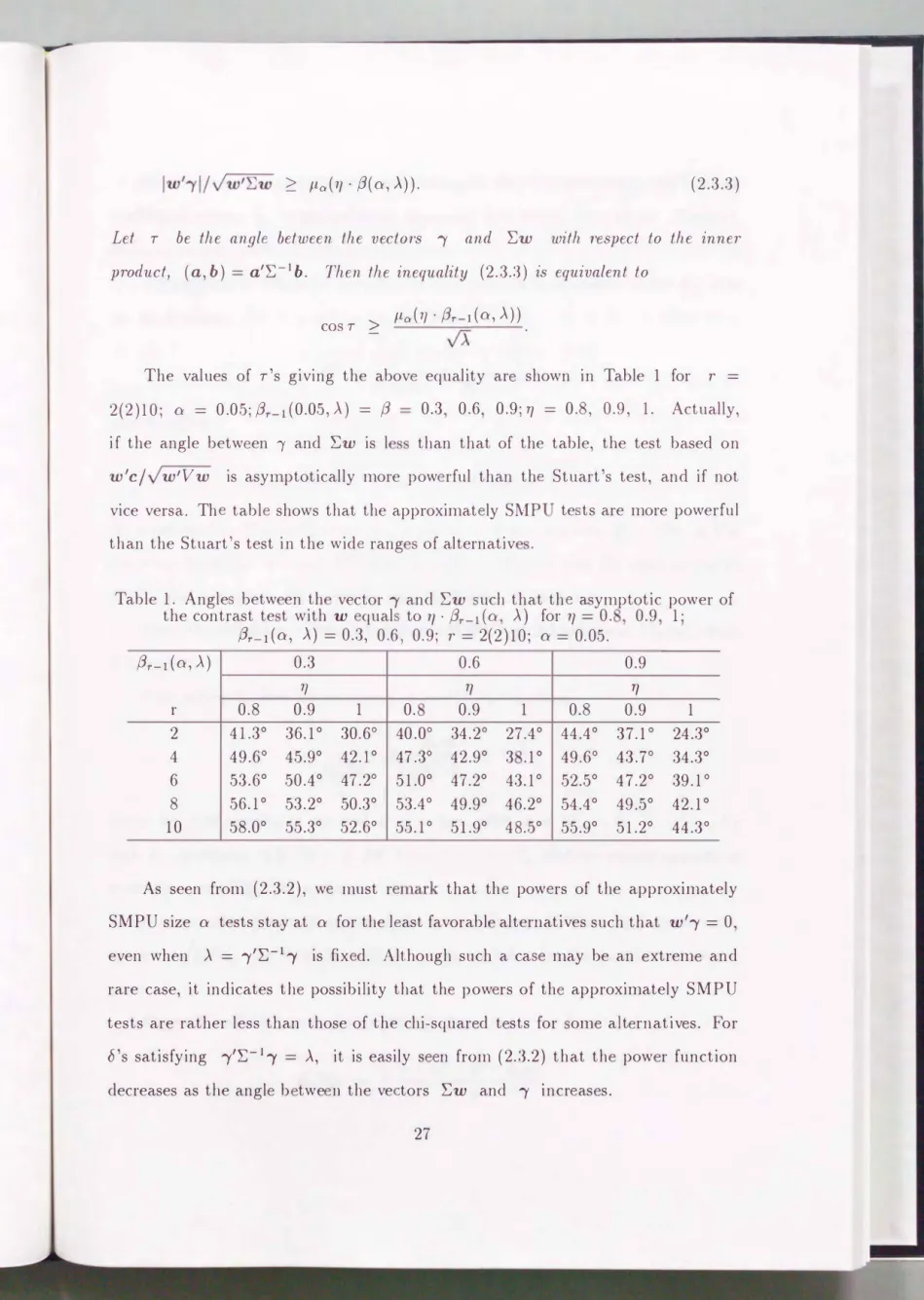
The values of T 's giving the abov equality ar shown in Table
1
for r= 2(2)10; a = 0.05; f3r-I (0.05, A) = /3 0.3 0.6 0.9;
7]= 0.8, 0.9, 1.
Actually, if the angle betw en 1 and�w
is 1 than that of the table, the test based onw' cj J w'V w
is asytnptotically more pow rful than th Stuart's test, and if notvice versa. Th tabl shows that the approximat ly SMP te ts are more powerful than the Stuart's test in the wid rang s of alternativ .
Table
1.
Angle betw en th vector1
and�w
uch that th asymptotic power of the contrast te t withw
qual to17
·f3r-I (a A)
for 77 =0. 0.9 1·
f3r-l(a, A)= 0.3, 0.6 0.9;
r= 2(2)10; a= 0.05.
f3r-l(a, A) 0.3 0.6 0.9
7]
7] 7]r
0.8 0.9 1 0. 0.9 1 0.8 0.9 1
2 41.3° 36.1° 30.6° 40.0° 34.2° 27.4° 44.4° 37.1° 24.3°
4 49.6° 45.9° 42.1° 47.3° 42.9° 3 .1 ° 49.6° 43.7° 34.3°
6 53.6° 50.4° 47.2° 51.0° 47.2° 43.1° 52.5° 47.2° 39.1°
8 56.1° 53.2° 50.3° 53.4° 49.9° 46.2° 54.4° 49.5° 42.1°
10 58.0° 55.3° 52.6° 55.1° 51.9° 4 .5° 55.9° 51.2° 44.3°
As seen from
(2.3.2),
w must r mark that th pow rs of the approximately SMPU sizea
tests stay ata
for the 1 ast favorabl alternatives such thatw'r = 0
even when
A = 1'�-Ii'
is fix d. Although such a ca may be an xtrem and rare case, it indicates th possibility that th pow rs of th approximately SMPU tests are rather less than those of the chi-squar d t sts for om alt rnativ s. For 8's satisfyingr'�-li' = A,
it is easily s n from(2.3.2)
that th pow r function decreases as the angl b twe n the ve tors�w
and1
incr as s.Concerning the approximat ly mo t stringent SMPU test statistic, the limiting coefficient v ctor
eo
is g nerally not xpr ss d in a simpl form of p's. However, some cases giv relativ ly sitnpl xpr sswns.Propo ition 5. Wh
n the va1·iabl s in each pair are independent under H0, that zs, Pii
=Pi+P+i for i, j
= 1, ... , r, we have
� ( -1-+
1)
2
Pi+ P(i+t)+ ' and therefore
for a constant
k.Esp cially when PI+
=P2+
=. .
. =Pr+' we have eo
=k'1ro
= k"1for some constants k' and k", with
1 =(1
... 1)' and thu the most stringent
SMPU
test a ymptotically coincid with the Mann- Whitney t st.
From the definition of the mo t string nt SMP t st(Schaafsma and Smid,1966), it follows:
Proposition 6.
For
8'sati fying
A =1'2:-11, we have
where the first equality is attain d at 1
= kiei,with ei
=(0, ... , 0 (1), 0, ... , 0)
and
kisatisfying r'2:-1r
= Afor i
= 1,. .. , r -
1,and the second equality is given by 1
=k'2:e0 for a con tant k'.
Thus the possible minimum pow r of th most stringent SMPU test d pends only on X =
.j e�2:eo
for fix d A and so X is an ind X for th po ibl minimum power.Proposition 7.
When O"ij Py'CJiiO"jj for i =/= j, we hav (r
-1){1+ (r-
3)p}1-p 28