
Securing Data with Provenance and Cryptography
アムリル, シャリム
http://hdl.handle.net/2324/1959201
出版情報:九州大学, 2018, 博士(情報科学), 論文博士 バージョン:
権利関係:
and Cryptography
Amril Syalim
Department of Informatics
Kyushu University
With the advances in the network technology, it is now possible to implement the databases and applications as services. The main advantage of this model is the users can use the services at a fraction of the cost to maintain their own servers. The users can also use a powerful distributed computational resource that is provided as a service for their computation heavy tasks. However, this model has a fundamental problem, because the data are stored in the servers owned by the entities that are not controlled by the users, the users need to concern about the confidentiality and integrity of their sensitive data.
In a distributed system, because the tasks can be executed by many computers, some auditors may need to verify the integrity of data produced by the system.
Many researchers suggested the idea to implement the provenance concept in the distributed systems. In the context of the computer systems, the provenance of data is recorded as a collection of assertions created by the process executors that describe the origins and the processes to produce the data. The provenance is stored in a special database, we call the Provenance Store, that should be accessible to the auditors who need to verify the data integrity.
The Provenance Store should be protected from malicious entities who try to up- date the provenance assertions. The update to the provenance causes the integrity problems, namely “inconsistent claims” and “inconsistent interpretations” prob- lems. Storing the provenance in a trusted storage can prevent the attack. However, it is not practical to be implemented in many systems. We propose an integrity scheme that can be used to detect any changes to the provenance assertions by employing a signature chain and assigning a consecutive counter produced by a Trusted Counter Server (TCS) to each assertion.
The provenance should also be protected from unauthorized accesses. The existing methods for the access controls are designed for regular data that are not suitable for the provenance. A critical information in the provenance that needs to be protected by the access control is the causal relationships between the process and the data. We propose a method to implement access control system by defining the access right we call TRACE, that can be used to define access policy to a collection of assertions that have causal relationships to a specific assertion. We combine the TRACE right with a Multilabels method to support better granularity of the access restrictions.
In this thesis, we also discuss the method to protect the integrity of a sequence of documents by using digital signature. The signature is used to prove the authentic- ity of each document and the order of the documents in the sequence. The existing signature schemes have some disadvantages: either we need to include another in- formation to prove the order of the sequence (i.e., trusted time-stamps/counters) or during the verification, we need to have access to all (or large numbers) of the signed documents. We propose a scheme that allows a party to sign a sequence of digital documents with the following characteristics: (1) the party can prove the order of the document in the sequence without having a trusted timestamps/- counters, (2) the party can verify the authenticity of the members of the sequence without having access to all other members in the sequence, and (3) the stor- age that is needed for the signature is smaller than signing each member of the sequence.
To protect confidentiality of the data in an untrusted server, the data owner can encrypt the data before storing the data in the server. The problem is when- ever the data owner needs to update the encryption key, the data owner needs to re-encrypt the data by downloading the data from the server, decrypting the data, encrypting the data with the new key and uploading the new encrypted data to the server. It is desirable to have more efficient re-encryption method where the data owner can securely delegate the re-encryption process to a semi-trusted party (i.e., a proxy). Most symmetric ciphers do not support proxy encryption because malleability (the ability to meaningfully convert the ciphertext) is not a desired property in a secure encryption scheme. We propose a symmetric encryp- tion scheme that supports proxy re-encryption by first transforming the plaintext into a random sequence of blocks using a variant of an All or Nothing Transform (AONT), and then transforming the random sequences by using some combina- tions of permutations.
I am indebted to my research advisors, Professor Kouichi Sakurai, Professor Yoshi- aki Hori and Professor Takashi Nishide for their guidance, comments, supports and helps in everything related to my research work.
I am very grateful to my external advisors, Professor Toshihiro Yamauchi (Okayama University) and Dr. Naohiko Uramoto (IBM Tokyo Research Laboratory) for their advices during my study.
I am also very grateful to the Japanese Government (Monbukagakusho/MEXT) for the scholarship scheme and many supports provided by the Kyushu University during my study.
Many thanks to Professor Masafumi Yamashita and Professor Tsuyoshi Takagi for thoroughly checking my thesis and presentation that result in significant improve- ments to the thesis and presentation from their earlier drafts.
I would like to thank Professor Daisuke Ikeda and Professor Masaya Yasuda for their insightful and critical comments during the review of the thesis.
I would also like to express my gratitude to all members of Sakurai Lab, including all of the Japanese students, China Scholarship Council (CSC) students, Erwan Le Mal´ecot, Chunhua Su, Prof. Kyung Hyune Rhee and all other members who have helped me with rich discussions during seminars or casual discussions. I would also like to thank Dr. Junpei Kawamoto, Dr. Sabyasachi Dutta, and Nakano-san (KDDI Laboratory) for supportive discussions during the thesis revision. I would like to thank Sakurai Lab secretaries and also Misni Harjo Suwito for their kind help during the exam and public hearing.
I would like to give special thanks to my wife, daughter, and son for their supports during my study and writing this thesis.
iii
Abstract i
Acknowledgements iii
List of Figures xi
List of Tables xiii
1 Introduction 1
1.1 Summary of the Contributions . . . 3
1.1.1 An Integrity Scheme for the Provenance Recording System . 3 1.1.2 An Access Control Model for the Provenance Recording Sys- tem. . . 5
1.1.3 A Method to Sign a Sequence of Digital Documents . . . 6
1.1.4 A Proxy Re-encryption Scheme for the Symmetric Key Cryp- tography . . . 7
1.2 Thesis Organization. . . 9
2 Background 11 2.1 Cloud Computing . . . 11
2.2 Provenance Recording Systems . . . 13
2.2.1 What is the Provenance? . . . 13
2.2.2 Fine-grained vs Coarse-grained Provenance . . . 15
2.2.2.1 Fine-grained Provenance . . . 15
2.2.2.2 Coarse-grained/Workflow-based Provenance . . . . 16
2.2.3 Open Provenance Model . . . 18
2.2.4 Provenance vs Version Control System . . . 19
2.2.5 Related Projects on the Provenance . . . 21
2.2.5.1 EU Provenance Project . . . 21
2.2.5.2 Provenance in Healthcare Management . . . 22
2.2.5.3 Provenance Aware Storage System (PASS) . . . 24
2.2.5.4 Sprov Library . . . 25
2.2.5.5 Panda: A System for Provenance and Data . . . . 25
2.3 Modeling the Provenance Recording System . . . 26
2.3.1 Preliminaries . . . 27
2.3.2 Modeling the Distributed System . . . 27 v
2.3.3 Modeling the Storage . . . 29
2.3.4 Modeling the Parties . . . 31
2.3.5 Our Definition of Provenance . . . 32
2.3.6 Provenance Graph Model . . . 34
2.3.7 The Provenance Recording Protocol. . . 36
2.4 Basic Cryptography. . . 37
2.4.1 The Primitives . . . 38
2.4.1.1 Collision Resistant Hash Functions . . . 38
2.4.1.2 Private Key Encryptions . . . 40
2.4.1.3 Public Key Encryptions . . . 42
2.4.1.4 Digital Signatures . . . 44
2.4.2 How to Prove the Security of Cryptosystems . . . 46
2.4.2.1 Security Reduction . . . 46
2.4.2.2 Proofs in the Random Oracle Model . . . 47
2.4.2.3 Attack Scenarios . . . 48
2.4.2.4 Game-based Security Proof . . . 49
2.4.2.5 Simulation-based Security Proof. . . 56
3 An Integrity Scheme for the Provenance Recording System 59 3.1 Introduction . . . 59
3.1.1 Motivation. . . 60
3.1.2 The Problems of “Inconsistent Claims” and “Inconsistent Interpretations” . . . 62
3.1.3 Contributions . . . 63
3.2 Related Work . . . 64
3.3 Preliminaries . . . 68
3.3.1 Modeling the Security of the Provenance . . . 68
3.3.2 Definition of the Provenance . . . 69
3.4 Proposed Scheme . . . 71
3.4.1 Extended Hash/Signature Chain . . . 71
3.4.2 Labeling Each Assertion with Unique Counter . . . 72
3.4.3 Secure Provenance Recording Protocol . . . 72
3.5 Security Analysis . . . 75
3.6 Storage Requirements for the Integrity Schemes . . . 76
3.7 Beyond the Counter: Certificate of Relationships . . . 77
3.7.1 Including Certificate of Relationships . . . 78
3.7.2 How to recover the missing nodes . . . 79
3.8 Discussion: Public Key Infrastructure and Replay Attack . . . 79
3.9 Performance Analysis . . . 80
3.10 Conclusion . . . 80
4 An Access Control Model for the Provenance Recording System 81 4.1 Introduction . . . 81
4.1.1 The Problem of Access Control to the Provenance . . . 82
4.1.2 Contributions . . . 83
4.2 Related Work . . . 83
4.3 Preliminaries . . . 86
4.3.1 Definition of the Provenance . . . 86
4.3.2 Provenance Storage . . . 87
4.3.3 Access Control Enforcement . . . 87
4.4 Proposed Access Control System . . . 89
4.4.1 TRACE and Multilabels . . . 89
4.4.2 Implementation of the Multilabels . . . 90
4.4.3 Implementation of the TRACE . . . 91
4.4.4 Access Control Decision . . . 92
4.4.5 Security Analysis . . . 94
4.4.6 Performance Analysis . . . 95
4.5 Alternative Implementation: Encryption-based Access Control . . . 96
4.5.1 Encryption Method . . . 96
4.5.2 Key Generation . . . 97
4.5.3 Provenance Recording Protocol . . . 97
4.5.4 Accessing the Provenance . . . 98
4.5.5 Access Control Policy. . . 98
4.5.6 Performance Analysis . . . 99
4.6 Conclusion . . . 99
5 A Signature Scheme for a Sequence of Digital Documents 101 5.1 Introduction . . . 101
5.1.1 Problem Description . . . 101
5.1.2 Usage of the Proposed Scheme. . . 102
5.1.3 The Basic Method and Our Previous Attempts . . . 102
5.1.4 Contributions . . . 103
5.2 Related Work . . . 104
5.2.1 Plain Signature . . . 104
5.2.2 Signature Chain . . . 105
5.2.3 Signature Aggregate . . . 105
5.2.4 Signature with Message-Recovery . . . 107
5.3 Preliminaries . . . 108
5.3.1 Definition of the Signature . . . 108
5.3.2 Security Model . . . 109
5.3.2.1 Extended Existential Unforgeability Under Chosen Message Attack (EEUF-CMA) . . . 109
5.3.2.2 Order Unforgeability Under Chosen Message At- tack (OUF-CMA) . . . 110
5.3.3 Complexity Assumptions . . . 111
5.3.3.1 Assumption about the Hardness of the RSA problem111 5.3.3.2 Assumption about the Hash Functions . . . 112
5.4 Proposed Scheme . . . 112
5.4.1 Notations . . . 112
5.4.2 Primitives: VPSign, VPPla,VPVer . . . 113
5.4.3 Signing the Sequence . . . 114
5.4.4 Correctness of the signature scheme . . . 116
5.4.5 Proving the order of the sequence . . . 118
5.4.6 Signature size . . . 118
5.5 Security Proofs . . . 118
5.5.1 Security under EEUF-CMA . . . 118
5.5.2 Security under OUF-CMA . . . 121
5.6 Comparison of Our Scheme with the Other Schemes . . . 125
5.7 Conclusions . . . 126
6 Proxy Re-encryption for Symmetric Key Cryptography 127 6.1 Introduction . . . 127
6.1.1 Security Model . . . 128
6.1.2 Contributions . . . 130
6.2 Related Work . . . 130
6.2.1 Ciphertext Transformation and Proxy Re-encryption . . . . 130
6.2.2 All or Nothing Transform . . . 132
6.2.3 Our Original Scheme . . . 133
6.3 Preliminaries . . . 134
6.3.1 Notion of Security . . . 134
6.3.2 PRF and PRP Advantages . . . 136
6.3.3 Difference Lemma . . . 137
6.4 The Primitives . . . 137
6.4.1 All or Nothing Transform (AONT) . . . 137
6.4.2 The functions PE,DP, and F C . . . 139
6.4.3 Permutation Key Generator (PGen) . . . 140
6.5 The Proposed Scheme . . . 142
6.5.1 Definition . . . 142
6.5.2 The Scheme . . . 142
6.5.3 Correctness of the Re-encryption FunctionRE . . . 145
6.6 Security Analysis . . . 147
6.6.1 Security Against Outsiders . . . 147
6.6.2 Security Against Previous Users . . . 148
6.6.3 Security Against Proxy . . . 149
6.6.4 A Note on Collusion Attack . . . 149
6.7 Performance Evaluation . . . 149
6.8 Discussion: Using CBC and CTR modes as Alternatives to AONT 150 6.8.1 Using CBC mode . . . 151
6.8.2 Using CTR mode . . . 152
6.9 Proof of the Theorems . . . 152
6.9.1 Proof of Theorem 6.6 . . . 153
6.9.2 Proof of Theorem 6.7 . . . 155
6.9.3 Proof of Theorem 6.8 . . . 157
6.9.4 Proof of Theorem 6.9 . . . 161
6.10 Discussion: An Attempt to Develop a Secure Proxy Re-encryption Using Pure Symmetric Cipher . . . 162
6.10.1 Xor-scheme (Vernam Cipher) . . . 162
6.10.2 Stream cipher-like encryption . . . 163
6.10.3 Block cipher-like encryption . . . 166
6.11 Conclusion . . . 167
7 Conclusion 169 7.1 Recent Research on the Provenance and the Signature Chain . . . . 170
7.2 Recent Research on the Proxy Re-encryption . . . 171
7.3 Suggestions for the Future Work . . . 171
A Implementation and Experimental Results 173 A.1 Experimental Setup . . . 174
A.2 Results . . . 175
Published Papers 179
Bibliography 181
Index 199
1.1 Provenance recording . . . 3
1.2 Provenance as a proof of responsibility of each process executor . . 4
1.3 Access Control to Provenance . . . 5
1.4 An Encrypted Database . . . 7
1.5 Translating ciphertext encrypted with one key to another without knowing the keys . . . 8
2.1 Provenance chain of a medical record . . . 17
2.2 An example of the Open Provenance Model [1] . . . 19
2.3 An Architecture of Provenance-Aware Application Proposed by EU Provenance Project [2] . . . 22
2.4 An Architecture of Portal-EHCR [3]. . . 23
2.5 An Architecture of Provenance-Aware Storage Systems (PASS) [4] . 24 2.6 Provenance recording process in the Sprov Library [5] . . . 26
2.7 Execution Manager . . . 28
2.8 Provenance Store . . . 30
2.9 A Model of Provenance System . . . 31
2.10 The Uniform DAG model . . . 34
3.1 Provenance as a proof of responsibility of each process executor . . 62
3.2 Signature Chain . . . 63
3.3 A simplified model of Habert and Stornetta’s sceme . . . 65
3.4 Hash Chain . . . 66
3.5 Trusted Timestamping Service . . . 67
3.6 Trusted Counter Server (TCS) . . . 72
3.7 A Model of Secure Provenance System . . . 73
4.1 An Access Control Language for Provenance [1] . . . 86
4.2 Participants in the Provenance System . . . 88
4.3 Access Control Module . . . 89
4.4 An example of the access control policy . . . 99
6.1 Illustration of the encryption of a large block (`×n bits) . . . 145
A.1 Execution time of the Provenance Executor (in seconds) . . . 176
A.2 Execution time of the Provenance Store Interface (in seconds) . . . 176
A.3 Execution time of the TCS (in seconds) . . . 177 xi
5.1 Comparison with other signing methods . . . 125 6.1 The number of primitive executions . . . 150 A.1 Hardware and Software of experiment . . . 174 A.2 The complexity of each task (relative to the size of process docu-
mentationA) . . . 177
xiii
Introduction
Security is a classic problem and one of the most important requirements on the computer systems where the computers process and store sensitive data in many organizations. Since the invention and possible implementation of the time-sharing system, where the processes and data in a computer can be accessed by many people, there are many problems and security breaches involving the sensitive data.
Security is often defined in terms of CIA: confidentiality, integrity and availability.
Confidentiality requirements dictate who can access which sensitive data. The integrity prescribes that the data should not be changed/updated by unauthorized users. The availability defines that the data should be always accessible by its respective authorized users.
With the advances in the network technology, it is possible to outsource the com- putational and data storage to cloud services owned by Internet companies. The main advantage of this method is the users do not need to maintain their own physical computing and storage platforms. They can rent the computing and storage platforms at a fraction of the cost to maintain their own data centers. The users can also easily increase the capacity of the computing and storage platform without the need to physically buy new hardware. They can just change their plan to a more expensive one. However, the cloud computing model raise many security concerns because it has a fundamental weakness: the computing and stor- age platforms are not controlled by the users, so that the users should consider to implements additional security mechanisms to protect the confidentiality and integrity of their sensitive data.
1
To provide the computing and storage services to their users, a typical cloud systems uses a powerful distributed system (i.e., a grid system) to provide the services. In a distributed system, because the tasks can be executed by many computers, some curious parties (i.e., the auditors) may want to trace the origin and processes that produce the data (i.e., the provenance of data), so that they can judge the integrity and value of the data produced in the systems. The problem is the typical database services normally do not record the information about the origin and processes that produce the data, so that the cloud systems need to record the information using a provenance recording system. The provenance recording system, that is inspired from the provenance in the works of art, is suggested by many researchers to be implemented in a distributed system so that the auditors can completely trace the data history. The provenance recording systems keep the collection of metadata created by the process executors that describe the origins and the processes to produce the data. The metadata should be stored in a special database, we call the Provenance Store, that is accessible to the auditors. The problem is, the malicious parties, rather than attacking the databases, may also try to attack the Provenance Store to change the data history or access sensitive provenance. A trusted provenance recording system should implement security mechanisms to protect the data history and help the auditor correctly judge the value of data.
In this thesis, we are focusing on the problems to protect the integrity and confi- dentiality of data by implementing secure provenance and applying cryptographic schemes. In computing systems, a security problem can be defined by a descrip- tion of the state of computer systems and data when the attackers successfully break the systems or data security. The basic methods to protect the computing resources are by implementing access control schemes. Access control prevents unauthorized accesses by employing a trusted reference monitor (that can be im- plemented by a small program run in a tamper-resistant hardware) that intercepts all accesses and decides what are allowed and what are prohibited based on a secu- rity policy. The reference monitor can also be implemented in an operating system to mediate all accesses of users to the computer resources (application, memory or data), in a network router that mediates access to the network resources, or in a database interface that mediates access to data. A main challenge in an access control system is how to define policies that reject all possible malicious accesses while providing minimum accesses that are needed by authorized users efficiently.
Cryptography uses mathematical and statistical properties of cryptographic func- tions to ensure some security requirements. A central concept in cryptography is the one-way function that is a function that can be easily computed, but it is dif- ficult to compute the inverse. The one-way function can be implemented by some mathematical concepts that were treated pure theoretical (i.e., number theory, abstract algebra). It can also be implemented by a function that is heuristically developed and showed to be resistant to some specific security attacks. The main cryptographic schemes are encryption and digital signature that can be used to protect the confidentiality and integrity of data.
1.1 Summary of the Contributions
1.1.1 An Integrity Scheme for the Provenance Recording System
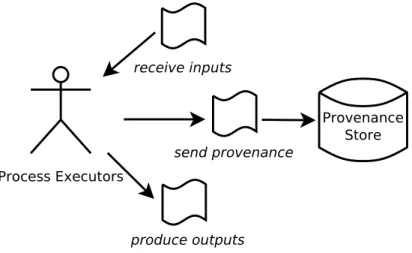
Process Executors
Provenance Store receive inputs
produce outputs send provenance
Figure 1.1: Provenance recording
In the context of the computer systems, the provenance is recorded in the form of assertions created by the process executors that explain about how to produce the data outputs. The provenance assertions are submitted by the process ex- ecutors to a dedicated database (in this thesis we call the provenance database as a Provenance Store – see Figure 1.1) for a long term storage and easy access by the auditors. The auditors are the parties who need to check and evaluate the processes to produce the data. An assertion submitted by a process executor confirms the responsibility of the process executor to the process and data output.
The assertion can also be an evidence to support the auditor’s appraisal about the quality and value of the data output.
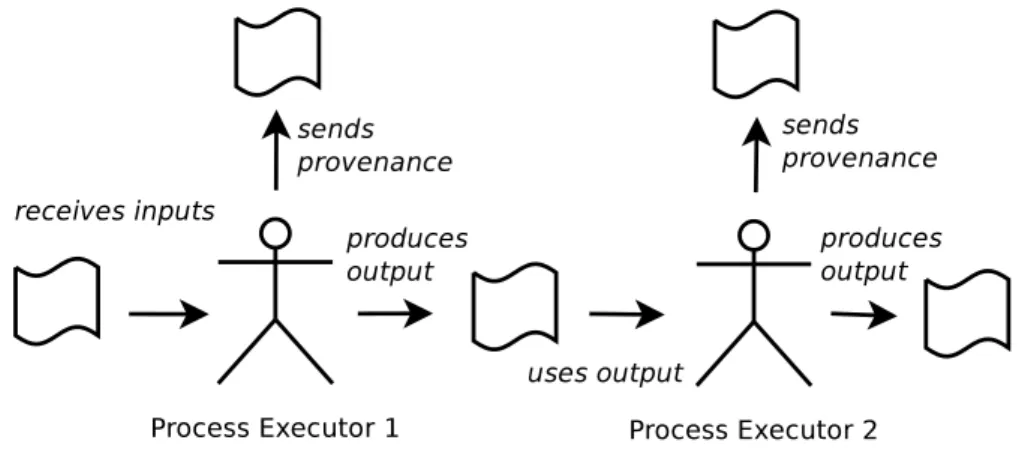
Figure 1.2: Provenance as a proof of responsibility of each process executor The provenance proves two main facts: the process to produce the data, and the source of the data. In a distributed system, the data can be produced by collab- orations of many process executors. The provenance of the distributed processes shows the contribution and responsibility of each process executor to each data output. By checking the provenance, the auditor should be able to trace whether there are more than one process executors should be responsible to the data out- put. For example, in Figure1.2,Process Executor 2 uses the output of theProcess Executor 1, so that in this case, the output of the Process Executor 1 affects the output of the Process Executor 2. Because the Process Executor 1 is responsi- ble to the data used by Process Executor 2, the Process Executor 1 should also be responsible in part to the data output produced by Process Executor 2. The auditor should be able to confirm the chain of responsibilities by inspecting the provenance and data.
The problem is, the provenance can also prove that some process executors are responsible for faulty processes that produce erroneous outputs. The faulty pro- cesses and outputs may cause disadvantages to the process executors who are responsible to the processes and outputs, because the parties who are affected by the outputs of the faulty processes may send complaints to the process executors.
The process executors may got reward (be respected) for high quality outputs, but they also may get disadvantages (penalty) if they produce low quality out- puts. The honest process executors will take responsibility to the faulty processes and all of the consequences (including bad reputation), and try to improve their credibility later. However, the malicious ones may try to avoid the responsibility by trying to update or delete the provenance of the faulty processes.
In this thesis, we propose an integrity scheme for the provenance recording sys- tem. We define the security model as “inconsistent claims” and “inconsistent interpretation” attacks. Our method uses the signature chain method and also uses a Trusted Counter Server (TCS) to label each provenance assertion with a consecutive and unique counter, and stores the latest counter in a trusted storage.
We show that the method can detect the “inconsistent claims” and “inconsistent interpretations” problems in the provenance system that cannot be detected by the normal hash/signature chain.
1.1.2 An Access Control Model for the Provenance Record- ing System
The provenance describes the processes to produce the data. To fully audit the processes, an auditor needs to access all of assertions created by the process execu- tors that have causal relationships with the data. A causal relationship means that a process has contribution or affects the output of another process. The causal relationship is transitive, so that if processA contributes the output of processB, and process B contributes to the output of processC, then the process A should have an indirect contribution to the output ofC.
User Provenance Storage
denied
allowed
Figure 1.3: Access Control to Provenance
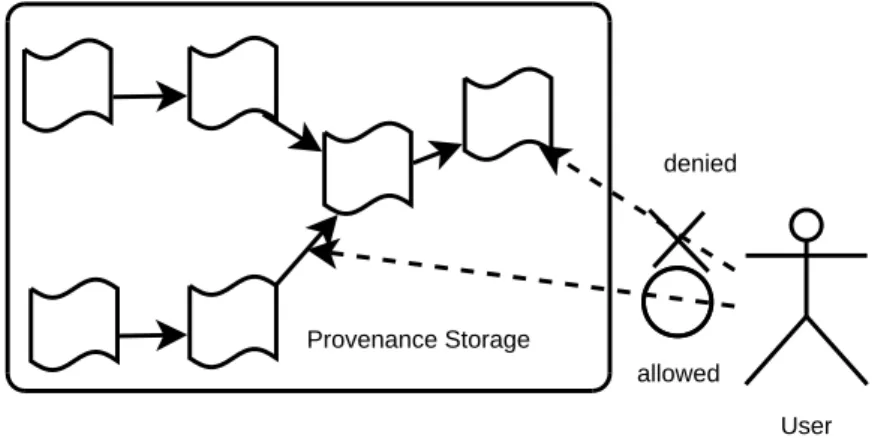
When an auditor needs to check the processes that led to a data object, for a full traceability of the causal relationships, the auditor needs to have access to all connected assertions. However, some of the assertions may be sensitive so that we need to restrict accesses by some auditors. A simple method of access control is by restricting access to each element of the provenance assertion: process docu- mentation and relationship between process documentations (see Figure1.3). It is
desirable to have an access control system that considers the causal relationships in the provenance and supports access control policy efficiently.
We propose an access control method to the provenance that supports access restriction based on the relationships between the provenance assertions. Our access control method restricts the traceability of the provenance assertion us- ing the access right we call TRACE. We combine the access right TRACE with the Multilabels method for better access granularity. We show and evaluate the implementation of our access control method by using a trusted and idealized reference monitor. We also propose an alternative implementation by using an encryption-based access control system for better security.
1.1.3 A Method to Sign a Sequence of Digital Documents
In a part of this thesis, we are concerned about the method to sign a sequence of digital documents (created by a party) that consists of many distinct docu- ments that are created sequentially. The signature of the sequence of the digital documents should prove two facts about the documents: the authenticity of each member of the documents, and the order of the documents in the sequence.
We identified two main differences of signing this type of documents with the signature scheme for a single document. The first one is the new members of the sequence can be added later after signing current existing members. The second difference is during verification of the members, we cannot assume that we have access to all documents in the sequence. We can only assume that we have access to the documents that will be verified.
A simple method to sign the sequence of the documents is by simply appending a consecutive counter to each member of the sequence and signing each consecutive member of the sequence with a standard signature. The signatures can be used to authenticate each member and also the order of the members without having access to other members of the sequence. However, this method has some disadvantages where we need to keep and track the unique identification number of each sequence, and also the counter does not represent the “hard-proof” about the order of the members in the sequence.
We propose a signature scheme for a sequence of digital document by extending the standard signature, so that it can be used to generate the signature sequentially
and also verifying the order of the members in the sequence. We show a variant of the signature with message recovery originally proposed by Bellare et al. and propose a signature scheme for the sequence of digital documents using a signature with message recovery as the primitive. We describe the security model of the scheme in the form of Extended Existential Unforgeability under Chosen Message Attack (EEUF-CMA) and Order Unforgeability Under Chosen Message Attack (OUF-CMA). We prove the security of the scheme in the random oracle model.
1.1.4 A Proxy Re-encryption Scheme for the Symmetric Key Cryptography
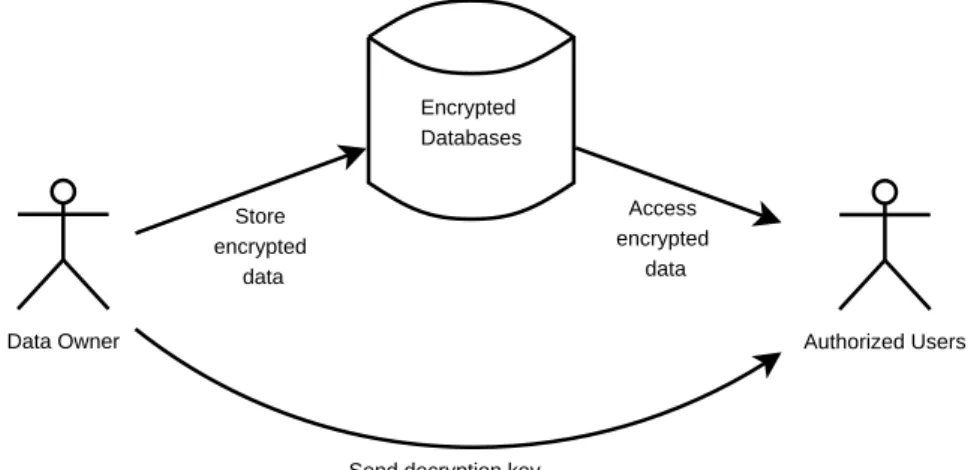
In a database service provider, the users may encrypt their data to protect the data confidentiality. In a typical implementation, the data is encrypted by the data owner before submitting the data, so that any other parties (including the service provider itself) cannot access the data without knowing the decryption keys (see Figure 1.4). The service provider can be an online provider in different places or organizations. The data owner encrypts the data because he/she may not trust the service provider, but he/she needs to use the database service so that he/she can access the data anywhere/anytime and does not need to be burdened with maintaining the database server. The data owner may also need to share the data to the other users. In an encrypted database, the data owner can share the data by simply providing the encryption keys that can be used to decipher the data.
Data Owner Authorized Users
Store encrypted
data
Access encrypted
data
Send decryption key Encrypted Databases
Figure 1.4: An Encrypted Database
A problem in an encrypted database is whenever the data owner needs to update the encryption/decryption keys because of the keys are leaked or the data owner wants to revoke access by the other users. Using the naive method, the data owner needs to download the encrypted data, decrypts the data and re-encrypts with the new key locally and submits the new encrypted data to the service provider. For a large encrypted data, this method is not efficient because the data owner needs to pay computation costs for decrypting and re-encrypting the data and high network cost for downloading and uploading the data.
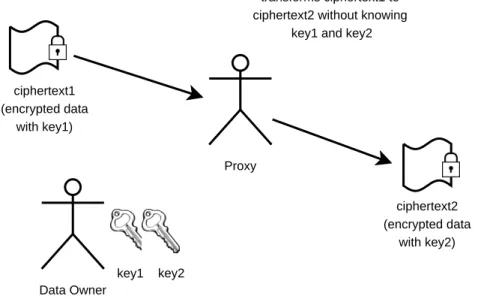
Proxy ciphertext1
(encrypted data with key1)
ciphertext2 (encrypted data
with key2) key1 key2
transforms ciphertext1 to ciphertext2 without knowing
key1 and key2
Data Owner
Figure 1.5: Translating ciphertext encrypted with one key to another without knowing the keys
A more efficient and desirable method is by allowing the service provider to re- encrypt the data with a proxy re-encryption scheme. Using this method, the re-encryption can be delegated to a proxy (that can be implemented in the service provider), without providing any encryption or decryption keys to the proxy. The proxy re-encryption works by finding a function that can directly translate the ciphertext encrypted with a key to another ciphertext encrypted with another key without knowing any encryption/decryption keys (see Figure 1.5).
In the asymmetric ciphers setting, we can use some beautiful mathematical func- tions and properties (i.e., pairing, homomorphic encryption property) to imple- ment a secure proxy re-encryption [6–10]. However, for performance reasons, the data is normally encrypted with a symmetric cipher (asymmetric encryption is much slower that symmetric encryption).
In this thesis, we propose a secure symmetric encryption scheme that supports fast key update and proxy re-encryption. The idea of our scheme is by first transform- ing the plaintext using an All or Nothing Transform (AONT) and then exploiting some of AONT’s characteristics to implement an efficient and secure proxy re- encryption scheme. We prove the security of the scheme under chosen plaintext attack security model. We also show that the scheme is more efficient than the simple decrypt and encrypt method.
1.2 Thesis Organization
This thesis consists of seven chapters.
• In the first chapter, we discuss the motivation and summarize all of the contributions that are included in this dissertation.
• In the second chapter, we discuss the background on the clouds and the provenance system and also the related projects on provenance system. We also describe our model for the provenance recording system. This model is used as a basis for the development of the integrity scheme and also the access control method described in the Chapter 5 and 6. In this chapter, we also discuss the background on cryptographic techniques.
• In Chapter 3, we describe our proposed method to protect the integrity of the provenance.
• In Chapter 4, we describe our proposal for the access control system that can be applied to a provenance recording system.
• In Chapter 5, we describe our proposed signature scheme that can be used to sign a sequence of digital documents.
• In Chapter 6, we describe our proxy re-encryption scheme in the symmetric cryptography setting.
• Chapter 7 is the conclusion of this thesis.
Background
2.1 Cloud Computing
The term cloud computing is typically referred to as the usage of computing ser- vices that are provided by the cloud companies. The customers of the cloud companies can access the computing services by using the networks (i.e., the In- ternet). The history of the cloud computing can be traced to the concept of time-sharing, where the resources of a computer (i.e., a mainframe) can be con- currently accessed by many users. With the advances of the network technologies, virtualization software, and distributed computing, it is now possible to provide many types of computing services in the Internet.
Foster et al. define the cloud computing as follows [11]:
A large-scale distributed computing paradigm that is driven by economies of scale, in which a pool of abstracted, virtualized, dynamically-scalable, managed computing power, storage, platforms, and services are deliv- ered on demand to external customers over the Internet.
A cloud computing system is a type of distributed system that is used to provide the computing resources as services [12]. Because the distributed system should provide an interface so that the users believe that they are dealing with a single system, the cloud computing is seen as a centralized system from the user’s per- spective [12]. From the perspective of the services provided by the clouds, the authors in [13] defines the clouds as everything as services (XaaS). So that, the
11
clouds can include SaaS (Software as a Service), PaaS (Platform as a Service), HaaS (Hardware as a Service), DaaS (Database/Desktop/Development as a Ser- vice), IaaS (Infrastructure as a Service), BaaS (Business as a Service), etc. They categorize the cloud services into four layers of the services [13] (from the low- est layer to the highest one): Hardware-as-a-Service, Infrastructure-as-a-Service (IaaS), Platform-as-a-Service (PaaS), Software-as-a-Service (SaaS).
The authors in [14] argue that the cloud should include both of the applications delivered as services over the Internet and the hardware and systems software in the data centers that provide those services. So that, all layers in the clouds are integral parts that support each other. From the economics perspective, they iden- tify that the clouds provide many advantages to the users/companies, because the users/companies can reduce the cost of maintaining their own hardware, infras- tructure, platform or software. Another advantage of the cloud is the scalability.
The users/companies can easily increase the computation power or storage to ful- fill their business requirements. However, they also suggest that the users should considers the security and reliability of the cloud services.
The authors in [15] found many security problems in the cloud, including the data integrity and data confidentiality. The main data security problems for an enterprise in the clouds are caused by the fact that data are stored outside of the enterprise boundaries. Without encrypting the data, the users have no choice other than trusting the cloud companies to protect their data.
Foster et al. argue that the cloud computing uses many concepts and services pro- vided by the grid computing [11]. The grid was originally proposed as a distributed computing infrastructure for advanced science and engineering [16,17]. The grid computing is basically a form of distributed computing that provide many services for the resources managements, for example the computing and data resources, virtualization and also the protocols for managements and communications.
Foster et al. state that an important feature in the grid that can also be useful in the cloud is the provenance system that is used to record the history of data [11].
In computer and grid systems, the provenance concept has been applied to record the history of data in the computer systems [18–21]. Other useful applications of the provenance concept are in the health-care applications [3, 22–24], and in the courts and police/law institutions [25, 26].
2.2 Provenance Recording Systems
2.2.1 What is the Provenance?
In the dictionary, provenance is defined as “the place of origin or earliest known history of something” and also “a record of ownership of a work of art or an antique, used as a guide to authenticity or quality” [27]. The word provenance in the English vocabulary was imported from the French word provenir, so we may say the provenance/origin of the English wordprovenanceis the French word provenir. Provenance of an object is a very useful information to understand the characteristics of the object. If we know the history about how the French word provenir was adapted to the English vocabulary, we may say that we know the provenance of the English word provenance. Furthermore, if we know the history of the French word provenir, for example its origin or the first person who used the word in conversation or writing, we have better understanding to all words that are derived from it, including its English word version.
The provenance has its root in the work of art where the provenance documents the history of an art object [28–30]. In the work of art, the provenance is used to estimate the quality (and also the value) of the art objects. An object origi- nated from famous artists and owned/maintained by trusted people/organizations has higher value than the object comes from unknown artists or maintained by untrusted people/organizations. In the traditional paper-based world, the prove- nance is recorded as a collection of documents that describe the origin of the object, and all events related to the object that affect the object’s current condition (i.e., who are the owners/maintainers).
In the context of the computer systems, Moreau and other researchers define the provenance as follows:
Definition 2.1(Provenance as Process). [2,31] The provenance of a piece of data is the process that led to that piece of data.
This definition says that to record the provenance of a piece of data, we should record the process that led to the data. We may record the process in detail, for example recording step by step of the process execution, or we may record as simple as the name of the process, with an assumption we understand the pro- cess from its name. Ideally, the provenance records the detail of the processes, at
the level so that we can re-produce the data exactly. However, it is not always practical to record the provenance of the large processes in detail because it needs large documentation storage (it is equivalent to the size of the complete programs executed by the processes). A more practical approach is by recording the higher level assertions about the process execution (i.e., by only recording the descrip- tions/summaries of the processes, the input parameters and the outputs of the processes).
There are two perspectives of the definition of the provenance in the computer systems [1, 18, 31–35]. The first perspective defines the provenance as the docu- mentation of the detail of data derivation in a database (fine-grained provenance).
In this perspective, we should record each step that are executed to derive data from its source, for example in a database, we should record each query that are executed to produce the data output.
The second perspective defines the provenance as a documentation of processes execution to produce the data (process-oriented or coarse-grained provenance).
From the coarse-grained provenance we know the sequences of the process execu- tions, which processes produce each data. However, the detail of data derivation in each process cannot be concluded precisely because there is no specific requirement to the format of the process description (that is why it is called a coarse-grained provenance).
In the coarse-grained provenance, the provenance of an object captures the infor- mation about the process to produce the object [33, 35, 36] that includes: (1) the origin/source of the object, and also entities that cause the existence of the object, (2) description about theprocessto produce the object, and (3) theactor that executes/controls the processes. For example, in the medical contexts, the provenance of a medical object (i.e., a medical record) should include the sources of the object (for example, medical tests), the description about the process (i.e., rea- soning of diagnosis or the treatment), and also the actor that executes the process (i.e., the physician who write the diagnosis or decides the medical treatments).
The provenance can be recorded by the actor that executes the process and can also be recorded by other parties (either manually by people or automatically by computers). On both cases, there should be a proof of the relation between the process with the actor (either by signatures or other proofs).
2.2.2 Fine-grained vs Coarse-grained Provenance
2.2.2.1 Fine-grained Provenance
In the fine-grained provenance, the data derivation is recorded in detail so that by having the provenance it is possible to reproduce the data as the original pro- cesses. A fine-grained provenance can be described as why and where provenance [35]. Why provenance records the detail on how to produce the data, that is the process. Where provenance records the origin/source of the data. For example, in a database, why provenance is a collection of queries that were executed to produce the data. Where provenance is a collection of the location of the data sources in the database. The definition of why provenance for relational view can be found in [37].
By having why and where provenance, we can reproduce the data verify the origin of data. An application of why and where provenance is to record the provenance in curated databases where the content of the database is the results of interpretation from other databases (raw data). Because the curators may modify the data to
“clean” the data [38], the provenance is useful when we need to trace the sources of the modified data. We can define the provenance in the form a relational calculus (in a relational query language: i.e., SQL) to trace the data derivation [35]. The SQL can describe the process to select the data from its sources. For example, we record the provenance during the data curation process, so that later we can answer the question: for a given database queryQ, a databaseD, and a tupletin the output of Q(D), which parts of D “contribute” tot? [30]. An example is the provenance is recorded in the form the relational calculus in the following query:
SELECT name, telephone FROM employee
WHERE salary $>$ SELECT AVERAGE salary FROM employee
By checking the provenance, for an output ("JohnClark", 12344444), we under- stand which tuple in the relation database employee that affects the output. In this case, it is called “why” provenance, that explains why we get the output. If we ask where the number 12344444 comes from? We may answer that the num- ber comes from the field "JohnClark". This is called “where” provenance, that explains where the output comes from. If any error to the output (for example
John Clark finds that his telephone number is incorrect), we can easily find the source of an error from “where” provenance. John Clark may conclude the source of the error is the field "JohnClark"in the database.
2.2.2.2 Coarse-grained/Workflow-based Provenance
Rather than recording the data derivation in detail, in the coarse-grained prove- nance, we only need to record a higher level description of the process of the data derivation (i.e., a workflow that describes the execution plan in a distributed sys- tem). The coarse grained provenance is normally used to record the provenance of data produced in a distributed system where many processes are involved to produce the data. Each process describes how to produce the data and the sources that are used in the provenance. A recorded provenance is a collection of assertions created by the process executors about how to produce the data and origin of the data.
From the coarse-grained provenance we understand how many processes in the distributed system collaborate to produce the data. The coarse-grained prove- nance also represents higher level understanding of execution of processes in the distributed system [39]. A simple model of execution is a sequential execution of processes [5, 40, 41]. The provenance captures the execution model in the form of a chain of assertions created by the process executors. Hasan et al. define the provenance record and provenance chain as follows:
Definition 2.2(Provenance chain). [40] A provenance chain for a given document D is comprised of a time-ordered sequence of provenance records P1|P2...|Pi|...Pn of length n > 0, where two adjacent entries Pi and Pi+1 indicate that user ui+1 obtainedDfrom the user ui where a provenance recordP for a document involves two components: the ownership entry for a document, and the log of the tasks applied on the document by authorized users.
The chain model represents the sequential execution of processes that produce the objects [5, 40, 41]. In this model, the processes are executed one after another where each process uses the output of the process that is executed before the process. The provenance also takes a form of a chain where each link is the docu- mentation of each process. The links are connected for two consecutive processes.
Checkup 1 Notes 1 Checkup 2 Test 1 Surgery 1 Result 1
Figure 2.1: Provenance chain of a medical record
Figure2.1 shows a provenance of a sequential execution of six processes (Checkup 1, Notes 1, Checkup 2, Test 1, Surgery 1, and Result 1).
A more sophisticated model of execution of processes is a directed acyclic graph [18]. For example, this model is used in the provenance of processes in service oriented architecture where the processes are invoked by sending inputs to the services in the systems and the services will send the outputs after each execu- tion. The provenance is recorded by each party after having executed a process or sending data to other parties. Simmhan et al. describe two features of the provenance in distributed system: the origin (ancestral data product(s)) and the process (that transform these ancestral data product(s)) [18]. In the process of audit, the auditor should treat the distributed system as a system that produce the outputs, so the different methods to produce the outputs are represented by the difference sequence/order of the processes execution in the distributed system.
The graph model supports sequential and also parallel execution of processes. The provenance of the processes can also be modeled by a directed graph where a node represents an entity and an edge represents a causal relationship between two entities (i.e., an object is derived from another object, a process uses an entity as its input) [42, 43]. There should be no cycle in the graph because a node in the provenance graph represents the condition of entity at a specific time [44] (in the case of the same process is repeated, the provenance is recorded in a new node). A relationship between two nodes in the graph is a causal relationship, for example a process B uses the output of processA so that the output of A causes the output of B. An annotation can be included in each edge to describe the detail of the causal relationship (i.e., what is the role of an input of a process).
Cohen et al. defines the provenance over a workflow execution as a function which takes as input the identifier of a data object and return the sequence of steps and input data objects on which it depends [45]. All produced data is called calculated data.
Definition 2.3. [45] The provenance of a data object d (P rov(d)) is given as:
P rov(d) =
(sid,{d1 :P rov(d1), ..., dn:P rov(dn)}) Inf o(d)
The first case is applied whenever d is calculated data, while the second case is applied whenever dis the other data.
For example, a workflow with two processes (S1, S2), where S1 takes as input {I1, I2}, produces as output {D}, which is taken as input to S2, which produces as output {O1}. Then
P rov(O1) = (S2,{D: (S1,{Ii :Inf o(I1), I2 :Inf o(I2)})})
Provenance can also capture the information from the computational tasks. There are two forms of the provenance for computational tasks: prospective provenance and retrospective provenance [46]. Theprospective provenance captures the work- flow to generate the data product (plan of distributed processes execution) while the retrospective provenance is a detail log of the execution that can be used to reconstruct the workflow (documentation during execution of the workflow). An important component of the provenance is causality that represent relationship between entities during the execution of the workflow
2.2.3 Open Provenance Model
An example of the graph model of the provenance is the Open Provenance Model (OPM). The OPM is being proposed by the provenance research community as a standard provenance model [33, 47, 48]. The model is a directed acyclic graph (DAG) with three types of nodes and five types of edges. The types of nodes are:
(1) the artifact, that is immutable information (i.e., an input or an output), (2) the process, that is the series of action on or caused by artifacts and resulting in new artifacts, and (3) the agent is the active entity that starts/controls a process (see Figure 2.2). The types of relationships between the nodes are as follows
(represented by edges in the graph): (1) an artifact wasused by a process, (2) an artifactwas generated by a process, (3) a processwas triggered by a process, (4) an artifactwas derived from an artifact, and (5) a processwas controlled by an agent.
The OPM standard does not specify the internal provenance representation and the protocol to store or query the provenance graph to/from a storage [33]. The OPM model also does not specify how to record and secure the provenance.
Checkup 1 Physician 1
Doc 1
Doc 2 Doc 3
Physician 2 Physician 3 Surgeon 1
Doc 4 Notes 1
Test 1
Checkup 2 Surgery 1 Result 1
U wCB
wDF
wGB U
wDF wCB
wCB wCB
wCB wCB wCB
wDF
wGB wGB
U
Figure 2.2: An example of the Open Provenance Model [1]
(U=Used, wDF=wasDerivedFrom, wGB=wasGeneratedBy, wCB=wasControlledBy)
The OPM can be represented graphically by using an octagon as an agent, a rectangle (or a square) to represent a process and an ellipse (or a circle) to represent an artifact. In Figure2.2, we show an example of the OPM in the medical context.
This example is adopted from the example of the OPM in [1]. In this example, a patient medical records are created by three physicians and one surgeon (Physician 1, Physician 2, Physician 3, and Surgeon 1). Initially, the Physician 1 does a checkup (Checkup 1) that uses a previous medical record (Doc 1). ThePhysician 1 writes a note that is recorded in the Doc 2. In the next checkup (Checkup 2), the patient meets the Physician 2 who reads the Doc 2, does a test (Test 1) that produces Doc 3. In the third visit a surgery (Surgery 1) is done by Physician 3 and Surgeon 1. They write the result (Result 1) in theDoc 4.
2.2.4 Provenance vs Version Control System
The existing system that is very related to the provenance is the version control system that is also known as the source code control system [49–51]. A version control system maintains multiple versions of the documents and the changes (difference, ∆) between the versions. Typical examples are Concurrent Versions Systems (CVS), and Subversion [52]. A manual of the Subversion [53] describes the main capability of the Subversion as follows.
Subversion manages files and directories over time. A tree of files is placed into a central repository. The repository is much like an ordinary file server, except that it remembers every change ever made to your files and directories. This allows you to recover older versions of your data, or examine the history of how your data changed. In this regard, many people think of a version control system as a sort of
“time machine”. [53]
A version control system can be seen as a form of the provenance system because it also records the history of update. It records a specific form of the provenance where we define the process as document editing process. De Nies et al. [54]
conclude that the version control system records an aspect of the provenance:
entities, activities, and people producing or modifying a piece of data. Koop et al.
[55] analyze that the current implementation of the provenance has a weakness, because the provenance cannot provide a strong link between the outputs that can be cured with a version control system. They argue that the provenance and version control are complement each other where the provenance can explain how the data is produced and the version control explains the changes between data.
By combining the version control with cryptographic hash, they incorporate the strong links between inputs in the existing provenance system [55].
Cheney et al. [56] analyzed that the version control system, the operating system log and other records to the changes of files are some forms of the provenance.
However, they are still not representing a complete provenance. Halpin et al. [57]
developed a provenance for the data in RDF (Resource Description Framework) by incorporating versioning system to the RDF’s data.
We conclude the main differences of the provenance and version control system as follows.
1. The version control has a strong relationship, where we can check whether the document is derived from another document by checking the differences (∆).
2. The provenance records any relationships, not only the differences, so that the provenance is more general than the version control. We can define the relationship with a new definition, for example a document A has a relationship with documentB if A affects the process to produce document
B, for example A is an input or parameter that is used by the process that produces B.
2.2.5 Related Projects on the Provenance
2.2.5.1 EU Provenance Project
The EU provenance project focuses on the framework to implement the provenance in the context of e-science and healthcare management. E-science is about using computation and data resources to help scientists to get scientific results [20]. In e- science, the scientists are doingin silico experiments to analyze the data products by using many services provided by many organizations (internal or external of the organization where the scientist are working). One motivation of e-science is to develop a better collaboration between scientists by sharing computation and data infrastructures. E-science normally uses grid-infrastructure to manage sharing of resources across many organizations.
A scientist performs in silico experiment by composing a workflow that describes how to combine many computation and data resources to get a result [18]. The scientist who invokes the services may want to verify that the executions were performed correctly or conform to some criteria [21]. The scientists also want to review the result of experiments started by other scientists. In these cases, the provenance can be used to trace and record the processes execution that produce outputs in the e-science experiments. The provenance is an alternative to static verification where each program that run in services is verified to conform the criteria or run-time checking that verify the program at run time [21].
Provenance can be used to record the history of the execution of processes so that the scientist can check whether the services correctly execute their invoca- tion and the other scientists can verify and audit the sources of the data inputs and the steps executed to produce the results. The information includes the the process (the description of process and identity of the service), data inputs and the parameters used to execute the processes, and the outputs. Figure 2.3 shows the provenance recording and user interfaces architecture for provenance-aware applications proposed by EU Provenance project. The central of the architecture is the Provenance Store where Application Services that execute the processes
User
Presentation User Interfaces (UIs)
Processing Services
Provenance Store
Application Services Recording
Query
Management User Interfaces (UIs)
Manage
Figure 2.3: An Architecture of Provenance-Aware Application Proposed by EU Provenance Project [2]
record the provenance and Processing Services that query the provenance from the Provenance Store to be sent to the user interfaces.
To implement the provenance system, the EU provenance project develop model of provenance record using the concept of p-assertion and the Open Provenance Model [2, 33, 47, 48]. They defined p-assertion as an assertion that is made by an actor and pertains to a process. The provenance (documentation of a process) consists of a set of p-assertions made by the actors involved in the process. What should be recorded in thep-assertion is specific to the requirements in each system.
2.2.5.2 Provenance in Healthcare Management
In healthcare management system, we need to share the healthcare data across healthcare boundaries so that we can trace the medical history of a patient for better understanding for the current patient’s health condition. Documents in a hospital include the patient medical records that are produced by many physician, and medical laboratory staffs from many different healthcare organizations. Be- cause the organizations may be independent, a standard for information exchange is needed.
A standard framework that can be used is a distributed Electronic Healthcare Record (EHCR) System [3, 22, 58]. The EHCR (see Figure 2.4) provides the sys- tem to collect the patient healthcare record from multiple database systems. It uses the ENV13606 standard, for the messages, and communication rules. ENV13606
standard provides three types of messages: (1) request message, (2) notification message, and (3) message that contains privacy protection rules [3].
EHCR
Provenance Store
Hospital Actors’
Interactions
Portlet Provenance
Portal
Web Browser User
Healthcare Organization
Figure 2.4: An Architecture of Portal-EHCR [3]
In a hospital, the provenance describes the causal relationships between the ob- jects (i.e., medical records, medical test results), the processes that produce the objects (i.e., a medical checkup, medical diagnosis) and the actors that control the processes (i.e., the physicians). Kifor et al. [22]) describe the case of provenance application in an Organ Transplant Management (OTM) application that uses a subsystem of EHCR. The challenging issues in implementing provenance in OTM are [22]): (1) the provenance should record the process execution carried by human being (i.e., physician) (2) the past treatments are relevant to the current treat- ment while there are not always strong connections in the provenance of previous treatments to the current treatments (3) privacy problem because the agent who manages the provenance knows much about the patient than any other agent.
A physician checks the provenance to know the past history of a patient and to understand the causes the current patient condition [3]. A patient wants to prove a wrong treatment or laboratory test by a doctor or a laboratory staff by showing the provenance. A physician wants to show he/she did not do a mistreatment to a patient by showing the provenance of the treatment [5]. An independent reviewer wants to know the cause of the death of a patient after having a medication or a medical treatment.
2.2.5.3 Provenance Aware Storage System (PASS)
Provenance-aware storage system (PASS) is a provenance implementation in the storage [59]. The main motivation is to support better traceability for processes execution. PASS automatically collects and stores the provenance and provides management interface for the provenance. We can use PASS to search and analyze the provenance, for example comparing two provenance. Figure 2.5 shows the architecture of the PASS. It is implemented in Linux OS.
User processes User
Kernel
Collector
Pasta KBDB
Ext2 VFS Layer
event records
provenance event
records
provenance
provenance data
data
Figure 2.5: An Architecture of Provenance-Aware Storage Systems (PASS) [4]
PASS mainly consists of two components: the storage system and the provenance collector. The provenance collector intercepts activities in the system, creates the provenance to be stored in the indexed provenance storage implemented in KBDB (an in-kernel port of BerkeleyDB engine) [4]. PASS uses the query tools in the database engine for searching and analyzing the provenance. PASS records the provenance in the form of a graph where the nodes consists of the processes (for example bash, config), a workflow engine, and the output. The process execution is managed by the workflow engine.
2.2.5.4 Sprov Library
The Sprov Library is developed by Hasan et al. [5]. It is an implementation of the provenance concept in a system similar to the PASS project. Hasan et al. define that a document can be a file, database tuple, or network packet.
The provenance of a document is defined as the record of actions taken on the document. Each access to a document D generates a provenance record P. P may include many information, for example the identity of the principal, a log of the actions and their associated data, a description of the environment when the action is executed, and confidentiality and integrity related components, such as cryptographic signatures, checksums, and keying material [5]. A provenance chain for a document Dis a time-ordered sequence of provenance records P1kP2k...kPn. The chain can be stored by simply appending it to the documentD.
To protect the provenance chain, they implement hash/signature chain C as fol- lows:
C =SU(hash(U, W, hash(D), public, I)|C0)
where U is the user identity and SU is a signature by U, W is description of the changes to the documentD,publicis the public key of user, andI is an encryption key to implement confidentiality by using broadcast encryption [5].
Sprov Library is implemented as application level library that consists of wrapper functions for the standard I/O library (stdio.h). Sprov captures the I/O operation executed by application, creates new provenance chain when the application write new data (see Figure 2.6). The data and the provenance are stored in the same storage.
2.2.5.5 Panda: A System for Provenance and Data
In Panda [60], provenance (also called “lineage”) captures where data came from, how it was derived, manipulated, and combined, and how it has been updated over time. Some functions of the provenance: (1) explaining how the data is derived, (2) verifying the correctness of the process that produce the data, (3) allowing re-computation of the data that may be produced by erroneous/outdated sources.
Application
SPROV Library
File system
Storage
provenance
provenance data
data
write operation
Figure 2.6: Provenance recording process in the Sprov Library [5]
The provenance is recorded in two forms [60]:
• Backward tracing. Given a data element D, where did D come from?
And, what data elements and processing contributed toD?
• Forward tracing. Given an input or derived data elementD, where did D later go? And, what processing nodes did Dsubsequently pass through and what data elements were produced?
2.3 Modeling the Provenance Recording System
In this section, we develop a model of the provenance recording system that in- cludes the distributed system model, the storage model, the participants, the process execution, and the provenance recording process. This model is a refer- ence model for the provenance recording system that will be used to describe the security schemes proposed in Chapter 3 and Chapter4.
2.3.1 Preliminaries
A set is a collection of distinct elements. For example a setP ={2,3,5,7}consists of four numbers as its elements. A set of elements of the same type, for instance {X0, X1, ..., Xn−1} is represented by {Xi}. An element in{Xi} is represented by Xi. We can use a more complex representation of the set of element with the same type, for example we can represent a set {hX, Z0i,hX, Z1i, ...,hX, Zn−1i} as {X, Zi}, and a set{hX0, Z0i,hX1, Z1i, ...,hXn−1, Zn−1i}is represented as{Xi, Zi}.
We use the term tuple to represent a collection of data or variables. A tuple with three elements a, b, c is represented by ha, b, ci. A tuple can have subtuples, for example a tuple ha,hb, cii.
We use some variables to represent data items and data in tuples that are sent through network or stored in a database. We also use some functions that take some inputs (variables or numbers) and produce outputs that is represented by Functionidentif ier(Inputs). The variables and functions (including their identifiers) are described each time they are first introduced. For example, in Section 2.5, we introduce variables PAsrt, A, Cid, I, O, P id, and P id0. In some parts of this thesis, we introduce functionsHash, Sign, Enc, and the other functions.
We use ref(Y) to represent a unique reference to a data represented by variableY so that we can retrieve the data Y from a database by providing its reference. In implementation, reference can be implemented by as simple the name of file/record in the database, or by a Uniform Resource Identifier (URI) that can be used to identify the data universally.
Communications and queries between two parties where the party A sends data or a query to the party B through network are represented as A → B : Data and A → B : Query(Inputs). For example, A sends data X to B is represented by A → B : X. A sends query Store with inputs X to B is represented by A→B :Store(X).
2.3.2 Modeling the Distributed System
In our model, the provenance system records the sources and processes that con- tribute to the data in a distributed system. A distributed system is defined as [12, 61]:
![Figure 2.2: An example of the Open Provenance Model [1]](https://thumb-ap.123doks.com/thumbv2/123deta/9881048.1906304/36.893.225.723.310.471/figure-example-open-provenance-model.webp)
![Figure 2.3: An Architecture of Provenance-Aware Application Proposed by EU Provenance Project [2]](https://thumb-ap.123doks.com/thumbv2/123deta/9881048.1906304/39.893.166.675.119.396/figure-architecture-provenance-aware-application-proposed-provenance-project.webp)
![Figure 2.4: An Architecture of Portal-EHCR [3]](https://thumb-ap.123doks.com/thumbv2/123deta/9881048.1906304/40.893.316.632.193.549/figure-an-architecture-of-portal-ehcr.webp)
![Figure 2.5: An Architecture of Provenance-Aware Storage Systems (PASS) [4]](https://thumb-ap.123doks.com/thumbv2/123deta/9881048.1906304/41.893.166.676.364.731/figure-architecture-provenance-aware-storage-systems-pass.webp)
![Figure 2.6: Provenance recording process in the Sprov Library [5]](https://thumb-ap.123doks.com/thumbv2/123deta/9881048.1906304/43.893.295.521.126.559/figure-provenance-recording-process-sprov-library.webp)
