Principl
esof Corporate Governance
KO.TIMA Hirotoku
I Introduction
Japanese companies have suffered from a high frequency of corporate scandals and a decline in earning power since the early 1990s. Corporate governance has been actively discussed in order to resolve these problems.
It is also an intense topic in other countries, although each has its own management environment and its own view of companies and their purpose. Moreover, it plays a central role in many companies of the 21st century. As discussion of the subject deepened, it became necessary to draw up some standardization. This is the "corporate governance principles"
eagerly published by institutions and groups all over the world.
The two characteristics of corporate governance principles are as follows. One is that these principles indicate a conclusion of the problem of corporate governance. The other is that they have an effect on the future management of companies from both the inside and the outside.
I recognize from these two characteristics that corporate governance principles are an intensive induction of research and discussion by scholars and businessmen.
Not all principles have been inclusively discussed, although certain typical principles have been investigated. To put it concretely, no examination that traces all the principles or grasps the overall system has
been undertaken. It is important to comprehend the system of corporate governance principles and resolve the issues related to it.
The purpose of this paper is to clarify the system of corporate governance principles. First, I classify the publication dates of these principles and
examine their historical details. Second, I reconfirm the purpose, definition, and content of corporate governance principles. Third, I classify these principles according to their foundations and investigate them in detail.
Finally, I define corporate governance principles and their system and clarify the essence of such principles.
II History of corporate governance principles
(1) First stage of corporate governance principles: The United Kingdom I consider that there have been three stages in drawing up corporate governance principles throughout the world. The early 1990s was the first.
In this stage, I survey the discussions in the United Kingdom, which took the lead in drawing up these principles.
In the United Kingdom, the establishment of the Cadbury Committee' in the 1990s was the first occasion of dealing with corporate scandal.
The Committee tried to find the causes of corporate scandal, directing its attention to transparency and disclosure. Nevertheless, after the Cadbury Committee was set up, successive prominent scandals occurred in the UK. In 1992, the Committee published the Cadbury Report' to address this serious situation. Since the Cadbury Report, two committees have actively discussed the problem of corporate governance. One is the Greenbury Committee, founded in 1995. This committee aimed to examine directors' rewards and of checking whether companies faithfully adhere to the content of the Cadbury Report. As a result, it published the Greenbury Report'. The other is the Hampel Committee, also founded in 1995. This committee published the Hampel Report4.
The Combined Code' is the result of long discussions in the above three committees6. In a word, it is the compilation of the discussions on corporate
12 ortwarfix No.33 2007
governance during the 1990s and on representative principles in the United Kingdom.
I would like to lay special emphasis on the fact that all three reports have been adopted as listing rules by the London Stock Exchange, which means that official institutions recognized the importance of the reports and made companies comply with the recommendations of each committee as part of their rules. The corporate governance activity in the United Kingdom has influenced trends in corporate governance all over the world, because these reports readily supplied practical principles for other countries to introduce as listing rules'.
(2) Second stage of corporate governance principles: The ICGN
The mid 1990s is the second stage of working out corporate governance principles. In this stage, I survey the discussions within the International Corporate Governance Network (ICGN), which is a private international institution set up to deal with the problem of corporate governance.
In 1995, the ICGN began running a discussion within the Council of Institutional Investors (CII)8 in which the California Public Employees' Retirement System(CaIPERS)9 and the Teachers Insurance and Annuity Association College Retirement Equities Fund (TIAA-CREF)10 took the leading roles. The purpose of the establishment is to stress the importance of dialogue in order to tackle the problem of corporate governance". The ICGN published the following four reports.
The first is ICGN Global Share Voting Principles' in 1998. This report focuses on voting rights of stockholders. The second is the ICGN Statement on Global Corporate Governance Principles' in 1999. This is a comprehensive report by the ICGN, and states its opinion on corporate governance. The third is the Statement on Global Implementation ofICGN Share Voting Principles"
in 2000. This report clarifies its overall attitude towards and the means to achieve corporate governance15. The fourth is the Resolution on the Mandate
of the Standing Committee on Share Voting16 in 2000. These reports encourage
each country and each company to comply with the content of the first
report, based on the second report.
This series of principles have had an influence the world over, because many managers, analysts, and scholars as well as the main institutional investors participate in the ICGN of today17. I believe that the ICGN will put forward the benchmark report that will hold well from now on18.
(3) Third stage of corporate governance principles: The OECD
The late 1990s is the third stage in the evolution of corporate governance principles. In this stage, I survey the activity of the Organization for
Economic Co-operation and Development (OECD).
The OECD recognizes that it is very important for governments and private enterprises to cooperate on the problem of developing corporate
governance within each country19. In 1998, the OECD published the report the OECD Business Sector Advisory Group on Corporate Governance20. To deepen the discussion of the report, the OECD published the OECD Principles of Corporate Governance21 in 1999. This is considered as the standard principles all over the world, because the OECD has tackled these principles within the processes of developing countries as well as developed countries interested in corporate governance22.
After the report was published, two remarkable situations arose. One is the activity of the Group of Seven (G7). Within the G7 in 1999, there was a consensus to use the OECD report as the international standard, with each country in favor of this23. The other is Asia Pacific Economic Cooperation (APEC). Within the APEC in 1999, there was a consensus to stress that the reform of corporate governance is extremely important24, given that Asian countries are adopting corporate governance principles".
Therefore, the OECD principles will have a powerful influence on the primary organizations tackling the problem of corporate governance. As Hirata Mitsuhiro acutely pointed out, the principles will penetrate across the entire world as the de jure standard". I can confirm that these principles are the fundamental principles to which each country refers.
14 Q ;r I S M No.33 2007
TIT Essence of corporate governance principles (1) Purpose of corporate governance principles
There is no single obvious standard principle, because each institution has drawn up a set of principles based on its own purposes. The trend towards publishing one standard principle arose because of the following sequence of events: Corporate scandals in advanced nations during the early 1990s, monetary crises in Asian countries during 1997, obstacles to the right to vote, and legal controls. These have had a negative impact on shareholders in market economies.
I believe that, in drafting one standard principle for the 21st century, a sound and effective management structure for shareholders must be considered from the shareholders' point of view. However, there is the possibility that this would cause corporations to confuse their cultures and obstruct their activities. The standard principle must be basic and minimal such that it can be used all over the world. Therefore, I believe that the final objective of this principle is to help corporations build their management structures in order to tackle corporate scandal and strengthen their competitive position.
(2) Definition of corporate governance principles
Among the forms of principles published by each country, region, and institution are the following: Listing rules, suggestions for rules on incorporation, principles on the right to vote for international institutional investors, and principles aiming at standards for international institutions.
Their common aim is that they finally provide an objective for corporations to practice the reform of corporate governance.
For the future, it is appropriate that principles of corporate governance also include the "best Practice" and "code." This means that expert or even partial descriptions are useful in corporations establishing the reform of
corporate governance.
(3) Content of corporate governance principles
The Combined Code, the OECD Principles, and the ICGN Principles are representative principles throughout the world and have one point in common. Table 1 shows the content of these three sets of principles (see Table 1). All of them are composed of four sections: "Stockholders' Rights,"
"Board
," "Transparency and Disclosure," and "Shareholders." It is important to look deeper into each section.
Combined Code (UK)
OECD Principles (public international
institution)
ICGN Principles (private international
institution)
Stockholders'
Rights C. dialogue with stockholders
I. stockholders' rights II. stockholders' impartial
dealings
1. corporate purpose 3. the right to vote 6. decision making 8. stockholders' profit
Board A. board members V. responsibility of board 4. managing board system
Transparency and Disclosure
B. remuneration of board members
D. accountability and audit
IV. transparency and disclosure 2. dialogue and report 5. managers' rewards
Shareholders E. institutional investors M. role of shareholders 9. corporate citizenship
Others
7. performance
10. achievement of corporate governance
Table 1 Content of representative corporate governance principles
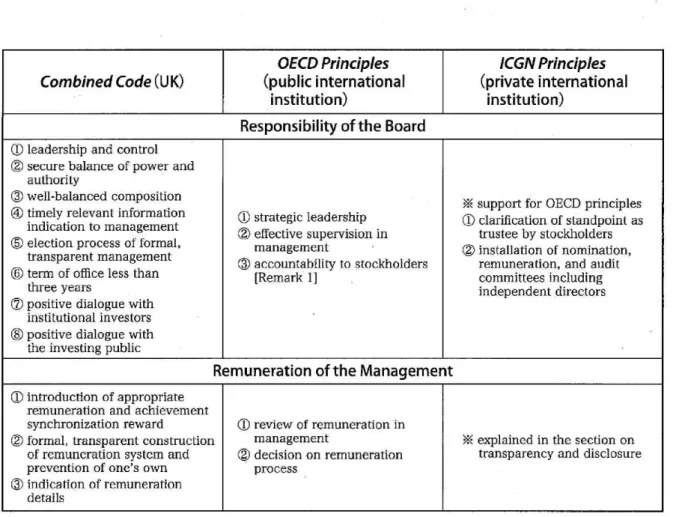
The section Board involves two functions: "Responsibility of the Board"
and "Remuneration of the Management" (see Table 2). Responsibility of the Board further includes three main items: "Strategic leadership,"
"effective supervision in management
," and "accountability to shareholders."
Remuneration of the Management also includes three items: "Securing of appropriate remuneration level," "decision on remuneration policy," and
"indication of remuneration level and details ."
16 at;1No.33 2007
OECD Principles ICGN Principles
Combined Code (UK) (public international (private international
institution) institution)
Responsibility of the Board 0 leadership and control
© secure balance of power and authority
3© well-balanced composition 0 timely relevant information
indication to management
~ election process of formal, transparent management
® term of office less than three years
0 strategic leadership ZO effective supervision in
management
CD, accountability to stockholders [Remark 1]
X support for OECD principles 0 clarification of standpoint as
trustee by stockholders 20 installation of nomination,
remuneration, and audit committees including independent directors
© positive dialogue with institutional investors
® positive dialogue with
the investing public
Remuneration of the Management
~l introduction of appropriate remuneration and achievement
synchronization reward @ review of remuneration in
20 formal, transparent construction management X explained in the section on
of remuneration system and © decision on remuneration transparency and disclosure
prevention of one's own process
3® indication of remuneration
details
Table 2 Outline of corporate governance principles regarding "Board"
The section Shareholders involves two functions: Stockholders' Rights and Shareholders Rights.' The section Stockholders' Rights includes three main items concerning rights: "Stockholders' fundamental rights," "fair treatment," and "positive dialogue." Shareholders' Rights demonstrates that on the whole the OECD Principles and the ICGN Principles demand that . a board of directors coordinate interests among shareholders, and the Combined Code lays emphasis on the relationship between institutional investors and boards (see Table 3).
Combined Code (UK)
OECD Principles (public international
institution)
ICGN Principles (private international
institution) Stockholders' Rights
Olstockholders' fundamental rights positive dialogue with
stockholders and corporations
stockholders' fundamental rights 0 protection of stockholders'
fundamental rights
©3fair treatment and compensation of stockholders
(1 to maintain the right to vote Q2 fair treatment for all stockholders
positive cooperation by stockholders and corporations Shareholders' Rights
(1 institutional investors' right to vote
OZpositive dialogue with institutional investors valuation of the board by institutional investors
(1 respect for and cooperation with shareholders
establishment of compensation for shareholders
Q3construction of a management structure that improves performance via shareholders' participation
X explained in the section stockholders' rights The cooperation between stockholders and corporations addresses the problem of the rights of the board of directors, management, and so on
Table 3 Outline of corporate governance principles on the "
stockholders and shareholders"
rights of
The section Transparency and Disclosure comprises four items:
"Establishment of disclosure policy
," "sufficient disclosure of financial accounting" "internal control and audit committee," and "independent auditor's role" (see Table 4).
OECD Principles ICGN Principles
Combined Code (UK) (public international (private international
institution) institution)
0 disclosure of corporation's 0 appropriate disclosure of the © appropriate disclosure of
valuation to the board details of corporations information concerning
02 construction of the internal 02 disclosure of information on corporation
control system
® cooperation with accounting auditor concerning the above
audit
audit by independent auditors
® the most suitable disclosure system
support for OECD principles 0 disclosure concerning
management members
0 disclosure of board of directors'
remuneration
® independent audit by audit
committee
Table 4 Outline of corporate governance principles on disclosure"
"transparency and
18 EllEffMtifiV No.33 2007
It is clear that corporate governance principles aim to resolve problems concerning management structure and shareholders, and to lay special emphasis on transparency and disclosure as a connection between these and as a means to settle these problems.
IV Type and role of corporate governance principles (1) International institution's principles
Principles are divided into three types according to establishment (see Figure 1). As the second column from the left indicates, these types are
"international institution
," "institutional investor," and "domestic institution."
I shall discuss each in detail.
Type Group
O 0 ly r+ CD 0
O CCD N C) CD
-o
-C C) CD N
International Institution
Institutional Investor
Domestic Institution
Law and Rule
Corporate Original
Examples
OECD World Bank
ICGN EASD
CII
CaIPERS- Hermes
CaIPERS TIAA-CREF Three
committee (UK) ALI(US) JCGF(Japan) CACG (UK) Corporate Legislation Degree Reform Listing Rule GM(US) Sony(Japan)
Published principles OECD Corporate Governance Principle (1999) GCGF Establishment Principle (2000)
ICGN Corporate Governance Principle (1999)etc.
EASDCorporate Governance Principle, Recommendation (2000)
Corporate governance policies (2001)
CaIPERS And Hermes Team To Form Corporate Governance Alliance (1998)
Global Corporate Governance Principle (1997.99) TIAA-CREF Annual report 2000 (2001) Cadbury(1992) Greenbury(95) Hampel (98) Corporate Governance Principle: Analysis and Recommendation (1992)
Revised corporate governance principles (1997.98.01)
CACG Corporate Governance Principle (1999) Proposal to Commercial Code revision UK, US, Hong Kong, Thailand etc.
General Motors Corporate Governance Principle (1995) Idea of Management Structure Reform (1999)
Figure 1 Types of corporate governance principles
The international institution principles, which could become the international standard principles, consist of the "public institution"
principles and the "private institution" principles. The public institution principles are generally accepted fundamental and standard principles, since representatives all over the world attend public institutions such as the Global Corporate Governance Forum (GCGF). The private institution principles are guiding principles in action, since private institutions are composed of all kinds of people including representatives from agencies and institutions as well as managers and professors.
In recent years, discussions between the public institution and the private institution have increased. I believe that the international institution has the initiative in publishing principles, and private institutions that have an action agenda character release better principles than public institutions for the reform of corporate governance.
(2) Institutional investors' principles
The institutional investor principles consist of private institution, "agency of investor institution," and "original principles of investor institution." Investor institutions have recently taken positive action on corporate governance and have published many principles since the late 1990s. I shall discuss each type in detail.
Private institution overlaps with "private international institution," one of the classifications of the international institution. It is clear that institutional investors participate in international institutions and publish corporate governance principles.
Agency of investor institution aims to cooperate with investors all over the world, to exchange useful information and to hold conversations with investors. For example, CII, which is a group of many investors, published the Corporate Governance Policies' in 2001. Ca1PERS and Hermes drew up the CaLPERS and Hermes Team to Form Corporate Governance Alliance' in 1998.
Original principles of investor institution are guiding principles on corporate governance for corporations. These generally have a powerful
20 aMNo.33 2007
influence on corporations by exercising voting powers. For instance, representative principles consist of Global Corporate Governance Principles, the Statement on UK Corporate Governance & Voting Policy, and the TTAA-CREF Policy Statement on Corporate Governance.
(3) Domestic institution's principles
The domestic institution principles, which have the clearly defined role of constructing a framework for management structure within domestic corporations, are composed of public institution, private institution, "law and rule," and "corporate original." I shall discuss each in detail.
The principles of public institution deal mostly with the problem of corporate governance within the host country. Typical institutions are the Cadbury Committee, the Greenbury Committee, and the Hampel Committee in the UK. They generally have legal force since each country adopts them as listing rules.
The principles of private institution have a tendency to powerfully and directly influence corporations, . since they are applied by many professors, managers, and organizations. Examples of these include the Corporate
Governance Principles' and Corporate Governance' .
The principles of law and rule are a minimum rule for when corporations conduct management activity. Each law and rule actively suggests a legislation degree. In recent years, such activities have led to the Commercial Code Revision' , produced the Tentative Plan for Commercial Code Revision Corporate Governance of View 32, and published many suggestions'.
The principles of corporate original are those whereby each corporation finally publishes its own original principles. Examples of this are the
Corporate Governance Guidelines34 by General Motors and the Idea of Management Structure Reform by Sony. The corporate original principles also
have an influence on the revision of the Commercial Code, and so on.
V System of corporate governance principles (1) Cooperation over corporate governance principles
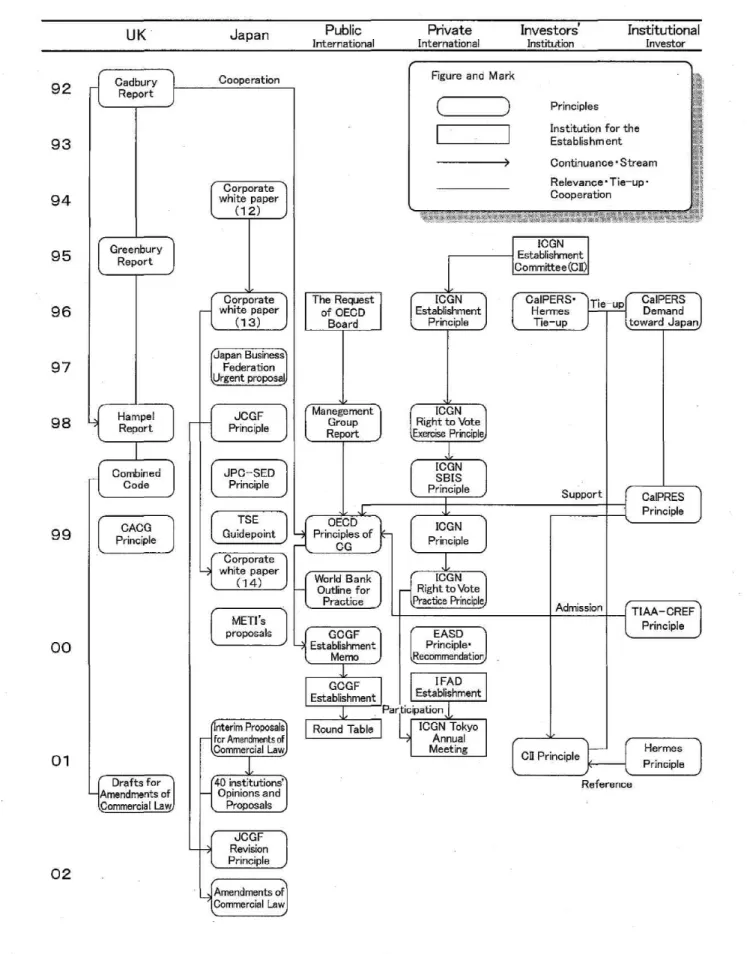
Figure 2 illustrates the flow of relationships concerning representative principles throughout the world (see Figure 2). It is important to note that
each principle has been published as a result of dialogues, cooperation, and complementarity.
Figure 2 clearly shows the "Cadbury Committee," which drew up the first principles in the Cadbury Report in the UK during 1992; the ICGN, which published principles as a private international institution during 1996; and the OECD, which began publishing principles as a public international institution during 1998.
It is interesting to note that the OECD Principles has a close relationship with the ICGN Principles. The ICGN recommends the OECD Principles to corporations and stockholders, as this appears to be a standard set of principles the world over. It also published its original principles in order to expand on these35. I believe that the ICGN has a role in disseminating the
OECD Principles.
It may be worth briefly mentioning the reason for the expansion of published corporate governance principles. In the early 1990s, principles were settled within each country. During the mid 1990s, principles were settled by private international institutions that transcended national borders. In the latter half of the 1990s, the trend was for public international institutions to also publish their own principles. It follows from this that in the future one standard principle would seem likely to be published.
22 Li M± S n No.33 2007
92
93
94
95
96
97
98
99
00
01
02
UK Japan Public
International
Private International
Investors' Institution
Institutional Investor
Cadbury Report
Cooperation
Greenbury Report
Corporate white paper
(12)
Corporate white paper
(13) Japan Business
Federation Urgent proposal
Hampel Report
Combined Code
JCGF Principle
JPC—SED Principle
CACG Principle
TSE Guidepoint
Corporate white paper
(14)
METI's proposals
Figure and M ark
l---J Principles
Institution for the Establishm ent Continuance • Stream Relevance • Tie—up • Cooperation
The Request of OECD
Board
ICGN Establishment
Principle
Manegement Group
Report
ICON Establishment Committee (CII)
:4_
CaIPERS•
Hermes Tie—up
Tie—up
ICGN Right to Vote Exercise Principle
ICGN SBIS Principle
Support OECD
Principles of CG
World Bank Outline for
Practice
ICON Principle
ICGN Right to Vote Practice Principle
GCGF Establishment Memo
GCGF Establishment
EASD Principle.
Recommendation I FAD Establishment Participation
Drafts for Amendments of
Commercial Law
Interim Proposals for Amendments of Commercial Law
Round Table
40 institutions Opinions and
Proposals
ICON Tokyo Annual Meeting
Admission
CII Principle
CaIPERS Demand toward Japan
CaIPRES Principle
TIAA—CREF Principle
Hermes Principle
JCGF Revision Principle
Amendments of Commercial Law
Reference
Figure 2 Flow of relationships among corporate governance principles
Principles of Corporate Governance 23
(2) Correlation on corporate governance principles
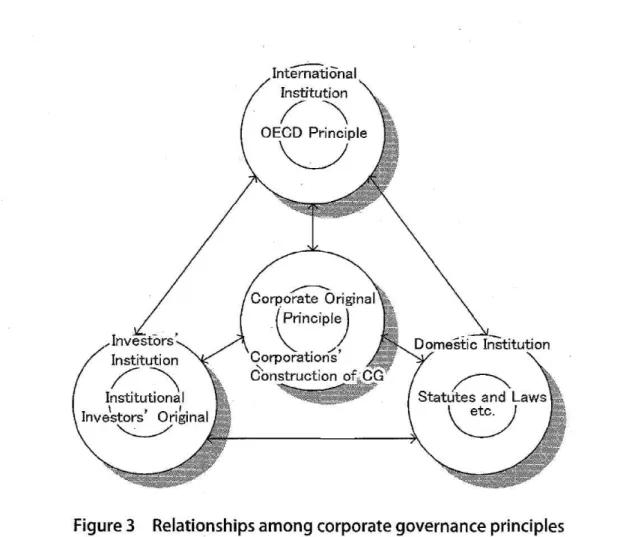
As I said earlier, the establishment types are international institution, investor institution, and domestic institution (see Figure 3). Each has its own purpose within corporate governance principles. International institution will have an influence on the laws and rules of each country.
Investor institution will require corporations to be , active concerning corporate governance for corporations. Domestic institution will encourage corporations to apply laws and rules and will point to the revision of laws.
Each corporation will structure the functions of corporate governance, as corporate governance principles have a strong influence on corporations.
Corporate governance principles are minimum principles for corporations managing soundly and efficiently. Each corporation will have to adapt each original activity concerning corporate governance to its own scale, type of industry, and culture and practice.
Investors Institution Institutional
Investors' Original
International Institution
OECD Principle
Domestic Institution
Statutes and Laws
etc.
Figure 3 Relationships among corporate governance principles
24 % No.33 2007
(3) System of corporate governance principles
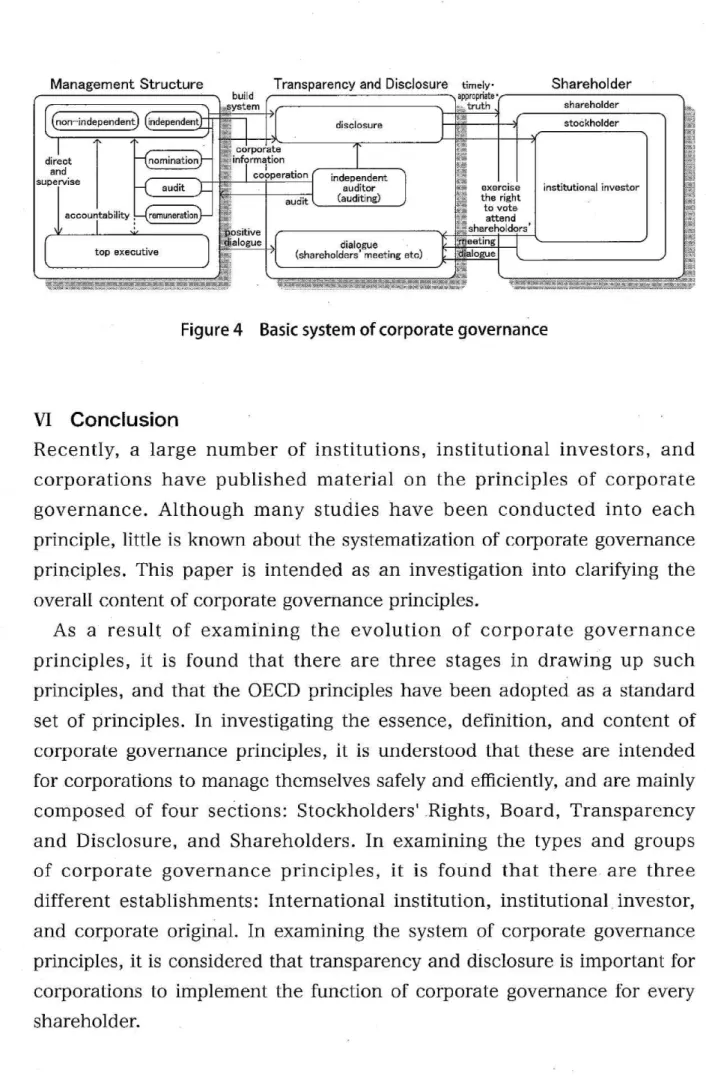
As shown by the representative principles (the Combined Code, the ICGN Principles, and the OECD Principles), corporate governance principles are mainly composed of three sections: "Management structure," "shareholder,"
and transparency and disclosure. Based on these categories, I can illustrate the system of corporate governance principles (see Figure 4).
The left-hand side of this figure illustrates the section management structure. This focuses on the board, which has three roles. The first is that board directors supervise and ask accountability of management. The second is that a board has to establish three committees: Nomination, audit, and remuneration. Within these committees, independent directors are appointed'. The third is that a board has to make sufficient provision for management audit, having independent auditors cooperate with the board.
The right-hand of this figure illustrates shareholder. This focuses on stockholders, which consist of institutional investors. Stockholders have the right of dialogue with corporations as well as the right to vote.. Shareholders who do not have direct influence on corporations have to forego many such rights.
The centre of this figure illustrates transparency and disclosure. This has the role of providing a connection between management structure and shareholders. To carry out this function, a board has to have a good relationship with the independent auditors, ensuring the information system that discloses corporate information. It is also important that corporations converse positively with shareholders.
It can be concluded from the above that the principles of corporate governance should assume transparency and disclosure to be the medium through which to advance the relationship between top management and its shareholders.
Management Structure Transparency and Disclosure timely. Shareholder
build ,;,system
appropriate•
truth shareholder
F &,i
disclosure
(non—independent) Independent stockholder
institutional investor direct
and supervise
1omination
t Jy`a corporate information IN I cooper
exE the
to cooperation r i
ndependent auditor (auditing) accountability
audit exercise
tg the right to vote attend '- -.shareholdors'
`ositive alogue
audit
i--Cemuneration
dialogue (shareholdersmeeting etc) top executive
lJ
Meeting jalogue
d tH7'
s~s,mci ¢+ma,s,Ioh~'6?b}xxs.yR'. e+Ex*-oVzo~
Figure 4 Basic system of corporate governance
VI Conclusion
Recently, a large number of institutions, institutional investors, and corporations have published material on the principles of corporate governance. Although many studies have been conducted into each principle, little is known about the systematization of corporate governance principles. This paper is intended as an investigation into clarifying the overall content of corporate governance principles.
As a result of examining the evolution of corporate governance principles, it is found that there are three stages in drawing up such principles, and that the OECD principles have been adopted as a standard set of principles. In investigating the essence, definition, and content of
corporate governance principles, it is understood that these are intended for corporations to manage themselves safely and efficiently, and are mainly
composed of four sections: Stockholders' Rights, Board, Transparency and Disclosure, and Shareholders. In examining the types and groups of corporate governance principles, it is found that there are three different establishments: International institution, institutional, investor, and corporate original. In examining the system of corporate governance principles, it is considered that transparency and disclosure is important for corporations to implement the function of corporate governance for every shareholder.
26 IIIMPATIA No.33 2007
This paper clearly shows that it is very important for corporations to finally establish original principles, referring to and adopting the articles of published principles. This paper proposes that a better understanding of how principles have actually influenced corporations needs to be gained in future studies in order to elucidate the development of corporate governance principles.
Notes
Strictly speaking, the first corporate governance principle was the Principle of Corporate Governance. Analysis and Recommendations by the American Law Institute. However, there
is fairly general agreement that the Cadbury Report was the first set of principles in the world in the sense that it took the initiative in corporate governance principles
2 Cadbury Report (1992) 3 Greenbury Report (1995) 4 Hampel Report (1997) 5 GCGF (2001) pp .411-427
6 The Combined Code is composed of 17 principles and 47 models .
7 Belgium has adopted the principles of the UK and made the best use of them as listing rules and a legislation degree for enterprise.
8 CII is an institution founded in the United States in 1985 . Its aim is to exchange
information on pension funds. The discussion accelerated the necessity for establishing
a world institution to look closely at the globalization of corporate management activity.
9 Ca1PERS is a pension fund that is composed of more than 1.1 million members, has property of US $175 billion or more, and aims at investing 20% of this property
overseas.
10 TIAA-CREF (2001)
11 ICGN (1996) . According to a trial calculation in August 2000, the stock holding property of institutional investors participating in the ICGN exceeded US $10 trillion.
12 ICGN (1998) 13 ICGN (1999) 14 ICGN (2000a)
15 This is composed of 11 original principles and 16 concrete actions that expand the OECD principles.
16 ICGN(2000b)
17 Dated Nihon Keizai Shinbun January 12 , 2001.
18 The ICGN had a big influence on Ca1PERS and Hermes etc as an international
institutional investor.
19 Hirata (2001a) p .278
20 Ibid ., pp.278-287. Professor Hirata shows the content in full. detail.
21 OECD (1999) . http://www.mofa.go.jp/mofaj/gaiko/OECD/hoshin.html
22 The OECD principles are composed of five principles and 23 recommendations that support them.
http://www.oecdtokyo.org/inpaku/04corpor/04-01t.html.
23 http://www .mofa.go.jp/daijin/le075.htm#bb
24 http://www .mofa.go.jp/mofaj/gaiko/apec/99/kyodo _2.html 25 http://www .mofa.go.jp/mofaj/gaiko/apec/99/s_sengen.htrnl 26 Hirata (2001a) p .291.
27 CII (2001)
28 CaLPERS (1998a)
29 Corporate Governance Principle Committee (1998)
, Corporate Governance Principle:
Thinking about Japanese New Corporate Governance, Japan Corporate Governance Forum.
3° Japan Corporate Governance Committee (2001)
31 For further details of the revision of the Commercial Code from the point of view of corporate governance, see Hirata (2000) pp.83-91.
32 The Ministry of Justice (2001)
33 Japan Business Federation (2001a) (2001b) 34GM(1995)
35 ICGN (1999)
36 In China , the appointment of independent directors was obligated by the corporate legislation degree reform in 2001. The legislation was strengthened in 2002. I can be
fairly certain that this situation was introduced by corporate governance principles in
China.
References
ALI (1994), American Law Institute.
Cadbury Report (1992), Report of the Committee on the Financial Aspects of Corporate Governance, Gee and Co. Ltd.
CaIPERS (1999), Global Corporate Governance Principles, California Public Employees'
Retirement System.
Ca1PERS (1998a), 'CaZPERS and Hermes Team to Form Corporate Governance Alliance' Corporate
Governance News 1998, California Public Employees' Retirement System.
Ca1PERS (I 998b), Japan Market Principles, California Public Employees' Retirement System.
Ca1PERS (1998c), Corporate Governance Core Principles & Guidelines: The United States, California
Public Employees' Retirement System.
Ca1PERS (1997a), United Kingdom Market Principles, California Public Employees' Retirement
System.
Ca1PERS (1997b), France Market Principles, California Public Employees' Retirement System.
Ca1PERS (1997c), Germany Market Principles, California Public Employees' Retirement
System.
CII (2001), Corporate Governance Policies, Council of Institutional Investors.
Corporate Governance Principle Committee (1998), Corporate Governance Principle: Thinking about Japanese New Corporate Governance, Japan Corporate Governance Forum.
28 ,;, No.33 2007
GM (1995), Corporate Governance Guidelines, General Motors.
Greenbury Report (1995), Report of a Study Group Chaired by Richard Greenbury, Gee, and Co.
Ltd.
Hampel Report (1997), Committee on Corporate Governance, Gee and Co. Ltd.
Hermes (2001), Statement on UK Corporate Governance & Voting Policy, Hermes Pensions
Management Limited.
Hirata, Mitsuhiro (2001a), "OECD Corporate Governance (OECD no Kooporeeto Gabanansu
Gensoku)", Studies in Administration, Toyo University Institute of Management, No.24, pp.277-292.
Hirata, Mitsuhiro (2001b), "The Challenges of Corporate Governance Research in Management of the 21st Century : Toward the Systematization of the Corporate
Governance Theory (21 Seiki no Kigyokeiei ni okeru kooporeeto Gabanansukenkyu no Kadai : Kooporeeto Gabanansuron no Taikeike ni mukete)", Studies in Administration,
Toyo University, No.53, pp.23-40.
Hirata, Mitsuhiro (2000), "Basic Making and Proposal of Corporate Governance Reform in Japan in 1990's (1990 Nendai no Nihon ni okeru Kigyotochikaikaku no Kibanzukuri to Teigen)", Studies in Administration, Toyo University, No.51, pp.81-106.
Hirata, Mitsuhiro (1999a), "Practice of Corporate Governance Reform in United Kingdom (Eikoku ni okeru Kooporeeto Gabanance no Jissen)", Studies in Administration, Toyo
University, No.49, pp.225-240.
Hirata, Mitsuhiro (1999b), "Practice of Corporate Governance in EU and United Kingdom
(EU to Eikoku ni okeru Kooporeeto Gabanansu no Jissen)", Practice of Management
Philosophy, Toyo University, No.39, pp.357-374.
ICGN (2000a), Statement on Global Implementation ofICGN Voting Principles. International Corporate Governance Network.
ICGN (2000b), Resolution on the Mandate of the Standing Committee on Share Voting, International
Corporate Governance Network.
ICGN (1999), ICGN Statement on Global Corporate Governance Principles, International
Corporate Governance Network.
ICGN (1998), ICGN Global Share Voting Principles, International Corporate Governance
Network.
ICGN (1996), ICGN Founding Principles, International Corporate Governance Network.
Japan Corporate Governance Committee (2001), Revision Corporate Governance Principle (Kaitei Kooporeeto Gabanansu Gensoku), Japan Corporate Governance Forum.
Japan Corporate Governance Forum (2001), Corporate Governance. Corporate Reform of United Kingdom (Kooporeeto Gabanansu: Eikoku no Kigyokaikaku), Commercial Firm Legal Affairs
Society.
Japan Association of Corporate Executives (1999), The 14th Corporate White Paper (Dai 14 Kai Kigyohakusyo).
Japan Association of Corporate Executives (1998), The 13th Corporate White Paper (Dai 13 Kai Kigyohakusyo).
Japan Association of Corporate Executives (1996), The 12th Corporate White Paper (Dai 12 Kai Kigyohakusyo).
Japan Business Federation (2001a), The way of thinking on amendments of corporations
(Kaisyakikan no Minaoshi ni kansuru Kangaekata).
Japan Business Federation (2001b), The Comment to 'interim Report for Partial Amendments of Commercial Law etc (Syohonado no Ichibu wo Kaiseisuru Horitshuanyokochukanshian ni taisuru
Komento)."
Japan Business Federation (2000a), Interim Report on Corporate Governance in Japanese Open Companies (Wagakunikoukaigaisya ni okeru Kooporeeto Gabanansu ni kansuru Rontenseiri/
Chukanhokoku).
Japan Business Federation (2000b), Proposals for Amendments of Commercial Law (Shohokaisei
heno Teigen).
Japan Corporate Governance Forum (2001), Corporate Governance: Corporate Reform of United Kingdom (Kooporeeto Gabanansu: Eikoku no kigyo Kaikaku).
Kikuchi, Toshio & Hirata, Mitsuhiro (eds.)(2000), A Comparative Study of Corporate Governance
(Kigyotochi no Kokusai Hikaku), Tokyo: Bunshindo.
Kojima, Hirotoku (2005a), "Corporate Governance and Disclosure/Investor Relationship
(Kooporeeto Gabanansu to Johokaiji • IR katsudo)", Kokusaikeieironsyu, Kanagawa
University, No. 30, pp. 1-36.
Kojima, Hirotoku (2005b), "The New OECD Corporate Governance Principle (Shin OECD Kooporeeto Gabanansu Gensoku)", Kokusaikeieironsyu, Kanagawa University, No.29, pp.
93-118.
Kojima, Hirotoku (2005c), "The International Institutions' Activities on the Issue of Corporate Governance (Kokusaikikan ni okeru Kooporeeto Gabanansu Mondai heno
Torikumi)", Kokusaikeieiforamu, Kanagawa University, No.16, pp. 89-110.
Kojima, Hirotoku (2005d), "Corporate Governance in Thailand (Tai no Kooporeeto
Gabanansu)", Sakuma, Nobuo(ed.), Corporate Governance in Asia, Tokyo: Gakubunsya,
pp. 168-193.
Kojima, Hirotoku (2005e), "The New Turn on Corporate Governance (Kooporeeto
Gabanansu Gensoku no Shintenkai)", Ajiakeieigakkaishi, The Japan Scholarly Association
for Asian Association, No.11, pp.129-137.
Kojima, Hirotoku (2004a), Corporate Governance Principles All Over the World: The System and Practice (Sekai no Kooporeeto Gabanansu Gensoku), Tokyo: Bunshinso.
Kojima, Hirotoku (2004b), "The Challenges on Corporate Governance in 21 Century (21 Seiki no Kooporeeto Gabanansu no Kenkyukadai)", Studies in Administration, Graduate
School of Toyo, No.39, pp.357-374.
Kojima, Hirotoku (2004c), "Corporations' Practice on Corporate Governance Principles
(Kigyo ni okeru Kooporeeto Gabanansu no Jissen)", Keieikoudoukenkyunenpo, Japan Academy of Management Behavior, No.13, pp.63-68.
Kojima, Hirotoku (2004d), "The State and Prospect of Corporations' Practice on Corporate
Governance (Kigyo ni okeru Kooporeeto Gabanansu Jissen no Genjyo to Tenbo)",
Kokusaikeieironsyu, Kanagawa University, No.28, pp. 23-42.
Kojima, Hirotoku (2004e), Studies in the Principles of Corporate Governance(Kooporeeto
Gabanansu Gensoku ni kansuru Kenkyu), A Thesis for Doctor's Degree.
Kojima, Hirotoku (2003a), "Corporate Governance Principles and Corporations' practice:
Toward Publishing Original Principles (Kooporeeto Gabanansu Gensoku to Kigyo no Jissen: Kigyodokujigensoku no Sakutei wo Mezashite)", Journal of Business Management, Tokyo: Chikura, No.9, pp.26-40.
Kojima, Hirotoku (2003b), "Corporate Governance Principles All Over the World: The History, Type and Role of Principles (Sekai no Kooporeeto Gabanansu Gensoku:
Gensoku no Sakuteikatei Ruikei to Yakuwari)", Management Education and the Latest Issued, Tokyo: Gakubunsya, No.6, pp.129-163.
OECD Business Sector Advisory Group on Corporate Governance(1998), Corporate
Governance: Improving Competitiveness and Access to Capital in Global Markets, Organisation for Economic Co-operation and Development.
30 Magitrf, No.33 2007
OECD (2004), OECD Principles of Corporate Governance, Organisation for Economic Co-
operation and Development.
OECD (1999), OECD Principles of Corporate Governance, Organisation for Economic Co-
operation and Development.
The Ministry of Justice (2001), "Opinion of the Law Idea Outline Middle Thought That Revises
a Part of Commercial Code", Commercial Legal Affairs, Society of Commercial Legal Affairs,
No.1593, pp.28-51.
TIAA-CREF (2001), TIAA-CREF Annual Report 2000: Built on A Strong Foundation, Teachers Insurance and Annuity Association College Retirement Equities Fund.
TIAA-CREF (2001), TIAA-CREF Policy Statement on Corporate Governance, Teachers Insurance
and Annuity Association College Retirement Equities Fund.