九州大学学術情報リポジトリ
Kyushu University Institutional Repository
凝集現象に於ける揺らぎの効果
早川, 尚男
九州大学理学研究科物理学専攻
https://doi.org/10.11501/3054122
出版情報:Kyushu University, 1990, 理学博士, 課程博士 バージョン:
権利関係:
c
Thesis
Fluctuation Effects in Coagulation Processes
Depart1nent of Physics, J(yushu University, Fukuoka 812
Hisao Hayakawa
Abstract
We formulate a theory of coagulation and develop the diagrammatic perturbation technique based on the Fock space formalsim. For a system of finite volume fraction of droplets ¢>, we find that the screening length plays an important role, where the screening length is proportional to ¢>-112 for a three dimensional system and has the logarithmic dependence on ¢> for a two dimensional system.
We calculate the effective coagulation rate for diffusion-controlled coagultion and find the followings: The coagulation rate has correction to Smoluchowski's classical result in a medium of three dimension. This correction term is given by the ratio of the reaction radius to the screening length. For a two dimensional system, the coagulation rate 1s determined by a self-consistent condition and there is a logarithmic correction in time.
We also calculate the scaling form for the scattering function and discuss its volume fraction dependence for a three dimensional system. We obtain qualitative agreements with experimental data of binary fluid mixture and previous phenomenological theories for the peak height, the full width of half maximun1, and the moment ratio of the scaling function.
1
Ackuowledgntent
I would like to express tny sincere gratitude to Prof.K.Kawasaki for his encouragement and suggestions during n1y study of physics. Stimulative discussion between us generates this thesis. I thank Prof.ICSekituoto(Nagoya), Dr.T.Kawakatsu and other members in our research group in Kyushu University for their helpful discussions.
I thank Prof.F.Fan1ily (Etnory) for his invitation to the United States and his col- laborations. Discussion with Dr.J. G .Atnar (Emory) was useful for me. I will not forget Prof.H.Takayasu (Kobe) who intiated me into the theory of coagulation. I thank Profs.
II.Tomita (Kyoto), A.Onuki (YITP), ll.Furukawa (Yamaguchi) and A.J.Bray (Manch- ester) for their useful con11nents. Stitnulative discussions with Profs. M.Doi (Nagoya), T.Ohta (Ochanomizu), Y.Oono (Illinois), H.J.llerrmann (Saclay), ll.M.Lindsay ( Emory ), L.P.Kadanoff (Chicago), and G.F.fvlazenko ( Chicago ), Drs.P.Meakin (du Pont) and T.Vicsek (Emory), Mr.lt.Boide (E1nory), S.Sasa (Kyoto) and II.Kohno (Kyoto) are ac- knowledged.
I thank warm hospitality during my stay at Etnory University (1989.1-7) and the Yukawa Institute for Theoretical Physics(1990.6-7) where part of my work was carried out. 1tly work has been partially supported by the Office of Naval Research and the Petrolen1 Fund, adtninistrated by the Atnerican Chetnical Society, and the Fellowships of the Japan Society for the Protnotion of Science for Japanese Junior Scientists.
I express my gratitude tny wife and tny parents for their help for my life. In particular, my father teachs me what physics is. He has also navigated me to the right direction to become a physist. I have learned physics very tnuch from hin1. I would like to devote this thesis to him.
2
Contents
Astract
Acknowledgment Contents
Chapter I: General Introduction
§ I-1. In trod uctoin: What is Coagulation?
§ I-2. Coagulation in Phase Separations
§ I-3. Scaling Concepts in Coagulation
§ I-4. Modern Theory of Coagulation: Beyond S1noluchowski's Theory References in Chapter I
Chapter II: Fluet uation Effects in Coagulation Processes
§ Il-l. Introduction
§ II-2. Basic Formalism
§ II-3. The Diagrammatic Perturbation
§ II-4. The Effective Reaction Rate
§ II-5. Scaling in the Scattering Function
§ II-6. Concluding Re1narks References in Chapter II
Figures and Figure Captions in Chapter II
Appendix A: Classical Theory of Coagulation Processes
§ A-1. Diffusion-Controlled Coagulation
§ A-2. Shear-Induced Coagulation
§ A-3. The Effect of Force Field to Brownian Coagulation 3
1 2 3 5 5 8 13 15 19 23 24 27 31 34 40 45 48 51 62 62 65 66
Appendix B: Exact Solutions of Smoluchowski's Rate Equation 68
§
B-1. Exact Solution forICi
= 1 69§
B-2. Exact Solution forICi
=ij
71§
B-3. Exact Solution forJ(ii
= i +j
74References in Appendices 76
Figures and Figure Captions in Appendices 77
4
_.-= -_::=-�
--.
·.::.t:l'!!_�,....
l"\..
,� .,=� r.�
Chapter 1: General Introduction
§ 1-1. Introduction: What is Coagulation?
Coagulation is an irreversible physical
process in which initially dispersed basic units (
1nonon1ers)
stick together to fonn clusters[1]. This process is also called aggregation or
flocculation in some texts. Two
f
unda1
ne
ntal aspects retain our attention. The first is
the geometrical aspect, that is, the
quantitative description of the structure of aggregates.
The second is the kinetic aspect, that is,
the quantitative description of the time evolution
of statistical quantities such as the 1nean cluster size, size distribution and correlation functions. Recently, the first aspect
has been the subject of a great a1nount of interest.
These recent progresses are essentially
due to the new mathematical concept , fractal [2],
which permits the quantitative description
of aggregates (aggregated clusters). On the
other hand, the second aspect is also
important and has long history since Smoluchowski [3,4]
proposed the kinetic rate equation in1916.
Coagulation occurs quite conunonly
in tnany fields of science and technology. For
example, such behavior can be observed
for dust formation in air [5] or in acqeous gold
colloids
[6].
In addition, exan1ples arefound in polymerization [7], the growth of interstellar
dust grain in astrophysics
[
8]
, red bloodcell coagulation in biology [9] and phase separa-
tions in metallurgy
[
10]
or chemical physics[11,12]. Recently, a rapid growth of interest
has taken place since the progress of
c
on1pu
ta
tio
na
lsimulation of colloidal aggregates [13].
Consequently, this process is called
cluster-cluster aggregation ( CCA). A typical computer
simulation is s
tar
te
df
r01
n rando
tnly distributed monomers. At each time step a cluster
tnoves
by one lattice
unit in a randotnlychosen direction. Two clusters stick together 5
-----·=-�-----�-- �---�-- --
-
ill
�.to form a larger cluster. This si1nple process leads to fractal aggregates similar to that observed by experi1nents in gold colloids. The description of such a process is fascinat-·
ing. However, theoretical description ·for fractal aggregates is very difficult compared to spherical clusters (droplets).
In kinetic description coagulation is represented as follows
(1.1.1)
where a cluster containing i ll10noiners (i-mer) denotes xi. Actually, as a description of a general coagulation process,
(1.1.1)
is a simplification. In practice the reverse reaction.x·i+i
---+-Xi
+Xi
occurs. Fragn1entation can be taken into account[14,15],
but for our purposes this would lead to needless complications. For this reason we restrict ourselves to irreversible coagulation. In 1nany cases the force between clusters is short ranged and it is strong enough to bind small clusters irreversibly when they contact each other. Even in the existence of the Coulotnb force the Debye screening ensures that the effective force is short ranged and its effect is not so large, at least, for weakly charged cases. In the classical theory, correction due to force among clusters appears in a multiplied constant (see Appendix A). Therefore, we restrict ourselves to interaction among clusters of a hard core type in the proceeding discussions.The usual description of kinetic aspect in coagulation is based on Smoluchowski's rate equation. Introducing the rate constant for coagulation J(ij the concentration of s-mer,
c.,(t),
satisfies the following set of coupled rate equationsBc�;t)
=� L K;j c; (t)cj (t)- f K,j c,(t)ci (t),
i+j=3 i=l
(1.1.2)
where J(ij depends on physical processes. Equation
(1.1.2)
is known as Smoluchowski's rate equation. It has a si1nple interpretation. The first term (gain term) in the right hand6
--- -
..
side of
(1.1.2)
states that s-tner is fanned out of possible combinations of i- and j-mers which satisfy i +j
= s. Si1nilarly the second term(
loss term)
describes the loss of s-n1er due to reactions of s-Iner with other Clusters. The rate equation, of course, contains only information for size of clusters, while it does not contain spatial correlations and cluster's shape. If we involve information for cluster's shape, we cannot use a simple description like(1.1.2),
because clusters with the same size have different shapes and the summation of their sizes beco1ne 1neaningless. Therefore we should discard an ambition to describe theoretically both geotnetry and kinetics.In so1ne special cases clusters have spherical forms due to the existence of surface tension. In such cases the systen1 is in local equilibrium at the cluster's surface. Therefore, cluster's shape is relaxed to a spherical forn1 to minimize the surface energy. We call such clusters droplets. Droplets can be observed in the course of phase separation of binary fluid mixtures
[11,12].
We 1nainly focus on coagulation process of droplets for simplification of our discussions.The arrangement of this thesis is as follows. First, we explain the contents in this chapter. In section I-2, we briefly explain the role of coagulation in phase separation. In section l-3 we introduce a key concept in coagulation process, namely, dynamical scaling law. vVe explain the outline of scaling properties in coagulation focusing on common aspects which are independent of a particular process. In section I-4 we explain the motivation of our work and give a brief survey of extension of the classical theory. This section can be regarded as an introduction to the next chapter which contains our original work. In the course of chapter I it becon1es clear that the papers previously published by the present author have been written under a unified point of views.
7
•
••We show the contents in the next chapter. The chapter II is the central part of this thesis which is also subtnitted to Physica A [12]. Section II-1 is the introduction of this chapter II. The classical theory by Snloluchowski[3] is explained briefly and we indicate crucial points of his argutnent. In section 11-2 we formulate a theory of coagulation using the Fock space fonnalistn [16]. In section II-3 we develop the diagrammatic technique to calculate statistical quantities. The essential part of the above sections can be found in the previous paper [17]. In section II-4 we obtain the effective coagulation rate and show that there is a correction tenn to Smoluchowski's classical theory even for d = 3. We also show the existence of the logarithn1ic correction in two din1ensional coagulation systems.
In section II-5 we calculate the scaling form for the scattering function and compare our results with experimental data for binary fluid mixtures[18]. In section II-6 we present the concluding remarks on this chapter.
In Appendices we present supplen1entary explanations to the text [4,5]. In Appendix A we derive coagulation rate constants for diffusion-controlled case and shear-induced case within the framework of classical theory. We also derive a correction term to the classical theory using an effective 1nediun1 theory. In addition, we discuss the effects of interaction among droplets. In Appendix B, we illustrate exact solutions of Smoluchowski's rate equation (!.1.2), where reaction kernels are J(ii = 1[3,4], i + j[19] and ij [7] in a certain unit.
§
1-2. Coagulation in Phase SeparationsIn this section, we g1ve a brief review of phase separation. We clarify the role of coagulation in phase separations.
- -- - ----
Phase separation is the ordering process undergoing a first-order phase transition
[20].
In a typical situation, a systen1 is rapidly quenched from a one-phase equilibrium state to a nonequilibrium state inside the coexistence curve. Such a quenched system gradually evolves from the nonequilibriun1 state to an equilibrium state consisting of two coexisting phases. Phase separation is clearly a nonequilibrium and a highly nonlinear phenomenon.
Since the pioneer work by Cahn and Hilliard
(21],
phase separation in binary alloys has been studied extensively. As a result, we have almost understood the mechanism of coars- ening processes. In the n1icroscopic approach, Kawasaki dynamics(22]
which involves ex- changes between nearest-neighbor atoms. On the other hand, in a semi-phenomenological approach we use the tin1e-dependent Ginzburg and Landau (TDGL) equation which isgiven by
8S(r, t)
=
L
\12 6F (( )
8t 6S(
r ,t)
+ r,t ' (1.2.1)
where
S( r, t)
is the local order para1neter which is the local concentration difference be- tween species A and B. We usually use a free energy functionalF{S}
describing the excess energy of mixtureF( {S})
=J dr[�('V S)2 + r; 52+ uS4- hS], (1.2.2)
where
ro
=(T- To)/To
with the mean field critical temperatureT0
andu
is a positive constant. The external field h ensures the off-critical quench in which the minority phase has spherical forms (droplets).(
(r, t)
represents a Gaussian thermal noise, which satisfies the fluctuation-dissipation theorem<
( ( r, t)
> =0
and <( ( r, t) ( ( r
1,t 1)
> =-2 k BTL
V2 6
( r - r1) 6
(t - t1),
where
kn
is the Boltzmann constant.9
(1.2.3)
.
�In contrast to the kinetic Ising n1odel (Kawasaki dynamics) the derivation of TDG L equation contains a coarse-grained picture. When we discuss dynamics of phase transitions, the coarse-grained picture is more effective way[23) than microscopic pictures, because the correlation length is n1uch larger than inter-atomic distances. In the late stage of phase separations, we can si1nplify the discussion using an interfacial approach [24) in which a further coarse-grained picture is used. In this stage the excess energy is accumulated in interface regions and dynatnics can be characterized by the motion of interfaces. Kawasaki and Ohta[24] developed a systetnatic method to derive the interface equations of motion from TDGL equation.
In the late stage of phase separations one distinguishes between two different types of instability. The first is an instability against finite amplitude localized (droplet-like) fluctuation which is produced by a quench into the metastable region (off-critical quench).
The second is an instability against infinitesimal amplitude, nonlocalized (long wave length) fluctuation which is produced by a quench into the unstable region (critical quench). The interfacial approach is applicable to both processes. Although we know that there is no sharp distinction between 1netastable and unstable states, the characteristics of dynamics is quite different with each other. In this thesis we n1ainly focus on the decay of metastable states, because coagulation of droplets plays an important role during coarsening processes.
In the final stage of the decay of a metastable state (off-critical quench) the growth of droplets due to condensation-evaporation process occurs, known as Ostwald ripening
[25).
During the coarsening process the critical droplet radius grows with titne where its growth law is represented by Rc(t) rv t113. In such a process small droplets shrink, while large droplets grow where n1ass transport takes place due to the Gibbs Thomson effects atdroplets' surface. Lifshitz and Slyozov (and also Wagner) [25] analyzed this process based on a classical picture like Sn1oluchowski's coagulation theory. Recently, modern theories (26-28] have been developed. The niodern theories clarify the followings: (i) Ostwald ripening can be described by the equation of interfacial motion which is derived from TDGL equation (1.2.1) (23]. (ii) LSW (Lifshitz, Slyozov and Wagner) theory[25] is only
valid for the dilute litnit of volutne fraction ¢. In reality, there is a correction term of the order
¢>(d-2)/2
[26]. (iii) There is the logarithn1ic dependence on the volume fraction for two din1ensional Ostwald ripening [27,28]. The logarithmic correction which includes time does not disappear in finite ti1ne (28]. These results suggest that the classical theory in coagulation can not be applied to finite volume fraction case of droplets.Kawasaki dynamics[24] and TDGL equation (1.2.1) contain a strong assumption in which atomic exchanges occur in a short distance as compared to the coarse-grained dis- tance which defines the local order parameter. This assumption is satisfied in usual hi- nary alloys, while it cannot be satisfied in more complex systems [29). For instance, de Gennes[30) suggested that the transport coefficient has a nonlocal structure in phase sep- arations of concentrated polyn1er tnixture. Hayakawa and his colleague[31] proposed a generalization for a long-range exchange model. We can see a nonlocal effect in phase sep- aration in binary fluid tnixtures. Here a local concentration exerts a force which generates convective flow, which in turn, affects the local concentration a long distance away. Thus, we can regard this tnechanistn as an effective long-range exchange of fluid molecules. In fact, we can write down the equation for a viscous binary fluid mixture[32]
8S(r·,t)
Jd 1
(1 { })
8F ( )at
=-r
Wr,r; S SS(r1,t) +( r,t,
(1.2.4)with
<
((r,t) >= 0
and <((1·,t)((1·',t') >=
-2knTW(r,r';{S})b(r-r')o(t-t'). (1.2.5)For fluid mixtures W is given by
W(1·, r'; {S})
= VS (r) T (
r-r')V'S(r')- LV2b(r-
r'),where
T( r)
is the Oseen tensor[33]T(r) = - 1_r 2 + rr
81r17 r3
1
(1.2.6)
(1.2.
7)
which incorporates a long-range exchange of n1olecules. In the case of a critical quench the characteristic length grows as
l(t) "'0.1(u/7J)t (11]
whereu
and 7] are the surface tension of interfaces and the v iscosity of fluid, respectively. This growth law is complete different from the Lifshitz and Slyozov rnechanism for solid [25]. Thus, we can expect more exotic feature in fluid mixtures than that in solid systems.For the decay of a Inetastable state in solid systems we know that Ostwald ripening is the do1ninant process in the late stage of coarsening. Coagulation plays a role only in the tniddle stage of coarsening
[10].
In off-critical quench of fluid mixtures the con- densation evaporation process excited by fluid is canceled out[24]. Therefore, we cannot observe the growth lawl(t)
"'(a)17)t
like that in critical quenches. However, coalescence among droplets beco1nes in1portant for fluid systems, because thermal fluctuation of liquidn1olecules produces the Brownian n1otion of liquid droplets. In the next section we show that the n1ean droplet radius grows
R(t) "' t113
with time for fluid mixtures. Although both growth laws for Ostwald ripening and for coagulation have the same time dependence, Siggia[11] pointed out that coagulation is the dominant process when the volume fractionof the n1inority phase (droplets)
¢>
is larger than 0.01. Ohta[34] also estimated that the cross over from Ostwald ripening to coagulation occurs at the ¢> = 0.021 by the comparison of the growth rates of n1ean droplet radius. Therefore, to investigate coagulation process is important for study of phase separations in fluid mixture.§ 1-3. Scaling Concepts in Coagulation
In this section we introduce a key concept, dynamical scaling. we apply it to coagu
lation and extract essential feature of coagulation.
Dynamical scaling[lO] is one of key concepts in nonequilibrium physical processes.
There is a relevant length scale (the characteristic length ) in the system. If we rescale sta
tistical quantities with the help of the characteristic length we obtain self-similar structure in rescaled quantities. For exan1ple, in a phase separation the interval between interfaces is the characteristic length and it grows with time obeying a power law of time. In the case of coagulation, the mean droplet radius is the characteristic length in the system. Even in the mean field type of kinetic equation
(1.1.2),
we know that the equations only for three types of rate constant,ICi
= 1[3], i
+j(19]
andij [7]
in a certain unit, can be solved exactly (see Appendix B). Therefore, we cannot expect to get exact solutions in physical realistic situations. In such cases the concept of dynamical scaling gives a strong support understanding physical processes.In literature vanous different fonns for J(;j are used to describe different physical processes. Simple exan1ples of derivations of rate constants are presented in Appendix A. These different forms have one property in common, namely that always [{ij is a
homogeneous function of the sizes i and j [35]. For this reason we can express
f{
(
a i, aj)
=a>.
f{(
i,j)
(1.3.1)for ho1nogeneous kernels, where A is the degree of homogeneity. When we consider homo
geneous kernels, the size distribution which has the scaling form
ca(t)
=Ms(t)-r F(s/s(t)),
(1.3.2)
where M =
I: a sc3
is the total Inass of clusters or droplets ands( t)
is the mean cluster size, satisfies the rate equation (1.1.2). It is easy to show that the exponent r is r = 2 in non-gelling systen1s, i.e. there is no singularities in moments of size, because M is a constant in time. Note that in source-enhanced coagulation processes[17 ,36,37] which lead to asymptotic power laws of size distribution the exponent r is not equal to 2 due to the increase of total n1ass of clusters. Another important property is the power law growth of mean cluster size. Substituting (1.3.1) and(
1.
3.
2)
into(
1.1.2)
we obtains(t)
<Xt1f<t->.)
(1.3.3)for -1 < A < 1. In the case of A = 1 like coagulation in shear flow the mean cluster size grows exponentially in ti1ne [5].
In this paper we focus on diffusion-controlled coagulation process. Smoluchowski[3]
obtained the classical rate constant (Appendix A and section
Il-l)
as(1.3.4)
for d = 3 where Dij = Di + Dj is the relative diffusion constant and Rij = R; + Rj is the reaction radius between i and j -n1er. In the case of suspensions in fluid or binary fluid
mixtures, the diffusion coefficient is given by D, rv
knT/17�.
Therefore, the growth law of mean cluster size iss(t)cxt (1.3.5)
because of Ra ex s113 and Da ex R; 1. The mean field theory discussed by Smoluchowski
[
3]
can be generalized for d-dituensional systems, where the growth law
(1.3.5)
is valid because of J(ij ex Daj Rfj-2 and D3 ex R;-d.§ 1-4. Modern Theory of Coagulation: Beyond Stnoluchowski's Theory
In this section we explain trials for constructing a coagulation theory beyond Smolu
chowski's theory
[
3]
.It is clear that Stnoluchowski's theory
[
3]
is based on a kind of mean field idea, because it is assumed that the probability of coalescence is proportional to the concentrations of colliding clusters. Usually tuean field theories are violated for low dimensional systems. Let us consider a one dimensional coagulation system as an example of violation of a mean field idea. It is clear that the coagulation rate is not proportional to the multiplication of mean concentrations of sizes of colliding clusters, because clusters collide their nearest-neighbor clusters. The validity of the 1nean-field theory is related to the recurrent probability of random walkers. In addition, Stnoluchowski's approach does not contain spatial correlation and shape of droplets. The analysis for Ostwald ripening suggests that coagulation theory has a correction of finite density of droplets to the classical theory. It is natural to try to improve the classical theory by Stnoluchowski(
3]
.Several at tempts have been carried out. One is to take into account fluctuation in size distribution in a finite systen1
[
38,39]
. This method is based on the idea of van Kampen's0-expansion method [40] which is a systematic expansion of the master equation in powers of inverse syste1n size. Although Ernst and van Dongen[38] developed this method, one.
cannot consider the spatial correlation within their framework, which is more important
in realistic systems. In addition, they regarded the coagulation kernel as an independent variable both of spatial correlation and dimension. This is not true. Therefore, it seems meaningless that van Dongen [39] suggested the violation of mean field theory even for d--+- 00.
The other approach is n1ore realistic and effective. This approach is based on the Fock space fonnalism proposed by Doi[16], which is a formal second quantization of classical particles. The Fock space formalism[16,41] has been applied to many stochastic models such as the epidemic model[42], reaction-diffusion chemical processes including the contact process[43] and diffusion-controlled annihilations (44]. Hayakawa(12,17] generalized the original formalism to apply it to coagulation processes. In this approach we begin with the Liouville equation like that in gas dynamics. Our approach is equivalent to the Fokker Planck equation, namely , ours is a stochastic approach. The Liouville equation leads to the hierarchical equations for correlation functions like BBGKY hierarchy in usual many body problems. It is not difficult to show that the critical dimension is two (see also [45]) , i.e. in systems for d > 2 the classical theory is applicable in the dilute limit of density of clusters. However, llayakawa[12] shows that the rate constant has finite density correction to Smoluchowski's classical one[3] even for d = 3. We can discuss the size distribution and correlation function or structure factor (scattering function) using our approach.
In the next Chapter which is the central part of this paper we develop the coagulation theory using the Fock space fonnalisn1. We start from the Liouville equation to construct
the hierarchical equations for correlation functions. Using a mean-field type approximation
we derive the effective rate constant which is identical to Smoluchowski's one in the dilute
limit and has correction of the order of
¢112
for d = 3, where ¢J is the volume fraction of droplets. From the straight-forward calculation we predict the scaling form for scattering function and compare it with an experimental result[18].
References
[1
). II.Sonntag and ICStrenge, Coagulation /(inetics and Structure Fo rmation, (Plenun1, New York1987).
T.Vicsek, Fractal G1·owth Pheno1nena (World Scientific, Singapore
1989).
R.J ullien and R.Botet, Agg1·egati on and Fractal Aggregates (Singapore
1987).
P.G.J.van Dongen, /(inetic Theo ry of Coagulation, (Phd.Thesis in Univ.of Utrecht, Utrecht
1987)
F.Fan1ily and D.P.Landau eds. /(inetics of Aggregation and Gelation (North-Holland, Amsterdam
1984).
[2
). B.B.Mandelbrot, The Fractal Geometry of Nature, (San Francisco1982) [3).
M.von Smoluchowski, Physik Z.l1(1916) 585.
M.von Smoluchowski, Z.Phys.Che7n.92
(1918) 129.
[4).
S.Chandrasekhar, Rev.AJod.Phys. 15(1943) 1.
[5).
S.K.Friedlander, S1noke, Dust and Haze(Wiley, New York1977).
[6].
D.A. Weitz, J .S.lluang, M.Y.Lin and J .Sung, Phys.Rev.Lett. 54(1985) 1396.
IIJvl.Lindsay, R.Klein, D.A.Weitz, M.Y.Lin and P.Meakin,Phys.Rev. A38
(1988) 2614.
M.Y.Lin, II.M.Lindsay, D.A. Weitz, R.Klein, R.C.Ball and P.Meakin, J.Phys: Con- dens.Matte1· 2
(1990) 3093.
[7].
R.M.Ziff, J.Stat.Phys.23(1980) 241.
RJvl.Ziff, l'vl.II.Ernst and E.l'vl.IIendriks, J.Phys.A16
(1983) 2293.
[8]
G.B.Field and W.C.Saslaw, A str ophys.J. 142(1965) 568.
C.Hayashi and Y.Nakagawa, Prog. Theor.Phys. 54
(1975) 93.
H.llayakawa and S.llayakawa, Pubi.Astron.Soc.Jpn. 40
(1988) 341.
(9].
R.W.Samsel and A.S. Perelson, Biophys.J37 (1982) 493.
(10).
K.Binder and D.Staufier, Adv.Phys.25 (1976) 343.
K.Binder, Ann.Phys. {New York} 98
(1976) 390.
[11 ]
. E.D.Siggia, Phys.Rev.A 20(1979) 495.
(12].
II.Hayakawa, submitted to Physica A and Chapter II in this thesis.[13].
P.Meakin, Phys.Rev.Lett. 51(1983) 1119.
M.Kolb, R.Botet and R.J ullien, ibid
1123.
P.Meakin, in Phase Transitions and Critical Phenomena vol.12 C. Domb and J. L.
Lebowitz eds. (Academic P ress, London
1988)
(14].
F.Fa1nily, P.Meakin and J.M.Deutch, Phys.Rev.Lett. 57(1986) 727.
P.G.J.van Dongen and M.II.Ernst, J.Stat.Phys. 37
(1984) 301.
M.ll.Ernst and P.G.J. van Dongen, Phys.Rev.A36
(1987) 435.
[15].
II.Hayakawa, Mod.Phys.Lett. B2(1988) 773.
( 1
6] .
M.Doi, J.Phys.A9(1976) 1465,1479.
[17).
H.Hayakawa, J.Phys. A22(1989) 571.
[18).
C.�I.Knobler and N.C.Wong, J.Phys.Chem. 85(1981) 1972.
[19).
W.I.Scott, J.Atnws.Sci. 25(1968) 54.
EJvi.Hendriks, RJvl.Ziff and M.H.Ernst, J.Stat.Phys. 31
{1983) 519.
[20].
J .D.Gunton and �l.Droz, Introduction to the Theory of Metastable and Unstable States: Lecture Notes in Physics, vo/.183 (Springer, Berlin,1983).
J .D.Gunton, M.S.�Iiguel and P.S.Sahni, Phase Transitions and Critical Phenomena vo/.8 C.Do1nb and J .L.Lebowitz eds. (Academic Press, London
1983).
H.Furukawa, Adv.Phys. 34 (1985) 703.
[21].
J.W.Cahn and J.E.llilliard, J.Che1n.Phys. 28 (1958) 258.J.W.Cahn and J.E.Hilliard, J.Che1n.Phys. 31 (1959) 688.
[22]
K.Kawasaki, Phys.Rev. 145 (1966) 224; 148 (1966) 375; 150 (1966) 285.K.Kawasaki, Phase Transitions and Critical Phenomena vol.2 C.Domb and M.S.Green eds. (Academic Press, London 1972).
[23].
Y.Oono and S.Puri, Phys.Rev.Lett. 58 (1987) 836; introduce the more effective method to simulate coarsening processes.[24].
K.Kawasaki and T.Ohta, Physica 118A (1983) 175.[25]
I.l'vl.Lifshitz and V.V.Slyozov, J.Phys.Che1n.Solids 19 (1961) 35.C.Wagner, Z.Electrochem. 65 (1961) 581.
[
26]
. J.A.Marqusee and J.Ross, J.Che1n.Phys. 81 (1984) 976.M.Tokuyama and K.Kawasaki, Physica 123A (1984) 386.
M.Marder, Phys.Rev.36A (1987) 858.
[27].
J .A.IVlarqusee, J. Che1n.Phys.81(1984) 976.Q.Zheng and J .D.Gunton, Phys.Rev.A39 (1989) 4848.
[28].
H.Hayakawa and F.Fa1nily, Physica 163A (1990) 491.[29].
K.Kawasaki and T.Koga, Prog. Theor.Phys.Suppl. 99 (1989) 339.[30].
P.G.de Gennes, J.Che1n.Phys.12 (1980) 4756.[31].
ll.Ilayakawa and F.Fa1nily, Physica 1G6A (1990) 408.II.Hayakawa, T.Koga and F .Family, in Dynamics and Patterns in Complex Fluids A.Onuki ed. (Springer, Berlin 1990).
II.IIayakawa and T.Koga, J.Phys.Soc.Jpn. 59 (1990) 3542.
(32]. K.Kawasaki,
Physica 119A(1983) 17.
(33]. see e.g. M.Doi and S.F.Edwards, The Theory of Po l yme r
Dy n am i
cs, ( Oxford Univ.
Press, Oxford 1986 ).
[34]. T.Ohta,
Ann.Phys.(
New Yo1·k)
163(1984) 31.
[35]. P.G. J .van Dongen and l'vl.H.Ernst,
Phys.Rev.Lett. 54(1985) 1396.
P.G.J . van Dongen and l'vl.Il.Ernst,
J.Stat.Phys.50(1988) 295.
[36). H. Takayasu, !.Nishikawa and II. Tasaki,
Phys.Rev. A37(1988) 3110.
H.Takayasu
Phys.Rev.Lett.63(1989) 2563.
li.Takayasu, l'vl.Takayasu, A.Provata and G.lluber, submitted to
J.Stat.Phys.[37). ll.llay akawa, M.Yarnarnoto and H.Takayasu,
Prog. Theor.Phys. 78(1987) 1.
H. llayakawa,
J.Phys. A20(1987) L801.
(38]. P.G.J .van Dongen and M.II.Ernst,
J.Stat.Phys.49(1987) 879.
P. G.J. van Dongen,
J.Stat.Phys. 49(1987) 927;
53(1988) 221;
54(1989) 221.
(39). P. G.J .van Dongen,
Phys.Rev.Lett. 63(1989) 1281
; J.Stat.Phys.58(1990) 87.
[40). N.G. van Karnpen,
St ochastic Processes in Physic and Chemistry(North-Holland,
Amsterdam 1981).
[41]. Ya.B. Zel'dovich and A.A.Ovchinnikov,
Pis '1na Zh.Eksp. Tear. Fiz. 26(1977) 588 [
JETP Lett.26(1977) 440).
P.Grassberger and l'vl.Scheunert,
Fortschr.Phys.28(1980) 547.
L.Peliti,
].Physique 46(1985) 1469.
[42).
J. L.Cardy,
J.Phys.A16(1983) L 709.
J.L. Cardy and P. Grassberger,
J.Phys.A18(1985) L267.
[43). P.Grassberger and ICSundenneyer,
Phys.Lett. 77B(1978) 220.
T.Ohtsuki and T.Keyes, Phys.Rev. A35
(1987) 2697.
[44].
A.S.Mikhailov and V.V.Yashin, J.Stat.Phys.38,(1985) 347.
AJvl.Gutin, A.S.Mikhailov and V:V.Yashin, Zh. Eksp. Teor. Fiz. 92
(1987) 941 [
Sov.Phys. JETP.65
(1987) 533].
[45] L
.Peliti, J.Phys.A19(1986) L365.
D.Elderfield, J.Phys.A20
(1987) L135.
Chapter II. Fluctuation Effects in Coagulation Processes
Abstract of this chapter
We study diffusion-controlled coagulation processes in the system of finite density of droplets using the Fock space formalism. We find that the effective reaction rate has correction to Smoluchowski's classical rate constant for three dimensional systems. We also predict the scaling fonn for the scattering function and find that our results qualitatively agree with experimental results.
§ 11-1.
IntroductionCoagulation
[
1]
is an irreversible' process in which basic units(
monomers) stick together to form clusters or droplets. This process takes place in many fields of science such as polymer physics
[
2]
, colloid chenlistry[
3]
, aerosol physics[
4,5]
, phase separations[6-8]
andastrophysics
[
9]
. In contrast to siinulations[
10]
and experiments[
1,3]
theoretical description, basically, remains at the classical level by Smoluchowski[
11]
. Several attempts(
12-14]
clarifythat the classical theory for diffusion-controlled coagulation is valid for three dimensional systerns in dilute limit. The classical theory, however, does not contain the spatial correla
tions and the validity of the classical theory for finite density cases is not clear. Therefore, we need a n1odern theory of coagulation processes.
Let us consider a phase separation of binary liquids
[
15]
. In the low volume fraction case, the time evolution of phase separation is determined by the competition between Ostwald ripening[
16]
and Brownian coagulation. Siggia[
6]
pointed out that coagulation is the dominant process when the volume fraction of droplets ¢J is larger than 0.01. Although several authors[7,8,17]
predicted scaling forn1s for the scattering function and their volume fraction dependence for binary fluid mixtures, it seems that these theories remain at phenomenological and classical levels. We should construct a theory for coagulation processes from the first principle.
First, we give a brief explanation of the classical theory. Let us consider the situation that a test droplet of i-mer which consists of i 1nonon1ers stays at the origin and coalescence process takes place between i-1ner and j-mer. Let wu
(
r,t)
be the concentration of j-m
er at a poi
nt rrelative to the test droplet of i-mer. Smoluchowski [ ll ] assumed that coalescence
process can be described by the diffusion equation
where
D;i = D;
+Di
is the relative diffusion constant. The boundary condition isw;i (
r,t = 0) = c;
forr
-I
rI
>R;i
=R;
+Ri W;j (
r,t)
=0
at(
11.1.1)
.(
11.1.2)
Since the flux of i-mer arriving at the reaction surface
r = R;i
is proportional to the gradient ofWij ( r, t)
at the reaction surface, the flux current is given by(II.1.3)
fort �
R;i / D;i.
We assume that the time evolution of size distribution is governed by a simple mass balance equation(
11.1.4)
This equation is well-known as Smoluchowski's rate equation
[
11]
. Smoluchowski[
11]
solved the rate equation with the approximationDii Rij
rvconst.
Friedlander and Wang[
5]
adopt the scaling ansatz(
11.1.5)
where
s( t)
is the mean droplet size andF3 ( x)
is the three dimensional scaling function for droplet size distribution. They nurnerically solved(II.l. 3), (II.l.4)
and(
11.1.5)
and found the followings:(
i)
Smoluchowski's approximation which is equivalent toF3(x)
= e-x is not bad for large cluster sizes, while the scaling function tends to zero for x ---+ 0.(
ii)
The mean droplet radiusR
and the nun1ber density of droplets p obey power laws in time as25
and p rv t-1 ' (11.1.6)
where they assumed that coagulation occurs in liquids. For fluid mixtures the diffusion
coefficient
Di
is given byDi
= 5 knTR'
7r7J
i
(ILl.7)
where T is the temperature, kn is the Boltzmann constant, and 7J is the viscosity of the background fluid. The classical theory predicts
Jij
rvDij Rtj-
2Ci
for ad-dimensional system where the diffusion coefficient for a fluid system is scaled asDij
rvR?i-d.
Although the classical theory seems plausible, there are several critical questions. The above approach is a kind of effective two-body approximation in which reactions among surrounding droplets are not taken into account. Such an approximation is analogous to LSW (Lifshitz, Slyozov and Wagner) theory[16] in Ostwald ripening. As well-known[18-20]
LSW theory is only valid for dilute limit for three dimensional systems, while a screening length plays an important role for finite density systems. In addition, Smoluchowski's theory cannot be applied to two dimensional coagulation [12-14,21]. In this case the finiteness of number density of droplets is essential. Therefore, we should consider the finite density effect in coagulation processes.
In this chapter we show the the mass current
Jij
has correction due to finite density.For spherical droplets for d = 3 the explicit form of the current is given by
(II.l.8)
26
where
(11.1.9)
is the square of inverse of the screening length. From the result of (II.l.8) and (I1.1.9), it is easy to obtain the scaling fonn for scattering function and its volu1ne fraction dependence.
We compare our theoretical results with experimental results for fluid mixtures.
The arrangement of this chapter is as follows. In section II-2 we formulate coagula- tion processes based on the Fock space formalism which is a method to describe dynamics of classical particles. In section II-3 we develop a perturbative expansion using the di- agrammatic method. In section 11-4 we obtain the effective coagulation rate and show that the effect of finite density of droplets is important in both two and three dimensional
syste1ns.
In section II-5 we predict the scaling form of the scattering function based on the droplet picture. vVe compare our results with experiments for binary fluid mixtures[15]and previous phenomenological theories[7,8,17]. In the final section we present concluding remarks.
§ 11-2. Basic Fortnalisnt
In this section we show the outline of the Fock space formalism (22-25]. Doi[22]
has
proposed
the Fock space forn1alism which is a formal second quantization procedure to describe various stochastic processes. In particular, diffusion controlled reaction pro-cesses[12,22,26,27]
are good subjects for this formalism. Hayakawa[14] generalized the original formulation to apply it to coagulation processes. Our stochastic approach [14] is applicable to any din1ensional systems even in d=
1. Here, we present the formulation based on the argutnent in llef.(
14]
. We assume that each droplet has a spherical formand the relaxation frorn a collision of two droplets to a large spherical droplet is fast. We
neglect the backflow effects of fluids during the relaxation.
In our formalism the state vector of each size of droplets is independent. Therefore the state vector I<I>(t) > is norntal product of the state vector of each size as
j<I>(t)
>=®,I<I>,(t) >.The tirne evolution of a state vector
j<I>{t)
>is described by8j<I>(t)
>=
Lj<I>(t)
>,8t
where L is the Liouvillian and it consists of two parts as L = Lo +Lint·
The free part La in {II.2.2a) represents diffusion
L0 =
2:.::/ dra!(r)D, \72a,( r)
3
(11.2.1)
(II.2.2a)
(11.2.2b)
with the diffusion coefficient D 3 of s-mer, while the interactive part Lint describes the coagulation process
In
(11.2.2) a!{ r)
anda, ( r)
are creation and annihilation operators, which satisfy the Bose commutation relations[ai(r),aj{r')]
=[aJ(r·),aJ(r')]
= 0 and[a ;(r)
,a J (r' )
] =8;j8(r- r').
For simplicity we assume that the reaction rate is given by
(11.2.3)
(11.2.4)
where B(t) is the step function, that is, B(t) =
1for t > 0 and B(t) = 0 fort
<0. In our model reactions occur within the capture radius Rij.
In this formalis1n the nun1ber det1sity of s-mer and the pair correlation function be- tween i-mer and j-mer are respectively given by
c,(r, t)
=< sumla!(r)a,(r)I<I>(t) > /V
=<a!(r)a,(r) > /V =< a,(r)
>/V, (11.2.5)
where V is the volume of the system, and
(11.2.6) In (11.2.5) and (11.2.6) the state I sum > is produced from the null (vacuum) state IO >
asi sum >= exp{ L J dra[(r)}IO
> .•
(11.2. 7) To obtain the final expressions in (11.2.5) and (11.2.6) we have used
a ,(r )lsum >=!sum>. (11.2.8)
From (11.2.1) to (11.2.8) we obtain the time evolution of the number density of droplets
as8c,(r,t) Bt
= D, 'V 2 c,( ) r, t
+-2
1.. """' J
�dr Aij r-r 9ii r, r , t
1 ,.(
1) (
1)
•+J=•
- fj dr'K,j(r-r')g,i(r,r',t).
i=l
(11.2.9)
Similarly
9ii( r, r1, t) obeys the equation which contains the three body correlation function.
These equations are analogous to the
BBGKYhierarchy in usual many body problems.
Equation (11.2.9) corresponds to Smoluchowski's rate equation. Since we are interested in the spatial homogeneous case, c, ( r, t) and 9ij ( r, r1, t) are respectively written
as c,( t)
and
9ij( r- r1, t). The classical theory is the result of the approximation
(11.2.10)
for d = 3. Although the validity of this approximation in dilute limit cases has been
already discussed, we do not know whether
(11.2.10)
is still valid in finite density cases. In the proceeding discussion we show that(11.2.10)
should have correction when we consider the systems in finite density of droplets.Let us rewrite
(11.2.9)
asfor the spatial ho1nogeneous case. The effective reaction rate
J(t/
1 satisfieswhere
Iii ( r)
is identical toWii ( r) / Ci
in sectionIl-l
and is defined by( 9ii(r,t)
( ) Iii r, t)
=( ) ( )
=1
+hii r, t ,
Cj t Ci t
(11.2.11)
(11.2.12)
(11.2.13)
where the spatial correlation disappears a long distance away,
i.e.,
hij(
r-+ oo)
-+0.
Thus, the problem is reduced to obtaininglii(r).
The correlation function
Iii (
r)
orhii ( r)
is also an important quantity to predict the functional form of the scattering function. Ohta[
7)
presented the formula for the scatteringIq
( t)
=L:S2
c,( t) \fT d ( qR, )2
+�
ij
c; ( t)ci ( t)
\fTd( qR;)
\fT d( qRi) J dr[fii ( r, t)
-l]e;qr
ll 1,)
(11.2.14)
ll
i
,jwhere i =
( 4/3)7r Rf
for d = 3 and i = 1rR[
ford
=2.
iw d(
x)
is the structure factor for a single spherical droplet of i-n1er in d-din1ensional space and its form isW J
(
X)
=3
Sl n X - X COS X x3(11.2.15a)
ford=
3
and(11.2.15b)
ford=
2,
whereJl(x)
is the Bessel function. In(11.2.14) hij(q)
=hij(jql)
is the Fourier component ofhij ( r)
and has relationshii(r)
= y-lL,'hii(q)eiqr q
and
(11.2.16)
The prime on the sununation in (II.
2.16)
indicates that the summation is performed overall
k
except fork-lkl
= 0. To obtain the scattering function we need to know bothhii (q)
and Ci (t). I
n the derivation of(Il.2.14)
we neglect the overlapping of droplets. Therefore,(11.2.14)
is valid for the volu1ne fraction cjJ � cPc where cPc is the percolation threshold of the minority phase.§ 11-3. The Diagraintnatic Perturbation
In this section we develop the perturbative expansion to calculate
J(t/
1 and/ii (
r).
Using the Fourier transforn1 as
(11.3.1) (II.2.9)
can be rewritten asFor simplicity we use the san1e notations both in the real space and Fourier space.
Introducing the interaction representation with a,
(
k,t)
= exp( -L0t)a,(k)
exp(L0t)
we have the Liouville equation
8lcP(t)
> --
at =
L;nc(t)I<I>(t)
>,(11.3.3)
where
Lint(t) = exp(Lot)Lint
ex
p( - L
ot)
andl�(t) >= exp(Lot)I<I>(t) >.
Thus the corre- lation in(11.3.2)
can be rewritten as< a;(k)ai(-k) >=< su•nlai(k,t)ai(k,t)U(t,t0 = O)l�(t0 = 0) >
=< ai(k, t)iii (k, t)U(t, 0) >o (11.3.4)
with the evolution operator
U(t, to)= Texp[ /. t L;nc(t')dt'],
Co
(11.3.5)
where
T
is the time ordering operator. The method for the perturbation is analogousto that in finite te1nperat ure systen1s for solid state physics. We perform the perturba-
tive
expansion by expandingU(t, 0)
into the products of the propagator which is defined through< Ta J (k,t)ai(k',t') >a= s,ib(k- k')G?(k-k',t -t')
= 6ii6(k- k')
exp(-Dik2(t- t'))B(t- t'), (11.3.6)
where
B(t)
is the step function.We summarize the Feyrunann rule (see Figs.Il-1 and
11-2)
on the perturbation ex- pansion as follows. The thin line (Fig.II-l(a)) is the free propagator where the arrow represents the direction of ii1ne. The zigzag line (Fig.Il-1 (b)) corresponds to the "con- densate" nutnber of s-In
erN3(t) =< a3(k = 0) >
and the dashed line (Fig.II-l(c)) is1 =<
a!{k = 0)
>. There are two kinds of bare vertices, where the three point vertex(Fig.ll-2(a))
isr?i-i+i(k, k'; k + k')/2V = f(;i(k)/2V
and the four point vertex (Fig.II-2(b))
isr?i-ii(p, q;p+ k, q- k)/2V = -J(1i(k)/2V.
At the vertices the momentum and frequency are conserved. Thus, the problem of obtainingJ(t /
1 is reduced to the calculationof the correction of the three point vertex function r
ii
-i
+i
(k
) ( Fig.II-2(c) ). Note that a four point vertex is identical to a three point vertex except for its sign when one of legs is<
a!(O)
>= 1. We count irreducible diagrams in terms of the standard rule to calculatethe correction to the vertex. Let us note that there are only retarded propagators and no branched vertices, because the propagator vanishes for
t
<0.
Figure 11-1 - Figure 11-2
In the previous paper[14] we show that the classical theory which corresponds to the ladder approximation is valid in dilute limit. Here we discuss the volume fraction dependence on the effective reaction rate
I<t'/
1, where we adopt the self-consitent mean- field approximation in the level of the ladder. In this approximation the real propagator of droplets (Fig.II-l(d)) defined inGii (k, t- t
')
=<Ta] (k, t)ai (k, t')U(t, o)
>oobeys the Dyson equation as
G ij ( k,
Z)
=G? (
k, Z) Dij
+L G? ( k,
Z) Ea m ( k,
Z)
Gm ,j
(k,
Z)
,m
(11.3.
7)
(11.3.8)
where
G(k,
z)
=J000 e-ztG(k, t)dt
andEam(k,
z)
:::Eam(O, 0)
is the self-energy. The real propagator and the self-energy have, in general, nondiagonal (i, j) elements[14],
becausecoagulation during its propagation tnakes the size of droplet increasing.
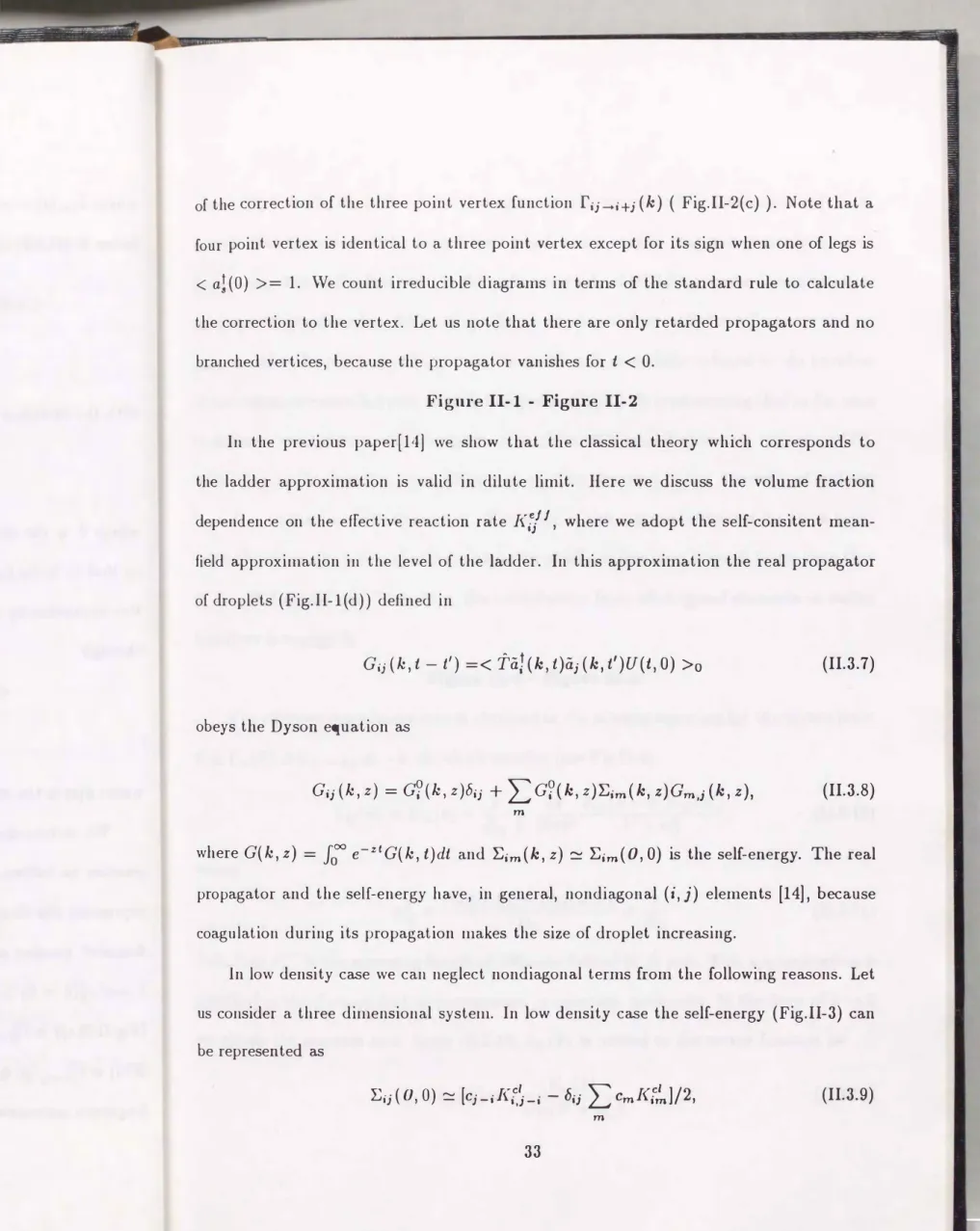
In low density case we can neglect nondiagonal terms from the following reasons. Let us consider a three ditnensional systetn. In low density case the self-energy (Fig.ll-3) can be represented as
Eij(O,O)::: [cj-iJ(i��-i- Dij Lcmi<,c�]/2,
(11.3.9)m
where
J(icj
= 47rDij Rij
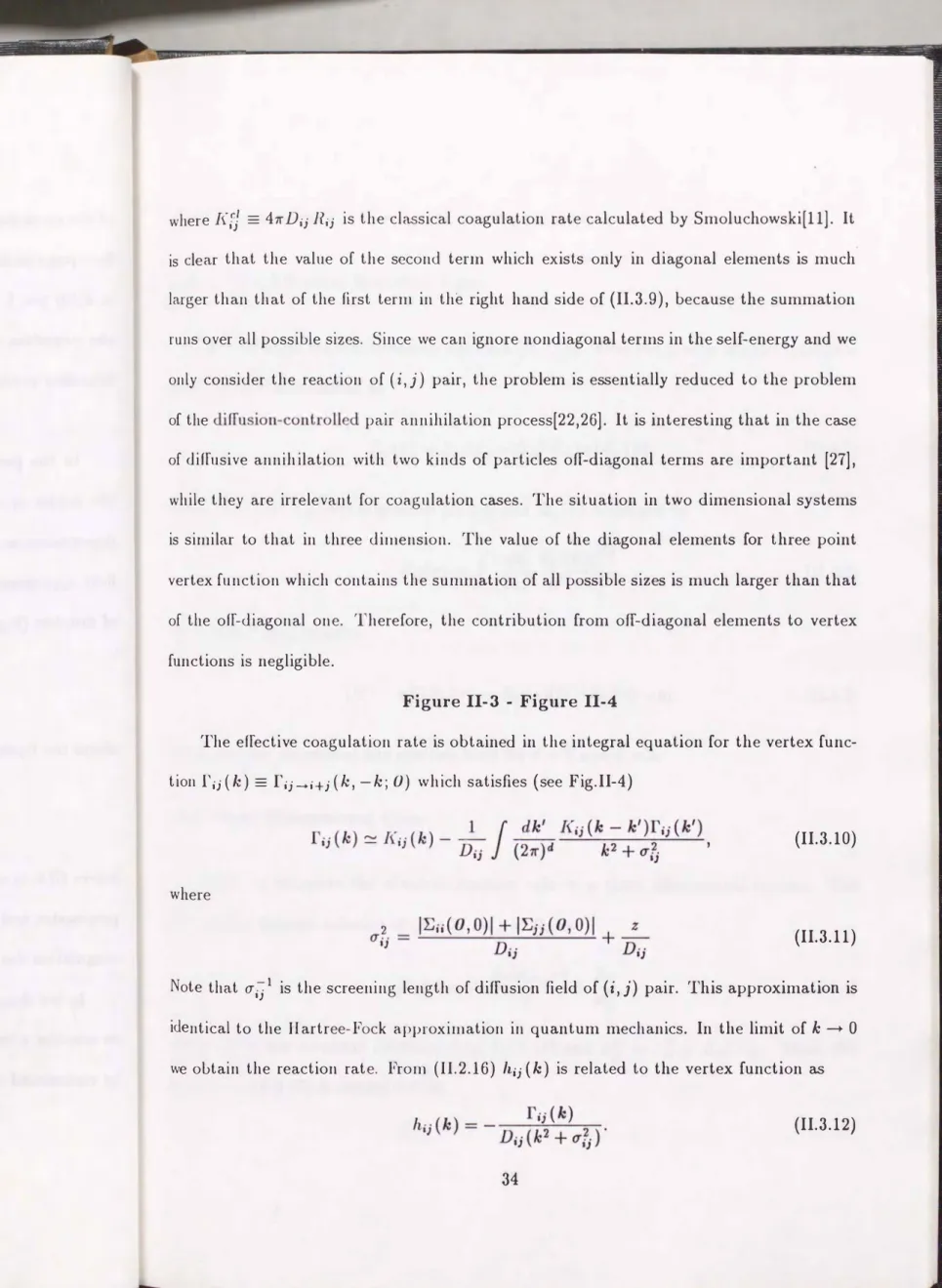
is the classical coagulation rate calculated by Smoluchowski(11]. It is clear that the value of the second tenn which exists only in diagonal elements is much larger than that of the first term in the right hand side of (II.3.9), because the summation runs over all possible sizes. Since we can ignore nondiagonal terms in the self-energy and we only consider the reaction of(
i,j)
pair, the problem is essentially reduced to the problem of the diffusion-controlled pair annihilation process(22,26]. It is interesting that in the case of diffusive annihilation with two kinds of particles off-diagonal terms are important (27], while they are irrelevant for coagulation cases. The situation in two dimensional systems is sin1ilar to that in three ditnension. The value of the diagonal elements for three point vertex function which contains the sun1mation of all possible sizes is much larger than that of the off-diagonal one. 1 herefore, the contribution from off-diagonal elements to vertex functions is negligible.Figure 11-3 - Figure 11-4
The effective coagulation rate is obtained in the integral equation for the vertex func- tion
fii(k)
=rii-i+i(k, -k; 0)
which satisfies (see Fig.II-4)(11.3.10)
where
(11.3.11)
Note that
uij1
is the screening length of diffusion field of (i,j) pair. This approximation is identical to the Ilartree-Fock approxitnation in quantum mechanics. In the limit of k--+- 0 we obtain the reaction rate. Frotn (11.2.16)hij(k)
is related to the vertex function as(11.3.12)
Therefore, to obtain r
ij
(k)
= rij (I
kI)
is a key problem.§ 11-4. The Effective Reaction Rate
We now solve the self-consistent equation (11.3.10). After the inverse Fourier transform (11.3.10) can be rewritten as
where
I<aj(r)
=J(ii(lrl)
is given in (II.2.4) andZ;j(r)
is defined byNote that
Z;j ( r)
satisfiesFrom now on, we present the analysis both for d = 3 and d = 2.
{a).
Three Diinensional Case{11.4.1)
{11.4.2)
{11.4.3)
First we calculate the effective reaction rate in a three dimensional system. The spherical symn1etric solution of (11.4.3) for r <
R;j
isZ .. ( ) _ A
sinh(J-laj r) /(0
•J
r
- 3 r +J-l;j
2 'where Aa is the constant detennined by (11.3.11) and
J-l[j
-integral in (II.3.10) is carried out as
(11.4.4)
o}i
+/{0/ D;j.
Thus, the4n1(ocr�.
f;j (k) = 2 k3'1 (sin(kR;j)- kR;j cos(kR;j
)]
J-lij
4
� � ;
oAa 2)
[JL;j cosh(p;;
R;j) sin( kR;j) - k sinh(JL;j R;j) cos( kR;i)]. (II.4.5)
D;i k + J-l;i
From (II.4.4) and (11.4.5) with the low density condition Uij R;j �
1,
we obtain the constantAa as
(11.4.6)
in the order of u;i R;j, where
(11.4. 7)
represents the strength of reaction. In this approximation the first term in the right hand side of (II.4.5) is negligible. Hence the effective reaction rate is reduced to
(11.4.8)
where Uij is given by
(11.4.9)
Equations(II.4.8) and (II.4.9) contain familiar results. For rapid coagulation (Aaj �
1)
(11.4.8) is reduced to
{11.4.10a)
where
(II.4.10b)
For fluid systen1s the first tenn in the right hand side of (11.4.10a) (
u ( 1))
is n1uch larger than the second term(u(2)),
because the first tenn can be estitnated as u(
l) rvpR(t)
rvt-213
while the second tern1 is
cr(2)
r-v 1/t, where we have used (II.1.6) and (11.1.
7). From now on, we neglect the second term in (11.4.9) and (II.4.10b) when we discuss three dimensional coagulation. In zero density litnit( cri·j Rij
� 1), (II.4.10) is identical to Smoluchowski'sresult. On the other hand, if a droplet of radius R is immobile except for monomers (diffusion coefficient D), i.e. R1m �
Rm
and Dlm =Dij
= D, the reaction rate (II.4.10) is reduced to(11.4.11)
This expression is identical to that for Ostwald ripening obtained by Marqusee and Ross [18]. Note that the expression in
(11.4.10)
can be obtained by the extension of conventional theory (Appendix A).For the slow reaction
(
A;j � 1) we reproduce the chemical kinetics}.-eff- 81r},
R3
'-ij
-3
\oij
(11.4.12)which corresponds to chen1ical kinetic process. Note that (II.4.12) is independent of the volume fraction, at least, in the level of the present approximation. The reaction rate in (11.4.12) is equivalent to that in the shear flow[4], where ](0 corresponds to the shear rate (Appendix A). Therefore, the Inean droplet size s(t) grows as s(t) f"V exp[f(oif>t] with time.
It is interesting to cmnpare our result with the experimental results for the reaction limited aggregation (RLA) of colloidal particles. In experimental situations, colloidal aggregates form fractal clusters. Then s1nall clusters can stay in the fjord region of a large cluster
where the distance between the centers of mass of two clusters is shorter than the reaction radius. Although the cluster shape is restricted to the sphere in our model, the overlapping of clusters is permitted for slow reactions because of the definition of the reaction rate