Nagaya, Naonori. 2013. ‘Voice and grammatical relations in Lamaholot of eastern Indonesia, in Alexander Adelaar (ed.), More on voice in languages of Indonesia. NUSA 54, 85-119. [Permanent URL: http://hdl.handle.net/10108/71807]
Naonori NAGAYA
National Institute for Japanese Language and Linguistics
This paper analyses voice and grammatical relations in Lamaholot (eastern Indonesia) in light of the typologies of voice systems in western Austronesian languages. In the literature, languages of eastern Indonesia are assumed either not to display any grammaticized voice contrasts, or to show asymmetrical voice alternations if they do. However, this literature does not take Lamaholot into account. On the one hand, this language does display various conceptual voice contrasts, such as antipassive, anticausative, and middle, by means of the transitivity alternation, addition of prepositional elements, and other periphrastic strategies.
On the other hand, there are also construction types differentiated by word order for different pragmatic requirements: the Subject-Topic and the Object-Topic constructions, the ditransitive alternation, and the benefactive alternation are all used to express the same conceptual content with different arguments highlighted for pragmatic purposes. These alternations essentially perform the same syntactic/pragmatic function as the focus system in Philippine languages. Therefore, the data and analyses presented here as well as the diversity shown in the growing literature on eastern Indonesian languages call for a more comprehensive and systematic typology of western Austronesian voice systems. At the very least, it is too early to conclude that eastern Indonesian languages lack voice alternations.
1 Western Austronesian voice systems
In the current typologies of western Austronesian languages,1 languages of eastern Indonesia are believed to be in contrast with those of the Philippines and western Indonesia with regard to the nature of voice systems (Arka & Ross 2005a, b;
Himmelmann 2005). To begin with, let us observe that voice systems in languages of the Philippines and western Indonesia can be characterized by two major features. The first feature is the existence of multiple voice constructions: there are multiple morphologically distinguished voice alternations. Another equally important feature lies in the symmetrical nature of voice systems. Voice alternations are marked by morphology of equal complexity, making it difficult to determine if one voice
*Earlier versions of this paper were presented at the 11th International Conference on Austronesian Linguistics in 2009 and at the Workshop on Indonesian-type Voice System in the Research Institute for Languages and Cultures of Asia and Africa of Tokyo University of Foreign Studies in 2010. I am grateful to the audience for their comments and criticism that have helped in improving the manuscript. My thanks also go to Sander Adelaar, I Wayan Arka, Masayoshi Shibatani, Fay Wouk, and two anonymous reviewers for their detailed comments and suggestions. Of course, any errors that remain are my responsibility. This work was supported by the Japan Society for the Promotion of Science (Grant-in-Aid
#24-9187).
1 The term ‘western Austronesian’ refers to Austronesian languages of Asia and Madagascar (plus Palauan and Chamorro) (Himmelmann 2005:111).
construction is basic, or unmarked, vis-à-vis another.2 For example, consider the Balinese examples in (1).
(1) Balinese (Wechsler & Arka 1998:388) a. Agentive Voice:
Tiang numbas bawi-ne punika. (high register) I AV-buy pig-DEF that
‘I bought the pig.’
b. Objective Voice:
Bawi-ne punika tumbas tiang. (high register) pig-DEF that OV.buy I
‘I bought the pig.’
As in (1), Balinese has a two-way voice contrast between agentive and objective voice.
The verb appears in its nasal form numbas in example (a) of (1), but in oral form tumbas in (b) of (1). Another characteristic is that an agent occurs in the clause-initial preverbal position in the former but a patient appears in that position in the latter. This voice alternation is considered as morphologically symmetrical because different voice forms are marked by different forms of a verb and appear in different word orders. See Arka (2003a, b).
Standard Indonesian displays a more elaborate three-way voice system as in (2): active, inverse, and passive. Again, we can see that there are multiple voice constructions in this language and that each voice form is marked in one way or another.
(2) Standard Indonesian (Donohue 2008:1475) a. Active:
Dia me-[n]onton gadis cantik itu.
3SG ACT-watch girl beautiful that ‘He watched that beautiful girl.’
b. Inverse:
Gadis cantik itu di-tonton-nya.
girl beautiful that NON.ACT-watch-3SG.GEN
‘He watched that beautiful girl.’
c. Passive:
Gadis cantik itu di-tonton (oleh dia).
girl beautiful that NON.ACT-watch by 3SG
‘That beautiful girl was watched (by him).’
A four-way voice contrast is found in Tagalog as shown in (3), where different voice constructions with different pivots are distinguished by different verbal morphology.
2 Another related characteristic of symmetrical voice systems is the possibility of the actor and undergoer arguments being equally linked to syntactic subject/pivot without demotion of either.
(3) Tagalog (Nagaya 2009:160) a. Actor Focus (Antipassive):
K<um>ain =ako nang= mansanas.
eat<AF> =1SG.NOM GEN= apple ‘I ate an apple/apples.’
b. Patient Focus (Active):
K<in>ain-ø =ko ang= mansanas.
eat<RL>-PF =1SG.GEN NOM= apple ‘I ate the apple.’
c. Locative Focus (Locative applicative):
K<in>ain-an =ko ang= pinggan ni= John Rey.
eat<RL>-LF =1SG.GEN NOM= plate PN.GEN= J.R.
‘I ate off of John Rey’s plate.’
d. Circumstantial Focus (Benefactive applicative):
I-k<in>ain =ko si= Fiona.
CF-eat<RL> =1SG.GEN PN.NOM= Fiona
‘I ate for Fiona (because she could not eat for some reason).
In a nutshell, languages of the Philippines and western Indonesia are believed to show two characteristics: (i) multiple voice constructions and (ii) symmetrical voice alternations. In contrast, with typologies of voice systems in western Austronesian, it is believed that languages of eastern Indonesia, specifically, languages of Flores, Timor, and Papua ‘either do not show any grammaticized voice alternations at all or the voice alternations are clearly asymmetrical’ (Himmelmann 2005:114). In other words, languages of eastern Indonesia are believed to not display the two features mentioned above.
It is in this context that Lamaholot, with which this paper is concerned, becomes important. This language displays a constructional contrast between two competing transitive constructions, the Subject-Topic and the Object-Topic constructions. The Subject-Topic construction is a transitive clause with a Subject-Verb-Object word order, with a subject argument in the sentence-initial topic position. See (4), for example.
(4) Subject-Topic construction:
Tanti bəŋo Ika.
Tanti hit Ika
‘Tanti hit Ika.’
In the Object-Topic construction, by contrast, a non-subject core argument occupies the topic position, yielding an Object-Subject-Verb word order. To illustrate, compare examples in (4) and (5).
(5) Object-Topic construction:
Ika, Tanti bəŋo.
Ika Tanti hit
‘Ika, Tanti hit.’
The constructional contrast between (4) and (5) does not involve additional morphological marking, unlike the above-mentioned Balinese, Standard Indonesian, and Tagalog voice alternations. Nevertheless, the Lamaholot pattern still seems to have two features in common with other western Austronesian voice systems. On one hand, the contrast between the two types of transitive constructions is expressed by different word orders, like it is in Balinese and Standard Indonesian. On the other hand, the alternation between the two construction types can be analyzed as symmetrical in the sense that the verb predicate in one construction is as morphologically unmarked as the verb predicate in the other. How should we understand these similarities?
In this paper, we present a description and analysis of the Subject-Topic and the Object- Topic constructions and other voice-related phenomena in Lamaholot with special reference to the way these voice phenomena change and interact with grammatical relations. There are two major claims in this paper. The first is that Lamaholot does not have voice morphology but expresses voice oppositions in a periphrastic way. Secondly, two distinct sets of grammatical relations are required for a better understanding of voice phenomena in Lamaholot, especially for the contrast between the Subject-Topic and the Object-Topic constructions.
This paper is organized as follows. In Section 2, we provide a preliminary description of the Lamaholot language and its typological characteristics. This language is strongly isolating and a typical example of a ‘preposed possessor language’ (Himmelmann 2005). Section 3 introduces grammatical relations and discusses how they are recognized in Lamaholot. In Section 4, it is demonstrated that this isolating language has various periphrastic means for expressing voice and transitivity-related functional domains. These voice phenomena without voice morphology interact with grammatical relations (which are explored in Section 3). In Section 5, then, the topic, another type of grammatical relation, is introduced to describe the Subject-Topic and Object-Topic constructions. Finally, Section 6 concludes this paper with some remarks about the symmetry of Lamaholot voice systems.
2 Lamaholot, an Austronesian language of eastern Indonesia
Lamaholot is a Central Malayo-Polynesian language of the Austronesian language family (Blust 1993). It is spoken in the eastern part of Flores Island and neighboring islands of eastern Indonesia, serving as the lingua franca of the region (Grimes et al.
1997). See Map 1.
Lamaholot is best understood as a dialect chain with enough substantial differences between some of the dialects to make them mutually incomprehensible (Keraf 1978;
Bowden 2008). In this description, we focus exclusively on Lewotobi, the most westerly dialect in the chain. This dialect is spoken by approximately 6,000 speakers in Kecamatan Ile Bura.
Two notes on the typological characteristics of Lamaholot are in order. First, Lamaholot is a strongly isolating language. Flores languages, including Lamaholot, are known for having little morphology (Himmelmann 2005; Arka 2007; Donohue 2007a; McWhorter 2007). The grammatical formatives of Lamaholot are S/A-agreement prefixes (Table 1), S-agreement enclitics (Table 2), the possessive/nominalization markers -N and =kə̃, the pronominal possessive/nominalization marker -ə̃ʔ, and several others. Central to our investigation is the lack of any dedicated affix for voice and valence-related functions.
Map 1: Flores Island and the islands of Indonesia
Second, Lamaholot is a typical instance of a preposed possessor language, despite transitional languages being predominant on this island (Himmelmann 2005 for preposed possessor and transitional languages), and represents an array of typical eastern Indonesian features (cf. Klamer 2002; Donohue 2007a; Musgrave 2008a). To begin with, like other eastern Indonesian languages, Lamaholot has person marking for S and A arguments (Table 1), while it also has agreement markers for S arguments (Table 2). S/A-agreement prefixes obligatorily occur with certain verbs, either transitive or intransitive, while S-agreement enclitics are optionally used with intransitive verbs.
Agreement phenomena provide strong evidence for positing the subject grammatical relation in this language (see Section 3.1).
SG PL SG PL
1 k- m- (EXC) 1 =əʔ =kə (EXC)
t- (INC) =kə (INC)
2 m- m- 2 =ko =kə
3 n- r- 3 =aʔ =ka
Table 1: S/A-agreement prefixes Table 2: S-agreement enclitics3 Now consider word order in Lamaholot. The basic word order of Lamaholot is SVO as in (6).
(6) go buka knaweʔ.
1SG open door
‘I opened the door.
Turning to the structure of noun phrases, a possessor precedes its possessum when it is realized as a lexical noun, whereas a noun precedes a numeral. See (7) and (8), respectively.
3 S-agreement enclitics take different forms when preceded by a nasalized vowel (Nagaya 2010:184ff).
For example, =nəʔ is used rather than =əʔ in (56), and =na instead of =ka in (58).
(7) Hugo laŋoʔ =kə̃
Hugo house =NMLZ
‘Hugo’s house’
(8) ata rua person two
‘two persons’
Importantly, as is often the case in languages of eastern Indonesia, alienable and inalienable possessive relationships take different possessive markers in Lamaholot.4 Compare (7) and (9).
(9) Hugo kotə̃ʔ
Hugo kotəʔ -N
Hugo head -NMLZ
‘Hugo’s head’
In (7), which represents an alienable possessive relation, the possessive relation is marked by the possessive enclitic =kə̃. In the case of the inalienable possessive relation in (9), by contrast, such a semantic relation is indicated by the possessive suffix -N, which is realized as nasalization on the last vowel of the possessum noun. In either case, a possessor is followed by its possessum.
Lastly, the negator and other TAM markers occur in clause-final position. For instance, the negator həlaʔ, the imperfective marker morə̃, and the perfective marker kaeʔ appear clause-finally in (10), (11), and (12), respectively.
(10) go isə kbako həlaʔ.
1SG suck tobacco NEG
‘I don’t smoke.’
(11) go biho lama morə̃. 1SG cook rice IPFV
‘I am still cooking rice.’ or ‘I haven’t cooked rice.’
(12) go biho lama kaeʔ.
1SG cook rice PFV
‘I have already cooked rice.’
3 Grammatical relations in Lamaholot
This section introduces grammatical relations and discusses how they can be posited in Lamaholot. In this paper, grammatical relations are considered as those higher-order groupings of arguments that are required in the analysis of grammatical phenomena of an individual language (cf. Dixon 1979, 1994; Dryer 1986, 1997; Croft 2001). This definition calls for two qualifications. First, according to this definition, different languages can have different grammatical relations. For instance, it is necessary to posit the absolutive grammatical relation for a description of the syntax of Dyirbal, but not for English. Second, even within a single language, different grammatical relations may
4 The enclitic =kə̃ and the suffix -N, both glossed as NMLZ, are used as nominalizers and possessive markers.
need to be recognized for different grammatical phenomena. For example, in Dyirbal, constructions such as coordination are governed by the absolutive relation, while other constructions, such as the imperative, make it necessary to posit the subject relation as well.
In this study, it is proposed that two kinds of grammatical relations must be distinguished in order to fully understand Lamaholot morphosyntax, as in (13) (cf.
Shibatani 2008, 2009).
(13) Grammatical relations in Lamaholot:
a. Semantico-syntactic grammatical relations:
Subject, primary object, and secondary object b. Pragmatico-syntactic grammatical relation:
Topic
The former set of grammatical relations is a semantically-motivated syntactic category, while the latter is a grammaticalized pragmatic category. A similar distinction is made in the framework of Lexical-Functional Grammar (‘argument functions’ vs. ‘non- argument functions,’ and ‘(grammaticalized) discourse functions’ vs. ‘non-discourse functions’; Bresnan 2001:97-98). The A-position and A’-position in a Government and Binding framework is also similar to the distinction in question. Furthermore, the contrast between agent-like and topic-like subjects has been a point of contention for centuries in Japanese linguistics (Shibatani 1991) and has long been known as the distinction between role-related and reference-related properties of subjects in Philippine linguistics (Schachter 1976; Foley & Van Valin 1984).
To define these grammatical relations in Lamaholot, we refer to proto-roles as defined in (14).
(14) Proto-roles:
S Single argument in an intransitive clause
A More agent-like argument in a mono- or di-transitive clause P More patient-like argument in a transitive clause
T Theme argument in a ditransitive clause R Recipient argument in a ditransitive clause
To illustrate each proto-role, let us consider examples in (15), (16), and (17).5
5 Although there is no space to fully develop this argument here, verbs of mental events, such as LOVE- verbs and HATE-verbs, form a semitransitive clause, taking an experiencer as a subject argument and a stimulus as an adjunct-marked argument (see footnote 6 for the verb ø-ə̃ʔə̃ ‘do’). See (i).
(i) go brea =əʔ k-ə̃ʔə̃ Nia.
1SG like =1SG 1SG-do Nia
‘I like Nia.’
As is often the case with other Indonesian languages (Palu’e (Donohue 2005), Manggarai (Arka 2008), and Indonesian (Musgrave 2008b)), the stimulus NP of this construction type is marked differently from OBJ but can be in the TOP relation in the Object-Topic constructions and can even acquire reference- tracking properties associated with TOP such as relativization. See (ii).
(15) Intransitive clause:
Ika pana.
Ika walk
‘Ika (S) walked.’
(16) Transitive clause:
Ika sepa bal.
Ika kick ball
‘Ika (A) kicked the ball (P).’
(17) Ditransitive clause:
Ika neĩ go doi.
Ika give 1SG money
‘Ika (A) gave me (R) money (T).’
Example (15) is an intransitive clause, and thus its single argument Ika is considered an S argument. In the transitive clause in (16), the more agent-like argument Ika is identified as an A argument, the other argument bal ‘ball’ being a P argument. Example (17) is a ditransitive or double-object construction with three arguments. In this sentence, the giver Ika is analyzed as an A argument, the recipient go ‘1SG’ as an R argument, and the entity given doi ‘money’ as a T argument.
On the basis of these proto-roles, grammatical relations can be identified. In Lamaholot, the semantico-syntactic grammatical relations listed in (18) are relevant to certain morphosyntactic phenomena and need to be postulated for their description.
(18) Semantico-syntactic grammatical relations:
a. Subject SUBJ {S, A}
b. Primary object PO {P, R}
c. Secondary object SO {T}
d. Oblique OBL {Neither SUBJ, PO, nor SO}
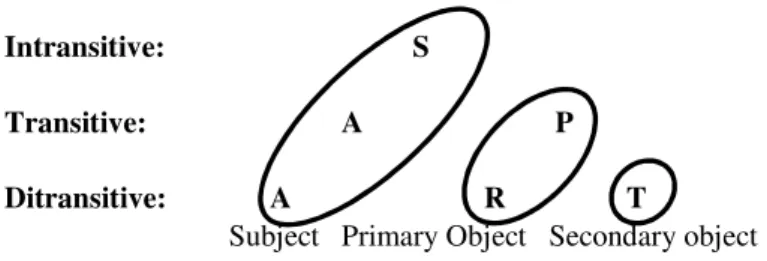
Alignment patterns of grammatical relations listed in (18) can be represented as in Figure 1, where those arguments that behave alike are indicated by a circle.
S P
A P R T
Subject (Primary) object Primary object Secondary object Figure 1: Semantico-syntactic grammatical relations
As shown in the left of Figure 1, S and A are treated alike in opposition to P, forming the subject relation as opposed to the (primary) object relation. This is an instantiation of the nominative-accusative alignment pattern. In contrast, the right of Figure 1 shows
(ii) Nia, go brea=əʔ.
Nia 1SG like=1SG
‘Nia, I like.’
that P behaves like R and differently from T, bearing the primary object relation relative to the secondary object relation. In this sense, Lamaholot ditransitive constructions represent a secundative alignment type in the typology of alignment patterns for ditransitive clauses (Haspelmath 2005; Siewierska 2003).
Figure 1 can be also represented as in Figure 2, where each semantico-syntactic grammatical relation is indicated relative to clause types. Intransitive constructions have only one S argument, which automatically counts as subject. Transitive arguments have A and P arguments, which bear the subject and the primary object relations, respectively. Ditransitive clauses have three arguments: an A argument that is in the subject relation, an R argument in the primary object relation, and a T argument in the secondary object relation.
Intransitive: S
Transitive: A P
Ditransitive: A R T
Subject Primary Object Secondary object Figure 2: Semantico-syntactic grammatical relations
In addition, the pragmatico-syntactic grammatical relation can be posited for a description of some other grammatical phenomena in Lamaholot, as in (19). It groups subject and pragmatically marked object relations, from which it follows that oblique elements cannot bear this relation (see Sections 3.2.1 and 3.2.2).
(19) Pragmatico-syntactic grammatical relation:
Topic TOP {Subject, Pragmatically marked Object}
(i.e., {{S, A}, Pragmatically marked {P, R, T}}) Now let us consider how these grammatical relations are justified in Lamaholot. As has been demonstrated by a number of recent typological works (Dryer 1997; Croft 2001;
Haspelmath 2010, among others), grammatical relations are construction-specific and thus language-specific concepts. For example, the subject relation in Lamaholot can be justified by means of the grammatical phenomena listed in (20), where S and A arguments are coded in the same way and behave alike.
(20) Grammatical phenomena justifying the subject relation {S, A}
a. [__ V (ARG)]
b. Agreement c. Reflexivization
d. Kədiʔ-coordination (i.e., coordination with the conjunction kədiʔ ‘and, so') e. Imperative construction
The other grammatical relations are grouped relative to the following grammatical phenomena. See (21) for the primary object relation, (22) for the secondary object relation, and (23) for the topic relation.
(21) Grammatical phenomena justifying the primary object relation {P, R}
a. [ARG V __ (ARG)]
b. Enclitic pronoun =roʔ c. Ditransitive alternation d. Benefactive alternation e. Object-Topic construction
(22) Grammatical phenomena justifying the secondary object relation {T}
a. [ARG V ARG ___ ] b. Ditransitive alternation c. Object-Topic construction
(23) Grammatical phenomena justifying the topic relation {Subject, Pragmatically marked Object}
a. Sentence-initial position b. Pragmatically marked status c. Relativization
d. Kia gə-coordination (i.e., coordination with the conjunction kia gə ‘and, then’)
In Section 3.1, we present a series of phenomena, as in (20), where S and A arguments are coded in the same way and behave alike, which in turn justifies the subject relation.
Section 3.2 discusses a set of morphosyntactic phenomena, as in (21) and (22), so as to posit the primary object relation and the secondary object relation, respectively.
Evidence for the topic relation in (23) is discussed later in Section 5.2, where we examine the nature of the Subject-Topic and the Object-Topic constructions introduced in Section 1.
3.1 Subjects {S, A}
There are several morphosyntactic phenomena that constitute evidence that S and A arguments are grouped together in Lamaholot. Evidence comes from both the structural coding and behavioral potential of S and A arguments.
Two structural coding phenomena are relevant to S and A arguments. First, only S and A arguments can appear directly to the left of the verb without any adjunct marking, such as a preposition.
Second, only S and A arguments can agree with verbs in terms of person and number.
Observe in (24), (25), and (26) that S/A-agreement prefixes (Table 1) agree with S and A but not P.
(24) Agreement with S:
go k-aʔi skola k-ai k-ə̃ʔə̃ Hugo.
1SG 1SG-leave school 1SG-go 1SG-do Hugo
‘I went to school with Hugo.’
(25) Agreement with A:
go k-əte kursi k-ai k-ə̃ʔə̃ Hugo.
1SG 1SG-bring chair 1SG-go 1SG-do Hugo
‘I brought the chair with Hugo.’
(26) Agreement with P:
*na k-ala go k-ai k-ə̃ʔə̃ Hugo.
3SG 1SG-follow 1SG 1SG-go 1SG-do Hugo Intended for ‘S/he followed me with Hugo.’
In (24), the S argument is go ‘1SG’. It agrees with the main verb ø-aʔi ‘leave’, the deictic motion verb ø-ai ‘go’, and the serialized verb ø-ə̃ʔə̃ ‘make, do’.6 In (25), all three verbs agree with the A argument go ‘1SG’. However, in (26), the main verb ø-ala
‘follow’, the deictic motion verb ø-ai ‘go’, and the serialized verb ø-ə̃ʔə̃ ‘make, do’
agree with the P argument go ‘1SG’, not the A argument na ‘3SG’, leading to an ungrammatical sentence.
Turning to behavioral potential, only S and A arguments can bind the reflexive expression wəki ‘self.’ See (27).
(27) Reflexive wəki ‘self’ construction:
a. S = antecedent, OBL = reflexive:
Hugo brea =aʔ n-ə̃ʔə̃ wəki nəʔẽ.
Hugo happy =3SG 3SG-do self 3SG.NMLZ
‘Hugo is happy with himself.’
b. A = antecedent, P = reflexive:
Hugo plewə̃ wəki nəʔẽ.
Hugo praise self 3SG.NMLZ
‘Hugo praised himself.’
c. A = reflexive, P = antecedent:
*wəki nəʔẽ plewə̃ Hugo.
self 3SG.NMLZ praise Hugo Intended for ‘Himself praised Hugo.’
In the kədiʔ-coordination construction, where two clauses are coordinated with the conjunction kədiʔ ‘and, so’, only S and A arguments can control a gap in the second clause. Consider (28) and (29).
(28) S → S:
na gaka, kədiʔ __ gwali.
3SG cry then return
‘S/he cried, and (s/he) returned.’
(29) A → S, but not P → S:
na bəŋo go, kədiʔ __ gwali.
3SG hit 1SG then return
‘S/he hit me, and (s/he) returned.’
6 The verb ø-ə̃ʔə̃ has a number of different meanings and functions: (i) lexical verb ‘make, do’, (ii) serialized verb ‘use, with’ (instrumental), (iii) serialized verb ‘with’ (companion), (iv) conjunction ‘and’
(see Nishiyama 2011), (v) marker of a stimulus argument in verbs of mental events (see footnote 5), and (vi) periphrastic causative marker (see Section 4.3), among others.
Lastly, the addressee of an imperative must be S or A, but not P. To illustrate, see (30), (31), and (32).
(30) S addressee:
mo gõ7 =no kia ka!
2SG eat.2SG =2SGPROS EMP
‘You eat!’
(31) A addressee:
mo gõ ikə̃ kia ka!
2SG eat.2SG fish PROS EMP
‘You eat (the) fish!’
(32) P addressee:
*ra bəŋo mo kia ka!
3PL hit 2SG PROS EMP
Intended for ‘Be hit by them!’
The addressee of the imperative construction is the S argument in (30), the A argument in (31), and the P argument in (32). Only (32) is not appropriate as an imperative construction.
3.2 Primary object {P, R} and secondary object {T}
Lamaholot also provides an array of evidence for the primary and secondary object relations. In this section, we make an analysis of the two grammatical relations with special reference to the ditransitive alternation (Section 3.2.1) and the benefactive alternation (Section 3.2.2). To begin with, consider structural coding for P and R arguments. First, in terms of word order, P and R arguments appear directly to the right of the verb. See (33) and (34).
(33) Transitive clause:
ra raga wata klipĩ. 3PL grasp corn crush.NMLZ
A P
‘They grasped crushed corn.’
7 The verb for ‘eat’ (Proto Malayo-Polynesian *kaen) shows irregular person and number inflection of a subject argument. It is the only Lamaholot verb showing this inflection.
SG PL
1 kə̃ məkə̃ (EXC) təkə̃ (INC)
2 gõ gẽ
3 gə̃ rəkə̃
(34) Ditransitive clause:
ra sorõ Tanti wata klipĩ.
3PL give Tanti corn crush.NMLZ
A R T
‘They gave Tanti crushed corn.’
Second, the third person singular pronoun =roʔ can be coreferential with only P and R arguments. Observe that in the transitive construction in (35), =roʔ refers to the P argument, while the same pronoun designates the R argument in the ditransitive construction in (36).
(35) Transitive construction:
go kə̃ =roʔ ia Ika.
1SG eat.1SG =3SGLOC Ika
A P
‘I ate it in Ika’s house.’
(36) Ditransitive/Double-object construction:
a. go sorõ Ika doi.
1SG give Ika money A R T
‘I gave Ika money.’
b. go sorõ =roʔ doi.
1SG give =3SG money A R T
‘I gave him/her money.’
Turning to behavioral potential, P, R, and T arguments are involved in two syntactic alternations: the ditransitive and the benefactive alternations (Nagaya 2012; see also Sections 4.7 and 4.8). The ditransitive alternation involves the prepositional recipient construction and the double-object construction. In the former, a theme argument bears the primary object relation; in the latter, a recipient argument bears the same relation. In contrast, the benefactive alternation is concerned with the benefactive construction and the benefactive serial verb construction. In the former, a beneficiary argument appears in the primary object relation, but in the latter, it is only in the oblique relation. Our analysis of the two alternations is presented in advance in (37) and (38) for ease of reference.
(37) Ditransitive alternation (← Topicality of a recipient) a. Prepositional recipient construction:
Agent Verb Theme ia Recipient
A P
SUBJ PO OBL
b. Double-object construction:
Agent Verb Recipient Theme
A R T
SUBJ PO SO
(38) Benefactive alternation (← Topicality of a beneficiary)
a. Benefactive serial verb construction (with a bivalent predicate):
Agent Verb Patient neĩ/sorõ Beneficiary
A P
SUBJ PO OBL
b. Benefactive construction:
Agent Predicate Beneficiary Patient
A P
SUBJ PO OBL
3.2.1 The ditransitive alternation
In a ditransitive alternation, the double-object construction is contrasted with the prepositional recipient construction in terms of the topicality of a recipient. Compare (39) and (40).
(39) Ditransitive/Double-object construction:
go sorõ Ika doi.
1SG give Ika money
A R T
‘I gave Ika money.’
(40) Prepositional recipient construction:
go sorõ doi ia Ika.
1SG give money LOC Ika A P Adjunct (Recipient)
‘I gave money to Ika.’
The recipient Ika is foregrounded in (39), while the theme doi ‘money’ is highlighted in (40). As will be discussed in Section 5, this difference in topicality results in different behaviors of recipient participants with respect to topic-related grammatical phenomena.
Crucially, what is referred to by =roʔ is the recipient in the double-object construction in (39) but the theme in the prepositional recipient construction in (40). Consider (41) and (42).
(41) Ditransitive/Double-object construction (39) + roʔ: go sorõ =roʔ doi.
1SG give =3SG money
A R T
‘I gave him/her money.’
(42) Prepositional recipient construction (40) + roʔ: go sorõ =roʔ ia Ika.
1SG give =3SGLOC Ika
A P Adjunct (Recipient)
‘I gave it to Ika.’
In typological studies on three-place predicates (Haspelmath 2005; Margetts & Austin 2007, to name a few), prepositional recipient constructions above are also often counted
as ‘ditransitive’, but in our analysis, the preposition-marked recipient element is an adjunct and the prepositional recipient construction is a mere transitive construction.
There are several language-internal reasons to choose this analysis over the prevalent analysis. First, the recipient participant above is marked by the locative ia as an adjunct.
Indeed, (40) is ungrammatical when the locative is omitted. See (43).
(43) *go sorõ doi Ika.
1SG give money Ika Intended for ‘I gave money to Ika.’
Second, it is not possible for the prepositional recipient to appear in the topic position.
To begin with, observe that the Object-Topic (OT) construction can be used to distinguish arguments from adjuncts: unlike arguments, oblique participants such as a companion and an instrument headed by serialized verbs cannot be in the sentence- initial topic position of the OT construction. See (44) and (45).
(44) Companion SVC:
a. go pana k-ə̃ʔə̃ Ika. [ST: Topic = Agent]
1SG walk 1SG-do Ika
SUBJ OBL
‘I walked with Ika.’
b. *Ika go pana k-ə̃ʔə̃. *[OT: Topic = Companion]
c. *Ika go pana.
(45) Instrument SVC:
a. go poroʔ ikə̃ pake hepe teʔẽ. [ST: Topic = Agent]
1SG cut fish use knife DEM.PROX.NMLZ
SUBJ PO OBL
‘I cut the fish with this knife.’
b. *hepe teʔẽ, go poroʔ ikə̃ pake. *[OT: Topic = Instrument]
c. *hepe teʔẽ, go poroʔ ikə̃.
Consider next the combination of the OT construction with the double-object and the prepositional recipient constructions. Both the recipient and the theme can occupy the topic position in the double-object construction as in (46), while only the theme can be in the topic position in the prepositional recipient construction as in (47).
(46) OT construction + Double-object construction (39):
a. Ika, go sorõ doi. [Topic = Recipient = PO]
Ika 1SG give money
PO SUBJ SO
‘Ika, I gave (her) money.’
b. doi, go sorõ Ika. [Topic = Theme = SO]
money 1SG give Ika
SO SUBJ PO
‘Money, I gave her (it).’
(47) OT construction + Prepositional recipient construction (40):
a. doi, go sorõ ia Ika. [Topic = Theme = PO]
money 1SG give LOC Ika
PO SUBJ OBL
‘Money, I gave (it) to her.’
b. *Ika, go sorõ doi ia. *[Topic = Recipient = OBL]
Ika 1SG give money LOC OBL SUBJ PO
Intended for ‘Ika, I gave money to (her).’
This strengthens the case that the recipient participant is in the oblique relation in the prepositional recipient construction, whereas the theme is still a core argument in the double-object construction.
To summarize, the double-object construction is a syntactically ditransitive construction, taking a recipient as primary object and a theme as secondary object. The primary object status of a recipient is guaranteed by co-reference with the pronominal enclitic =roʔ. Moreover, the core-argument status of primary and secondary objects is supported by the fact that both can be realized as the topic of OT constructions. On the other hand, the prepositional recipient construction is a syntactically transitive construction that takes a theme as primary object and has a recipient in the oblique relation. Taken together, the function of the ditransitive alternation lies in the manipulation of the topicality of the recipient. A recipient is foregrounded in the double-object construction but backgrounded in the prepositional recipient construction.
3.2.2 The benefactive alternation
The ditransitive alternation is similar to, but functionally different from, the benefactive alternation, in which benefactive serial verb constructions are contrasted with the benefactive construction in terms of the topicality of a beneficiary. On one hand, Lamaholot introduces a beneficiary into a clause by serializing the verb of giving (either neĩ ‘give’ or sorõ ‘give’). See examples of benefactive serial verb constructions with an intransitive verb in (48) and with a transitive verb in (49).
(48) Benefactive serial verb construction + intransitive verb:
go kriə̃ sorõ Ika.
1SG work give Ika
S Adjunct (Beneficiary)
‘I work for Ika.’
(49) Benefactive serial verb construction + transitive verb:
go hope gula neĩ Ika.
1SG buy candy give Ika
A P Adjunct (Beneficiary)
‘I bought candies for Ika.’ (P = theme)
On the other hand, a relatively large number of transitive verbs of transaction and creation (BUY-verbs, COOK-verbs, etc) can promote a beneficiary participant of high topicality into the primary object position. Thus, the conceptual content in (49) can also be expressed as in the benefactive construction in (50).
(50) Benefactive construction:
go hope Ika gula.
1SG buy Ika candy
A P Adjunct (Theme)
‘I bought Ika candies.’ (P = Beneficiary)
There are two important differences in structural coding between the benefactive serial verb construction (49) and the benefactive construction (50). First, what occupies the primary object position is a theme in (49) but a beneficiary in (50). Second, what the enclitic pronoun =roʔ can refer to is a theme in (49) but a beneficiary in (50). Compare (51) and (52).
(51) Benefactive serial verb construction (49) + =roʔ: go hope =roʔ neĩ Ika.
1SG buy =3SG give Ika
A P Adjunct (Beneficiary)
‘I bought it for Ika.’ (P = theme) (52) Benefactive construction (50) + =roʔ:
go hope =roʔ gula.
1SG buy =3SG candy
A P Adjunct/Theme
‘I bought him/her candies.’ (P = Beneficiary)
These two facts show that, in the benefactive construction, a participant bearing a beneficiary role is in the primary object relation, while in benefactive serial verb constructions the beneficiary is only an adjunct.
Unlike the theme participant of the double-object construction, the theme of the benefactive construction should be analyzed as an oblique rather than as a secondary object. The oblique status of the theme in (50) is again confirmed by means of the OT construction. Consider (53).
(53) OT construction + Benefactive construction (50):
a. Ika, go hope gula. [Topic = Beneficiary = PO]
Ika 1SG buy candy
PO SUBJ OBL
‘I bought Ika a candy.’
b. *gula, go hope Ika. *[Topic = Theme = OBL]
OBL SUBJ PO candy 1SG buy Ika
The contrast in (53) demonstrates that when the benefactive construction in (50) is combined with an OT construction, the beneficiary can be in the sentence-initial topic position, but the theme cannot. Paul Kroeger (pers. comm.) suggested that the ungrammaticality of (53) might be due to the indefinite interpretation of the topic gula
‘candy’. But the theme of BUY-verbs cannot be raised to topic position, even if it is made definite with a demonstrative pronoun. See example (54).
(54) OT construction + Benefactive construction:
*gula teʔẽ, go hope Ika. *[Topic = Theme = OBL]
candy DEM.DIS.NMLZ 1SG buy Ika
OBL SUBJ PO
Intended for ‘This candy, I bought Ika.’
In summary, in the benefactive construction, the theme is an adjunct and in oblique relation. This means that the theme in this construction cannot be involved in the topic- related morphosyntactic phenomena discussed in Section 5.
3.2.3 Primary and secondary object
To conclude, the ditransitive and the benefactive alternations look superficially similar, but work in a different way, and can only be understood by positing the grammatical relations PO, SO, and OBL. The primary object in Lamaholot can be defined by its position in a clause or by the possibility of replacing it with the enclitic pronoun =roʔ. It is also involved in the ditransitive and the benefactive alternations. In these two alternations, the division between PO/SO and OBL is highlighted. The former can be in the sentence-initial topic position in OT constructions, but the latter cannot.
3.3 Summary
In this section, we discussed the semantico-syntactic grammatical relations in Lamaholot, and argued that subject, primary object, and secondary object relations can be distinguished in terms of the morphosyntactic phenomena summarized in (20), (21), and (22). In Section 5, another type of grammatical relation is introduced, which is the topic. It is shown that the distinction between subject and topic is the key to understanding the Subject-Topic and the Object-Topic constructions in Lamaholot.
4 Voice oppositions without voice morphology
Lamaholot does not have any morphological means dedicated to voice and valence- changing operations (Section 2). However, the language utilizes other morphological and syntactic means for these purposes, such as the transitivity alternation (i.e., using a single verb interchangeably either as intransitive or transitive), agreement enclitics, and verb serialization. This section shows how voice and valence-changing operations are expressed in Lamaholot.
Following Shibatani’s (2006) conceptual framework for voice phenomena, voice and transitivity-related phenomena are divided into two types: semantically-based and pragmatically-motivated voice phenomena.
In semantically-based voice alternations, different voice forms represent different conceptual contents in terms of parameters pertaining to the evolution of an action (Shibatani 2006). Relevant parameters are, among others, whether the action extends beyond the agent’s personal sphere or is confined to it (active vs. middle), it achieves the intended effect in a distinct patient (active/ergative vs. antipassive), or it originates with an agent heading the action chain that is distinct from the agent or patient of the main action (causative vs. non-causative).
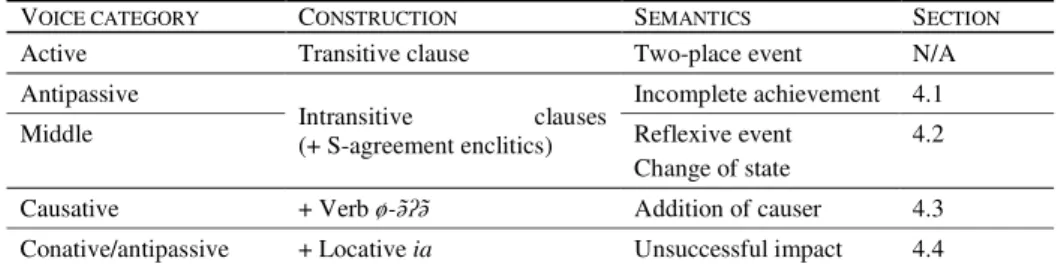
In Lamaholot, voice contrasts of the semantically-based type are expressed by the transitivity alternation, S-agreement enclitics (indirectly), the verb ø-ə̃ʔə̃, and the locative ia. See Table 3.
Table 3: Semantically-based voice constructions in Lamaholot
Pragmatically-motivated voice alternations are those in which different voice constructions are contrasted in terms of topicality and other discourse factors. For example, the English passive construction represents such a voice contrast. Its pragmatic function is to indicate that a patient is more topical than an agent by bringing a patient into the subject position.
For pragmatically-motivated voice alternations, Lamaholot also uses periphrastic strategies: word order, verb serialization, the locative ia, and the third person plural pronoun ra. See Table 4.
VOICE CATEGORY CONSTRUCTION TOPICALITY SECTION
Subject- vs. Object-Topic Word order Object 4.5
Ditransitive Word order + LOC Recipient 4.6
Benefactive Word order + SVC Beneficiary 4.7
Passive(-like) (Generic agent) ra ‘3PL’ Agent 4.8
Table 4: Pragmatically-motivated alternations in Lamaholot
These alternations change the grammatical relation of an argument from one relation to another, bringing about different interpretations with respect to reference-tracking. The Subject- and Object-Topic constructions are concerned with the topicality of arguments bearing the object relation. The ditransitive alternation and the benefactive alternation pertain to participants playing recipient and beneficiary roles, respectively. The terms
‘ditransitive’ and ‘benefactive’ may not always be used as terms for voice categories.
However, they are included here, because their function is similar to that of applicatives, where the action develops further than its normal course, such that an entity other than the direct event-participants becomes a new terminal point registering an effect of the action (Shibatani 2006:241). The generic agent construction manipulates participants playing an agent role, resulting in a passive-like agent-defocusing effect (Shibatani 1985).
In the rest of this section, we offer a description of each voice category in the order listed in Tables 3 and 4.
4.1 Antipassive
Syntactic transitivity of Lamaholot verbs is lexically determined. Some verbs are strictly transitive or intransitive; others are ambitransitive, involving the transitivity alternation between intransitive and transitive uses. Although there is no transitivity marker per se in this language, the syntactic transitivity of an ambitransitive verb can be explicitly indicated by the existence or absence of S-agreement enclitics (Table 2): since these enclitics are used to index the person and number of an intransitive subject, they practically function as intransitive markers.
VOICE CATEGORY CONSTRUCTION SEMANTICS SECTION
Active Transitive clause Two-place event N/A
Antipassive
Intransitive clauses (+ S-agreement enclitics)
Incomplete achievement 4.1
Middle Reflexive event
Change of state
4.2
Causative + Verb ø-ə̃ʔə̃ Addition of causer 4.3
Conative/antipassive + Locative ia Unsuccessful impact 4.4
For this reason, the transitivity alternation between the intransitive and the transitive uses of ambitransitive verbs is correlated with the voice oppositions between the intransitive-related voice categories (antipassive and middle) and the transitive-related one (active). In most of these cases, the intransitive categories are explicitly marked by S-agreement enclitics.
The first voice category expressed by the transitivity alternation or its combination with S-agreement enclitics is antipassive. In the conceptual framework for voice phenomena (Shibatani 2006), the active voice is defined as that in which an action extends beyond the agent’s personal sphere and achieves its effect on a distinct patient. In the antipassive voice, by contrast, an action extends beyond the agent’s personal sphere, but does not develop to its full extent and fails to achieve its intended effect on a patient. Consider the active-antipassive alternation between (55) and (56).
(55) Active:
go kə̃ pao peʔẽ.
1SG eat.1SG mango DEM.DIS.NMLZ
‘I ate that mango.’
(56) Antipassive/indefinite object deletion:
go kə̃ =nəʔ.
1SG eat.1SG =1SG
‘I ate (a meal or something one typically eats).’
The transitive clause in (55) expresses an active situation type where the agent achieved its intended action of eating, and the patient pao ‘mango’ was affected by that action. In (56), by contrast, the verb kə̃ ‘eat’ is followed by an S-agreement enclitic, showing that it works as an intransitive verb. As a result, the antipassive reading is obtained, such that the object of the action of eating remains unspecified.
Sentences (57) and (58) form another pair of examples.
(57) Active:
ra kriə̃ laŋoʔ goʔẽ.
3PL work house 1SG.NMLZ
‘They are working on (i.e., building) my house.’
(58) Antipassive/indefinite object deletion:
ra kriə̃ =na.
3PL work =3PL
‘They are working.’
Attention should be called to the fact that what brings about an antipassive effect is not the existence of S-agreement enclitics itself but the transitivity alternation (or indefinite object deletion). S-agreement marking is simply a consequence of this deletion process rather than that it causes the antipassive effect by itself. Thus, when an S-agreement marker is not available in a sentence, the resulting sentence is ambiguous between active and antipassive readings, as in (59).
(59) go kə̃ kaeʔ.
1SG eat.1SG PFV
Active reading: ‘I already ate (the food object recoverable from the context).’
Antipassive reading: ‘I already ate (a meal).’
The sentence in (59) has an active reading when it is construed to have an understood object argument or a so-called phonologically null pronoun; it has an antipassive reading when it is construed to have its object argument deleted and the verb kə̃ ‘eat’ is used intransitively.
4.2 Middle
Another voice alternation distinguished by the transitivity alternation or its combination with S-agreement enclitics is the middle, where the development of an action is confined within the agent’s personal sphere so that the action’s effect accrues back onto the agent itself. Consider an active-middle alternation between (60) and (61).
(60) Active:
go həbo anaʔ goʔẽ.
1SG bathe child 1SG.NMLZ
‘I bathed my child.’
(61) Middle (reflexive):
go həbo =əʔ.
1SG bathe =1SG
‘I took a bath.’ or ‘I bathed myself.’
The same verb həbo ‘bathe’ is used in (60) and in (61). In (60), it does not take an S- agreement enclitic and expresses an active meaning, where the agent did an action of bathing that affected his or her child. In (61), the verb is used intransitively and thus followed by an S-agreement enclitic, resulting in the middle reading that the agent bathed him- or her-self.
In terms of proto-roles, the transitivity alternations above are that of an S-A type, where the S argument of an intransitive clause corresponds to the A argument of a transitive clause. As is often the case in other languages, there is another kind of transitivity alternation in Lamaholot: an S-P type, where the S argument of an intransitive clause is on par with the P argument of a transitive clause. Compare (62) and (63).
(62) Active (causative):
go ləŋa wato.
1SG fall stone
‘I dropped the stone.’
(63) Middle (non-causative):
wato ləŋa =aʔ.
stone fall =3SG
‘The stone fell down.’
The same verb ləga ‘fall’ is used in (62) and (63). In (62), it is used transitively, meaning that the agent carries out some action towards the patient. But the verb in (63) takes an S-agreement enclitic and is used intransitively. As a result, it means a change- of-state event instead of a causative event.
Another example of such an alternation is found between (64) and (65) with the verb buka ‘open’. The causative meaning observed in (64) is not obtained in (65).
(64) Active (causative):
go buka knaweʔ.
1SG open door
‘I opened the door.’
(65) Middle (non-causative):
knaweʔ buka =aʔ.
door open =3SG
‘The door opened.’
4.3 Causative
The causative valence-changing operation forms a causative sentence from a change- of-state sentence. The verb ø-ə̃ʔə̃ ‘make, do’ is used for this operation. Compare (66) and (67).
(66) Adjectival verb predicate clause:
laŋoʔ goʔẽ belə̃ʔ. house 1SG.NMLZ big.NMLZ
‘My house is big.’
(67) Periphrastic causative:
go k-ə̃ʔə̃ beləʔ laŋoʔ goʔẽ.
1SG 1SG-do big house 1SG.NMLZ
‘I will make my house bigger (by renovating it).’
Example (66) expresses that the subject of the non-verbal predicate sentence has a property of being big; example (67) indicates that the speaker brings about such a state.
Another pair of examples is found in (68) and (69).
(68) Intransitive verb predicate clause:
kamera goʔẽ da =aʔ.
camera 1SG.NMLZ break =3SG
‘My camera broke.’
(69) Periphrastic causative:
go k-ə̃ʔə̃ da kamera goʔẽ.
1SG 1SG-do break camera 1SG.NMLZ
‘I broke my camera.’
Importantly, Lamaholot does not have a lexical causative form for ‘make bigger’ and
‘break’. Thus, periphrastic causative constructions with the verb ø-ə̃ʔə̃ ‘make, do’ are the only construction types that allow for expressing causative events.
4.4 Conative
One of the functions of the locative ia is to introduce an adjunct participant. When it is used with verbs of contact, it indicates an incomplete or unintended contact, which corresponds to an antipassive voice category, expressing conative situations in particular. Compare an active sentence in (70) and a conative sentence in (71).
(70) Active:
go tədu knəbi.
1SG collide wall
‘I collided with the wall (intentionally).’
(71) Conative:
go tədu =əʔ ia knəbi.
1SG collide =1SGLOC wall
‘I (almost) collided with the wall’ or ‘I collided with the wall (accidentally).’
4.5 Subject-Topic and Object-Topic constructions
Lamaholot has two competing (mono- and di-) transitive constructions, the Subject- Topic and the Object-Topic constructions (Sections 1 and 3). The former construction is a transitive clause with Subject-Verb-Object word order, and a subject argument in sentence-initial position. In the latter, by contrast, a non-subject argument occupies sentence-initial position, yielding Object-Subject-Verb word order. See Section 5.
4.6 Ditransitive
The ditransitive alternation is the constructional correspondence between the prepositional recipient construction and the double-object construction, in verbs of transferring ownership. In the former, the theme of the action of transferring ownership appears in the primary object relation; in the latter, the position in question is occupied by the recipient. See Section 3.2.1.
4.7 Benefactive
The benefactive alternation refers to a verb alternation concerning a beneficiary participant of high topicality and is found between the benefactive serial verb construction and the benefactive construction. See Section 3.2.2.
4.8 Generic agent
Lamaholot does not have a morphological passive, but expresses an agent’s low degree of topicality by means of the third person plural pronoun ra. The generic agent constructions in (72) and (73) indicate that someone non-specific or unknown did something to the speaker. This construction may be interpreted as an incipient stage of passive in the sense of ‘agent-defocusing’ (Shibatani 1985).
(72) ra bəŋo go.
3PL hit 1SG
Reading I: ‘They hit me.’
Reading II: ‘Someone hit me’ or ‘I was hit.’ (Generic agent) (73) ra broka go.
3PL cheat 1SG
Reading I: ‘They cheated me.’
Reading II: ‘Someone cheated me’ or ‘I was cheated.’ (Generic agent) 4.9 Summary
Flores languages are considered to be isolating languages, and Lamaholot does lack any morphological means for showing voice oppositions. This Flores language, however,
uses periphrastic strategies, like the locative and word order, for distinguishing voice categories. In this sense, Lamaholot has voice alternations without voice morphology.8 5 Subject and topic
This section is concerned with the Subject-Topic (ST) and the Object-Topic (OT) constructions, as shown in (74) and (75), respectively.
(74) Subject-Topic construction:
go loge spatu teʔẽ.
1SG wear shoes DEM.PROX.NMLZ
‘I will wear this pair of shoes.’
(75) Object-Topic construction:
spatu teʔẽ, go loge.
shoes DEM.PROX.NMLZ 1SG wear
‘This pair of shoes, I will wear.’
We examine the nature of the contrast between the Subject-Topic and the Object-Topic constructions in detail and make the following arguments. First, the OT constructions are pragmatically marked constructions (Section 5.1). Second, the topic relation needs to be posited for a better understanding of the contrast between the ST and the OT constructions (Section 5.2). Third, and more crucially, this alternation does not change the semantico-syntactic grammatical relations posited in Section 3 (Section 5.3). Our analysis of the two constructions is presented in advance in (76).
(76) Subject-Topic and Object-Topic constructions (← Topicality of an Object) a. Subject-Topic construction:
Argument structure: Agent Verb Patient
| |
Semantico-syntactic GRs: SUBJ OBJ
| Pragmatico-syntactic GR: TOP b. Object-Topic construction:
Argument structure: Patient Agent Verb | |
Semantico-syntactic GRs: OBJ SUBJ |
Pragmatico-syntactic GR: TOP 5.1 Pragmatics of the ST and the OT constructions
According to Lamaholot speakers’ intuition, there is no doubt that ST constructions are more basic than OT constructions. When they were asked, the consultants clearly stated that an ST construction is more biasa ‘usual’ than its OT counterpart. In elicitation sessions, they usually used ST constructions to answer the present author’s questions.
8 See Donohue (2004, 2005), Arka & Kosmas (2005), and Shibatani (2008, 2009) for other cases of voice alternations without voice morphology in eastern Indonesian languages.
This observation is also borne out by text frequency. OT constructions occur less frequently than ST constructions in the text data available at this point.
If ST constructions are basic and unmarked, then what is the best analysis of OT constructions? At this point, attention should be called to the fact that, in terms of surface structure, the OT construction uses the same word order as the inverse in Standard Indonesian (Donohue 2007b, 2008; Section 1) and the passive in Palu’e (Donohue 2005). Indeed, analyzing the same constructional contrast in another Flores language, Palu’e, Donohue (2005) concludes that the OT construction in Palu’e is passive, and an object is promoted into the clause-initial subject position (see also Arka
& Kosmas 2005 for Manggarai passive). Is this analysis also applicable to Lamaholot?
Or can it not be applied to the Lamaholot voice system, as argued by Shibatani (2009) for Sikka, another Flores language? In order to answer this question, it is necessary to examine OT constructions in more detail first.
The most prominent characteristic of Lamaholot OT constructions is that they show certain properties often associated with topicalization (in the broadest sense of the word) or marked topic constructions in other languages. First, the object of OT constructions usually has an intonationally distinct contour and is pronounced with emphasis. Second, it is optionally followed by an intonational break (i.e., pause). These characteristics are also found in the topicalization of obliques as in (77), as well as in the regular OT constructions.
(77) a. Intransitive clause with an oblique:
go pana k-ə̃ʔə̃ Hugo.
1SG walk 1SG-do Hugo ‘I walked with Hugo.’
b. Topicalization of an oblique:
k-ə̃ʔə̃ Hugo, go pana.
1SG-do Hugo 1SG walk ‘With Hugo, I walked.’
Third, OT constructions can be used only in main clauses. This is reminiscent of topicalization in topic-prominent languages such as Chinese and Japanese (Li &
Thompson 1981 and Kuno 1973).
These formal characteristics suggest that OT constructions share some features with topicalization. Needless to say, this fact raises a question about the pragmatic status of the object argument of OT constructions. Interestingly, this argument is constrained pragmatically. First, the object argument of OT constructions cannot be the focus of the answer in question-and-answer pairs. In general, the portion of a sentence that corresponds to the answer of question is considered as focus (Halliday 1967). In the case of Lamaholot, an object argument can be the focus in an ST construction but cannot be the focus in an OT construction, although a subject argument can be the focus in either construction. Compare (78) and (79).