An Investigation into Nurses' behavior with regard to Human Caring
journal or
publication title
Journal of Nursing Studies, NCNJ
volume 1
number 1
page range 11‑16
year 2002‑03‑25
URL http://doi.org/10.34514/00000017
Original Article
An Investigation into Nurses' Behavior with regard to Human Caring
Puangrat Boonyanurak
*1, Mieko Ozawa
*1, David R. Evans
*2, Keiko Takeo
*3【Abstract】 The purpose of this study is two-fold. Firstly, the concept of 'human caring' is examined by reviewing the literature and identifying the elements that constitute its' essence.
The HCMQ is a questionnaire that consists of seven elements of human caring; essence of person, relationships, choices, genuine dialogue, experiential process, healing, and human/economic resource exchange. Each element consists of 5 items; consequently thirty-five questions were developed into this questionnaire. Three nurse experts, who earned doctoral degrees from the United States, validated the content. The pretest was conducted and the reliability coefficient of this instrument is 0.94.
The English version of the HCMQ was translated into Thai, and pre-tested with 30 nurses. A reliability coefficient of 0.95 resulted for the HCMQ (Thai). The questionnaire was disseminated to the nurses working at six national centers belonging to the Ministry of Health in Thailand. Data was collected from 1,387 and the response rate was 84.6%. Completed questionnaires only (1,221) were used for the data analysis. There were no statistically significant differences according to work position, and gender. However, an ANOVA did show significant differences when the subjects were grouped according to educational background. Nurses who held a master's degree had the highest scores for practicing the meaning of human caring followed by those with a bachelor's degree, and the two-year program group had the lowest scores (p<0.001). Age also has a significant impact on HCMQ scores. For nurses who graduated from 2-year programs, the HCMQ score fell as the age of the respondents rose, but for nurses who attended 4-year programs the HCMQ score rose according to age.
Keywords human caring, questionnaire development, nurse, Thailand
Human caring is an important concept in nursing1). The sense of healing, relief, peace of mind and mutual trust etc., are included in the concept of human caring. In a clinical setting, human caring will be achieved through the nurses' daily behavior towards patients' care. However, it might vary according to the nurses' cultural background or tradition2), as in the differences between Asia and the West. This time, nurses' behavior with regard to human caring is investigated in Thailand, which has an Asian culture.
Firstly, the concept of human caring was examined by reviewing the literature and identifying 7 patterns of behavior (elements) that constitute its' essence. Each element was then sub-divided into 5 items of behavior. The second stage was to
ask practicing nurses and administrators to self-evaluate the extent to which they fulfilled these criteria in their working lives. These findings were then analyzed according to the subjects' educational background, age, experience, and work position, as human behavior or the way of thinking are influenced by such characteristics. The subjects of this research were nurses and nursing administrators working at six national health centers for the Ministry of Health in Thailand.
the behavior of human caring:
The most important step for the development of this instrument was the identification and specification of the
*1National College of Nursing, Japan (Fundamental Nursing)
1-2-1, Umezono, Kiyose-shi, Tokyo, 204-8575, Japan
TEL:0424-95-2211 FAX:0424-95-2698 e-mail:[email protected]
*2National College of Nursing, Japan (Human Science)
*3President, National College of Nursing, Japan
concept of human caring. Ford's survey of 192 nurses identified two major categories for caring: genuine concern for the well- being of another and giving of yourself3). From seventy-five behaviors, Wolf4) identified the five highest ranked caring behaviors as attentive listening, comforting, honesty, patience, and responsibility.
Howard5) pointed out eight theoretical components:
inherent worth, irreplaceability, holistic selves, freedom of action, status equality, shared decision making and responsibility, empathy, and positive affect. Fenton6) developed the Scale of Humanistic Nursing Behaviors by observing nurses' activity in a clinical setting. This scale was based on four dimensions: shared decision making, holistic selves, empathy, and status equality. These four dimensions were based on Howard's5) eight components.
Lakomy7) examined the meaning of human caring by using qualitative methodology, and identified seven themes of human caring: essence of person/being; relationships/encounters;
decisions/choices/judgments; genuine dialogue; experiential process; healing modalities; and human/economic resource exchanges.
Watson's caring concept and Lakomy's seven themes of human caring have been adapted for the questionnaire as a theoretical base to measure human caring.7,8)
Consequently, human caring is defined as 7 patterns of behavior (elements): essence of person, relationships, choices, genuine dialogue, experiential process, healing modalities, and human/economic resource exchange.
Five items were developed for each of these 7 elements.
Consequently, the instrument consists of the following thirty- five items:
1. Essence of person
Understanding and loving humanity Loving others as well as oneself
Allowing others the freedom to be human
Promoting and sustaining the human qualities of others Understanding the reality and the meaning of life and death 2. Relationships
Being comfortable in developing friendship with others Being willing to develop companionship
Being sensitive to the needs of others Providing support to others
Recognizing the uniqueness of others
3. Choices
Understanding the values of others
Providing alternatives to others in their decision-making Respecting the opinions of others
Respecting the rights of others Understanding the desires of others 4. Genuine dialogue
Using warm and kind expressions Listening with understanding Expressing oneself
Being able to communicate in a humanistic way Showing willingness to communicate with others 5. Experiential process
Being open to others Being gentle and tender
Willingly satisfying the needs of others Satisfying the extra needs of others Being sympathetic to others 6. Healing
Using "touch" in a therapeutic way Believing in faith
Believing in hope
Being willing to help others without hesitation Showing empathy
7. Human/economic resources exchange Having a social network
Having supportive exchanges
Being satisfied with one's economic status Being friendly to others
Having the ability to utilize supportive relationships with others
The following Likert scale was used to determine the extent to which the respondents behaved in the manner outlined in the elements described. For each item the respondents awarded self-evaluation grade as follows:
Nearly always = 5 marks (76 -100 % acceptance) Usually = 4 marks (51-75 % acceptance) Sometimes = 3 marks (26-50 % acceptance) Seldom = 2 marks (1-25 % acceptance) Never =1 mark (0 % acceptance)
In order to keep the respondent's thinking within the meaning of each element of human caring, the headings for the
An Investigation into Nurses' Behavior with regard to Human Caring
elements were included in the questionnaire. The items, then, were arranged in sequence under each element. Researchers indicated how the questionnaire should be completed.
Completion of all items was requested.
This questionnaire, named The Human Caring Meaning Questionnaire (HCMQ), was written in English and reviewed by three nurse researchers who were interested in the concept of caring. Additionally, a panel of experts (Thai faculty members possessing a doctoral degree from the USA) was asked to review the questionnaire. As a result of their suggestions, some changes were made.
The pretest was performed by 15 staff nurses and nurse administrators who could understand English. The internal consistency of the test (Cronbach's alpha) was computed and the reliability coefficient was 0.94, which was considered to be quite high.
Subjects and Method
To carry out this research in Thailand, the English version of the HCMQ was translated into the Thai language. The same panel of experts tested the content validity. (Reverse-translation was not performed). After making some amendments, the pretest was carried out with 30 staff nurses and nurse administrators. The reliability coefficient (Cronbach's alpha) was 0.95 in the Thai version of HCMQ (HCMQ-Thai).
Setting and sample. The target population for this study was staff nurses and nurse administrators employed by the government and working at the National Health Centers such as General Hospitals, Cancer Centers, Cardiovascular Centers, and Mental Health-Neuro-Psychiatric Centers. Confidentiality was maintained by the questionnaires being completed anonymously and by not using any form of coding. All the respondents were informed that if the results of the study were published, only group data would be unveiled.
Data collection. The HCMQ-Thai was distributed through the nurse supervisors of each center to 1,640 Thai staff nurses and nurse administrators in 6 national health centers (classified in 4 areas; general, cancer, cardiovascular, and mental health and psychiatric) belonging to the Ministry of Health. There were 1,387 respondents, a response rate of 84.6 %. The completed questionnaires (1,221) were used for the data analysis.
Data analysis: Each questionnaire was verified and a score was calculated. Percentages were used for demographic data analysis. Mean, standard deviation, t-test, and ANOVA were used for the statistical analysis.
lts:
The sample consisted predominantly of females (92.5%) with the majority of the respondents being staff nurses (87.3%). The percentage of respondents holding a bachelor's degree was 64.9%, with 4.7% holding a master's degree. The average age and working experience were 36.0 years and 14.0 years respectively (See Table 1).
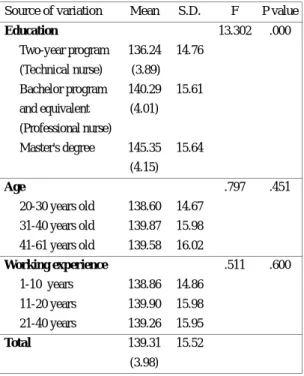
For all respondents, the mean score for all items was 139.31, which corresponds to a mean score of 3.98 for each item. This indicates that for 75% of their working lives, the subjects perform the items as outlined in the questionnaire. The mean score of the respondents holding master's degrees was 145.35, equal to 4.15 per item, which indicated that for approximately 80% of the time nurses performed behaviors consistent with the questionnaire (see Table 2).
There were no statistically significant differences in the means of the total scores when measured according to place of work, age, and experience (see Table 2). However, significant differences (p< 0.001) were found in regard to educational background (see Table 2). Nurses with master's degrees had the highest score on the questionnaire (mean=145.35) followed by Table 1:The characteristics of the sample
Characteristics N % Max. Min. Mean S.D.
Center
General 441 36.1 - - - -
Cancer 151 12.4 - - - -
Cardiovascular 304 24.9 - - - -
Mental health 325 26.6 - - - -
Total 1,221 100.0 - - - -
Sex
Female 1,129 92.5 - - - -
Male 92 7.5 - - - -
Position
Staff nurse 1,066 87.3 - - - -
Nurse administrator 155 12.7 - - - -
Education
Technical nurse 365 29.9 - - - -
(two-year program)
Professional nurse 799 65.4 - - - -
Three-year program 6 0.5 - - - -
Four-year program 793 64.9 (Bachelor's degree)
Master's degree 57 4.7 - - - -
Age - - 61 20 36.0 9.54
Working experience - - 40 1 14.0 9.53
the bachelor degree group (mean=140.29), with the two-year program group having the lowest score for carrying out the items expressed in the questionnaire (mean=136.24). The relationship between age and the HCMQ score for each educational group was then analyzed. For technical nurses (graduates from a 2-year program), the score becomes lower as the nurses get older (p< 0.01; ANOVA). However, for nurses who graduated from a 4-year program, the score becomes higher according to age (p< 0.01; ANOVA) (see Figure 1). This pattern was also the case for nurses who have a master's degree.
It is possible that the members of masters' group are comparatively older than the members of other groups. As the score becomes higher according to age, the higher scores of bachelors' and masters' groups might be due to the higher age of the members of this group. Therefore a comparison was made for all subjects over 31 years old. An ANOVA showed that for these comparable age-groups, the HCMQ score was still higher for those who had higher qualifications.
When the HCMQ score was analyzed according to length of work experience, the results were similar (see Table 3). For technical nurses the score decreases with more experience, whereas for the 4-year group the opposite is the case, and the HCMQ score increases(see Figure 2).
No significant differences were according to work position or gender.
The questionnaire was designed to measure the behavior of human caring by nurses who have been working in hospitals in Thailand. Significant differences were found between groups only for educational background, and age. Nurses with master's degrees demonstrated the highest score per item (mean score:
4.15), followed by those who hold a bachelor's degree (4.01), and the lowest (3.89) was found in technical nurses with 2 years of nursing education. Higher education may be effective in influencing the performance of actions consistent with human caring. However, it cannot be stated categorically that this is the case. It might be possible that highly-educated nurses wish to be more humanistic and convince themselves that they are; resulting in higher scores. As more highly motivated nurses gain higher qualifications to improve their ability, nurses who are more able to perform humanistic care might be concentrated in these more highly qualified groups. Reviewing the literature of human caring, Schultz et al9) investigated the perceptions of caring using the Caring Behavior Assessment instrument. They did not find any difference in scores between antepartum and postpartum participants. These results are for patients, not nurses. No articles relating to the direct influence of education, culture and age on nurses’ behaviour of human caring could be found. In this study, it has been presumed that the concept of human caring consists of 7 elements or 35 items.
A t-test showed no statistically significant differences between the 7 elements. From the factor analysis for the 35 items, no factors were recognized. This may mean that the concept of human caring cannot be divided into elements of behavior as in this framework. Each element is closely linked to every other element with a high correlation coefficient. However, the elements used in this study might be useful in helping nurses to achieve 'human caring' through actual behavior.
Table 2:Summary of the results of the analysis of variances
Source of variation Mean S.D. F P value
Education 13.302 .000
Two-year program 136.24 14.76 (Technical nurse) (3.89) Bachelor program 140.29 15.61 and equivalent (4.01) (Professional nurse)
Master's degree 145.35 15.64 (4.15)
Age .797 .451
20-30 years old 138.60 14.67 31-40 years old 139.87 15.98 41-61 years old 139.58 16.02
Working experience .511 .600
1-10 years 138.86 14.86 11-20 years 139.90 15.98 21-40 years 139.26 15.95
Total 139.31 15.52
(3.98)
2-year program
3-year program
4-year program
Master's degree
mean ± S.D. mean ± S.D. mean ± S.D.
138.9 ± 13.9 (n=160)
(n=6) (n=129) (n=76)
11-20 years 1-10 years
135.8 ± 15.0
21-40 years
133.2 ± 15.2
138.8 ± 15.2
(n=337) (n=296) (n=160) 140.3 ± 16.1 143.4 ± 14.8
139.0 ± 25.2
(n=4) (n=35) (n=18) 145.7 ± 14.9 146.0 ± 15.4
138.7 ± 22.9
Significance
p<0.01(ANOVA)
−
−
−
p<0.01(ANOVA)
not significant
Table 3:Mean score for HCMQ according to length of work experience & educational back- ground
An Investigation into Nurses' Behavior with regard to Human Caring
A questionnaire was developed to evaluate nurses' behavior of human caring in Thailand. Significant differences were found between groups only for educational background and age. Higher education might be effective in influencing the performance of actions consistent with human caring.
References
1)Watson, J. (2002). Assessing and measuring caring in nursing and health science, New York: Springer Publishing Company, 11-19.
2)Leininger, M. (1993). Cultural care theory : The comparative global theory to advance human care nursing knowledge and practice. In Delores A. Gaut (Ed.) A global agenda for caring. New York: National League for Nursing Press, 3-18.
3)Ford, M.B. (1981). Nurse professionals and the caring process. Dissertation Abstracts International.
4)Wolf, Z.R. (1986). The caring concept and nurse identified caring behaviors. Topics in Clinical Nursing, 8(2), 84-93.
5)Howard, J. (1975). Humanization and dehumanization of health care: A conceptual view. In J. Howard & A. Strauss (Eds.) Humanizing health care. New York: John Wiley &
Sons.
6)Fenton, M.V. (1987). Development of the scale of humanistic nursing behaviors. Nursing Research, 36(2), 82-87.
7)Lakomy, J.M. (1993). The interdisciplinary meaning of human caring, In D.A.Gaut, (Ed.) A global agenda for caring. New York: National League for Nursing Press, 181-199.
8)Watson, J. (1999). Nursing : Human science and human care : A theory of nursing, Massachusetts: Jones and Bartlett Publishers.
9)Schultz A.A., Bridgham C., Smith M.E., Higgins D.
(1998). Perceptions of caring. Comparison of antepartum and postpartum patients, Clin Nurs Res, 7(4), 363-78.
Figure 1:Mean score for HCMQ according to age &
educational back ground
Figure 2:Mean score for HCMQ according to length of work experience & educational back ground
Puangrat Boonyanurak
*1,小澤三枝子*1,David R. Evans*2,竹尾惠子*3【要 旨】 タイ国看護職の「ヒューマンケアリング」にかかわる行動を評価することを目的として,ヒューマンケアリ ングに関する調査票(HCMQ)を開発し,タイ国立ヘルスセンターに勤務する看護職を対象に,質問紙による調査を 行った.質問紙では,「ヒューマンケアリング」の核となる7要素を文献に基づき採用した.7要素とは,①人間性に対 する理解,②人との関係性,③ものごとの決め方,④会話のしかた,⑤対応のしかた,⑥癒し(ヒーリング),⑦人的・
経済的資源の交換,である.要素ごとに5質問項目を作成し,全体で 35 項目からなる質問紙を作成した.質問紙の妥 当性については,タイのエキスパートナース(3人)の協力を得て,慎重に検討した.また,HCMQ(英語)を用いて,
タイの15名のナースにプレテストを行い,信頼性係数0.94を得た.
HCMQをタイ語に訳して,タイの30名の看護職を対象に行ったプレテストでは,信頼性係数0.95を得た.本調査で の質問紙回収数は1,387で,回収率は84.6%であった.そのうち,35の質問項目のすべてに回答していた1,221を分析 した.各看護職の職位,性別と HCMQスコアの間に有意な差はみられなかったが,看護教育背景(2年課程,4年課 程,修士)とHCMQスコアの間には有意な差がみられ,修士号を持った看護職のHCMQスコアが最も高く,次いで4 年課程,2年課程の順となった(ANOVA,p<0.001).また,年齢と HCMQ スコアとの間にも有意な差がみられた.
2年課程の看護職においては年齢が高くなるにつれて HCMQスコアは減少するが,4年課程のナースにおいては年齢 が増すとHCMQスコアも増加した.
ヒューマンケアリング,質問紙の開発,ナース,タイ国
*1国立看護大学校 基礎看護学
〒204-8575
東京都清瀬市梅園1-2-1 電話:0424-95-2211 FAX:0424-95-2698
メールアドレス:[email protected]
*2国立看護大学校 人間科学(語学)
*3国立看護大学校 大学校長