Introduction
In 2008, the Japanese government announced the "300,000 Foreign
Students Plan," which aimed to increase the number of foreign students in Japan from 140,000 to 300,000 students by 2020 (1). The number of international students coming to Japan has increased sharply over the past two decades (2), and 92.7% of these students came from other Asian countries (2). Students from
China account for 45.2% of the total number of international students (2).
Along with an increase in the number of international students, the crosscultural adjustment issues associated with these students have increased. There are many reports on the stress and mental health issues of international students (36).
International students’ health problems can be serious barriers to their
acquisition of knowledge and skills.
Subjective health status and lifestyle habits of Chinese international students in Japan.
Ayaka Yazawa, and Meng Chang
College of Health and Human Sciences, Osaka Prefecture University
Summary
The number of international students enrolled in Japan is increasing.
The majority of these students are from China. International students face various challenges, such as the language barrier and culture shock, when faced with a new intercultural society. In this study, we investigated the lifestyle, Japanese ability, subjective health status, nutritional intake, and body composition of Chinese international students attending a university in Osaka. As a result, 44% of the students did not have good subjective health and there was an association between poor subjective health status and lower frequency of exercise. The skipping breakfast habit was found in 41% of the students, and there was a positive correlation between a late bedtime and skipping breakfast. The fatenergy ratio was higher than the Dietary Reference Intakes (DRIs) for Chinese people. On the other hand, 43% of females were underweight. These findings are similar to previous reports on Japanese university students. Therefore, it was suggested that the contents of health promotional and nutritional education could be the same as those used for Japanese students. Language ability and cross
cultural adaptation are important factors for living in a foreign country.
Although 71% of the students in this study had acquired the N1 grade of the Japanese Language Proficiency Test and possessed Japanese ability at a level where they did not experience difficulties in everyday life, some students had difficulties using their language skills. Consequently, when providing health promotion and nutritional instruction to Chinese students, it is important to consider that there are cultural and language barriers.
Keywords: Chinese international students, Lifestyle habits, Subjective health status, and Nutrient intakes
Corresponding Author: Ayaka Yazawa Email address: [email protected]u.ac.jp
College of Health and Human Sciences, Osaka Prefecture University, 3730 Habikino, HabikinoCity, Osaka 5838555, Japan.
2019 年 6 月 25 日受付 2019 年 8 月 19 日受理
Therefore, it is important that their health problems be understood so that they can be dealt with effectively and efficiently (7). Diet is one of the factors supporting good health. In prior research about Japanese international students in the United States, it was food that had the greatest impact on international adjustment (8), and studies have reported changes in dietary patterns after immigration (9,10). Pan et al.
reported that Asian international students in the United States changed their dietary pattern. These students skipped breakfast, increased the frequency of consumption of salty and sweet snack items, and decreased the frequency of consumption of vegetables, which could have undesirable longterm health effects (9). Lee et al. reported that Chinese international students in South Korea showed an increase in skipping meals and eating speed, but a decrease in the frequency of fruit and vegetable consumption in South Korea compared to when they lived in China (10). In Japan, reports on diet, food and nutritional environment of international students have been published (11,12), but so far no study of the dietary conditions, health status, lifestyles, and the relationship between these factors has been
conducted to the author's knowledge.
Dietary conditions are closely related to health. Therefore, it is an important consideration in the
development of nutritional education programs for international students.
Since international students differ in their religion, culture and social background, their ability to adapt to living in Japan is not the same (13). In this study, we focused on Chinese
students, who account for more than 45%
of all of the international students, and investigated their lifestyle habits, Japanese ability, subjective health status, nutrient intake, and body
composition.
Materials and Method 1.Participants
The participants were 86 Chinese students (38 males and 48 females) attending a university in Osaka, Japan.
Their age was 24.1 ± 3.0 years old for the males, 23.8 ± 2.7 years old for the
females. This study was a crosssectional study that utilized survey methodology.
Data were collected between 2014 and 2015. Consent for participation was obtained prior to beginning the present study. We conducted this study with the approval of the Ethical Review Board of Osaka Prefecture University’s Graduate School of Comprehensive Rehabilitation (approval number: 2013303).
2. Basic attributes, lifestyle habits and subjective health status
As basic attributes, questions were asked about age, sex, the number of years lived in Japan, lifestyle, whether they received scholarship or not, and Japanese language ability. Japanese language ability was surveyed based on the results of the Japanese Language Proficiency Test organized by Japan Educational Exchanges and Services and The Japan Foundation. This Japanese language proficiency test has five levels:
N1, N2, N3, N4, and N5. The easiest level is N5 and the most difficult level is N1. N4 and N5 measure the
understanding of basic Japanese mainly learned in class. N1 and N2 measure the understanding of Japanese used in a broad range of scenarios based on everyday life. N3 is a bridging level between N1/N2 and N4/N5. Self
assessment of Japanese ability was
evaluated in 4 grades (Low: can talk in
simple Japanese, Middle: able to speak
Japanese of level that does not encounter
difficulties in everyday life, Middle to
high: can understand the contents of a
newspaper, High: Conference presentations can be made using technical terms).
To understand the participants’
lifestyles, questions were asked about exercise habits, sleeping duration and bedtime. The participants’ health condition was assessed by self
assessment. Subjective health status was divided into 4 health statuses (healthy, mostly healthy, somewhat unhealthy, and unhealthy).
3. Nutrient intake and body composition The food frequency questionnaire (FFQ) developed by Willett et al. (14) is a semiquantitative dietary survey that is the most widely used method to assess food or nutrient intake in dietary studies.
In Japan, some simple nutritional
questionnaires have been developed and their reproducibility and validity have been evaluated (15). In this study, we used a Food Frequency Questionnaire that is based on 29 food groups and 10 types of cooking (FFQg version 3.0, Kenpaku Co., Ltd., Tokyo, Japan). This was used to estimate the energy and nutrient intake of each participant during the previous 1
2 months. The
questionnaire used in this study was
translated into Chinese by a
translator. In addition, a questionnaire was conducted on the frequency of breakfast intake (every day, almost every day, sometimes eat, skip).
Body composition was measured using a body composition analyzer (DC320, TANITA), body weight, body fat percentage, and Body
Mass Index (BMI) were calculated as weight (kg) / height (m
2).
4.Statistical analysis
Statistical analyses were performed using statistical analysis software (SPSS Ver. 22.0, IBM Japan, Tokyo, Japan). The numerical data were expressed as the mean ± SD. The intake of most nutrients were correlated and calculated by the residual method using a regression model. The density method was used for energycontaining
nutrients. The association between each survey item was tested using Spearman’s rank correlation. The presence or
absence of scholarship was compared with nutrient intake using Student’s t
test. All reported p values are twosided with a significance level of 5%.
Results
1. Characteristics of participants
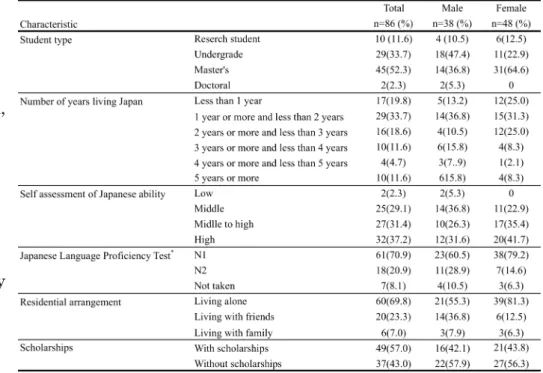
Table 1 shows the characteristics of the Chinese international students.
The mean of number of years living
Japan was 2.8 years. 69.8% of the
students were living alone and 23.3% of
the students were living with friends.
70.9% of the students had acquired the N1 grade of the Japanese Language Proficiency Test. In selfassessment of their Japanese ability, 98% of students responded ‘My Japanese ability is able to deal with common challenges in everyday life’ or reported an even higher level;
however, 30% of them had language difficulties (data not shown), and 57% of the students were receiving scholarship.
2. Body composition
Table 2 shows the measurement results of body composition. BMI values were divided into four categorical levels based on the World Health
Organization’s definition: underweight, BMI <18.5kg/m
2; normal weight, BMI 18.524.9 kg/m
2; preobesity, BMI 25.0
29.9 kg/m
2; and obesity, BMI 30 kg/m
2. The mean value of BMI was 22.2 for males and 19.8 for females, according to the WHO BMI classification (16). In our experiment, 7.9% (n=3) of males and 43.8% (n=21) of females were
underweight, 18.4% (n=7) of males and 8.3% (n=4) of females were preobese.
There were no students with BMI 30 kg/
m
2.
3. Lifestyle and subjective health status Table 3 shows the participants’
lifestyle habits and subjective health status. Sleep duration was more than 7 hours and less than 8 hours in 40.7% of students. As for bedtime, 51.2% slept after 1 a.m., and when bedtime was later, the duration of sleep was shorter (r=0.264, p<0.05). 41.9% of students ate breakfast sometimes or skipped it every day. The skipping breakfast habit
started after coming to Japan. There was a positive correlation between a late bedtime and skipping breakfast (r=0.307, p<0.01). The longer the number of years of residence in Japan, the more
frequently the students skipped breakfast (r=0.279, p<0.01). Frequency of alcohol consumption was less than once per week in 89.5% of students. 24.4% of students partook in exercise twice a week or more, but 41.9% of students did not do any exercise at all. In response to the
subjective health status questionnaire, 55.8% of students answered ‘healthy’
and 43.0% answered
‘somewhat
unhealthy’ or
‘unhealthy’. The worse the subjective health status, the lower the frequency of exercise. There was no significant
correlation between subjective health status and BMI.
4. Nutrient intake and food group intake Table 4 shows the nutrient intake, and Table 5 shows the food group intakes of participants. The proteinenergy ratio was 13.7% for males, 13.6% for females, and the fatenergyratio was 33.1% for males and 34.1% for females. The proteinenergy ratio was within the range of 1015%, but the fatenergy ratio was outside the range of 2030% of energy intake advised by the Dietary Reference Intakes (DRIs) for Chinese
people (17).
Concerning food group intakes, intake of dietary fiber,
vegetables and fruits were low compared with the dietary
guidelines for Chinese residents (2016) (18).
The higher the fat
energy ratio, the more frequently the
skipping breakfast habit was observed (r=0.214, p<0.05). The proteinenergy ratio of students with a
scholarship was higher than those without scholarships. In males, there was a significant correlation between soft drinks and BMI (r=0.640, p<0.05). On the other hand, there was no significant correlation between nutrient intake and BMI in females. The intake of vegetables and fruits were significantly higher for the students who had a part
time job, but only in the males (Data not shown).
Discussion
In this study, we investigated the lifestyle habits, Japanese ability,
subjective health status, nutrient intake, and body composition of Chinese
international students attending a university in Osaka, Japan.
As a result, 44% of the students did not feel that their health status was good. Subjective health status was poorer when the frequency of exercise was lower. In a prior study of Japanese university students, 16.933.6% of students were a little unhealthy or unhealthy (11,19,20).
Compared with these studies, Chinese international students in this study tended to be unhealthy.
There are many reports on the
relationship between exercise and health (21), similar to our study, students who partook in exercise had a better
subjective health status. These results suggest that it is necessary to educate the students about the importance of doing exercise.
There are many reports on the importance of eating breakfast (2225).
The skipping breakfast habit was found in 41% of the students. The skipping breakfast habit started after coming to Japan, and increased in frequency as the number of years of residence in Japan increased. In Japan, the skipping
breakfast habit rate is highest in people in their 20s (male: 30.6%, female: 23.6%) (26), and is considered a problem among young people in Japan. In previous studies, the prevalence of skipping breakfast increased with increasing distance from the place of study, and 60%
of students living alone developed this habit after becoming university students (27). A student who skipped breakfast typically had a late wakeup time (28) and a late bedtime has an influence on the state of wakefulness (29). The
Chinese international students’ situation was similar to that of the Japanese university students. Therefore, it is important that the students are advised not to delay their bedtime and eat
breakfast.
Concerning nutrient intake, the fatenergy ratio was higher than the DRIs for Chinese (17), and the
consumption of vegetables and fruits was lower than the dietary guidelines for Chinese residents (18). In a previous study of international students in Japan, 35.1% of the foods were categorized as staple foods, and 47.1% of staple foods were prepared with oil (11). The low consumption of vegetables and fruits is also reported in international students from other countries (9,10). In this study, it was not possible to clarify whether the
high fatenergy ratio and low
consumption of vegetables and fruits started after arrival in Japan, as the diet survey was not conducted before and after the visit to Japan. In China, lifestylerelated diseases are increasing (30), and there have been reports on eating disorders in young people (31).
Therefore, high fat intake and the low consumption of vegetables and fruits may have started before arrival in Japan. In any case, since the fatenergy ratio was higher than that of the DRIs and the consumption of vegetables and fruits was lower than the dietary guidelines for Chinese residents, it is important to provide nutritional
education to help students reduce intake from fat and increase intake from
vegetables and fruits. Additionally, only in the male students, there was a
significant correlation between soft drink consumption and BMI. The consumption of soft drinks is related to obesity (32), hence, dietary education is needed to advise students on how to consume soft drinks in moderation. On the other hand, almost half of the female respondents were underweight. Being underweight is a concern in both China and Japan, and young female students are more prone to being underweight than males (33,34).
Although there was no significant
correlation between BMI and nutritional intake or subjective health status in this study, dietary education based on
tackling this issue is important.
Health status is influenced by socioeconomics, Ohashi et al. reported that students without scholarships showed more symptoms of depression compared with students who received scholarships, which suggests that
financial conditions affect healthrelated quality of life (35). In this study, there was no significant difference in
subjective health status between
students who received a scholarship and
those who did not receive a scholarship, but the proteinenergy ratio was higher for students who received a scholarship.
From these results, we concluded that although receiving or not receiving a scholarship affects the students’ dietary patterns, the possibility of it affecting subjective health is low. Most of today’s Chinese students are an only child, and rely on their parents for tuition and living expenses (36,37). It is necessary to investigate household income and
expenditure details in order to confirm this, but the economic situation of
Chinese students is generally considered to be better. Since scholarships are part of household income, research on
household income and expenses is necessary.
In conclusion, for information about diet and lifestyle disorders, since the Chinese students’ situation is similar to that of Japanese university students, the basic recommendations should be similar to those given to Japanese university students. However, there are also reports that recent Chinese students contact family and Chinese friends more frequently using Chinese social network services, and have few Japanese friends.
This situation affects their crosscultural adaptation (38). Furthermore, some students were having difficulties with language. Therefore, in order to promote health and nutritional education, it is necessary to consider that some students may lack sufficient Japanese language ability and have an insufficient
understanding of Japanese culture. In addition, it is considered important to consult with advisers who can speak Chinese and hold communication events with Japanese people.
There are several limitations to our study. Our study is limited strictly to Chinese international students at a university in Osaka, therefore our findings may not be generalized to
Chinese students attending other universities or in other areas in Japan, nor to Chinese international students from other countries.
Acknowledgements We would like to thank all the Chinese international students who participated in our survey.
Conflicts of interest None.
References
1. Ministry of education, culture, sports, science and technology; Ministry of foreign affairs, the foreign ministry;
Ministry of justice; Ministry of health, labor and welfare; Ministry of economy, trade, and industry; Ministry of land, infrastructure and tourism. A plan for 300,000 exchange students. NAFSA association of international educators.
2008, 2(3), p. 16
2. Japan student services organization (JASSO). Result of an annual survey of international students in Japan. 2016, p.
120.
3. Kinjo, Naomi. An investigation of factors contributing to psychological stress among the foreign students: A relationship between their language ability and stress. Scripsimus of Ryukyu University. 1997, 6, p.1942. http://
hdl.handle.net/20.500.12000/2700 4. Murase, Sanako; Murase, Sumio;
Kitabatake, Masayoshi. Depression symptoms among Chinese students in Japan. Japanese society of public health.
1996, 43(5), p. 398402.
5. Yokoo, Akiko, I; Takeuchi, Mika, S;
Long, Yue; Suzuki, Masao. Differences between Japanese and Chinese
university students in subjective well
being: Research on selfesteem and consciousness as to control over health.
Bulletin of Denen Chofu University.
2017, 12, p. 8196,
6. Mamiya Kunimitsu. Mental care for
international students and a support system for those with disabilities: A case study of Waseda University. JASSO webmagazine.2017, 81(12), p. 111.
7. Herag, Hamboyan; Anne, K., Bryan.
International Students: Culture shock can affect the health of students from abroad. Canadian family physician. 1995, 41, p. 17131716.
8. Furukawa, Toshiaki. Cultural distance and its relationship to
psychological adjustment of international exchange students. Psychiatry and
clinical neurosciences. 1997, 51(3), p. 87
91.
9. Pan, Yiling;Dixon, Zisca ; Himburg, Susan; Huffman, Fatma. Asian students change their eating patterns after living in the United States. Journal of the American dietetic association. 1999, 99(1), p. 5457.
10. Lee, Jounghee; Gao, RanRan;
Kim, JungHee. Acculturation and changes in dietary behavior and
anthropometric measures among Chinese international students in South Korea.
Nutrition research and practice. 2015, 9(3), p. 304312.
11. Yasutomo, Hiroko; Nishio Motoko.
The relationships between dietary habits of foreign students and their food and nutrition environment A case of N University Journal of lifology. 2008, 14, p. 8395.
12. Zhao, Xiaoning. A surrey on the eating habits of multicultural residents
in particularly Chinese students studying at Hokuriku University
Journal of Hokuriku university. 2016, 42, p. 111128.
13. Tanaka, Tomoko; Takai, Jiro;
Kohyama, Takaya; Muranaka, Chiho;
Fujihara, Takehiro. A study on the adjustment of international students in Japan(1)A factor analysis of cross
cultural adjustment scale Bulletin of the faculty of integrated arts and sciences of Hiroshima University. 1990, (14), p. 77
94.
14. Walter, C. Willett. Reproducibility and validity of a semiquantitative food frequency questionnaire. American journal of Epidemiology. 1985, 122(1), p.
5165.
15. Takahashi, Keiko; Yoshimura, Yukio; Kaimoto, Tae, Kunii Daisuke;
Komatsu, Tatsushi; Yamamoto, Shigeru.
Validation of a food frequency
questionnaire based on food groups for estimating individual nutrient intake.
Japanese journal of nutrition and dietetics. 2001, 59(5), p. 221232.
16. World Health Organization.
Preventing and managing the global epidemic. WHO technical report series.
2000, 894, p. 1253.
17. Chinese dietary reference intakes Part 1 : Macronutrient. National health commission of the People’s Republic China. 2018 http://www.hcod.dl.gov.cn/
wjwcms/newscontent/
pdfFileDownload.act?path=/wjwcms/
UserFiles/File/
201712/20171201105129225.pdf (access20190625)
18. Wang, Shanshan; Lay, Sovichea;
Yu, Haining; Shen, Shenrong. Dietary guidelines for Chinese residents (2016):
comments and comparisons. Journal of Zhejiang Universityscience.2016,17(9), p. 649656.
19. Shimamoto, Takako; Hafsi, Med;
Tahara, Takehiko. Analysis of subjective and psychological health in college
students: Effects of gender and time of academic year on selfrated heath and stresscoping ability. Bulletin of research institute of Nara University. 2015, 23, p.
4351.
20. Sasaki, Hiroko. Relationship between lifestyle, mental health and self
rated health in the university student.
Human welfare studies. 2012, 15, p. 73
87
21. Crews, DJ; Landers, DM. A meta
analytic review of aerobic fitness and
reactivity to psychological stressors.
Medicine and science in sports and exercise. 1987, 19, p. 114120.
22. Alec, J. Davidson; Özgur,
Tataroglu; Michael, Menaker. Circadian effects of timed meals (and other
rewards). Methods in enzymology. 2005, 393, p. 509523.
23. Meike, Traub; Romy, Lauer; Tibor, Kesztyüs; Olivia, Waltha; Jürgen,
Michael, Steinacker; Dorothea Kesztyüs and the research group “Join the healthy boat”. Skipping breakfast,
overconsumption of soft drinks and screen media: longitudinal analysis of the combined influence on weight
development in primary schoolchildren.
BMC public health. 2018, 18, p. 110.
24. Horikawa, Chika; Kodama, Satoru;
Yachi, Yoko; Heianza, Yoriko; Hirasawa, Reiko; Ibe, Yoko; Saito, Kazumi;
Shimano, Hitoshi; Yamada, Nobuhiro;
Sone, Hirohito. Skipping breakfast and prevalence of overweight and obesity in Asian and pacific regions: A meta
analysis. Preventive Medicine. 2011, 53, p. 260267.
25. Saitho, Sanae; Simoda, Taeko.
Association between energy and nutrient intake and skipping meals in female university students. Bulletin of the Tokyo Healthcare University. 2006, 1, 3137.
26. The National Health and Nutrition Survey. Outline of national health and nutrition survey Japan. 2012. https://
www.mhlw.go.jp/bunya/kenkou/eiyou/dl/
h24houkoku.pdf (access. 20190625) 27. Hirose, Ayumi. Type of University students who skip breakfast and the relationship between the initiation period: before and after becoming university students: and lifestyle behavior. The journal of Seigakuin University. 2017, 30(1), p. 5563.
28. Shigaki, Hitomi; Yamada,
Norihiro; Iwahashi, Akiko. A Surveyon Student's Breakfast Ingestion.
Repository of Tezukayama University.
2014, 10, p. 1−10.
29. Takizawa, Hiroto; Matsuoka, Hiroki; Murase, Tomohiko. A study on how the bedtime, the wakeup time and the amount of sleep influence the state of wakefulness and the frequency of
breakfast intake. Repository of Aichi University. 2006, 14, p. 2133.
30. Yazawa, Ayaka; Chang, Meng. The eating habits and lifestyle related
diseases in China. Journal of life science research. 2013, 11, p. 59.
31. Watanabe, Kenji; Yu Fei. Study of eating habits and BMI of the youth in China. Journal of Okayama Shoka University. 2016, 52(1), p. 7790.
32. Maria, BesRastrollo; Carmen, SayonOrea; Miguel, RuizCanela;
Miguel, A., MartinezGonzalez. Impact of sugars and sugar taxation on body
weight control: A comprehensive
literature review. Obesity. 2016, 24(7), p.
14101426.
33. Sakamaki, Ruka; Toyama, Kenji;
Amamoto, Rie; Liu, ChuanJun;
Shinfuku, Naotaka. Nutritional knowledge, food habits and health attitude of Chinese university students―a cross sectional study
Nutrition Journal. 2015, 4(4), p. 15 34. Uragami, Ryoko; Sawamiya, Yoko.
Relation between media use and thin
ideal internalization: university undergraduates. Japanese Journal of educational psychology. 2015, 63, p. 309
322.
35. Ohashi, Toshiko. Mental health and crisis intervention for international students. Journal of JASSO. 2018, 88(7), p. 1522.
36. Inai, Tokiyo. For the improvement
of overseas students’ support On the
basis of questionnaire survey on the
Chinese overseas students Bulletin of
Takamatsu University. 2011, 54, p. 7192
37. Xu, Qian; Matsuda, Eiko. Effects of
personality traits on crosscultural
adjustment of Chinese international students in Japan. Bulletin of the
graduate school of Toyo University. 2016, 53, p. 6376.
38. Li, Wen. Change in the intimacy of
Chinese students studying abroad: On
exclusiveness of SNS. Social science
review. 2018, 126, p. 3349.
中国人留学生の主観的健康状態と生活習慣
矢澤彩香、常盟 大阪府立大学地域保健学域