原著論文
Pharmacognostic Studies on Ginger and Related Drugs-part 2 : Constituents of Zingiberis Processum Rhizome (Kankyo)
Yumiko Hori*1, Yukiye Wakabayashi1, Kayoko Mizui1, Motonori Fukumura1, Kazuo Toriizuka1, and Yoshiteru Ida1, 2
1 Laboratory of Pharmacognosy and Phytochemistry, School of Pharmacy, Showa University, 1-5-8, Hatanodai, Shinagawa-ku, Tokyo 142-8555, JAPAN
2 Yokohama College of Pharmacy, 601 Matano-cho, Totsuka-ku, Yokohama 245-0066, JAPAN
ABSTRACT
Nineteen compounds has been isolated from the 80% methanolic extract of Kankyo (Japanese name for Zingiberis processum rhizome) made out of ginger, including a glucoside of 6-gingerdiol (15), four diarylheptanoids (16 – 19) and the sulfonated compounds such as 6-gingesulfonic acid (10) and shogasulfonic acid A (12) previously reported, besides twelve known compounds. This is the first isolation of compounds 15 – 19 from the Kankyo. In addition, interestingly, two kinds of Kankyo are found to be sold in the Japanese market: one contains sulfonated derivatives and the other contains no such compound.
Key words:Zingiberofficinale, Zingiberaceae, Kankyo, Zingiberis processum rhizome, sulfonated compounds.
INTRODUCTION
Shokyo and Kankyo (Japanese names of Zingiberis rhizome and Zingiberis processum rhizome, respectively) are important crude drugs in traditional Kampo medicine made out of ginger, the rhizomes of Zingiber officinale ROSCOE (Zingiberaceae), by different process. According to the Japanese Pharma- copeia, Shokyo is prepared simply by drying, while Kankyo is by drying after steaming. It is interest that the two crude drugs prepared from the same origin of ginger have been discriminated clinically use in Kampo medicine [1-3]. However there are no scien- tific evidences for the clinical discrimination between Shokyo and Kankyo. In order to clarify the chemical evidences for the discrimination between them, we started the studies on their chemical constituents.
We studied previously on the phytochemical in- vestigation on Shokyo, and isolated, unexpectedly, six sulfonated compounds, i.e. 4- and 6-gingesulfonic acids (10), shogasulfonic acids A (12), B, C and D, together with gingerols, shogaols, diarylheptanoids [4] and five monoterpene glycosides, zingiberosides A, B, C, D and E [5]. Further on, we clarified that the sulfonated derivatives were artificial products formed by bleaching with sulfur in the preparation process [6], although the preparation procedure of Shokyo had been believed only drying without sulfur bleaching.
Kankyo is also prepared from ginger in almost same manner, only different process from Shokyo is prepared by steaming followed by drying as described above. The constituents of Kankyo have been regard- ed to be as the same as those of Shokyo, because their origins are same, and the previous investigations were
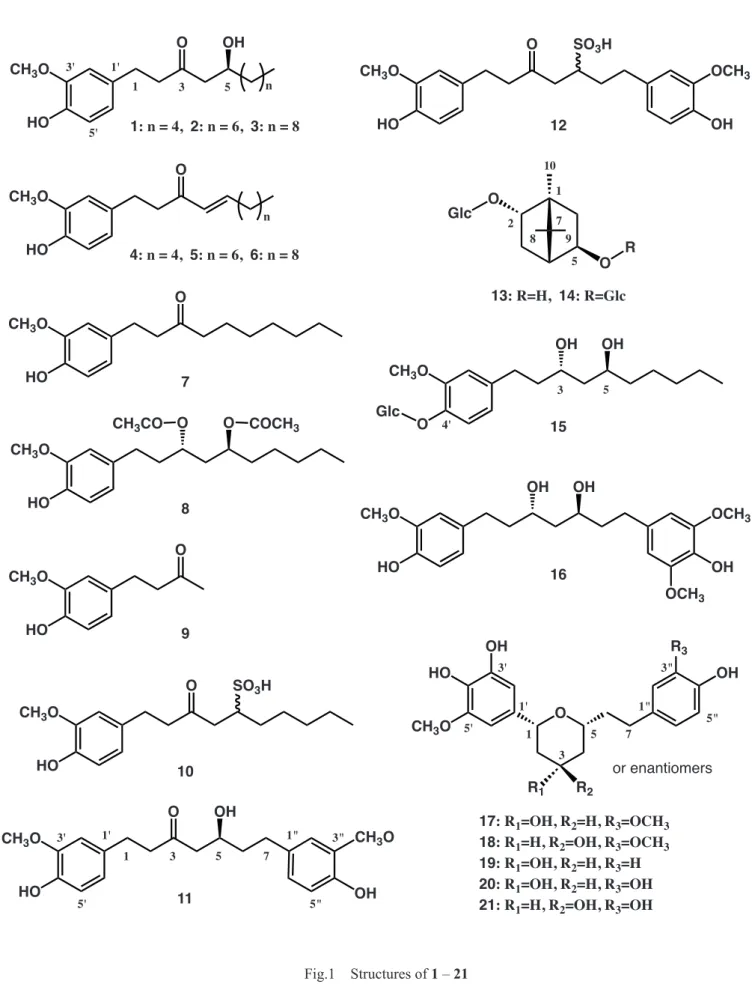
15 was characterized as (3S,5S)-6-gingediol 4'-O-β-D- glucopyranoside, which was previously isolated from the ginger rhizome [11].
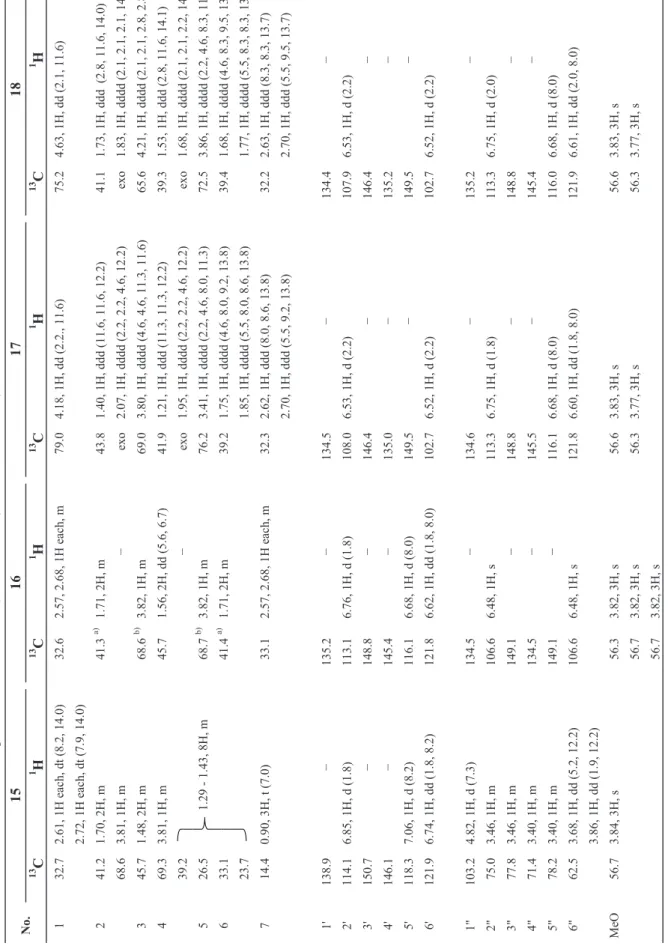
Compound 16 was obtained as a pale yellowish oil, [α]16D –11.0˚ (c 1.07, EtOH). It showed a [M+H]+ ion peak at m/z 407.2044 (C22H31O7) in the HR FAB-MS, which was 31 mass unit (CH3O) larger than that of hexahydrocurcumin (11) [12]. The IR spectrum of 14 showed absorption bands due to hydroxyl group at 3335 cm-1. The feature of the 1H and 13C NMR spec- tra of 16 were similar to those of 11, and they showed the presence of a β-glycol, a 1,3,4-trisubstituted ben- zene ring, and a symmetrical 1,3,4,5-tetrasubstituted benzene ring having one hydroxyl group and two methoxyl groups in 11 (Table 1-1), suggesting 16 to be 3,5-dihydroxy-1-(4-hydroxy-3-methoxyphenyl)-7- (4-hydroxy-3,5-dimethoxyphenyl)heptane. Finally, 16 was identified as (3S,5S)-3,5-dihydroxy-1-(4-hy- droxy-3-methoxyphenyl)-7-(4-hydroxy-3,5- dimethoxyphenyl)-heptane by comparison of the data with those reported [13].
Compounds 17 and 18 were isolated as a pale yel- lowish oily substance, and they showed the same [M+H]+ at m/z 391 in the Positive FAB-MS. Their
1H and 13C NMR spectra showed the presence of the same aromatic rings as 16, three oxymetine and four methylen groups, and their plane structures were sup- posed to be 1,5-epoxy-3-hydroxy-1-(3,4-dihydroxy-5- methoxyphenyl)-7-(4-hydroxy-3-methoxyphenyl)hep- tane, which was recently isolated from the rhizome of ginger [10] (Table 1-1). The H-3 signal of 17 was appeared as a dddd (J = 4.6, 4.6, 11.3 and 11.6 Hz) at δ 3.80, while that of 18 was as a dddd (J = 2.1, 2.1, 2.8 and 2.8 Hz) at δ 4.21. These facts demonstrated that the orientation of the C-3 hydroxyl group must be equatorial in 17 and axial in 18, that is, the structures of 17 and 18 were determined to be (1R,3S,5R)-1,5- from Shokyo, volatile oils consist of sesquiterpenes
of bisabolane-type and pungent constituents such as gingerols, shogaols and zingerone [7].
This paper deals with the isolation and characterization of nineteen compounds from the 80%
methanol extract of Kankyo as well as the compara- tive study on various Kankyo samples in the Japanese market.
RESULTS AND DISCUSSION
The 80% methanol extract of commercial Kankyo A (imported from China, 5.0 kg) was divided into an ether- and a water-soluble fractions. By means of column chromatography (CC) and HPLC, nine compounds (1 – 9) were isolated from the ether- soluble fraction, and ten (10 – 19) were from the water-soluble fraction, as described in Experimental.
Of them, the fourteen compounds were identified as follows by direct comparison with those obtained from Shokyo previously [4, 5] or by comparison of the data with those reported [8, 9]: 6-, 8-, 10-gingerols (1 – 3), 6-, 8-, 10-shogaols (4 – 6), 6-paradol (7), 6-gingediacetate (8), zingerone (9), 6-gingesulfonic acid (10), hexahydrocurcumin (11), shogasulfonic acid A (12), zingiberosides A (13) and B (14), respec- tively.
Compound 15 was isolated as a white amorphous powder, mp 123 ˚C. It showed a pseudomolecular ion ([M+H]+) peak at m/z 459 (C23H39O9) in the FAB-MS.
The 13C NMR spectrum of 15 revealed the presence of a 1,3,4-trisubstituted benzene, an arylic methoxyl group, two carbinyl methines, seven methylenes, an aliphatic methyl group and a β-D-glucopyranosyl moiety (Table 1-1). The signals due to the aglycone part were resembled on those of 6-gingediol [8, 10], except for the C-4’ carbon signal due to the glycosyla- tion shift. In addition, an HMBC correlation was ob- served between glucosyl H-1" (δ 4.82, d, J = 7.3 Hz) /
OH O
CH3O
HO
O CH3O
HO
O CH3O
HO
1: n = 4, 2: n = 6, 3: n = 8
4: n = 4, 5: n = 6, 6: n = 8
7
n
n
1 3
1' 3'
5'
5
O CH3O
HO 8
O COCH3 CH3CO
O CH3O
HO 9
O CH3O
HO
SO3H
10
11 O CH3O
HO
OH
1 3
3' 1'
5'
5 7 CH3O
OH
1" 3"
5"
O O
13: R=H, 14: R=Glc
1 2
5 7
8 9
10
Glc
R O
CH3O HO
SO3H
OCH3
12 OH
OH CH3O
HO
OH
OCH3
OH OCH3
O HO
OH
CH3O
OH
17: R1=OH, R2=H, R3=OCH3 18: R1=H, R2=OH, R3=OCH3 19: R1=OH, R2=H, R3=H 20: R1=OH, R2=H, R3=OH 21: R1=H, R2=OH, R3=OH
R1 R2 1
3
5 7
1' 3'
5'
1"
3"
5"
R3
OH CH3O
O
OH
15
4'
3 5
Glc
16
or enantiomers
Fig. 1 Structures of 1 Fig.1 Structures of 1 – 21! 21
Table11 1 Hand13 CNMRspectraldataof1518(inmethanold500and125MHz)Table 1-1 H and C NMR spectral data of 15-18(in methanol-d4, 500 and 125 MHz) 15161718 N15161718 131131131131No. 13 C1 H13 C1 H13 C1 H13 C1 HCHCHCHCH 13272611Heachdt(82140)3262572681Heachm7904181Hdd(22116)7524631Hdd(21116)132.72.61, 1H each, dt (8.2, 14.0)32.62.57, 2.68, 1H each, m79.04.18, 1H, dd (2.2., 11.6)75.24.63, 1H, dd (2.1, 11.6) 2721Heachdt(79140)2.72, 1H each, dt (7.9, 14.0) 24121702H413a) 1712H4381401Hddd(116116122)4111731Hddd(28116140)241.21.70, 2H, m41.3a) 1.71, 2H, m43.81.40, 1H, ddd (11.6, 11.6, 12.2)41.11.73, 1H, ddd (2.8, 11.6, 14.0) 6863811201dddd(222246122)1831dddd(212121140)68.63.81, 1H, míexo2.07, 1H, dddd (2.2, 2.2, 4.6, 12.2)exo1.83, 1H, dddd (2.1, 2.1, 2.1, 14.0),,,,(,,,),,(,,,) b) 345.71.48,2H,m68.6b) 3.82,1H,m69.03.80,1H,dddd(4.6,4.6,11.3,11.6)65.64.21,1H,dddd(2.1,2.1,2.8,2.8)345.71.48, 2H, m68.63.82, 1H, m69.03.80, 1H, dddd (4.6, 4.6, 11.3, 11.6)65.64.21, 1H, dddd (2.1, 2.1, 2.8, 2.8) 46933811Hm4571562Hdd(5667)4191211Hddd(113113122)3931531Hddd(28116141)469.33.81, 1H, m45.71.56, 2H, dd (5.6, 6.7)41.91.21, 1H, ddd (11.3, 11.3, 12.2)39.31.53, 1H, ddd (2.8, 11.6, 14.1) 392íexo1951Hdddd(222246122)exo1681Hdddd(212122141)39.2exo1.95, 1H, dddd (2.2, 2.2, 4.6, 12.2)exo1.68, 1H, dddd (2.1, 2.1, 2.2, 14.1) 52651291438Hm687b) 3821Hm7623411Hdddd(224680113)7253861Hdddd(224683116)526.51.29 - 1.43, 8H, m68.7) 3.82, 1H, m76.23.41, 1H, dddd (2.2, 4.6, 8.0, 11.3)72.53.86, 1H, dddd (2.2, 4.6, 8.3, 11.6) 6331414a) 1712H3921751Hdddd(468092138)3941681Hdddd(468395138)633.141.4a) 1.71, 2H, m39.21.75, 1H, dddd (4.6, 8.0, 9.2, 13.8)39.41.68, 1H, dddd (4.6, 8.3, 9.5, 13.8) 2371851Hdddd(558086138)1771Hdddd(558383138)23.71.85, 1H, dddd (5.5, 8.0, 8.6, 13.8)1.77, 1H, dddd (5.5, 8.3, 8.3, 13.8),,(,,,),,(,,,) 714.40.90, 3H, t (7.0)33.12.57, 2.68, 1H each, m32.32.62, 1H, ddd (8.0, 8.6, 13.8)32.22.63, 1H, ddd (8.3, 8.3, 13.7)7.0.90,3,t(7.0)33..57,.68,eac,3.3.6,,ddd(8.0,8.6,3.8)3..63,,ddd(8.3,8.3,3.7) 2701Hddd(5592138)2701Hddd(5595137)2.70, 1H, ddd (5.5, 9.2, 13.8)2.70, 1H, ddd (5.5, 9.5, 13.7) 1'13891352134513441138.9í135.2í134.5í134.4í 2'11416851Hd(18)11316761Hd(18)10806531Hd(22)10796531Hd(22)2'114.16.85, 1H, d (1.8)113.16.76, 1H, d (1.8)108.06.53, 1H, d (2.2)107.96.53, 1H, d (2.2) 3'15071488146414643'150.7í148.8í146.4í146.4í 4'146.1í145.4í135.0í135.2í 5'118.37.06,1H,d(8.2)116.16.68,1H,d(8.0)149.5í149.5í5118.37.06, 1H, d (8.2)116.16.68, 1H, d (8.0)149.5149.5 6'12196741Hdd(1882)12186621Hdd(1880)10276521Hd(22)10276521Hd(22)6121.96.74, 1H, dd (1.8, 8.2)121.86.62, 1H, dd (1.8, 8.0)102.76.52, 1H, d (2.2)102.76.52, 1H, d (2.2) 1"10324821Hd(73)1345134613521"103.24.82, 1H, d (7.3)134.5í134.6í135.2í 2"7503461H10666481H11336751Hd(18)11336751Hd(20)2"75.03.46, 1H, m106.66.48, 1H, s113.36.75, 1H, d (1.8)113.36.75, 1H, d (2.0)()() 3"77.83.46, 1H, m149.1í148.8í148.8í,, 4"71.43.40,1H,m134.5í145.5í145.4í471.43.40, 1H, m134.5145.5145.4 5"7823401Hm1491í11616681Hd(80)11606681Hd(80)578.23.40, 1H, m149.1116.16.68, 1H, d (8.0)116.06.68, 1H, d (8.0) 6"6253681Hdd(52122)10666481Hs12186601Hdd(1880)12196611Hdd(2080)662.53.68, 1H, dd (5.2, 12.2)106.66.48, 1H, s121.86.60, 1H, dd (1.8, 8.0)121.96.61, 1H, dd (2.0, 8.0) 3861Hdd(19122)3.86, 1H, dd (1.9, 12.2) MO5673843H5633823H5663833H5663833HMeO56.73.84, 3H, s56.33.82, 3H, s56.63.83, 3H, s56.63.83, 3H, s 638236333633356.73.82, 3H, s56.33.77, 3H, s56.33.77, 3H, s,,,,,, 56.73.82,3H,s56.73.82, 3H, s a-b)Theassignmentsmaybeinterchangeablewithinthesamecolumnab) The assignments may be interchangeable within the same column. Couplingconstants(JinHz)aregiveninparenthesesCoupling constants (J in Hz) are given in parentheses.
Table 1-1 1 H and 13 C NMR spectral data of 15 – 18 (in methanol-d4, 500 and 125 MHz)
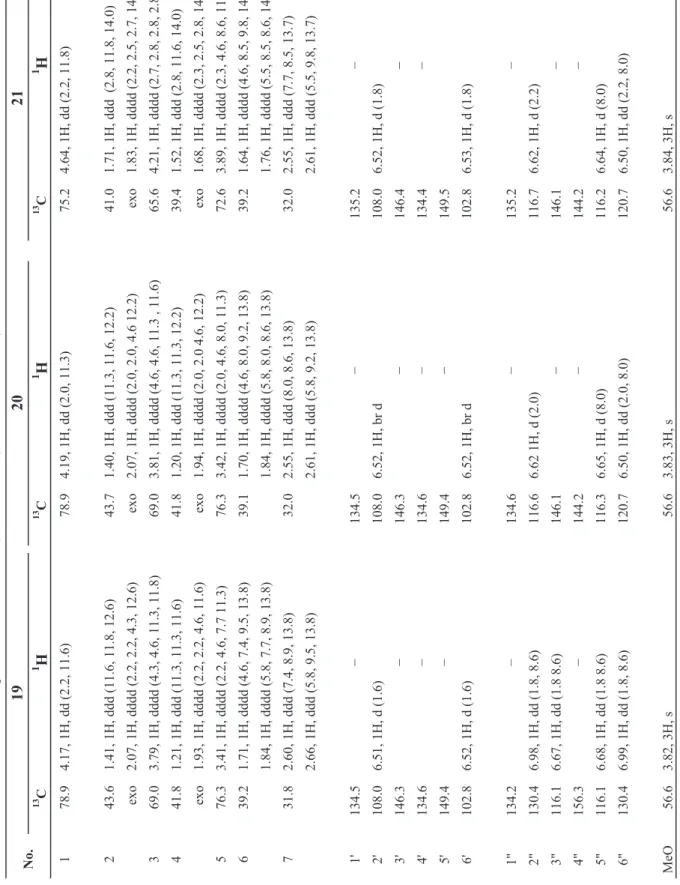
Table 1-2 1 H and 13 C NMR spectral data of 19-21 (in methanol-d4, 500 and 125 MHz) 13 C1 H13 C1 H13 C1 H 178.94.17, 1H, dd (2.2, 11.6)78.94.19, 1H, dd (2.0, 11.3)75.24.64, 1H, dd (2.2, 11.8) 243.61.41, 1H, ddd (11.6, 11.8, 12.6)43.71.40, 1H, ddd (11.3, 11.6, 12.2)41.01.71, 1H, ddd (2.8, 11.8, 14.0) exo2.07, 1H, dddd (2.2, 2.2, 4.3, 12.6)exo2.07, 1H, dddd (2.0, 2.0, 4.6 12.2)exo1.83, 1H, dddd (2.2, 2.5, 2.7, 14.0) 369.03.79, 1H, dddd (4.3, 4.6, 11.3, 11.8)69.03.81, 1H, dddd (4.6, 4.6, 11.3 , 11.6) 65.64.21, 1H, dddd (2.7, 2.8, 2.8, 2.8) 441.81.21, 1H, ddd (11.3, 11.3, 11.6)41.81.20, 1H, ddd (11.3, 11.3, 12.2)39.41.52, 1H, ddd (2.8, 11.6, 14.0) exo1.93, 1H, dddd (2.2, 2.2, 4.6, 11.6)exo1.94, 1H, dddd (2.0, 2.0 4.6, 12.2)exo1.68, 1H, dddd (2.3, 2.5, 2.8, 14.0) 576.33.41, 1H, dddd (2.2, 4.6, 7.7 11.3)76.33.42, 1H, dddd (2.0, 4.6, 8.0, 11.3)72.63.89, 1H, dddd (2.3, 4.6, 8.6, 11.6) 639.21.71, 1H, dddd (4.6, 7.4, 9.5, 13.8)39.11.70, 1H, dddd (4.6, 8.0, 9.2, 13.8)39.21.64, 1H, dddd (4.6, 8.5, 9.8, 14.0) 1.84, 1H, dddd (5.8, 7.7, 8.9, 13.8)1.84, 1H, dddd (5.8, 8.0, 8.6, 13.8)1.76, 1H, dddd (5.5, 8.5, 8.6, 14.0) 731.82.60, 1H, ddd (7.4, 8.9, 13.8)32.02.55, 1H, ddd (8.0, 8.6, 13.8)32.02.55, 1H, ddd (7.7, 8.5, 13.7) 2.66, 1H, ddd (5.8, 9.5, 13.8)2.61, 1H, ddd (5.8, 9.2, 13.8)2.61, 1H, ddd (5.5, 9.8, 13.7) 1'134.5í134.5í135.2í 2'108.06.51, 1H, d (1.6)108.06.52, 1H, br d108.06.52, 1H, d (1.8) 3'146.3í146.3í146.4í 4'134.6í134.6í134.4í 5'149.4í149.4í149.5 6'102.86.52, 1H, d (1.6)102.86.52, 1H, br d102.86.53, 1H, d (1.8) 1"134.2í134.6í135.2í 2"130.46.98, 1H, dd (1.8, 8.6)116.66.62 1H, d (2.0)116.76.62, 1H, d (2.2) 3"116.16.67, 1H, dd (1.8 8.6)146.1í146.1í 4"156.3í144.2í144.2í 5"116.16.68, 1H, dd (1.8 8.6)116.36.65, 1H, d (8.0)116.26.64, 1H, d (8.0) 6"130.46.99, 1H, dd (1.8, 8.6)120.76.50, 1H, dd (2.0, 8.0)120.76.50, 1H, dd (2.2, 8.0) MeO56.63.82, 3H, s56.63.83, 3H, s56.63.84, 3H, s Coupling constants (J in Hz) are given in parentheses.
2021 No.19Table 1-2 1 H and 13 C NMR spectral data of 19– 21 (in methanol-d4, 500 and 125 MHz)
(1R,3R,5R)-1,5-epoxy-3-hydroxy-1-(3,4-dihydroxy- 5-methoxyphenyl)-7-(4-hydroxy-3-methoxyphenyl) heptane [14], or their enantiomer, respectively.
Compound 19 was obtained as a pale yellowish oily substance, and its HR FAB-MS showed a [M+H]+ ion peak at m/z 361.1647 (C20H25O6), which was 30 mass unit smaller than that of 17 corresponding to loss of CH2O from 17. The IR spectrum showed an absorption band at 3402 cm-1 due to hydroxyl group.
The 13C NMR spectrum was very close to that of 17, but it showed the presence of another 4-hydroxy- 3-methoxyphenyl group instead of the 4-hydroxy- 3,5-dimethoxyphenyl group in 17, indicating the structure of 17 to be 1,5-epoxy-3-hydroxy-1-(3,4- dihydroxy-5-methoxyphenyl)-7-(4-hydroxyphenyl) heptane. Whereas, the H-3 was observed a dddd (J = 4.3, 4.6, 11.3 and 11.8 Hz) at δ 3.79, and the orienta- tion of the C-3 hydroxyl group at must be equatorial.
Thus, 19 was characterized as (1R,3S,5R)-1,5-epoxy- 3-hydroxy-1-(3,4-dihydroxy-5-methoxyphenyl)-7-(4- hydroxyphenyl)heptane [15] or its enantiomer.
The nineteen compounds were isolated from Kan- kyo A, and their structures were characterized as mentioned above. This is the first isolation of 10 – 19 from Kankyo (Kankyo A in Experimental), and it is noteworthy that the sulfonated derivatives (10 and 12) were also found as constituents of Kankyo, which had been believed to be prepared from ginger simply by steaming and then drying without sulfur bleaching.
So that, this fact suggests that the sulfonated deriva- tives must be artifacts caused by sulfur bleaching as previously reported on Shokyo [6], and that there would be two kinds of Kankyo in the Japanese mar- ket: one is “genuine” Kankyo prepared from ginger, and another is “pseudo” Kankyo provably prepared from “sulfur-breached” ginger.
While, we examined on another Kankyo (Kankyo
rivatives have been obtained therefrom as its constitu- ents [4, 6]. In addition to them, two compounds were isolated and identified as (1R,3S,5R)-1,5-epoxy-3- hydroxy-1-(3,4-dihydroxy-5-methoxyphenyl)-7-(3,4- dihydroxyphenyl)heptane (20) and (1R,3R,5R)-1,5-ep- oxy- 3-hydroxy-1-(3,4-dihydroxy-5-methoxyphenyl)- 7-(3,4-dihydroxyphenyl)heptane (21) or their enantiomers, respectively, based on coincidence of their data with those reported [15].
Further, we carried out additional examination on many samples of Shokyo and Kankyo collected in the Japanese market by means of TLC method. As a re- sult, sulfonated derivatives are contained in the almost every Shokyo samples, but in a half of Kankyo ones.
On the other hand, the fresh ginger root contained no sulfonated derivatives as their constituents [6].
EXPERIMENTAL
General Procedures Melting points were determined on a Yanaco micro-melting point apparatus (hot stage type) and were uncorrected.
Optical rotations were carried on a JASCO DIP 140 digital polarimeter. IR spectra were measured on a JASCO FT/IR-410 spectrometer. NMR spectra were recorded on a JEOL JNM LA-500 spectrometer (500 MHz for 1H, 125 MHz for 13C) or JEOL JNM GX-400 spectrometer (400 MHz for 1H, 100 MHz for 13C).
Chemical shifts were given in a δ ppm scale from TMS used as an internal standard, and the signals were assigned by means of DEPT and 2D NMR techniques (1H-1H COSY, HMQC and HMBC). MS spectra were obtained on a JEOL JMS SX-120A or JMS-700 spectrometer. The matrix used for FAB-MS was shown in the parenthesis. TLC was performed on a precoated silica gel 60 F254 or RP-18W F254 plate (Merck) and the detection was achieved by spray- ing with 10% H2SO4 followed by heating. Column chromatography was performed on silica gel 60 (< 45 µm, Merck), Sephadex LH-20 (Pharmacia), or ODS
acetone) and silica gel CC [Toluene-Acetone (3:1)]
to give 11 (22 mg). Fr. F4-3 was subjected to silica gel CC [CHCl3-MeOH (20:1)] and silica gel CC [Toluene-Acetone (3:2)] to give 16 (10 mg). Fr. E was separated into four fractions by Sephadex LH-20 CC (80% MeOH): Frs. E1 (0.9 g), E2 (6.1 g), E3 (0.5 g) and E4 (50 mg). Fr. E2 (1.0 g) was successively applied to silica gel CC [CHCl3-MeOH-AcOEt- H2O (2:2:4:1), lower phase; CHCl3-MeOH-H2O (8:2:0.2)], Sephadex LH-20 CC (MeOH), and ODS CC (30% MeCN) to give 10 (17 mg). Fr. E3 was chromatographed on silica gel CC [CHCl3-MeOH- H2O (9:1:0.08)] to give five fractions: Frs. E3-1 (124 mg), E3-2 (189 mg), E3-3 (84 mg), E3-4 (104 mg) and E3-5 (59 mg). Fr. E3-2 was successively applied to ODS CC (45% MeOH) and HPLC (30% MeCN) to give 17 (32 mg) and 18 (10 mg). Fr. E3-4 was subjected to ODS CC (30% MeCN) to give 19 (35 mg). Fr. D (10.0 g) was separated into three fractions by Sephadex LH-20 CC (MeOH): Frs. D1 (4.1 g), D2 (6 g) and D3 (8 mg). Fr. D2 was chromatographed on ODS CC with a gradient mixture of H2O and MeOH providing the following five fractions: Fr. D2-1 (25%
MeOH, 1.5 g), D2-2 (25% MeOH, 627 mg), D2-3 (25% MeOH, 534 mg), D2-4 (30% MeOH, 1.4 g) and D2-5 (30% MeOH, 1.9 g). Fr. D2-4 was subjected to Sephadex LH-20 CC (MeOH) to give six fractions:
Frs. D2-4-1 (190 mg), D2-4-2 (894 mg), D2-4-3 (193 mg), D2-4-4 (12, 12 mg), D2-4-5 (7 mg) and D2-4- 6 (3 mg). Fr. D2-4-2 was chromatographed on silica gel CC [CHCl3-MeOH-H2O (8:2:0.2, 7:3:0.5)] to give six fractions: D2-4-2a (96 mg), D2-4-2b (80 mg), D2- 4-2c (45 mg), D2-4-2d (365 mg), D2-4-2e (32 mg), D2-4-2f (264 mg). Fr. D2-4-2d was successively applied to Sephadex LH-20 CC (MeOH) and ODS CC (10% MeOH) to give 13 (73 mg). Fr. D2-4-2f was chromatographed on ODS CC (25% MeOH), and Sephadex LH-20 CC (MeOH) to give 12 (55 mg). Fr. D2-2 was successively applied to silica gel CC [CHCl3-MeOH-H2O (8:2:0.2, 7:3:0.5)], ODS CC (15% MeCN), Sephadex LH-20 CC (MeOH), silica Plant Material Kankyo A (Lot. No. VMFNM:
imported from China) was purchased from Uchida Wakanyaku Co., Ltd., Tokyo, Japan. Kankyo B (Lot.
No. 231001: imported from China) was purchased from Tochimoto-Tenkaido Co., Ltd., Osaka, Japan.
Extraction and Isolation Powdered Kankyo A (5.0 kg) was percolated with 80% MeOH (37 L) at room temperature. The 80% MeOH extract was concentrated in vacuo at 40 ˚C. The residual syrup was suspended in H2O and extracted with ether (3 times) to afford an ether extract (164.5 g) after concentration to dryness. The ether extract was chromatographed repeatedly on silica gel column chromatography (CC) [Hexane-Acetone (4:1)] and ODS CC (80% MeOH) to give nine compounds, 6-, 8-, 10-gingerols (1 – 3), 6-, 8-, 10-shogaols (4 – 6), 6-paradol (7), 6-gingediacetate (8), zingerone (9), identification of which were performed by direct comparison with their authentic samples isolated from Shokyo [4]. The aqueous layer (476.4 g) was, after concentration at 40 ˚C in vacuo, subjected to an ODS CC with a gradient mixture of H2O and MeOH pro- viding the following eight fractions: Fr. A (H2O, 266.9 g), B (H2O, 41.3 g), C (H2O, 10.5 g), D (50% MeOH, 26.1 g), E (50% MeOH, 7.6 g), F (50% MeOH, 3.9 g), G (50% MeOH, 2.2 g) and H (MeOH, 4.6 g). Fr.
F was separated into five fractions by Sephadex LH- 20 CC (MeOH): Frs. F1 (52 mg), F2 (1.5 g), F3 (1.6 g), F4 (715 mg) and F5 (42 mg). Fr. F3 was subjected to an ODS CC with a gradient mixture of H2O and MeOH providing the following five fractions: Frs.
F3-1 (20% MeOH, 53.3 mg), F3-2 (30% MeOH, 114 mg), F3-3 (30% MeOH, 55 mg), F3-4 (30% MeOH, 1.07 g) and F3-5 (MeOH, 13 mg). Fr. F3-2 was suc- cessively applied to Sephadex LH-20 CC (MeOH) to give 10 (107 mg). Fr. F4 (430 mg) was chro- matographed on silica gel CC [CHCl3-MeOH-H2O (225:25:2)] to give six fractions: Frs. F4-1 (20 mg), F4-2 (77 mg), F4-3 (82 mg), F4-4 (19 mg), F4-5 (78 mg) and F4-6 (121 mg). Fr. F4-2 was successively applied to ODS (50% MeCN), Sephadex LH-20 (80%
20 CC (MeOH) and ODS CC (10% MeCN) to give 14 (3 mg). Fr. G was separated into two fractions by Sephadex LH-20 CC (MeOH): Frs. G1 (1.7 g) and G2 (188 mg). Fr. G2 was successively applied to ODS (40% MeCN), Sephadex LH-20 (MeOH), silica gel [CHCl3-MeOH-H2O (8:2:0.2)], Sephadex LH-20 (MeOH) and ODS CC (35% MeCN) to give 15 (15 mg).
Powdered Kankyo B (5.0 kg) was also treated as in the case of Kankyo A: the ether extract (235 g) afford- ed nine compounds, 1 – 9; the aqueous extract (241 g) gave 11, 13, 17 – 18, 20 – 21 [15]. But no sulfonated compounds (10 and 12) were obtained.
6-Gingesulfonic acid (10) [4] White amorphous powder, mp. 177 – 181 ˚C, [α]21D + 0.7˚ (c 1.00, MeOH). Positive FAB-MS (NBA) m/z: 359.1457 [M+H]+ (Calcd for C17H27O6S: 359.1528). IR νmax
(KBr): 3182 (OH), 1711 (C=O), 1525 (benzene ring), 1219, 1175, 1056 (SO3H) cm-1. These data were coin- cident with those reported for 6-gingesulfonic acid [4].
Hexahydrocurcumin (11) [12] Yellow oil, [α]17D + 8.3˚ (c 0.29, CHCl3). Positive FAB-MS (NBA), m/
z: 375.1815 [M+H]+ (Calcd for C21H27O6: 375.1808).
The specific rotation of authentic hexahydrocurcumin was + 9.0˚, and the configuration of the 5-position of 11 must be S [12].
Shogasulfonic acid A (12) [4] Pale yellowish amorphous powder, mp. 205 ˚C, [α]21D – 0.5˚ (c 2.00, MeOH). Positive FAB-MS (NBA) m/z: 439.1417 [M+H]+ (Calcd for C21H27O8S: 439.1427). EI-MS, m/
z: 356 ([M-H2SO3])+). IR νmax (KBr): 3379 (OH), 1698 (C=O), 1523 (benzene ring), 1222, 1179, 1154, 1054 (SO3H) cm-1. These data were coincident with those reported for Shogasulfonic acid A [4].
Zingiberoside A (13) [5] White amorphous pow- der, mp. 99 – 103 ˚C, [α]20D –18.4˚ (c 1.00, MeOH).
Positive FAB-MS (NBA) m/z: 332.2064 [M+H]+
der, mp. 123 ˚C, [α]D – 40.7˚ (c 1.27, MeOH). Posi- tive FAB-MS m/z: 495.2442 [M+H]+ (Calcd for C22H39O12: 495.2490).
(3S,5S)-6-Gingerdiol 4’-O-β-D-glucopyranoside (15) [11] White amorphous powder, mp. 123 ˚C, [α]17D – 37.1˚ (c 1.03, MeOH). Positive FAB-MS (NBA) m/z: 459 [M+H]+ (Calcd for C23H39O9: 459).
IR νmax (KBr): 3335 (OH), 2858 (OCH3), 1518 (ben- zene ring) cm-1. 1H, 13C-NMR: Table 1-1.
( 3 S , 5 S ) - 3 , 5 - h y d r o x y - 1 - ( 4 - h y d r o x y - 3 - methoxyphenyl)-7-(4-hydroxy-3,5-dimethoxy- phenyl)heptane (16) [13] Yellow oil, [α]16D – 11.0˚
(c 0.52, EtOH). Positive FAB-MS (NBA) m/z:
407.2044 [M+H]+ (Calcd for C22H31O7: 407.1992). IR νmax (KBr): 3335 (OH), 2931, 2858 (OCH3), 1635, 1515 (benzene ring) cm-1. 1H, 13C-NMR: Table 1-1.
(1R,3S,5R)-1,5-epoxy-3-hydroxy-1-(3,4-dihy- droxy-5-methoxyphenyl)-7-(4-hydroxy-3- methoxyphenyl)heptane or its enantiomer (17) [14]
Pale yellowish oil, [α]16D – 65.2˚ (c 1.07, EtOH). Posi- tive FAB-MS (NBA) m/z: 391 [M+H]+ (Calcd for C21H27O7: 391). IR νmax (KBr): 3397 (OH), 2941, 2852 (OCH3), 1615, 1517 (benzene ring) cm-1. 1H,
13C-NMR: Table 1-1.
(1R,3R,5R)-1,5-Epoxy-3-hydroxy-1-(3,4-dihy- droxy-5-methoxyphenyl)-7-(4-hydroxy-3- methoxyphenyl)heptane or its enantiomer (18) [14]
Pale yellowish oil, [α]17D – 56.5˚ (c 0.84, EtOH). Posi- tive FAB-MS (NBA) m/z: 391 [M+H]+ (Calcd for C21H27O7: 391). IR νmax (KBr): 3339 (OH), 2927 (OCH3), 1654, 1520 (benzene ring) cm-1. 1H, 13C- NMR: Table 1-1.
(1R,3S,5R)-1,5-Epoxy-3-hydroxy-1-(3,4-dihy- droxy-5-methoxyphenyl)-7-(4-hydroxy-phenyl) heptane or its enantiomer (19) [15] Pale yellowish oil, [α]15D – 87.7˚ (c 1.28, EtOH). Positive FAB-MS (NBA) m/z: 361.1647 [M+H]+ (Calcd for C20H25O6: 361.1651). IR νmax (KBr): 3402 (OH), 2853 (OCH3), 1615, 1516 (benzene ring) cm-1. 1H, 13C-NMR: Table
(1R,3S,5R)-1,5-Epoxy-3-hydroxy-1-(3,4-dihy- droxy-5-methoxyphenyl)-7-(3,4-dihydroxyphenyl) heptane (20) or its enantiomer [15] Pale yellowish oil. [α]15D – 58.3°(c 1.03, EtOH). HR FAB-MS (NBA) m/z 377.1579 [M+H]+, (Calcd for C20H25O7: 377.1600). IR νmax (KBr): 3398 (OH), 1618, 1524 (benzene ring) cm-1. 1H and 13C NMR:Table 1-2.
(1R,3R,5R)-1,5-Epoxy-3-hydroxy-1-(3,4-dihy- droxy-5-methoxyphenyl)-7-(3,4-dihydroxyphenyl) heptane (21) or its enantiomer [15] Pale yellowish oil. [α]15D –31.0°(c 0.31, EtOH). HR FAB-MS (NBA) m/z 377.1579 [M+H]+, (Calcd for C20H25O7: 377.1600). IR νmax (KBr): 3398 (OH), 1618, 1524 (benzene ring) cm-1. 1H and 13C NMR:Table 1-2.
ACKNOWLEDGMENT
We thank to Ms. Kimiko Shiohara (Analytical Center of in this school) for measurement of the MS spectra. This research work was supported in part by a Grant-in-aid for Scientific Research (No. 20590011) and URAKAMI Foundation.
REFERENCE
1) Egawa, M.: The prescription of Zingiberis Rhi- zoma in Kampo medicine., Gendai Toyo Igaku (in Japanese), 8, 40-49 (1987)
2) Nishimoto, K.: The quality of ginger., Gendai Toyo Igaku (in Japanese), 8, 62-67 (1987) 3) Aburada, M.: Pharmacological effects of “Zin-
giberis Rhizoma”., Gendai Toyo Igaku (in Japa- nese), 8, 45-50 (1987)
4) Hori, Y., Miura, T., Hirai, Y., et al.: Pharmacog- nostic studies on ginger and related drugs (1).
Five sulfonated compounds from Zingiberis Rhi- zome (Shokyo)., Phytochemistry, 64, 613-617 (2003)
5) Hori, Y., Miura, T., Wakabayashi, Y., et al.: Five Monoterpene Glycosides from Zingiberis Rhi- zome (Shokyo)., Heterocycles, 65, 2357-2367 (2005)
6) Hori, Y., Wakabayashi, Y., Oheda, M., et al.: Sul-
fonated Compounds in Shokyo and Kankyo., J.
Nat. Med., 59, 229-236 (2005)
7) Kano, Y.: Chemistry of “Zingiberis Rhizoma”., Gendai Toyo Igaku (in Japanese)., 8, 51-56 (1987)
8) Yamagishi, T., Hayashi, K., Mitsuhashi, H.: Iso- lation of hexahydrocurcumin, dihydrogingerol and two additional pungent principles from gin- ger., Chem. Pharm. Bull., 20, 2291-2292 (1972) 9) Kikuzaki, H., Tsai, S-M., Nakatani, N.: Ging-
erdiol related compounds from the rhizomes of Zingiber officinale., Phytochemistry, 31, 1783- 1786 (1992)
10) Masada, Y., Inoue, T., Hashimoto, K., et al.:
Studies on the Constituents of Ginger (Zingiber officinale ROSCOE) by GC-MS., YAKUGAKU ZASSHI (in Japanese), 94, 735-738 (1974) 11) Sekiwa, Y., Kubota, K., Kobayashi, A.: Isolation
of Novel Glucosides Related to Gingerdiol from Ginger and Their Antioxidative Activities., J.
Agric. Chem., 48, 373-377 (2000)
12) Itokawa, H., Morita, H., Midorikawa, I., et al.:
Diarylheptanoids from the Rhizoma of Alpinia officinarum HANCE., Chem. Pharm. Bull., 33, 4889-4893 (1985)
13) Yamahara, J., Hatakeyama, S., Taniguchi, K., et al.: Stomachic principles in ginger. II. Pungent and anti-ulcer effects of low polar constituents isolation from ginger, the dried Rhizoma of Zin- giber officinale Roscoe cultivated in Taiwan.
The absolute stereostructure of a new diarylhep- tanoid., YAKUGAKU ZASSHI (in Japanese)., 112, 645-655 (1992)
14) Kikuzaki, H., Nakatani, N.: Cyclic diarylhep- tanoids from rhizomes of Zingiber officinale., Phytochemistry., 43, 273-277 (1996)
15) Tao, Q., F, Xu, Y., Lam, R, Y, Y., et al.: Diaryl- heptanoids and a Monoterpenoid from the Rhi- zomes of Zingiber officinale: Antioxidant and Cytoprotective Properties., J. Nat. Prod., 71, 12- 17 (2008)
カンキョウ (乾姜) の成分
堀 由美子*1,若林雪絵1,水井香代子1,福村基徳1,鳥居塚和生1,伊田喜光1,2
1 昭和大学薬学部 生薬学・植物薬品化学教室
2 横浜薬科大学 漢方薬学科 天然物化学研究室
要 旨
ショウガを基原とするカンキョウ (Zingiberis processum rhizome) の80% MeOH抽出エキスから 19種の化合物を単離した.これらは,既知化合物12種とgingerdiol 4'-O-β-D-glucopyranoside (15),
4種のジアリルヘプタノイド類 (16 – 19),既報のスルホン化誘導体:6-gingesulfonic acid (10) と shogasulfonic acid A (12) であった.このうち,15 – 19はカンキョウからは初めて得られた化合物で ある.
また興味深いことに,本邦市場にはスルホン化誘導体を含むカンキョウと含まないカンキョウ の2種類が存在することが分かった.
Key Words: ショウガ,ショウガ科,カンキョウ,Zingiberis processum rhizome, スルホン化誘導体
受付:2012年2月16日,受理:2012年3月26日