SUZUKI-NISHIMURA Tamiko BABA Masayoshi・KODAMA Yasushi
OTANI Shiori・YAMAMOTO Arisa NISHIDA Tomokazu・TANAKA Kaori
Histamine release from rat peritoneal mast cells induced by Mas-related G protein-coupled receptor activators was inhibited by lithium carbonate, whereas that by the calcium ionophore
A23187 was not
就実論叢 第49号(2019),pp.203-211
Histamine release from rat peritoneal mast cells induced by Mas - related G protein - coupled receptor activators was inhibited by lithium carbonate, whereas that by the calcium ionophore
A23187 was not
SUZUKI-NISHIMURA Tamiko*
BABA Masayoshi, KODAMA Yasushi OTANI Shiori, YAMAMOTO Arisa NISHIDA Tomokazu, TANAKA Kaori
Department of PharmacologyⅡ, School of Pharmacy, Shujitsu University
*Corresponding author: [email protected]
[Abstract]
Activators of the Mas-related G protein-coupled receptor release histamine independent of IgE from rat peritoneal mast cells. We found that the bipolar affective disorder drug lithium carbonate inhibited the release of histamine induced by 1 µg/mL, but not 5 µg/mL of compound 48/80; therefore, we herein examined the effects of lithium carbonate on histamine release induced by various mast cell activators. The Mas-related G protein-coupled receptor activators used were NK-1 agonists, including substance P and bradykinin, and bee venom, such as melittin and mastoparan. The GlcNAc-GlcNAc-specific lectin Datura stramonium agglutinin and calcium ionophore A23187 were also used. Lithium carbonate dose-dependently inhibited histamine release induced by 10 µM substance P, 50 µM bradykinin, and 100 µg/mL of Datura stramonium agglutinin. At a concentration of 3 mM, lithium carbonate significantly inhibited histamine release induced by 3 µg/mL of melittin and 10 µg/mL of mastoparan. However, 3 mM lithium carbonate did not inhibit histamine release induced by 4 µM or 10 µM A23187. These results suggest that lithium carbonate blocks the signal transduction pathway involving the Mas-related G protein-coupled receptor and GlcNAc-GlcNAc sugar residues. Since lithium
carbonate did not inhibit histamine release induced by A23187, it did not appear to inhibit the signal transduction pathway after increases in intracellular calcium concentrations. It is important to note that the dose of lithium carbonate that inhibited mast cells was similar to its clinical serum dose for the treatment of bipolar affective disorder.
Keywords: Mas-related G protein-coupled receptor, mast cells, histamine release, lithium carbonate, inhibition.
[Introduction]
Lithium carbonate (Li2CO3) is one of the drugs used to treat bipolar affective disorder and has many mechanisms of action, one of which involves the inhibition of amine release from the ends of synapses1). Therefore, we herein examined the effects of Li2CO3 on histamine release from rat peritoneal mast cells as an animal model of an anaphylactic reaction.
A recent study reported that mouse and human mast cells express the G protein-coupled receptors Mrgprb2 and MRGPRX2, respectively2). The activation of Mrgprb2 or MRGPRX2 by the basic polymer compound 48/80 (48/80) and inflammatory peptide substance P (SP), as well as by many small-molecule drugs, has been associated with systemic pseudo-allergic or anaphylactic reactions3-5). In addition to mice and humans, rats possess a G protein in the MRG family, and MRGPR plays roles in calcium-dependent and calcium- independent pathways for mast cell activation6).
We previously reported that rat mast cell activation induced by 48/80, SP, bradykinin (BK), and the basic polymer PEI6 were sugar-specifically inhibited by the N-acetyl glucosamine (GlcNAc)-specific lectin wheat germ agglutinin (WGA)7,8). Furthermore, GlcNAc-GlcNAc-specific Datura stramonium agglutinin (DSA) induced pertussis toxin-sensitive histamine release from mast cells, similar to 48/809), and also sugar-specifically induced calcium mobilization, histamine release, and PGD2 production by rat mast cells10,11). The bee venoms melittin (ML)12) and mastoparan (MP)13), which are a mast cell activator similar to 48/80 and MRGPRX2 activator, respectively, were also examined.
induced by Mas-related G protein-coupled receptor activators was inhibited by lithium carbonate, whereas that by the calcium ionophore A23187 was not
[Materials and Methods]
Chemicals
48/80, SP acetate salt, BK acetate salt, ML, MP, A23187, and Li2CO3 were purchased from Sigma-Aldrich (U.S.A.). DSA and o-phthalaldehyde were from Wako Pure Chemical Industries Ltd. (Osaka, Japan). A dimethyl sulfoxide (DMSO) solution of 3 mM A23187 was stored at -20℃ and diluted with HEPES- buffered Tyrodeʼs solution before use. DMSO did not enhance or inhibit histamine release at the final concentration of 0.13 or 0.33% v/v DMSO in the assay.
Assay of histamine release
Mast cell activation was examined by histamine release. Histamine release from rat peritoneal mast cells was measured as described previously11). Mast cells from the peritoneal cavity of male Sprague Dawley rats (300-450 g) were purified using Percoll and suspended in HEPES-buffered Tyrodeʼs solution (137 mM NaCl, 2.7 mM KCl, 12 mM HEPES, 1 mM MgCl2, 0.3 mM CaCl2, 5.6 mM dextrose, and 0.03% bovine serum albumin, pH 7.4). Mast cells were preincubated with various concentrations of Li2CO3 in HEPES-buffered Tyrodeʼs solution at 37℃ for 10 min, and 1 µg/mL of 48/80, 10 µM SP, 50 µM BK, or 100 µg/mL of DSA was then added. After a 10min incubation, the amount of histamine released was analyzed using a fluorometric assay14).
Mast cells were also preincubated with 3 mM Li2CO3 at 37℃ for 5 min before the incubation with 4 or 10 µM A23187 for 5 min, with 3 µg/mL ML for 5 min, and 10 µg/mL MP for 20 min.
Animal studies
All animal studies were previously approved by the Animal Care Committee of Shujitsu University (#018-001, #18-002) and were conducted in accordance with the Principles of Laboratory Animal Care (NIH Publication #85-23).
Sprague-Dawley male rats were used in animal studies.
Statistical analysis
Values are box-and-whisker plots of the replicated experiments. Statistical analyses were performed using ANOVA with Dunnettʼs test, employing P=0.05 as the upper limit of significance.
[Results]
1. Li2CO3 inhibited histamine release induced by 1 µg/ml, but not 5 µg/mL 48/80.
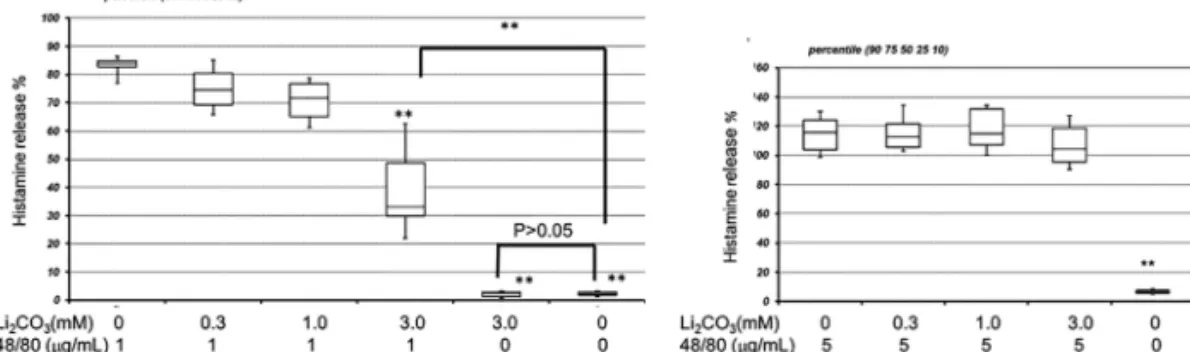
In the presence of 0.3 mM CaCl2, at concentrations ranging between 0.3 and 3.0 mM, Li2CO3 dose-dependently inhibited histamine release induced by 1 µg/
mL 48/80, with an IC50 of 2.31 mM (Fig. 1a). On the other hand, histamine release induced by 5 µg/mL 48/80 was not inhibited by Li2CO3 (Fig. 1b). At a concentration of 3 mM, Li2CO3 did not induce the release of histamine from rat mast cells (Figs. 1a and 1b). No significant differences were observed between histamine release in the absence and presence of 3 mM Li2CO3 (Fig. 1a).
Fig. 1a Effects of lithium carbonate on histamine release induced by the compound 48/80 (1 µg/mL). Mast cells were preincubated with 0.3, 1.0, and 3.0 mM lithium carbonate in HEPES-buffered Tyrodeʼs solution at 37℃ for 10 min, and 1 µg/mL 48/40 was then added. After a 10min incubation, the amount of histamine released was analyzed, n=6, Dunnettʼs analysis, **P<0.01 Repeated measures ANOVA.
Fig. 1b Effects of lithium carbonate on histamine release induced by the compound 48/80 (5 µg/mL). Mast cells were preincubated with 0.3, 1.0, and 3.0 mM lithium carbonate in HEPES-buffered Tyrodeʼs solution at 37℃ for 10 min, and 5 µg/mL 48/40 was then added. After a 10min incubation, the amount of histamine released was analyzed, n=12, Dunnettʼs analysis, **P<0.01 Repeated measures ANOVA.
2. Inhibitory effects of Li2CO3 on histamine release induced by 10 µM SP or 50 µM BK.
Histamine release induced by 10 µM SP (Fig. 2) and 50 µM BK (Fig.
3) was dose-dependently inhibited by Li2CO3, with IC50 of 1.45 and 1.50 mM, respectively. No significant differences were observed between 10 µM SP-induced histamine release preincubated with 3.0 mM Li2CO3 and spontaneous histamine release (Fig. 2).
Fig. 2 Effects of lithium carbonate on histamine release induced by 10 µM SP. Mast cells were preincubated with 0.3, 1.0, and 3.0 mM lithium carbonate in HEPES-buffered Tyrodeʼs solution at 37 ℃ for 10 min, and 10 µM SP was then added. After a 10min incubation, the amount of histamine released was analyzed, n=6, Dunnettʼ s analysis, **P<0.01 Repeated measures ANOVA.
induced by Mas-related G protein-coupled receptor activators was inhibited by lithium carbonate, whereas that by the calcium ionophore A23187 was not
Histamine release induced by 50 µM BK preincubated with 3.0 mM Li2CO3 was similar to spontaneous histamine release (Fig. 3).
Fig. 3 Effects of lithium carbonate on histamine release induced by 50 µM BK. Mast cells were preincubated with 0.3, 1.0, and 3.0 mM lithium carbonate in HEPES- buffered Tyrodeʼs solution at 37℃ for 10 min, and 50 µM BK was then added. After a 10min incubation, the amount of histamine released was analyzed, n=4-12, Dunnettʼs analysis, *P<0.05, **P<0.01 Non-repeated measures ANOVA.
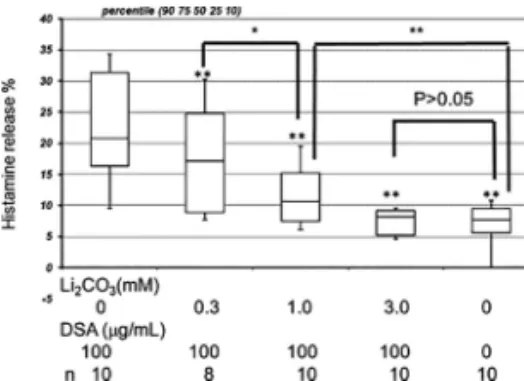
3. Inhibitory effects of Li2CO3 on histamine release induced by 100 µg/mL DSA.
Li2CO3 dose-dependently inhibited histamine release induced by 100 µg/mL DSA (Fig. 4). Its IC50 was 0.51 mM.
Fig. 4 Effects of lithium carbonate on histamine release induced by 100 µg/mL DSA.
Mast cells were preincubated with 0.3, 1.0, and 3.0 mM lithium carbonate in HEPES- buffered Tyrode's solution at 37℃ for 10 min, and 100 µg/mL of DSA was then added.
After a 10min incubation, the amount of histamine released was analyzed, n=8-10, Dunnettʼs analysis, *P<0.05, **P<0.01 Non-repeated measures ANOVA.
4. Inhibitory effects of Li2CO3 on histamine release induced by 3 µg/mL ML and 10 µg/mL MP.
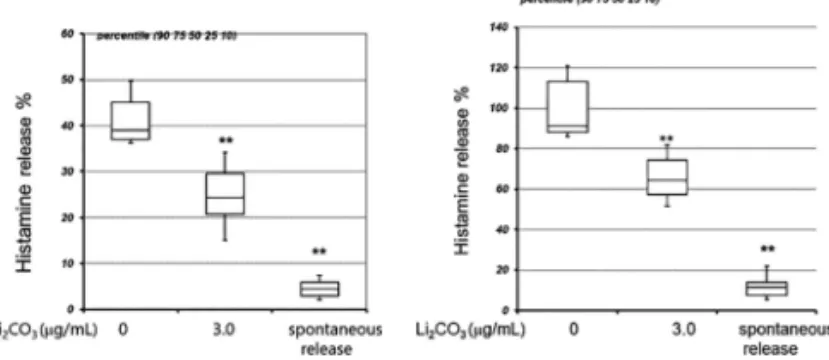
Since histamine release induced by 48/80, SP, BK, and DSA was significantly inhibited by 3 mM Li2CO3 (Figs. 1a, 2, 3, and 4), the effects of 3 mM Li2CO3 on histamine release induced by ML and MP were examined. After a preincubation with 3 mM Li2CO3 for 5 min, histamine release induced by 3 µg/mL ML and 10 µg/mL MP was significantly inhibited (Figs. 5 and 6). The incubation times of
ML and MP were 5 and 20 min, respectively, and were selected in a preliminary study.
Fig. 5 Effects of lithium carbonate on histamine release induced by 3 µg/mL ML.
Mast cells were preincubated with 3.0 mM lithium carbonate in HEPES-buffered Tyrodeʼs solution at 37℃ for 5 min, and 3 µg/mL ML was then added. After a 5min incubation, the amount of histamine released was analyzed, n=6, Dunnettʼs analysis,
**P<0.01 Repeated measures ANOVA.
Fig. 6 Effects of lithium carbonate on histamine release induced by 10 µg/mL of MP.
Mast cells were preincubated with 3.0 mM lithium carbonate in HEPES-buffered Tyrodeʼs solution at 37℃ for 5 min, and 10 µg/mL MP was then added. After a 20min incubation, the amount of histamine released was analyzed, n=6, Dunnettʼs analysis,
**P<0.01 Repeated measures ANOVA.
5. Effects of 3 mM Li2CO3 on histamine release induced by the calcium ionophore A23187.
Li2CO3 did not inhibit histamine release induced by 4 or 10 µM A23187 (Fig. 7).
At a concentration of 10 mM, Li2CO3 enhanced histamine release, and it was not possible to examine the inhibitory effects of Li2CO3 on mast cells.
Fig. 7 Effects of lithium carbonate on histamine release induced by 4 or 10 µM A23187. Mast cells were preincubated with 3.0 mM lithium carbonate in HEPES- buffered Tyrodeʼs solution at 37℃ for 5 min, and A23187 was then added. After a 5min incubation, the amount of histamine released was analyzed, n=6, Dunnettʼs analysis,
**P<0.01 Repeated measures ANOVA.
induced by Mas-related G protein-coupled receptor activators was inhibited by lithium carbonate, whereas that by the calcium ionophore A23187 was not
[Discussion]
SP and 48/80 are well-known activators of Mas-related G protein-coupled receptors (MRGPR)3-5). Murine Mrgprb2, rat MrgprC, and human MRGPRX2 on mast cells may be targets of pseudo-allergic drug reactions involving mast cell activation4-6). The inhibition of SP- or BK-induced histamine release by Li2CO3 was not recovered by increases in extracellular calcium concentrations (data not shown), suggesting that MRGPR on rat mast cells may be calcium- independent, G protein-dependent receptors.
We previously reported that DSA induced rat mast cell activation, including calcium mobilization, histamine release, and PGD2 production9-11). The haptenic sugars of DSA inhibited histamine release, suggesting that DSA recognizes GlcNAc㌼1-4GlcNAc instead of Gal㌼1-4GlcNAc15).
Since Li2CO3 inhibited histamine release induced by 1 µg/mL, but not 5 µg/
mL 48/80, higher concentrations of 48/80 decreased the inhibitory effects of Li2CO3. Therefore, the effects of Li2CO3 on histamine release induced by A23187 were examined at 4 and 10 µM. A23187 activated the signal transduction pathway after an increase in intracellular calcium ions, whereas Li2CO3 did not inhibit histamine release induced by A23187, suggesting that Li2CO3 inhibited the signal transduction pathway from MRGPR to increase intracellular calcium concentrations.
We also investigated the effects of Li2CO3 on histamine release induced by ML and MP, which cause pseudo-allergic drug reactions. Li2CO3 inhibited histamine release induced by various IgE-independent activators, including ML and MP, but not A23187. Li2CO3 toxicity is closely related to serum lithium levels, which are close to the therapeutic level. The clinical dose of Li2CO3 ranges between 0.5 and 1 mM, and addiction occurs between 1.8 and 2.5 mM1). One of the toxicities of Li2CO3 is renal toxicity in which mast cells may play a role16). The inhibitory effects of Li2CO3 on IgE-independent histamine release have been observed at both clinical and addictive doses in humans, suggesting that Li2CO3 similarly inhibits histamine release from mast cells and brain amine release from synapses.
Conflicts of Interest
The authors declare no conflicts of interest.
[References]
1. Prescribing information of LITHOBID® (Lithium Carbonate, USP).
2. McNeil BD, Pundir P, Meeker S, Han L, Undem BJ, Kulka M, Dong X:
Identification of a mast-cell-specific receptor crucial for pseudo-allergic drug reactions, Nature, 519(7542):237-241(2015).
3. Ali. H: Mas-related G protein coupled receptor-X2: A potential signal for modulating mast cell-mediated allergic and inflammatory diseases. J Immunobiol. 1(4):1-11(2016).
4. Ali H: Emerging roles for Mas-related G protein-coupled receptor-X2 in host defense peptide, opioid, and neuropeptide-mediated inflammatory reactions.
Adv Immunol, 136:123-162(2017).
5. Kashem SW, Subramanian H, Collington SJ, Magotti P, Lambris JD, Ali H: G protein coupled receptor specificity for C3a and compound 48/80-induced degranulation in human mast cells: roles of Mas-related genes MrgX1 and MrgX2. Eur J Pharmacol, 668: 299-304(2011).
6. Hager UA, Hein A, Lennerz JK, Zimmermann K, Neuhuber WL, Reeh PW:
Morphological characterization of rat Mas-related G-protein-coupled receptor C and functional analysis of agonists. Neuroscience 151(1):242-254(2008).
7. Suzuki-Nishimura T, Nagaya K, Matsuda K, Uchida MK, Aoki J: Sugar- specific inhibitory effects of wheat germ agglutinin and phytohemagglutinin-E4 on histamine release induced by basic secretagogues from rat peritoneal mast cells and their possible action sites. Jpn J Pharmacol, 57(1):79-90(1991).
8. Matsuda K, Niitsuma A, Uchida MK, Suzuki-Nishimura T: Inhibitory effects of sialic acid- or N-acetylglucosamine-specific lectins on histamine release induced by compound 48/80, BK, and a polyethylenimine in rat peritoneal mast cells. Jpn J Pharmacol, 64(1): 1-8(1994).
9. Matsuda K, Aoki J, Uchida MK, Suzuki-Nishimura T: Datura stramonium agglutinin released histamine from rat peritoneal mast cells that was inhibited by pertussis toxin, haptenic sugar and N-acetylglucosamine- specific lectins:
involvement of glycoproteins with N-acetylglucosamine residues, Jpn J Pharmacol, 66(2): 195-204(1994).
10. Suzuki-Nishimura T, Furuno T, Uchida MK、Nakanishi M: An initial signal of activation of rat peritoneal mast cells stimulated by Datura stramonium agglutinin; a confocal fluorescence microscopic analysis of intracellular calcium ion and cytoskeletal assembly, Jpn J Pharmacol, 66(2): 205-211(1994).
induced by Mas-related G protein-coupled receptor activators was inhibited by lithium carbonate, whereas that by the calcium ionophore A23187 was not
11. Suzuki-Nishimura T, Uchida MK: Prostaglandin D2 generation by rat peritoneal mast cells stimulated with Datura stramonium agglutinin and its inhibition by haptenic sugar and wheat germ agglutinin. Jpn J Pharmacol, 90(1): 77-80 (2002).
12. Koch G, Habermann B, Mohr C, Just I, Aktories K: ADP-ribosylation of rho proteins is inhibited by melittin, mast cell degranulating peptide and compound 48/80. Eur J Pharmacol. 226(1):87-91(1992).
13. Arifuzzaman M, Mobley YR, Choi HW, Bist P, Salinas CA, Brown ZD, Chen SL, Staats HF, Abraham SN: MRGPR-mediated activation of local mast cells clears cutaneous bacterial infection and protects against reinfection. Sci Adv.
5(1): eaav0216(2019)
14. Shore PA, Burkhalter A, Cohn VH: A method for the fluorometric assay of histamine in tissues. J Pharmacol Exp Ther, 127: 182-186(1959).
15. Suzuki-Nishimura T, Hosokawa T, Seno M, Kato Y: Inhibitory effects of GlcNAc polymers on histamine release from mast cells by Datura stramonium agglutinin. The Shujitsu university journal of pharmaceutical sciences, 4:10-15 (2017).
16. Kumarguru BN, Natarajan M, Nagarajappa AH: The pathology of lithium induced nephropathy: a case report and review, with emphasis on the demonstration of mast cells. J Clin Diagn Res, 7(2):374-377(2013).