• 検索結果がありません。

VasSF treatment increased the number of pup deliveries per female in SCG/Kj mice

N/A
N/A
Protected

Academic year: 2021

シェア "VasSF treatment increased the number of pup deliveries per female in SCG/Kj mice"

Copied!
3
0
0

読み込み中.... (全文を見る)

全文

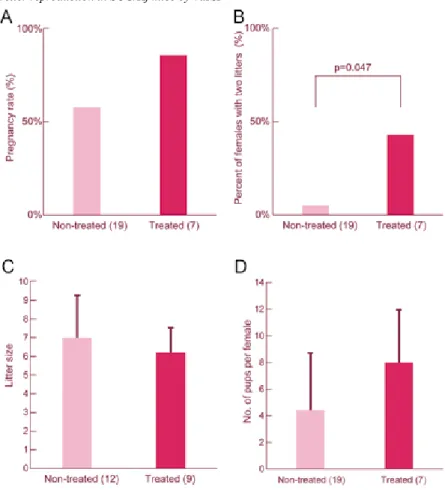
Volume 8 (1), January 2021 ADC Letter for Infectious Disease Control 33. Corresponding author (*) Osamu Suzuki, Laboratory of Animal Models for Human Diseases, National Institutes of Biomedical Innovation, Health and Nutrition, 7-6-8 Saito-Asagi, Ibaraki city, Osaka 567-0085, JAPAN E-mail: [email protected]. Received November 19, 2020 Accepted December 24, 2020. Abstract Background: Viral infection of SARS-Cov-2 causes severe. pathogenesis due to vasculitis and Kawasaki disease-like symptoms. We have demonstrated the efficacy of a drug seed VasSF, a recombinant single-chain Fv of IgG, using vasculitis model SCG/Kj mice. However, it is a problem using the SCG/Kj mice as they have low reproductive performance due to disease symptoms.. Objective: To improve the performance, we tested if the VasSF treatment could increase the pup production in SCG/ Kj mice.. Methods: SCG/Kj female mice (n=7) were treated with VasSF. After the treatment, the females were caged with SCG/Kj males. Pup production of the females was compared with that of females without VasSF treatment (n=19). The effect of VasSF on the females was also assayed by the urinary protein and occult blood scores.. Results: VasSF increased the number of deliveries in SCG/Kj females, but not the litter size or pregnancy rate. The increase in the number of litters was slightly related to low urinary protein score, but not to urinary occult blood score.. Conclusions: VasSF treatment increased the number of pup deliveries per female in SCG/Kj mice, maybe due to the suppression of vasculitis/nephritis progression. With efficient reproduction by VasSF, further use of SCG/Kj mice can be expected in vasculitis/nephritis research.. Keywords: Vasculitis, mouse model (SCG/Kj), Reproductive performance, antibody drug (VasSF). Introduction Viral infection of SARS-Cov-2 causes severe pathogenesis. due to vasculitis and Kawasaki disease-like symptoms all around the world1). For elucidating the pathophysiology of such vasculitis and drug discovery for the disease, pathological models are necessary. SCG/Kj mice are essential animals as disease models for human vasculitis and crescentic glomerulonephritis2,3). With SCG/Kj mice and its congenic strain, we have determined genetic locus candidates responsible for the antineutrophil cytoplasmic autoantibody (ANCA)- associated vasculitis4). We also have demonstrated the efficacy of a drug seed VasSF, a recombinant single-chain Fv of IgG5), for vasculitis/nephritis using model SCG/Kj mice6). In the study, we found that the therapeutic effect of VasSF improved serum biochemistry and histopathological pathology and enhanced general health conditions such as the life-prolonging effect. Thus, the use of this model is expected to advance the etiology analysis and drug discovery of vasculitis, such as. Covid-19. However, there are drawbacks when using SCG/ Kj mice. SCG/Kj female mice are quite challenging to be reproduced and maintained since they have low reproductive performance due to deterioration of general conditions induced by vasculitis and nephritis.. In the present study, we investigated if the therapeutic effect of VasSF improves the disease symptoms and the reproductive performance of SCG/Kj mice for efficient utilization of SCG/ Kj mice in analyses of the pathophysiology of vasculitis and drug discovery. Our results indicated that the administration of VasSF could be expected to improve female reproductive performance by increasing the number of litters per female.. Materials and methods 1. Animals. We used SCG/Kj mice raised in the National Institutes of Biomedical Innovation, Health, and Nutrition, Osaka, Japan (NIBIOHN). All animal experiments were conducted in accordance with the guidelines for animal experiments of the National Institutes of Biomedical Innovation, Health, and Nutrition (Authorization number: DS25-60).. 2. Urinalysis Urine was collected from mice following spontaneous urination. of the mice when handled. Urinary protein concentrations and occult blood were measured by urine test dipsticks (Uropaper III, Eiken, Tokyo). Values were recorded and displayed by digits (0: -, 0.5: ±, 1: +, 2: ++, 3: +++, and 4: ++++).. 3. Reproduction performance tests with or without VasSF treatments When SCG/Kj female mice (n = 7) became six-week-old,. they were started to be intraperitoneally injected with VasSF5) (Lot: 9nSU) solution at 0.1 mg/kg/day, twice a week (Monday and Thursday, or Tuesday and Friday) for three weeks. After these treatments, the mice were caged with SCG/Kj males. We monitored the body weight, urinary protein concentration, and occult blood in the treated group on Mondays and Fridays, except when the mice were nursing pups. When females became pregnant, the numbers of deliveries, pups delivered per delivery (litter size), and pups delivered per female were recorded. Reproductive parameters in SCG/Kj females of the same generation of treated females in our breeding colony were used as untreated controls (n = 19). No urinary parameters were recorded in the non-treated control group.. 4. Statistical analyses Percentages (pregnancy rates and the percentage of females. with two litters) were analyzed with Fisher exact tests. The numbers of deliveries, pups delivered per delivery (litter size), and pups delivered per female were analyzed with one-way ANOVA. The difference was considered to be significant if p < 0.05.. Results 1. Reproductive performance. There was no significant difference in the pregnancy rate. PEER-REVIEWED ORIGINAL ARTICLE VasSF treatment increased the number of pup deliveries per female. in SCG/Kj mice. Minako Koura1, Yuko Doi1, Fukuko Kishi2, Yosuke Kameoka2, Yoshio Yamakawa2, Rora Nagasawa2, Fuyu Ito3, Yasutomo Hamano4, Kazuo Suzuki2,3, and Osamu Suzuki1*. 1Laboratory of Animal Models for Human Diseases, National Institutes of Biomedical Innovation, Health and Nutrition, 7-6-8 Saito-Asagi, Ibaraki city, Osaka 567-0085, JAPAN. 2A-CLIP Institute, Inohana 1-8-15, Chuo-ku, Chiba city, Chiba, 260-0856, JAPAN 3Asia International Institute of Infectious Disease Control, Teikyo University, Kaga 2-11-1 Itabashi-ku, Tokyo 173-8605, JAPAN. 4Department of Pathology and Oncology, Juntendo University School of Medicine, Hongo 2-1-1, Bunkyo-ku, Tokyo 113-8421, JAPAN. 34 ADC Letter for Infectious Disease Control Volume 8 (1), January 2021. Better reproduction in SCG/Kj mice by VasSF. (p = 0.357, Fig. 1A), but significantly more females (3/7) in the treated group had two litters than those (1/19) in the untreated group (p = 0.047, Fig. 1B). No female delivered three or more litters. Although there was no difference in litter size (p = 0.368, Fig. 1C), the number of pups born from each female tended to be higher in the treated group than in the untreated group (p = 0.067, Fig. 1D).. 2. Body weight and urinalysis in the treated group Body weight, urinary protein, and occult blood scores in all. VasSF-treated females during the observation period are shown in Fig. 2. For females that delivered only one litter (n = 3) and females that gave two litters (n = 3), urinary protein and occult blood scores during the gestation period of the first birth are shown in Fig. 3. In the female without pregnancy, occult blood increased steadily, and urinary protein also tended to increase in the latter half of the observation period. Urinary protein tended not to exceed 2+ in females, which delivered pups but tended to increase in the last half of the gestation period in females, which failed to deliver the second litter. Regardless of the number of delivered litters, occult blood tended to be low and high in the first half (-21 to -10 days before delivery) and the second half (-10 to delivery days), respectively, of the gestation period.. Discussion In the present study, we found that the VasSF treatment. improved the reproductive performance in SCG/Kj females by making them deliver two litters in comparison with non- treated females, which can deliver only one litter. The beneficial effect of VasSF might be due to the suppression of vasculitis/ nephritis progression, suggested by the observation of urinary. proteins. Regarding occult blood, a different mechanism related to pregnancy is suggested in addition to the ones associated with vasculitis/nephritis.. VasSF was proven to enhance the reproduction of the SCG/Kj mice by increasing the number of deliveries in SCG/Kj females (Fig. 1B). So far, the low reproductive performance of SCG/Kj mice has been a problem for the proliferation and maintenance of the strain2). Non-treated SCG/Kj females became pregnant as VasSF-treated females (Fig. 1A), but only a few non-treated females delivered two litters (Fig. 1B). In the present study, VasSF treatment could significantly increase the number of females that delivered two litters if VasSF suppressed vasculitis/ nephritis, which was suggested by the urinary protein score (Figs. 3A and 3C). However, vasculitis/nephritis in pregnant SCG/Kj females needs to be examined in more detail since the protein score difference was small between females with one and two litters, and no direct comparison of urinary scores between treated and untreated groups was carried out in the present study. Since VasSF did not improve pregnancy rate or litter size (Figs. 1A and 1C), vasculitis/nephritis is suggested to have a small effect on these parameters.. Urinary occult blood was suggested to be caused by pregnancy rather than vasculitis/nephritis since occult blood increased in. Figure 1. Reproduction of SCG/Kj mice in groups with or without VasSF treatment A. Pregnancy rate. Pregnancy rates were not significantly different between non-treated and treated groups (p = 0.357 by Fisher Exact Test). Nos. of observed females are indicated in the parentheses. B. Percentages of females with two deliveries. Percentage of females with two delivery in observed females in the treated group was significantly higher than that of the non-treated group (p = 0.047 by Fisher Exact Test). Nos. of observed females are indicated in the parentheses. C. Litter sizes. Litter sizes (MEAN ± SD) were not significantly different between non-treated and treated groups (p = 0.368 by ANOVA). Nos. of observed deliveries are indicated in the parentheses. D. Nos. of pups per female. Treated females tended to produce more pups (MEAN ± SD) than non-treated females (P = 0.067 by ANOVA). Nos. of observed females are indicated in the parentheses.. Figure 2. Body weight, urinary protein concentration, and occult blood in the treated group Body weights, urinary protein, and occult blood scores in all VasSF- treated females (n = 7) during the observation period are shown in A, B, and C, respectively. Time for VasSF treatment is indicated in the figures (horizontal bar).. Volume 8 (1), January 2021 ADC Letter for Infectious Disease Control 35. Better reproduction in SCG/Kj mice by VasSF. pregnant females as the pregnancy progressed (Figs. 3B and 3D). In humans, occult blood is possible due to compression of the ureter by the pregnant uterus, and both occult blood and urinary protein increase in the last trimester (full-term) compared to non-pregnancy7). These suggest that elevated occult blood during pregnancy may not necessarily correlate with vasculitis or nephritis. Some reports also indicated that there is little association between occult blood and fertility8,9). Hidaka et al.10) referred to reports showing pregnancy is an exacerbating factor for kidney diseases11,12). They also mentioned reports showing no tight relationship between pregnancy and kidney diseases13-15). They described a case in that pregnancy improved kidney disease10). Thus, caution should be needed when we analyze the relationship between urinary occult blood and pregnancy.. Although a more detailed study is needed to elucidate the mechanism of the VasSF treatment, the present study showed that VasSF increased the number of pup deliveries in SCG/Kj mice. Better reproductive performance induced by VasSF would facilitate further use of SCG/Kj mice in vasculitis research, such as Covid-19. SCG/Kj mice are available from our mouse repository (the Laboratory Animal Resources Bank of National Institutes of Biomedical Innovation, Health and Nutrition, https://animal. nibiohn.go.jp).. Conclusions VasSF treatment increased the number of pup deliveries. per female in SCG/Kj mice, maybe due to the suppression of vasculitis/nephritis progression. With efficient reproduction by VasSF, further use of SCG/Kj mice can be expected in vasculitis/ nephritis research.. Conflict of interest The named authors have no conflict of interest.. Acknowledgment This work was supported by the institutional funding of. the National Institutes of Biomedical Innovation, Health and Nutrition. This study was also supported by the Ministry of Education, Culture, Sports, Science, and Technology of Japan (MEXT) KAKENHI Grant Numbers 18K07047 and 19K07489.. References 1) Uppal NN, Kello N, Shah HH, Khanin Y, De Oleo IR,. Epstein E, Sharma P, Larsen CP, Bijol V, Jhaveri KD. De novo anca-associated vasculitis with glomerulonephritis in covid-19. Kidney Int Rep 2020; 5: 2079-2083.. 2) Kinjoh K, Kyogoku M, Good RA. Genetic selection for crescent formation yields mouse strain with rapidly progressive glomerulonephritis and small vessel vasculitis. Proc Natl Acad Sci U S A 1993; 90: 3413-3417.. 3) Salama AD, Little MA. Animal models of antineutrophil cytoplasm antibody-associated vasculitis. Curr Opin Rheumatol 2012; 24: 1-7.. 4) Hamano Y, Ito F, Suzuki O, Koura M, Matsuoka S, Kobayashi T, Sugitani Y, Wali N, Koyanagi A, Hino O, Suzuki S, Sugamata R, Yoshizawa H, Yumura W, Maruyama N, Kameoka Y, Noda Y, Hasegawa Y, Arai T, Suzuki K. Vasculitis and crescentic glomerulonephritis in a newly established congenic mouse strain derived from anca- associated vasculitis-prone scg/kj mice. Autoimmunity 2019; 52: 208-219.. 5) Kameoka Y, Koura M, Matsuda J, Suzuki O, Ohno N, Nakayama T, Suzuki K. Establishment of a library having 204 effective clones of recombinant single chain fragment of. variable region (hscfv) of igg for vasculitis treatment. ADC Letter for Infectious Disease Control 2017; 4: 44-47.. 6) Kameoka Y, Kishi F, Koura M, Yamakawa Y, Nagasawa R, Ito F, Matsuda J, Suzuki O, Nakayama T, Suzuki K. Efficacy of a recombinant single-chain fragment variable region, vassf, as a new drug for vasculitis. Drug Des Devel Ther 2019; 13: 555-568.. 7) Liang H, Xie Z, Liu B, Song X, Zhao G. A routine urine test has partial predictive value in premature rupture of the membranes. J Int Med Res 2019; 47: 2361-2370.. 8) Shahraki AD, Bardeh ME, Najarzadegan MR. Investigation of the relationship between idiopathic microscopic hematuria (in the first and second trimesters) and major adverse outcomes of pregnancy. Adv Biomed Res 2016; 5: 186.. 9) Brown MA, Holt JL, Mangos GJ, Murray N, Curtis J, Homer C. Microscopic hematuria in pregnancy: Relevance to pregnancy outcome. Am J Kidney Dis 2005; 45: 667-673.. 10) Hidaka M, Ohi H, Ohsawa I, Endo M, Fujita T, Kanmatsuse K. [three cases of pregnancy in primary glomerulonephritis with successful outcomes in spite of severe histological findings]. Jpn J Nephrol 1999; 41: 454-459.. 11) Dodds GH, Browne FJ. Chronic nephritis in pregnancy: (section of obstetrics and gynaecology). Proc R Soc Med 1940; 33: 737-740.. 12) Packham DK, North RA, Fairley KF, Kloss M, Whitworth JA, Kincaid-Smith P. Primary glomerulonephritis and pregnancy. Q J Med 1989; 71: 537-553.. 13) Katz AI, Davison JM, Hayslett JP, Singson E, Lindheimer MD. Pregnancy in women with kidney disease. Kidney Int 1980; 18: 192-206.. 14) Surian M, Imbasciati E, Cosci P, Banfi G, Barbiano di Belgiojoso G, Brancaccio D, Minetti L, Ponticelli C. Glomerular disease and pregnancy. A study of 123 pregnancies in patients with primary and secondary glomerular diseases. Nephron 1984; 36: 101-105.. 15) Jungers P, Houillier P, Forget D, Labrunie M, Skhiri H, Giatras I, Descamps-Latscha B. Influence of pregnancy on the course of primary chronic glomerulonephritis. Lancet 1995; 346: 1122-1124.. Figure 3. Urinary protein concentration and occult blood of females with litters in the treated group during the gestation period of the first birth Urinary protein (A and C, respectively) and occult blood (B and D, respectively) are shown for females that delivered only one litter (n = 3, Animal IDs: R2, R5, and R6) and females that gave two litters (n = 3, Animal IDs: R3, R4, and R7) during the gestation period of the first birth.

Figure 2. Body weight, urinary protein concentration, and occult  blood in the treated group
Figure 3. Urinary protein concentration and occult blood of females with litters in the  treated group during the gestation period of the first birth

参照

関連したドキュメント

Keywords: Convex order ; Fréchet distribution ; Median ; Mittag-Leffler distribution ; Mittag- Leffler function ; Stable distribution ; Stochastic order.. AMS MSC 2010: Primary 60E05

In Section 3, we show that the clique- width is unbounded in any superfactorial class of graphs, and in Section 4, we prove that the clique-width is bounded in any hereditary

Inside this class, we identify a new subclass of Liouvillian integrable systems, under suitable conditions such Liouvillian integrable systems can have at most one limit cycle, and

Answering a question of de la Harpe and Bridson in the Kourovka Notebook, we build the explicit embeddings of the additive group of rational numbers Q in a finitely generated group

Then it follows immediately from a suitable version of “Hensel’s Lemma” [cf., e.g., the argument of [4], Lemma 2.1] that S may be obtained, as the notation suggests, as the m A

Definition An embeddable tiled surface is a tiled surface which is actually achieved as the graph of singular leaves of some embedded orientable surface with closed braid

We give a Dehn–Nielsen type theorem for the homology cobordism group of homol- ogy cylinders by considering its action on the acyclic closure, which was defined by Levine in [12]

The proof uses a set up of Seiberg Witten theory that replaces generic metrics by the construction of a localised Euler class of an infinite dimensional bundle with a Fredholm