For Indonesian Journal of Pharmaceutics Regular article
Takenaka et al.
The impact of sunitinib N-oxide as a photodegradation product of sunitinib
Miki Takenaka, M.S.1,2, Yuta Takahashi, M.S.1,3, Hideaki Yashima, M.S.1,2, Takuya Araki, Ph.D.1,2, Koujirou Yamamoto, Ph.D.1,2
1. Department of Clinical Pharmacology and Therapeutics, Gunma University Graduate School of Medicine, 3-39-22 Showa-machi, Maebbashi 371-8511, Japan
2. Department of Pharmacy, Gunma University Hospital, 3-39-15 Showa-machi, Maebashi 371-8511, Japan
3. Center for Medical Education, Gunma University Graduate School of Medicine, 3- 39-22 Showa-machi, Maebashi 371-8511, Japan
Corresponding author: Takuya Araki, Ph.D.
Department of Clinical Pharmacology and Therapeutics, Gunma University Graduate School of Medicine, 3-39-22 Showa-machi, Maebashi 371-8511, Japan
Phone & Fax: +81-27-220-8769 E-mail: [email protected]
Abstract
During treatment with sunitinib, dosage adjustment according to the monitored blood concentration of sunitinib and SU12662 is considered useful. On the other hand, the appearance of hand-foot skin reaction (HFSR) cannot be explained by blood sunitinib concentration alone. Although light exposure greatly affects skin disorders associated with medication use, the photodegradation of sunitinib has not been studied in detail. Here, we investigated the photodegradation products of sunitinib using LC-MS and examined cytotoxic activities using an MTT assay. N-desethyl sunitinib and sunitinib N-oxide were identified as photodegradation products, and their concentrations increased under irradiation in a time-dependent manner. Although the IC50 value of N-desethyl sunitinib in the HEK 293 cell line (11.6 µmol/L) was similar to that of sunitinib (8.6 µmol/L), the IC50 value of sunitinib N-oxide (121.9 µmol/L) was over 10 times higher than that of sunitinib. In addition, N-desethyl sunitinib and sunitinib N-oxide were found in blood obtained from a patient taking sunitinib (24.7 and 2.3 ng/mL, respectively). Because the
appearance of adverse drug reactions associated with sunitinib can be reduced by using α-tocopherol nicotinate, which has a strong antioxidant effect, we believe that sunitinib N-oxide might strongly promote the development of HFSR.
Key words: sunitinib, sunitinib N-oxide, photodegradation product, light
Introduction
Sunitinib, a multi-targeted tyrosine kinase inhibitor, is used as a first-line drug treatment for metastatic renal cell carcinoma (RCC) and is considered to be one of the key drugs for treating RCC [1-3]. The antitumor activity of sunitinib depends on its concentration in the blood and, in a meta-analysis of clinical trials of patients taking sunitinib for metastatic RCC and gastrointestinal stromal tumor, patients with a high cumulative area under the concentration-time curve (AUCcum) of total sunitinib—
reflecting the total amount of sunitinib and SU12662, an active metabolite of sunitinib—
had a significantly longer time to tumor progression and overall survival [4]. In addition, some adverse drug reactions (ADRs) such as anorexia and fatigue were reported to be correlated with total sunitinib concentration, and the mean total sunitinib concentration is also reported to be higher in patients with bleeding events than in those without them [5].
Thus, during treatment with sunitinib, dosage adjustment according to the monitored concentration of sunitinib and SU12662 in blood is considered useful [6-9].
Noda and colleagues [5] have also reported that some dose-limiting toxicities of sunitinib, such as hand-foot skin reaction (HFSR), hypertension, and blood toxicity, developed irrespective of the total sunitinib concentration. In addition, the frequency of HFSR is significantly higher in Japanese people, although there is no significant
difference in the blood concentration of sunitinib between Japanese and Western populations [3, 10]. Thus, the appearance of HFSR cannot be explained solely by a high blood concentration of sunitinib.
Although HFSR due to sunitinib has been considered to be caused mainly by damage to the capillary endothelium due to physical pressure and VEGF inhibition, the precise mechanisms remain unclear [11]. The causes of skin disorders linked to the use of various drugs have been studied, and several factors and mechanisms have been elucidated. As an example, light-dependent photosensitivity is reported to be caused by the interaction of an active substance generated by light exposure with constituent components in the body [12]. In addition, skin disorders linked to a new quinolone antibacterial agent are caused by photoreactive substances generated by exposure of a drug or its metabolites in the skin to light [13]. As mentioned above, light exposure has been considered to strongly promote the appearance of skin disorders associated with medications [14].
Sunitinib and SU12662 have been reported to be converted from the Z form to the E form by photoinduced isomerization upon exposure to light in water [15]. On the other hand, because the sum of the E and Z forms after irradiation of sunitinib did not coincide with the original drug amount in that study, it is conceivable that other
photodegradation products are generated. However, photodegradation products other than the E/Z conversion have not been well studied.
Accordingly, in this study, we investigated the photodegradation products of sunitinib in detail and studied the possibility that ADRs, including HFSR, are caused by the photodegradation products of sunitinib.
Methods
Materials
Sunitinib and sorafenib were purchased from LC Laboratories (Woburn, MA).
Sunitinib N-oxide and N-desethyl sunitinib were purchased from Toronto Research Chemicals (Toronto, Canada). Cell Proliferation Kit I (MTT) was purchased from Roche Diagnostics GmbH (Mannheim, Germany). The human embryonic kidney cell line HEK 293 was purchased from the Japanese Collection of Research Bioresources (JCRB) Cell Bank (Osaka, Japan). ISOLUTE SLE+ column and UV lamp (SYN185UV1) were purchased from Biotage Japan Ltd. (Tokyo, Japan) and Merck KGaA (Darmstadt, Germany), respectively. Culture reagents were purchased from Wako Pure Chemical Industries (Osaka, Japan). All other reagents were obtained from commercial sources, and those used for analysis were graded for high-performance liquid chromatography, liquid chromatography-mass spectrometry (LC-MS), or analytical use.
Sample preparation
Sunitinib, sunitinib N-oxide, N-desethyl sunitinib, and sorafenib were dissolved in methanol and diluted to 1.0 mg/mL with methanol as stock solutions. Samples were stored in light-proof bottles at −20°C.
Analysis of the photodegradation products of sunitinib
Sunitinib stock solution was diluted to 500 ng/mL with 50% methanol and exposed to room or UV (185 nm) light at room temperature. Samples were collected 0, 24, 48, and 72 h after the start of the irradiation and photodegradation products were detected and quantified using time-of-flight (TOF) MS. The structures of these products were determined using quadrupole MS/MS (qMS/MS).
MTT assay
The HEK 293 cell line was cultured in a humidified 5% CO2 incubator at 37°C.
The cells were seeded at 4 × 10⁵ cells/well in a 24-well plate and cultured for 24 h in Dulbecco's Modified Eagle's medium (DMEM) containing FBS at 37°C, followed by
incubation at 37°C for an additional 24 h in 900 µL/well of serum-free DMEM. Thereafter, 100 μL of sunitinib, sunitinib N-oxide, and N-desethyl sunitinib at 0.1, 0.25, 1.0, 2.5, 10,
25, 100, 250, 1000, and 2500 μmol/L in 0.1% DMSO or 100 μL of 0.1% DMSO as control were added for 72 h. Then, 100 μL of MTT solution was added to each well and the cells were incubated at 37°C for 4 h. After the addition of 1 mL of DMSO, the samples were allowed to stand at room temperature for 1 h and absorbance at 570 nm was measured.
Cell viability was calculated by determining the ratio of the absorbance to that of the control group.
Clinical analysis
Blood samples (8 mL) were taken from a patient who received 37.5 mg/day sunitinib with a 2-week on/1-week off schedule 24 h after the last dose of sunitinib. The blood was centrifuged at 3,000 rpm for 5 min to separate the plasma. A mixture of 50 μL of plasma, 10 μL of 50% methanol or standard solution in 50% methanol, 10 μL of 100 ng/mL sorafenib in methanol (as internal standard), and 130 μL of Milli-Q® water (Millipore, Temecula, CA) was applied into an ISOLUTE SLE+ column (400 μL capacity). The sample was eluted with 2 mL of ethyl acetate, and the eluate was evaporated to dryness under reduced pressure. The residue was dissolved in 50 μL of 50%
methanol, and 10 μL was used for LC-qMS/MS analysis. This study was approved by the Gunma University Ethical Review Board for Medical Research Involving Human Subjects; the patient gave written informed consent prior to participating in the study.
Mass spectrometric analysis
Exploration of photodegradation products was performed using time-of-flight
mass spectrometry (TOF MS) on an LCT Premier™ XE (Waters, Milford, MA), with flow injection mode and in LC-TOF MS mode for quantification of the detected photodegradation products. MS analysis was performed using an electrospray ionization (ESI) source in positive ionization mode (W mode). Survey scans were acquired in the range of 100 to 1000 m/z. Instrument settings were as follows: capillary voltage, 3200 V;
sample cone voltage, 30 V; desolvation temperature, 350°C; source temperature, 130°C;
cone gas flow, 60 L/h; desolvation gas flow, 700 L/h; and aperture 1 voltage, 0 V. For quantification of the detected photodegradation products, LC was performed with an
ACQUITY UPLC® system (Waters). An ACQUITY UPLC® BEH C18 column (2.1 mm
× 50 mm, 1.7 μm) (Waters) was used as the LC column. The LC conditions were as
follows: column temperature, 40°C; mobile phase, 0.1% formic acid in Milli-Q® water (A) and 0.1% formic acid in acetonitrile (B); flow rate, 0.3 mL/min; gradient program, 5% to 35% B in 6 min, 35% to 95% B in 1 min, 95% B for 2 min, and 95% to 5% B in 1 min.
Tandem quadrupole MS was used to determine the structure of the photodegradation products in flow injection mode and analyze the concentration of sunitinib and its degradation products in the plasma in LC-MS/MS mode. XevoTQ (Waters) with ESI turbo spray in the positive ionization mode was used with the following
ionization parameters: capillary voltage, 3000 V; desolvation temperature, 500°C; source temperature, 150°C; desolvation gas flow, 1000 L/h; and cone gas flow, 50 L/h. The following transitions were monitored: 399/283 for sunitinib, 371/283 for N-desethyl sunitinib, 415/326 for sunitinib N-oxide, and 465/252 for sorafenib. Sample cone voltage and collision energy were 50 V and 22 V for sunitinib, 32 V and 24 V for N-desethyl sunitinib, and 24 V and 22 V for sunitinib N-oxide, respectively. For blood sample analysis, LC was performed with an ACQUITY UPLC® system (Waters). An ACQUITY UPLC® BEH C18 column (2.1 mm × 50 mm, 1.7 μm) (Waters) was used as the LC column. The LC conditions were as follows: column temperature, 40°C; mobile phase, 0.1% formic acid in Milli-Q® water (A) and 0.1% formic acid in acetonitrile (B); flow rate, 0.5 mL/min; and gradient program, 5% to 35% B in 6 min, 35% to 95% B in 1 min, 95% B for 2 min, and 95% to 5% B in 1 min.
Results
Analysis of photodegradation products
In TOF MS analysis of sunitinib exposed to UV light for 72 h, two clear signals were found at m/z 415.213 and 371.189 (Fig. 1). In qMS/MS analysis, signals at m/z 326, 283, and 255 were found as fragment ions of m/z 415.2. Because the pattern of these fragment ions coincided with that obtained from m/z 399.2 of sunitinib, a photodegradation product found as the m/z 415.2 ion was identified as a sunitinib oxide, which was generated by oxidation of the nitrogen atom side of sunitinib, to which two ethyl groups bind (Fig. 2). Similarly, clear signals at m/z 326, 283, and 255 were found as fragment ions of m/z 371.2, and a photodegradation product found as the m/z 371.2 ion was identified as a deethylate of sunitinib that was generated by deethylation of the tertiary amine of sunitinib (Fig. 2). In addition, in LC-qMS/MS analysis, the retention times of the peaks of the photodegradation products m/z 415/326 and 371/283 were consistent with the retention times of sunitinib N-oxide (m/z 415/326) and N-desethyl sunitinib (m/z 371/283), respectively. Furthermore, the MS spectra of the fragment ions of m/z 415.2 and 371.2 in UV-irradiated samples were consistent with the fragment ion MS spectra of m/z 415.2 of sunitinib N-oxide and of m/z 371.2 of N-desethyl sunitinib (data not shown).
The concentration of sunitinib decreased in a time-dependent manner up to 48 h in the UV-irradiated sample and rapidly decreased after 72 h (Fig. 3A). By contrast, sunitinib was only slightly decreased after irradiation with indoor light. Sunitinib N-oxide comprised 64.0% and 77.0% of the photodegradation products in the samples exposed to UV light for 48 and 72 h, respectively (Fig. 3B).
Analysis of the cytotoxicity of the photodegradation products of sunitinib
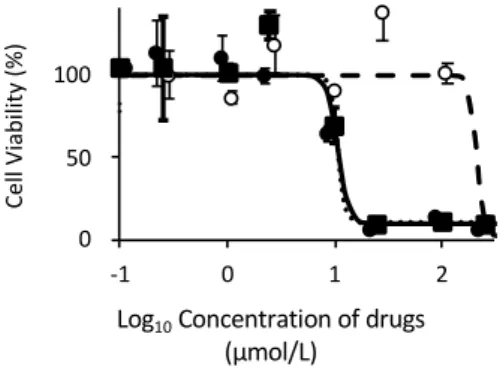
The cytotoxicity of sunitinib and its photodegradation products N-desethyl sunitinib and sunitinib N-oxide was assessed by MTT assay. In contrast to N-desethyl sunitinib (IC50 value, 11.6 µmol/L), the IC50 value of sunitinib N-oxide was over 10 times higher than that of sunitinib in the HEK 293 cell line (121.9 and 8.6 µmol/L for sunitinib N-oxide and sunitinib, respectively) (Fig. 4).
Blood concentrations of the photodegradation products of sunitinib
The concentrations of sunitinib, N-desethyl sunitinib, and sunitinib N-oxide in blood obtained from a patient taking sunitinib at trough were 79.9, 24.7, and 2.3 ng/mL, respectively (Fig. 5).
Discussion
The risk of developing HFSR, one of the dose-limiting toxicities of sunitinib, has not been correlated with the blood concentration of sunitinib, and so elucidation of the factors leading to the onset of HFSR is required. We focused on the skin reactions accompanying light irradiation, considered an important clinical problem for many medicines, and investigated the photodegradation products of sunitinib. We found for the first time that sunitinib N-oxide is generated by UV irradiation of sunitinib and that it is also present in the blood of a patient taking sunitinib. Although sunitinib N-oxide was found in plasma and urine as a micro-decomposition product in an in vivo rat study, its contribution to drug efficacy and adverse and pharmacological effects has not been studied [16].
Recently, α-tocopherol nicotinate was reported to reduce the appearance of
ADRs related to sunitinib [17]. The authors found that ADR was reduced due to the hydrogen peroxide trapping efficacy of α-tocopherol nicotinate. However, because α-
tocopherol nicotinate has a strong antioxidant effect, we believed that the ADRs of sunitinib could be suppressed via an antioxidant-mediated decrease in sunitinib N-oxide generation. Because we have not assessed the impact of sunitinib N-oxide on the appearance of HFSR, we need to fully explore the influence of sunitinib N-oxide in the
human body and the relationship between sunitinib N-oxide level and HFSR onset in future research.
In an MTT assay, the cytotoxic activity of sunitinib N-oxide was found to be lower than that of sunitinib and N-desethyl sunitinib. These data suggested that the effect of sunitinib N-oxide on humans may be different from that of sunitinib and N-desethyl sunitinib. However, we could not rule out the possibility that the differences in intracellular uptake of each substance may have affected the MTT assay results, and we also did not evaluate the pharmacological effects of sunitinib N-oxide in detail. At least for this point, the effect on sunitinib N-oxide on ADRs remains to be clarified and requires further in-depth study.
In the analysis of sunitinib and sunitinib-related compounds using LC, the retention time of sunitinib N-oxide was very similar to that of sunitinib. Because they both have the same basic structure, it may be difficult to distinguish these compounds by UV detection and accurate long-term separation analysis is needed to separately quantify these compounds using a UV detector [18]. Because the activity of sunitinib and sunitinib N-oxide was indicated to be different in our study, we believe that LC-MS/MS but not LC-UV/Vis is suitable for the separate routine clinical analysis of sunitinib and sunitinib- related compounds.
In conclusion, we found that sunitinib N-oxide was generated by UV irradiation of sunitinib and could be detected in the blood of a patient taking sunitinib. Although the pharmacological effects of sunitinib were not clarified, we believe that sunitinib N-oxide might strongly affect the appearance of ADRs because it has been reported that the ADRs induced by sunitinib can be ameliorated by antioxidant treatment. We aim to study the distribution and pharmacological effects of sunitinib N-oxide and assess its influence on the development of ADRs of sunitinib.
Acknowledgement
This study was supported by a grant-in-aid for scientific research KAKENHI 15H00520 from the Japan Society for the Promotion of Science.
References
1. Le Saux O, Freyer G, Négrier S. First-Line Treatments for Poor-Prognosis Metastatic Renal Cell Carcinoma: Experts' Prescribing Practices and Systematic Literature Review. Clin Drug Investig. 2016;36(5):389-99.
2. Larkin J, Paine A, Foley G, Mitchell S, Chen C. First-line treatment in the management of advanced renal cell carcinoma: systematic review and network meta-analysis.
Expert Opin Pharmacother. 2015;16(13):1915-27.
3. Motzer RJ, Hutson TE, Tomczak P, Michaelson MD, Bukowski RM, Oudard S, et al.
Overall survival and updated results for sunitinib compared with interferon alfa in patients with metastatic renal cell carcinoma. J Clin Oncol. 2009;27(22):3584-90.
4. Houk BE, Bello CL, Poland B, Rosen LS, Demetri GD, Motzer RJ, et al. Relationship between exposure to sunitinib and efficacy and tolerability endpoints in patients with cancer: results of a pharmacokinetic/pharmacodynamic meta-analysis. Cancer Chemother Pharmacol. 2010;66(2):357-71.
5. Noda S, Otsuji T, Baba M, Yoshida T, Kageyama S, Okamoto K, et al. Assessment of sunitinib-induced toxicities and clinical outcomes based on therapeutic drug monitoring of sunitinib for patients with renal cell carcinoma. Clin Genitourin Cancer.
2015;13(4):350-8.
6. Gao B, Yeap S, Clements A, Balakrishnar B, Wong M, Gurney H, et al. Evidence for therapeutic drug monitoring of targeted anticancer therapies. J Clin Oncol.
2012;30(32):4017-25.
7. Cabel L, Blanchet B, Thomas-Schoemann A, Huillard O, Bellesoeur A, Cessot A, et al.
Drug monitoring of sunitinib in patients with advanced solid tumors: a monocentric observational French study. Fundam Clin Pharmacol. 2018;32(1):98-107.
8. Yu H, Steeghs N, Nijenhuis CM, Schellens JH, Beijnen JH, Huitema AD, et al. Practical guidelines for therapeutic drug monitoring of anticancer tyrosine kinase inhibitors:
focus on the pharmacokinetic targets. Clin Pharmacokinet. 2014;53(4):305-25.
9. Haouala A, Zanolari B, Rochat B, Montemurro M, Zaman K, Duchosal MA, et al.
Therapeutic Drug Monitoring of the new targeted anticancer agents imatinib, nilotinib, dasatinib, sunitinib, sorafenib and lapatinib by LC tandem mass spectrometry. J Chromatogr B Analyt Technol Biomed Life Sci. 2009;877(22):1982-96.
10. Tomita Y, Shinohara N, Yuasa T, Fujimoto H, Niwakawa M, Mugiya S, et al. Overall survival and updated results from a phase II study of sunitinib in Japanese patients with metastatic renal cell carcinoma. Jpn J Clin Oncol. 2010;40(12):1166-72.
11. Tsai KY, Yang CH, Kuo TT, Hong HS, Chang JW. Hand-foot syndrome and seborrheic dermatitis-like rash induced by sunitinib in a patient with advanced renal cell
carcinoma. J Clin Oncol. 2006;24(36):5786-8.
12. Epstein JH, Wintroub BU. Photosensitivity due to drugs. Drugs. 1985;30(1):42-57 13. Wagai N, Yamaguchi F, Sekiguchi M, Tawara K. Phototoxic potential of quinolone
antibacterial agents in Balb/c mice. Toxicol Lett. 1990;54(2-3):299-308.
14. Khandpur S, Porter RM, Boulton SJ, Anstey A. Drug-induced photosensitivity: new insights into pathomechanisms and clinical variation through basic and applied science.
Br J Dermatol. 2017;176(4):902-9.
15. de Bruijn P, Sleijfer S, Lam MH, Mathijssen RH, Wiemer EA, Loos WJ, et al.
Bioanalytical method for the quantification of sunitinib and its n-desethyl metabolite SU12662 in human plasma by ultra performance liquid chromatography/tandem triple- quadrupole mass spectrometry. J Pharm Biomed Anal. 2010;51(4):934-41.
16. Speed B, Bu HZ, Pool WF, Peng GW, Wu EY, Patyna S, et al. Pharmacokinetics, distribution, and metabolism of [14C] sunitinib in rats, monkeys, and humans. Drug Metab Dispos. 2012;40(3):539-55.
17. Amemiya T, Honma M, Kariya Y, Ghosh S, Kitano H, Kurachi Y, et al. Elucidation of the molecular mechanisms underlying adverse reactions associated with a kinase inhibitor using systems toxicology. NPJ Syst Biol Appl. 2015;1:15005.
18. Mohsen P, Solmaz G, Hossein A, Mahdieh N. Reverse phase HPLC determination of
sunitinib malate using UV detector, its isomerisation study, method development and validation. J Anal Chem. 2017;72(5):567-74.
Figure legends
Fig. 1 TOF MS spectrum of sunitinib solution before and after UV irradiation. A:
before irradiation. B: after 72-h irradiation.
Fig. 2 Fragment ion MS spectrum of photodegradation products.
Fig 3. Amount of photodegradation products and duration of light exposure. A: Change in the amount of sunitinib and the total photodegradation products detected. Closed, sunitinib (E); open, sunitinib (Z); hatched, degradation products. B: Change in the amount of each of the photodegradation products detected. Closed, N-desethyl sunitinib (E); open, N-desethyl sunitinib (Z); hatched, sunitinib N-oxide (E); dotted, sunitinib N-oxide (Z).
Fig. 4 Cytotoxic activity of sunitinib, N-desethyl sunitinib, and sunitinib N-oxide.
Closed circle, sunitinib; closed square, N-desethyl sunitinib; open circle, sunitinib N- oxide.
Fig. 5 Chromatogram of a clinical sample. A: m/z 399/283 (sunitinib); B: m/z 371/283 (N-desethyl sunitinib); C: m/z 415/326 (sunitinib N-oxide); D: m/z 465/252 (sorafenib as
internal standard).
Fig. 1
Fig. 2
Fig. 3
0 250 500 750 1,000
0hr 24hr 48hr 72hr
0 250 500 750 1,000
0hr 24hr 48hr 72hr
0 40 80 120 160
0hr 24hr 48hr 72hr
0 40 80 120 160
0hr 24hr 48hr 72hr
Under indoor light Under UV light
Peak area
Peak area
A
Under indoor light Under UV light
B
Peak area
Peak area
Fig. 4
0 50 100
-1 0 1 2
Cell Viability (%)
Log10Concentration of drugs (μmol/L)
Fig. 5