権利 Copyrights 日本貿易振興機構(ジェトロ)アジア 経済研究所 / Institute of Developing
Economies, Japan External Trade Organization (IDE‑JETRO) http://www.ide.go.jp
journal or
publication title
Yearbook of Asian Affairs 2006 page range 461‑506
year 2007
URL http://hdl.handle.net/2344/00010526
INDIA
Republic of India
Area: 3,287,590 km2
Population: 1.09 billion (FY2005 government estimate)
Capital: New Delhi
Language: Hindi (official language) and others
Religion: Hinduism, Islam, Christianity, Sikhism, and others Government type: Federal republic
Chief of state: President A.P.J. Abdul KALAM, the eleventh president (since July 25, 2002)
Currency: rupee (INR) (US$1 = 44.93 rupees; FY2004/5 average)
Fiscal year: April–March
461
T
he United Progressive Alliance (UPA) government, led by the Indian National Congress (referred to hereinafter as the “Congress”), com- pleted its first year in May 2005. The two-head system of Prime Minister Manmohan Singh and Sonia Gandhi, the Congress chairperson, is func- tioning well as a system for the full division of the responsibilities of the government head and the party head. Chairperson Sonia Gandhi, who is teasingly referred to as the “super prime minister” by the National Democratic Alliance (NDA), the opposition party coalition led by the Bharatiya Janata Party (BJP), is supportive of Prime Minister Singh’s dis- play of leadership in running the government by putting other Congress leaders under her control.Meanwhile, Prime Minister Manmohan Singh, against the backdrop of India’s growing presence in the international fora, scored significant points in diplomacy with countries such as the United States, China, and Pakistan as well as the East Asian region, even more than in the economy which is his forte.
In domestic politics, state assembly elections were held in the states of Haryana, Bihar, and Jharkhand. Except for Haryana, neither the UPA nor the NDA was able to capture a stable majority. In the process of forming new governments, the behavior of state governors was made into an issue and friction among the political parties in the UPA came to the surface. In Bihar, elections were held again under President’s rule, and the NDA camp won. On the other hand, the political stance of L.K. Advani, presi- dent of the BJP was sharply criticized from within the party and by the party’s parent organization, Rashtriya Swayamsevak Sangh (RSS), and this led to Advani’s resignation from the post.
Presence
M
AYUMIM
URAYAMAand K
OHEIS
HIINO462
The GDP growth rate during FY2005/6 (April to March) was forecast to achieve 8.1 percent due to buoyancy in the industrial and the service sectors. This will mean that a growth rate exceeding 7 percent will have been achieved for three consecutive years, starting in FY2003/4. In trade, the monetary value of trade with China continued to expand. Relaxation of restrictions on foreign direct investment has progressed, and direct investment was in a bullish trend, including large projects such as the construction of a steelworks by the South Korean company Posco.
DOMESTIC POLITICS
UPA Government and the Left Political Parties
The UPA government, formed after defeating the NDA coalition in May 2004, adopted as its guiding principle the National Common Minimum Program (NCMP), which upholds rural development, consideration for the socioeconomically underprivileged, and an administration that ensures transparency and provides accountability. This was also agreed to by the left political parties that supported the government from out- side the cabinet. Noteworthy outcomes include the Right to Information Act enacted in June and the National Rural Employment Guarantee Act enacted in August. The Right to Information Act, which was initially to be applied only to the central government in the original bill, was expanded to cover state governments and institutions receiving govern- ment subsidies on the suggestions of the National Advisory Council (headed by Sonia Gandhi), which supervises the operation and the progress of the NCMP, and NGOs. Furthermore, institutions engaged in security and intelligence-related work were required to disclose informa- tion not only on corruption issues but also on human rights’ infringe- ments. On the other hand, the National Rural Employment Guarantee Act, which is the highlight of the NCMP, guarantees employment of at least 100 days per year for each household. The differences between this and conventional employment programs are that the central government contributes 90 percent of the funds; the state pays unemployment bene- fits if work cannot be found. Also, individuals who could not obtain the guarantee are able to sue the state. Policies for women were also legis- lated, with revisions in the Protection of Women from Domestic Violence Act and the Hindu Succession Act in order to ensure women’s right to inherit farmland.
Meanwhile, at the end of May, strong opposition arose from left politi- cal parties and the member parties of the UPA against the proposal to divest the 10 percent stake in Bharat Heavy Electricals Limited (BHEL), maintaining it would be a breach of the statement in NCMP that “prof- itable public companies will not be privatized.” The government explained the sale of BHEL stock was necessary to mobilize funds for the social sector welfare plan which was a public promise in NCMP and that stock sale did not amount to privatization, but the opposition faction was not persuaded and the bill had to be shelved.
In the parliament, while the parliamentary measures of BJP, the largest opposition party, were often belated due to internal discord in the party (discussed below), the presence of the left political parties has grown. The support by left political parties is important for the UPA, which does not have a majority of the seats in the Lok Sabha (Lower House), and the UPA cannot ignore their opinions. The left political parties have repeatedly emphasized that their cooperation with the government is aimed to keep the BJP away from power and that it is not unconditional. During the above-mentioned BHEL problem, they said they would not be attending the regularly held coordination meetings with the ruling party, and so no coordination meetings were held until it was decided to shelve the plan in October. Moreover, the left parties strongly criticized the stance of the government on relations with the United States. Even so, the left does not wish to endanger the rule of the current government. In the state assem- bly elections discussed below, the left supported the UPA camp in order to prevent divisions for the anti-communalism and anti-BJP vote. There were calls for a third group, outside the Congress and BJP, from other par- ties such as the Samajwadi Party, but the possibilities were still being care- fully studied.
The left parties themselves are also fully aware of the changes in their own role. In April, the main left party, the Communist Party of India (Marxist) (CPIM), held its 18th Party Congress in Delhi for the first time.
The purpose was to consolidate organizational strength on the central stage of politics and to expand its political program nationwide. At the same time, it was an occasion that marked the beginning of serious debate on how the party might be engaged in the realities of the world which include liberalization, privatization, and globalization. Within the CPIM, there are state governments, such as West Bengal led by Buddhadev Bhattacharjee, which actively promote the inflow of direct foreign invest- ment. Given this reality, it became necessary to organize the opinions
within the party and to come up with a course of direction for the party.
The party congress decided that the guideline would be to accept foreign investment if it met certain conditions of increasing existing production capacity, boosting technological capabilities, and creating employment. In August, West Bengal Chief Minister Buddhadev Bhattacharjee was criti- cized within the Left Front concerning his invitation to Salim Group, an Indonesian business group, to construct an industrial park. However, the party politburo declared that it was consistent with the platform decided at the party congress. At the party congress, Prakash Karat was selected to replace Harkishan Singh Surjeet as party secretary-general, which indi- cated a generational change in the party leadership.
Elections of Three State Assemblies
In February, state assembly elections were held in the states of Haryana, Bihar, and Jharkhand. In Haryana (voter turnout 71.96 percent), the Congress secured 67 out of 90 seats, which was over two-thirds of the seats, thereby recapturing power after nine years. The image of dictator- ship and corruption of the Om Prakash Chautala government (Indian National Lok Dal) was considered to have led to the crushing defeat where the party won only nine seats (compared to 47 seats in the previous election). Bhupendra Singh Hooda, a Lok Sabha member, was sworn in as chief minister of Haryana.
In contrast to Haryana where a change of power took place between the two overwhelmingly dominant parties, in states where coalitions must be formed in order to establish a government, the government tends to be unstable. First of all, the framework of alliance such as that of the UPA and NDA at the center is not simply transferred to the local level. This is because local partnerships formed by national parties such as the Congress and BJP in each state are not necessary the same, reflecting dif- ferences in political party influence in the given state. This problem appeared conspicuously in Bihar. The NDA camp was able to form an axis for electoral cooperation with the BJP and the Janata Dal (United) (JD [U]), just as at the central level. However, the UPA camp was unable to do that, and disorder occurred in the establishment of the government.
Let us take a slightly more detailed look at this situation. In Bihar, the Rashtriya Janata Dal (RJD) government retained the control of the state for 15 years, under the leadership of Lalu Prasad Yadav, union railway minister. The NDA camp developed its election campaigning with the focus on ending Lalu Prasad Yadav’s rule. In the UPA camp, the Congress,
being aware that voters’ dissatisfaction with RJD was not trifling, aimed to increase its own seats while distancing itself to a certain degree from RJD.
The Lok Jan Shakti Party (LJP), which was led by the Union Steel Minister Ram Vilas Paswan and was a member of the UPA camp, appealed for cooperation excluding the RJD. Ultimately, the Congress decided to pur- sue its own election campaigning although it refrained from fielding its candidates in the seats held by the partner parties prior to the election.
In the election results (voter turnout 47.5 percent), the RJD took 75 seats, the most of any single party, but it not only lost 40 seats compared to the previous election, it also remained very far from gaining a majority of the 243 total seats. The Congress won only 10 seats. Meanwhile in the NDA camp, the BJP and the JD (U) increased their seats from the previous time, winning 37 seats and 55 seats, respectively, but they did not gain a majority, either. For this reason, attention was focused on the decision of the LJP, which had acquired 29 seats. Due to strong antipathy toward the RJD, Ram Vilas Paswan, LJP chairperson, searched to establish a coalition government with the Congress and JD (U) excluding the RJD and BJP.
Meanwhile, the Congress declared its support of the RJD in a letter sent to Governor Buta Singh on March 2. Ultimately on March 6, Governor Buta Singh recommended, in a report to the central government, President’s rule in the State stating that no political party or a coalition of parties was in a position to form a stable government. On the following day, March 7, Bihar came under President’s rule for the eighth time in that state.
In the state of Jharkhand as well, political chaos occurred when no alliance could win the majority in the election. The main point at issue in the election was the corruption of the Arjun Munda government (BJP), and given the strong anti-incumbency tendency among the voters, the BJP was expected to have a difficult time. Looking at the results, BJP, the rul- ing party, won 30 seats and the Jharkhand Mukti Morcha (JMM), which is in the UPA camp, secured 17 seats, making them the first and second place parties, respectively (voter turnout 57.03 percent). However, nei- ther the NDA camp nor the UPA camp obtained a majority of the total 81 seats, and so the key became the acquisition of the support of the other political parties. On February 28, the NDA selected former chief minister Arjun Munda again as a candidate for chief minister and met with the State Governor Syed Sibtey Razi to convey their intention to form a cabi- net. In response, Governor Razi requested the submission of the list of names of supportive assembly members. The next day, both the NDA and the UPA claimed 41 supporters. BJP criticized Governor Razi for need-
lessly prolonging the formation of the cabinet of the NDA due to pressure from the central government. On March 2, Governor Razi ordered Shibu Soren, JMM chairperson of the UPA camp, to verify the formation of the cabinet and the support of a majority. The NDA strongly criticized the governor as there had been no sounding out of the opinion on cabinet for- mation of the NDA, which had the largest number of seats, and the NDA sought the intervention of the president. This non-neutral behavior of the governor became a point of dispute in the Parliament’s budget sessions taking place at that time. On March 3, the Congress of the UPA camp dis- tanced itself from the governor, saying “the governor acted on his own.”
Meanwhile on March 9, the Supreme Court, responding to Arjun Munda’s complaint, ordered the pro tem Speaker of the Jharkhand Legislative Assembly to conduct a composite floor test in the assembly to ascertain who enjoyed the majority on March 11. However, the government failed to comply with the Supreme Court directive to obtain a vote of confidence in the assembly, and Chief Minister Shibu Soren was forced to resign. On March 12, Arjun Munda was sworn in as the new chief minister, and on March 15, the new government was announced to have won the confi- dence of the majority.
Election Held Again in Bihar
What changed the political situation in Bihar under President’s rule was the internal rupture of the LJP, which had greatly extended its influence in the February election. On May 21, more than 10 state assembly mem- bers including Secretary-General Nagmani left the party and joined JD (U), a party that was part of NDA. Originally, LJP was a party that formed by splitting off from JD (U). The NDA camp claimed that they immedi- ately secured 122 seats, which was more than a majority. In response to this situation, State Governor Buta Singh recommended the dissolution of the state assembly on March 22, on the grounds that attempts at horse trading had been made. The government made a decision that night, and on March 23, the president dissolved the state assembly.
The rupture in the LJP acted to strengthen the standpoint of the RJD within the UPA camp. On September 3, the Election Commission announced that it would implement the Bihar state election over four days in October and November. This time, the Congress was quick to announce full cooperation with RJD, and it pushed Ram Vilas Paswan, LJP chairperson, to decide whether or not the LJP would participate in the alliance with the Congress and RJD. Meanwhile, Lalu Prasad Yadav, RJD
chairperson, demanded the expulsion of the LJP from the UPA tent because the LJP refused to cooperate with the RJD. Ultimately, LJP did not cooperate with the RJD and the Congress, and it formed a separate united front with left parties other than the CPIM.
The October elections, held under strict security, were reported as being the freest and fairest elections in Bihar’s history (voter turnout 45.85 percent). In the election results released on October 22, the JD (U) (88 seats, an increase of 33 seats from the February elections) and the BJP (55 seats, an increase of 18 seats from the February elections) secured a majority by winning 143 seats out of 243 seats, opening the way for a new government in Bihar after 15 years. Seats won by the UPA amounted to only 65 in total, including those won by the RJD (54 seats, 21 fewer than in the February elections) and the Congress (9 seats, 1 fewer than in the February elections). The LJP experienced a large decrease, from 29 seats to 10 seats. The reason for the NDA’s victory was that, firstly, the UPA camp was split in two; secondly, as a result, a battle unfolded between the incumbent RJD government and the NDA camp. In its campaign against the Lalu Prasad Yadav, RJD chairperson and the incumbent government, the NDA, which highlighted the clean image of Nitish Kumar (JD [U]) as a chief minister candidate and the agenda of “development of Bihar,” cap- tured voters’ expectations. It appears that more than a few of the Yadav caste and Muslims who were said to be RJD’s support base switched to support Nitish Kumar in this election.
Following their defeat in the Bihar election, there were voices in the UPA that called for the expulsion of Ram Vilas Paswan; however, Sonia Gandhi emphasized the need for a gathering of secular groups and advo- cated that the UPA pull itself together in preparation for the five state assembly elections coming up in 2006.
Trends in the BJP
On April 4, the day before the silver jubilee celebrations marking the foundation of the BJP, BJP President Advani restated his commitment to Hindutva which is partly symbolized by the Ramjanmabhoomi campaign in Ayodhya. At the national council on April 6, Advani again stressed the relationship with the RSS, the parent organization of the BJP, saying that the party’s policy was overly focused on the issues of development and governance and that the support base which was their core was neglected.
This return to a religious path was probably due to the party’s renewed awareness of the necessity of the relationship with RSS, in the context of
the leveling off of their support in Bihar and Jharkhand in February, in addition to their defeat in the Lok Sabha election in 2004. Incidentally, at almost the same time, K.S. Sudarshan, Sarsangchalak (Chief) of RSS, stated in a televised interview that “both the senior BJP leaders, Atal Bihari Vajpayee and L.K. Advani, should step down to make way for new faces and a younger leadership,” revealing his dissatisfaction with the BJP lead- ership. The relationship of the RSS and BJP had innate tension, with the BJP requiring cooperative relationships with other political parties, even if it meant compromising its own ideology, in order to secure its status as the political party that could be an alternative to the Congress, and with the RSS being dissatisfied with this. However, criticism from the top leader of the RSS triggered the arousal of criticism both inside and outside the BJP over its leadership and its political stance.
Criticism of Advani was reignited on the occasion of his statement made during his Pakistan visit which took place from the end of May through early June. Advani praised Muhammad Ali Jinnah, the founder of Pakistan, as “a great man” who had espoused the cause of secular Pakistan and said that the destruction of the mosque at Ayodhya was the saddest day of his life. It is thought that the aim of this statement by Advani con- cerning the Ayodhya incident, in which he himself actually had a leading role, was to stress the change in his own image, which heretofore had been strongly hawkish, and to emphasize the large contribution of the previous NDA government in the ongoing peace process between India and Pakistan. Advani’s statement was favorably received by JD (U), which is a partner of the NDA camp, and by most of the media. However, the RSS and related groups placed particular weight on the fact that Advani’s statement had been made in the “enemy territory” of Pakistan, and there were many who called for Advani’s resignation.
Inside the BJP, former prime minister Atal Bihari Vajpayee and others moved to protect Advani, but the existence of critical groups also became apparent. Advani, who returned to India on June 6, announced his inten- tion to resign the following day, on June 7. Advani himself was displeased that, instead of receiving an overall evaluation of his visit, his statement was being distorted and he was being criticized. Thereupon, the situation was saved by having the party on one hand praise his visit as a landmark visit, and on the other hand, issue a statement that included criticism of Muhammad Ali Jinnah, such as “there can be no re-visiting the reality that Jinnah led a communal agitation to achieve his goal of Pakistan,” and “it continues to steadfastly reject the two-nation theory.” After this, Advani
withdrew his resignation, but the appeasement measures within the BJP did not lead to a softening of the attitude of the RSS. As a result of debate at the Conclave of Pracharaks in Surat during July 3 to 5, the RSS made a statement on July 9 where it seemed to refer to Advani, saying that it expressed “serious concern over the ideological erosion, behavioural mis- demeanour and violation of organisational discipline with impunity by some functionaries of a couple of like-minded organisations.” According to information that became available at a later date, the RSS had decided at the Surat conclave to formally request Advani’s resignation, and this had been communicated to Advani.
The person who stepped into this confrontation was NDA convener, George Fernandes (JD [U]). He urged the RSS to confine itself to sociocul- tural activities and argued that “a strong NDA and a united and cohesive BJP, fully and unequivocally wedded to the NDA’s agenda” was necessary before the next elections in Bihar. However, Fernandes’ statements were oil on the fire of the RSS’s indignation. On July 14, as a response to Fernandes, the RSS declared that if the NDA were going to pursue Hindutva, then the RSS would continue to support it. On July 17, Advani and the RSS held a discussion, and they reached a compromise consisting of the postponement of the national executive meeting which had been scheduled to start on July 21 in Chennai and agreement that Advani him- self could select the timing of his resignation. It was judged that time was necessary for internal reorganization of the BJP and recovery of its pres- ence as the largest opposition party during the monsoon session (July 25 to August 26).
On September 18, the final day of the party’s national executive meet- ing held in Chennai, Advani revealed that he would resign after the silver jubilee celebrations scheduled to be held in December in Mumbai. In his speech, Advani scathingly condemned the RSS’s intervention in the party.
On December 31, Advani formally resigned from the post of party presi- dent, and as his successor, Rajnath Singh, former chief minister of Uttar Pradesh, was chosen. As the new president, Rajnath Singh set out to reconstruct the stance of the party on the two issues of improvement of the relationship with the RSS and maintenance of the party’s indepen- dence, stating that while he was a member of the RSS and would have no hesitation whatsoever about holding discussions with RSS, in the end the party would make its own decisions.
(by Mayumi Murayama)
ECONOMY
Economic Overview of FY2005/6
In the Indian economy in FY2005/6 (April to March), the agriculture, forestry, and fisheries and the industrial sectors achieved growth rates that exceeded those of the previous year, and so it is forecast that the real GDP growth rate was 8.1 percent, marking the first time in two years that it has exceeded 8 percent. The stock market is also brisk due to the vigor- ous inflow of capital, with the leading stock indicator, the BSE Sensitive Index (SENSEX), having risen from an initial 6606 points in April 2005 to more than 10,000 points in February 2006.
Financial and Monetary Policy Management in FY2005/6 Reflecting the NCMP of the UPA government in the FY2005/6 budget bill, the FY2005/6 budget policy gave consideration to agricultural develop- ment, poverty, and measures for unemployment, while also placing emphasis on reconstruction of finances. Specifically, the Food for Work Programme (a system for giving both food and wages as compensation for employment) which had been introduced in November 2004 was expanded, shifting to a National Rural Employment Guarantee Scheme, and proposals were made to expand the number of households that receive food rations for the poor and introduce a National Rural Health Mission with the objectives of public healthcare to rural areas. Moreover, it emphasized the installation of infrastructure in rural areas, including irrigation facilities, electrification, installation of a communications net- work, and building and improvement of roads between rural areas, and it included a budget increase for primary education and school lunches. In the National Manufacturing Competitiveness Programme, which aims to strengthen the competitiveness of the manufacturing industry, there were set forth a support policy for the textile industry and sugar industry, a plan for nurturing the pharmaceuticals and bio industry, and a plan for further deregulation of trade. Regarding expenditures, a plan was incor- porated to review subsidies for food, fertilizer, and petroleum products, which are the main subsidy expenditures, while continuing the indispens- able subsidies to the poor.
Regarding taxes, there were revisions to reduce the tax rate and expand the tax base such as by expanding the types of industries that pay service tax and concurrently lowering customs duties and the corporate tax.
Specifically, the peak rate of basic custom duty (excluding agricultural
products) was lowered from 20 percent to 15 percent, which means the peak rate of basic custom duty which was 40 percent in 2000 was reduced by 25 percent over five years. Also implemented were a reduction of the corporate tax rate from 35 percent to 30 percent (however, the surcharge on corporate tax was raised from 2.5 percent to 10 percent), expansion of the number of industries that pay service tax (10 percent), and raising of the minimum taxable income level of individual income. Starting from April 1, 2005, value-added tax was introduced to replace state sales tax.
In the initial budget, the revenue deficit as a share of the GDP in FY2005/6 was 2.7 percent, the same level as in FY2004/5, and a fiscal deficit of 4.3 percent was estimated. However, as of February 2006, the revised estimated figures were 2.6 percent and 4.1 percent respectively.
The fiscal deficit as a share of the GDP, which worsened in FY2001/2 to 6.2 percent, is in an improving trend due to increased tax receipts as a result of the economic recovery. The Fiscal Responsibility and Budget Management Act effectuated in July 2004 makes obligatory the reduction of the revenue deficit to zero by FY2008/9 and reduction of the fiscal deficit to 3 percent by FY2007/8.
Turning to monetary policy, the Reserve Bank of India (India’s central bank) continued its stance from the previous year of both restraining inflation due to higher crude oil prices, etc., and fulfilling the vigorous domestic investment demand. In the Monetary and Credit Policy for FY2005/6 released in April 2005, the bank rate is kept at 6.0 percent and the cash reserve ratio is kept at 5.0 percent. However, the reverse repo rate (the interest rate applied when the Reserve Bank of India borrows funds from commercial banks using government bonds as security) was raised 0.25 points to 5.0 percent. The Mid-term Review of Monetary and Credit Policy for FY2005/6 released in October, while leaving the bank rate and the cash reserve ratio unchanged in an endeavor to maintain price stability and to continue to supple moderate liquidity to meet the demand for funds, the central bank raised the reverse repo rate another 0.25 points, to 5.25 percent.
Economic Conditions in FY2005/6
Production. According to the announcement in the Central Statistical Organization on February 7, 2006, the real GDP growth rate for FY2005/6 was projected to be 8.1 percent (estimate), marking the first time in two years that it has exceeded 8 percent (Table 15.1). In FY2002/3, the Indian
economy grew at only 3.8 percent, but now it has achieved a growth rate of over 7 percent for three consecutive years, at 8.5 percent in FY2003/4 and 7.5 percent in FY2004/5. This is the first time that the economy has achieved growth over 7 percent for three consecutive years since FY1994/95 to FY1996/97.
By sector, the service industry, which accounts for 54 percent of the GDP, was the driving force behind the overall economy with a growth rate of 9.8 percent (contribution ratio to the overall growth rate was 5.2 per- cent), and the industrial sector, with contributions from construction and manufacturing, was buoyant at 9.0 percent (contribution ratio 2.4 per- cent). The agriculture, forestry, and fishing industry experienced a low growth rate, at 2.3 percent (contribution ratio 0.5 percent), but it was improved from the previous year. Looking at the growth rate of each quarter in FY2005/6, the first quarter was 8.1 percent, second quarter 8.0 percent, and third quarter 7.6 percent, which shows a high growth rate being maintained amidst slight downtrend.
Food grains production is forecast to rise slightly from 204.6 million tons in FY2004/5 to 209.3 million tons due to the fact that the rainfall during the monsoon season was near the annual average.
Table 15.1. Performance of Real GDP Growth Rate
Contribution Ratio Share 2003/4 2004/5 %
(Quick Estimate)
2005/6 (Estimate)
Agriculture, forestry, & fishing Industry
Mining & quarrying Manufacturing
Electricity, gas & water supply Construction
Services
Trade, hotels, transport &
communication
Financing, insurance, real estate &
business services
Community, social & personal services GDP
10.0 7.6 5.3 7.1 4.8 10.9
8.2 12.0
4.5 5.4 8.5
0.7 8.6 5.8 8.1 4.3 12.5
9.9 10.6
9.2 9.2 7.5
2.3 9.0 1.0 9.4 5.4 12.1
9.8 11.1
9.5 7.9 8.1
19.7 26.2 2.1 15.3
2.2 6.8 54.1 26.2 13.6 14.3 100.0
0.5 2.4 0.0 1.4 0.1 0.8 5.2 2.8 1.3 1.1 8.1
(%)
Source: Prepared from a press release (February 7, 2006) and the website of the Central Statistical Organization.
The growth rate of the index of industrial production (April–
December), at 7.8 percent YOY, remained strong since FY2004/5 (8.4 per- cent) (Table 15.2). By industry, manufacturing was satisfactory at 8.9 per- cent and has been rising annually since the low in FY2001/2 (2.9 per- cent). In manufacturing, production increased conspicuously in textiles (18.6 percent), beverages, tobacco, and related products (16.4 percent), basic metal and alloy industries (15.0 percent), transport equipment and parts (12.5 percent), machineries (10.5 percent), and chemical products (9.7 percent). By product, capital goods were at 15.7 percent and con- sumer goods were at 12.2 percent, and so investment and consumer- related industries performed at a high level. After the growth rate of capi- tal goods production fell to minus 3.4 percent in FY2001/2, it expanded at a double-digit growth rate for four consecutive years due to the vigorous investment in plant and equipment from FY2002/3 onward. Among con- sumer goods, consumer nondurables rose 11.7 percent and consumer durable rose 13.6 percent.
Sales of passenger cars (April–December), which are the typical con- sumer durable, displayed a growth rate of 5.9 percent, or 810,000 vehicles, and although this was sluggish compared to the 27.6 percent in FY2003/4 and the 17.6 percent in FY2004/5, it means that the market has expanded Table 15.2. Performance of the Growth Rate of the Index of Industrial Production
Share 2002/3 2003/4 2004/5 2005/6 General
By industry Mining Manufacturing Electricity By account
Basic goods Capital goods Intermediate goods Consumer goods
Consumer durables Consumer non-durables
100.0 10.5 79.4 10.2 35.6 9.3 26.5 28.7 5.4 23.3
5.7 5.8 6.0 3.2 4.9 10.5
4.1 7.1 -6.3 12.0
7.0 5.2 7.4 5.1 5.4 13.6
6.1 7.1 11.6
5.8
8.4 4.3 9.2 5.2 5.5 13.3
5.9 11.5 14.3 10.6
7.8 0.4 8.9 4.8 6.0 15.7
2.2 12.2 13.6 11.7 (FY1993=100, %)
Source: Prepared from Reserve Bank of India, Bulletin, February 2006, and a press release (February 10, 2006) of the Central Statistical Organization.
Note: Figures for FY2005 are for April to December YOY.
for four consecutive years. Two wheelers, at 12.7 percent, or 5.2 million vehicles, are forecast to reach sales of 7 million vehicles total for FY2005/6.
Prices. In prices, due to the slower rate of increase in prices of manufac- tured goods, the rise of the wholesale price index (April–December), at 4.5 percent, was slack compared to the 6.4 percent of the same period in the previous year. However, fuel prices and primary commodities prices are rising, and the hikes in crude oil prices are putting upward pressure on inflation. The rise of the consumer price index (April–December) was 4.3 percent.
In response to the hikes in crude oil prices, the government lowered the customs duty on crude oil in March 2005 from 10 percent to 5 per- cent, and the customs duty on gasoline and diesel oil was also lowered.
For kerosene and LPG, both the customs duty and the excise duty were exempted. However, prices were also raised on petroleum products. In June 2005, gasoline was raised by 2.5 rupees/liter (4.68 rupees in Delhi) and diesel oil by 2 rupees/liter (5.13 rupees in Delhi), and in September, gasoline was further raised by another 3 rupees/liter and diesel another 2 rupees/liter. The prices of kerosene and LPG gas, which are daily necessi- ties, remained unchanged.
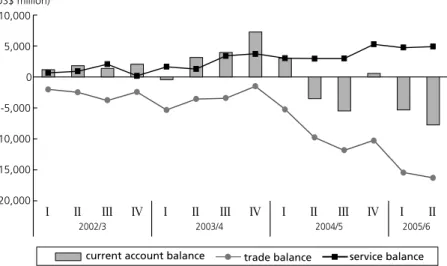
Balance of Payments. Looking at the balance of payments in the first half of FY2005/6, the current account posted a deficit of US$13 billion, greatly exceeding just in the first half of the year the deficit that was posted for the entire FY2004/5 (US$5.4 billion). The major cause was the trade deficit of US$31.6 billion due to the large increase in imports, which was double the deficit of US$14.8 billion in the same period the previous year.
There was also contribution from the increase in crude oil imports, which accounted for one-quarter of imports, the increase in imports overall due to demand factors brought on by the strong economy, and price factors due to appreciation of the rupee. Meanwhile, service expanded its surplus in the first half of FY2005/6 to US$9.5 billion, from US$6.0 billion in the same period of the previous year, due to continuing strong exports of soft- ware services. The majority of the surplus in service is from software ser- vice exports, which amount to a US$9.8 billion surplus for the period.
Transfers also showed a surplus of US$1.2 billion due to remittances from nonresident Indians.
In India’s current account balance, due to the fact that the surplus of services and transfers from FY2001/2 to FY2003/4 exceeded the trade
deficit, a surplus was posted for three consecutive years (Figure 15.1).
However, starting in FY2004/5, the trade deficit increased because of the growth in imports due to the economic expansion and the hikes in crude oil prices, resulting in a current account deficit for two consecutive years and an expansion of the current account deficit as a share of the GDP from 0.9 percent in FY2004/5 to 3.9 percent in the first half of FY2005/6.
This was the highest level since FY1991/92.
Meanwhile, the surplus of the capital balance doubled to US$18.7 billion from US$7.4 billion YOY. The main cause was the rapid increase in portfolio investment (net) which saw an influx of capital in the stock market, etc., to US$5.1 billion from US$500 million YOY. Foreign direct investment (net) also rose from US$2 billion to US$2.3 billion, and so India’s capital inflow is increasing. The overall balance was a US$6.5 bil- lion surplus because of the capital balance surplus which exceeded the current account deficit. The overall balance has consistently posted a surplus since 1996, but the significant expansionary tendency of the current account deficit is cause for concern in the Indian economy henceforth. Foreign exchange reserves dropped slightly from US$141.5 billion at the end of March 2005 to US$137.2 billion at the end of December.
(US$ million) 10,000
5,000 0 -5,000 -10,000 -15,000 -20,000
current account balance trade balance service balance
2002/3 2003/4 2004/5 2005/6
I II III IV I II III IV I II III IV I II
Figure 15.1. Performance of the Current Account Balance (on quarter-by-quarter basis)
Sources: Reserve Bank of India, Bulletin, February 2006, and Handbook of Statistics on Indian Economy, 2004/05.
The rupee/dollar foreign exchange rate performed stably in the range of 43 rupees to the dollar during the first half of FY2005/6, but starting in October, there was an increasing trend toward a weak rupee. However, the real effective exchange rate (YOY) which takes into account the domestic–foreign price differentials appreciated by 3.5 percent during April through November.
Trade. Exports during April to December 2005 (customs clearance basis) were US$66.4 billion, an increase of 18.1 percent YOY, and imports were US$96.2 billion, an increase of 27.3 percent. Thus, the trade deficit, at US$29.8 billion, had already reached the level of the trade deficit for the entire year of FY2004/5 (US$28.6 billion).
Looking at trade by country and region (April–September), the trade with China continued to expand. China’s share of the total exports and imports, at 6.4 percent, was higher than the 6.0 percent in FY2004. China is India’s second largest trade partner after the United States (10 percent) and the two countries’ trade relationship has been getting closer. In the joint statement issued by India and China during the visit to India of Chinese Premier Wen Jiabao in April 2005, the goal was mentioned of expanding trade between the two countries to more than US$20 billion by 2008 (see “Foreign Relations” section).
By product, imports of oil and petroleum products (April–October) increased 41.4 percent YOY, making them the leading imports due to the effect of price hikes in crude oil products. In energy trade, with the Indian government attempting to diversify energy sources, imports of LNG (liq- uid natural gas) have increased rapidly in recent years. The LNG import base at Hajra, Gujarat, came into operation in April 2005, while the LNG import base at Dahej, Gujarat, has operated since 2004, and LNG imports (April–September) expanded greatly by 132.4 percent YOY to 2.15 mil- lion tons.
Foreign Direct Investment. During January to November 2005, foreign direct investment increased from the previous year (of US$3.2 billion) to US$4 billion. Software, electronics, services, and cement performed well and led foreign direct investment.
In 2005, announcements of large-scale foreign direct investment pro- jects followed one after the other. In February 2005, Renault announced that it would establish a joint venture for passenger car production with Mahindra & Mahindra Limited. In April, Nokia announced the establish-
ment of a mobile phone factory in Chennai, and in October, Flextronics announced the building of an industrial park in Chennai. Moreover, for- eign direct investment is brisk in the iron and steel industry and in the petrochemical industry. In June, the South Korean steelmaker Posco for- mally announced the construction of a steelworks with an annual output of 12 million tons in the state of Orissa. In October, British Petroleum (BP) and Hindustan Petroleum Corporation Limited (HPCL) announced the establishment of a joint venture in the field of oil refining.
Easing of NOC Regulations and Foreign Direct Investment Regulations in Real Estate
In the area of foreign direct investment policies, the government of India abolished “Press Note 18” which was pointed out as being one obstacle to foreign direct investment, and newly introduced “Press Note 1.” Press Note 18 was identified as an obstacle to new investment because if a for- eign company was already conducting a joint venture, technology transfer or trademark agreement with an Indian company, then it was required to seek individual government approval to establish a new company in the same or allied field. Because acquisition of a Non Objection Certificate (NOC) from the Indian partner is required to receive individual govern- ment approval, it is known as the “NOC regulation.” The newly intro- duced Press Note 1 did not fully abolish this regulation but only partially eased it by not applying the NOC regulation to newly entering companies and changing “in the same or allied field” to “in the same field” for exist- ing companies.
Moreover, foreign direct investment regulations were also relaxed in the townships, housing, built-up infrastructure and construction devel- opment projects where foreign equity had been strictly regulated. It was decided to permit foreign direct investment with up to 100 percent for- eign equity on a limited basis in serviced housing developments over 10 hectares and in general development projects over 50,000 square meters.
In foreign trade policy, the FY2005 revision of the Foreign Trade Policy (FY2004–FY2008) that took place in April 2005 included easing of export obligation conditions in the Export Promotional Capital Goods Scheme (EPCG) which provides reductions of customs duties on capital goods, etc., on the condition that export obligations are achieved within a certain time period. Furthermore, the number of anti-dumping (AD) cases during the first half of 2005 (January–June) in India, which imposes
the highest number of AD in the world, was seven, following the United States (with 13 cases) and China (with 10 cases).
Amendment of Patent Act
Based on the WTO’s Agreement on Trade-Related Aspects of Intellectual Property Rights (TRIPS), India put into effect a patent act (third revised) starting January 1, 2005. The patent system for pharmaceuticals and foods, etc., switched from “process patents” to “product patents.” In the process patent system, there is no patent infringement if the process dif- fers even if the constituents are the same, and this system was the basis that allowed Indian pharmaceutical companies to manufacture pharma- ceuticals at a low cost. Because approval for the shift to the product patent system was not initially received in time from the Parliament, the act was put into effect by the president and then the revised patent act was approved by the Parliament in March 2005.
(by Kohei Shiino)
FOREIGN RELATIONS
Further Progress in India-Pakistan Relations
Relations between India and Pakistan, which had gradually begun to progress toward a relaxation of tensions since 2003 during the previous NDA government, showed further progress after the change of govern- ment. As stated below, the rise of India’s global presence has made third countries such as the United States and China, which have conventionally exerted enormous influence on the bilateral relations of India and Pakistan, change their stance from a posture of supporting one or the other to a stance of pursuing foreign relations with each one separately.
This fact has widened the latitude of options in India’s policy toward Pakistan.
On April 7, a direct bus service (covering 170 km) began between Srinagar, the capital of Jammu and Kashmir (JK), and Muzaffarabad in the Pakistan-administered side of Kashmir. The bus service, which had remained shutdown ever since the Partition in 1947, had been proposed by India in October 2003. This was the first concrete outcome of confi- dence-building measures developed in the comprehensive India-Pakistan dialogue that began in January 2004. Initially, there was disagreement between the countries concerning who would be allowed to ride the buses
and what documents they would be required to carry. Pakistan opposed India’s assertion that passports and visas should be required, on the grounds that this would be treating the Line of Control (LoC) between India and Pakistan as if it were a national border. Pakistan also sought to limit passengers to Kashmir people. However in February, in talks during Indian External Minister Natwar Singh’s visit to Pakistan (February 15–17), the first visit to Pakistan by an Indian foreign minister since 1989, the two sides compromised by agreeing upon an entry permit issued by each government in place of passports and agreeing to make all people in India and Pakistan eligible to visit anywhere in Kashmir. During these talks by the foreign ministers, agreement was also reached on the start of bus service between Amritsar and Lahore, early reopening of Pakistan’s and India’s consulates in Mumbai and Karachi, and study of the Iran- Pakistan-India (IPI) gas pipeline project.
The start of bus service was generally supported by people in both countries, aside from some extremists and hard-line separatist groups.
Those opposed to the bus service held that it was a plot to keep Kashmir under Indian occupation permanently, and they threatened passengers who were scheduled to ride. Also, on the day prior to the start of bus ser- vice, an attack by militants took place, aimed at passengers who were going to board the bus in Srinagar. Even so, on April 7, buses traveled as scheduled from both India and Pakistan, and 19 persons from India and 30 persons from Pakistan crossed the LoC.
With the reverberations of the success of the bus service still lingering, Pakistani President Musharraf visited India during April 16 to 18. In an interview with Reuters two days previous to the visit, while stressing that he would not accept the LoC as a permanent border, President Musharraf said that he expected that more bus routes would be opened and that the LoC function as a soft border. Moreover, on the day following the inter- view, April 15, Indian Prime Minister Manmohan Singh stated that both national governments as well as the local authorities in Srinagar and Muzaffarabad should take joint responsibility and work to maintain the security of the LoC. Both of these statements by the leaders were highly regarded as suggesting a new approach to emphasize people’s contact and to institutionalize the cooperation between the two countries with regard to the Kashmir problem. This was President Musharraf’s first visit to India since India-Pakistan summit in Agra in July 2001 (attended by then Indian Prime Minister Atal Bihari Vajpayee). The nominal purpose was to watch the India-Pakistan cricket match, but this visit, where bilateral relations
were conducted in a better atmosphere than any heretofore, was welcomed in every way by India. In addition to the summit meeting on April 17, President Musharraf also met with the former prime minister, Atal Bihari Vajpayee, BJP President L.K. Advani, and various faction leaders of sepa- ratist groups in JK. The joint statement released on April 18 before President Musharraf departed India declared resolutely with regard to the India-Pakistan peace process that “the peace process is now irreversible.”
The comprehensive dialogues between India and Pakistan covered the demilitarization of Siachen Glacier and border demarcation at Sir Creek in May, cultural exchanges in July, and confidence-building measures con- cerning nuclear-related and conventional weapons and improvement of the trade relationship in August, bringing to a conclusion the second round of comprehensive dialogues that began in December 2004. At the foreign secretary talks held in Islamabad in September, together with expressing their satisfaction with the outcome of the second round, both countries agreed to hold a third round starting in January 2006.
The earthquake of October 8 affected both sides of Kashmir. From the standpoint of bilateral relations, it may be said that the earthquake con- tributed to confidence building because priority was placed on rescue and consideration of the feelings of the public. In addition to India’s offer of aid supplies to Pakistan, an agreement was reached to open the LoC at five points at the suggestion of President Musharraf, enabling transport of aid supplies and movement of people who had been separated by the LoC.
India-China Relations Enter a New Stage
The India-China relationship had shown progress under the previous NDA government not only in economic relations but also in the fields of politics and security due to visits by Chinese Premier Zhu Rongji to India (January 2002), Indian Minister of Defense George Fernandes to China (April 2003), and Indian Prime Minister Atal Bihari Vajpayee to China (June 2003). India-China relations began 2005 with the first-ever strategic dialogue, conducted by both countries’ foreign secretaries in New Delhi during January 24 to 25. This was to provide a venue for dialogue con- cerning a variety of issues such as terrorism, energy security, disarma- ment, and UN reforms. In the talks, both countries agreed on the neces- sity of the UN reforms, and China showed understanding toward India’s desire to become a permanent member of the UN Security Council. The talks also served a purpose in preparing the groundwork for Chinese Premier Wen Jiabao’s subsequent visit to India.
Chinese Premier Wen Jiabao made an official visit to India during April 9 to 12, as the last stop on his round of visits to four South Asian countries. Premier Wen traveled from Sri Lanka to Bangalore then went to Delhi on April 10 and conducted a summit meeting with Prime Minister Manmohan Singh on April 11. The joint statement issued following the conclusion of the meeting declared the relations of the two countries to be entering a new stage of comprehensive development and stated that the relationship was being elevated to “a strategic, cooperative partnership for peace and prosperity.” The joint statement also mandated promotion of a full range of economic cooperation, the establishment of a joint task force to raise bilateral trade from the current US$14 billion to over US$20 bil- lion by 2008, and the exploration of the feasibility of and the benefits of India-China regional trade agreement. Also included was the promotion of cooperative relationships in various fields such as energy, culture, edu- cation, science and technology, flood control, and civil aviation links.
A total of 11 agreements were signed during this visit to India, and one of those was the “Agreement between India and China on the Political Parameters and Guiding Principles for the Settlement of the India-China Boundary Question.” This agreement, which is composed of 11 articles, first declares that it aims to resolve the border issues through peaceful dia- logue, upon mutual confirmation that differences of opinion over the bor- der issues will not affect the overall development of bilateral relations.
Following the 1962 Sino-Indian Border War, efforts to resolve the border issues began when China proposed a package settlement through mutual compromise during the 1979 visit of then Indian External Minister Atal Bihari Vajpayee. Subsequently during Prime Minister Rajiv Gandhi’s visit to China in 1988, it was agreed to set up a joint working group on border issues. Furthermore, during Prime Minister Narasimha Rao’s visit to China in 1993, an agreement was signed on maintenance of peace and tranquility along the Line of Actual Control (LAC), which is the cease-fire line of the 1962 Sino-Indian Border War. This agreement was solidified by the “Agreement Confidence Building Measures in Military Regions along the Line of Actual Control,” which was signed during the visit of President Jiang Zemin to India in 1996. The Agreement on Political Parameters concluded this time includes the contentions of both China, which seeks a package settlement of the border problems, and India, which says that the current situation must be taken into account. There is a possibility that scheme it calls for will be put into effect henceforth, including China’s renunciation of possession rights in Arunachal Pradesh
in the east in return for India’s renunciation of possession rights in Aksai Chin, a western border region under Chinese occupation. The China’s recognition of Sikkim as a state of India was specified in the joint state- ment where it referred to advancement of cross-border trade.
Meanwhile, China avoided clear support for India’s candidature to the UN Security Council, although the Chinese mentioned their understand- ing and support of India’s wish to play an active role in the United Nations and UN issues. Foreign Secretary Shyam Saran recognized that there are differences in the approaches of the two countries concerning UN Security Council reform and said that the Chinese prime minister’s remarks this time were important and positive at the political level.
Furthermore, Chinese Premier Wen expressed opposition to the gaining of permanent membership on the UN Security Council by Japan, a matter in which India was cooperating together with Germany and Brazil.
Relations with Japan
The first visit in five years to India by a Japanese prime minister, since Japanese Prime Minister Yoshiro Mori’s visit in August 2000, was made by Prime Minister Junichiro Koizumi from April 28 to 30. Following a meet- ing with Prime Minister Manmohan Singh, there were released a joint statement entitled “Japan-India Partnership in a New Asian Era: Strategic Orientation of Japan-India Global Partnership” and an Eight-fold Initiative for Strengthening Japan-India Global Partnership. The aim of the joint statement was to deepen the global partnership between Japan and India that was begun in 2000, and for that reason it discussed the strengthening of strategic orientation. The eight-fold initiative advocates (1) enhanced and upgraded dialogue architecture; (2) comprehensive economic engagement, through expansion of trade, investment flows and other areas of economic cooperation, and exploration of a Japan-India economic partnership agreement; (3) enhanced security dialogue and cooperation; (4) the science and technology initiative; (5) cultural and academic initiatives and strengthening of people-to-people contacts; (6) cooperation in ushering in a new Asian era (realization of an East Asian Community and Indian participation in an East Asian Summit); (7) coop- eration in the United Nations and other international organizations; and (8) cooperation in responding to global challenges and opportunities.
The reporting in the Indian media showed an undeniable tendency to negatively compare this visit with the visit of Premier Wen, which was deemed a great success for India, with statements appearing here and
there such as “no specific agreements were concluded this time” and “the
‘strategic partnership’ of the two countries was not defined.” There has been a sharp increase in visits to India by government officials and private sector leaders from Japan, including former Japanese prime minister Mori, prime minister’s aide Yoriko Kawaguchi (former minister of foreign affairs), and Liberal Democratic Party (LDP) secretary-general Shinzo Abe. In January 2006, Japanese Foreign Minister Taro Aso visited India as his first visit to an Asian country after his appointment as foreign minister for bilateral talks that were a follow-up of Prime Minister Koizumi’s visit.
In 2006, a visit to Japan by Prime Minister Manmohan Singh is also sched- uled, and it is expected that this will provide momentum for India-Japan relations.
Closer Relations between India and the United States The relationship between India and the United States has rapidly become closer since January 2004 when former Prime Mnister Vajpayee and US President Bush declared the start of “Next Steps in Strategic Partnership”
(NSSP). The major changes in recent years in the India-US relationship have been that the United States has recognized India as a global player, and is attempting to adjust its agenda likewise, and that the United States is displaying a stance wherein it separates its relationships with India and Pakistan and works to strengthen each relationship separately.
On March 15 and 16, US Secretary of State Rice visited India for the first time. In a meeting with Prime Minister Manmohan Singh and External Minister Natwar Singh, US Secretary of State Rice formally stated the United States’ opposition to the pipeline construction project with Iran and then recognized India’s energy demand and proposed the start of wider-ranging energy talks.
In March 2005, the United States decided to sell to Pakistan the F16 fighter jets which it had frozen since the early 1990s. Prime Minister Manmohan Singh, who was informed of this decision beforehand by a telephone call from the US President Bush, expressed great disappoint- ment. However the same day, the United States permitted US companies to offer multi-role combat aircraft to India, and it was also communicated to India that the United States was considering civilian nuclear energy and nuclear safety cooperation. US Secretary of State Rice said in a Washington Postinterview, “The sale of the jets to Islamabad should not be under- stood in isolation,” for Washington was trying to “solidify and extend relations” with both New Delhi and Islamabad at a time when good rela-
tions existed with both countries. She also stated, “what we are trying to do is break out of the notion that this is a hyphenated relationship—
somehow that anything that happens that’s good for Pakistan has to be bad for India and vice versa.”
Cooperation in the military arena materialized in an agreement for strengthening new military cooperation when Minister of Defense Pranab Mukherjee visited the United States in June. The agreement stressed that defense cooperation was one part of the bilateral strategic partnership and stated that, during the coming 10 years, study would be conducted on the possibilities of expanding defense-related commerce, strengthening joint maneuvers and assistance, and joint production and technological assis- tance for weapons.
The most critical moment of the India-US relationship came in July during Prime Minister Manmohan Singh’s visit to the United States. Prime Minister Manmohan Singh, who was given a large-scale welcome, met with US President Bush on July 18 and issued a joint statement. In the statement, after declaring the NSSP finished and elevating the two coun- tries’ relationship to a global partnership, agreement was stated in the five areas of the economy, energy and the environment, democracy and devel- opment, nonproliferation and security, and high technology and space.
The points that attracted the most attention this time were the reference to India as “a responsible state with advanced nuclear technology” in the latter half of the document and the fact that it permitted civil nuclear energy cooperation and trade, making an exception for India which was not a signatory nation of the Treaty on the Non-proliferation of Nuclear Weapons (NPT). For this, the Bush administration promised that it would take steps for legal and policy adjustment in the US Congress and iron out differences with friendly nations and related countries, and India promised to separate civilian and military nuclear facilities, take a deci- sion to place voluntarily its civilian nuclear facilities under the International Atomic Energy Agency (IAEA) safeguards, and continue its unilateral moratorium on nuclear testing. This move caused a large reac- tion both inside and outside the two countries. One of the members of the Energy Committee in the US House of Representatives criticized it, saying that it would create a bad precedent. A spokesperson for the British Foreign Office announced, “The U.K. policy on the issue remains until India signs the NPT. We want all nuclear countries to adhere to the Treaty.” In contrast, France and Russia expressed their agreement with the move. Within India, former prime minister Vajpayee expressed criti-
cism, saying, whereas India made specific, long-term promises, “the United States merely made promises, which it may not be able to see through, in either the US Congress or its friends in the exclusive nuclear club” and that India will be denied flexibility to determine the size of its own nuclear deterrent. The left parties, while strongly criticizing the fact that agreement was made on nuclear cooperation without consulting the supporting parties, declared that it was concerned whether intangible promises made by the United States would restrict India from pursuing an independent nuclear technology for peaceful purposes.
Meanwhile, the United States did not commit itself to allowing India permanent membership on the UN Security Council.
Strengthening of nuclear cooperation with the United States compli- cated India’s stance with regard to suspicions over its nuclear develop- ment with Iran. At the September IAEA Board of Directors Meeting, India voted in agreement with the proposal made by the United States and oth- ers to place the Iran problem on the agenda of the UN Security Council.
This move was strongly criticized, not only by Iran but also the left parties and BJP. Subsequently, at the IAEA Board of Directors Meeting held again in November, India adopted the stance of not agreeing with placement of the matter before the UN Security Council, as a result of discussion between the UPA camp and the left parties. In November, the Board of Directors Meeting put off submitting the matter, but at the emergency Board of Directors Meeting held on February 4, 2006, it was decided to submit the matter, with the agreement of 27 out of 35 countries, includ- ing India. The Ministry of External Affairs stated with regard to India’s stance that “India had worked together with the Non-Aligned Movement group in Vienna to soften the resolution” and “should not be interpreted as in any way detracting from the traditionally close and friendly rela- tions” with Iran. As discussed below, India was pursuing discussions with Iran concerning the installation of a pipeline to import natural gas, and up to this point, Iran had not gone so far as to say that it would scrap the plan. However, it is thought that this plan will be affected by how much distance India maintains in its relationship with the United States.
More Active Energy Diplomacy
With India’s demand for energy growing, the Indian government is actively engaging in energy diplomacy with the surrounding countries of Iran, Pakistan, Turkmenistan, Myanmar, and Bangladesh, etc. There were security issues with regard to the importation of natural gas by pipeline
from Iran because it passes through Pakistan, but the pipeline project is displaying rapid progress as relations between India and Pakistan improve.
In February 2005, the Cabinet decided to start negotiations on the construction of the natural gas pipeline with Iran, Pakistan, and Bangladesh, etc., through the Ministry of Petroleum and Natural Gas.
Subsequently, after agreement was reached to discuss energy cooperation between both countries’ ministers of oil and natural gas, including the pipeline project, at the India-Pakistan summit meeting held in April 2005, Mani Shankar Aiyar, petroleum and natural gas minister, visited Pakistan in June, held discussions on natural gas imports from Iran and Turkmenistan, and agreed to establish a Joint Study Group (JSG).
Minister Aiyar also visited Iran in that same month, conducted discus- sions concerning imports via pipeline together with LNG imports, and reached agreement on the establishment of a Special Joint Study Group (SJSG). Meetings of the joint study groups with both Pakistan and Iran are ongoing and the discussion continues.
In January 2005, the ministers in charge of energy from India, Myanmar, and Bangladesh held trilateral talks in Yangon, and agreement was reached on Myanmar’s exports of natural gas through a pipeline across Bangladesh and on the establishment of a technology and trade working group.
Moreover, in response to hikes in oil prices, in May 2005 the govern- ment adopted a plan to prepare strategic oil reserves in the future.
Specifically, this is a plan to prepare strategic oil reserves of 5 million tons in Mangalore and Visakhapatnam, etc., through subsidiaries of the state- operated Indian Oil Company (IOC).
Trade Diplomacy with East Asia
The Indian government had been actively engaging in trade diplomacy with East Asia under the Look East Policy. Prime Minister Singh attended the first East Asia Summit held in Kuala Lumpur in December 2005. The summit statement incorporated the declaration that “the East Asia Summit could play a significant role in community building in this region,” and the statement left the impression that India’s presence had increased in the East Asia community concept.
As a result of negotiations conducted since 2002, in June 2005 India and Singapore signed the Comprehensive Economic Cooperation Agreement (CECA) which came into effect in August. The CECA with
Singapore was the first comprehensive FTA signed by India with an East Asian country. With regard to reduction of customs duty, Singapore abol- ished customs duty on all products. India abolished customs duty on 506 products from August and will progressively abolish or reduce customs duty on 4,609 products, but a majority of 6,551 products were listed on the negative list which was not subject to any reduction.
There is a conspicuous delay in the negotiations on the FTA with ASEAN, for which the framework agreement was signed at the second ASEAN-India summit meeting in October 2003. In the framework agree- ment, it was planned to begin early harvest of 105 products starting from April 2005, but this was cancelled because matters could not be settled concerning rules of origin, etc. Moreover, the framework agreement includes the progressive implementation of customs duty reductions starting from January 2006, but the start has been postponed due to diffi- culties in discussions concerning rules of origin and sensitive products.
Difficulties are also being encountered in discussions on sensitive prod- ucts in the FTA negotiations with Thailand with which early harvest of 82 products started in September 2004. While India gave the impression of an increased presence in East Asia through its participation in the East Asia Summit, delays are beginning to appear in the practical matter of FTA negotiations.
In the framework of the South Asian Association for Regional Cooperation (SAARC) which is composed of seven south Asian member countries, the SAARC free trade agreement known as the Agreement on South Asian Free Trade Area (SAFTA) which was agreed upon at the 2004 summit meeting went into effect as scheduled starting in January 2006.
Bangladesh, Bhutan, the Maldives, and Nepal were designated as the least- developed countries (LDCs) in the region, and the customs duty was reduced for non-LDCs to 20 percent and to 30 percent for LDCs within two years. Subsequently, customs duty was reduced to between 0 percent and 5 percent within five years for non-LDC countries except Sri Lanka, within six years for Sri Lanka, and within 8 years for LDCs, and SAFTA is scheduled to be completed in 2016. Rules of origin are used together with value-added content criterion and a change in tariff classification criterion at the 4-digit level of the Harmonized System. The value-added content cri- terion is 30 percent for LDCs and 40 percent for non-LDCs. India’s sensi- tive products, which are mainly agricultural products, textile products, and chemicals, number 763 products for LDCs and 884 products for non- LDCs.
In India’s relationship with Japan, after agreeing at the Japan-India summit meeting in November 2004 to establish a Joint Study Group (JSG) to discuss comprehensive strengthening of the economic relationship, it was agreed at talks between Japanese Minister of Economy, Trade, and Industry Shoichi Nakagawa and Kamal Nath, Commerce and Industry Minister, in January 2005 to begin policy dialogue for a comprehensive economic partnership agreement between Japan and India. In the Japan- India Partnership in a New Asian Era: Strategic Orientation of Japan-India Global Partnership announced at the Japan-India summit meeting held in Delhi in April 2005, it was agreed that a JSG would study a framework for economic partnership, including a Japan-India economic partnership agreement, and that the policy dialogue would study the necessary mea- sures promoting closer economic relations. The JSG launched in June 2005 is supposed to produce a report within one year.
The Japanese and Indian governments reached basic agreement in October 2005 on reduction from 20 percent to 10 percent of the maxi- mum tax rate on dividends, interest, royalties, and fees for technical ser- vices which are regulated by the convention for the avoidance of double taxation. Through this, the rate of withholding tax on software and ser- vices, which fall under fees for technical services, will also be reduced.
WTO Hong Kong Ministerial Conference and India
At the WTO Hong Kong Ministerial Conference held in December 2005, India highly appreciated the fact that expansion of preferential measures for developing countries was included. Based on prerequisites in the agri- cultural field such as food security and rural development in developing countries, a Special Safeguard Mechanism (SSM) for developing countries which recognizes quantity triggers was approved to cope with Special Products (SP) that are not included among the specific items eligible for customs duty reduction and rapid increase in imports. The Indian govern- ment evaluated this as a victory for developing countries because it pro- tected the profits of farmers. India also welcomed the agreement to abol- ish export subsidies for agricultural products, to be implemented in advanced countries by 2013 and in developing countries by 2018, because it will improve the competitive situation for developing countries’ agricul- tural products vis-a-vis those of Europe.
(by Mayumi Murayama and Kohei Shiino)