Vol. 29 (1992)
I Original I
Radon Measurement Using a Liquid Scintillation Spectrometer
Taeko KOGA *1, Hiroshige MORISHIMA *1, Hiroshi KA W AI*1, Sohei KONDO*1, Masaki MIFUNE, Masanobu KONISHI*2
and Chiaki SHIRAI*2
(Received: October 15, 1992)
ABSTRACT
A convenient radon detecting device for the purpose of estimating natural radiation exposure is described. The a radioactivity of radon gas adsorbed in fine active carbon particles exposed to air is measured with a liquid scintillation spectrometer (Packard-PICO-RAD system).
Its detection limits are 2 mBq/ E in air and 0.5 Bq/ E in water with an accuracy of about 10%.
Radon concentrations at Misasa hot springs in Tottori prefecture were measured using this method. They were 0.16--7.7 Bq/£ in a bath room and 0.057--0.36 Bq/£ outdoors. Radon concentrations of the hot springs were 82--1, 700 BqjE.
KEYWORDS
Radon, Liquid scintillation spectrometer, Packard-PICO-RAD, Misasa hot springs, in air
1. Introduction
The annual exposure dose due to natural radiation is around 2.4 mSv (240 mrem), varying with the location of residence and the environment. The exposure in the environ- ment is predominantly due to the respiration of radon, followed by cosmic and terrestial ry-ray radiation and the intake of natural radionuclidesY Recently worldwide attention has focused on exposure due to natural radioactivitiesP especially radon and its daughters (including thoron)Y ,3) .4) Detections methods of radon are classified into sampling devices and durations, detectors and analyses, etc. For sampling devices, there are several kinds of filter trapping methods,S) ,6) electrostatic trapping ones, active carbon trapping ones,7) etc.. For detection instruments, there are liquid scintillation countersS)-12> and nuclear track detectors,13),14) etc. These radon measurement methods are applied to the investiga- tion of hot spring radiation exposure as well as earthquake forecasting.15)-17) The be- havior of radon and its decay products have also been widely studied. However, many radon researchers in Japan are working almost individually, since the measurement method
*lKinki University Atomic Energy Research Institute
*2Department of Nuclear Reactor Engineering, Faculty of Science and Technology, Kinki University
KOGA et. aL: Radon Measurement Using a Liquid Scintillation Spectrometer is not yet standardized at present.
We have adopted a simple and highly sensitive radon measurement method, named the PICO-RAD system, using active carbon adsorption vials manufactured by Packard Co.
an liquid scintillation spectrometer. We have measured the radon concentration in air and water at the well-known Misasa hot spring area in Tottori prefecture.
2. Methods
2.1 PICO-RAD System
The PICO-RAD radon detector is a vial containing an active carbon ad sorber and has the following characteristics.
(1) It is exposed to air for 12"""'96 hrs.
(2) The treatment of the exposed vial is simple.
(3) Humidity does no influence the calculating procedure.
(4) It is light and of small size.
The liquid scintillation counting procedure should be begun after complete radiation equilibrium. The radon survey of the hot springs in the Misasa area using this system is as follows.
Misasa district
Kurayoshi ~ Togo cho ~.r--'
~,.:--.""'/
/' ..
_.,
(u: Misasa district Mitoku r.
o In water
• Bath room A Indoors E>Outdoors
Fig. 1 Sampling points in Misasa district, Tottori
Vol. 29 (1992) 2.2 Sampling
Hot springs gush out at Misasa and Yamada along both banks of the Mitoku stream, the branch of Tenjin river flowing to the north in the middle of the Tottori prefecture.
Daily gushing amounts to about 3,000m3 and its temperature is 36,...,85°C. It contains Rn, Na and Cl or Rn, Na, Cl and HCO.2) We sampled the hot spring water along both banks of the Mitoku stream. Fig. 1 shows the spots where radon was determined.
2.3 Radon measurement
Radon measurements were done in air (bath rooms, indoors. outdoors). (1) The lid of the PICO-RAD vial was removed for 24 hours for radon adsoption, then 10 mt of scintillation solution (INSTA-FLUOR) was poured into each vial. These vials were brought to our laboratory and the radon concentration was measured with a liquid scintillation spectrometer (TRI-CARB 2250 CA Type). (2) Ten milliliters of sampled water was poured in to a 20 mt glass vial containing 10 mt of scintillator solution. After shaking for 30 seconds, the radon concentration was measured with a liquid scintillation spectrometer.
3. Results and Discussion
3.1 Elution and disintegration of radon
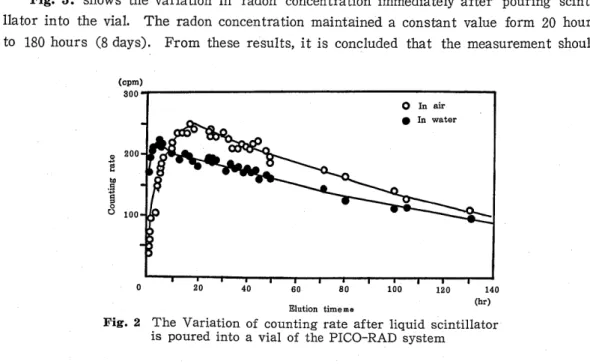
The variations in radon concentration in air and in the hot springs are shown in Fig. 2. The counting rate of radon in air increased to the maximum value 20 hours after scintillator pouring and decreased with the same half-life as Rn, while the counting rate of radon in water reached a maximum 5 hours after scintillator pouring and decreased with a slightly longer half-life. This difference may be due to the mixing of some radio- active nuclides other than radon.
Fig. 3. shows the variation in radon concentration immediately after pouring scinti- lla tor in to the vial. The radon concen tra tion maintained a constant value form 20 hours to 180 hours (8 days). From these results, it is concluded that the measurement should
(cpm) 300
2 200
e
.~ bO
=' 0
0 100
20 40 60 80 100
Elution timeme
0 In air
120 140
(hr)
Fig. 2 The Variation of counting rate after liquid scintillator is poured into a vial of the PICO-RAD system
KOGA et. al.: Radon Measurement Using a Liquid Scintillation Spectrometer
(Bq/ l)
0.5
• •
40
- • • •
80 120
Elution time
•
160
•
200 (hr)
Fig. 3 The variation in radon concentration after liquid scintillator is poured into avial of the PICO-RAD system
be made 20 hours after scintillator pouring and not later than 8 days.
3.2 Characteristics of radon measurement using the PICO-RAD system
The measurement of radon concentration is made after radiation equilibrium. Accu- mulated counts due to a-radioactivity of Rn, 2l8po (RaA) and 214PO (RaC'), and ,8-radio- activity of 214Pb (RaB) and 214Bi (RaC) are determined and the concentration of 222Rn in one liter of drinking water is calcnlated from the these counts. The detection limit was determined from twice the standard deviation of the counts of the PICO-RAD detector of which the lid was put on immediately after scintillator (INSTA-FLUOR) addition wi thou t exposure to air. Ten minutes of counting gave 37 mBq/.e.
From this value, the detection limit of radon in air was determined to be 3 mBq/.e.
The relative standard deviation (accuracy) was estimated to be about 10%, which was derived from the counted value of the same sample replicated several times.
This method has the following shortcomings.
(1) Since the sample water is poured directly into the PICO-RAD counting vial, other a-emitting nuclides in the uranium series could be also counted.
(2) Since solvent extraction is used, radionuclides in the thorium series having the same chemical forms could be counted together.
(3) Since the half-life of Rn is short (3.8 days), the counting period after sampling is limited.
3 .3 Comparison 0 f measurements 0 f radon in water
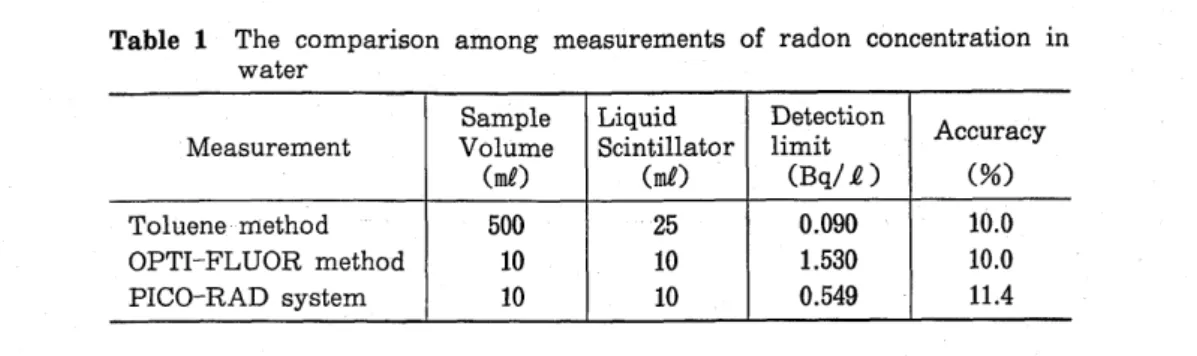
Table 1 shows the comparison between the PICO-RAD system by the Packard Co. and the toluene method as well as OPTI-FLUOR method which we formerly used. Since the procedure of sampling and treatment were about the same, the usefulness of the PICO- RAD system was clearly examined.
The toluene methodS) .10) is as follows: since toluene easily dissolves Rn and is a good
Table 1 The comparison among measurements of radon concentration in water
Sample Liquid Detection
Accuracy Measurement Volume Scintillator limit
(mf) (mf) (Eq/ £) (%)
Toluene method 500 25 0.090 10.0
OPTI-FLUOR method 10 10 1.530 10.0
PICO-RAD system 10 10 0.549 11.4
scintillator, of 25 mE toluene is added to a 500 mE sample of water in a 1 liter Erlenmeyer flask. After 5 minutes of strong shaking, it remains still for 10 minutes. The formed toluene layer is transferred to a scintillation vial for counting. Background counts, radioactivity decaying, extraction condition (temperature etc.) and the amount of sample water, etc.S) are compensated for.
The OPTI-FLUOR method is as follows: the OPTI-FLUOR solution is added to the sample water in the flask. After 30 seconds of strong shaking, radon is extracted.
The other procedures are the same as those of the toluene method.
The detection limit of radon concentration in water determined by the PICO-RAD system isO.5 Bq/E and seems to be sufficient for radon measurement in water, though it is a little higher than that by the toluene method. The detection limit of the OPTI- FLUOR method is higher than the other two methods. However, it has some advantages, i. e. the assay procedure is simple and easy, and glass vials can be used. The accuracies for the three methods were all nearly 10%, being defined as the be relative standard deviations derived from 10 countings of the same sample. Fig. 4 shows the comparison of radon concentration in water in the Misasa area using toluene method, OPTI-FLUOR method and PICO-RAD system. The radon concentration in the hot springs, which we measured by the PICO-RAD system this time, was in the range of 82""1,700 Bq/ E.
This is nearly the same level as those which we measured by other two methods in 1989.
(Bq/l)~ ________________________________________ ~
d .~
li
~ 1000t) d o
t)
o
~ Toluene method
m
OPTI-FLUOR method• PICO-RAD system
B H A K J E D F
Fig. 4 The comparison of radon concentration measurements.
B, H, A ... show the sampling points.
KOGA et. al.: Radon Measurement Using a Liquid Scintillation Spectrometer
3.4 Radon concen tra tion in water and air in· the Misasa area
Radon concentration in water and air inthe Misasa area is summarized in Fig. 5·
Radon concentration in the hot springs was in the range of 82"""'1,700 Bq/f, being nearly
(Bql.e> ... _ _ _ _ _ _ _ _ _ _ _ _ _ _ _ , -_ _ _ _ ... (mBq/.e>
i
.S s= 1000i
5i'"
g
~ 0\
~
c::::I in water I2ZZI Bath room
~ indoor _ outdoor
B e H A K J E D F X Y z
Fig. 5 Radon concentration in the Misasa.
B, C, H, .... show the sampling points.
°ia .S
the same range as the reference.2) Radon concentration in the river was in the range 13"""'18 Bqj£. Radon concentration in air was in the range of 0.16,...,7.7 Bq/ f in the bath rooms, 0.057--0.36 Bq/ f indoors, 0.05,...,0.12 Bq/ £ outdoors. These seem to be somewhat higher in comparison to the reference,2) i.e. 0.019,...,0.13 Bq/ £ indoors and 0.007--0.063 Bq/£ outdoors. In the hotels where the hot water is supplied from the outside, the radon concentration in the water is high. In the hotels where the radon concentration in hot spring is high, the radon concentration in air of the bath rooms is also high. However, at point C in Fig. 1, the radon concentration in air of bath rooms is low, though radon concentration in hot spring is high. This seems to be due to the good ventiliation and high ceiling. But the features of hotels at points Band C are different, though they both have fountain heads. The radon concentration varies with the environment such as place, time, height from the surface of the ground, and also with the arrangement of the hot spring in the hotel which includes ventilation of the bath rooms and dilution of the hot spring with tap water.
3.5 Radon concentration in the control area
Indoor and outdoor radon concentrations in the areas around Higashi-Osaka city (Osaka prefecture, Wakayama prefecture and Hyogo prefecture) were measured. The ou tdoor radon concen tra tion was near the detection limi t, while the indoor radon con- centration was generally higher.
These values are consistent with the values reported by UNSCEAR in 1988,3) i. e., 3 mBq/£ in air and 1 Bq/£ in water. Our radon data in concrete houses seem to be higher than those in wooden houses, though the number of samples was seven and the radon concentration did show some variation. Our recent data derived using the PICO-RAD system showed nearly the same level as those of the above reports or references. However,
Vol. 29 (1992)
we have not made a comparison with a standard sample yet. Hereafter, standardization should be indispensable.
4. Summary
Radon concentration in air and water at the Misasa hot spring area in Tottori pre- fecture was investigated using the PICO-RAD in the system made by Packard Co. as follows.
1) Radon concentration in bath rooms at Misasa area was 0.16--7.7 Bq/.e, while out- doors it was 0.05--0.12 Bq/.e, and indoors it was 0.057--0.36 Bq/.e. These values are 5--30 times the values derived in control areas such as Higashi-Osaka city.
2) Radon concentration in hot springs varied in the range of 82--1,.700 Bq/.e, while that in the Mitoku river water was 13--18 Bq/.e.
REFERENCES
1) United Nations Scientific Committee on the Effect of Atomic Radiation (UNSCEAR) 1988 Report,
"Sources, effect and risks of ionizing radiation", United Nations, New York (1988).
2) M. Mifune; Natural radioactivity of misasa-spa, Proc. of the 15th NIRS Seminar, held at China, Radon in the Living Environment --Levels and Risks, 259-269 (1987) (in Japanese).
3) National Institute of Radiological Sciences; Radiation and its effect on human exposure, UN- SCEAR 1982 report, Technoproject (1984) (in Japanese).
4) S. Okabe; Introduction of Natural Radon and Its Families. Atmospheric Radon Families and Environmental Radioactivity lI, 1-16 (1990) (in Japanese).
5) J. W. Thomas, P. C. LeClare; A study of the two-filter method for Rn, Health Physics, 18(2), 113-122 (1970).
6) M. Shimo; Determination efficiency on filter method using ZnS (Ag) scintillation detector, Health Physics, 23(3), 209-215 (1988) (in Japanese).
7) M. Shimo, K. Ikebe, J. Maeda et. al.; Determination method of Radon in the air using activated charcoals-Fundamental discussion on practical use, J. of Nuc. Sci. Technology, 25(7), 562-570
(1983) (in Japanese).
8) M. Mifune, Masaki Mifune; The calculation by the personal computer for radon-222 determi- nation in the mineral water with a liquid scintillation counter, Onsen Kogaku Gakkaishi, 21(1), 1-4 (1987) (in Japanese).
9) K. Horiuchi; Extraction of radon in mineral springs-- The new determination . method with a liquid scintillation counter, Onsen Kougaku Gakkaishi, 13(2) 95-103 (1987) (in Japanese).
10) K. Horiuchi, T. Ishii, Y. Murakami; Results on the simultaneous determination of 222Rn, 22°Rn and 226Ra contents in mineral springs of Izu peninsula, J. of the Balneological Soc. of Japan, 30(2), 84-89 (1979) (in Japanese).
11) K; Horiuchi, Y. Murakami; Determination of radon in soil gas by opened counting vial and liquid scintillation counter, Chemistry Letters (The Chemical Society of Japan), 159-162 (1983).
12) K. Horiuchi, Y. Murakami; A new method for the determination in soil air by the "Open vial" and integral counting with a liquid scintillation counter, J. of Radioanalytical Chemistry, 80 (1-2) 153-163 (1983).
13) M. Yamamoto. S. Yoneda, T. Nakanishi; Measurement of indoor radon concentration by CR-39 track detector, Atmospheric Radon Families and Environmental Radioactivity lI, 221-228 (1990) (in Japanese).
KOGA et. al.: Radon Measurement Using a Liquid Scintillation Spectrometer
14) T. Iida; Determination method of Rn concentration using solid state Track Detector, Radiological Sciences, 27(12), 217-220 (1984) (in Japanese).
15) M. Shimo, T. Iida; Thoron and their decay products --Progress and problem of measurement method, JCAC, No. 18, 12-29 (1990) (in Japanese).
16) Y. Matsumoto, K. Ishibashi, T. Sakae et. al.; Method to calibrate an ionization chamber for measuring indoor radon concentration with standard gamma-ray sources, Atmospheric Radon Families and Environmental Radioactivity IT, 55-63 (1990) (in Japanese).
17) M. Shimo, T. Iida at al.; Intercomparison of different instruments for measuring radon concen~
tration in air, Atmospheric Radon Families and Environmental Radioactivity II, 113-118 (1990) (in Japanese).