IEICE TRANS. ELECTRON., VOL.E102–C, NO.3 MARCH 2019
217
INVITED PAPER
Special Section on Superconducting Electronics for Quantum Information TechnologiesSuperconducting Digital Electronics for Controlling Quantum Computing Systems
Nobuyuki YOSHIKAWA†a),Member
SUMMARY The recent rapid increase in the scale of superconducting quantum computing systems greatly increases the demand for qubit control by digital circuits operating at qubit temperatures. In this paper, supercon- ducting digital circuits, such as single-flux quantum and adiabatic quan- tum flux parametron circuits are described, that are promising candidates for this purpose. After estimating their energy consumption and speed, a conceptual overview of the superconducting electronics for controlling a multiple-qubit system is provided, as well as some of its component cir- cuits.
key words: qubit, quantum computing, single-flux quantum circuit, adia- batic quantum flux parametron circuit, superconducting integrated circuits
1. Introduction
Recently, superconducting qubits have attracted attention as devices capable of realizing scalable quantum computers us- ing integrated circuit processes[1]–[3]. Even though the decoherence time of the firstly demonstrated superconduct- ing qubit was about one ns[4], it reached several tens of microsecond in the recent superconducting qubits[5]. The gate fidelity exceeds 99 percent, which is larger than the fi- delity threshold necessary for the quantum error correction using the surface code approach[6]. In light of the recent huge improvements in decoherence time, and with the help of the quantum error correction concept, the realization of a large-scale quantum computer system appears to be pos- sible. For this reason, companies and national projects are actively pursuing quantum computing research and develop- ment, especially in Europe and the United States. It can be said that quantum computers have moved from the basic re- search to the applied research and development stage, where the full use of various peripheral technologies becomes important.
To realize a large-scale quantum computer system, one critical issue is how to externally control many qubits and read out their state to the outside world. Usually, control of the qubit state and the coupling between qubits is performed using external microwave pulses or current pulses. For ex- ample, to perform coherent control of qubits, it is necessary to apply accurate microwave pulses with uniformly syn- chronized phases into each qubit. Such pulses require that the frequency of the microwaves is on the order of several
Manuscript received September 11, 2018.
Manuscript revised November 15, 2018.
†The author is with Department of Electrical and Computer Engineering, Yokohama National University, Yokohama-shi, 240–
8501 Japan.
a) E-mail: [email protected]
DOI: 10.1587/transele.2018SDI0003
gigahertz with a small spectral linewidth. In addition, the rise time of the microwave pulse has to be less than several tens of picoseconds. For a small quantum computing sys- tem with several qubits, microwave pulses can be applied by room-temperature electronics. However, room-temperature control systems are challenging for large quantum comput- ing systems with more than a few hundred qubits due to the huge number of microwave lines between cryogenic and room temperatures. Integration of a large number of qubits with microwave lines is not straightforward, and they induce a substantial heat load to the system.
To solve this problem, many studies aimed at manipu- lating and reading the qubit state using single-flux-quantum (SFQ) circuits[7]have been performed up to now[8]–[12].
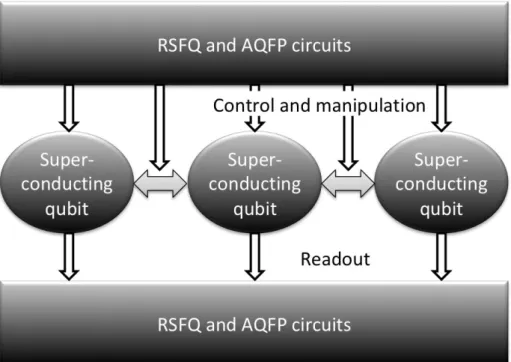
Recently, the control of a superconducting transom qubit by a train of SFQ pulsed was demonstrated with the fidelity of about 95 percent[13]. We also have been conducting research to realize a superconducting quantum computing system that combines superconducting qubits and supercon- ducting digital electronics, as shown in Fig. 1. In this sys- tem, state control and readout of each qubit are performed using SFQ or adiabatic quantum flux parametron (AQFP) circuits[14], which make it possible to build a scalable quantum computing system with minimal external wiring.
In addition to the high-speed manipulation and readout of the qubit state by SFQ circuits, AQFP circuits would pro- vide another option to the interface circuits: extremely low- power and high-sensitive manipulation and readout of the qubit.
In this paper, superconducting circuits that are promis- ing candidates for controlling the quantum computing sys- tem are described. After estimating their energy consump- tion and speed in Sect. 2, a conceptual overview of super- conducting electronics for controlling a multiple-qubit sys- tem is provided in Sect. 3.
2. Superconducting Digital Electronics for Controlling a Quantum Computing System
To control a superconducting qubit, microwave pulses are mainly used to rotate the phase accurately. Square current pulses are also used to control the qubit state. To calibrate the parameters for qubit devices, DC biases have to be ap- plied to each qubit. The requirements for the signals neces- sary to control qubits are as follows:
• The microwave pulses, whose typical frequency is Copyright c2019 The Institute of Electronics, Information and Communication Engineers
218
IEICE TRANS. ELECTRON., VOL.E102–C, NO.3 MARCH 2019
Fig. 1 Superconducting quantum computing system.
several gigahertz, must have a rise/fall time of several tens of picoseconds and a controllable envelope am- plitude on the order of several microamps[15]. The frequency and the envelope amplitude must be control- lable for each qubit.
• The square current pulse must have a rise/fall time of several tens of picoseconds and an amplitude of sev- eral tens of microamps because the typical critical cur- rent of Josephson junction in superconducting qubits is ranging from 0.1 to 10μA[16],[17]. The amplitude and width of the pulse must be controllable.
• A controllable DC bias with an amplitude of several tens of microamps is necessary for each qubit.
As for the detection of the qubit state, a small DC out- put current from the qubit must be detected. In recent circuit QED systems, the scattering parameters for microwave sig- nals are measured to determine the qubit state. The require- ments for detecting the qubit state are as follows:
• The DC current sensitivity must be less than several hundred nanoamps, assuming the typical critical cur- rent of Josephson junction in superconducting qubits is ranging from 0.1 to 10μA.
• The microwave sensitivity must be less than the power ranging from−130 dBm to−120 dBm when the read- out time of the qubit state is about 100 ns[18].
It is also important that the controlling electronics have a total energy consumption of less than 10μW, which is the cooling power of the cold head of a typical 10 mK dilution refrigerator[19].
2.1 SFQ Circuits
Rapid SFQ (RSFQ) circuits are known as high-speed logic circuits operating at clock frequencies exceeding hundreds of gigahertz with low power consumption[7]. Recently, var- ious types of energy-efficient versions have been invented and demonstrated, including low-voltage SFQ[20], efficient RSFQ[21], and energy-efficient SFQ[22] circuits, where static power consumption at the bias resistance was consid- erably reduced. Because of the low energy consumption of SFQ circuits, they are promising candidates for digital elec- tronics for controlling a quantum computing system.
The bit energy (switching energy) Eb of an SFQ cir- cuit is determined by the dynamic energy consumption at the junction given byEb=IcΦ0, whereIcis the critical cur- rent of the Josephson junction andΦ0is a flux quantum. At any finite temperature, Eb has to be much larger than the thermal energy kBT to reduce the bit error rate. In other words,Eb kBT, where kBis the Boltzmann constant and T is the temperature. The switching time of the Josephson junction is given by theL/Rtime constant:
τsw=2πLj
R = Φ0
IcR =
2πΦ0Cs
βcJc , (1)
whereLjis the Josephson inductance given byΦ0/2πIc,Cs
is the junction capacitance per unit area, Jc is the critical current density for the Josephson junction, and βc is the McCumber parameter. The McCumber parameter is calcu- lated by
βc=2πR2CIc/Φ0, (2)
where Ris the parallel resistance of the subgap resistance
YOSHIKAWA: SUPERCONDUCTING DIGITAL ELECTRONICS FOR CONTROLLING QUANTUM COMPUTING SYSTEMS
219
Fig. 2 Quantum computing system controlled by superconducting digital electronics.
and the shunt resistance of the junction andCis the junction capacitance. In conventional SFQ circuits,βcis chosen to be 1.
If we assume that the SFQ circuits are operating at a cryogenic temperature of several tens of millikelvins, we can reduce the value ofIcdown to 10μA, by accounting for both the error rate and the minimum size of the junction. If we assume that the junction size is 1μm, which is a typical junction size with current fabrication technology, the critical current density for the Josephson junction has to be reduced toJc = 1 kA/cm2, which corresponds to one-tenth of the present high-speed Josephson integrated process[23]. Ac- cording to Eq. (1) and assuming the above values, the clock frequency of the SFQ circuit at a cryogenic temperature is deduced to be fc=10–15 GHz. The bit energy of the gate is estimated to be about 20 zJ per bit. The amplitude of the output current of the SFQ circuit is in the range of several microamps. When we integrate 1,000-gate SFQ circuits, the total power consumption is estimated to be about 2μW at a 10-GHz clock frequency. This power is small enough for a dilution refrigerator with typical cooling power.
2.2 AQFP Circuits
An AQFP can realize a logic operation with extremely high energy efficiency by slowly and adiabatically operat- ing a quantum flux circuit with a high intrinsic operating speed[14]. However, the operating frequency of the AQFP ranges from 2 to 5 GHz, which is still faster than CMOS cir- cuits. The extremely low energy consumption of the AQFP circuit makes it a strong candidate for the control electronics of a quantum computing system.
The bit energyEbitof the AQFP is represented by the ratio of two time constants[24],[25]:
Ebit=2IcΦ0τsw
τr , (3)
where τr is the rise/fall time for the excitation current and τsw is the intrinsic switching time for the Josephson junc- tion given by Eq. (1). Because the shunt resistance can be removed from the junction to increaseβcin the AQFP cir- cuit, the intrinsic switching timeτswbecomes quite small.
220
IEICE TRANS. ELECTRON., VOL.E102–C, NO.3 MARCH 2019
Fig. 3 Conceptual diagram of highly sensitive AQFP microwave detector.Iinis a small signal from a qubit with a frequency ofωwhileIxis an excitation current with a frequency ofωxapplied to the AQFP gate. (a) Whenωis equal toωx, the output from the AQFP gate becomes “1” for every clock cycle. (b) Whenωis not equal toωx, the output signal exhibits both “1” and “0”.
Thus, the bit energy can be reduced significantly. In an AQFP circuit operating at a cryogenic temperature, we may even assume a critical current ofIc=50μA, which is simi- lar to that for operation at 4.2 K because of the high energy efficiency of the AQFP circuit. Thus a similar critical cur- rent density can be used, which simplifies the testing of the circuits at 4.2 K. The amplitude of the output current of the AQFP is in the range of a few tens of microamps. If we assume a 5-GHz clock frequency, the switching energy of the AQFP gate per bit is estimated to be 0.5 zJ[25], which is six orders of magnitude better than that of semiconductor circuits and two orders of magnitude better than that of SFQ circuits. When we integrate 1,000,000-gate AQFP circuits, the total power consumption is estimated to be about 2.5μW at a 5-GHz clock frequency.
3. Quantum Computing System Controlled by Super- conducting Electronics
To realize a scalable quantum computing system, it is neces- sary to implement control and readout systems operating in the same temperature environment as the qubits, and to di- rectly control and observe multiple qubits at cryogenic tem- peratures. This integration can not only significantly reduce the number of wires between the room-temperature and low- temperature environments but also enable high-speed repet- itive and feedback calculations. In recent years, propos- als have been made to reduce the number of control lines from room-temperature systems by mounting a semiconduc- tor control circuit on a 4.2-K stage. However, this incurs a large cooling cost[26].
YOSHIKAWA: SUPERCONDUCTING DIGITAL ELECTRONICS FOR CONTROLLING QUANTUM COMPUTING SYSTEMS
221
Fig. 4 AQFP demultiplexer for readout of multiple qubit states: (a) Circuit diagram and (b) Simula- tion results.
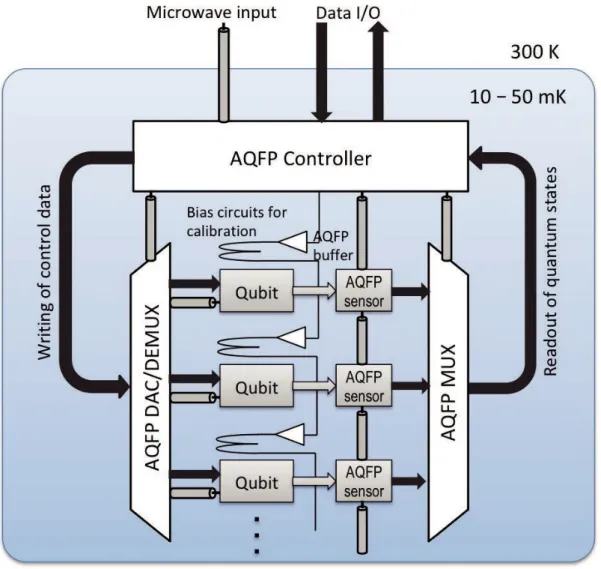
Figure 2 shows a conceptual diagram of the proposed qubit control system using superconducting digital electron- ics. An AQFP digital-to-analog converter (DAC) and de- multiplexer (DEMUX) convert the digital signal from an AQFP controller to the analog signals, and provide it to the
appropriate qubit. Microwave signals are also delivered to the appropriate qubit by DEMUX. The required number of the microwave lines per qubit depends on the method to con- trol and readout the qubit. However, the total number of the microwave lines can be scalable with an increase of the
222
IEICE TRANS. ELECTRON., VOL.E102–C, NO.3 MARCH 2019
number of qubits because the external microwave signals and DC signal are demultiplexed into each qubit, and sig- nals readout from each qubit are multiplexed. AQFP sensors detect microwave or DC signal from qubit with high sensi- tivity. An AQFP multiplexer selects one of the qubit signals and sends it to the AQFP controller. An AQFP buffer chain provides DC calibration signals to each qubit. Some circuit blocks can be replaced with SFQ circuits if their speed is critical.
This system has the following features:
• By operating the controller and qubits in the same temperature environment, the number of control and reading connections between the room-temperature and cryogenic environments can be significantly re- duced, and the scalability of the quantum comput- ing system can be improved. It is possible to per- form fast feedback operations with the qubits at the low-temperature stage, which opens new opportunities, such as a quantum-classical hybrid algorithm that re- peats small-scale quantum computations.
• By using AQFP or SFQ circuits, variable DC pulse generators and microwave choppers with sub- nanosecond time resolution can be constructed. With the AQFP buffer array, it is possible to calibrate many qubits individually by applying a static bias current to each one. Because AQFP circuits have high cur- rent sensitivity without a transit to the voltage state, high-precision readout of the quantum state is possi- ble. Also, they can have a high current sensitivity to the microwave input.
All these features make it attractive to use AQFP circuits as controlling and reading electronics for quantum computing systems.
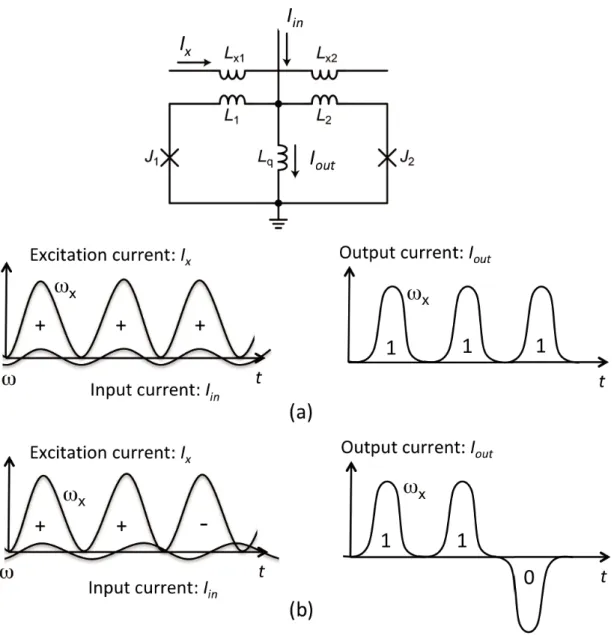
Figure 3 shows a conceptual diagram of a highly sen- sitive microwave detector using AQFP circuits, where the amplitude of the microwave signal from a qubit with a fre- quency ofω is measured. In the figure, Iin is a small sig- nal from a qubit while Ix is an excitation current with a frequency ofωx applied to the AQFP gate. When the fre- quencyω of the input signal is equal to the frequencyωx
of the excitation current, the output from the AQFP gate be- comes “1” for every clock cycle (see Fig. 3 (a)). Whenω is not equal toωx, the output signal exhibits both “1” and
“0” (see Fig. 3 (b)). Thus, the AQFP acts as a narrow line- width amplifier. By averaging the output signals from the AQFP with an analog or digital integrator, its sensitivity is expected to be considerably improved. The AQFP gate has a reported sensitivity of a fewμA in the GHz operation fre- quency range at 4.2 K[27]. There is a possibility that the sensitivity is improved at a lower temperature.
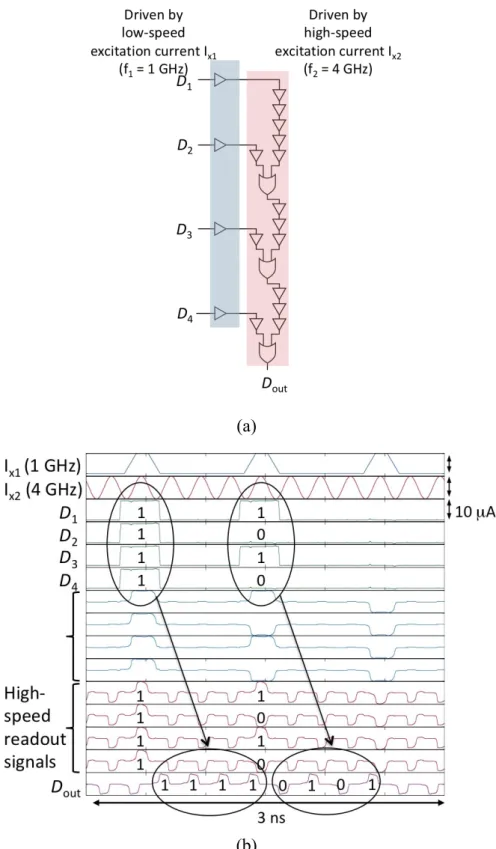
Figure 4 (a) shows an example of an AQFP multiplexer for a hybrid quantum computing system. This multiplexer makes a parallel-to-serial conversion so that many qubit states can be read out from a single output port. The figure shows an example of a four-to-one multiplexer, where de- tected signals are input fromD1 throughD4 in parallel and
the output signals are read out fromDoutin serial. The cir- cuit is clocked by two excitation currents: a low-speed clock with f1 =1 GHz and a high-speed clock with f2 =4 GHz.
By using this readout scheme, the quantum states of mul- tiple qubits can be read out in series. The circuit can also be used for the interface to decrease the number of wires between the room-temperature and cryogenic circuits. Fig- ure 4 (b) shows the circuit simulation results for the four-to- one AQFP multiplexer. The simulation shows that the input data (D4,D3,D2,D1)=(0,1,0,1) can be successfully read out fromDoutin series.
4. Conclusions
The bit energy, operating frequency, and signal amplitude for SFQ and AQFP digital circuits applied to quantum com- puting systems have been evaluated. It was shown that these circuits are promising for the integration with and the con- trol of qubits, as well as for improvement of the scalability of a quantum computing system. A concept of a quantum computing system controlled by superconducting electron- ics was also shown. Some component circuits were pro- posed and examined by circuit simulations.
References
[1] J. Clarke and F.K. Wilhelm, “Superconducting quantum bits,” Na- ture, vol.453, pp.1031–1042, 2008.
[2] M.H. Devoret and R.J. Schoelkopf, “Superconducting Circuits for Quantum Information: An Outlook,” Science, vol.339, no.6124, pp.1169–1174, 2013.
[3] G. Wendin, “Quantum information processing with superconducting circuits: a review,” Rep. Prog. Phys., vol.80, no.10, p.106001, 2017.
[4] Y. Nakamura, Y.A. Pashkin, and J.S. Tsai, “Coherent control of macroscopic quantum states in a single-Cooper-pair box,” Nature, vol.398, pp.786–788, 1999.
[5] R. Barends, J. Kelly, A. Megrant, D. Sank, E. Jeffrey, Y. Chen, Y. Yin, B. Chiaro, J. Mutus, C. Neill, P. O’Malley, P. Roushan, J.
Wenner, T.C. White, A.N. Cleland, and J.M. Martinis, “Coherent Josephson Qubit Suitable for Scalable Quantum Integrated Circuits,”
Phys. Rev. Lett., vol.111, p.080502, 2013.
[6] R. Barends, J. Kelly, A. Megrant, A. Veitia, D. Sank, E. Jeffrey, T.C. White, J. Mutus, A.G. Fowler, B. Campbell, Y. Chen, Z. Chen, B. Chiaro, A. Dunsworth, C. Neill, P. O’Malley, P. Roushan, A.
Vainsencher, J. Wenner, A.N. Korotkov, A.N. Cleland, and J.M.
Martinis, “Superconducting quantum circuits at the surface code threshold for fault tolerance,” Nature., vol.508, pp.500–503, 2014.
[7] K.K. Likharev and V.K. Semenov, “RSFQ logic/memory family:
A new Josephson-junction technology for sub-terahertz-clock-fre- quency digital systems,” IEEE Trans. Appl. Supercond., vol.1, no.1, pp.3–28, 1991.
[8] D.S. Crankshaw, J.L. Habif, X. Zhou, T.P. Orlando, M.J. Feldman, and M.F. Bocko, “An RSFQ variable duty cycle oscillator for driv- ing a superconductive qubit,” IEEE Trans. Appl. Supercond., vol.13, no.2, pp.966–969, 2003.
[9] V.K. Semenov and D.V. Averin, “SFQ control circuits for Josephson junction qubits,” IEEE Trans. Appl. Supercond., vol.13, no.2, pp.960–965, 2003.
[10] N. Takeuchi, D. Ozawa, Y. Yamanashi, and N. Yoshikawa, “On-chip RSFQ microwave pulse generator using a multi-flux-quantum driver for controlling superconducting qubits,” Physica C, vol.470, no.20, pp.1550–1554, 2010.
[11] K.G. Fedorov, A.V. Shcherbakova, M.J. Wolf, D. Beckmann, and
YOSHIKAWA: SUPERCONDUCTING DIGITAL ELECTRONICS FOR CONTROLLING QUANTUM COMPUTING SYSTEMS
223
A.V. Ustinov, “Fluxon Readout of a Superconducting Qubit,” Phys.
Rev. Lett., vol.112, 160502, 2014.
[12] R. McDermott and M.G. Vavilov, “Accurate Qubit Control with Sin- gle Flux Quantum Pulses,” Phys. Rev. Appl., vol.2, p.014007, 2014.
[13] E. Leonard Jr. et al., “Digital coherent control of a superconducting qubit,” arXiv: 1806.07930v1, 2018.
[14] N. Takeuchi, D. Ozawa, Y. Yamanashi, and N. Yoshikawa, “An adia- batic quantum flux parametron as an ultra-low-power logic device,”
Supercond. Sci. Technol., vol.26, no.3, p.035010, 2013.
[15] O. Naaman, J.A. Strong, D.G. Ferguson, J. Egan, N. Bailey, and R.T. Hinkey, “Josephson junction microwave modulators for qubit control,” J. Appl. Phys., vol.121, no.7, p.073904, 2017.
[16] C.H. van der Wal, A.C.J. ter Haar, F.K. Wilhelm, R.N. Schouten, C.J.P.M. Harmans, T.P. Orlando, S. Lloyd, and J.E. Mooij, “Quan- tum superposition of macroscopic persistent-current states,” Sci- ence, vol.290, no.5492, pp.773–777, 2000.
[17] M.W. Johnson, M.H.S. Amin, S. Gildert, T. Lanting, F. Hamze, N. Dickson, R. Harris, A.J. Berkley, J. Johansson, P. Bunyk, E.M. Chapple, C. Enderud, J.P. Hilton, K. Karimi, E. Ladizinsky, N. Ladizinsky, T. Oh, I. Perminov, C. Rich, M.C. Thom, E.
Tolkacheva, C.J.S. Truncik, S. Uchaikin, J. Wang, B. Wilson, and G. Rose, “Quantum annealing with manufactured spins,” Nature, vol.473, pp.194–198, 2011.
[18] D.T. Sank, “Fast, Accurate State Measurement in Superconduct- ing Qubits,” A dissertation for PhD, University of California, Santa Barbara, 2014.
[19] https://nanoscience.oxinst.com/products/cryofree-dilution-refrigerat ors/
[20] M. Tanaka, A. Kitayama, T. Koketsu, M. Ito, and A. Fujimaki,
“Low-energy consumption RSFQ circuits driven by low voltages,”
IEEE Trans. Appl. Supercond., vol.23, no.3, p.1701104, 2013.
[21] D.E. Kirichenko, S. Sarwana, and A.F. Kirichenko, “Zero Static Power Dissipation Biasing of RSFQ Circuits,” IEEE Trans. Appl.
Supercond., vol.21, no.3, pp.776–779, 2011.
[22] M.H. Volkmann, A. Sahu, C.J. Fourie, and O.A. Mukhanov, “Ex- perimental investigation of energy-efficient digital circuits based on eSFQ logic,” IEEE Trans. Appl. Supercond., vol.23, no.3, p.1301505, 2013.
[23] S. Nagasawa, T. Satoh, K. Hinode, Y. Kitagawa, M. Hidaka, H.
Akaike, A. Fujimaki, K. Takagi, N. Takagi, and N. Yoshikawa,
“New Nb multi-layer fabrication process for large-scale SFQ cir- cuits,” Physica C, vol.469, no.15-20, pp.1578–1584, 2009.
[24] N. Takeuchi, Y. Yamanashi, and N. Yoshikawa, “Simulation of sub-kBT bit-energy operation of adiabatic quantum-flux-parametron logic with low bit-error-rate,” Appl. Phys. Lett., vol.103, no.6, 062602, 2013.
[25] N. Takeuchi, Y. Yamanashi, and N. Yoshikawa, “Energy efficiency of adiabatic superconductor logic,” Supercond. Sci. Technol., vol.28, no.1, p.015003, 2015.
[26] E. Charbon, F. Sebastiano, A. Vladimirescu, H. Homulle, S. Visser, L. Song, and R.M. Incandela, “Cryo-CMOS for Quantum Comput- ing,” IEDM 2016, 343-346.
[27] Y. Yamanashi, T. Matsushima, N. Takeuchi, N. Yoshikawa, and T. Ortlepp, “Evaluation of current sensitivity of quantum flux parametron,” Supercond. Sci. Technol., vol.30, no.8, p.084004, 2017.
Nobuyuki Yoshikawa received the B.E., M.E., and Ph.D. degrees in electrical and com- puter engineering from Yokohama National University, Japan, in 1984, 1986, and 1989, re- spectively. Since 1989, he has been with the De- partment of Electrical and Computer Engineer- ing, Yokohama National University, where he is currently a Professor. His research interests in- clude superconductive devices and their appli- cation in digital and analog circuits. He is also interested in single-electron-tunneling devices, quantum computing devices and cryo-CMOS devices. He is a member of the Institute of Electronics, Information and Communication Engineers of Japan, the Japan Society of Applied Physics, the Institute of Electrical Engineering of Japan, and Cryogenics and Superconductivity Society of Japan.