SPIN‑DEPENDENT TRANSPORT PROPERTIES OF SnTe‑MnTe SYSTEMS
journal or
publication title
福井大学工学部研究報告
volume 27
number 1
page range 161‑181
year 1979‑03
URL http://hdl.handle.net/10098/4417
FUKUI UNIVERSITY VOL.Z7 No. 1 1979
SPIN-DEPENDENT TRANSPORT PROPERTIES OF SnTe-MnTe SYSTEMS
Masahiro TANABE*, Masasi INOUE*, Hisao YAGI* and Toshiaki TATSUKAWA**
(Received February 20, 1979)
Electrical measurements have been made of the Bridgman-grown degenerate magnetic semiconductors Snl_xMnxTe (0.::. x .::. 0 ~ 19) over a temperature range from room temperature to liquid helium tempera- tures. The magnetic impurities have an effect on carrier transport in two different ways. First, the Mn ions act simply as ionized- impurity scattering centers giving rise to a decrease in the Hall mobility. In addition, the exponent n in the temperature dependence of the Hall mobility in the temperature range 77-300K, ~~T-n, the residual resistivity at 4.2 K, P4.2' and the residual resistance ratio, RRR=P300/P4.2' are all affected appreciably by the magnetic impurities. Second, the localized spins on the magnetic ions come into play at low temperatures, which align ferromagnetically at an ordering temperature. As a result, the Hall effect consists of the ordinary component due to the Lorentz force and the anomalous (or extraordinary) one arising from asymmetric or skew scattering of conduction carriers through a spin-orbit coupling; the second component is found to be strongly temperature-dependent, Rl ~ T , 2 in agreement with the Voloshinskii model. The results of magnetic susceptibility and estimated spontaneous magnetization are also presented as a function of temperature.
1. INTRODUCTION
Highly degenerate semiconductors SnTe or GeTe, normally p-type with carrier concentration of the order of 1020 ~ 1021 cm- 3 , form a solid solution with a magnetic material like MnTe to become so- called "degenerate magnetic semiconductor", which is now known to be a suitable matrix for the study of conduction carriers (holes)- magnetic moment interaction by varying intentionally the carrier
*
Dept. of Applied Physics.** Experimental Laboratory for Low Temperature Physics.
and magnetic impurity concentrations.l ) For such a study of magnet- ism, representati~e systems have been for many years the well-known
"dilute alloys" --- a system of magnetic impurities diluted in various metals. However, these semiconductors have the cubic NaCI structure with some degree of ionicity and covalency in chemical bonding nature, in striking contrast with metals. As in dilute alloys, a basic mechanism of the interaction is through indirect exchange (RKKY type) interaction and localized spins play an impor- tant role in various transport properties of the carriers.
Thus far a number of experimental studies have been carried out on these magnetic semiconductors. First, the magnetic susceptibility measurements on the systems SnTe-MnTe2-4) and GeTe-MnTe 5,6) show a Curie-Weiss behavior in the paramagnetic region and the ferro- magnetic ordering below the Curie temperature Tc which depends on Mn content and slightly on carrier concentration. Second, the electrical measurements are performed near the ordering temperature, such as resistivity7,8) and anomalous (or extraordinary) Hall
effect 2 ,9)(AHE) for SnTe-MnTe, and resistivity for GeTe-MnTelO).
A small resistivity maximum in its temperature dependence, negative magnetoresistance, and AHE are observed near the temperature Tc ' which are all spin dependent transport phenomena. Finally, electron paramagnetic resonance (EPR) experimentsll) on Mn2+ in SnTe crystals also indicate the role of the carrier~localized spin interaction.
On the other hand, in the past several years we have studied SnTe-MnTe system from both transport 12 - 14 ) and EPR
measurements15~17)
Our samples were grown by the Bridgman method and isothermally annealed to control the carrier density and to bring the magnetic atoms into substitutional lattice sites effectively. Other systems of Pbl Sn Te 18 ) and GeTe 19 ) doped with Mn impurities were also
-x x
investigated by the EPR technique. In the case of Snl_xMnxTe, we have found that l7 ) for low Mn content less than x=O.2 at.%
the EPR spectra are resolved into six hyperfine lines, indicating the localized state of Mn 2+ ions, while for 0.2 at. % < x < 1 at. % the observed linewidths suggest the presence of exchange interactions between Mn2+ ions and for higher x >1 at.% dipole-dipole inter-
action dominates. These facts imply that the magnetic properties of this system are strongly dependent on Mn content. This
situation seems to be the same as in a magnetic alloy (random spin system) like AuFe,20) in which various magnetic ordering states exist, such as localized Kondo state, mictomagnetism or
spin glass, and complete rerromagnetic ordering, depending on the Fe concentration.
In the present work, we have carried out a more exhaustive study of the transport measurements extended over the range of Mn content up to 19 at.% with an emphasis on AHE. We first review briefly on the AHE in the nest section and in the subsequent
sections will present our experimental results including resistivity, Hall mobility, Hall effect, and magnetic susceptibility.
2. ANOMALOUS HALL EFFECT
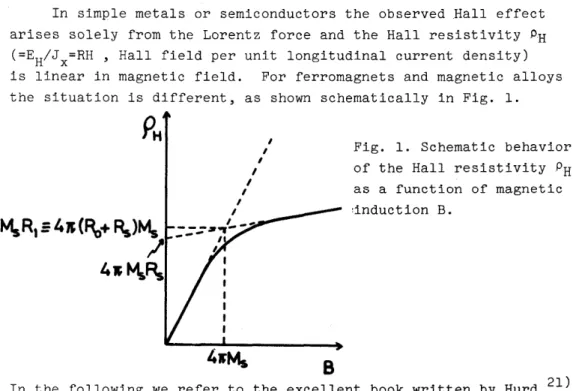
In simple metals or semiconductors the observed Hall effect arises solely from the Lorentz force and the Hall resistivity PH C=EH/Jx=RH , Hall field per unit longitudinal current density) is linear in magnetic field. For ferromagnets and magnetic alloys the situation is different, as shown schematically in Fig. 1.
I I I I
I I I I
B
Fig. 1. Schematic behavior of the Hall resistivity PH as a function of magnetic :induction B.
In the following we refer to the excellent book written by Hurd.21 ) In this case the behavior is expressed empirically by
PH = R B o + 4~R s M, (1)
where B is the applied magnetic induction,and M the macroscopic magnetization above the magnetic ordering (Curie) temperature Tc and will be the spontaneous magnetization Ms below Tc. The first term is the normal Hall effect with the coefficient Ro and the second is the anomalous Hall effect; Rs is called the spontaneous Hall coefficient because the second term is present even when there is no applied magnetic induction. Another form or eq.(l) is written as, with B=H
i + 4~M, where Hi is the internal magnetic
field in the sample,
where Rl =4n(Ro + Rs) is the anomalous Hall coefficient (often Rs is also called so indiscriminately). In a more convenient form for a comparison with experiments, PH is expressed as
(2)
PH = Ro[Ha + 4nM(1 - N)] + 4nRsM, (3) with H =H i a + 4nNM and B=H a + 4nM(1 - N), where H is the applied a magnetic field and N is the demagnetization factor. At saturation B= 4nMs (or H =4nNM ) and a s · PH becomes 4nM (R s 0 + R ) as shown in s Fig. 1. Since in practice IR I «IR I is usually true, R can be o s s determined directly from this ordinate intercept. On the other hand, in the paramagnetic region the magnetic susceptibility X is M/Hi' and eq.(3) leads to
R + 4nx*[R + R (1 - N)],
o s 0 (4 )
where X*=X/(l + 4nNx) is an effective susceptibility which includes the effects of the demagnetizing field (M=X*H ).
a
Now the starting point of all attemps to understand the AHE in magnetic substances is a model which consists of itinerant current carriers (either magnetic or nonmagnetic electrons) moving under the applied electric field. These carriers interact
asymmetrically with the scattering centers in the metal. This process is seen either as an asymmetric (or skew) scattering or as a finite transverse displacement of the carrier as it passes the scattering center. The questions are (i) what is the nature of the scattering process, and (ii) how is it that the carriers are scattered asymmetrically? In addition to the appropriate scatter- ing mechanism, some spin-orbit coupling effect is required.
The fundamental interactions are known to be (1) direct exchange interaction, (2) indirect exchange interaction, (3) direct s-d interaction, (4) s-d mixing interaction, (5) intrinsic spin-orbit interaction, and (6) mixed spin-orbit coupling. Furthermore, the scattering mechanisms possible in a magnetic material are;
(I) impurities and lattice imperfections at low temperature, (II) phonons, and (III) spin waves (thermal disorder of the organized spin system) at high temperature. In the following we only write the final forms which are to be compared with experiments, derived by various authors based on different models:
[Luttinger]22): 2
Rs = apo + bpo ; po=residual resistivity. (5) [Kondorskii]23): p =(R + 4nXR
s)H H 0
=(Ro + ap2)H or (Ro + bT2 )H; p « T. (6)
[VoloshinSkii]24): (7)
[Kagan and Maksimov]2S): R «T
4
s
« T2
[low temperature].
[high temperature].
(8 ) (8' ) [Irkhin et al., and Lazarev]26,2
7):
R «T 3 s [low temperature]. (9) In fact, the theoretical development of the AHE has been
viewed from two main streams;21) theories with itinerant magnetic carriers and those with localized magnetic carriers (s-d model).
The first stemmed from the Karplus-Luttinger model for a ferro- magnet, which consists of a gas of magnetic charge carriers,
corresponding to itinerant vacancies in the d band of a transition metal, which move in the periodic potential of the nonmagnetic ions. To account for the spontaneous magnetization, the carriers with up-spin are more numerous than those with down-spin, and it is the same itinerant carriers which are responsible for the electric and magnetic properties of the solid. As the carriers move under the external electric field through the periodic potential of the ions they experience an intrinsic spin-orbit coupling between their spin and their orbital angular momentum.
This gives rise to a transverse current --- thus the AHE, and from this theory Rs is found to vary with the square of the total electrical resistivity. After some modification, eq.(S) was derived and Kondorskii extended the theory to the paramagnetic state leading to eq.(6).
The second of the theoretical developments originates from the Kondo mOdel,28) where the magnetic d-electrons are localized on the ions. The charge carriers are taken to be free and equally distributed between states of opposite spin. In this theory it is necessary to invoke the intrinsic spin-orbit coupling of the localized magnetic electrons in order to obtain skew scattering with a direct spin-spin scattering mechanism. Later by taking into account the mixed spin-orbit interaction, together with
spin disorder as the scattering mechanism, Voloshinskii obtained eq.(7); other formulations leading to eqs.(8) and (9) were made by Soviet researchers. The concept of the mixed spin-orbit interaction was introduced by Voloshinskii24) and Maranzana 29 ).
This interaction is between the magnetic field due to localized moments of d-electrons and that produced by the s-electrons (which are the current carriers in this model) temporarily localized in the vicinity of the magnetic ions. The magnetic moment M situated at the origin of rectangular coordinates generates a magnetic field whose vector potential A is
A =
~
= curl~
, (10)r
where r is the position vector. This vector potential produces a new term in the Hamiltonian which is the energy of interaction between
A
and the current of charge carriers each with a momentum p:- __ e __ (p.A + A.p)=- ~(p·A)· divA=O.
2mc m c ' (11)
If the orbital angular momentum L (=r x p) of the charge carrier around the origin is introduced, it reduces to
- ----e M~L ,
mcr3 (12)
where M is the magnetic moment proportional to the sum of the spins of the d- electrons and equals g~S; S is the total spin of the ion, g the g-factor, and ~ the Bohr magneton. Clearly, Hso is an odd function of r, i.e., it changes sign when the position of the charge carrier is reflected in the plane containing M and p (the primary current direction). This implies that the matrix elements of eq.(12) between quasi-free electron states of wave vector k and k' are antisymmetric under an exchange of k and k'. If an odd power of such a matrix element appears in a transition probability, skew scattering results. In this picture, the itinerant charge carrier can be imagined to orbit somewhat around the ion during the scattering process. Then the magnetic field produced by this circulating current will interact directly with that due to the localized moment, and will produce a coupling between the d spin and the orbit of the itinerant s electron --- referred to as mixed spin-orbit coupling.
Experimental data of the AHE for degenerate magnetic semi- conductors are not so much available as those for metals, including
spin glass systems. 3D) The SnTe-MnTe system has been investigated by two groups with different results: Escorne et al.
9,3
1 ) show both experimentally and theoretically that the anomalous Hall coefficient in Snl Mn Te (2.5 at. % < x < 7 . 5 at. %) is temperature--x x
independent in the whole ferromagnetic range and does not vanish in the paramagnetic range, whereas our limited number of resultsl4) with x=0.88 and 2.2 at.% show a quite different behavior, where it rather increases with decreasing temperature below the ordering temperature and vanishes at the point. Our primary interest is to clarify these differences.
3. EXPERIMENTAL
The samples Snl~~mxTe (x < 19 at.%) were prepared by the same method as previous works --- the crystal growth by the Bridgman technique and the isothermal annealing in Zn vapor followed by quenching. Typically the carrier concentration of the as-grown crystals was in the range p=(6-10) x 1020 cm-3 and that of the annealed samples was p=(1-4) x 1020 cm-3 at room temperature.
In the present Hall measurements, instead of a conventional four- probe method used previOUSly,14) the three probes (one at one side and two at the opposite side) were attached to the rectangular sample and a null position was set by adjusting a variable resistor potentiometrically. The dc measurements were carried out using a built-up cryostat in the same way as previous work. Some data presented here of residual resistivity and Hall mobility include those obtained in the past several years.
The magnetic susceptibility data of our samples are also presented here to show the paramagnetic behavior in the temperature range 77-300 K, taken by a magnetic balance at Hiroshima University
(Dr. M. Nomura) several years ago and by a vibrating sample magne- tometer at Toei Ind. Co. (Dr. H. Nishio) recently.
4. RESULTS AND DISCUSSION
A. Hall Mobility and Resistivity
We will first show the effect of magnetic impurities as scattering centers on the transport properties of Snl_xMnxTe.
In Fig. 2(a) the Hall mobility ~77 at 77 K against the nominal carrier concentration p obtained from the Hall coefficient at 300 K is shown for different Mn content. It decreases linearly with
10 20 10
( a )
0.1
(b)
1 10
x (at~/o)
Fig. 2. Hall mobility of Snl_xMnxTe at
77
K plotted against (a) nominal carrier concentration p at 300 K and (b) against nominal Mn content x.increasing carrier concentration due to carrier-carrier scattering as found by many workers and the absolute value becomes small with the increase in the magnetic impurity content. To clarify the latter we plot it in Fig. 2(b) as a function of x; here the annealed samples with lower carrier concentration are indicated by open symbols and the as-grown samples by solid symbols. The dotted lines in Fig. 2(b) indicate the general trend of the ~77
vs x relation covered by all samples with different carrier
concentrations p=(I-lO) x 1020 cm-3 , the upper part in the bounded region corresponding approximately to the lower density.
The similar plot for lower x < 0.1 at. % was shown in Fig. 1 of
previous report. 12 ) We note that the decrease in the Hall mobility with increasing Mn content is gradual up to x=l at.% and rather drastic for x >1 at.%.
The temperature dependence of the observed Hall mobility in the range 77-300 K is approximated by the form ~ « T-n , where n is an exponent which depends on x as shown in Fig. 3. Also in this case, the value n begins to decrease drastically for x > 1 at. %.
As is well known in ordinary nondegenerate semiconductor physics, a different scattering mechanism leads to a different temperature dependence of the Hall mobility; roughly speaking for electrons
(n~type material), n=1.5 for acoustic and nonp6lar optical phonon scattering and n=-1.5 for ionized-impurity sc~ttering at high tem- perature. But the values for holes (p-type material) and degenerate
o
- - -0-13- - 6 -
i'o~,~,
0'\
c 0.1
'\
'\
\
\
'0
d0.01 L-.--J'---L-L----LJL....L...L.I....I...-_...l---'--..L-J...L...L.u....L._----'--'
0.1 10 20
x (at.%)
Fig. 3. The exponent n plotted against Mn content x in the tem- perature dependence of the Hall mobility, ~~T-n, for the annealed
20 -3 samples with p=(1-4) x 10 cm .
case are less known, in particular for SnTe in which the light and heavy holes contribute to the carrier transport. The above data (Figs. 2 and 3) show only the general trend of the carrier mobility as a function of p and x. We may conclude that conduc- tion carriers and magnetic impurities are responsible for the decrease in the mobility.
E u
...;r ~
1$2
X
a.
2.0
1.5
1.0
0.5
o
5 10T (K)
15
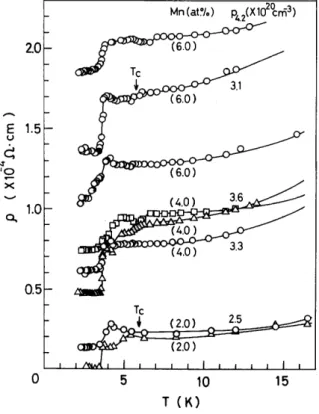
Fig. 4. Temperature depend- ence of the resistivity for some annealed samples with different Mn content.
Arrows indicate the Curie temperature for the respec- tive sample, determined by the AHE measurement.
a annealed
• as-grown
10
u E
c:
N
o::!
105
-6
10 0 0.1 1
x (at.°,o)
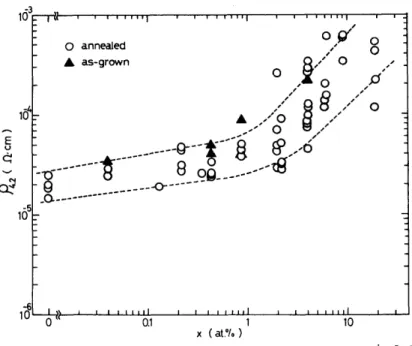
Fig. 5. Dependence of residual resistivity on Mn content. The points on the left are for the undoped samples (x=O).
o annealed
• as-grOwn
x ( at~/o )
10 10
at 4.2 K the data
100 Fig. 6. Dependence of RRR (=P300/ P4.2) on Mn content.
Now we pay attention to one of the spin dependent transport properties --- resistivity at low temperatures. Figure
4
shows the temperature dependence of the resistivity for some of our annealed samples with different Mn content; we already reported the similar data for lower Mn content. 13 ) A characteristic feature is that for low Mn content x < 1 at.% the resistivity has a small maximum appearing at some characteristic temperature or ordering temperature (denoted by T in ref. 13), while for x>l at.%m
the resistivity drops abruptly at the corresponding temperature.
(The variation of T or T with x will be shown later). Ghazali et al.B) attributedmsuch
~
resistivity maximum to the critical scattering of carriers by spin fluctuation.In Figs. 5 and 6 are shown, respectively, the residual
resistivity at 4.2 K, P4.2' and the residual resistivity ratio RRR (=P300/ P4.2) plotted against x for the as-grown and annealed samples studied thus far. Again the dotted lines indicate the general trend of the behavior. It should be emphasized that these quantities are strongly dependent on the magnetic impurities as scttering centers.
B. Anomalous Hall Effect
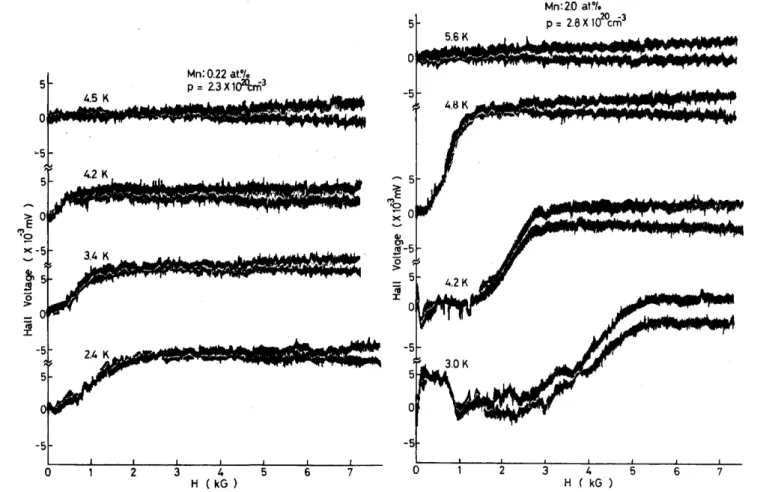
Our main interest is concerned with the magnetization depen- dent Hall effect. In Fig. 7 the Hall voltages recorded against the magnetic field strength at various temperatures are shown for samples with (a) x=O.22 at.% and (b) x=2.2 at.%. A pair of the curves measured at a fixed temperature were obtained by reversing the magnetic field direction each other as usually employed in the Hall effect measurement. The absolute Hall voltages were checked by a dc potentiometer. At high enough temperatures the Hall voltage varies linearly with the applied field, showing a normal Hall effect. Once the temperature is lowered to below some magnetic ordering temperature Tc' an initial increment in the Hall voltage at weak field is followed by the linear and normal region at higher field. Such behavior is quite similar to that shown schematically in Fig. 1, as observed in ferromagnets and magnetic alloys, in which there is a contribution to the'Hal1 field depending on the state of magnetization of the sample. For a
sample with high Mn content, however, the behavior observed at low field becomes complicated as the temperature is lowered, as
shown in Fig. 7(b). Presumably this may be due to the presence
5 Mn: 0.22 at~/o
p = 2.3 X lo3'cm3
.., =e
'2
~ ~ (5 >
i;i ::r:
o
4 5H (kG)
5
=ii J:
-5
6 7 o 2
p = 2.8 X 1020cm3
3 4 5 H ( kG )
6 7
Fig.
7.
The recorded traces of the Hall voltages against the applied magnetic field at various temperatures for the samples (a) x=0.22 at.% and p=2.3 x 1020 cm-3, and (b) x=2.0 at.% and p=2.8 x 1020cm- 3 . A pair of the curves at a fixed temperature were obtained by reversing the field.
of any suppressive force against the existing transverse Hall field in the sample, though its origin is not clear at present. At any rate, from these curves one can obtain the ordinary Hall coefficient Ho ' the anomalous Hall coefficient HI' and the spontaneous magneti- zation 4lfNMs at temperature T, according to the procedure described in section 2.
The ordinary Hall coefficient H , of the order of (2-4) x 10-2 o
cm3/c, was found to be independent of temperature over the tempera- ture ranges studied, which is characteristic of degenerate semi- conductors. On the contrary, the anomalous component HI was strongly temperature-dependent. The experimental results are
illustrated in Fig. 8 for different samples with various Mn content.
The absolute value of Rl and the slope of the RI-T curves differ slightly each other, even for the same amount of Mn content, and thus it seems difficult to obtain a systematic variation of HI with magnetic impurity. Such a difference may be due to the fact that the Hall field to be observed is strongly sensitive to the various crystalline imperfections such as lattice defects and inhomogeneous distribution of magnetic impurities over a grown ingot. It is worth noting, however, that in contrast with our
-
UM"-
E u
-- a::
10
-1
Mn at. 0
o 0.3
l::. 1
o 2
10 ~_..o.o...--"--""""""....&...I~
1
T (K) 10 1 10 1
T(K)
Mn(at~/o)
A 3
o 4
• 9.1
o
19o
T(K)
10 Fig. 8. Temperature dependence of the anomalous Hall coefficient Rl for the samples with different Mn contents. A vertical dotted line to each sample indicates the Curie temperature at which the anomalous component vanishes.
previous results, 14) now the value RI increases with temperature up to a Curie temperature T
c' at which the anomalous component becomes vanishingly small and coincides with that of the ordinary Hall coefficient; each vertical dotted line in Fig. 8 indicates the respective Curie temperature (see also arrows in Fig. 4).
Though not conclusive and with some exceptions, the temperature dependence of Rl for Snl Mn Te system below T (ferromagnetic state) is expressed
roug~~y ~s
RI « T2, inag~eement
with eq.(7).Our result is different from that found by Escorneet al.9 ), who showed that RI is independent of temperature over a paramagnetic region.
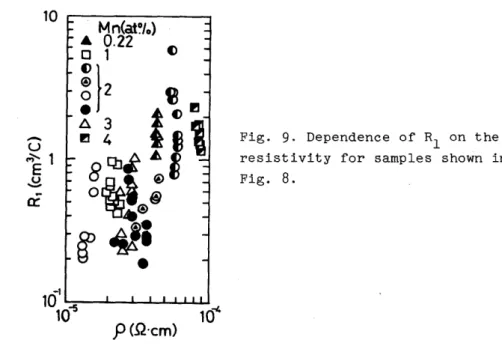
In Fig. 9 we in passing show the dependence of RI on the resistivity for each sample in a log-log scale.
10
-
uM"'-1 S E
0::
10
-1 ~~=----'&"'--L~...L....I'-'-L..u10 P
(Q'cm)Fig. 9. Dependence of RI on the resistivity for samples shown in Fig. 8.
Since the resistivity of each sample varies only slightly with temperature (Fig. 4), the observed points lie on a vertical line.
Though these experimental points scatter considerably, one may observe that as the overall trend RI likely increases quadratically with the sample resistivity as in eq.(5) applicable to ferro-
magnets,which is predicted by Luttinger using a spin-orbit coupl- ing. However, the anomalou.s Hall coefficient of the Sn1 Mn Te
z-x x system likely follows the T2 behavior rather than the p behavior.
This means that the ferromagnetic ordering state of our system occurring at low temperature is induced by long-range indirect
spin-spin interactions via conduction carriers just as in dilute alloys and it is by no means the same ferromagnetism appearing in ferromagnetic substances like Ni, Co, and Fe, or rare-earth metals, to which the Luttinger theory is applicable. Conclusively, the present degenerate magnetic semiconductor likely follows the second type of the anomalous Hall effect theories mentioned in section 2.
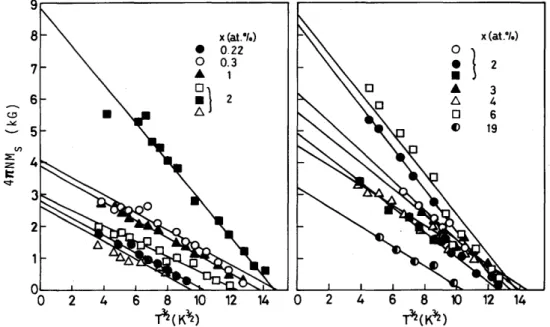
We return to the observed Hall field as shown in Fig. 7 or the schematic behavior of Fig. 1, from which we can estimate the spontaneous magnetization Ms and the ferromagnetic Curie temperature Tc for our system of weak ferromagnetism. The well-known Bloch spin-wave theory for ferromagnets predicts that the temperature dependence of the magnetization varies as T3/2 at low temperature T < Tc '
M (T) = M s s (0)[1 - (TIT ) 3/2c
J,
(13) where Ms(O) is the saturation magnetization at absolute zero.Thus we have attempted to plot the observed magnetization 4nNMs against T3/2
, as shown in Fig. 10. We note that at saturation the applied magnetic field Ha is equal to 4nNMs (section 2), where the demagnetization factor N is actually unknown for our sample of a rectangular bar. But we may assume that N is approximately the
x (at. Ofo) x (at.Of.)
•
0.22 01
7
•
0 0.3 1• •
2~) •
36 2 .6. 4
( l ' 0 6
~ t) 19
Vl
:E z:
I:::
'<:T
O~--L---~--~--~~~~~~~~ ~ __ ~ __ L -_ _ ~ _ _ ~ _ _ ~ _ _ ~~~~
o
2 4 6 8 10 12 14 0 2 4 6 8 10 12 14-f2(
K~) ~(K~)Fig. 10. Temperature dependence of the estimated spontaneous magnetization Ms times 4nN for various samples, where N is a demagnetization factor of our rectangUlar sample.
same for all samples with nearly identical dimensions. The experi- mental values obey well the T3/2
behavior; the solid line each is the best-fit theoretical curve of eq.(13) for each sample with appropriate values of M (0) and T. In Fig. 11 the value of
s c
4WNMs(O) per unit volume is plotted against Mn content. A linear relationship is approximately fulfilled.
Furthermore, Fig. 12 shows the Curie temperature estimated in the above manner as a function of Mn content. For comparison, also are included those obtained from magnetization measurements by Cohen et al.2
) and Escorne et
al.9~
without regard to carrier concentration, and our previous magnetic ordering temperature Tm determined from the resistivity anomaly in its termperaturedependence.13) It is interesting to see the marked difference in the Mn content dependence of ordering temperature, determined
o o
o
0.1 1
X (at~/o
)
10
0.1 1
x (at~/o )
o
10
Fig. 11. Dependence of the estimated spontaneous magnetization 4nNMs(O) per unit volume on Mn content.
10
Fig. 12. Dependence of magnetic ordering (Curie) temperature on Mn content in Snl_xMnxTe.Open circles: Present work.
Dotted line: Ordering temperature T determined
m
earlier from the resisti- vity anomaly.13)
Open triangles and squares are determined from
magnetic measurements by Cohen et al.2
) and Escorne et al. 9 ), respectively.
either by magnetic measurements or by transport measurements.
In our case the rerromagnetic Curie temperature is apparently
almost independent of Mn content, whereas those determined by others are strongly dependent on it. On the other hand, in their analysis of the magnet ic measurement s on Gel r1n Te system, Cochrane et al. 6)
-x x
considered the Mn atoms having a well defined local moment and assumed the simple RKKY interaction as well as a nearest-neighbor antiferromagnetic exchange between the Mn ions. Treating the Hamiltonian by the random-phase approximation ror spins, they found that both the ferromagnetic Curie temperature Tc and paramagnetic Curie-Weiss temperature 8 are linear in Mn content x, in agreement with their experimental results. In view or these facts, a satis- factory explanation of our results requires further studies such as magnetic measurements at low temperatures. At present these were carried out only in the temperature range 77-300 K, as shown in the next section.
~ Magnetic Susceptibility
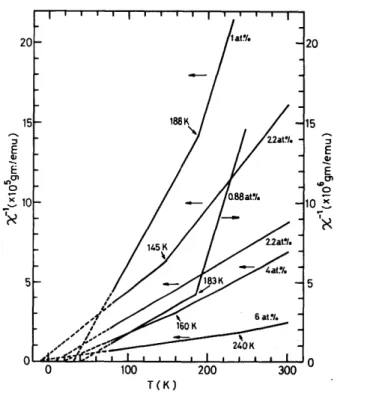
Figure 13 shows the recip"rocal magnetic susceptibility for some of our samples with different Mn contents; part of the Curves (x=0.88 and 2.2 at.%) taken by M. Nomura were reported previoUSly17) and others were measured by Toei Ind. Co. Only one sample (x=2.2 at.%), which was cut from the central part of a grown ingot, shows a straight line in the whole temperature range studied. Others cut from an end of the ingot have two linear segments separated at a temperature Tk (call a kink temperature) as indicated by arrows. As noted previously,17) there is inhomogeneous distribu- tion of magnetic impurities in the sample and the kink in the l/X- T curve suggests the presence of some clusters of Mn atoms with neighboring host atoms (Sn or Te), namely, the formation of some magnetic materials.
In the paramagnetic region, the magnetic susceptibility follows a Curie-Weiss law,
x
- - , C C (14)T-8
where 8 is the paramagnetic Curie-Weiss temperature and other symbols stand for usual meaning. For a given Mn content x we calculated the Curie constant C I with the values g=2, J=S=5/2
+2 ca
for Mn -state as found from EPR studies. The two segments of Fig. 13 yield the two Curie constants C
L and C
H at low and high
20
15
5
T(K)
-
E ::J~
E
<s>rJI
o 10 ~
IX
5
Fig. 13. Reciprocal magnetic susceptibility as a function of temperature for some of our samples with various Mn content. The samples showing a kink were cut from the ends of the grown-ingot.
temperature side, respectively. Also the corresponding Curie- Weiss temperatures 8
L and 8H at both sides are determined from the curves. These values are given in Table I. The agreement between CL and Ccal is satisfactory. However, no systematic variation of 6L with x is clearly seen. Low temperature measurements are then required for further details.
5. CONCLUSIONS
We have carried through an exhaustive study of the electrical properties of the ,Bridgeman-grown Snl -x x Mn Te (x<O.19) over a wide range of temperature. The manganese impurities exert two kinds of influence on the carrier transport in the deg~nerate magnetic semiconductor. First, the Mn ions act as usual ionized-impurity scattering centers responsible for the decrease in the Hall mobility and the increase in the residual resistivity. Second,
Weiss temperatures 8L and 8H, the Curie constants CL and CH, at low and high temperature side of Fig. 13, respec- tively, and the calculated Curie constant C 1 from eq.(14). ca
x 8
L 8H Tk CL CH C
cal (at.%) (K) (K) (K) (XIO- 4 emu·K/g)
6 -10 65 240 14.3 9.09 10.7
4* 20 48 160 4.71 3.60 7.11
2.2 10
- -
3.33 3.912.2 -9 48 145 2.44 1.57 3.91
1.0 32 114 188 1.10 0.61 1.78 0.88 34 160 183 0.34 0.06 1.56
*
As-grown sample, others being annealed in Zn vapor at 6000C for 2 days.magnetic moments on the Mn ions align ferromagnetically at some ordering temperature, which produce an anomalous Hall effect.
The anomalous Hall coefficient Rl seems to increase roughly with the resistivity, as predicted by Luttinger for ferromagnets based on theories with itinerant magnetic electrons. But we observe rather that it depends quadratically on temperature, as Rl ~ T2, in agreement with the Voloshinskii model which is based on theories with localized magnetic electrons and takes account of the mixed spin-orbit interaction, together with spin disorder as scattering mechanism. These results suggest that weak ferro- magnetism appearing in this magnetic semiconductor is not just like usual ferromagnetism in ferromagnets, but it is through the RKKY-like long-range indirect exchange interaction as in dilute alloys. However, it cannot be reasonably explained that the ferromagnetic Curie temperature Tc determined from the transport measurements is almost independent of Mn content, in contrast with those determined by magnetic measurements. We hope that a clear understanding of the fundamental mechanism of weak ferromagnetism in degenerate magnetic semiconductor calls for a wide range of experimental data.
The authors wish to thank M. Morisaki and K. Furukawa for assistance in taking the present data and N. Nishio (Toei Ind. Co.) for susceptibility measurements of some of our samples.
REFERENCES
1) M. Inoue and H. Yagi: Butsuri 31 (1976) 357 [in Japanese].
2) J. Cohen, A.Globa, P. Mollard, H. Rodot and M. Rodot:
J. Phys. 29 (1968) C4-142.
3) M.P. Mathur, D.W. Deis, C.K. Jones, A. Patterson, W.J. Carr, Jr.
and R.C. Miller: J. Appl. Phys. 41 (1970) 1005.
4) R.W. Cochrane, F.T. Hedgcock, A.W.Lightstone and J.O. Strom- Olsen: Preprint of San Francisco Magnetism Meeting, Dec. 1974.
5) M. Rodot, J. Lewis, H. Rodot, G. Villers, J.Cohen and P. Mol1ard:
J. Phys. Soc. Jpn., Suppl. 21 (1966) 627.
6) R.W. Cochrane, M. P1ischke and J.O. Strom-Olsen: Phys. Rev.
B
2
(1974) 3013.7) M.P. Mathur, D.W. Deis, C.K. Jones, A. Patterson and W.J. Carr, Jr.: J. Appl. Phys. 42 (1971) 1693.
8) A Ghaza1i, M. Escorne, H. Rodot and P. Leroux-Hugon: AlP Conf.
Proc. 10 (1972) 1374.
9) M. Escorne, A. Ghazali and P. Leroux-Hugon: Proc. 12th Int.
Conf. Phys. Semicond., Stuttgart 1974, B. G. Teubner, p.915-919.
10) J.E. Lewis and M. Rodot: J. Phys. 29 (1968) 352.
11) R.W. Cochrane, F.T. Hedgcock and A.W. Lightstone: Preprint of LT-14 Conf.
12) M. Inoue, H. Yagi and S. Morishita: J. Phys. Soc. Jpn. 34 (1973) 562.
13) M. Inoue, H. Yagi, K. Ishii and T. Tatsukawa: J. Low Temp.
Phys. 23 (1976) 785.
14) M. Inoue, K. Ishii and H. Yagi: J. Phys. Soc. Jpn. ~n977) 903.
15) M. Inoue, H. Yagi and Y. Kamino:J. Phys. Soc. Jpn. ~ (1973)561.
16) M. Inoue, H. Yagi and Y. Kamino: J. Phys. Soc. Jpn. 37 (1974) 284 and 285.
17) M. Inoue, H. Yagi, T. Muratani and T. Tatsukawa: J. Phys. Soc.
Jpn. ~ (1976) 458.
18) M. Inoue, Y. Kaku, H. Yagi and T. Tatsukawa: J. Phys. Soc. Jpn.
43 (1977) 512.
19) M. Inoue, H. Yagi, T. Tatsukawa and Y. Kaku: J. Phys. Soc. Jpn.
45 (1978) 1610.
20) V. Cannella and J.A. Mydosh: Phys. Rev. B ~ (1972) 4220.
21) C.M. Hurd: The H~ll Effect in Metals and Alloys (Plenum Press, New York-London, 1972) Chap. 5, p. 153.
22) J.M. Luttinger: Phys. Rev. 112 (1958) 739.
23) E.I. Kondorskii: Zh. Eksp. & Teor. Fiz. 55 (1968) 558 [Sov.
Phys.-JETP 28 (1968) 291J.
24) A.N. Voloshinskii: Fiz. Metal. Metalloved. 18 (1964) 492 [Phys. Met. Metal. 18 (1964) 13J.
25) Yu. Kagan and L.A. Maksimov: Fiz. Tverd. Tela
I
(1965) 530 [Sov. Phys.-Solid StateI
(1965) 422J.26) Yu. P. Irkhin, A.N. Voloshinskii and Sh.Sh. Abel'skii: Phys.' Status Solidi 22 (1967) 309J.
27) G.L. Lazarev: Fiz. Tverd. Tela ~ (1972) 29 [Sov. Phys.- Solid State ~ (1972) 22J.
28) J. Kondo: Prog. Theor. Phys. 27 (1962) 772.
29) F.E. Maranzana: Phys. Rev. 160 (1967) 421.
30) S.P. McAlister: J. Appl. Phys. ~ (1978) 1616.
31) Private communication: One of us (M.I.) is grateful to Dr. A. Ghazali for sending their preprint (ref. 9) and
valuable information about the anomalous Hall effect in SnTe- MnTe system.