動
物
心
理
第4卷
第1號
昭 和 13年 6月
研
究
SOME OBSERVATIONS
ON SNAKES
RYOTA TA KATSUKI
Psychological Institute, Keijo Imperial University.
( 1 ). On the behavior of a snake, Elaphe schrenckii (STRAUCH),
and a new device for its terrarium.
The animal was 157cm. long and weighed 1010gr ; the observations
here reported were begun on June 26 and ended on July 9, 19 7, in
the outdoor snake terrarium of the Psychological Institute of the
Im-perial University of Keijo.
The diagram of the terrarium is
illustrated below.
Fig . 1
Fig . 2
Fig . 3 1
2 RYOTA TAIZATSUKI
The real size of each part in fig. I is as follows : ab : be : cd : de :
ea = 260 : 345 : 175: 90 : 316cm. The numerals in figs. 2 and 3 should
also be read in cm. The walls are made of zinc-sheet and as high as
135cm. , their top being crooked down inward by 15cm. as shown in
fig. 2 (b) to prevent the animal from climbing over it. At the
north-western corner and 11cm. above the ground, there is an entrance door, D, 65 •~ 122cm. , as shown in fig. 2 (a) ; its surface also made of
zinc-sheet is set three centimeters back from that of the wall, A brass
catch is equipped 70cm. above the lower edge of the door •kfigs. 2 (a)
and 3•l it is 10cm. long and 4cm. apart from the wall end, but on
July 2 it was removed to a new position x as illustrated in fig. 3. P is a pond 153 x 92 x 64 and its depth of water was only 2cm. at the
time of observation.
June 26. Fine. A little alteration was given to the terrarium
formerly used for tortoises and I put into it about . 1 o'clock in the
afternoon the snake above mentioned together with some smaller ones
belonging to Elaphe rufodorsata and Natrix tigrina lateralis. It made
an escape from it between 3.00 and 4.00 p.m. but it was found soon on
a cherry-tree about 50cm. south-west of the terrarium and in the
adja-cent hen-house the roof of which made of the wire net was 55cm.
higher than the top of its wall. The branches of the tree covered the
wire roof of the hen-house and, therefore, the animal could easily go
from the the top of the wall to the tree clibming over the roof. It
was taken down and shut up in a feeding box in the laboratory.
June 29. Fine after rain. Seeing that the animal was fled into
the pond of the terrarium at 12.40 p. m. the author inspected it
stealthily from the laboratory window. The sky cleared up at about
1.30. It began to move at 1.35 and landed 5 minutes later from the southwest corner of the pond, there being a stepstone for tortoises to
crawl up. It soon hid under a strawmat and never appeared. At 4.00
it was driven by the author out of the mat with a long stick stretched out from the window. It went along the wall to the northwestern
cor-ner and tried in vain to climb up though it could stanl straight
al-most as high as 100cm. against the right-angled walls. Between 5.30 and
Some Observations on Snakes 3
6.30 when he was absent for his supper, it again took to flight and was found to be on the cherry-tree.. It. was immediately replaced in the terrarium. A 100 watt electric bulb was furnished in the north-western corner about 100 centimeters above the ground and the obser-vation was continued. It commenced to creep at 8.15 exploring along the wall and at last succeeded to thrust itself between the catch of the
door and the wall ; at 8.40 after a skillful climbing-up struggle for about 5 minutes using its tail most effectively (plates 1 and 2), its head reached the top of the bending edge of the wall and soon lifted half of its body over the wall. Again it was placed down at once into the terrarium. Since it seemed a little tired and could not move until 12.40 a.m. of the next day (30th), it was 'confined in a small box placed in it,
July 1. Fine. At 6.00 p.m. the animal was set free from the box. It did not move for a long time. At 9.40 it succeeded to run away from the same place by just the same means as before. It was put down at once. Hiding under the mat, it never came out. Though it was driven out, it remained quite motionless. It succeeded a third time
Plate 1 Plate 2
4 RYOTA TAKATSUKI
at 1.30 a.m. (July 2) in a similar manner. Its body posture is indicat-ed in plates 1 and 2, the latter showing the pose which was seen at about one minute's lapse after the former. It was then shut up like-wise as before in the box.
July 2. The catch on the door was removed to a new place x as illustrated in fig. 3 in order to make it unable for the animal to climb up along the wall, the space between the catch and the edge of the wall being changed from 4 cm. to 9 cm. It was set free from the box at 3.00 p.m. Betraying the supposition of the observer, it escaped clev-erly between 5.00 and 8.00 p.m. and absolutely no route of flight could be traced anywhere.
July 4. In the morning it showered very hard, but in the after-noon it cleared up. About 4.00 p.m. the observer out near the terra-rium met with Mr. SAI TO ZYU, a school guard, on his round of inspection and told how the animal escaped from the fence on July 2. Then all at once Mr. SAI noticed that a Chinese magpie was cawing in a low cherry-tree near a pile of the newly cut branches of a plane-tree about 30 feet to the south of the terrarium and that sparrows
were also chirping in crowds near it. He at once said intuitively that the snake must be near that tree. The observer drew nearer doubting
at first but astonished at fiuding th3 missing snake in safety on the pile of the branches. It had often previously been observed that a crowd of sparrows flew away from the terrarium. It was captured after an absence of about 24 hours and again was shut up in a feeding box in the laboratory.
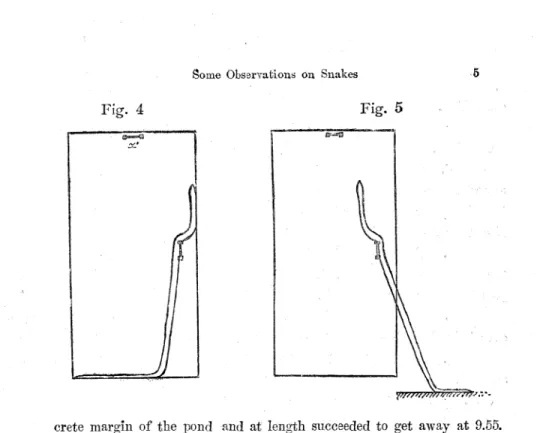
July 9. Fine. The animal was -Liken into the terrarium at 9.20 in the morning. As it lay still in the shade of the wall, it woe forced to crawl about with a stick at 9.30. It went along the wall first to the west, then to the north, and at last to the east, It began to climb up the door as usual supporting itself in such a way as shown in fig. 4. on a catch removed and succeeded to place the bead on the top of the wall at 9.88, being, however, soon after put down. It started to climb up again at 9.40 in another way illustrated in fig. 5.
It lifted its body by degrees pushing itself earnestly on the
Some Observations on Snakes 5
crete margin of the pond and at length succeeded to get away at 9.55. From these o servations, it could probably be supposed that the animal had run away by the same method as above stated on July 2, too. Such being the case, the catch was then transferred to the middle of the upper end of the door as was shown as x' in fig,. 4 and the obser-vation was continued. The animal tried bard to climb up several times in succession at the door first and then at some corners, but all was of no use.
GENERAL CONCLUSIONS.
1). The snake, Elaphe schrenckii, has an apparent tendency of learning.
2). Some biological connections could be supposed between the snake and the Chinese magpie or sparrows.
3). a. An ideal outdoor snake terrarium should be made round or oval with a perpendicular, thoroughly even wall made of the zinc-sheet or painted board.
b. The terrarium with right-angled corners which was for-merly used for tortoises is not at all suitable, for they supply cues to escape by supporting the body against two walls when they are not
Fig. 4 Fig. 5
6 RYOTA PAKATSUKI